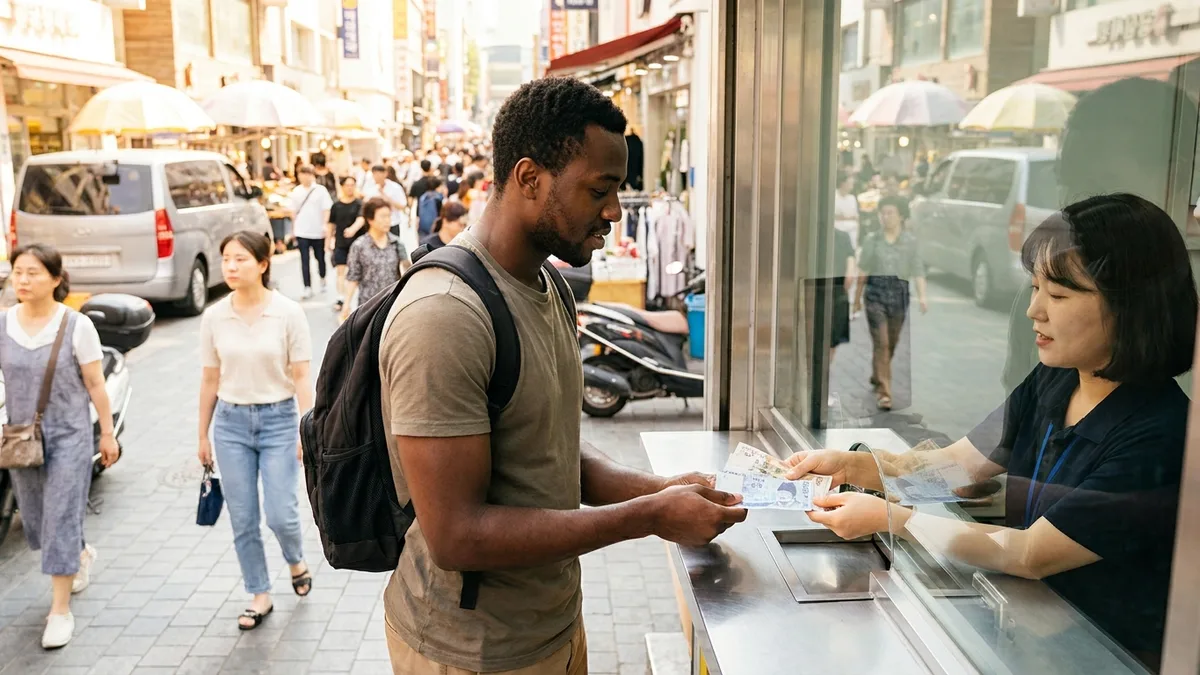
If you exchange 500 dollars at Incheon Airport, you might receive about 30,000 won less than you would in Myeongdong. Same bills, same currency — yet the won you end up holding changes based on nothing more than where you exchange it.
Airport exchange is generally the least favorable, while private city exchange offices like the ones in Myeongdong and unmanned exchange apps tend to be the most favorable. That said, the ranking can flip depending on the currency, the timing, and the amount. Below, we'll compare the differences by location in numbers, walk through the procedures and things to watch out for, and even look at ways to reduce how much you need to exchange in the first place.
Last updated: 2026-07 · Exchange rates, fees, and preferential rates change daily and vary by location. The figures below are general tendencies — always check the real-time posted rate on the actual shop's or app's screen right before you exchange.
1. How Rates Work — Start by Understanding the "Posted Rate" and the "Spread"
To cut your losses, there are just two concepts worth knowing.
- Mid-market rate (the middle rate): This is the reference rate used for transactions between banks. The number you see when you search "USD KRW" on Google or Naver is close to this. As of early July 2026, 1 dollar was moving around roughly 1,550 won (with large fluctuations depending on the timing).
- Spread: This is the difference between the mid-market rate and the rate you actually get when buying. It's the exchange provider's profit and effectively a fee. When you buy cash (foreign currency → won), a rate less favorable than the reference rate is applied.
Even when a place advertises "0 fees," if a spread is baked into the rate itself, a real cost is still there.
That's why, to be accurate, you should compare based on "the final amount of won you receive" rather than on the fee alone.
2. Rate Comparison by Location (Difference per Dollar)
Here's the tendency commonly cited across various Korea travel resources.
| Exchange location | Rate tendency | Notes |
|---|---|---|
| Airport exchange booths (Incheon Airport, etc.) | Least favorable | Large spread versus the mid-market rate. About 30–60 won per dollar worse than the city |
| Commercial bank branches | Middle | Better than the airport but somewhat worse than private Myeongdong offices. About a 1.5–2% spread on USD (lower with a preferential rate; larger for other currencies) |
| Private city exchange offices (Myeongdong, etc.) | Among the most favorable | Narrow spread. Longer hours than banks, with room to negotiate or get preferential rates |
| Unmanned exchange apps / kiosks (WOWPASS, etc.) | Favorable + convenient | Better rate than the airport, with card and transit functions combined |
The table alone can be hard to picture, so let's convert it into actual amounts.
When the reference rate is 1,550 won, exchanging 500 dollars at the airport gets you about 745,000 won (at a rate of 1,490 won per dollar), while the same 500 dollars in Myeongdong gets you about 772,000 won (at a rate of 1,544 won per dollar). That's roughly a 27,000 won difference on the same amount (varies by timing and shop).
Converted to a rate, that's around 30–60 won per dollar. For 500 dollars that's about 15,000–30,000 won, and for 2,000 dollars the gap can widen to 60,000–120,000 won.
3. Recommended Strategies by Situation
① Right After Arriving at the Airport — "Only the Bare Minimum"
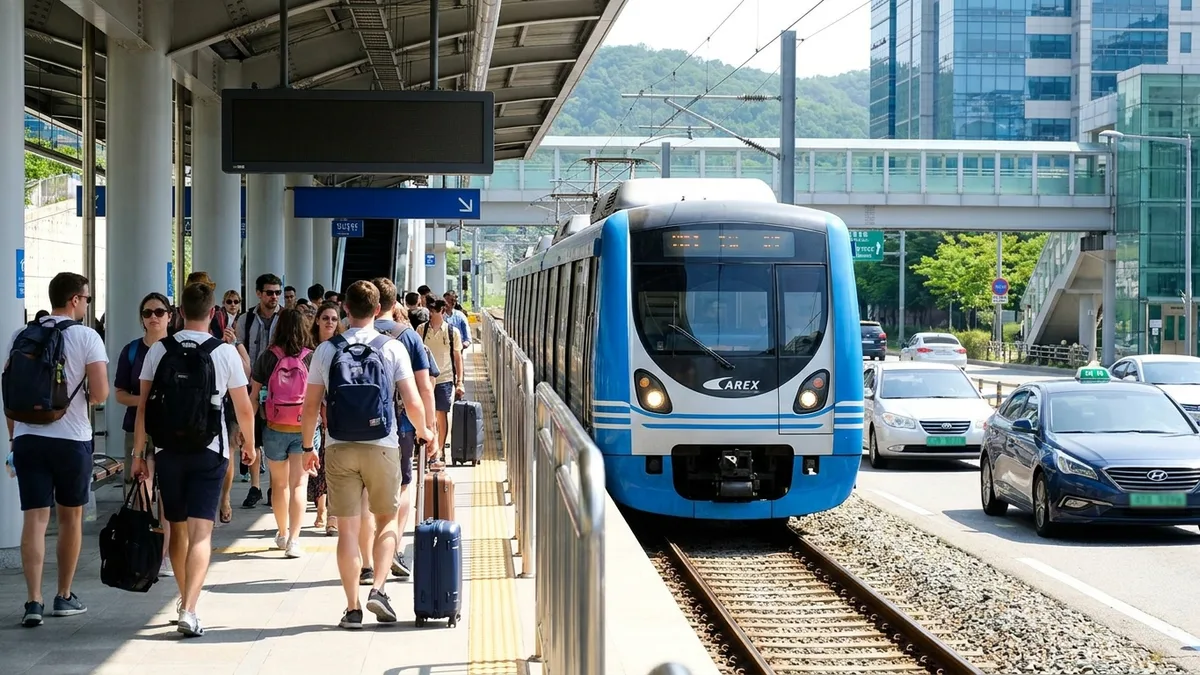
Airport rates are unfavorable, but if you arrive late at night and need money for a taxi or subway right away, there's no avoiding it. In that case, exchange only about 20,000–30,000 won for a taxi or to top up a transit card, and exchange the rest in the city. Exchanging your entire amount at the airport from the start is the biggest loss of all.
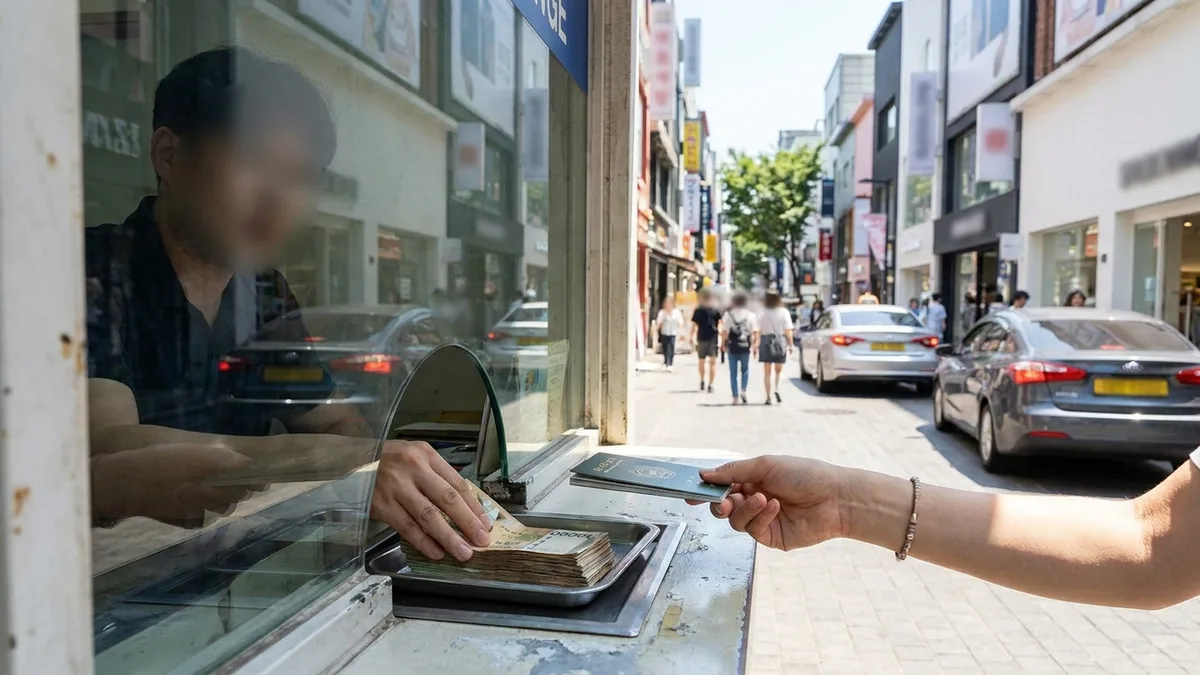
② Private City Exchange Offices (Myeongdong, Dongdaemun, etc.) — "Large Amounts"
If you're exchanging a large amount, private exchange offices such as the ones in Myeongdong are favorable.
- Several exchange offices are clustered together, so you can compare posted rates side by side.
- Some offices offer an additional discount on the exchange fee with a travel platform coupon (for example, coupons that deeply discount fees on major currencies like USD, JPY, and EUR). Check for coupons before you go.
- Their hours are longer than banks' (into the evening), making them easier to fit into your schedule.
③ Unmanned Exchange Apps / Kiosks — "Convenience + a Good Rate"
Unmanned exchange machines and prepaid card services for foreign travelers (WOWPASS being the most well-known) convert your foreign currency to won at a better rate than the airport and load it onto a card.
- You can instantly exchange and load 16 currencies — including USD, EUR, JPY, AUD, GBP, and SGD — by feeding in bills.
- More than 300 machines are installed at major subway stations, hotels, and shopping malls nationwide (Hongik Univ. Station, Lotte Mart at Seoul Station, Gwanghwamun Station, and so on). Operating hours vary by location (generally around 06:00–24:00).
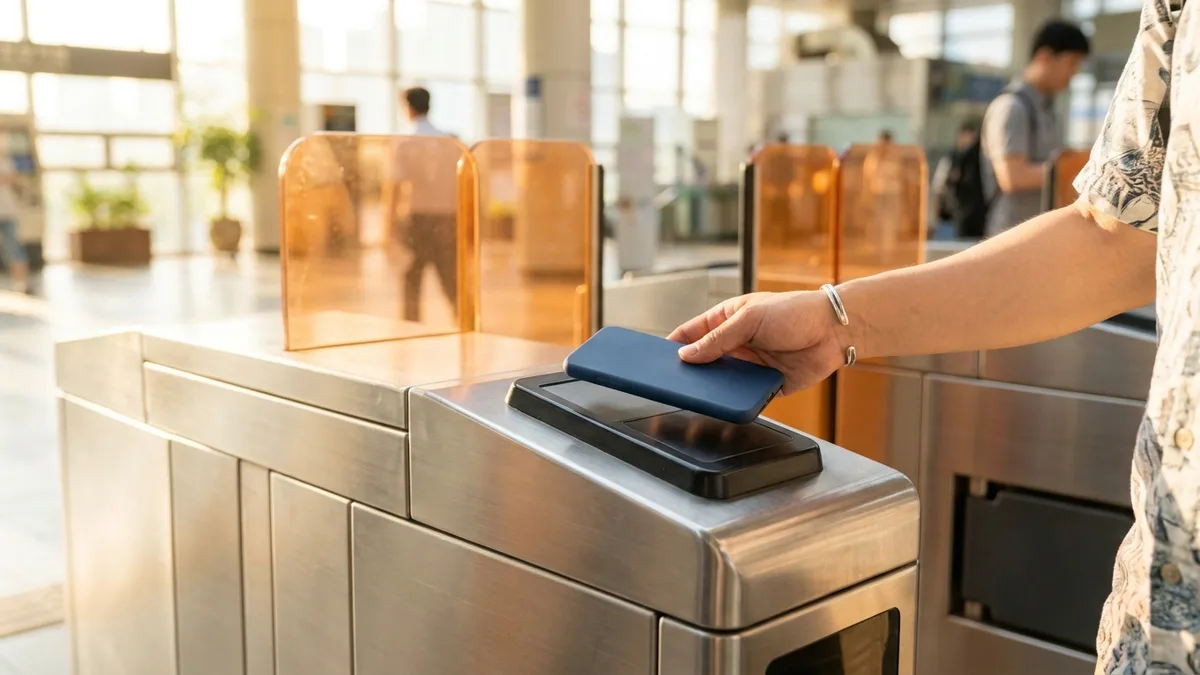
- A T-money transit card function is built in, so you can tag to pay directly on the subway, buses, and some taxis.
- ⚠️ Korean passport holders cannot use it (it's a service exclusively for foreign travelers). Some machines inside Incheon Airport can't exchange foreign currency and only allow won top-ups, so check the guidance at each location.
④ Global ATM Withdrawals — "Small Amounts of Cash"
Even without a Korean card, you can often withdraw won from global ATMs (at airports, convenience stores, and banks) with a card issued overseas. An ATM fee plus your card company's overseas withdrawal fee applies, so this is best for small withdrawals of around 30,000–50,000 won. (Availability and fees vary by card company, ATM, and timing.)
4. The Key to Cutting Exchange Losses — "Use Less Cash to Begin With"
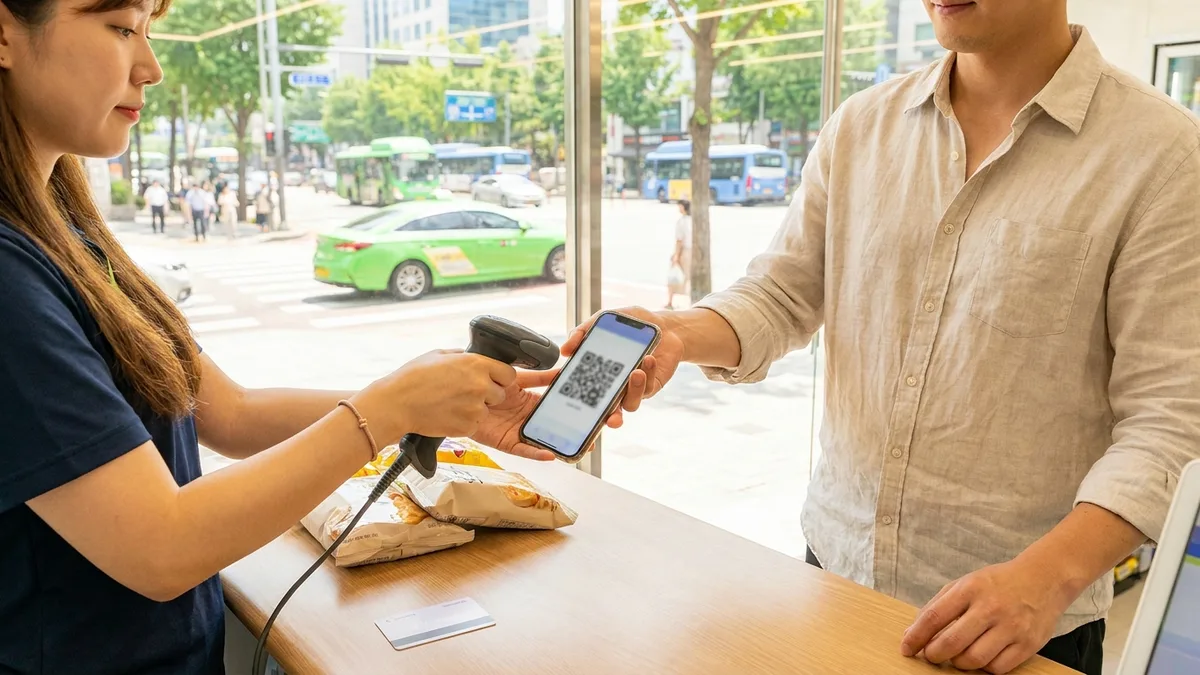
Korea has a very high share of credit card and simple payments, so most things — convenience stores, restaurants, even transit — are paid by card or mobile. That means the very need to exchange a lot of money goes down.
- International cards for transit: As of March 2026, buying and topping up transit cards with an overseas-issued international card is supported at 273 stations on the Seoul subway. (May vary by station and timing.)
- T-money in Apple Wallet: Since July 2025, you can add T-money to Apple Wallet on an iPhone to top up and tag.
- Foreign payment methods: At merchants displaying the Alipay or WeChat Pay logo, you can often use the same apps you used back in China or Southeast Asia.
If you exchange an appropriate amount only for places that truly require cash (some traditional markets, small restaurants, cash discounts, and the like) and handle the rest by card or mobile, you can structurally reduce losses from the exchange spread.
Stuck on payments or bookings without a Korean phone or bank account? Check out LACHA.
Built to work without a Korean phone number or bank account, with overseas payment methods like Alipay, WeChat Pay, and Apple Pay. Taxi hailing plus KTX, express bus, and airport railroad (AREX) booking — all in one app.
Download now


Frequently Asked Questions (FAQ)
Q1. In Korea, is the airport or the city the best place to exchange money? A. Generally, private city exchange offices (like the ones in Myeongdong) and unmanned exchange apps are more favorable than the airport. The airport tends to be about 30–60 won per dollar worse, so for large amounts we recommend exchanging in the city. (Varies by timing and shop.)
Q2. Is it better to exchange to won in advance in my home country before departure? A. It depends on the country and the bank. In regions that handle little won, your home-country rate can be worse than the rate in the city in Korea. Compare your home bank's rate with the city rate in Korea, and when in doubt, a safe approach is to exchange only a small amount at the airport and exchange the rest in the city in Korea.
Q3. Is a 0-fee exchange always the best deal? A. Not necessarily. Even with a 0 fee, a cost can be hidden in the rate (the spread). Always compare based on "the final amount of won you receive."
Q4. Can foreigners without a Korean bank account or phone use exchange apps? A. Unmanned exchange and prepaid card services for foreign travelers are generally designed so that they can be used without a Korean bank account or phone-based identity verification. However, conditions differ by service — Korean passport holders are excluded, for instance — so check the guidance on the sign-up screen.
Q5. How much should I exchange? A. Since card and mobile payments work well in Korea, the surest way to reduce exchange losses is to exchange only a small amount of cash (for traditional markets and small restaurants) and handle the rest with card, transit card, and mobile payments.
Note: The exchange rates, fees, preferential rates, machine locations, and service conditions in this article reflect general tendencies as of the 2026-07 writing date. Exchange rates fluctuate daily and vary by shop, app, currency, and timing. Before you actually exchange, please check the real-time posted rate and the final amount you'll receive directly with the relevant shop, app, or bank. This article does not endorse any particular exchange provider or app, and whether payment or exchange is possible may vary by card company, station, and timing.