
When you open the booking screen for a route like Seoul–Busan, Standard, Deluxe, and Premium all show up side by side. And the fares can nearly double from one to the next. "It's the same Seoul–Busan trip, so why do the prices differ?" "What's actually different between Deluxe and Premium?" Quite a few people end up just tapping the most expensive ticket, or the opposite — picking a cramped Standard seat and toughing it out for 4 hours.
The real difference between the three grades comes down to seat layout, amenities, and fare. Just pick based on your travel distance and budget. (Fares are as of 2026-06 and vary by route, time of day, and when you book, so please confirm on an official booking channel.)
The Three Grades at a Glance
| Category | Standard (일반) | Deluxe (우등) | Premium (프리미엄) |
|---|---|---|---|
| Seat layout | 2+2 (4 across) | 1+2 (3 across) | 1+2 (3 across, with an individual canopy and curtain per seat) |
| Seats (per bus) | about 45 | about 28 | about 21 |
| Seat width/pitch | Narrow | Wide | Widest |
| Reclining | Moderate | Large | Maximum (nearly flat) |
| Personal monitor (PTV) | None | Some/none | Yes |
| Charging (USB/outlet) | Varies by route | Usually yes | Yes (USB, Type-C) |
| Wi-Fi | Varies by route | Varies by route | Usually provided |
| Privacy curtain | None | None | Yes |
| Fare level | Baseline (100%) | About +40–50% vs. Standard | About +30% vs. Deluxe |
The key is the seat layout. Whether it's 4 across or 3 across determines whether you'll have a seatmate and shapes the fare.
Sources: compiled from the KOBUS grade guide and other materials. Seat counts and fare multiples can vary by route and vehicle, so official confirmation is needed.
A Closer Look at Each Grade
Standard Express Bus (Standard / 일반)
This is the most basic grade. Seats are arranged 2+2, 4 across, so about 45 passengers ride per bus. The seat width and legroom are narrow, so it suits short trips of 1–2 hours. Its advantage is being the cheapest, but these days, depending on the route, the number of Standard buses themselves has shrunk and many routes run mostly Deluxe.
Deluxe Express Bus (Deluxe / 우등)
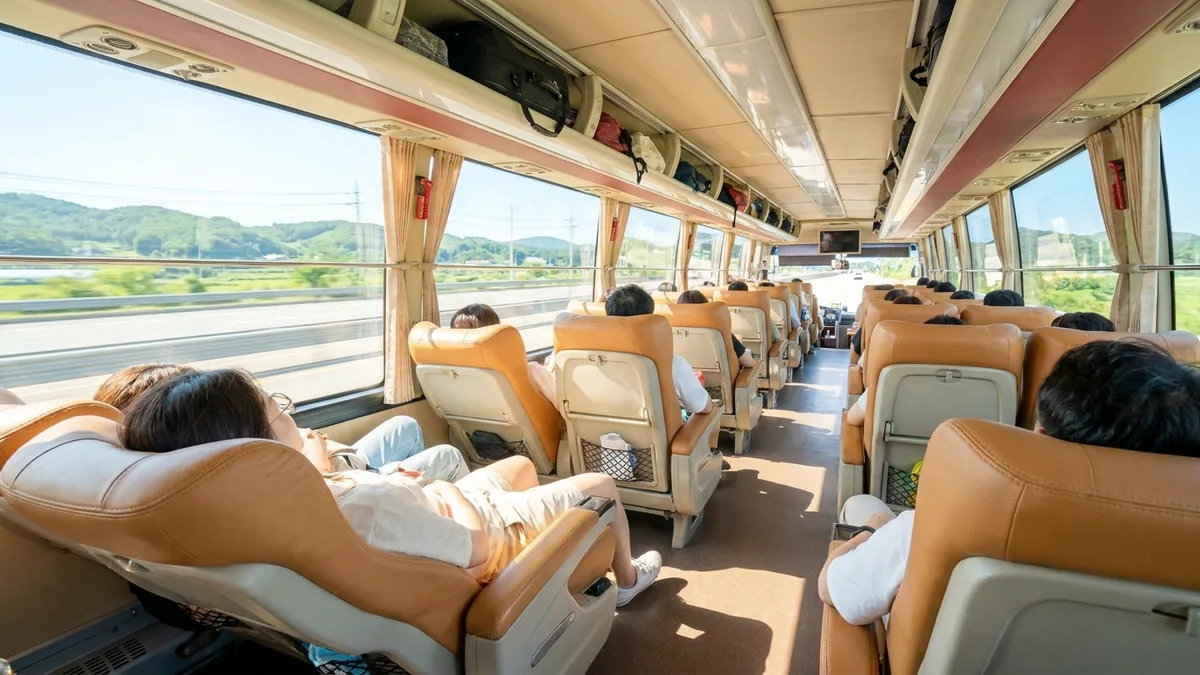
This is effectively the standard grade of Korean express buses. With a 1+2, 3 across layout, about 28 passengers ride per bus. Since one side of the aisle is a single seat, you can travel without a seatmate, and the wider recline angle makes long trips relatively comfortable.
It's about 40–50% more expensive than Standard, but the comfort-for-the-price value is good, making it the safest choice for medium-to-long distances.
Premium Express Bus (Premium / 프리미엄)
Introduced in 2016, this is the top grade, sometimes called "business class on the road" (KDI Economic Education & Information Center policy materials). It has the fewest seats, about 21. Each seat has a personal monitor (PTV), privacy curtain, USB (Type-C) charging, reading light, and footrest, and many routes offer free Wi-Fi. Because the curtain wraps around each seat, you can recline all the way back without worrying about the person behind you.
Note: The monitors (PTV) on Premium buses mostly show Korean content, and some let you connect (mirror) your own smartphone to the screen. Since the interface is Korean-centric, if you need English it's easier to download movies and music to your phone in advance.
How Much Do Fares Differ (Seoul–Busan Example)
The longer the trip, the wider the gap between grades. The below is an example to give you a feel for Seoul–Busan fares; actual prices vary by when you book and the time of day (official confirmation is recommended).
| Grade | Approx. Seoul–Busan fare | Notes |
|---|---|---|
| Standard | Cheapest | May have few departures |
| Deluxe | About +40–50% vs. Standard | Safest choice |
| Premium | About the low ₩50,000s (daytime; late-night in the ₩60,000s) | About +30% over Deluxe |
On the same stretch, a Premium express bus is often cheaper than KTX while offering roomier seats. If you want to prioritize "comfort and price over time," it's a candidate (the trip may take longer by bus — it varies by route).
Discount Points
- Weekday travel: Depending on the route and time of day, fares are sometimes set lower.
- Late-night Deluxe/Premium: Departures after 22:00 run as a separate late-night grade, and popular routes sell out fast.
- You can confirm the exact discount rate and eligibility from the amount on the booking screen (don't guess).
How Foreigners Can Book
Bookings are split between two systems: express buses are handled by KOBUS (kobus.co.kr) and intercity buses by Bustago (bustago.or.kr). KOBUS offers English, Japanese, and Chinese pages, while Bustago's foreign-language support is relatively limited. The operating system can differ by route, so it's worth checking both.
- Online booking: www.kobus.co.kr — supports Korean, English, Japanese, and Chinese. Enter your origin, destination, and date, and the fares for each grade show up compared on a single screen.
- On-site ticketing: terminal ticket counters and self-service kiosks. Kiosks are mostly in Korean, so it may be easier to ask a counter staff member in English.
- Payment: Whether an overseas-issued card works depends on the timing, card issuer, and booking channel — it may go through or be blocked (it sometimes fails at the 3D Secure authentication step). If it's blocked, consider on-site ticketing or a different payment method.
- All-in-one booking app: With LACHA, you can sign up without a Korean phone number or identity verification and book express buses using overseas payment methods like Alipay and WeChat Pay. KTX tickets can be booked in the same app, too. Foreign cards often get blocked at the 3D Secure step on the official sites, but LACHA supports easy-payment options like Alipay, so the payment goes through without that step.
Best seats: the single seat in a 1+2 Deluxe, and a window-side solo seat (not the middle) on Premium, are the most comfortable. If you get motion sick, it's best to avoid the seats over the wheels (the very back) and the first row at the very front.
Want to search and book KTX and express buses in one app? Check out LACHA.
Built to work without a Korean phone number or bank account, with overseas payment methods like Alipay, WeChat Pay, and Apple Pay. Taxi hailing plus KTX, express bus, and airport railroad (AREX) booking — all in one app.
Download now


Frequently Asked Questions (FAQ)
Q1. Deluxe or Premium — which should I choose? A. For trips within 2–3 hours, Deluxe is plenty. For long trips of 4 hours or more, or if you want to sleep soundly along the way, we recommend Premium. With a canopy and curtain at each seat, it's practically like a private cabin, and if you want a fully independent seat, choose the single seat on the left.
Q2. Do all routes have Premium? A. No. Premium mainly runs on major long-distance routes like Seoul–Busan. Short-distance and regional routes often have only Standard and Deluxe, so check on the booking screen.
Q3. Are Wi-Fi and outlets always available? A. Premium usually provides them, but for Deluxe and Standard it varies by route and vehicle (differs by timing and vehicle). If you really need to charge, it's safer to bring a power bank.
Q4. My overseas card won't work for booking. A. It may be blocked depending on the card issuer, booking channel, and timing (especially at the 3D Secure authentication step). You can use on-site ticketing at the terminal, or use an all-in-one booking app like LACHA.
Q5. Are late-night express buses more expensive? A. The late-night grade departing after 22:00 runs separately and its fare may differ from regular hours. Please confirm the exact amount on the booking screen.
Note: The fares, seat specifications, and operating information in this article are general guidance compiled as of 2026-06 and may vary by route, vehicle, time of day, and when you book. Whether payment goes through depends on the card issuer, booking channel, and timing. Before booking, be sure to check the latest fares and service information on an official booking channel such as KOBUS (www.kobus.co.kr) or Bustago.