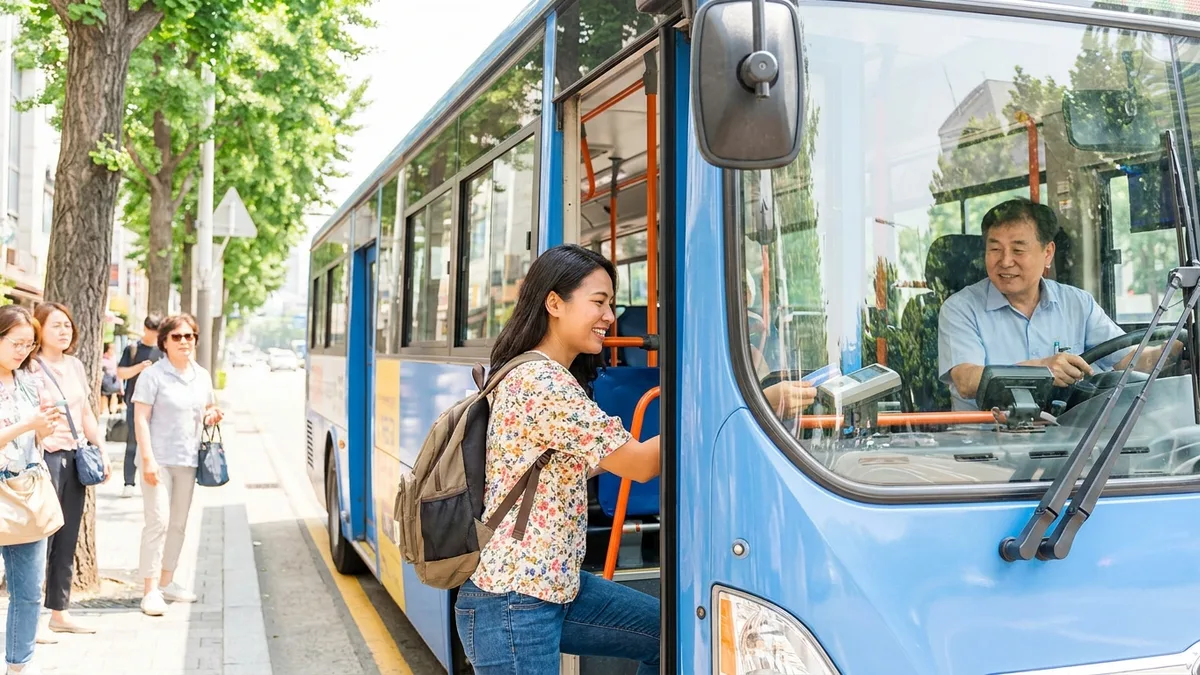
If you got off the subway, transferred to a bus, and another full 1,550 won was deducted from your card, chances are you missed the transfer discount.
Korea's public transit has a system called the "transfer discount" (integrated transfer). As long as you meet the conditions, when you switch you don't pay the base fare again — you only pay the distance difference. The catch is that these conditions are trickier than you'd expect, and there are many traps that foreign travelers and residents miss without realizing it. In particular, since March 2026 you can buy tickets with an overseas credit card at Seoul subway ticket machines — but this is not open-loop payment where you tap your card directly at the gate (under the Seoul city roadmap, direct tapping in the subway is planned for after 2027), and single-use tickets bought with an overseas card don't qualify for the transfer discount either — if you use them without knowing this, you may actually end up paying more.
The fares and rules below are as of 2026-06 and may vary by time, agency, and line. You can confirm the actual application through official channels such as the Seoul transit information site (news.seoul.go.kr/traffic) or the T-money customer center.
What Is the Integrated Transfer Discount? — The Principle of "Paying the Base Fare Only Once"
The metropolitan integrated transfer discount is a system where, when you switch between different modes of transit such as subway, city bus, and village bus, the base fare you've already paid isn't charged again. Even if you split your trip across several rides, the fare is calculated only once based on the distance traveled.
- Base fare (card basis, 2026-06): Subway 1,550 won, city bus 1,500 won (regular adult; varies by line and section).
- Base distance: The base fare covers up to about 10 km as is.
- Distance surcharge: Beyond 10 km, about 100 won for every 5 km is added (varies by section and mode).
For example, if you go 8 km by subway and another 5 km by bus, it's calculated as a total of 13 km, so only the distance difference (about 100 won) is added to the base fare. You don't pay the full bus base fare again.
This bundle, calculated as a single journey, is exactly what the transfer discount is.
The 3 Key Conditions for the Transfer Discount — Time, Count, and Tap
To be recognized as a transfer, you must meet all three of the following.
1) Time: Within 30 minutes of tapping out (60 minutes late at night)
- You must tap in on the next mode within 30 minutes of tapping out on the previous mode for the transfer to be recognized.
- Between 21:00 and 07:00 the next day, services run less frequently, so the valid window extends to 60 minutes.
- The reference point is not the time you got off but the time you boarded the next mode. Just tap in on the next vehicle within 30 minutes.
2) Count: Up to 4 transfers (5 modes total)
Transfers are bundled for free up to 4 times. In other words, you can ride up to 5 modes of transit in sequence. From the 5th transfer (the 6th mode) onward, a new base fare is charged again.
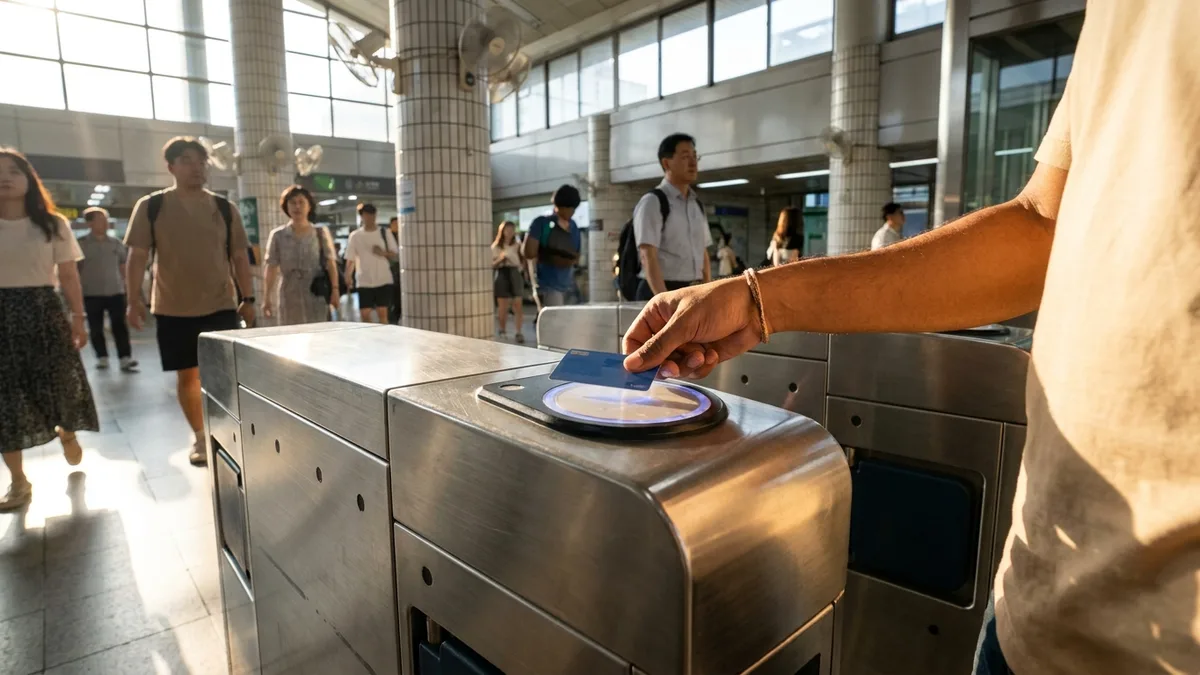
3) Tap: Tap your card both when boarding and when getting off
- Bus: Tap the reader both when boarding and when getting off.
- Subway: Tap the gate both when entering and when exiting.
- If you don't tap out, the transfer discount won't apply, and a missed-tap penalty may add extra charges (such as the maximum distance fare).
| Category | Rule (as of 2026-06) |
|---|---|
| Transfer valid window | Within 30 minutes of tapping out (60 minutes from 21:00 to 07:00 the next day) |
| Number of transfers | Up to 4 (5 modes total) |
| Tap in/out | Tap when boarding and when getting off on both bus and subway — required |
| Base distance | Base fare covers up to about 10 km |
| Distance surcharge | About 100 won for every 5 km beyond 10 km |
Memorizing just the table solves most cases, but in practice the discount leaks away through the traps below.
5 Traps Foreigners Often Miss
- Not tapping out — This is the most common mistake. On Korean buses you must tap when getting off, too. If you don't, your next transfer discount is completely lost, and a penalty fare may be added on your next boarding.
- Re-boarding the same route in the same direction — Getting back on a bus with the same number in the same direction you just got off, or exiting a subway station and re-entering the same one right away, is not recognized as a transfer (to prevent misuse).
- Paying with cash — The transfer discount only applies when you tap with a transit card (or a payment method with card functionality). Cash boarding gets no discount.
- Exceeding 30 minutes — If you board again after a meal or shopping, more than 30 minutes will have passed and a new fare is charged.
- Paying for several people with one card — Tapping for several people with a single card (multi-passenger processing) makes the transfer rules complicated and can break your companions' transfers. One card per person is best when possible.
Whether the Transfer Discount Applies by Payment Method (★ Must-read for Foreigners)
This is the point that confuses foreigners the most. "Being able to ride the subway directly with an overseas card" and "getting the transfer discount" are two separate things.
- Prepaid transit cards such as T-money: The transfer discount applies normally. Buy a card at a convenience store or station for about 3,000 won and top it up.
- Apple Wallet T-money (since 2025-07) / mobile T-money: These follow the T-money standard, so the transfer discount applies.
- Direct payment with an overseas credit card (EMV open loop): Since 2026-03-17, at the new ticket machines in 273 stations on Seoul subway Lines 1–8, you can buy and top up single-use tickets and the Climate Card with an overseas Visa or Mastercard (used by about 9,158 people per day on average). However, domestic transit settlement uses the 'PayOn' standard while overseas cards use the EMV standard, so there are limits to linking the transfer discount. A fully open-loop transfer discount is expected to be applied in phases after 2027, once the replacement of EMV terminals and the buildout of the settlement system are complete (Seoul city roadmap: Phase 1 buses ~2026, Phase 2 subway ~2027, Phase 3 expansion ~2030).
- Google Wallet does not support transit card (T-money) payment in Korea, so Android users typically use a physical T-money card or the mobile T-money app.
In short, if you tap directly with an overseas card every time right now, you may end up paying the base fare again each time you switch. If you transfer often, topping up a prepaid transit card (T-money type) is more cost-effective.
Whether payment and the transfer discount apply varies by card issuer, station, and time. Before a trip that involves a major transfer, we recommend testing first with a small amount.
Want to search and book KTX and express buses in one app? Check out LACHA.
Built to work without a Korean phone number or bank account, with overseas payment methods like Alipay, WeChat Pay, and Apple Pay. Taxi hailing plus KTX, express bus, and airport railroad (AREX) booking — all in one app.
Enter code GUIDE3 at sign-up for 3,000P instantly
Download now


Frequently Asked Questions (FAQ)
Q1. Is it really free when I transfer from the subway to a bus? A. It's not entirely free. Within the base fare you've already paid, there's no extra charge up to the distance (about 10 km); beyond that, you only pay the distance difference (about 100 won per 5 km). It means you don't pay the full bus base fare again.
Q2. When does the 30-minute transfer window start counting? A. It counts from the moment you tapped out on the previous mode. From that point, if you tap in on the next mode within 30 minutes (60 minutes late at night, from 21:00 to 07:00 the next day), it's recognized as a transfer.
Q3. If I ride the subway with an overseas credit card, do I get the transfer discount? A. Right now in Seoul you can't tap an overseas credit card directly at the gate to ride. The method is to buy a single-use ticket or a short-term Climate Card pass with an overseas card at a ticket machine, and single-use tickets don't qualify for the transfer discount. If you transfer often, it's better to use a prepaid card of the T-money type (varies by card, station, and time).
Q4. I forgot to tap out when getting off the bus. What happens? A. If you miss tapping out, the transfer discount for that leg won't apply, and a surcharge (such as the maximum distance fare) may be added on your next boarding. From now on, just make sure to tap the reader when getting off, too.
Q5. What's the maximum number of transfers? A. Up to 4 transfers are bundled for free (5 modes of transit total). From the 5th transfer, a new base fare is charged.
Note: This article is general information summarizing publicly available information as of 2026-06, and fares, transfer rules, and whether overseas cards apply may vary by time, line, card issuer, and agency. Please be sure to confirm the actual details through official channels such as the Seoul Metropolitan Government transit information site (news.seoul.go.kr/traffic) or the T-money customer center.