Convenience stores have T-money on display, airports have WOWPASS kiosks standing by, and the moment you open a blog you see "unlimited Climate Card." The names sound similar, all three get you onto the subway and buses, so it's no surprise that your very first question on arrival becomes "OK, so which one do I actually buy?"
Here's the key point: these three cards aren't competing products — they're built for different purposes.
Someone on a short trip, someone who'd rather skip the hassle of exchanging cash, and someone who rides public transit in Seoul every day for more than a month — the right answer is different for each of them. Below, we'll break it down one piece at a time: how to top up, where each card works, refunds, and coverage.
Fares and conditions are as of 2026-06, and policies and prices change frequently. Check each card's official channels for the latest information before buying or topping up.
The Three Cards at a Glance
| Category | T-money | WOWPASS | Climate Card |
|---|---|---|---|
| Type | Prepaid transit card | All-in-one prepaid card: payment + transit + currency exchange | Pass (fixed-price unlimited pass) |
| Main users | Anyone (travelers and residents alike) | Short-term foreign travelers | Long-term residents who ride daily in Seoul |
| How you pay | Deducted from your topped-up balance | Deducted from your topped-up balance | Unlimited rides within the period |
| Payment at regular stores | Only at some partner merchants | Widely accepted (card network) | Not possible (transit only) |
| Currency exchange | None | Yes (app and kiosk) | None |
| Top up with a foreign card | Mostly cash at stations and convenience stores | Can top up in the app with an overseas card or mobile pay | Mostly cash top-up on the physical card |
The table alone can be confusing, so let's take each card apart.
1. T-money — The basic one; you should probably have at least one
This is the most common prepaid transit card in Korea. You can use its topped-up balance on the subway, city buses, village (maeulbus) buses, most taxis, and at some partner merchants including convenience stores.
Buying and price
- Where to buy: convenience stores such as CU, GS25, and 7-ELEVEN inside Incheon and Gimpo airports, ticket machines in subway stations, and some tourist information centers
- Card price: about 2,500–4,000 won (the card itself; top-up amount is separate)
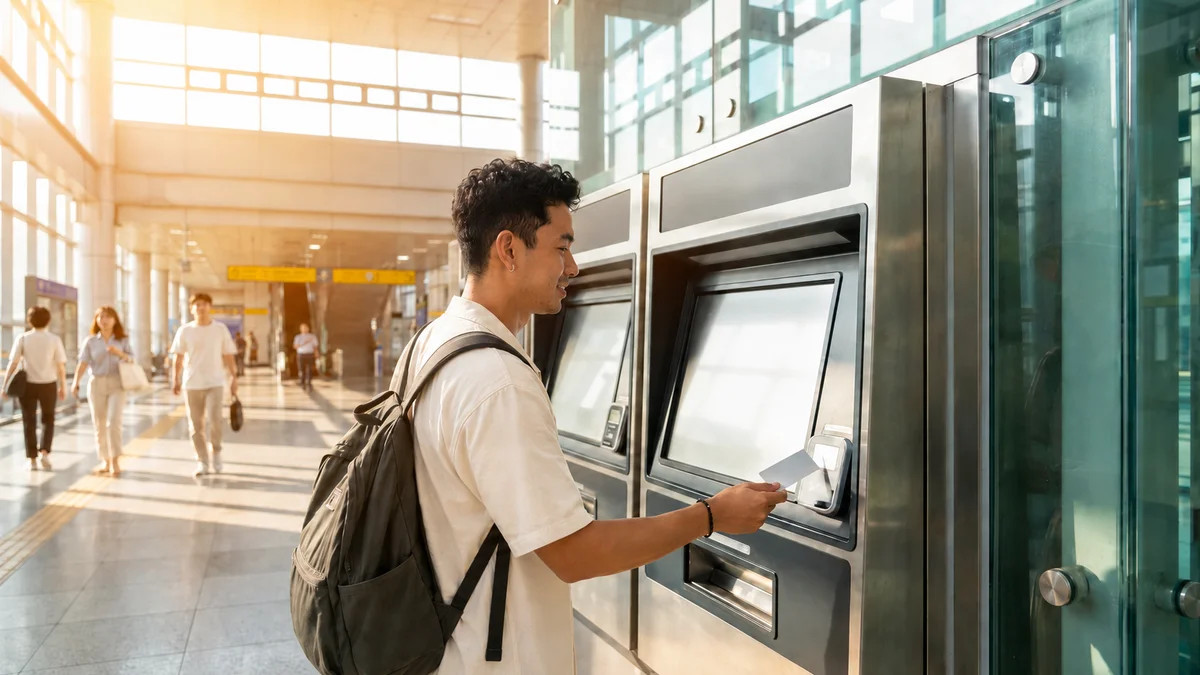
- Top up: hand the card and the amount to the cashier at a convenience store and it's charged right away. Self-service top-up machines in subway stations support multiple languages
Refunds
- A balance of 20,000 won or less can be refunded in cash at a convenience store (a fee of about 500 won is deducted)
- For amounts above that, use a station customer service center or a T-money center
- The card price (a purchase cost, not a deposit) is usually non-refundable
In the end, your T-money balance is topped-up money you spend like cash. Since it has no currency-exchange function, you can only load it with Korean won in cash or at certain top-up machines, and whether you can charge it directly with an overseas credit card depends on the station and the moment.
2. WOWPASS — Currency exchange, payment, and transit in one card
This is an all-in-one prepaid card aimed at foreign tourists. Currency exchange, payment at regular stores, and transit-card functions are combined into a single card. Think of it as T-money with currency exchange and payment added on top.
Top-up and currency exchange
- Kiosk top-up: top up with cash at WOWPASS machines at major locations in Seoul and across the country
- App top-up: you can top up through the mobile app using an overseas credit card or mobile pay
- Multi-currency support: supports 16 currencies in total, exchanging foreign currency into won and loading it onto the card
- Cash-out: the card balance can be withdrawn as Korean won cash at WOW Exchange kiosks (limit 100,000 won per transaction, 1,000 won fee)
Where it works
Restaurants, cafés, taxis, cosmetics road shops, shopping malls, duty-free shops, hospitals, tourist attractions, and even unmanned kiosk stores — it's widely accepted through the card company's partner network. In places where T-money isn't accepted, WOWPASS is a credit-card merchant, so it often works.
It's a good fit for short-term travelers who'd rather not deal with exchanging cash and want to handle both payments and transit with one card. That said, the balance is simply your own won, so it's deducted as you ride — it's not an unlimited pass.
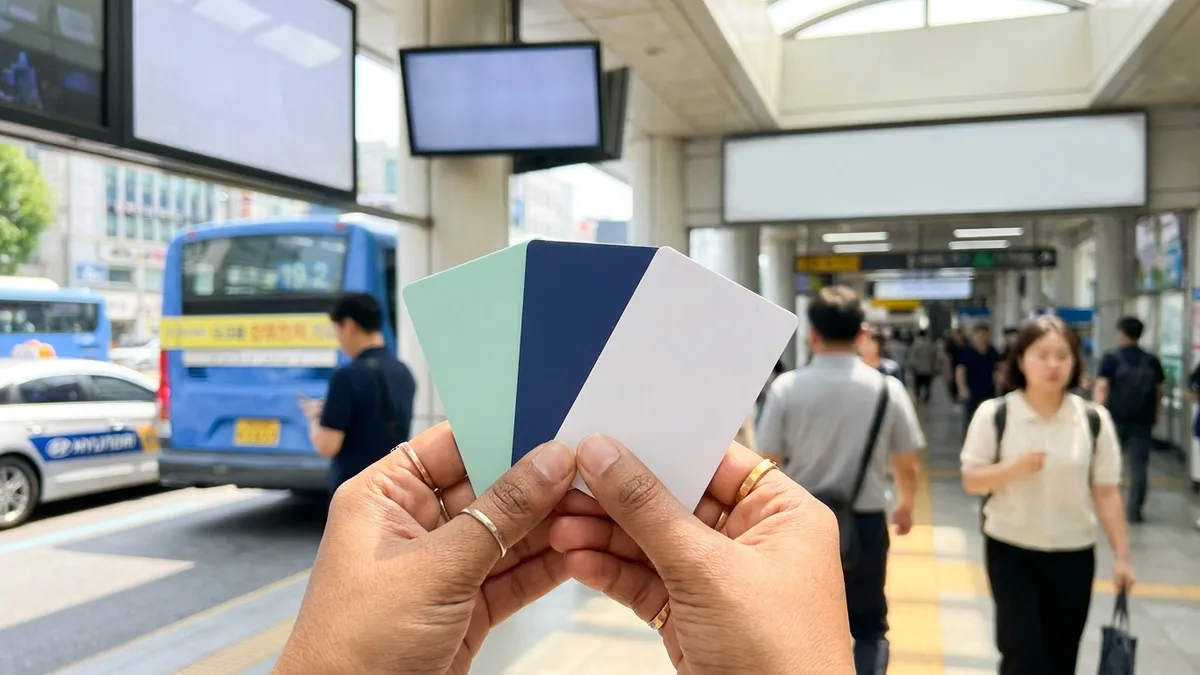
3. Climate Card — An unlimited pass for people who ride daily in Seoul
This one is completely different in nature from the first two. Instead of drawing down a topped-up balance, it's a fixed-price pass that lets you ride unlimited within a set period. It's run by the Seoul city government and works out well for long-term residents who take public transit every day.
Price and types (as of 2026-06)
- 30-day pass: 62,000 won (without Ttareungi) / 65,000 won (with Ttareungi) — note: scheduled to end in late August 2026, after which the K-Pass ('Moduui Card') takes over.
- Short-term passes for foreigners and tourists: 1-day 5,000 won · 2-day 8,000 won · 3-day 10,000 won · 5-day 15,000 won · 7-day 20,000 won
- A short-term pass starts working as soon as you charge it, while for the 30-day pass you can set the start date within 5 days of the charge date
Coverage (★ the most important part)
The lines you can ride are strictly defined. This is where most of the misunderstandings come from.
- Covered: subway lines within Seoul, buses licensed by the city of Seoul (branch, trunk, village, late-night, and circular), and Ttareungi (with a Ttareungi-inclusive pass type and card registration)
- Not covered / excluded: Sinbundang Line, GTX, wide-area (gwangyeok) buses, airport buses, intercity and express buses, KTX, SRT
- Watch the boundaries: if you board within the covered area but get off at a station outside it, the pass won't apply → a separate fare is charged
Conditions for foreigners and Ttareungi
- Foreigners can use short-term passes only with a physical card (mobile is mainly for Korean nationals)
- The physical card must be registered on the "T-money Card&Pay" website — without registration, you can't use Ttareungi or get refunds
- Once registered, you can use Ttareungi's 1-hour rides an unlimited number of times during the pass period
The only people who come out ahead are those who ride the subway or buses in Seoul almost every day. If you're on a trip of just a few days, or you travel between regions on KTX or express buses, a top-up card (T-money or WOWPASS) is better than a pass.
So which one should I buy?
| Your situation | Recommendation |
|---|---|
| A short trip of a few days, don't want to bother exchanging cash | WOWPASS (exchange + payment + transit in one card) |
| Just one basic transit card, kept simple | T-money |
| More than a month in Seoul, subway and buses every day | Repeat short-term passes or K-Pass (30-day pass ends late Aug 2026) |
| A few days of intensive sightseeing mostly in Seoul, lots of public transit | Climate Card short-term pass |
| Frequent trips outside Seoul (KTX, express buses) | A pass isn't suitable → top-up card + LACHA for KTX/express bus booking |
Frequently Asked Questions (FAQ)
Q1. If I buy just one of the three cards, will it cover everything? A. Unfortunately, no. Their purposes are different. The Climate Card gives you unlimited transit within Seoul, but it doesn't cover KTX, express buses, or in-store payments. If you need to travel between regions or make payments, it's best to carry another option alongside it.
Q2. Can I top up directly with a foreign credit card? A. WOWPASS supports top-up with an overseas credit card or mobile pay in the app. For T-money and the physical Climate Card, cash top-up is the default, and whether an overseas card works depends on the station, the moment, and the card issuer.
Q3. Can I take the Climate Card all the way to Incheon Airport? A. Airport buses and some wide-area routes are excluded from coverage. On the Airport Railroad (AREX), you can board and alight only between Gimpo Airport and Seoul Station; at the Incheon Airport T1 and T2 stations you can only get off (boarding is not allowed). It's safest to remember that you can't use it to get to Incheon Airport.
Q4. Can't I book KTX or express buses with these cards? A. No. All three cards are centered on city transit, so they don't have seat-booking functions for KTX, SRT, or express buses. Long-distance trains and buses require separate booking and payment. With LACHA, you can book KTX and express buses in one app, without a Korean phone number or identity verification.
Q5. Can I use these even without a Korean phone or bank account? A. You can buy and top up physical T-money and WOWPASS cards with cash, so you can get started without a Korean phone or bank account. That said, some app features (mobile registration, online top-up) may require an identity verification step.
Want to search and book KTX and express buses in one app? Check out LACHA.
Built to work without a Korean phone number or bank account, with overseas payment methods like Alipay, WeChat Pay, and Apple Pay. Taxi hailing plus KTX, express bus, and airport railroad (AREX) booking — all in one app.
Enter code GUIDE3 at sign-up for 3,000P instantly
Download now