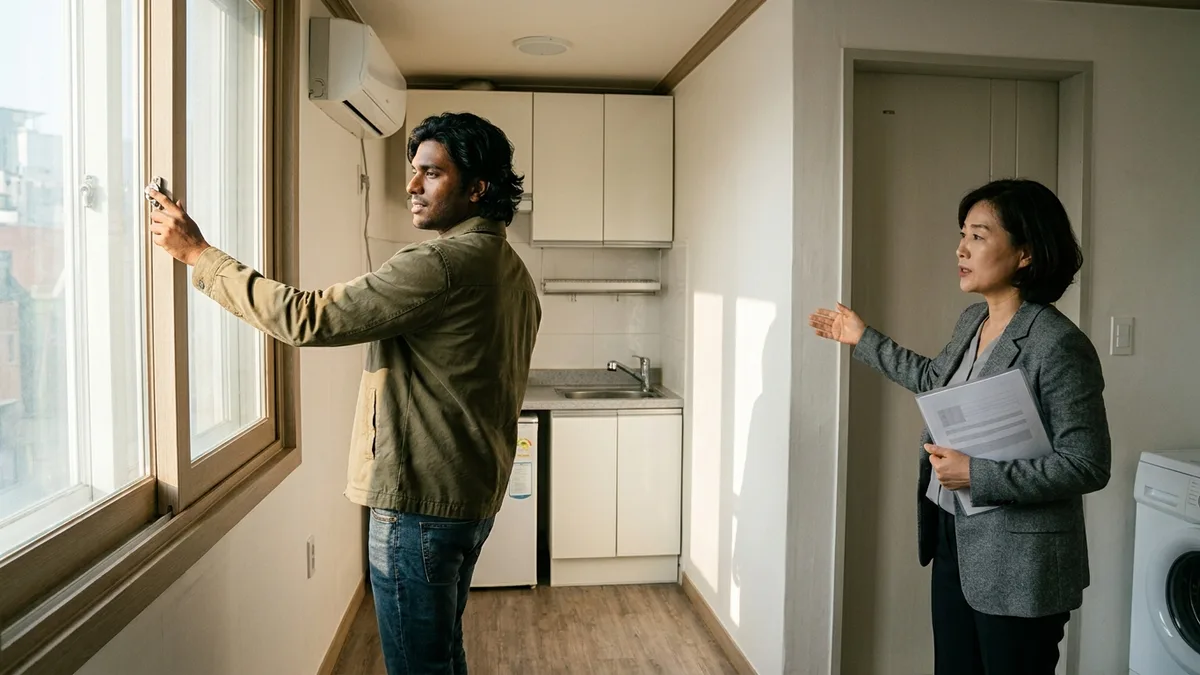
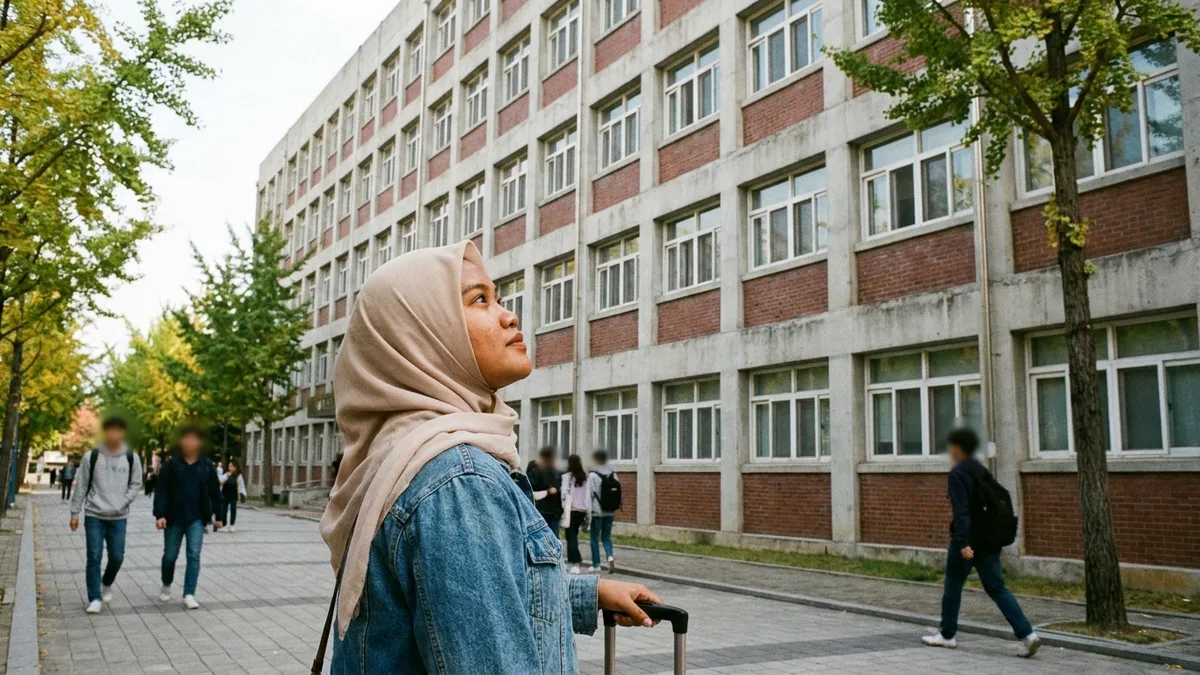
The first thing you search for once your acceptance letter arrives is the dormitory. But a Korean university dormitory isn't a place you get into by applying — it's a place where you compete for a bed. In the analysis of the October 2025 university information disclosure by the Ministry of Education and the Korean Council for University Education (한국대학교육협의회), the dormitory capacity rate at 193 four-year general and education universities was 22.2%, down 0.6 percentage points from 22.8% the year before, and it splits into 17.8% for general universities in the Seoul metropolitan area and 25.9% outside it (26.6% at national and public universities, 20.8% at private ones).
The number of students is moving the other way. In the 2026 Basic Educational Statistics from the Ministry of Education and the Korean Educational Development Institute (한국교육개발원, as of April 1, 2026), international students numbered 307,464 — passing 300,000 for the first time. That is 54,030 more (21.3%) than the year before, and students from Vietnam took the top spot for the first time at 96,834 (31.5%).
This article covers how dormitory selection for international students differs from the track for Korean nationals, what options are left if you don't get in, and — if you've signed for a room — what you have to do within 15 days of the day you move in to keep your deposit protected. The figures for dormitory fees and selection conditions are examples taken from specific university notices, so check them again in the guidelines of the university you're applying to.
Caution: This article is not legal advice. For stay and reporting matters, check with ☎1345 (Immigration Contact Center, multilingual), and for deposit disputes with the Korea Legal Aid Corporation (☎132).
The dormitory is a competition, not a default
At a general university in the Seoul metropolitan area, that figure means there are dormitory beds for fewer than two out of every ten enrolled students. That said, the capacity rate above covers all enrolled students without separating Korean nationals from foreign nationals, so it is not your odds of getting into a dormitory as an international student. We could not find official nationwide statistics on foreigner-only dormitory beds or competition ratios at each university, so you'll need to ask your own school's international office directly how many beds are allocated.
Being turned down doesn't end the semester. When beds open up, the waiting list moves. Seoul National University's Gwanak Student Dormitory kept announcing additional move-ins for the first semester of academic year 2026 through round 12 for undergraduate freshmen and round 14 for continuing undergraduates and graduate students, and the second semester was announced through round 7. Still, a room you sign for in a hurry during those weeks of waiting will shape your whole year, so put in the application and prepare a plan B alongside it.
International students stand in a different line
Looking only at the capacity rate, you might assume your own chances are around 22% — but international students are in a separate line from the start. Pusan National University's Student Dormitory sets its recruitment quota after excluding single rooms and the separate quota for foreign nationals from the dormitory's total capacity, and foreign nationals are selected separately under the international office's own selection rules (the notice gives the dormitory office, idorm@pusan.ac.kr, as its contact, and the criteria for selecting foreign students belong to the international office). The pool you compete in is not the full capacity but that separate quota set aside in advance.
The ranking criteria on the Korean-national track show why the lines are split. In the same university's regular recruitment, after the first-priority groups such as basic livelihood security recipients and students with disabilities, it gives precedence to applicants whose father's or mother's address on the resident registration copy (주민등록등본) is outside Busan Metropolitan City and then selects by grades. An international student, who has no resident registration document at all, cannot stand in this line.
It stings more when a vacancy appears. Pusan National University's additional recruitment for vacancies explicitly lists foreign students as ineligible to apply, so even when a room opens up you cannot get in through that additional recruitment. The conditions attached specifically to international students also differ from school to school.
- Seoul National University, Gwanak Student Dormitory — the minimum GPA is 2.4 or higher for Korean undergraduates and 2.3 or higher for foreign undergraduates (freshmen and graduate students excluded). A health certificate covering tuberculosis, measles and the like is required, and it must carry a hospital stamp and be in Korean or English.
- Pusan National University, Student Dormitory — successful applicants must submit the original chest X-ray health certificate issued within the three months before the move-in date.
- Hanyang University, International Education Institute dormitory — offered only to new students in the Korean language program (language training), it can be applied for up to a maximum of two semesters and closes on a first-come, first-served basis.
That last line matters. At a school where the dormitory is for new students only, the moment you use up the number of semesters you can apply for (a maximum of two semesters at Hanyang's International Education Institute), the point where you have to find your own room arrives without warning. All of this was confirmed from specific university notices, so check directly in the guidelines of the university you're applying to.
Take apart what's included in the dormitory fee
Dormitory fees differ from school to school starting with the billing unit. The figures below are examples taken from notices and are not an average of Korean university dormitory fees.
| University · dormitory | Billing unit | Amount for a double room | Deposit · meals |
|---|---|---|---|
| Seoul National University, Gwanak Student Dormitory | Monthly | ₩139,800–278,100 for undergraduates | A deposit equal to one month's fee, charged once; meals separate |
| Jeonbuk National University dormitory | Per semester | ₩727,320 at Hyemin Hall (혜민관) to ₩1,796,080 at Hanbit Hall (한빛관) | No deposit; at some halls you can opt out of the meal plan |
| Pusan National University, Student Dormitory | Per semester (114 days of operation) | ₩1,246,020–1,936,860 at Jinri Hall (진리관), ₩1,642,500–2,192,220 at Jayu Hall (자유관) | Meals are mandatory, so the amount varies with the meal plan |
| Hanyang University, International Education Institute | Per semester | ₩1,880,000 at Dormitory 6 (women), ₩1,627,000 at Dormitory 7 (men) | No deposit, utilities or maintenance fee; there's no cafeteria, so meals are on you |
The same double room runs from ₩727,320 to ₩2,192,220 per semester — a threefold gap — and Seoul National University bills monthly, so the unit of comparison itself is different. A large share of the difference is food. Pusan National University's dormitory has a mandatory meal plan, so "no meals" isn't an option, and you can change the meal type or the number of meals only once during the semester. Of the ₩1,936,860 for a Jinri Hall double room with three meals seven days a week, ₩1,272,240 is the meal charge — more than half of it is food. If halal, vegetarian or allergy needs mean you can't use the dormitory cafeteria, you'll be paying all semester for meals you won't eat. The one-year total, with tuition, health insurance premiums and residence fees added on top of the dormitory fee, is worked out in what a year of studying in Korea actually costs.
Look at payment methods too. As of the October 2025 disclosure, among 249 four-year university dormitories (that's the number of dormitories, not the number of universities), 149 (59.8%) required payment in one lump sum in cash — a bank transfer or the like, not a card and only 55 (22.1%) accepted card payment. You won't have a Korean bank account right after you arrive, so schedule opening a bank account as a foreigner in advance.
Read the conditions for leaving before you move in, as well. At Pusan National University's dormitory, if your academic status changes you must move out completely within 15 days of the date of the change. A mid-term move-out refund covers only 90% of the maintenance and meal charges for the remaining days of the month you leave, with the full amount for the period after that, and there is no refund from seven days before the operating period ends. Taking a leave of absence also affects your status of stay, so housing and visa problems land on the same day.
If you don't get in — hasuk, share houses, goshiwon, and the joint student dormitory
We haven't put the monthly cost of hasuk, share houses or goshiwon in this article. None of the three has official price statistics, and moving platform numbers into an article as if they were statistics leaves you with no basis for a correction when they turn out to be wrong. Instead, here's what each one is legally.
We could not find a statutory definition of hasuk (하숙, boarding in a room in someone's home, meals included). Because it is a form of renting part of a home, Article 2 of the Housing Lease Protection Act (which applies to leases of all or part of a residential building) may well apply, but there is no conclusive basis for saying so. Check directly whether a written contract is signed and whose account the deposit goes into.
With a share house, the first thing to look at is whether the party you're contracting with is the owner or someone who rented the place. If the operator is a tenant and re-rents the rooms, that is a sublease, and Article 629 of the Civil Act prohibits subleasing without the landlord's consent and lets the landlord terminate the lease if it is violated. The home you live in can be shaken even when you've done nothing wrong.
A goshiwon isn't classified as housing to begin with. Under Table 1 of the Enforcement Decree of the Building Act it is classified as a multi-unit living facility (다중생활시설), and if the total floor area used for that purpose is less than 500㎡ it is a Class 2 neighborhood living facility, while at 500㎡ or more it is a lodging facility. It does fall under quasi-housing in Article 2, Item 4 of the Housing Act (dormitories, multi-unit living facilities, elderly welfare housing, officetels). Here is what to check.
- Cooking facilities and bathtubs cannot be installed in the individual rooms (Ministry of Land, Infrastructure and Transport public notice, Building Standards for Multi-unit Living Facilities; shower stalls are allowed). For a student who planned to cook food from home to save on living costs, this single line is a disqualifier on its own.
- They cannot be located in a basement level, and the minimum corridor width is 1.2m or more for a single-loaded corridor and 1.5m or more for a double-loaded corridor.
- In Seoul, each room must be at least 7㎡ of exclusive area (9㎡ or more if it includes a bathroom), and every room must have a window facing outdoors of at least 0.5m effective width by 1m in height (ordinance amended 2021-12-30, in force 2022-07-01). Room area and window standards are delegated to each local government's building ordinance, so they can differ outside Seoul.
Not being housing doesn't mean you get no protection at all. Whether Article 2 of the Housing Lease Protection Act applies is judged by whether the place is actually used for residence, not by the use recorded in the building register. It is decided case by case, though, so nothing here is conclusive.
Finally, international students can also apply to the Korea Student Aid Foundation's joint student dormitory for university students (연합생활관, also called 행복기숙사). Its residents are university and graduate students who are enrolled at, or admitted to, a Korean university or graduate school — foreign nationals included. Selection runs first to people recommended by the Korea Federation of Banks, second to housing-vulnerable groups, third to students who belong to (or came from) universities or local governments that provide housing scholarships, and fourth to general applicants, with ties broken in favor of the lower student aid income bracket. We couldn't confirm the fees by hall, or how ranking works when no income bracket has been calculated, so ask the foundation directly.
Signing for a one-room — the deposit wall, and where the money goes
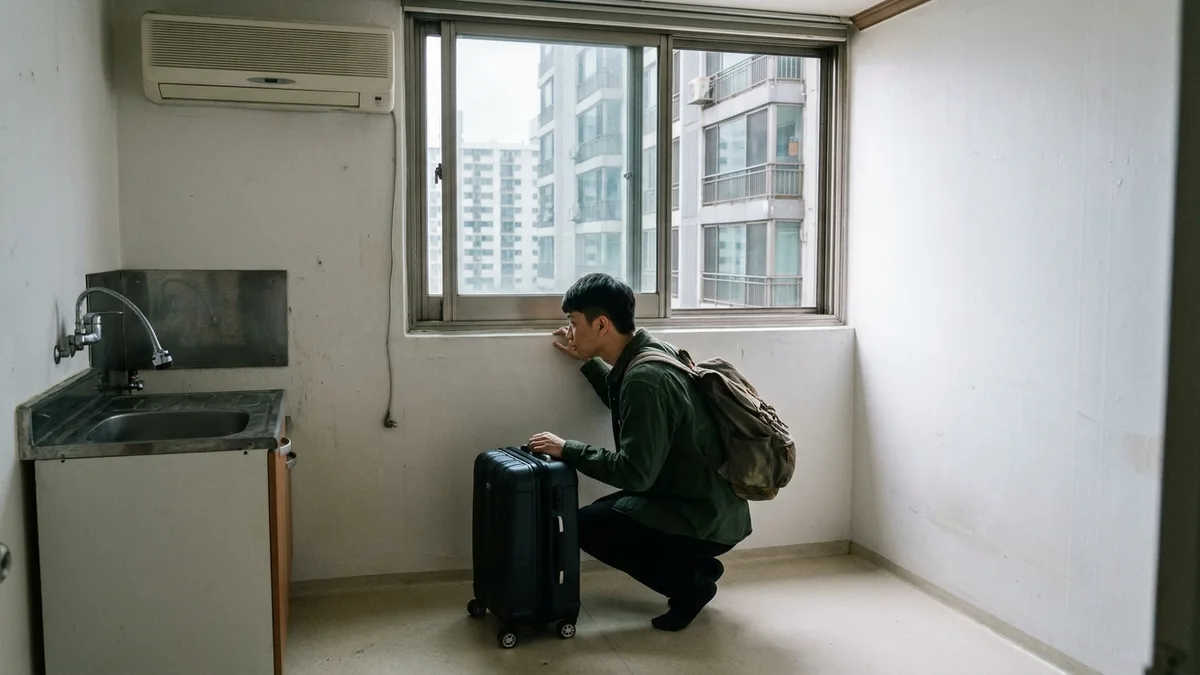
The first wall you hit with a one-room is the deposit. Even if you split it into a down payment and a balance, you need the whole lump sum by the time you move in, and at that point an international student usually has neither a Korean bank account nor a Korean phone number. The period when transfers and automatic rent payments are both blocked falls right after you arrive.
Here's how to check the price range. We could not obtain median actual transaction prices for one-rooms nationwide or in Seoul from primary statistics — you have to look them up yourself on the Ministry of Land, Infrastructure and Transport's Real Transaction Price Disclosure System and the Seoul Real Estate Information Plaza. For reference, Seoul's youth monthly rent support notice sets eligibility at a deposit of ₩80 million or less together with monthly rent of ₩600,000 or less, and divides applicants into four brackets that weigh the deposit and the rent together, the lowest being a deposit of ₩5 million or less with rent of ₩400,000 or less. That's a line drawn by policy, not a market rate, and international students cannot apply for this support at all (we come back to it below).
There's one more place your money goes: the brokerage fee. For a monthly-rent lease, the transaction amount is calculated as deposit + (monthly rent × 100), and if that total comes to less than ₩50 million you recalculate it as deposit + (monthly rent × 70). The brackets an international student's one-room reaches are the three below (above them it's 0.4–0.6%).
| Transaction amount | Ceiling rate | Cap |
|---|---|---|
| Under ₩50 million | 0.5% | ₩200,000 |
| ₩50 million or more but under ₩100 million | 0.4% | ₩300,000 |
| ₩100 million or more but under ₩600 million | 0.3% | None |
With a deposit of ₩10 million and rent of ₩500,000, the transaction amount is ₩60 million, so 0.4% applies and the fee is ₩240,000; with a deposit of ₩5 million and rent of ₩400,000 it comes to ₩45 million, so you recalculate with ×70 to get ₩33 million, and 0.5% of that is ₩165,000. These are ceilings, so the actual amount is settled by agreement — but working it out in advance keeps you from paying whatever you're quoted.
Some landlords ask for a Korean guarantor or for rent paid up front. In a residential lease, requiring a guarantor is not a legal requirement — it's the landlord's discretion. Don't take it as a given; ask whether the terms can be adjusted. We could not find an official survey on how common it is.
What to check before you sign the contract
There are two pieces of paper to get in hand before you sign. One is the property register (등기부등본, formally a certified copy of the registry). Anyone can pull it from the Internet Registry Office, and what you're looking for is whether the owner's name matches the person signing and whether there is a senior mortgage. The second is the building register (건축물대장), which tells you whether the place is housing or a neighborhood living facility.
A lot of people also miss the fact that translations of the contract already exist. The Ministry of Justice released English, Chinese and Vietnamese translations of the standard housing lease agreement on March 10, 2026, and the Seoul Metropolitan Government provides the same contract in six languages — English, Chinese, Japanese, Russian, Uzbek and Vietnamese. Even if you sign the Korean version, put the translation beside it and compare before you sign.
The clause on the lease term is a sensitive one for international students. Article 4(1) of the Housing Lease Protection Act treats a lease with no fixed term, or with a term set at less than two years, as a two-year lease — but the tenant may assert that a term set at less than two years is valid. Paragraph 2 provides that even after the term ends, the lease relationship continues until the deposit is returned.
- Increases in rent or deposit are capped at one twentieth (5%) of the agreed amount, and no further increase can be demanded within one year of an increase (Article 7).
- If you want to hand your room to someone else when you go home, you need the landlord's consent (Article 629 of the Civil Act). For leases with no agreed term in general, Article 635 of the Civil Act provides that a tenant's notice of termination takes effect one month later, but for residential leases Article 4(1) of the Housing Lease Protection Act above also applies, so don't assume — check.
15 days from the day you move — the change-of-residence report and the fixed-date stamp
This is the most important part. A Korean friend will tell you to file a move-in report (전입신고) when you move, but a foreign national cannot file a move-in report. The proviso to Article 6(1) of the Resident Registration Act makes foreign nationals an exception, which means you are not a subject of resident registration.
What you have instead is the change-of-residence report (체류지 변경신고). Article 88-2(2) of the Immigration Act provides that alien registration and the change-of-residence report take the place of resident registration and the move-in report. The Supreme Court has also held that this report is recognized as having the same legal effect as the resident registration that Article 3(1) of the Housing Lease Protection Act sets as the requirement for opposability (Judgment of April 11, 2019, 2015Da254507; see also 2015Da14136).
Delivery of the housing (moving your things in and receiving the keys) + the change-of-residence report → opposability from the following day. Add the fixed-date stamp on top of that and the priority right to repayment arises.
Article 3(1) provides that once you have taken delivery of the housing and completed resident registration, opposability arises from the following day, and Article 3-2(2) provides that a tenant who has both the opposability requirements and a fixed-date stamp is repaid ahead of junior right holders in an auction or public sale. With only one of the two, you're only halfway there.
The deadline is within 15 days of the day you moved in (the day you moved to the new place of residence) (Article 36(1) of the Immigration Act). The amending act promulgated on June 9, 2020 (Act No. 17365) took effect on December 10, 2020 and changed the deadline from 14 days to 15, but some university and district office notices still say 14. You file by presenting your alien registration card to the head of the city, county or district, or of the eup, myeon or dong, for your new place of residence, or to the head of the competent regional immigration office. There is no fee, and you can also do it through Hi Korea (www.hikorea.go.kr) e-Application. Updating the back of the card is covered in alien registration card reissue and address change.
You'll need documents proving your place of residence too. If you have a lease agreement in your own name, that's what you submit; if you live in a dormitory or the lease isn't in your name, you submit the residence (accommodation provision) confirmation issued by your university or the accommodation provider.
You should also know what happens if you miss the deadline. This is a criminal fine, not an administrative fine. It is a criminal fine of up to ₩1 million under Article 98, Item 2 of the Immigration Act, and Article 36 does not appear in the administrative fine provision at Article 100. In practice you pay a summary fine (범칙금) through the notice disposition in Article 102, and Table 7 of the Enforcement Rules sets brackets by period.
| Period left unreported | Summary fine |
|---|---|
| Less than 3 months | ₩100,000 |
| 3 months or more but less than 6 months | ₩300,000 |
| 6 months or more but less than 1 year | ₩500,000 |
| 1 year or more but less than 2 years | ₩700,000 |
| 2 years or more | ₩1,000,000 |
A few days late and two years of neglect are ten times apart. The ₩1 million figure people usually quote is the two-years-or-more bracket, so don't give up because you're late — file the day you realize. A record of failing to report can also count against you when an extension of your stay is reviewed.
The fixed-date stamp is obtained separately. It is granted by the eup or myeon office, the dong community service center, the city, county or district branch office, the district court or registry office, or a notary for the area where the housing is located (Article 3-6(1) of the Housing Lease Protection Act), and an alien registration card is accepted as ID. The fee is ₩600 per document.
There is one more thing on top: the housing lease report. Article 6-2 of the Act on Report on Real Estate Transactions, Etc. and Article 4-3 of its Enforcement Decree require a residential lease with a deposit over ₩60 million or monthly rent over ₩300,000 to be reported within 30 days of signing (an extension of the term with no change in the amounts is excluded). There is a geographic limit as well. Article 4-3(2) of the Enforcement Decree sets the covered areas as special self-governing cities and provinces, cities, counties and districts, but counties only within metropolitan cities and Gyeonggi Province. A county in an ordinary province that is neither a metropolitan city nor Gyeonggi (South Chungcheong, North Gyeongsang and so on) is not covered under the text of the provision, while counties in Gangwon and Jeonbuk Special Self-Governing Provinces (강원특별자치도·전북특별자치도) overlap with the “special self-governing province” item and views differ, so check first with the housing division of the competent city, county or district office. Failing to report or reporting falsely draws an administrative fine of up to ₩1 million (Article 28(5), Item 3 of the same Act), but ₩1 million is the ceiling the Act sets. The amount actually imposed is set by the imposition standards in Table 3 of the Enforcement Decree, from how long the report was missing and the contract amount, so a failure to report runs ₩20,000 to ₩300,000 and the ₩1 million attaches to a false report. The grace period from June 1, 2021 to May 31, 2025 has ended, and fines apply to contracts signed on or after June 1, 2025.
Under Article 6-5(3) of the same Act, filing the lease report together with the contract is treated as having obtained the fixed-date stamp. Conversely, Paragraph 1 — that filing a move-in report is treated as filing the lease report — is a provision about the move-in report under the Resident Registration Act, and the text says nothing about whether the change-of-residence report has the same effect. So file the lease report within 30 days separately from the change-of-residence report.
- Get the original contract and keep it, and take a photo of a copy.
- Move your things in and receive the keys (= delivery of the housing).
- File the change-of-residence report within 15 days (Hi Korea, or a community service center or immigration office; no fee).
- If your lease is subject to the 30-day lease report, file it with the contract attached (once it's accepted, you're treated as having the fixed-date stamp). If it isn't covered, get the fixed-date stamp separately (₩600).
Three things to know about getting your deposit back
The first is priority. Having both the opposability requirements and the fixed-date stamp gives you the priority right to repayment, but that only means you come ahead of junior right holders — if a mortgage was already registered before you moved in, that right comes first.
The second is the smallest-deposit tenant's top-priority repayment. Under Article 8 of the Housing Lease Protection Act and Articles 10 and 11 of its Enforcement Decree, if your deposit is at or below a set amount, a tenant who met the opposability requirements before the auction registration receives a set portion of the deposit ahead of other secured creditors.
| Region | Deposit threshold | Top-priority repayment amount |
|---|---|---|
| Seoul | ₩165 million or less | Up to ₩55 million |
| Overconcentration control region (과밀억제권역, excluding Seoul), Sejong, Yongin, Hwaseong, Gimpo | ₩145 million or less | Up to ₩48 million |
| Metropolitan cities (excluding overconcentration control regions and county areas), Ansan, Gwangju in Gyeonggi, Paju, Icheon, Pyeongtaek | ₩85 million or less | Up to ₩28 million |
| Other regions | ₩75 million or less | Up to ₩25 million |
The cap is half the value of the housing, and because these figures get amended, the numbers above are as of September 2026. Timing matters more than the amount: you have to meet the opposability requirements before the auction registration, so putting off the change-of-residence report means putting off this protection.
The amounts in the table don't apply as they are to every property, either. If a mortgage was registered on the property first, the lower threshold in force when it was registered may apply, so check the mortgage registration date on the property register before you sign (Addenda to the Enforcement Decree of the Housing Lease Protection Act).
The third is the lease term and how you leave. If the landlord gives no notice of refusal to renew between six months and two months before the term ends and the tenant likewise gives no notice up to two months before it ends, the lease is treated as renewed on the same terms with a duration of two years (Article 6 of the Housing Lease Protection Act, implied renewal). The tenant also has one right to demand renewal, and the renewed term is likewise two years (Article 6-3). What comes after that is the important part. Once implied renewal has happened, the tenant may give notice of termination at any time, and it takes effect three months after the landlord receives the notice (Article 6-2 of the Housing Lease Protection Act). The same three-month termination rule applies to a lease renewed through the right to demand renewal (Article 6-3(4) of the same Act). Build at least three months in before you book your flight home.
This Act also applies mutatis mutandis to unregistered jeonse contracts, with the jeonse money treated as a lease deposit (Article 12). That said, we won't judge whether jeonse or monthly rent is the better choice. With jeonse the entire deposit is exposed to risk, and which one suits you depends on your own circumstances. If it comes to a dispute, use the Housing Lease Dispute Conciliation Committee and the Korea Legal Aid Corporation (☎132), and if your status of stay is tangled up in it, ☎1345 — see official labor and residence help desks for foreigners as well.
Housing support international students can't get, and what's still left
The worst guidance is the kind that gets you turned away at a counter, so let's start with what you can't have.
- LH youth jeonse rental — the 2026 first-priority rolling recruitment notice states that foreign nationals cannot apply, and that an application is also impossible where the applicant's spouse is a foreign national who has not completed alien registration.
- Seoul's youth monthly rent support — the 2026 recruitment notice states in the eligibility section that foreign nationals and overseas Koreans cannot apply (only the newlywed category with a foreign spouse is conditionally allowed).
- The Ministry of Land, Infrastructure and Transport's temporary special youth monthly rent support — for foreign nationals it applies the special provision for foreigners under the National Basic Living Security system, so only those married to a Korean national who are pregnant or raising a minor child, or those recognized as refugees, are eligible. Student (D-2) status alone doesn't qualify.
There is still something left, though. The Korea Student Aid Foundation's joint student dormitory described above includes foreign nationals among its residents, and local government programs are appearing too. Busan runs a project that remodels empty homes into dormitories for international students: the Cheonghak-dong dormitory houses five students, and another is being built in Dongsam-dong, Yeongdo-gu (₩1.17 billion in city and district funding and other sources for the two). If you're still choosing a school, the Ministry of Justice and Ministry of Education's universities certified for international education competency are also worth a look. As of the February 2026 announcement (based on the 2025 evaluation), 181 institutions are certified for degree programs (including 39 rated excellent) and 123 for language training programs. Still, international student support is only one of the evaluation areas — certification does not guarantee you a dormitory bed. Check the latest list at Study in Korea (www.studyinkorea.go.kr), and how to read the list is covered in six things to check before signing with a study abroad agency.
It's worth thinking about how you'll get around while you're viewing rooms. Before your registration card arrives you often have no Korean bank account or phone number, and LACHA lets you book and pay for taxis, the Airport Railroad, KTX, express buses and VANs (5- and 6-seaters) without identity verification, so you can use it for the trip from the airport to your school or for going to see rooms. Life before the card arrives is covered in surviving in Korea before your alien registration card arrives.
Want Korea's transit and payments in one app — without a Korean phone number or bank account? Check out LACHA.
Built to work without a Korean phone number or bank account, with overseas payment methods like Alipay, WeChat Pay, and Apple Pay. Taxi hailing plus KTX, express bus, and airport railroad (AREX) booking — all in one app.
Up to 60% off Korea transit with a coupon (max ₩3,000): enter code at sign-up. KTX gets up to 18% off on top
Download now


Frequently Asked Questions (FAQ)
Q1. I applied for the dormitory and didn't get in. Can I still get in through additional recruitment? It depends on the school. Seoul National University's Gwanak Student Dormitory kept announcing additional move-ins through round 12 for undergraduate freshmen and round 14 for continuing undergraduates and graduate students, but Pusan National University's additional recruitment for vacancies explicitly lists foreign students as ineligible, so even when a room opens up foreign nationals cannot get in through that additional recruitment.
Q2. I moved, and I've been told to file a move-in report. Do I just go to the community service center? A foreign national cannot file a move-in report. Under the proviso to Article 6(1) of the Resident Registration Act you are not a subject of resident registration. The procedure you need is the change-of-residence report, and Article 88-2(2) of the Immigration Act provides that this report takes the place of resident registration and the move-in report. The Supreme Court has also recognized that it has the same effect as the resident registration in Article 3(1) of the Housing Lease Protection Act (2015Da254507). Eup, myeon and dong community service centers do accept this report, so tell the counter you're filing a change-of-residence report (체류지 변경신고).
Q3. I forgot to file the change-of-residence report. Do I have to pay ₩1 million? It depends on the period. It isn't an administrative fine but a criminal fine of up to ₩1 million under Article 98, Item 2 of the Immigration Act, and in practice you pay a summary fine under the notice disposition in Article 102. Table 7 of the Enforcement Rules splits it into ₩100,000 for less than 3 months, ₩300,000 for 3 months or more but less than 6 months, ₩500,000 for 6 months or more but less than 1 year, ₩700,000 for 1 year or more but less than 2 years, and ₩1 million for 2 years or more. The ₩1 million figure is for leaving it two years or more, so file the day you realize.
Q4. If I just get the fixed-date stamp, is my deposit safe? That's not enough. The priority right to repayment arises only when you have both the opposability requirements (delivery of the housing + the change-of-residence report) and the fixed-date stamp (Article 3-2(2) of the Housing Lease Protection Act), and even then it does not come ahead of a senior mortgage registered earlier. That's why you check the property register before signing. If your deposit is small, the smallest-deposit tenant's top-priority repayment is added on top (in Seoul, up to ₩55 million when the deposit is ₩165 million or less, as of September 2026) — but that too requires meeting the opposability requirements before the auction registration, and if a mortgage was registered first, the lower threshold in force at that time may apply.
Q5. The contract is only in Korean. Can I just sign it? Get a translation first. The Ministry of Justice released English, Chinese and Vietnamese translations of the standard housing lease agreement on March 10, 2026, and the Seoul Metropolitan Government provides it in six languages (English, Chinese, Japanese, Russian, Uzbek, Vietnamese). Even if you sign the Korean version, compare it against the translation beside you before you do. Check the handwritten special terms line by line too, and ask the Korea Legal Aid Corporation (☎132) about any clause you don't understand.
Note: This article is intended as general information and is not legal advice. The provisions and amounts in the text are as of September 2026 and were confirmed against the original texts on the National Law Information Center (the Housing Lease Protection Act and the Addenda to its Enforcement Decree, the Immigration Act together with its Enforcement Decree and Table 7 of its Enforcement Rules, Table 1 of the Enforcement Decree of the Building Act, the Housing Act, the Civil Act, and the Act on Report on Real Estate Transactions, Etc.), Supreme Court Judgment 2015Da254507, the Ministry of Education and Korean Council for University Education's "Analysis of the October 2025 University Information Disclosure," the Ministry of Education and Korean Educational Development Institute's "2026 Basic Educational Statistics," the February 12, 2026 announcement by the Ministry of Justice and Ministry of Education of the international education competency certification results, the Ministry of Land, Infrastructure and Transport public notice "Building Standards for Multi-unit Living Facilities" and the Seoul Metropolitan Government building ordinance, the recruitment guidelines of Seoul National, Pusan National, Jeonbuk National and Hanyang universities, the Korea Student Aid Foundation's move-in guidance, and notices from LH, the Seoul Metropolitan Government and the Ministry of Land, Infrastructure and Transport. Dormitory fees and selection methods differ by university and by semester, and the smallest-deposit tenant thresholds, the housing lease report thresholds and the summary fine brackets get amended. Actual one-room market prices, the legal status of hasuk, whether the deemed lease report on filing a move-in report (Article 6-5(1)) also applies to the change-of-residence report, and the joint student dormitory's fees are things we could not obtain from primary sources and have not stated conclusively. Before signing or filing, please confirm again with your university's international office, ☎1345 (Immigration Contact Center), and the housing division of your local government. LACHA is a transport and payment app and does not broker housing or handle lease contracts on your behalf.