The only number that arrives with your acceptance letter is tuition. Dormitory fees are announced separately by the residence hall, health insurance premiums come as a bill from the National Health Insurance Service (NHIS), and residence fees are paid at the immigration counter. Because four organizations each tell you only their own number, no single document answers what a year costs in total.
Asking a Korean student doesn't help either. A health insurance bill in your own name as an individual (regional) subscriber, alien registration, and extension of your period of stay are things a Korean student usually never runs into. Ask an international student who arrived before you and you get the numbers from the one university they attended. In the same 2026 academic year, undergraduate tuition in the humanities at the University of Seoul is 1,078,000 KRW a semester (about 2.16 million KRW a year), while the first-semester tuition Konkuk University bills new and transfer international students in the humanities and social sciences is 4,768,000 KRW (including a 187,000 KRW registration fee), which leaves 4,581,000 KRW (about 9.16 million KRW a year) once that fee is taken out. Even comparing the same humanities track, that is about 4.2 times, so taking one school as your reference figure throws your whole budget off.
So this article lines up the government's published figures next to the amounts universities actually post, and calculates the annual total as a range. It also separates why the financial-capability threshold used in visa screening is a different number from actual spending, and it ends with a checklist you can fill in with your own figures.
Note: The amounts in this article are meant to set a range. Tuition varies by university, department, and year of entry, and dormitory fees vary by room type and meal plan. For confirmed amounts, check the admissions guidelines, the tuition bill, and the residence hall notices at the university you're applying to. This article is not visa screening, tax, or legal advice.
Start With the Total — Between About 7.11 Million and About 16.16 Million KRW a Year
As of April 1, 2026, there were 307,464 international students at higher education institutions in Korea, passing 300,000 for the first time (223,191 in degree programs and 84,273 in non-degree programs such as language training and exchange programs). All 300,000 pay different amounts, but the line items themselves are the same. The table below is that list of items.
| Item | Low end | High end | What combination this is |
|---|---|---|---|
| Tuition (2 semesters a year) | 4,250,000 KRW | 10,325,900 KRW | The low end is the average across all national and public universities (no split by field or region); the high end is the average for medical fields (2026 academic year disclosure) |
| Entrance fee | 0 KRW | 0 KRW | Undergraduate programs cannot charge it to students entering from the 2023 academic year. Graduate degree programs are separate and depend on the school |
| Dormitory (housing fee + mandatory meals, one semester's amount × 2) | 1,848,000 KRW | 4,803,960 KRW | The low end is a 4- or 6-person room at Woosong University's Soljio (솔지오) hall (a private university outside the Seoul metropolitan area) with one meal a day; the high end is a single room at Pusan National University's Jinrigwan (진리관) with 3 meals a day, 7 days a week |
| Health insurance premium (12 months) | 951,840 KRW | 951,840 KRW | 79,320 KRW a month (2026, the amount posted by several universities) × 12 months. The 12 months assume a degree program (D-2), which is enrolled on the day of entry, so a language program (D-4-1) at a university language institute pays about 476,000 KRW less in the first year |
| Residence fees | 60,000 KRW | 80,000 KRW | Based on a year in which you extend (60,000 KRW per extension; the high end is the case where you also pay the 20,000 KRW part-time work permit fee. Some places state that this fee is waived). Your first year instead brings the visa review fee, equivalent to USD 60, and 35,000 KRW for the alien registration card |
| Annual total | About 7.11 million KRW | About 16.16 million KRW | Residence fees are based on a year in which you extend; airfare, key deposits, textbooks, and settling-in costs are left out |
Let me be clear about what each end is made of. For tuition the lower and the higher were picked from the published averages, and for dormitory fees from the university examples given in this article, then added up separately. The low end pairs the national and public average tuition, which isn't split by field or region, with the multi-person room and one-meal-a-day dormitory fee at Woosong University, a private university outside the Seoul metropolitan area; the high end pairs the average tuition for medical fields with a single room at Pusan National University's Jinrigwan on 3 meals a day, 7 days a week. Dormitory fees assume the second semester costs the same, so the one-semester amount is multiplied by 2, and vacation periods aren't included. Because it mixes averages with examples from a handful of universities, your own amount may fall outside this range. Somewhere like the humanities track at the University of Seoul, where tuition is about 2.16 million KRW a year, comes in below the low end, and choosing a department or dormitory that costs more than average can push you past the high end. The 12 months of health insurance also assume a degree program (D-2). A language program (D-4-1) at a university language institute is enrolled not on the day of entry but on the day after the six-month mark, so in the first year that line comes out about 476,000 KRW lower.
Let me be equally clear about what's missing. Round-trip airfare, the key deposit on a rental, textbooks, and initial settling-in costs such as bedding and household goods aren't included. Airfare varies by more than double depending on your departure country and the season, and no primary source was found for it; the deposit only arises if you don't get into a dormitory, which is covered below. Scholarships are also set to 0 KRW in this calculation.
Tuition Has Published Figures — 4.25 Million KRW at National and Public Universities, 8.23 Million at Private Ones
Tuition is the one item you don't have to guess at. The Ministry of Education and the Korean Council for University Education (KCUE) publish averages every year through the university information disclosure system. For the 2026 academic year, the average annual tuition per student at four-year universities and universities of education is 7,270,300 KRW, up 147,100 KRW (2.1%) from 7,123,100 KRW the year before.
| Category | Average annual tuition, 2026 academic year |
|---|---|
| All four-year universities | 7.27 million KRW (7,270,300 KRW) |
| National and public | 4.25 million KRW (4,250,000 KRW) |
| Private | 8.23 million KRW (8,231,500 KRW) |
| Seoul metropolitan area | 8.27 million KRW (8,270,000 KRW) |
| Outside the Seoul metropolitan area | 6.62 million KRW (6,619,600 KRW) |
| Junior colleges | 6.65 million KRW (6,653,100 KRW) |
| Humanities and social sciences | 6.43 million KRW (6,433,700 KRW) |
| Natural sciences | 7.32 million KRW (7,323,300 KRW) |
| Engineering | 7.68 million KRW (7,677,400 KRW) |
| Arts and physical education | 8.34 million KRW (8,338,100 KRW) |
| Medicine | 10.33 million KRW (10,325,900 KRW) |
There are three lines worth reading here. Private universities cost about 1.94 times national and public ones, and the Seoul metropolitan area and everywhere else are about 1.65 million KRW a year apart. And the gap between fields is as big as the gap between establishment types, with about 3.89 million KRW a year separating humanities and social sciences from medicine, so even if you get into the same university, your budget changes with your department.
Your year of entry is a variable too. For 2026 academic year tuition, 130 of 192 four-year universities (67.7%) raised it and 62 (32.3%) froze it. Copying the amount from the bill of someone who entered last year will put you off. On top of that, the published figure is an average across all students at that university and can differ from the bill for a specific department, so check the actual amount for each university on Academyinfo (대학알리미, academyinfo.go.kr).
📌 Note: The study-cost page of Study in Korea (studyinkorea.go.kr), run by the National Institute for International Education (NIIED), also carries tuition figures, but those are 2024 figures (national average 6,820,243.8 KRW, national and public 4,265,841.8 KRW, private 7,625,335.6 KRW). Assuming a number must be current because it's on a government site means using a figure that's two years old. Check the year it refers to before you cite it.
There's one wall here that catches only international students. The Korea Student Aid Foundation (KOSAF) sets eligibility for the National Scholarship as "a student enrolled at a university in Korea who holds Republic of Korea nationality." Because it's a nationality requirement, the National Scholarship, the National Work-Study Scholarship, and student loans are all unavailable to you. You receive the same bill while the main tools Korean students use to lower tuition are absent entirely, so before you enroll, check whether the university lets you pay tuition in installments and what scholarships it offers internally or specifically for international students.
The Entrance Fee Disappeared Only for Undergraduates — Graduate Schools Can Still Charge It
"Korea abolished entrance fees" is only half true. Article 11(2) of the Higher Education Act provides that the founder or operator of a school (excluding graduate school universities) may not collect an entrance fee from a person entering or transferring in, while excluding in parentheses people who enter or transfer into degree programs, research programs, and integrated degree programs established at graduate schools. The provision itself draws the line, so there's no room for interpretation.
The effective date is fixed too. Article 3 of the Addenda to the same Act (Act No. 16679) provides that this amended provision applies to people entering or transferring in from the 2023 academic year onward. For undergraduate freshmen that means entrance fees disappeared as of the 2023 academic year, and because the provision draws no distinction by nationality, the same applies to international students entering an undergraduate or junior college program through special admissions for foreign applicants.
Graduate school is different. Degree programs are left out of the ban, so universities may charge an entrance fee. For example, the entrance fee on Yonsei University's 2026 academic year general graduate school tuition schedule is 1,028,000 KRW. On that same schedule, tuition per semester is 5,217,000 KRW for humanities and social sciences, 5,244,000 KRW for business and economics, 6,298,000 KRW for natural sciences, human ecology, physical education, and nursing, 7,342,000 KRW for engineering, and 8,376,000 KRW for medicine and dentistry. Whether it's charged and how much differ by school, so if you're applying to a graduate program, check the entrance fee line on the tuition schedule first and put it in your first-semester budget.
For Dormitory Fees, Look at the Actual Amounts at Three Universities
There's no published average for dormitory fees, so you have to read each university's notice yourself. The problem is that the number of days the dormitory is open differs by university and some include meal costs while others don't, so lining up the amounts alone produces a false comparison. Below, the Korea University and Pusan National University figures are taken from their 2026 academic year first-semester notices, while the Woosong University figures come from a dormitory fee information page with no academic year listed. The Woosong totals are calculated by adding the housing fee and the mandatory meal fee.
| University and type | First-semester open period | Housing fee (1 semester) | Meals | Total due for the semester |
|---|---|---|---|---|
| Korea University Residence Halls | 117 nights | 1,684,800 KRW (14,400 KRW a night) | Not included | 1,684,800 KRW, housing fee only |
| Pusan National University Jinrigwan, 2-person room | 114 days | 664,620 KRW (5,830 KRW a day) | Mandatory meals (cannot opt out) | 1,246,020 KRW (1 meal a day, 7 days a week) |
| Pusan National University Jayugwan (자유관), 2-person room | 114 days | 919,980 KRW (8,070 KRW a day) | Mandatory meals | 2,192,220 KRW (3 meals a day, 7 days a week) |
| Pusan National University Jinrigwan, single room | 114 days | 1,129,740 KRW (9,910 KRW a day) | Mandatory meals | 1,711,140 KRW to 2,401,980 KRW |
| Woosong University Soljio, 4- and 6-person rooms | 110 days | 484,000 KRW | Mandatory meals, 1 meal a day, 440,000 KRW | 924,000 KRW (calculated) |
| Woosong University Soljio, single room | 110 days | 825,000 KRW | Mandatory meals, 1 meal a day, 440,000 KRW | 1,265,000 KRW (calculated) |
Don't compare the first and second rows as they stand. Korea University's 1,684,800 KRW is the housing fee only and contains no meal costs. Pusan National University's 1,246,020 KRW, on the other hand, already includes one meal a day, so putting the two numbers side by side and reading it as "Korea University is more expensive" gets it wrong.
And because Pusan National University's meals are mandatory, you can't select "no meals." Even if you plan to eat out, the meal cost is attached. The per-meal rate is 3,720 KRW for 3 meals a day 7 days a week, 4,460 KRW for 3 meals a day 5 days a week, 2 meals a day 7 days a week, and 2 meals a day 5 days a week, and 5,100 KRW for 1 meal a day 7 days a week, so the fewer meals you sign up for, the higher the per-meal price actually climbs.
Room type is a big variable too. The 1,129,740 KRW housing fee for a single room in Pusan National University's Jinrigwan is about 1.7 times the 664,620 KRW for a 2-person room in the same hall, and a 2-person room in the mid-tier Ungbigwan (웅비관) is 824,220 KRW (7,230 KRW a day). Add the meal plan and the semester payment within that same Jinrigwan spreads from 1,246,020 KRW to 2,401,980 KRW, close to double (about 1.93 times).
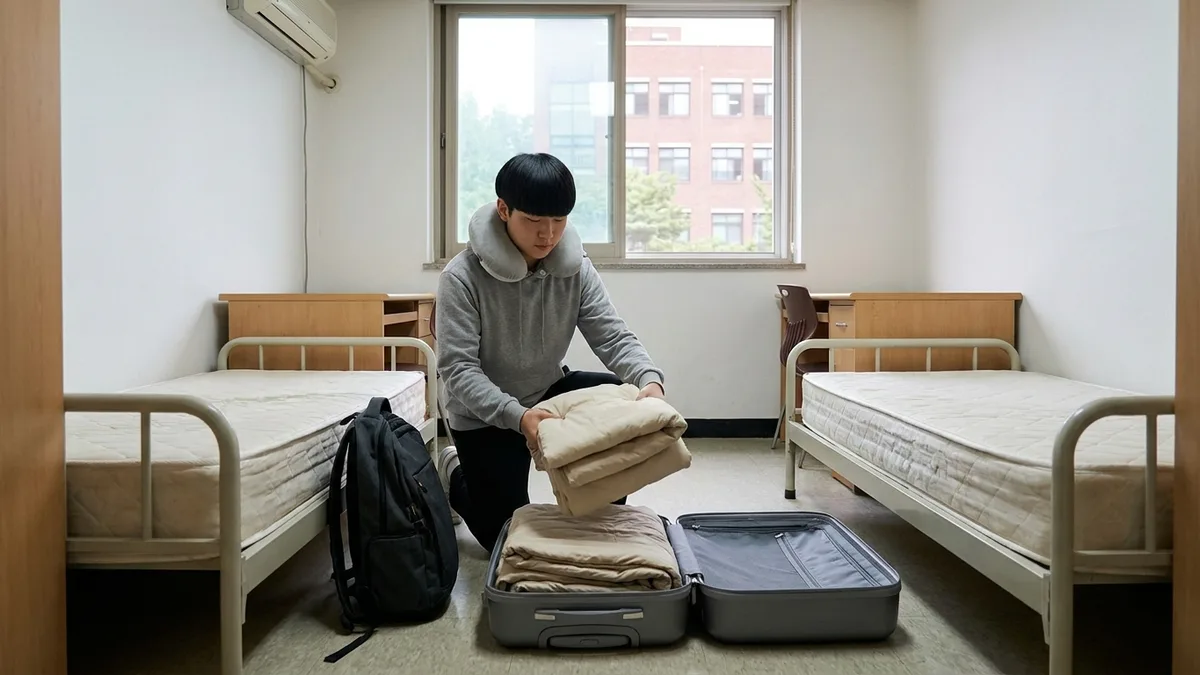
Check Dormitory Placement Separately — the 22.2% Capacity Rate Isn't an International Student's Odds
The table above assumes you get into a dormitory. That assumption has to be checked separately. As of the October 2025 university information disclosure, the dormitory capacity rate at four-year universities is 22.2% (22.8% the year before; junior colleges went from 15.9% to 15.2%). But this figure covers all enrolled students without separating Korean nationals from foreigners, so it shouldn't be read as an international student's chance of getting a dormitory room. Placement for international students is sometimes run under a separate quota the school sets on its own, which the overall capacity rate can't tell you. When your acceptance comes through, ask the international office at the university first how many spots go to international students, whether new students get priority, and whether a waiting list is run for those turned down.
If you don't get a spot, the alternatives are a studio apartment (원룸) or a goshiwon, and here a system peculiar to Korea gets in the way: the key deposit. You have to hand over a lump sum up front, separate from the monthly rent, and this is the hardest item for a foreigner to arrange before entering the country. No figure is given here. Studio rents near universities couldn't be verified against primary statistics and only private platform data was available, so copying it over would produce a figure that hides the variation between areas. The contract structure and the split between deposit and maintenance fees are in the monthly rent contract guide for foreigners, and market rates need to be checked separately for the area around your university.
Even if you get a dormitory spot, there's one more threshold: how you pay. As of the October 2025 university information disclosure, 149 of 249 four-year university dormitories (59.8%) require payment in one go in cash, such as a bank transfer, 55 (22.1%) accept card payment, and 79 (31.7%) allow cash payment in installments. The last two figures overlap, because some dormitories take both cards and installments, so the three numbers add up to more than 249. With the most expensive combination among the universities covered here (a single room in Pusan National University's Jinrigwan with 3 meals a day, 7 days a week), you may have to send roughly 2.4 million KRW for the semester in one go out of a Korean bank account, and at that point most international students don't have a Korean bank account yet.
That's why the order matters. Put the dormitory payment deadline, your own arrival date, your alien registration schedule, and the date you can open a bank account on one line and compare them. If the deadline falls before you can open an account, you need to ask in advance about an international transfer or an alternative payment route through the university's international office. The procedures are in opening a bank account as a foreigner and the first month in Korea checklist.
Health Insurance Starts on the Day You Enter If You're in a Degree Program — 79,320 KRW a Month Even With No Income
This is the item international students miss most often. A bill arrives for something you never applied for. Article 109(3) of the National Health Insurance Act provides that a foreigner staying in Korea who isn't an employer-based subscriber becomes an individual (regional) subscriber once certain requirements are met. It isn't something you choose; enrollment is mandatory by law.
The timing of enrollment matters especially, and this is where degree programs and language programs split. Article 4(1), item 2(c) of the Ministry of Health and Welfare notice "Standards for Applying Health Insurance to Long-Term Resident Overseas Korean Nationals and Foreigners" (장기체류 재외국민 및 외국인에 대한 건강보험 적용기준) provides that people on study abroad or general training "falling under any item of paragraph 3" acquire individual subscriber status on "the day they enter Korea." Paragraph 3 pins that range down to two cases: item 1 is study or research on Study Abroad (D-2) status and the like, and item 2 is study at a school under Article 2 of the Elementary and Secondary Education Act. Among General Training (D-4) holders, only this item 2 case counts, meaning students at an elementary, middle or high school (in practice D-4-3). So a degree student (D-2) has premiums accruing from the first day in the country without the six-month residence requirement, but a language program (D-4-1) at a university language institute doesn't fall under this exception and follows the six-month rule in Article 4(1), item 1. Language students are enrolled on the day after the six-month mark.
The amount is close to a flat rate. The 2026 National Health Insurance premium for international students is 79,320 KRW a month, and international offices at several universities post the same figure. Over 12 months that comes to 951,840 KRW. The reason it has nothing to do with your income is written into the notice: premiums for foreign individual subscribers are calculated on the same basis as for Korean nationals, but if the calculated premium falls short of the average premium, that average premium becomes the premium. An international student with no income and no assets hits this floor, so the expectation that "I have no income, so it'll be small" doesn't hold. An appended table to the same notice also provides that where the head of household holds Study Abroad (D-2) or General Training (D-4) status, monthly premiums from March 2023 onward are reduced by 50 out of 100. The 79,320 KRW that universities post appears to reflect that reduction, but it couldn't be confirmed against the original text from NHIS.
The payment schedule differs from Korean nationals too. A Korean-national subscriber pays a given month's premium by the 10th of the following month (Article 78(1) of the National Health Insurance Act), but a foreign individual subscriber such as an international student pays that month's premium in advance, by the 25th of the preceding month, under Article 109(8) (per NHIS billing). That said, the premium for the month in which you acquire eligibility, and cases where you acquire eligibility between the 26th and the last day of a month, follow what NHIS determines, so check the due date on your first bill separately.
Falling behind isn't just a hospital-bill problem. Since August 2019, the Ministry of Justice, working with the Ministry of Health and Welfare and NHIS, has run a system that restricts extension of the period of stay for foreigners in arrears on health insurance premiums. That's why "I'll just pay it all at once later" doesn't work.
One more thing needs confirming. How much of the 79,320 KRW is the health insurance premium and how much is the long-term care insurance premium also couldn't be confirmed against the original text from NHIS. Several university notices give the same total but the breakdown couldn't be cross-checked. Premiums change every January and can rise above the floor, so check your own billed amount with NHIS at ☎1577-1000 (foreign-language counseling, option 6: English 61, Chinese 62, Vietnamese 63, Uzbek 64) or the line dedicated to foreign customers at ☎033-811-2000 (English 1, Chinese 2, Vietnamese 3, Uzbek 4, weekdays 09:00-18:00). How enrollment works and how to use hospitals are in the health insurance guide for foreigners.
Visa and Residence Fees — 60,000 KRW to Extend, 35,000 KRW for the Card
The amounts are small, but leaving them out is what leaves you flustered at the counter. All of them are written out as provisions in the Enforcement Rules of the Immigration Act.
| What | Amount | Provision |
|---|---|---|
| Visa issuance review fee | Equivalent of USD 60 (single-entry visa for a stay of 91 days or more) | Enforcement Rules Article 71(1), item 1(b) |
| Alien registration card issuance or reissuance | 35,000 KRW | Enforcement Rules Article 72, item 10 |
| Permission to extend the period of stay | 60,000 KRW | Enforcement Rules Article 72, item 6 |
| Permission for activities outside your status, such as part-time work | 20,000 KRW (D-2, D-4); some guidance says it's waived | Proviso to Enforcement Rules Article 72, item 2 (the Government24 civil service guide states it's waived) |
| Permission to change your status of stay | 100,000 KRW | Enforcement Rules Article 72, item 5 |
The commonly quoted "30,000 KRW for an alien registration card" is the pre-amendment amount. Article 72, item 10 of the Enforcement Rules became 35,000 KRW with an amendment promulgated on December 24, 2024 that took effect on January 1, 2025. In your first year you pay the visa review fee (equivalent of USD 60) and 35,000 KRW for the alien registration card. Under the Ministry of Justice's "Guidelines on Visa Issuance and Stay Management for International Students" (the publicly released version fully amended March 1, 2018), your first alien registration issues a card with the period of stay aligned to the end of March or the end of September of the following year, and at that point only the card fee is charged, not an extension fee. Extensions after that are granted within 2 years, and the rule in principle is that a student at a university certified for its international education capacity (교육국제화역량 인증대학) who keeps a C average (GPA 2.0) or above is given the 2-year maximum (there are exceptions by nationality). So how many times you extend while enrolled depends on your school's certification, your grades, and when you graduate, and for budgeting you can simply count 60,000 KRW each time you extend. It's based on the 2018 public version and may have been amended since, so check with ☎1345 or HiKorea. The procedures are laid out in applying to extend your period of stay and how to get an alien registration card.
If you plan to work part-time, one more line gets added. The fee for permission to engage in activities outside your status is 120,000 KRW in principle, but the proviso to Article 72, item 2 of the Enforcement Rules sets it at 20,000 KRW for cases the Minister of Justice recognizes, such as part-time work permitted under Study Abroad (D-2) and General Training (D-4). However, the Government24 civil service guide and some university notices say it's waived if you submit the part-time employment confirmation issued by your university, so the two sets of guidance diverge. Check with the immigration office with jurisdiction over you or your university's international office before you apply. How many hours a week you're allowed to work depends on your Korean language ability, your degree program, and whether your university is designated, and it's revised often, so it isn't reproduced here. Check the conditions in the part-time work permit for international students.
What comes after graduation is worth counting in advance too. Permission to change your status of stay is 100,000 KRW, so switching after graduation to something like the D-10 job-seeking visa adds a line to that year's budget. Fees change with amendments, so check again on HiKorea or at ☎1345 right before you apply.
The 20 Million and 16 Million KRW Financial Requirements Aren't What a Year Costs
These are the two numbers most often mixed up when preparing to study in Korea. One is the actual spending calculated up to this point; the other is the balance threshold you have to show in visa screening. They serve different purposes and the amounts don't match.
Start with the threshold. As of July 3, 2023, the Ministry of Justice switched the financial-capability screening criteria for international students from dollars to Korean won and set a separate, lower bar for universities located outside the Seoul metropolitan area. For degree programs (D-2), it's at least 20 million KRW a year for universities in the Seoul metropolitan area and at least 16 million KRW a year for universities outside it; for language training programs (D-4), it's at least 10 million KRW in the Seoul metropolitan area and at least 8 million KRW outside it. The Ministry of Education's "Standard Operating Procedures for International Students and Language Trainees" (amended March 27, 2026) carries the same table. The bar itself differs by 4 million KRW depending on where the university is, and while the Seoul metropolitan area in general legislation means Seoul, Incheon, and Gyeonggi, the publicly available text doesn't say whether the visa criteria use exactly that scope. If you've been accepted by a university in Incheon or Gyeonggi, confirm with the university's international office and the Korean diplomatic mission handling your application.
The nature of the number is the key. The Ministry of Justice's "Guidelines on Visa Issuance and Stay Management for International Students" (the publicly released version fully amended March 1, 2018) defines the scope of financial capability as "tuition plus all living expenses" and sets the proof period at one year in principle (six months for language training). Whether it's 20 million KRW in the Seoul metropolitan area or 16 million outside it, the threshold amount is a screening bar that looks at a year of tuition and living costs combined, not at tuition.
So the misunderstanding runs in both directions. One is reading the threshold as "one year of tuition to study in Korea." The low combination in the earlier table is about 7.11 million KRW in actual spending, but the bar is set by your program and the location of your university rather than by spending, so for a degree program at a university outside the Seoul metropolitan area the threshold is 16 million KRW. The other is reading it as "the threshold amount is all you need." The high combination is about 16.16 million KRW from four items alone, and adding airfare, a key deposit, and textbooks can push you past the bar.
The method has a trap too. The same guidelines accept balance certificates issued by banks in Korea or abroad, in your own name or a parent's, for visa issuance and changes of status, but for cases such as extending the period of stay and changing from language training to study status, they provide that "only a balance certificate in the applicant's own name issued by a bank in Korea is recognized." This concerns which documents count if you're asked to prove your finances at extension; it doesn't mean every extension requires a balance certificate. A student at a certified university with a C average or above is in principle exempt from financial proof documents at extension. Ask your university's international office before your extension which category you fall into.
It isn't a formality, either. The guidelines explain the reason for financial-capability screening as "the possibility of easily falling into the temptation to engage in activities outside the permitted status of stay if sufficient financial capability isn't secured," citing Seoul Administrative Court ruling 2017구단57526. That said, the documents required can differ depending on the university's international education certification grade and the applicant's nationality and residence history, and there's also a special rule easing the criteria to within one half when you finish language training and move into a degree program at the same university. Individual screening outcomes are decided by the immigration office (출입국·외국인청), so this article can't settle them. The guideline content is based on the 2018 public version and may have been amended since, so check again with ☎1345, HiKorea, and the international office at your university.
Building Your Own Budget Table — a Checklist by Item and Where to Confirm Each
The last step is converting all of this into your own numbers. Fill in the six slots below and you have a budget table.
- Tuition: Find the per-semester amount for your field in the admissions guidelines of the university you're applying to and multiply by 2. You can also check it through the by-university search on Academyinfo (대학알리미, academyinfo.go.kr).
- Entrance fee: 0 KRW for undergraduates. Some schools charge it for graduate degree programs, so check the entrance fee line on the tuition schedule.
- Dormitory fee: Check the housing fee by room type and whether meals are mandatory on the residence hall's website. Since the number of open days differs, you have to convert to a daily rate to compare, and vacation periods often require a separate application and a separate payment.
- Housing (in case you don't get a dormitory spot): The 22.2% capacity rate doesn't separate Korean nationals from foreigners, so you have to ask the international office separately how many spots go to international students. If placement isn't certain, write down the key deposit, monthly rent, and maintenance fees separately as an alternative budget.
- Health insurance premium: Multiply 79,320 KRW a month (2026) by the number of months you'll be enrolled. Count from the day of entry for a degree program (D-2), and from the day after the six-month mark for a language program (D-4-1). Check your own billed amount at ☎1577-1000 (foreign-language counseling, option 6) or the line dedicated to foreign customers at ☎033-811-2000.
- Residence fees: In your first year it's the visa review fee (equivalent of USD 60) and 35,000 KRW for the alien registration card; after that it's 60,000 KRW each time you extend. If you work part-time, the 20,000 KRW part-time work permit fee may be added (some places state that it's waived).
Add round-trip airfare, initial settling-in costs, textbooks, your phone bill, and transportation at your own figures and you get the real total. If you have to take a Korean language test, add the TOPIK fee as well (for 2026, based on the paper-based test in Korea, 40,000 KRW for TOPIK I and 55,000 KRW for TOPIK II; the 2027 amounts will be newly announced by the end of October 2026). Where to confirm differs by item. Tuition is at the university's admissions office, dormitory fees at each university's residence hall, health insurance at ☎1577-1000 (foreign-language counseling, option 6) and ☎033-811-2000, residence fees and the financial-capability criteria at HiKorea and ☎1345, and per-university published figures on Academyinfo. The university's international office can answer several items at once, so it's the first place worth contacting.
The slot most likely to sit empty until the very end is transportation. It covers the trip from the airport to your school on your first day and the KTX and express bus rides to and from other regions every vacation, and yet at exactly that time you don't have a Korean bank account or phone number yet, so payment in booking apps tends to be blocked. LACHA is a transit app for foreigners that lets you book and pay for taxis, KTX, express buses, VANs (5- and 6-seaters), and the airport railroad with overseas payment methods, without identity verification. KTX comes with a discount of up to 10,000 KRW one way depending on the route, so a round trip brings it down by up to 20,000 KRW. LACHA does not handle study abroad counseling, university applications, or visa applications on your behalf.
Want Korea's transit and payments in one app — without a Korean phone number or bank account? Check out LACHA.
Built to work without a Korean phone number or bank account, with overseas payment methods like Alipay, WeChat Pay, and Apple Pay. Taxi hailing plus KTX, express bus, and airport railroad (AREX) booking — all in one app.
Up to 60% off Korea transit with a coupon (max ₩3,000): enter code at sign-up. KTX gets up to 18% off on top
Download now


Frequently Asked Questions (FAQ)
Q1. How much does a year of studying in Korea cost? Adding only tuition, dormitory fees (mandatory meals included), health insurance premiums, and residence fees gives between about 7.11 million and about 16.16 million KRW a year. For tuition the lower and the higher come from the published averages, and for dormitory fees from the university examples given in this article, added up separately: the low end pairs the average tuition across national and public universities with a 4- or 6-person room and one meal a day at Woosong University, a private university outside the Seoul metropolitan area (924,000 KRW a semester), and the high end pairs the average tuition for medical fields with a single room in Pusan National University's Jinrigwan on 3 meals a day, 7 days a week (2,401,980 KRW a semester). Because it mixes averages with examples from a handful of universities, your own amount may fall outside this range. Residence fees are based on a year in which you extend, so in your first year you pay, instead of an extension fee, the visa review fee (equivalent of USD 60) and 35,000 KRW for the alien registration card. Round-trip airfare, the key deposit and rent if you don't get a dormitory spot, textbooks, and initial settling-in costs aren't included. Check your own figures in the admissions guidelines and residence hall notices at the university you're applying to.
Q2. If I just prepare the financial requirement (20 million KRW for the Seoul metropolitan area), can I live on it for a year? That's not how to read it. The degree-program thresholds of 20 million KRW for universities in the Seoul metropolitan area and 16 million KRW for universities outside it are a visa screening bar set by the Ministry of Justice, and the Ministry's guidelines (2018 public version) define the scope as "tuition plus all living expenses" with a proof period of one year. It's a different number from actual spending, so with the low combination the bar is larger than what you spend, while with the high combination, once you add airfare and a key deposit, you may go past the bar. Whether the Seoul metropolitan area in this criterion follows exactly the Seoul, Incheon, and Gyeonggi scope isn't in the public text, so if your university is in Incheon or Gyeonggi it's safer to confirm with the international office, and the documents required can differ by the university's certification grade and your nationality. Individual screening outcomes are decided by the immigration office.
Q3. I'm an international student with no income. Why do I pay health insurance premiums? It's mandatory enrollment under Article 109(3) of the National Health Insurance Act, so it isn't an item you choose. The timing, though, splits by program. Article 4(1), item 2(c) of the Ministry of Health and Welfare notice gives "the day you enter Korea" only to study or general training falling under the items of paragraph 3 of the same article, and the range paragraph 3 sets is study or research on Study Abroad (D-2) status and the like, plus General Training at an elementary, middle or high school (D-4-3). A degree program (D-2) is enrolled on your first day without the six-month residence requirement, but a language program (D-4-1) at a university language institute is not covered by this exception and is enrolled on the day after the six-month mark. The reason the amount has nothing to do with income is that the same notice provides that if the calculated premium falls short of the average premium, that average premium becomes the premium. The notice also has a provision reducing premiums by 50% for D-2 and D-4 heads of household, and the 79,320 KRW a month that universities posted for 2026 appears to reflect it, but it couldn't be confirmed against the original text from NHIS. Check your exact billed amount at ☎1577-1000 (foreign-language counseling, option 6) or the line dedicated to foreign customers at ☎033-811-2000.
Q4. Dormitory fees differ by university. How do I compare them? You have to line up three things. The first is the number of open days: Korea University is based on 117 nights, Pusan National University on 114 days, and Woosong University on 110 days, so you have to convert to a daily rate to put them on the same line. The second is whether meals are included: Korea University's 1,684,800 KRW is the housing fee only, with meal costs left out. The third is mandatory meals: at Pusan National University you can't choose "no meals," and the fewer meals you sign up for, the higher the per-meal price actually climbs (3,720 KRW for 3 meals a day 7 days a week, 5,100 KRW for 1 meal a day 7 days a week). Without matching all three, the ranking flips.
Q5. Can international students receive the National Scholarship? The Korea Student Aid Foundation sets eligibility for the National Scholarship as "a student enrolled at a university in Korea who holds Republic of Korea nationality," so international students are excluded by the nationality requirement. The National Work-Study Scholarship and student loans have the same structure and are unavailable as well. That's why it's better to ask the university's international office before you enroll whether tuition can be paid in installments and whether there are internal scholarships or ones for international students. There are also programs such as the Global Korea Scholarship (GKS), but the support offered and the amounts are set each year in the recruitment notice, so check the original notice. This article calculates with scholarships set to 0 KRW.
Note: This article is intended as general information and is not visa screening, tax, or legal advice. The figures and provisions in the text were verified as of 2026-09 against the Ministry of Education and Korean Council for University Education releases analyzing the university information disclosures (April 2026 and October 2025), the Ministry of Education and Korean Educational Development Institute's 2026 Basic Statistics on Korean Education, the Higher Education Act, the National Health Insurance Act, and the Enforcement Rules of the Immigration Act on the National Law Information Center, the Ministry of Health and Welfare notice "Standards for Applying Health Insurance to Long-Term Resident Overseas Korean Nationals and Foreigners," the Ministry of Justice's announcement on improving the visa system for international students (June 2023) and its "Guidelines on Visa Issuance and Stay Management for International Students" (the publicly released version fully amended March 1, 2018), the Ministry of Education's "Standard Operating Procedures for International Students and Language Trainees" (amended March 27, 2026), the 2026 TOPIK administration plan notice, and the tuition and dormitory fee information from the University of Seoul, Konkuk University, Yonsei University, Korea University, Pusan National University, and Woosong University. The Ministry of Justice guidelines may have been amended since the public version, and the breakdown of the 79,320 KRW premium and whether it reflects the 50% reduction, the latest October 2026 university information disclosure, primary statistics on rents and key deposits near universities, and Global Korea Scholarship amounts are not stated as settled because the original sources couldn't be obtained. Amounts change every year and vary by university, department, and room type, so confirm them for your own case with the admissions office and residence hall of the university you're applying to, NHIS at ☎1577-1000 (foreign-language counseling, option 6) and ☎033-811-2000, ☎1345, and Academyinfo (academyinfo.go.kr). LACHA does not handle study abroad counseling, university applications, or visa applications on your behalf.