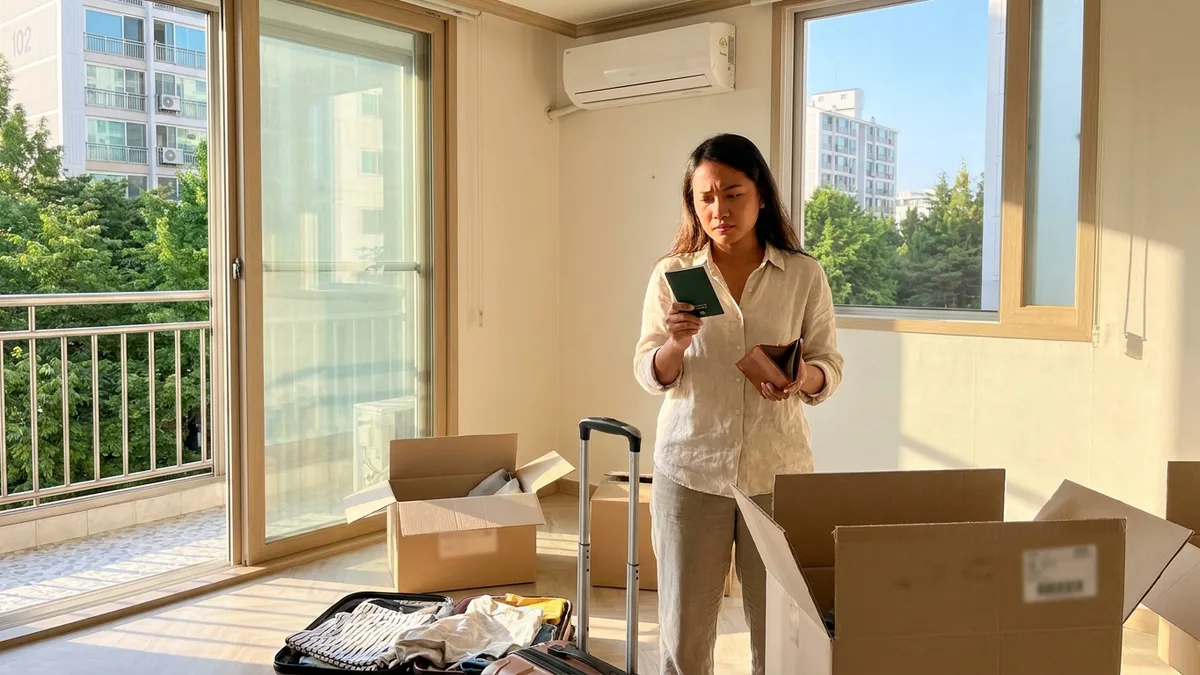
You find a room you like on an app, and then the inquiry-call button asks for Korean phone identity verification and you stop right there. You finally make it to a real-estate office in person, sign a Korean-language contract, and stamp it without knowing what a property register is. And nobody tells you there's a filing you have to make after moving in, so you let it pass. Then the building goes to auction, or the landlord stops answering the phone, and a deposit you saved several months of salary for is suddenly all at risk. This is the failure course foreign tenants walk again and again.
A monthly-rent lease isn't difficult once you know the sequence. This article follows the real order of events: how the deposit, monthly rent, and maintenance fee are structured, how to find listings, checking the property register before you sign, writing riders into the contract, calculating the agency fee, and the post-move-in filings that protect your deposit. Preparation for early life in Korea more broadly is covered separately in the First Month in Korea Checklist.
The prices, rates, and deadlines below are based on publicly available information as of Aug 2026. Market rents shift every quarter, and rates and filing rules can be revised, so before you sign, be sure to double-check official sites such as the Supreme Court Internet Registry Office (iros.go.kr) and Hi Korea (hikorea.go.kr).
Understanding the deposit, monthly rent, and maintenance fee
Renting a one-room in Korea sends your money down three channels: the deposit (bojeungeum — a lump sum you leave at signing and get back when you move out), monthly rent (wolse — what you pay each month), and the maintenance fee (gwallibi — nominally building upkeep and utilities). One-room market statistics are converted on a ₩10 million deposit basis, which tells you how standard the arrangement is: a Seoul one-room typically means a deposit of about ₩10 million with rent layered on top (as of Aug 2026). Raising the deposit in exchange for lower monthly rent is sometimes possible if you negotiate with the landlord.
Korea also has a distinctive system called jeonse, worth knowing about. You pay no monthly rent and instead leave one large deposit for the length of the lease — but it demands a great deal of cash up front, and the loss if the deposit isn't returned is correspondingly larger, so for a foreigner starting life in Korea, monthly rent is usually the realistic choice. This article is written for monthly-rent leases.
Maintenance fees are a frequent source of disputes, because a listing that says only "₩X per month" tells you nothing about what's included. That's why listings with a flat maintenance fee of ₩100,000 or more per month are required to itemize it in the advertisement as general maintenance, electricity/water/heating usage, and other charges (a Ministry of Land, Infrastructure and Transport notice in force since September 2023). Breaking the rule carries a fine of ₩500,000, and false or exaggerated listings ₩5 million. When you inquire, always confirm whether internet and water are included and whether electricity and gas are billed separately.
Getting a feel for Seoul one-room prices (Q1 2026 basis)
According to statistics analyzing 35,516 actual transactions reported to the Ministry of Land, Infrastructure and Transport, the average monthly rent for a Seoul one-room (33㎡ or less of exclusive area) in Q1 2026 was ₩809,000 for row houses and multiplexes and ₩820,000 for officetels (converted on a ₩10 million deposit basis, using a 5.5% jeonse-to-rent conversion rate). Other statistics with different survey bases put the figure in the high ₩600,000s, so it's more accurate to conclude that there is no single "Seoul one-room average."
| Category | Row house / multiplex | Officetel |
|---|---|---|
| Highest-rent districts | Gangnam ₩988,000 > Seocho ₩984,000 > Yongsan ₩945,000 > Yeongdeungpo ₩942,000 > Seongdong ₩879,000 | Yongsan ₩1,072,000 > Songpa ₩976,000 > Gangnam ₩971,000 |
| Lowest-rent districts | Nowon ₩500,000 < Dobong ₩586,000 < Gangbuk ₩593,000 | Nowon ₩592,000 (lowest) |
Even within Seoul, Nowon and Gangnam are roughly 2x apart. Yongsan was the only district where officetels crossed ₩1 million a month. If your budget is tight, the trick is to start with districts like Nowon, Dobong, and Gangbuk, which keep rents low while still reaching the city center by subway. Keep in mind, though, that these are Q1 2026 transaction figures and may differ from the asking prices you meet when you actually sign.
Finding listings — the Zigbang and Dabang apps, and walking into an agency
Most Korean one-room listings are posted on two apps: Zigbang (직방) and Dabang (다방). Here's what is known about using them as a foreigner (as of Aug 2026).
- Signing up and browsing generally work: Zigbang lets you create an account with Kakao, Gmail, or Facebook social login, so searching listings and scanning prices is described as possible without Korean phone identity verification.
- The screens are effectively Korean-only: Many foreign users report that the interface and the listing descriptions are largely in Korean. How far English support extends may differ by app and version, so you'll need to check for yourself (check official sources). Paired with a translation app's camera function, browsing isn't much of a problem.
- Identity verification can block the core features: Functions like masked-number (안심번호, ansim-beonho) calls and electronic contracts may require Korean phone identity verification. Opening a phone line in your own name with an Alien Registration Card (ARC) lets you use PASS identity verification (per carrier guidance), so for a long stay, sorting out getting a phone plan first makes many things easier.
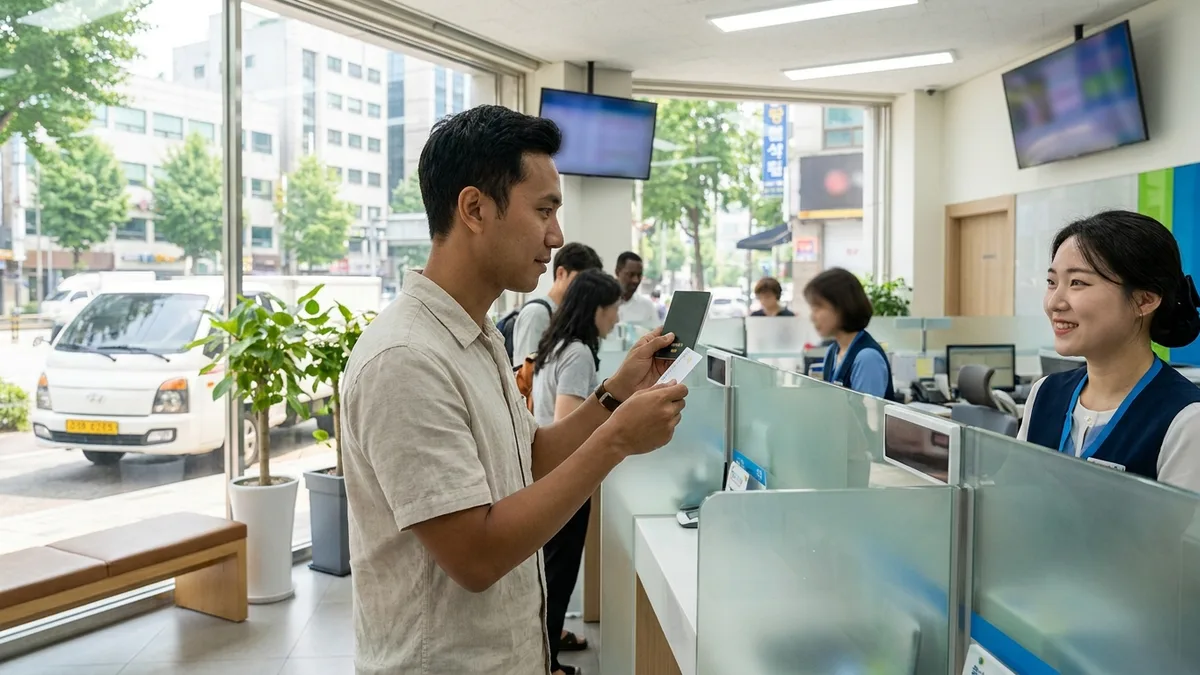
There's also a structural limit. Even when you find a room in an app, an in-person signing is assumed, so the process doesn't end inside the app. The practical route is visiting in person a real-estate office (budongsan, a licensed agency) in the neighborhood you want. Agencies cluster around subway stations, so once you've used the apps to settle on a price range and a couple of candidate neighborhoods, walk into two or three offices with "deposit ₩X, rent up to ₩Y, move-in date Z" written down, show it, and they'll pull up rooms that match immediately. A translation app screen is plenty for the conversation.
Check the property register before you sign anything
The property register (deunggibu deungbon, formally a certified copy of the registry) is the official record of who owns the property and what debts sit on it. Checking this one document before you sign filters out a large share of deposit disasters. Anyone can pull it from the Supreme Court Internet Registry Office (iros.go.kr) with only the address — no proof that you're the tenant required — at ₩700 to view and ₩1,000 for an issued copy. Online payment and verification can be rough with a foreign card, so if you get stuck, ask the agent for a fresh copy issued right before signing — producing it is normal procedure.
There are three places to look.
- The description section (pyojebu): Confirm that the address matches exactly the room you're about to lease.
- Section Gap, ownership (gapgu): Check the current owner's name, listed last. That name must be the person you contract with. If you see words like seizure or provisional seizure (압류·가압류), it's safest to walk away.
- Section Eul, encumbrances (eulgu): Look at whether a mortgage (geunjeodang, collateral for a loan) is registered and for how much. If the property carries heavy debt and goes to auction, the bank is paid first and you may not get your deposit back.
Fortunately, smaller deposits have a safety net. In Seoul, a tenant with a deposit of ₩165 million or less can recover up to ₩55 million ahead of all other claims even if the property goes to auction (Enforcement Decree of the Housing Lease Protection Act, as amended in February 2023). The amount that applies varies with the date the senior security interest was registered, so if the property carries a mortgage, ask the agent to work out the numbers. And the textbook final step is to pull the property register once more on the morning you pay the balance, to confirm no new mortgage appeared in the meantime.
Signing-day checklist
- Verify the landlord in person: Check that the owner's name in Section Gap of the property register matches the ID of the person sitting across from you. If a representative comes instead, requiring a power of attorney and a certificate of seal impression is standard.
- Transfer only to an account in the owner's name: Send the down payment and deposit only to an account held in the name of the registered owner. If you're told to send it to a third party's account, stop right there. A Korean bank account is effectively required for transfers, so if you don't have one yet, start with opening a bank account as a foreigner.
- Write the riders in: Verbal promises leave no trace. Agreements like "wallpaper and flooring replaced before move-in," "landlord repairs any mold or leaks," "deposit returned on the move-out date," or "maintenance fee includes internet and water" should be written as sentences in the special-terms (riders) box of the contract — ask for it.
- Keep your documents: Hold on to the original contract and your transfer receipts until you move out. The address-change report, the lease report, and the deposit guarantee that come later all require the contract.
- The Korean text is the governing version: Even if you receive a translation, the legally binding version is the Korean original. Before you sign, at minimum run the amounts, the term, and the numbers in the riders through a translation app and compare.
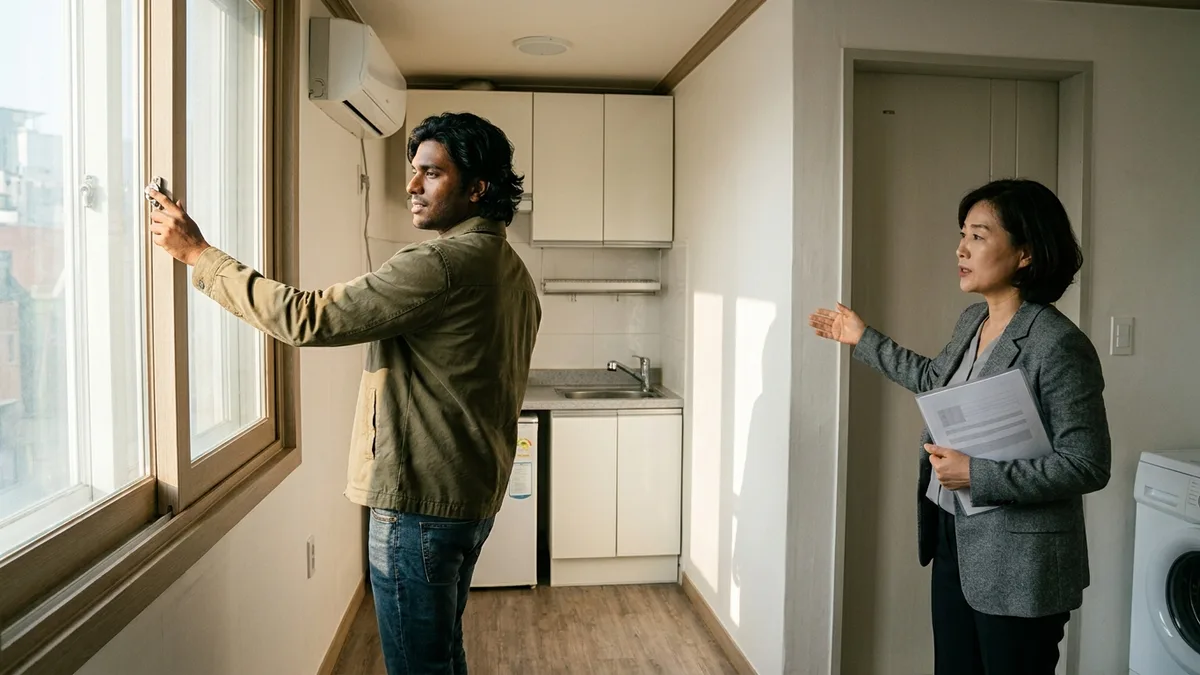
Even without a rider, some basic rules cover the problems winter tends to bring. Defects in the unit itself that make it hard to live there unless they're fixed, such as leaks or an aging boiler, are in principle the landlord's duty to repair (Article 623 of the Civil Act; Supreme Court ruling 94Da34692). The tenant, in turn, must preserve the unit with the care of a good manager until handing it back (Article 374 of the Civil Act), so damage from poor upkeep, like mold that grew because the room was never aired out, can end up as the tenant's cost depending on the circumstances. When you find a leak or mold that needs repair, the tenant must tell the landlord without delay (Article 634 of the Civil Act), so send a text with photos to keep a record. The Ministry of Justice's standard housing lease contract also states that restoring the unit when you move out does not include aging of the fixtures or damage that ordinarily occurs. In Seoul, if a cold snap freezes and bursts your water meter, the city covers the cost of replacing it, but not if the meter box wasn't insulated or its protective casing was damaged, exposed, or dislodged (Article 42 of the Seoul Metropolitan Government Water Supply Ordinance), so before winter, stuff the meter box with old clothes or other insulation.

What should the agency fee actually be?
Signing through an agency means paying a brokerage fee (jungae-bosu, colloquially bokbi). For a monthly-rent lease, you calculate a converted deposit = deposit + (monthly rent × 100) and multiply it by the ceiling rate for that bracket — and if that figure comes to under ₩50 million, you recalculate as deposit + (monthly rent × 70).
| Converted deposit | Ceiling rate | Cap |
|---|---|---|
| Under ₩50 million | 0.5% | ₩200,000 |
| ₩50 million–₩100 million | 0.4% | ₩300,000 |
| ₩100 million–₩600 million | 0.3% | — |
| ₩600 million and up | 0.4–0.6% (by bracket) | — |
For example, a ₩20 million deposit with ₩400,000 monthly rent gives a converted deposit of ₩60 million → a 0.4% rate → a brokerage fee of at most ₩240,000. The key point is that this rate is a ceiling — it's only the legal maximum, so you can negotiate it down before signing. Rate tables follow local government ordinances and can differ slightly by region, and they're often posted in the agency office, so check what figure your fee was calculated at before you sign (as of Aug 2026, check official sources).
Within 15 days of moving in: the change-of-residence report
What a Korean resident does as a move-in report (jeonipsingo) is, for a foreigner, the change-of-residence report. You must file it within 15 days of your move with the community service center (jumin senteo) for your new address or with an immigration office (Article 36 of the Immigration Act). There's no fee, and filing online through Hi Korea (hikorea.go.kr) or Gov.kr (gov.kr) is described as available. Bring your Alien Registration Card plus your lease contract (or, if the lease isn't in your name, an accommodation provision certificate).
Miss the deadline and the law provides for a fine of up to ₩1 million (Article 98 of the Immigration Act). The amount actually imposed and how it's handled vary with the length and number of delays (check official sources), so either way, finishing within 15 days is the answer. The procedure for updating the address on your Alien Registration Card afterward is covered separately in Alien Registration Card reissue and address change.
The real reason this filing matters is something else. A foreigner's change-of-residence report legally stands in for the move-in report (Article 88-2 of the Immigration Act), which makes it the requirement for opposability (daehangnyeok) under the Housing Lease Protection Act — the right to assert your position as tenant even if the property is sold or auctioned. This was confirmed by a Supreme Court ruling (2015Da14136). Put another way, delaying the filing isn't just a fine problem: it leaves the first button of deposit protection undone.
Three layers of deposit protection — fixed-date stamp, lease report, deposit guarantee
① Fixed-date stamp (hwakjeong-ilja): This is the step of having a date stamped on your contract to secure the priority right to repayment — the right to be paid ahead of junior creditors in an auction. Take the contract to a community service center and you get it on the spot for ₩600. There's also an online application through the Internet Registry Office (₩500), but it requires a joint certificate, so for a foreigner the sure move is to handle it at the community service center while you're already there filing the change-of-residence report.
② Housing lease report: Leases with a deposit over ₩60 million or monthly rent over ₩300,000 must be reported within 30 days of signing (jointly by landlord and tenant, though either party can file alone by attaching the contract). File with the contract attached and the fixed-date stamp is granted automatically, so you don't need to do ① separately. The Ministry of Land, Infrastructure and Transport has stated that since the grace period ended in June 2025, failure to report draws a fine of ₩20,000–300,000 (₩1 million for a false report). Whether a foreigner's change-of-residence report also covers this lease report has not been confirmed, so if your lease is above those amounts, it's safest to file separately through the Real Estate Transaction Management System (rtms.molit.go.kr) or at a community service center.
③ Lease deposit return guarantee (HUG): This is a guarantee product under which the Korea Housing & Urban Guarantee Corporation (HUG, khug.or.kr) returns your deposit on the landlord's behalf and then bills the landlord, if the landlord won't return it. Foreign nationals and overseas Koreans are described as eligible — but you must have opposability (the change-of-residence report) and the fixed-date stamp in place, and additional documents such as your Alien Registration Card and a certificate of entry and exit records may be requested (check official sources). Applications are described as needing to be made before half the term has passed, on leases of one year or longer, and premiums and limits vary with the terms, so check with the HUG call center at ☎1566-9009. Note that Seoul's guarantee-premium support program (up to ₩300,000) excludes foreign nationals and overseas Koreans, so budget the premium as your own cost.
Cover the legwork and the moving day, and the lease is done
House hunting is, in truth, one long series of trips. You ride the subway between three or four candidate neighborhoods, do a tour of agencies, go to the community service center and the immigration office to file, and on moving day you haul suitcases and boxes and call a taxi. And since a good many Korean transport and taxi apps block foreigners at the Korean phone identity verification step, people often find themselves stranded from the room-viewing stage onward.
Installing one transport and payment app designed to work without identity verification simplifies this whole route. Being able to call a taxi without a Korean phone and pay directly with overseas payment methods (Visa, Mastercard, Alipay, and more) makes moving day with your luggage — or viewing rooms out in the outer neighborhoods — far more manageable.

Want Korea's transit and payments in one app — without a Korean phone number or bank account? Check out LACHA.
Built to work without a Korean phone number or bank account, with overseas payment methods like Alipay, WeChat Pay, and Apple Pay. Taxi hailing plus KTX, express bus, and airport railroad (AREX) booking — all in one app.
Up to 60% off Korea transit with a coupon (max ₩3,000): enter code at sign-up. KTX gets up to 18% off on top
Download now


Frequently Asked Questions (FAQ)
Q1. Can foreigners not sign up for Zigbang and Dabang? Creating an account with social login (Kakao, Gmail, and so on) and browsing listings is described as possible (as of Aug 2026). Core features like masked-number calls and electronic contracts may require Korean phone identity verification, and that is solved by opening a phone line in your own name with an Alien Registration Card. It's easier on the mind to treat the apps as price research and do the signing at an agency.
Q2. Can foreigners pull the property register? Yes. Proof that you're the tenant isn't required, so anyone who knows the address can view it (₩700) or have a copy issued (₩1,000) at the Internet Registry Office (iros.go.kr). If online payment or verification fails with a foreign card, ask the agent to have a current copy issued. And do check the date on the document you receive, to be sure it was issued right before signing.
Q3. I've already passed the 15-day change-of-residence deadline. What do I do? File right now, late as it is. The actual disposition under the statutory penalty (the provision for a fine of up to ₩1 million) is described as varying with the length and number of delays (check official sources), so waiting longer only works against you. If an address mismatch surfaces during other immigration business, such as a visa extension, it gets more awkward — so don't put it off; handle it at a community service center or through Hi Korea.
Q4. Can I find out what the maintenance fee covers before signing? Listings with a flat maintenance fee of ₩100,000 or more per month are required to itemize general maintenance, electricity/water/heating, and other charges in the advertisement (a Ministry of Land, Infrastructure and Transport notice). If the listing lumps it all together, ask specifically at the inquiry stage whether internet and water are included and whether electricity and gas are separate, then write the answer into the contract riders to head off disputes.
Q5. Do I have to pay whatever agency fee I'm quoted? No. The statutory rate is a ceiling, so you can negotiate below it. For a monthly-rent lease, build the converted deposit as deposit + (monthly rent × 100) and multiply by the bracket rate to get the maximum (see the table above). The right order is to ask what figure the fee was calculated at before you sign the contract.
Lease signed? On to the next steps of settling in
Once your contract is stamped, three things remain, in order. Within 15 days, file the change-of-residence report (the Alien Registration Card address change procedure), then get the fixed-date stamp or file the lease report, then take out a deposit guarantee if you need one. Setting up an automatic transfer from a Korean bank account for the rent means one less thing to think about each month. And when the lease eventually ends and your deposit comes back, how to send that lump sum home is laid out in how to send money overseas from Korea. There's a lot of unfamiliar paperwork, but with each item you finish, the foundation under your life in Korea gets that much firmer.
Note: This article is for general information purposes and is not legal advice. The prices in the text are Q1 2026 transaction statistics, and the rates, deadlines, and fines are based on publicly available information as of Aug 2026, all of which may change. Before signing or filing, check the latest guidance from the Supreme Court Internet Registry Office (iros.go.kr), Hi Korea (hikorea.go.kr), the Real Estate Transaction Management System (rtms.molit.go.kr), and the Korea Housing & Urban Guarantee Corporation (khug.or.kr), and for foreign-language help use the Immigration Contact Center at ☎1345. LACHA is not a real-estate brokerage or legal service provider and takes no responsibility for outcomes arising from this guidance.