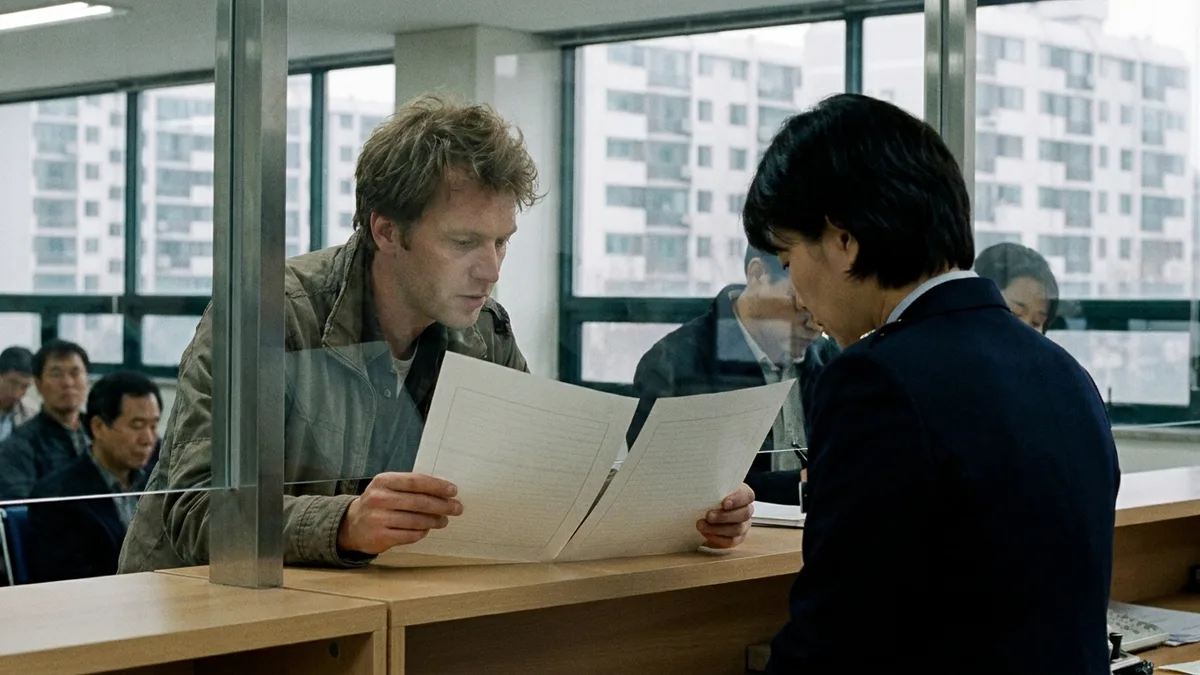

The graduation ceremony is over, hiring results still haven't come, and your D-2 period of stay is running out. The track that makes that gap legal is Job Seeking (D-10). It is item 13 of [Annex Table 1-2] Long-Term Stay Statuses in the Enforcement Decree of the Immigration Act, and the definition reads: "a person who intends to undertake training, job-seeking activities and the like in order to obtain employment in a field falling under a status of stay from Professor (E-1) through Specific Activities (E-7), and who is recognised by the Minister of Justice" (the basis for setting long-term stay statuses in Annex Table 1-2 is Article 12 of the same Decree, as of 2026).
Start with the scale: as of 31 July 2026 there were 26,559 D-10 holders in Korea. At the same point there were 236,884 D-2 international students and 88,988 E-7 Specific Activities holders, so this is the corridor between studying and working (Ministry of Justice, Monthly Statistics on Immigration and Foreign Policy, July 2026). The top nationality is Vietnam with 12,269 people, so there is a lot of information in Vietnamese-language communities — but much of it was written against the pre-October-2025 rules. Check what date the article you are reading is based on before anything else.
Note: This article organises publicly available laws and Ministry of Justice guidance and is not legal advice. It is current as of August 2026, and the Job Seeking (D-10) scheme already changed once in October 2025. A final report meeting of the Ministry of Justice "Council for Improving the Visa System for International Students" is scheduled for September 2026, so it may change again. Please re-confirm on Hi Korea and at ☎1345 before you apply.
D-10 Is Not a "Visa That Lets You Work"
Everything else goes wrong if you don't start here. Article 23(1) of the Enforcement Decree of the Immigration Act lists the statuses that permit employment activity as Short-Term Employment (C-4), Professor (E-1) through Crew Employment (E-10), and Working Visit (H-2) (effective 1 June 2025, Presidential Decree No. 35540). Job Seeking (D-10) is not on that list.
So the conclusion is a single one. D-10 is not a status that lets you work; it is a status that makes the time you spend looking for work legal. To do anything paid, you must separately obtain permission to engage in activities outside your status of stay under Article 20 of the Immigration Act.
There are four sub-codes, and this article deals with D-10-1, which is what most readers hold.
| Sub-code | Scope of activity (August 2026 edition) |
|---|---|
| General Job Seeking (D-10-1) | Job-seeking at domestic companies and organisations, plus short-term internships receiving a training allowance before formal employment |
| Technology Start-Up Preparation (D-10-2) | Participation in start-up immigration education programmes, IP applications, preparing to establish a start-up corporation, etc. (internship activity restricted) |
| Advanced Technology Internship (D-10-3) | Internships in advanced technology fields under an internship employment contract with a company or institution meeting requirements set by the Minister of Justice |
| Top Talent (D-10-T) | The same job-seeking activities and short-term internships as D-10-1 (prospective top tier) |
D-10-2, D-10-3 and D-10-T are separate tracks tied to the start-up immigration points system or to their own guidelines. This article tells you only that they exist and where the boundary lies; it does not cover their detailed requirements.
Am I Someone Who Has to Worry About Points?
The rule for General Job Seeking (D-10-1) is the points system. Out of 190 points total, you need at least 20 points in the basic items and a total score of at least 60 (Ministry of Justice, "Stay-Related Civil Affairs Manual by Status", August 2026 edition). However, nationals of countries designated by the Minister of Justice who change to D-10-1 from within Korea while holding B-1, B-2, C-1, C-3, C-4, D-3, E-9, E-10 or G-1 status are required to score at least 80. This is why you and a friend with the same score can get different outcomes.
There is a special provision for those who graduated from a Korean university, and you must read the two rows below together.
| Stage | Moving from D-2 at a Korean university to D-10-1 (August 2026 edition) |
|---|---|
| First change | The points system is not applied, submission of proof of living expenses is waived, and a one-year period of stay is granted |
| On extension | The points system applies. The waiver is for the first time only, not for all three years |
If you have held D-10 status before, this is not a "first change" and the points system applies; if you left Korea and obtain a D-10 visa within one year of your graduation date, you are included in the waiver. What is waived here is "submission of proof of living expenses" — it does not mean your bank balance is never examined.
There are other branches to the points-system waiver as well (August 2026 edition). The following is a summary, so confirm whether it applies to you with ☎1345 or your competent immigration office.
- Those who obtained an associate degree or higher at a regular Korean university and for whom fewer than three years have passed, and who have passed the Stage 4 mid-term evaluation of the Korea Immigration and Integration Program or hold TOPIK Level 4 or above
- "Foreign youths raised in Korea" aged 18 or over and 24 or under as of the application date who completed elementary, middle and high school entirely in Korea
- "Promising talent" aged 29 or under who, within the past three years, obtained a bachelor's degree or higher at a university ranked in the top 200 of THE or QS, or who majored in Korean Studies and hold TOPIK Level 6
- Those who completed the specialised care worker training course at the Korea Human Resource Development Institute for Health and Welfare
- Those whose employment activity ended for a legitimate reason, such as expiry of an employment contract under E-1 to E-7 status (living-expense proof waived only at the first change to D-10)
Not being on this list does not automatically mean no, and being on it does not automatically mean yes. The determination is made by your competent immigration office.
Why You Should Read the 190-Point Table Before You Graduate
The scoring structure has three blocks. Basic items up to 50 points (age 20 + highest education 30), optional items up to 70 points (work experience 15 + study in Korea 30 + training/education in Korea 5 + Korean language ability 20), and bonus points up to 70. Add the three and you get exactly 190.
| Item | Points (August 2026 edition) |
|---|---|
| Age (Korean age reckoning: years) | 20–24: 10 · 25–29: 15 · 30–34: 20 · 35–39: 15 · 40–49: 5 |
| Highest education | Korean associate degree 15 · bachelor's 15 · master's 20 · doctorate 30 (degree certificate only; overseas associate degrees excluded) |
| Work experience | 1–2 years in Korea or 3–4 years abroad: 5 · 3–4 years in Korea or 5–6 years abroad: 10 · 5 years or more in Korea or 7 years or more abroad: 15 |
| Study in Korea | Associate 5 · bachelor's 10 · master's 15 · doctorate 20; but 30 each if within three years of graduation |
| Korean language ability | TOPIK / Korea Immigration and Integration Program Level 5 or Stage 5: 20 · Level 4 or Stage 4: 15 · Level 3 or Stage 3: 10 · Level 2 or Stage 2: 5 |
| Bonus points | Recommendation by the head of a central administrative agency or a Korean overseas mission 20 · graduation from a world-class university (Times top 200, QS top 500) 20 · work at a global company (Fortune 500) 20 · bachelor's or higher in science and engineering 5 · high-income (USD 50,000) professional experience 5 |
Looking at the table, the time-bound items stand out. The 30 points for study in Korea carry the condition within three years of graduation, and TOPIK and the Korea Immigration and Integration Program are tied to exam and course schedules. In other words, some items are too late to start once you have already graduated.
📌 Important: Do not calculate your own score from this table. It mixes in items that require an examiner's judgement — the scope of degree recognition, assessment of comparable experience, substantiating world university rankings — so the number you calculate yourself will come out different from the counter's result. Use this only to see what earns points, and confirm your own score with ☎1345 and your competent office.
How Long Can I Stay — One Year Per Grant, Three Years Maximum
The Ministry of Justice announced improvements to the Job Seeking (D-10) scheme in a press release on 27 October 2025, and the effective date was 29 October 2025.
| Item | Before the change | From 29 Oct 2025 |
|---|---|---|
| Job-seeking period | 6 months per grant, up to 2 years | 1 year per grant, up to 3 years |
| Internship activity | Within 1 year in total, maximum 6 months at a single company | Total-period cap removed; maximum 1 year at a single company |
The press release gave "internship activity being part of job-seeking" as the reason for removing the total internship cap, and "concerns about low-wage labour" as the reason for holding a single company to one year.
Note that this does not mean three years are granted at once. The cap per grant is one year, and the total cap is "up to three years, differentiated according to the applicant's expertise and other factors". Each time there are documents, fees and screening, and the points system may apply on extension. On top of that, there are four cases where only six months are granted at a time — ① those who completed the specialised care worker training course, ② those scoring 60 or more but less than 80 under the points system, ③ those with work experience in a professional status (E-1 to E-7), and ④ interns at foreign missions in Korea.
There is one more rule that applies only to foreign nationals. In principle, the period of stay granted with a stay permit is only granted within the validity of your passport (in effect since 1 July 2021). Even if you qualify for one year, if your passport has five months left you get five months. Passport renewal is handled by your own country's embassy, so appointments and delivery add several weeks, and that time comes straight out of your job-seeking period. Where reissuing the passport within the remaining period of stay is practically impossible, there is an exception allowing a one-time grant treated as six months (since 1 July 2022).
If You Have a Criminal Fine or Summary Fine on Record — Point Deductions and Disqualification Are Different Things
This is where people who received a notice disposition while studying are most often mistaken. Point deductions and disqualification are separate judgements.
| Category | Content (August 2026 edition) |
|---|---|
| Point deduction | Summary fine (notice disposition) of 3,000,000 KRW or more: −30 · 1,000,000 to under 3,000,000 KRW: −10 · 500,000 to under 1,000,000 KRW: −5 / Criminal fine of 3,000,000 KRW or more: −30 · 2,000,000 to under 3,000,000 KRW: −10 · under 2,000,000 KRW: −5 |
| How deductions are calculated | Based on the aggregate amount of dispositions within five years of the application date, and the two axes — summary fines and criminal fines — are counted separately as well as together |
| Disqualification (application barred) | Imprisonment or heavier within 5 years / deportation or departure order within 5 years / criminal fine of 3,000,000 KRW or more within 3 years / summary fines (first offence 5,000,000 KRW or more; for repeat offences, an aggregate of 7,000,000 KRW or more within the last 3 years) |
| Additional restriction for General Job Seeking | Those whose contract period with a previous workplace remains, limiting a new contract (an exception applies with the employer's letter of consent to transfer) |
The important point is that administrative fines are not included in the deduction aggregate. The scoring table states explicitly "administrative fines not included". For example, being late to report a change to your alien registration details attracts an administrative fine of up to 1,000,000 KRW (Immigration Act Article 100(2)1, as of 2026), and that is not a criminal punishment. By contrast, a summary fine notified after an immigration violation investigation establishes proof of an offence (Article 102(1) of the same Act) counts for both deductions and disqualification.
Note: Neither "I paid the fine so it's over" nor "any record means an automatic no" is true. Disqualification turns on the combination of amount, timing and type of disposition. This is hard to judge on your own. Bring your disposition notice and confirm with ☎1345 or your competent immigration office.
Earning Money While Job-Seeking — "Permission" and "Reporting" Are Different Procedures
Many people have the order backwards. The rule is that employment is not allowed, and it becomes possible within a set scope only when someone who meets every requirement has obtained permission in advance.
Part-time work is a matter of "permission". For General Job Seeking (D-10-1) to obtain permission to engage in activities outside the status of stay, all four requirements must be met (August 2026 edition) — ① holding an associate degree or higher from a Korean university and fewer than three years since the graduation date, ② completion of Stage 4 or above of the Korea Immigration and Integration Program or TOPIK Level 4 or above, ③ never having stayed under E-1 to E-7 status, and ④ not being a person barred from applying due to a violation. D-10-2 and D-10-3 are excluded from this provision. The permitted hours are 25 hours on weekdays, or 30 hours on weekdays for those who have completed Stage 5 or above of the Korea Immigration and Integration Program, with no hour limit on weekends and public holidays.
Where your wallet gets a surprise is the fee. The fee for permission to engage in activities outside your status of stay is 120,000 KRW, and the provision lowering it to 20,000 KRW applies only to Study Abroad (D-2) and General Training (D-4) (Immigration Act Enforcement Rule Article 72(2), effective 23 January 2026). If you once paid 20,000 KRW for a part-time work permit as a D-2 student, the same procedure costs 120,000 KRW on D-10.
Internships (training) are a matter of "reporting". If you begin an internship in an E-1 to E-7 field during your job-seeking period or change the organisation you belong to, you must report the change to your alien registration details (Immigration Act Article 35, and Article 49-2(3) of its Enforcement Rule). The deadline set by Article 35 of the Act is within 15 days. However, the attached form in the manual says "report 14 days in advance", so the values differ within government documents — check with your competent office before you start an internship.
A report can also be rejected. If, within the past year, the number of interns the company did not convert to employment reaches 10% of its regular workforce (20% for companies with fewer than 10 employees) or more, it is restricted; and a record of interning at the same company for a year or more in total also blocks it. That means your own eligibility can be fine and it can still fail because of that company, so there is something to check with the employer before signing.
Note: Engaging in activities corresponding to another status of stay without permission is subject to imprisonment of up to three years or a criminal fine of up to 30,000,000 KRW (Immigration Act Article 94(12), as of 2026), and engaging in activities without a change permit or overstaying without an extension carries the same statutory penalty under subparagraphs 16 and 17 of the same Article. It is also a ground for deportation under Article 46(1)8. The January 2026 and August 2026 editions of the manual list permitted industries differently, so this article does not fix them. Check whether your industry qualifies with ☎1345 and your competent office.
Where and How to Apply — Booking, Documents, Fees
Permission to change your status of stay is a permission you must obtain in advance, yourself (Immigration Act Article 24(1)). Permission to extend your period of stay must likewise be obtained before your period of stay ends (Article 25(1) of the same Act). Applications go to the head of the immigration office, branch office or sub-office (Enforcement Decree Articles 30 and 31).
Visits are by appointment. You book a visit date and time slot on Hi Korea (hikorea.go.kr) and must bring the confirmation; if you go without a booking you may not be processed, or may wait a long time. Electronic applications can be filed on weekdays from 07:00 to 22:00, and system enquiries go to ☎1345. How to book is covered separately in How to Book a Hi Korea Appointment, and online filing in How to Use Hi Korea e-Application.
| Application | Fee (Immigration Act Enforcement Rule Article 72, as of 2026) |
|---|---|
| Permission to change status of stay | 100,000 KRW (subpara. 5) |
| Permission to extend period of stay | 60,000 KRW (subpara. 6) |
| Permission for activities outside status of stay | 120,000 KRW (subpara. 2) |
| Issue or reissue of alien registration card | 35,000 KRW (subpara. 10) |
| Permission to change or add a workplace | 120,000 KRW (subpara. 3) |
Applying online for a change or extension of status reduces the fee by two tenths (Article 74(2)2 of the same Rule). However, whether online filing is available is decided status by status, and we could not confirm an explicit entry for D-10, so check on the e-application screen itself.
The document names are all Korean administrative terms and do not translate well even with a translation app. If this is your first change after graduating from a Korean university, you submit the common documents (application form, photo, passport copy, fee, ID copy) plus a job-seeking activity plan (form posted on Hi Korea), your degree certificate or graduation certificate, and proof of your place of residence (lease agreement, dormitory confirmation, etc.), with proof of living expenses waived. If you fall under the points system, documents relevant to you — work experience, Korean language ability, employment recommendation letters — plus proof of living expenses (bank balance certificate, etc.) are added. The manual gives only a formula for the living-expense standard, "annual single-household housing benefit standard × number of months of stay", with no amount, so ask your competent office how much is required.
Extension is not automatic. A job-seeking activity plan is required for extension applications too, and those under the points system are additionally asked for proof of living expenses and "other documents deemed necessary for points-system evaluation". So collect the companies you applied to, interview dates and rejection emails as you go. Almost none of it survives if you try to reconstruct it a year later.
After the Job Is Settled
The most dangerous misunderstanding is "once I'm hired, the company will take care of it". Permission to change your status of stay is a permission you must obtain in advance yourself, so you can do that work from the day the change is permitted, not the day you sign the employment contract. For which E-7 occupation applies, see E-7 Visa Occupation Codes Explained, and for what work each status allows, see Work Permission by Status of Stay.
The plan "I'll just go home and come back with a job-seeking visa" is narrower than it sounds. D-10 visas for the purpose of E-7 semi-professional and skilled workers cannot be applied for from overseas, and discretionary issuance by the head of a Korean overseas mission is a single-entry visa with a six-month period of stay (August 2026 edition). That said, if you have completed alien registration, re-entry within one year of your departure date is exempt from re-entry permission (or within your remaining period of stay, if that is shorter than a year) — so a short trip out and "leaving to get a new one" are different things.
📌 Important: This article is general information, not legal advice. For stay and visa matters, confirm with ☎1345 (Immigration Contact Center, multilingual), Hi Korea (hikorea.go.kr), and above all your competent immigration office, which makes the final decision. Wage and working-condition issues are handled separately by ☎1350 (Ministry of Employment and Labor Customer Counseling Center). If you studied here, your university's international office is practically the fastest first port of call, but school guidance sometimes lags behind manual revisions, and the final judgement rests with the office. Writing down Korean terms such as 체재비 입증서류 (proof of living expenses), 이적동의서 (letter of consent to transfer) and 통고처분 (notice disposition) exactly as they are before you call improves interpretation accuracy.
You will end up going back and forth between offices, your school and interview venues more often than you expect. Immigration offices open only on weekday daytimes, so a whole day goes; and if the interview is in another city, the travel itself becomes the schedule. Deciding the route for that day in advance takes some of the weight off. LACHA is a transport and payment super-app for foreign residents and visitors that works without Korean identity verification, letting you pay for taxis, KTX, express buses, the Airport Railroad and transit cards in one place. Note that LACHA is a private transport and payment service and does not provide job placement or visa and stay agency services.
Need transit and payments while you wait for your residence card? Check out LACHA.
Built to work without a Korean phone number or bank account, with overseas payment methods like Alipay, WeChat Pay, and Apple Pay. Taxi hailing plus KTX, express bus, and airport railroad (AREX) booking — all in one app.
Up to 60% off Korea transit with a coupon (max ₩3,000): enter code at sign-up. KTX gets up to 18% off on top
Download now


Frequently Asked Questions (FAQ)
Q1. I graduated from a Korean university — can I skip the points system? For that one time when you take a degree on D-2 at a Korean university and change to D-10-1 "for the first time", the points system is not applied, proof of living expenses is waived, and a one-year period of stay is granted (Ministry of Justice, "Stay-Related Civil Affairs Manual by Status", August 2026 edition). But the points system applies when you extend. It does not mean a waiver for all three years, and if you have held D-10 before, this is not a "first" and the points system applies from the outset. Confirm whether the provision covers you with ☎1345 or your competent immigration office.
Q2. Can I work part-time on D-10? As a rule, no. D-10 is not on the list of employment-eligible statuses in Article 23(1) of the Enforcement Decree of the Immigration Act, so to work you must obtain permission for activities outside your status of stay under Article 20 of the Act in advance. General Job Seeking (D-10-1) requires all four conditions — a Korean university degree with fewer than three years since graduation, Stage 4 or above of the Korea Immigration and Integration Program or TOPIK Level 4 or above, and so on — and the fee is 120,000 KRW (Enforcement Rule Article 72(2)). Working without permission is subject to imprisonment of up to three years or a criminal fine of up to 30,000,000 KRW (Act Article 94(12), as of 2026) and can also be a ground for deportation. Permitted industries differ between editions of the manual, so this article does not fix them — check with ☎1345.
Q3. I hear you can get three years on a job-seeking visa. Is that three years at once? No. What changed with effect from 29 October 2025 is that "6 months per grant, up to 2 years" became "1 year per grant, up to 3 years" (Ministry of Justice press release, 27 October 2025), and the cap per grant is one year. The total cap is also "up to three years, differentiated according to the applicant's expertise", so it varies from person to person. Those who completed the specialised care worker training course, those scoring 60 or more but less than 80 under the points system, those with E-1 to E-7 work experience, and interns at foreign missions in Korea receive only six months per grant. On top of that, the period of stay is granted only within the validity of your passport, so if your passport has little time left, that is all you get.
Q4. I paid a summary fine while I was a student. Does that block my application? You have to separate deductions from disqualification. Deductions are assessed from −5 to −30 by band, based on the aggregate amount of dispositions within five years of the application date across summary fines and criminal fines. Disqualification means imprisonment or heavier within 5 years, deportation or a departure order within 5 years, a criminal fine of 3,000,000 KRW or more within 3 years, or summary fines of 5,000,000 KRW or more for a first offence (for repeat offences, an aggregate of 7,000,000 KRW or more within the last 3 years). Administrative fines are not included in the deduction aggregate (the scoring table states "administrative fines not included"). The conclusion turns on the combination of amount and timing, so bring your disposition notice and confirm with ☎1345 and your competent office.
Q5. My job is confirmed. When can I start work? From the day permission to change your status of stay is granted. Article 24(1) of the Immigration Act requires you to obtain change permission "in advance" in order to engage in activities corresponding to another status of stay, so signing an employment contract alone does not let you work. The change permission fee is 100,000 KRW and issue or reissue of an alien registration card is 35,000 KRW (Enforcement Rule Article 72(5) and (10)). Starting work first on the strength of the company saying it will handle things can amount to a violation of Article 94(16) of the Act, so confirm the permission date before you move.
Note: This article organises publicly available laws and government guidance and is not legal advice. The provisions, points, fees and periods of stay in the text are current as of 2026-08, taken from the original texts on the National Law Information Center (Immigration Act effective 23 January 2026, Act No. 20992; Enforcement Decree effective 1 June 2025, Presidential Decree No. 35540; Enforcement Rule effective 23 January 2026, Ministry of Justice Ordinance No. 1106), the Ministry of Justice "Stay-Related Civil Affairs Manual by Status" and "Visa-Related Civil Affairs Manual by Status" (August 2026 editions), a Ministry of Justice press release (27 October 2025), and the Monthly Statistics on Immigration and Foreign Policy for July 2026. This manual is revised whenever the guidelines change — the January 2026 and August 2026 editions already differ — and a final report meeting of the Council for Improving the Visa System for International Students is scheduled for September 2026, so the period of stay, points system and part-time work items may change again. The permitted industries for part-time work, the 30-hour weekday requirement, and the timing of internship reporting differ between government documents, so this article does not fix them. Do not judge your score, disqualification or industry eligibility yourself — before you act, re-confirm for your own situation with ☎1345 (stay and visa), your competent immigration office, and Hi Korea (hikorea.go.kr). Wages and working conditions are handled by ☎1350. LACHA is a private transport and payment service unrelated to the above institutions and does not provide job placement or visa and stay agency services.