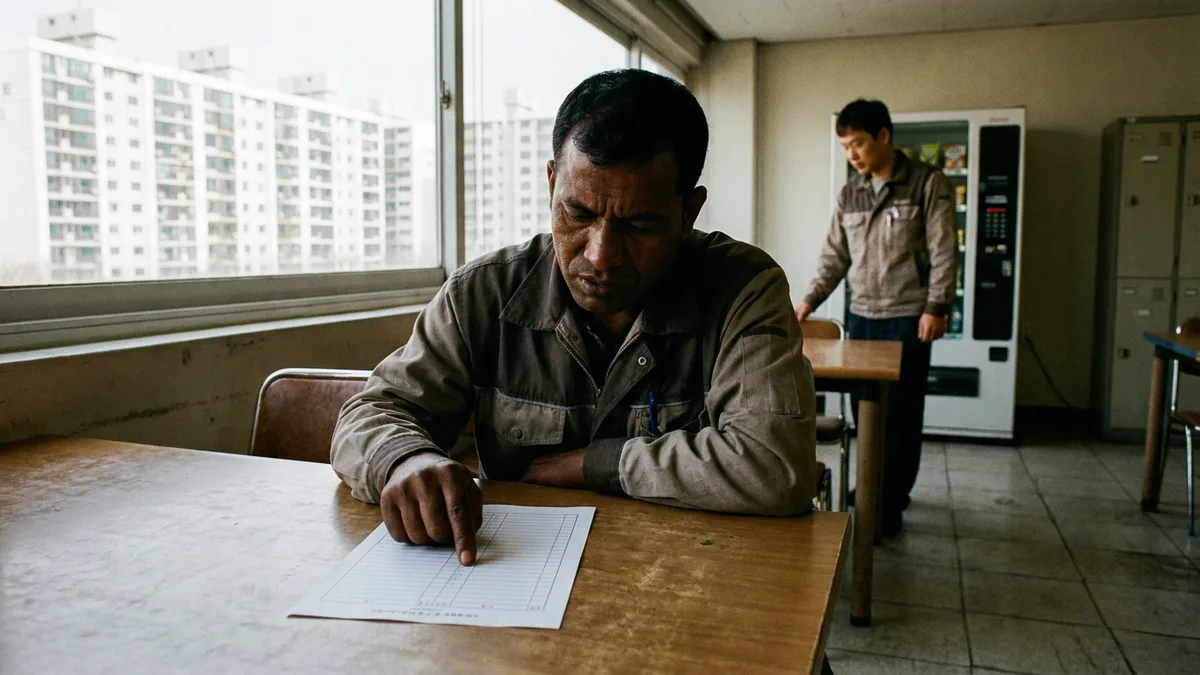

The National Tax Service announced that approximately 700,000 foreign workers need to complete the February 2026 year-end tax settlement, and made this clear: "The year-end tax settlement schedule and procedures for foreign workers are identical to those for domestic workers" (for the 2025 tax year, press release dated January 7, 2026). That means there's no separate procedure just for foreign workers.
Instead, within the same procedure, there are five places where only foreign workers get caught differently: Hometax login, home-country family documents, money spent abroad, housing savings, and the 19% flat tax rate.
The most expensive misunderstanding is "the company will handle everything." Article 137(3) of the Income Tax Act (as of 2026) provides that for persons who do not submit the income and tax deduction report, only the basic personal deduction and standard tax credit apply. If you sit idle, your tax will be finalized without your dependents, medical expenses, or monthly rent.
Note: This article is general information summarizing published laws and NTS guidance, not legal or tax advice. What deductions you can receive depends on your income type, residency status, and tax treaty, so always confirm with official channels. The NTS English helpline for foreign workers is ☎1588-0560 (weekdays 09:00–18:00, excluding 11:30–13:00).
Year-End Tax Settlement Is a Company Procedure — When Does What Happen
Year-end tax settlement is a procedure in which your employer (withholding agent) finalizes the tax on your employment income for the year. Article 137(1) of the Income Tax Act (as of 2026) requires the withholding agent to settle when paying February employment income of the following year. If the total withheld tax exceeds the finalized tax, you receive a refund; if it falls short, you pay more (paragraph 2 of the same article). If the additional tax exceeds 100,000 KRW, the company may withhold it in installments from February through April salary (paragraph 4 of the same article).
| Period | What Happens | Who |
|---|---|---|
| Dec. 1, 2025 – Jan. 15, 2026 | Confirm and consent to which company will receive data and scope on Hometax | Employee |
| Jan. 10, 2026 (Sat) | Employer registers list of employees for bulk data provision | Employer |
| Jan. 15, 2026 (Thu) | Employer downloads bulk simplified data for consenting employees | Employer |
| February salary payment date | Tax finalized, refund or additional withholding | Employer |
| End of February | Withholding receipt issued | Employer |
The dates above are for the 2025 tax year (February 2026 settlement). The NTS updates these dates annually, so check the NTS website for the current year's schedule.
If your company doesn't use the bulk provision service, you must download simplified data from Hometax yourself and submit it to your employer. Ask your payroll staff which method your company uses.
It's Not About Nationality — It's About Being a "Resident" First
Whether you can receive deductions splits not by nationality but by whether you're a resident. Article 1-2 of the Income Tax Act (as of 2026) defines a resident as an individual who has a domicile in Korea or has a dwelling for 183 days or more. Domicile is determined by objective facts such as family living together domestically and domestic assets; overseas life circumstances are not considered (Enforcement Decree Article 2(1) of the same Act).
The calculation differs from intuition. The NTS counts dwelling days from the day after entry to the day of departure, the 183 days need not be consecutive, and even temporarily leaving for tourism or medical treatment counts as time you had a dwelling in Korea.
Even among residents, there's another split. The principle is to aggregate all domestic and foreign employment income for the year, but for foreign residents whose total period of domicile or dwelling in Korea within the past 10 years from the end of the tax year is 5 years or less, only foreign employment income paid domestically or remitted to Korea is aggregated (Income Tax Act Article 3(1) proviso and Article 20).
Non-residents aren't exempt from year-end tax settlement either. You complete the same settlement on domestic employment income, but personal deductions other than yourself, special income deductions, child tax credits, and special tax credits don't apply (Income Tax Act Article 122). What's available: your own personal deduction, employee stock ownership association contribution income deduction, and taxpayer association deduction.
📌 Important: If you have multiple entries and exits, even the 183-day calculation gets blocked. Don't make the determination yourself—call ☎1588-0560 or your local tax office with your specific case.
You Submit Two Bundles to Your Company — Report and Documentation
First is the Employee Income and Tax Deduction Report. Article 140(1) of the Income Tax Act (as of 2026) requires you to submit this report to your employer before receiving February employment income of the following year (or before receiving employment income for the month of resignation if you quit). Because the form is in Korean, it's easy to submit blank spaces without knowing what each field means—and then Article 137(3) kicks in exactly as written above.
Second is documentation. Some automatically arrives as simplified data, others you must obtain manually—and the latter eats up preparation time.
| Documents You Must Obtain Manually | Issuer |
|---|---|
| Alien Registration Certificate | Immigration office |
| Insurance Premium Payment Receipt | Insurance company |
| Medical (Pharmaceutical) Expense Confirmation | Hospital/pharmacy |
| Education Expense Payment Certificate | Educational institution |
| Donation Receipt | Donation recipient |
| Credit Card Income Confirmation | Card company |
The top row is the foreign-worker-only slot. The NTS lists Alien Registration Certificate for 'foreign workers hired in 2025 or foreign workers whose dependents changed,' with the issuer as the immigration office. Payroll staff often don't know this document because it doesn't exist for domestic workers, so write the Korean name exactly when requesting it.
Even logging into Hometax can be a wall. The NTS guidance on bulk provision consent states, "Foreign workers can only use a certified certificate issued with their alien registration number when logging into Hometax." The screen layout changes every year, so check the actual login screen, and if stuck, call ☎1588-0560. What and why deductions come out of your salary is separately laid out in How to Read Your Korean Payslip Deductions.

How to Include Family in Your Home Country as Dependents
"Foreign workers can't receive dependent deductions" is false. The NTS explains that foreign workers who are domestic residents can receive basic deductions for a spouse with annual income of 1 million KRW or less even if that spouse lives in the home country (Income Tax Act Article 50). Documentation consists of family relation certificates, marriage certificates, and income certificates issued by the home country government.
Direct ascendants and descendants have one more condition. In addition to living together, you need proof of actual support (living expense remittance records) (Income Tax Act Article 50; Ministry of Economy and Finance Income Tax Division-84, February 10, 2010). Conversely, "you can just write down your home country family" is also wrong.
Authentication takes longer than the documents themselves. Documents issued by a foreign government require apostille authentication in the home country if that country is a party to the Apostille Convention, or consular confirmation by a Korean consulate in the home country if it's not. In January 2026 guidance, the NTS listed 129 countries including Korea as parties, with Thailand, Vietnam, UAE, Cambodia, Nepal, and Sri Lanka as representative non-parties.
Note: The number and list of party countries change over time. Check the current status of your country with a Korean consulate in your home country or the Ministry of Foreign Affairs. And preparation takes weeks, but the company deadline is January–February. Even starting in December can be too late.
Money Spent in Your Home Country Generally Isn't Deductible
This section reaches the exact opposite conclusion from the one right above. While people (dependents) can qualify even if in the home country, expenses don't. The NTS explicitly states three overseas expenses are not deductible.
| Overseas Expense | Conclusion | Legal Basis |
|---|---|---|
| Overseas medical institution medical expenses | Not deductible | Income Tax Act Article 59-4(2), Enforcement Decree Article 118-5(1) |
| Credit card used abroad | Not deductible | Restriction of Special Taxation Act Article 126-2(1) |
| Child education at foreign educational institution | Not deductible | Income Tax Act Article 59-4(3), Enforcement Decree Article 118-6(4)·(5) |
One sentence summary: Family in your home country qualifies if requirements are met; expenses in your home country generally don't. Thinking of these two as one package throws off your whole report.
There's Exactly One Place Where the Box Is Different for Foreign Workers
Transferring the NTS comparison table of deductions for domestic vs. foreign workers shows a surprisingly simple conclusion. As long as you're a resident, foreign and domestic workers' deduction boxes are almost identical.
| Deduction Item | Foreign Resident |
|---|---|
| Personal deductions (basic·additional) | Same as domestic resident |
| Special income deductions (health·employment insurance, housing funds) | Same as domestic resident |
| Credit card usage amount | Same as domestic resident |
| Child tax credit·special tax credits | Same as domestic resident |
| Monthly rent tax credit·foreign tax credit | Same as domestic resident |
| Housing savings contribution | The only box that splits in the table |
Only housing savings (Restriction of Special Taxation Act Article 87) splits. Through the 2024 contribution year, only non-homeowner heads of household who are employed workers qualified, and foreigners were blocked because they cannot become heads of household under the Resident Registration Act. But starting with the 2025 contribution year, eligible persons expanded to include spouses of heads of household, opening the path for foreigners. Requirements: domestic resident with total salary of 70 million KRW or less who is a spouse of a non-homeowner head of household. Deduction: 40% of contribution (3,000,000 KRW annual cap).
Monthly rent tax credit has one condition foreigners often miss. The Enforcement Decree of the Restriction of Special Taxation Act requires that the address on the lease agreement match the domestic residence under Immigration Control Act Article 32(4) (or the domestic residence reported under the Overseas Koreans Act Article 6). If you delayed your residence change report after moving, the documents won't match. The order to align contract and reported address is in Monthly Rent Contract Guide for Foreigners.
📌 Important: Just because something isn't in this table doesn't mean it's automatically allowed, and being in it doesn't mean it's unconditionally granted. Each deduction has separate requirements (head of household determination, etc.). Check whether you qualify by calling ☎1588-0560 or your local tax office.
To Choose the 19% Flat Rate, When Do You Submit What
Foreign workers can choose a 19% flat tax rate instead of the basic progressive rate. This section covers only when and what to submit, not which is more advantageous.
Application is one form. Under Enforcement Decree Article 16-2 of the Restriction of Special Taxation Act (as of 2026), attach the "Foreign Worker Flat Tax Rate Application" to the Employee Income and Tax Deduction Report and submit it to your employer at the February settlement or to the head of the tax office with jurisdiction over your tax domicile at the May final return. Only persons who do not hold Korean nationality as of the end of the relevant tax year are eligible.
Many get the period wrong. The current provision states that if you first provided labor domestically before December 31, 2026, the period extends to tax years ending within 20 years from that date (Restriction of Special Taxation Act Article 18-2(2)). Many online resources still cite '5 years' from before the amendment—don't erase your options based on that number. Employment at a specially related corporation is excluded (same paragraph, Enforcement Decree Article 16-2 of the same Act).
A lot disappears if you choose it. Article 18-2(3) of the Restriction of Special Taxation Act provides that non-taxable income, deductions, exemptions, and tax credits do not apply when the flat rate is applied. The NTS explains that as a result, National Health Insurance and employment insurance premiums paid by the employer also aren't exempt.
Comparing just the rate numbers flips the conclusion. The two methods have different bases for multiplying the rate. The basic rate applies a 6–45% progressive rate to taxable income—annual employment income minus non-taxable income, employment income deduction, personal deductions, etc.—while the flat rate multiplies the full annual employment income including non-taxable income directly by 19%. The NTS only states, "Whether flat-rate application is advantageous differs for each individual." Calculation comparison and tables are laid out in May Comprehensive Income Tax Filing and Hometax.
Choosing 19% doesn't end there. Article 103-13 of the Local Tax Act (as of 2026) requires special withholding of 10 percent of income tax to which the special taxation applied as local income tax.
There's also a separate track that only catches certain people. Foreign workers who provide technology under engineering technology introduction contracts or who hold a bachelor's degree or higher in science/engineering with overseas R&D experience receive 50% income tax reduction on employment income arising over 10 years; working at material/parts/equipment specialized leading companies gives 70% reduction for the first 3 years (Restriction of Special Taxation Act Article 18). Native-speaking teachers may be exempt if the tax treaty with their home country has a teacher (professor) exemption clause and they meet the requirements, but requirements differ by treaty. Treaty texts are available on the NTS National Tax Law Information System (taxlaw.nts.go.kr → Laws → Tax Treaties).
Three Cases Where Procedure Changes Entirely — Daily Workers, Mid-Year Resignation, Two Workplaces
| Case | What Happens | What to Do |
|---|---|---|
| Daily worker | Not subject to year-end settlement | Withholding at payment is final (final separate taxation) |
| Mid-year resignation | Settled when paying salary for resignation month | Submit report and documentation before receiving that salary |
| Two workplaces in one year | New employer consolidates and settles | Submit prior workplace withholding receipt to new employer |
Daily employment income is subject to final separate taxation where withholding at payment completes the tax obligation, so it's not subject to year-end settlement and isn't aggregated into comprehensive income either. Withholding rate: 6%; daily employment income deduction: 150,000 KRW; employment income tax credit: 55% of calculated tax (per NTS guidance). The NTS explains daily workers as those working for less than 3 months (less than 1 year for construction) and receiving pay according to daily or hourly work performance, but the determination is based on actual work conditions, not the name in the contract, and if daily and regular employment mix in one year, the conclusion changes again. Leave the determination to ☎126 or ☎1588-0560.
If you resign mid-year, settlement happens when paying employment income for the resignation month (Income Tax Act Article 137). If you changed employers, you must submit a report including employment income received from January through the resignation month at the prior workplace so the new employer can withhold on the sum of both workplaces (same Act Article 138(1)). Withholding receipts are issued by the end of February of the following year; for mid-year resignations, by the end of the month following the month containing the payment date of employment income for the resignation month (same Act Article 143).
If neither path worked out, the exit is in May. If you didn't complete the February settlement or missed deductions because you didn't gather documentation, you can settle by filing or receive a refund through comprehensive income tax final return from May 1 to 31 (Income Tax Act Article 70(1)). If you're facing repatriation, the refund account and National Pension Service lump-sum refund procedures overlap, so plan the sequence ahead.
| Where | Number | For What |
|---|---|---|
| NTS Foreign Worker English Helpline | 1588-0560 (weekdays 09:00–18:00, excluding 11:30–13:00) | Year-end settlement, deduction eligibility, flat rate |
| National Tax Call Center | 126 (weekdays 09:00–18:00) | General tax consultation |
| Ministry of Justice Foreign Resident Support Center | 1345 | Residence, visa, residence change report |
| Ministry of Employment and Labor Customer Service | 1350 | Wages, working conditions |
The NTS English website (nts.go.kr/english → Year-end Tax Settlement) posts English guidebooks and English/Chinese/Vietnamese explanatory materials. However, NTS multilingual resources exist only in English, Chinese, and Vietnamese, so some readers have no official materials in their language at all. In that case, use English materials to identify what to prepare and call ☎1588-0560 for consultation.
Tax filing itself has nothing to do with LACHA. However, schedules for visiting immigration offices, hospitals, educational institutions, and tax offices overlap in January–February, and most are open only during weekday business hours. LACHA is a foreign-resident transportation and payment super-app you can use immediately without personal authentication, letting you pay for KTX, intercity buses, taxis, airport rail, and transit cards in one place. LACHA does not handle tax filing or refunds.

Want Korea's transit and payments in one app — without a Korean phone number or bank account? Check out LACHA.
Built to work without a Korean phone number or bank account, with overseas payment methods like Alipay, WeChat Pay, and Apple Pay. Taxi hailing plus KTX, express bus, and airport railroad (AREX) booking — all in one app.
Up to 60% off Korea transit with a coupon (max ₩3,000): enter code at sign-up. KTX gets up to 18% off on top
Download now


Frequently Asked Questions (FAQ)
Q1. My company says they'll handle everything—do I have anything to submit? Yes. Article 140(1) of the Income Tax Act (as of 2026) requires employees to submit the Employee Income and Tax Deduction Report to their employer before receiving February employment income of the following year. If you don't submit this report, under Article 137(3) of the same Act, only your basic personal deduction and standard tax credit apply. That means your tax is finalized with dependents, medical expenses, and monthly rent all missing.
Q2. Can I include my spouse and parents in my home country as dependents? The NTS explains that if the spouse of a foreign worker who is a domestic resident has annual income of 1 million KRW or less, basic deduction is available even if the spouse resides in the home country (Income Tax Act Article 50). For direct ascendants and descendants, in addition to living together, proof of actual support such as living expense remittance records is also required. Documents issued by the home country government require apostille authentication if the home country is an Apostille Convention party, or consular confirmation by a Korean consulate in the home country if not. Check your situation by calling ☎1588-0560.
Q3. Isn't the 19% flat rate only available for 5 years? The current Restriction of Special Taxation Act Article 18-2(2) provides that if you first provided labor domestically before December 31, 2026, the period extends to tax years ending within 20 years from that date. '5 years' is from before the amendment, but many online resources still show it. However, if you choose the flat rate, non-taxable income, deductions, exemptions, and tax credits all disappear (paragraph 3 of the same article), and under Local Tax Act Article 103-13, 10% local income tax is also added separately. Whether it's advantageous or not differs for each individual, so the NTS guidance is to calculate and choose.
Q4. I worked as a daily worker—why don't I have year-end settlement? Daily employment income is subject to final separate taxation where withholding at payment completes the tax obligation, so it's not subject to year-end settlement and isn't aggregated into comprehensive income either (per NTS guidance). Withholding rate: 6%; daily employment income deduction: 150,000 KRW. However, whether you're a daily worker is determined by actual work conditions, not the name in the contract, and if daily and regular employment mix in one year, the conclusion changes again. Don't make the determination yourself—call ☎126 or ☎1588-0560.
Q5. I missed the February settlement. Is that the end? No. If you didn't complete the February settlement or didn't receive deductions because you didn't prepare documentation, you can settle through comprehensive income tax final return from May 1 to 31 (Income Tax Act Article 70(1)). Procedures and English-accessible routes are laid out in May Comprehensive Income Tax Filing and Hometax. However, whether you're subject to filing and what your tax is aren't finalized by that article, so check with ☎1588-0560 or your local tax office.
Reference: This article is general information summarizing published laws and NTS guidance, not legal or tax advice. Legal provisions, schedules, and contact information in the text are as of August 2026, confirmed from the NTS press release "Year-end Tax Settlement for Foreign Workers Is Not Difficult with the National Tax Service!" (January 7, 2026) and original legal texts on the National Law Information Center. The NTS updates the year-end settlement schedule annually, tax law changes every year, and phone numbers and operating hours may also change. What deductions you can receive depends on income type, residency status, and tax treaty, so before acting, re-confirm based on your situation by calling ☎1588-0560 (NTS foreign worker English helpline) or ☎126 (National Tax Call Center). For residence and visa, call ☎1345; for wages and working conditions, ☎1350. LACHA is a private transportation and payment service unaffiliated with the above agencies and does not handle tax filing or refunds.