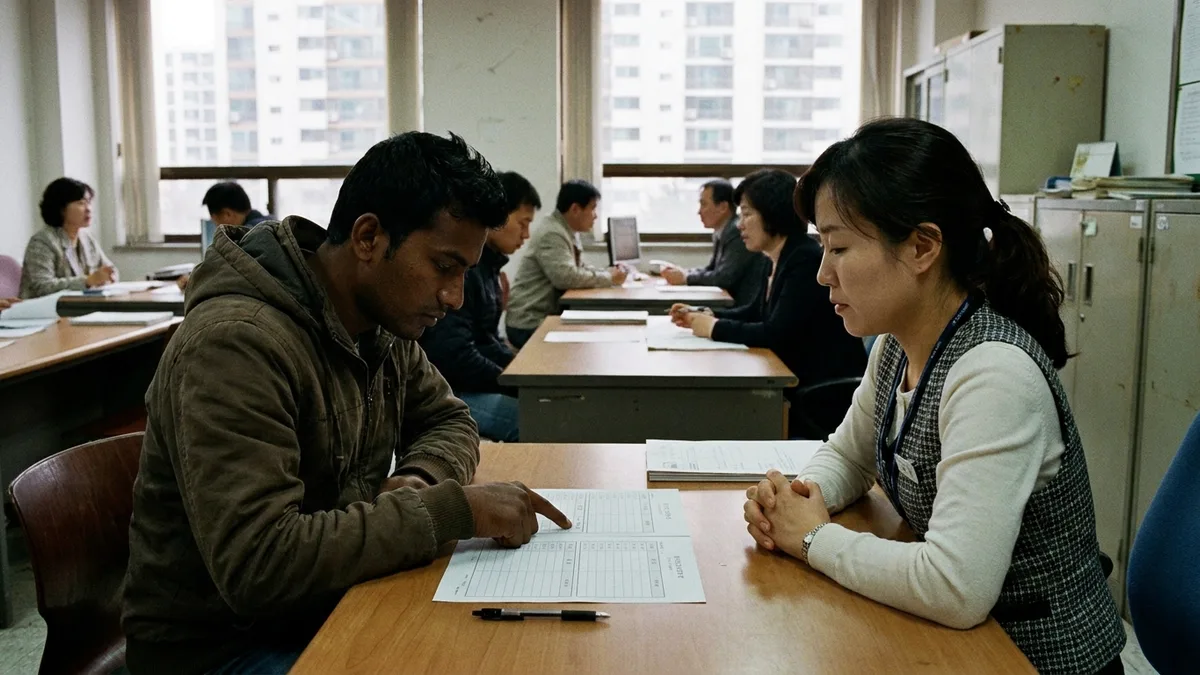
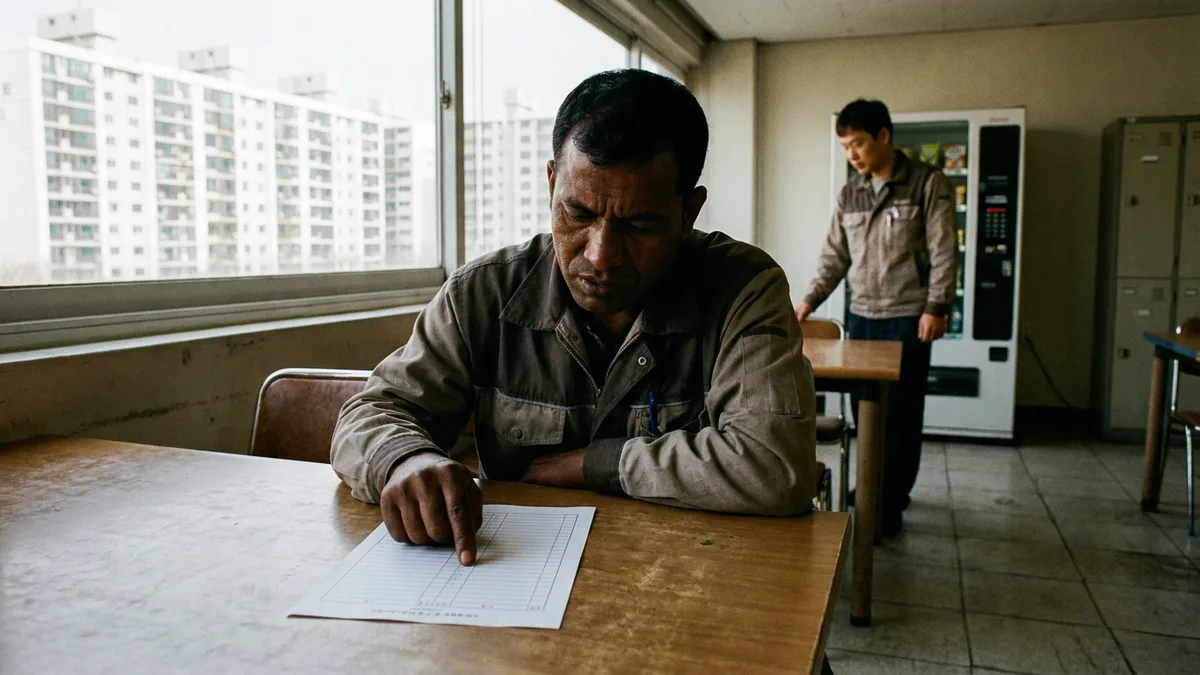
If you work in Korea, you have the right to receive a payslip every time you're paid. Article 48(2) of the Labor Standards Act places that duty on the employer, and it has been in force since November 19, 2021. Deduction amounts differ from person to person depending on how your pay is structured, your visa status, your nationality, and your enrollment history. This article only explains what must appear on the payslip and where to check it — it can't judge whether your own deduction amounts are correct. To verify amounts, call ☎1350 (Ministry of Employment and Labor).
This duty applies regardless of nationality. Article 6 of the Labor Standards Act prohibits discrimination in working conditions based on nationality, religion, or social status, and Article 22 of the Act on the Employment, etc. of Foreign Workers also states that "an employer shall not treat a foreign worker unfairly or discriminate against them on the ground that they are a foreign worker."
The problem is that payslips come only in Korean. When you're handed a sheet with 기본급 (base pay), 연장근로수당 (overtime allowance), 건강보험 (health insurance), 장기요양 (long-term care), 소득세 (income tax), and 지방소득세 (local income tax) lined up vertically, you get stuck right away on which line is money coming to you and which line is money going out.
And there's one more misunderstanding that Korean workers never run into. Each insurance applies to foreign workers under different conditions, so it can be perfectly normal for certain items to be missing from your payslip. The National Pension depends on your nationality, the unemployment benefit portion of Employment Insurance depends on whether a separate application was filed, and Industrial Accident Compensation Insurance premiums are paid by the employer in the first place, so they never show up in the deduction column. If you don't know this, you may suspect your company over a perfectly normal payslip — or, the other way around, miss the fact that something that should have been deducted wasn't.
Note: This article is general information and not legal advice. The provisions and rates cited are current as of 2026-08, and rates change every year. For individual matters (deduction amounts, visa status, contract terms), please check with the official helplines below based on your own situation.
A payslip isn't a document you're lucky to get
It isn't a favor — it's a document your company is required to give you. Article 48(2) of the Labor Standards Act requires the employer, each time wages are paid, to issue a payslip stating the wage components, the calculation method, and the details of any portion of wages deducted under statute or a collective agreement.
And paper isn't the only way to deliver it. It can be provided in writing or as an electronic document, and since there is no statutory form, the layout differs from company to company. Electronic methods such as entry into an internal company system, email, or text message are also recognized as valid delivery. So the mere fact that you didn't get a printed copy isn't in itself a violation.
If they don't give you one, then under Article 116(2)2 of the Labor Standards Act, as of 2026 the employer faces an administrative fine of up to 5 million KRW. But that number is easy to misread.
Caution: 5 million KRW is the statutory ceiling, not the amount actually imposed. The actual amount is set through a separate process based on Table 7 of Article 60 of the Enforcement Decree of the Labor Standards Act, and the levels confirmed through Ministry of Government Legislation and Ministry of Employment and Labor interpretations are 300,000 KRW for a first non-issuance, 500,000 KRW for a second, and 1 million KRW for a third or later (we could not verify the original table text, so treat this as reference only). On the other hand, the duty to issue arises separately for each worker on each payday, so administrative interpretation holds that where several months were missed, penalties may be imposed for each instance under Article 13(2) of the Act on the Regulation of Violations of Public Order.
In other words, it's not that the company will be hit with 5 million KRW — it's that the penalty can go up to that level, and the more months they skip, the more counts pile up.
The 6 items that must appear on your payslip
Article 27-2(1) of the Enforcement Decree of the Labor Standards Act sets out six required entries. Put your own payslip next to this and check them off from the top.
| Provision | What must be stated | Where to look on your payslip |
|---|---|---|
| Item 1 | Information identifying the worker, such as name, date of birth, or employee number | Personal details box at the very top |
| Item 2 | Payment date | Next to the title or below the personal details |
| Item 3 | Total wage amount | Bottom line of the payments column |
| Item 4 | Amount of each component — base pay, allowances, bonuses, performance pay, etc. (if any wages were paid in something other than currency, the item name, quantity, and total assessed value) | Each line of the payments column |
| Item 5 | Where a component varies according to days worked, hours, etc., the method of calculation — for overtime, night, and holiday work, including the number of hours | Calculation/remarks box beside the payments column |
| Item 6 | Where part of the wages was deducted under the proviso to Article 43(1) of the Act, the amount of each deduction item and the total | Deduction column |
There are two ways to get this table wrong, in opposite directions.
- Having all six items doesn't mean the wage calculation itself is correct. The disclosure requirements and the accuracy of the amounts are separate issues.
- Conversely, don't assume a missing item is automatically a violation. We weren't able to review the original text on whether some entries may be omitted depending on the type of worker or the workplace situation. If you need a judgment call, the accurate route is to call ☎1350 with the payslip in front of you.
Item 5 matters especially for foreign workers. If you worked overtime, night, or holiday hours, not just the amount but the number of hours must be written down. Without the hours, you lose any way to cross-check against the time you actually worked.
The principle behind the deduction column — full payment is the rule
Reading the deduction column gets much easier if you fix one principle in mind first. Article 43(1) of the Labor Standards Act provides that wages must be paid in currency, directly to the worker, in full. The proviso, however, allows part of the wages to be deducted or paid in something other than currency where a statute or collective agreement specifically so provides. Paragraph 2 of the same article requires payment at least once a month on a fixed date.
That's exactly why Article 27-2(1)6 of the Enforcement Decree limits the duty to state deduction details to deductions made under the proviso to Article 43(1). The deduction column is designed so that only deductions with a legal basis are written there.
So when you look at the deduction column, the question isn't "is this amount right?" — it's two other questions. First, is an item name written? Second, does the net pay (payments minus deductions) match the amount that landed in your bank account? Judging whether an amount is appropriate is ☎1350's job.
Once your eyes get used to the Korean item names, it takes 30 seconds a month. The item numbers in the table below all refer to the subparagraphs of Article 27-2(1) of the Enforcement Decree of the Labor Standards Act.
| Payslip label | Which column | What it is |
|---|---|---|
| 기본급 (base pay) | Payments | The base component under Item 4 |
| 연장·야간·휴일근로수당 (overtime / night / holiday allowance) | Payments | Must be listed with the number of hours under Item 5 |
| 상여금·성과금 (bonus / performance pay) | Payments | A component under Item 4 |
| 국민연금 (National Pension) | Deductions | Application varies by nationality |
| 건강보험 (health insurance) | Deductions | Registered foreign residents working as employees are workplace-based subscribers |
| 장기요양보험 (long-term care insurance) | Deductions | Calculated as a percentage of the health insurance premium and shown on its own line |
| 고용보험 (employment insurance) | Deductions | For E-9 and H-2, the unemployment benefit portion applies only if separately applied for |
| 소득세·지방소득세 (income tax / local income tax) | Deductions | Not a final tax bill — money paid in advance |
| 공제계·실지급액 (total deductions / net pay) | Totals | Net pay must match the amount deposited in your account |
Deduction column ① The four major insurances — coverage for foreigners differs by insurance
"Foreigners get all four insurances deducted" and "the four insurances have nothing to do with nationality" are both untrue. Each insurance has a different governing statute, so the outcomes differ too.
National Pension is subject to a reciprocity rule under the proviso to Article 126(1) of the National Pension Act. If, with respect to a pension corresponding to the National Pension, the foreigner's home-country law does not apply to Korean nationals, that person is excluded from coverage. So the absence of a National Pension deduction on your payslip may be perfectly normal depending on your nationality. Which way it goes varies by country and agreements change, so don't try to memorize a country list — check with the National Pension Service at ☎1355 based on your own nationality. The procedure for getting money back when you eventually leave Korea is covered separately in How to Claim Your National Pension Lump-Sum Refund.
Health insurance is grounded in Article 109(2)3 of the National Health Insurance Act. A person who has completed alien registration under Article 31 of the Immigration Act and works at a workplace subject to the scheme becomes a workplace-based subscriber (day laborers employed for less than one month and similar cases are excluded). The company must report the acquisition of eligibility to the NHIS within 14 days of hiring. You can read more about the premium structure and using hospitals in Health Insurance Enrollment and Premiums for Foreigners.
Employment insurance hinges on Article 10-2 of the Employment Insurance Act. For registered E-9 (Non-Professional Employment) and H-2 (Working Visit) workers, the employment security and vocational skills development programs apply automatically, but unemployment benefits, parental leave benefits, and maternity leave benefits apply only where a separate enrollment application has been made. So not seeing an employment insurance deduction can also be normal. If you're working on an E-9, reading it alongside The Employment Permit System (EPS) Hiring Process will help you get the whole picture faster.
Industrial accident insurance applies automatically to any business employing workers under Article 6 of the Industrial Accident Compensation Insurance Act, and protection applies regardless of visa status. Since the premium is borne by the employer, it does not, as a rule, appear in the worker's deduction column. The absence of an industrial accident line does not mean your company failed to enroll. If you get hurt, medical care and compensation claims go through the Korea Workers' Compensation & Welfare Service at ☎1588-0075.
| Item | Worker's share as of 2026 | Where to check |
|---|---|---|
| Health insurance | 3.595% of monthly remuneration (7.19% total, split evenly with the employer; decided 2025-08-28) | ☎1577-1000 / foreigner line ☎033-811-2000 |
| Long-term care insurance | 13.14% of the health insurance premium (0.9448% of income in 2026; resolved 2025-11-04) | Same as above |
| National Pension | The rate is rising in stages under the 2025 pension reform legislation, so we're not printing a number here — check the rate that applies to you | ☎1355 |
| Employment insurance | Rates aren't covered in this article. For E-9 and H-2, start with the coverage structure above | ☎1350 |
| Industrial accident insurance | Employer-borne, so as a rule it doesn't appear in the deduction column | ☎1588-0075 |
Caution: Don't use this table to decide whether your own deductions are correct. The standard monthly income and monthly remuneration used to calculate premiums are determined separately by each agency and have upper and lower limits (for the National Pension, the standard monthly income applied from 2025-07 to 2026-06 ranges from a minimum of 400,000 KRW to a maximum of 6.37 million KRW). So multiplying your gross pay by the rate can give a different figure from the deduction on your payslip. Rates change every year, so cross-check against the year your payslip belongs to.
Deduction column ② Taxes — what's taken monthly is money paid in advance
The income tax that comes out on your payslip is not a finalized tax. Under Article 137(1) of the Income Tax Act, the withholding agent performs the year-end tax settlement when paying February wages of the following year (or, if you leave mid-year, when paying the wages for the month you leave). The difference between what was withheld each month and your actual tax liability is refunded or collected at that point.
So instead of asking "why is my income tax so high this month?", it's more important to know that it gets settled at the year-end adjustment. The gap tends to be large in a year when you arrived in Korea partway through, or left a job partway through.
We won't list tax rates here. There are separate tax special provisions that may apply to foreign workers, but the eligibility conditions and whether you elect them vary from person to person, so generalizing could actually cost you money. Check what applies to you at these three places.
- National Tax Service Tax Counseling Center ☎126 (just dial it as is, no area code)
- National Tax Service English-language line for foreigners ☎1588-0560 — weekdays 09:00–18:00, closed 11:30–13:00
- Your company's payroll officer — they're the ones who actually process your year-end settlement paperwork, so they're the fastest
Deduction column ③ Dormitory fees, meal costs, and other deductions
Sometimes you'll see deductions that are neither one of the four insurances nor a tax, such as dormitory fees or meal costs. This article won't judge whether those amounts are appropriate. We couldn't obtain the text of the underlying Ministry of Employment and Labor guidelines, and copying percentage tables floating around the internet would only lead you to act on wrong numbers.
Instead, there's exactly one thing to check. Just look at whether the item name and its basis are written in the deduction column. What Article 27-2(1)6 of the Enforcement Decree requires is the amount of each deduction item and the total. If money has been taken out in one lump with no item name, that alone is reason to ask.
There's a mismatch that comes up often for foreign workers. Dormitory fees or meal costs appear only in the employment contract and not as line items in the payslip's deduction column, leaving you no way to lay the two documents side by side and compare. In that case, bring both the employment contract and the payslip and call ☎1350. Checking first, before confronting the company, is the safer order.
📌 Important: If you're being paid in cash, this matters even more. The currency-payment and direct-payment principles of Article 43(1) of the Labor Standards Act don't in themselves prohibit cash payment, but no record remains to prove the payment was made. If you haven't opened a bank account yet, at the very least photograph your payslip every month.
When you don't get a payslip, or don't understand an item
The most common failure in this area is being unable to ask anyone because making a phone call in Korean is too hard. But there's a dedicated helpline that offers multilingual three-way interpretation. Call the Foreign Workforce Counseling Center at ☎1577-0071 first, get an interpreter on the line, then talk to the other agency.
| What you're asking about | Helpline | Number |
|---|---|---|
| Wages, payslips, deduction amounts, unpaid wages | Ministry of Employment and Labor Customer Counseling Center | ☎1350 |
| Multilingual interpretation (three-way call), general employment counseling | Foreign Workforce Counseling Center | ☎1577-0071 |
| Residence, visas, alien registration | Immigration Contact Center (Hi Korea) | ☎1345 |
| National Pension coverage, reciprocity | National Pension Service | ☎1355 |
| Health insurance eligibility and premiums | National Health Insurance Service | ☎1577-1000 / foreigner line ☎033-811-2000 |
| Industrial accident care and compensation claims | Korea Workers' Compensation & Welfare Service | ☎1588-0075 |
| Income tax, year-end settlement | National Tax Service | ☎126 / English ☎1588-0560 |
| Legal counseling and legal aid | Korea Legal Aid Corporation | ☎132 |
There are two traps here that only foreign workers fall into.
First, foreign-language support at these helplines is limited by time of day. ☎1345 is listed as operating weekdays 09:00–22:00, but it's understood that evening hours may run mainly in Korean, English, and Chinese. If you need interpretation in another language, calling in the morning or early afternoon is safer.
Second, don't act based on the labor helpline alone. For E-9 workers in particular, what happens after a report or complaint is entangled with the workplace-change procedure, so you need to check the labor side (☎1350) and the residence side (☎1345) together. This isn't meant to scare you — it's because acting with only half the picture can lead you into a choice that's hard to undo. The workplace-change process itself is covered in E-9 Workplace Change Procedure, and how to use each helpline is laid out in Labor Counseling Helplines for Foreign Workers.
A 30-second monthly filing habit
There are only three things to do when you receive a payslip, and together they take 30 seconds.
- Take a photo. Paper or screen, it doesn't matter. One shot with the date visible is enough.
- Compare the net pay on the payslip with the deposit in your bank account. If the two numbers differ, ask about it that same month.
- Keep them in the same folder as your employment contract. When the moment comes that you need them, you'll need both documents together.
If you only receive electronic documents, pay special attention. If your payslip arrives through an internal company system or company messenger, your access is cut off the moment you resign, and you won't be able to open past payslips again. If you don't save them while you're still employed, there's no way to get them later.
Why go to this trouble? Because when something goes wrong, the payslip is often the only thing left in your hands. If unpaid wages arise when you've never received a single payslip, your only evidence is your bank transaction history. On top of that, wage claims have a statute of limitations. Article 49 of the Labor Standards Act is said to set it at three years, but we found only one source for this, so please re-confirm the starting point and remaining period for your own case at ☎1350 or ☎132.
The public agencies, labor offices, and tax offices are mostly open only during weekday business hours. Sorting out a payslip problem often means taking half a day off and making the rounds of two or three offices in one day — and that travel rarely ends within a few subway stops. LACHA is a transport-and-payment super app for foreigners that you can use right away without Korean identity verification. You can get started with just your passport — no Korean bank account or phone number needed — and pay for taxis, KTX, express buses, the Airport Railroad, and transit cards all in one place using overseas payment apps like Alipay and WeChat Pay, or an overseas card.

Need transit and payments while you wait for your residence card? Check out LACHA.
Built to work without a Korean phone number or bank account, with overseas payment methods like Alipay, WeChat Pay, and Apple Pay. Taxi hailing plus KTX, express bus, and airport railroad (AREX) booking — all in one app.
Up to 60% off Korea transit with a coupon (max ₩3,000): enter code at sign-up. KTX gets up to 18% off on top
Download now


Frequently Asked Questions (FAQ)
Q1. My payslip has no National Pension deduction. Did my company skip paying it? Not necessarily. Under the reciprocity rule in the proviso to Article 126(1) of the National Pension Act, if your home country's law on a pension corresponding to the National Pension does not apply to Korean nationals, you are excluded from coverage. So it can be perfectly normal for there to be no National Pension deduction, depending on your nationality. That said, country-by-country determinations shift as agreements change, so don't trust lists you find online — call the National Pension Service at ☎1355 and ask about your specific nationality.
Q2. I don't see an industrial accident insurance deduction. Does that mean my company didn't enroll? Industrial accident insurance premiums are borne by the employer, so as a rule they don't appear in the worker's deduction column. Under Article 6 of the Industrial Accident Compensation Insurance Act, coverage applies automatically to any business employing workers, and protection applies regardless of visa status. In other words, its absence from the deduction column is normal. If you actually get injured, file your medical care and compensation claim with the Korea Workers' Compensation & Welfare Service at ☎1588-0075.
Q3. My company only sends it through the internal messenger instead of on paper. Does that count as a payslip? Yes. A payslip may be issued in writing or as an electronic document, and electronic methods such as an internal company system, email, or text message are recognized as valid delivery. There is also no statutory form, so a company-specific layout isn't a problem in itself. Just remember that once you resign, access to the internal system is cut off and you can't open past payslips — so save a photo every time you receive one.
Q4. I've been here six months and have never received a payslip. What happens now? Issuing a payslip is a duty under Article 48(2) of the Labor Standards Act, and a violation is subject to an administrative fine of up to 5 million KRW as of 2026 under Article 116(2)2 of the same Act. That said, this is the statutory ceiling, and the actual amount is set through a separate process based on Table 7 of the Enforcement Decree. Since administrative interpretation holds that the duty to issue arises for each worker on each payday, you can raise several months' worth in a single consultation. Start with ☎1350, and if Korean is difficult, call ☎1577-0071 to get an interpreter on the line. If you're on an E-9, also check the residence-side implications at ☎1345.
Q5. Dormitory fees were taken out, but there's no such item in my payslip's deduction column. Article 27-2(1)6 of the Enforcement Decree requires that, where a deduction is made, the amount of each deduction item and the total be stated. If money has been taken out in one lump with no item name, that's the first thing to ask about. That said, this article doesn't determine how much may be deducted for room and board — we weren't able to verify the text of the governing guidelines. The accurate route is to bring both your employment contract and your payslip and consult ☎1350.
Note: This article is intended as general information and is not legal advice. The provisions, rates, and helplines in the text are current as of 2026-08 and were verified against the Korea Law Information Center and Easy-to-Find Practical Law, Ministry of Health and Welfare press releases, and official guidance from the National Pension Service, the National Health Insurance Service, the National Tax Service, and the Human Resources Development Service of Korea (EPS). Premium rates and the upper and lower limits of standard monthly income change every year, and items we could not verify against the primary source — such as Article 49 of the Labor Standards Act (statute of limitations for wage claims) and the administrative fine criteria in Table 7 of the Enforcement Decree — are hedged in the text. We have not printed figures for the National Pension rate, income tax rates, or room-and-board deduction limits because they vary by individual or we couldn't secure a source, so please confirm those with each agency or the National Tax Service. For individual matters, we recommend re-confirming based on your own situation at ☎1350 for deduction amounts, ☎1345 for residence, and ☎1577-0071 for interpretation. LACHA is a private transport-and-payment service unaffiliated with the public agencies above, and does not handle wage, labor, or social insurance matters on your behalf.