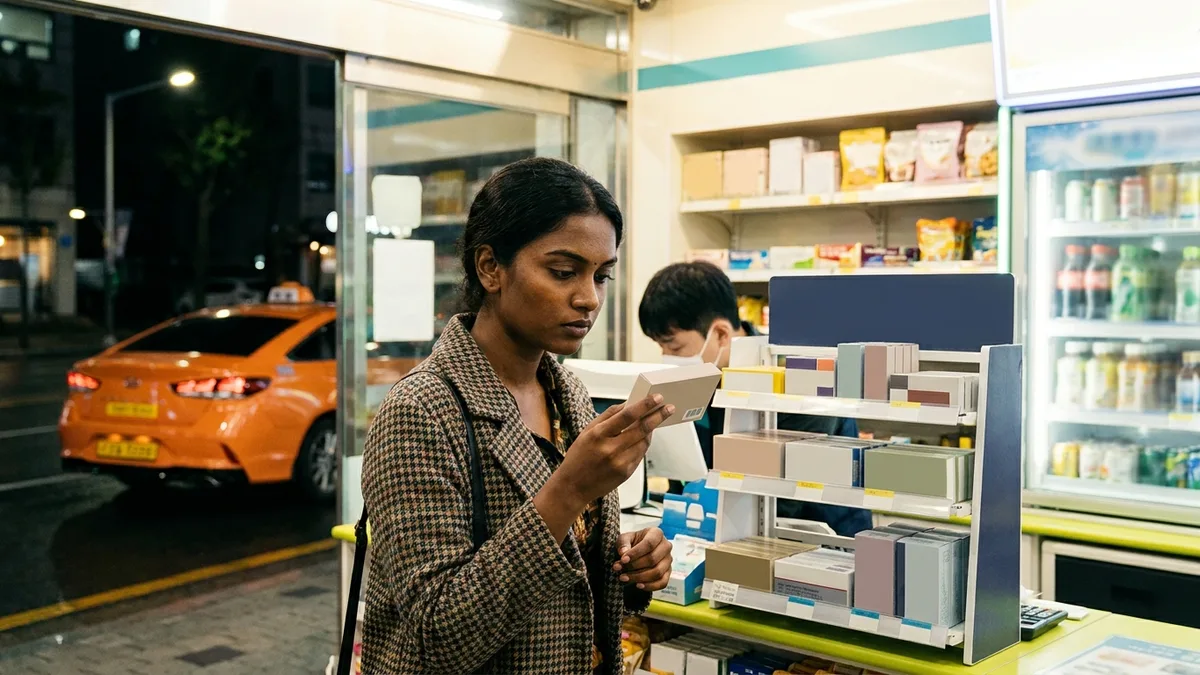
Getting a stomach bug at 11 p.m. and sprinting to the convenience store is usually a wasted trip. Convenience stores can only sell the 13 items the Ministry of Health and Welfare has designated by public notice, and anti-diarrheal medicine isn't one of them.
Look at what makes up those 13 and the reason becomes obvious. Five fever reducers/painkillers, two cold medicines, four digestive aids, two medicated patches — that's the whole list. Anti-diarrheals, allergy medicine (antihistamines), and anti-inflammatory painkillers are not on the designated list. So the line between "a convenience store can handle this" and "you need a pharmacy" is drawn before you even walk in.
The good news is that pharmacies are everywhere. According to National Health Insurance Service figures, there were 25,633 pharmacies nationwide as of Q1 2026 (up from 25,047 in 2024 and 25,497 in 2025). And medicine you can buy without a prescription has an official legal name in Korea — ilban-uiyakpum (일반의약품), or general/OTC medicine. Learning that one word makes the conversation at the pharmacy counter far simpler.
Note: The rules, product lists, and copay rates below reflect public information as of August 2026. Designated items and fee regulations can change, so check again with the Ministry of Health and Welfare (mohw.go.kr) or the MFDS drug safety portal, Uiyakpum Anjeon Nara (nedrug.mfds.go.kr), before you actually need them.
Medicine you can buy without a prescription = 일반의약품 (OTC)
Article 2 of the Pharmaceutical Affairs Act splits medicines into two groups.
- General medicine / OTC (일반의약품): drugs that can reasonably be expected to be safe and effective when used without a prescription from a doctor or dentist. A licensed pharmacy owner may sell these without a prescription.
- Prescription-only medicine (전문의약품): everything that isn't classified as general medicine. As a rule, it must be dispensed against a prescription from a doctor or dentist.
So the precise name for "medicine you can buy without a prescription" is 일반의약품. That distinction is the baseline for what you can pick up at a pharmacy and what requires a hospital visit first.
One thing to watch out for: which drug classes count as OTC and which are prescription-only is decided product by product. A medicine you buy over the counter back home may be prescription-only in Korea, or the other way around. The most reliable way to check any specific product is to look it up by product name or ingredient on the MFDS portal, Uiyakpum Anjeon Nara (nedrug.mfds.go.kr).
Tip: If a medicine requires a prescription, your starting point is a clinic, not a pharmacy. The path from consultation to prescription is laid out step by step in How to See a Doctor in Korea.
How to buy medicine at a pharmacy — describe your symptoms and the pharmacist picks
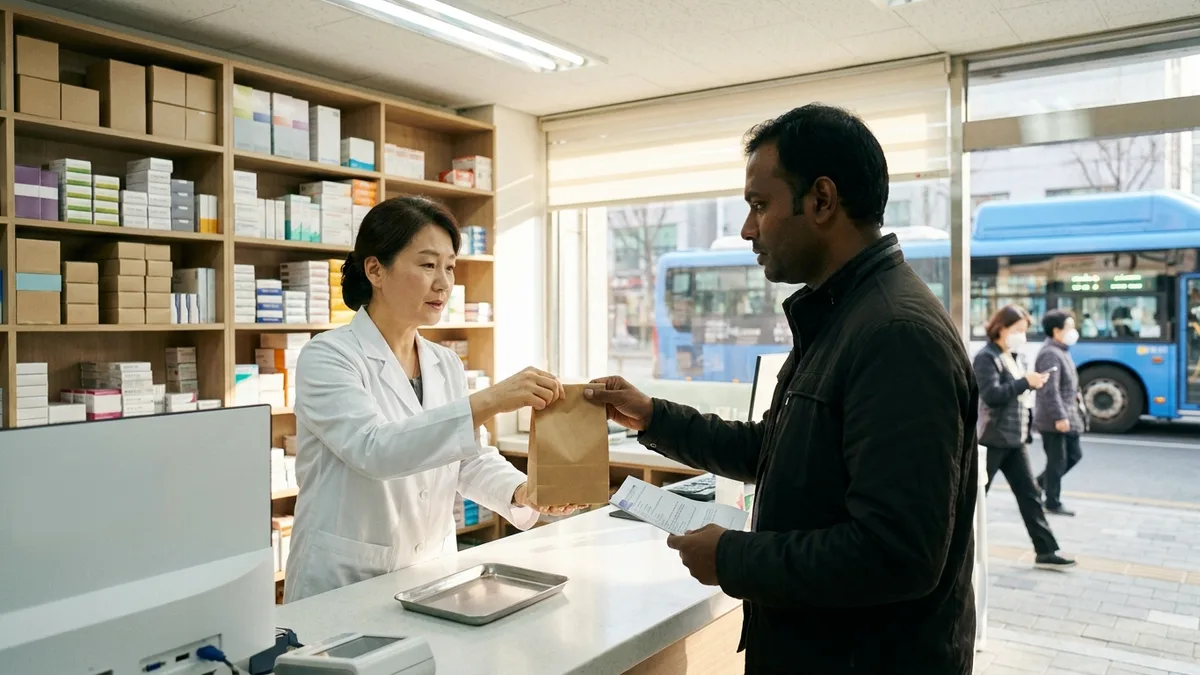
It's completely fine to walk in without knowing a product name. The definition of "medication counseling" (복약지도) in Article 2, Item 12 of the Pharmaceutical Affairs Act includes "helping the purchaser select the medicine they need, without making a diagnostic judgment, when selling general medicine." In other words, having the pharmacist choose a medicine after you describe your symptoms is the role the law assigns them.
In practice, this is what keeps things moving.
- Describe symptoms exactly as they are: where it hurts and how, since when, whether you have a fever. If the words are hard, showing a translation app screen works perfectly well.
- A photo of what you're already taking: if you're on medication from back home, show a picture of the packaging. It helps avoid overlapping ingredients.
- Who the medicine is for: options differ depending on whether it's for an adult or a child, and whether you're pregnant or breastfeeding.
When a prescription is dispensed, medication counseling is a legal duty under Article 24(4) of the Pharmaceutical Affairs Act. Violations carry an administrative fine of up to 1,000,000 KRW (Article 98). If you were handed medicine with no explanation, asking again about dosage and precautions is a perfectly legitimate request.
There's one practical limitation worth knowing. There is no list of "English-speaking pharmacies." The Seoul Open Data Plaza dataset "Seoul Foreign Language-Capable Pharmacy Information" was last updated with 2015 data, and the service was discontinued on February 17, 2023 at the request of the source department. If language is a concern, the safer approach is to pair your pharmacy visit with one of the multilingual phone lines covered later in this guide.
The 13 convenience store medicines — for when pharmacies are closed at night
Convenience store sales are a formal program. The system for selling safety-designated household medicines outside pharmacies (안전상비의약품 약국외 판매제도) took effect on November 15, 2012 through an amendment to the Pharmaceutical Affairs Act, and its purpose is to reduce the difficulty of getting medicine on holidays and late at night when pharmacies are shut.
There's a cap on how many items can be included. Under Article 44-2 of the Pharmaceutical Affairs Act, the Minister of Health and Welfare designates items by public notice within a limit of 20 items; as of August 2026, 13 items are designated.
| Product name | Category | Notes |
|---|---|---|
| Tylenol Tablets 500mg (타이레놀정500밀리그람) | Fever reducer / painkiller | Ingredient: acetaminophen |
| Tylenol Tablets 160mg (타이레놀정160밀리그람) | Fever reducer / painkiller | Reportedly not actually distributed since the product was withdrawn in March 2022 |
| Children's Tylenol Tablets 80mg (어린이용타이레놀정80밀리그람) | Fever reducer / painkiller | Reportedly not actually distributed since the product was withdrawn in March 2022 |
| Children's Tylenol Suspension (어린이타이레놀현탁액) | Fever reducer / painkiller | Liquid |
| Children's Brufen Syrup (어린이부루펜시럽) | Fever reducer / painkiller | Ingredient: ibuprofen |
| Pancold-A Oral Liquid (판콜에이내복액) | Cold medicine | Liquid |
| Panpyrin T Tablets (판피린티정) | Cold medicine | Tablet |
| Beazym Tablets (베아제정) | Digestive aid | — |
| Dr. Beazym Tablets (닥터베아제정) | Digestive aid | — |
| Festal Gold Tablets (훼스탈골드정) | Digestive aid | — |
| Festal Plus Tablets (훼스탈플러스정) | Digestive aid | — |
| Shinshin Pas Arex (신신파스아렉스) | Medicated patch | External use |
| Jeil Cool Cataplasm (제일쿨파프) | Medicated patch | External use |
The official list has 13 items, but as noted in the table, two of them — Tylenol Tablets 160mg and Children's Tylenol Tablets 80mg — had their product registrations withdrawn in March 2022 after the manufacturer (Janssen Korea) pulled out of domestic production, and are reportedly not actually distributed. That's why many sources say the number you'll really find on the shelf is 11 (tentative — needs official confirmation).
There are limits on where they're sold, too. To register as a sales outlet, a store must ① operate a retail business under the Korean Standard Industrial Classification, ② be open 24 hours a day, year-round, ③ have completed seller training, and ④ have a barcode system in place, then register with the public health center of the city/county/district where the store is located. That's why convenience stores that aren't open 24 hours don't carry these medicines.
The rules for buying are fixed as well.
- One package unit per purchase: you can buy at most one of each item at a time.
- No sales to children under 12: even for children's products, a child can't come buy it alone.
- No selling opened packages: individual pills can't be broken out and sold loose.
- Registration certificate must be displayed: sales outlets must post their registration certificate and the precautions for use. You can spot these near the shelf.
Caution: In its second-half 2026 work plan (announced July 16, 2026), the Ministry of Health and Welfare said it would "expand the range of safety-designated household medicines sold at convenience stores and the criteria for selling them." However, as of August 2026 the public notice has not yet been amended, and the added items and the effective date are undecided. Check the Ministry of Health and Welfare's announcements for whether it has taken effect.
What you can't buy at a convenience store — go to a pharmacy for these
Look at the table again and you'll see only four categories — fever reducers/painkillers, cold medicine, digestive aids, and medicated patches. So for the situations below, you need to find a pharmacy even if it's late.
- Diarrhea or stomach flu symptoms: anti-diarrheals are not on the designated list.
- Allergies, rhinitis, hives: antihistamines aren't on the list either.
- Inflammatory pain: anti-inflammatory painkillers are also outside the list.
- Ointments, eye drops, antiseptics, and other OTC medicines: if it isn't among the 13 designated items, convenience stores can't sell it.
Here's how the two options compare.
| Category | Pharmacy | 24-hour convenience store |
|---|---|---|
| What you can buy | OTC medicines generally | Only the safety-designated household medicines on the official list |
| Number of items | No list-based cap like the public notice | Designated within a 20-item cap; currently 13 |
| Pharmacist consultation | You can receive medication counseling from a pharmacist | The seller has completed training, but there's no pharmacist consultation |
| Quantity per purchase | No blanket rule like the OTC list; the pharmacist judges | One package unit per item |
| Age restriction | No blanket rule; the pharmacist judges by age and condition | No sales to anyone under 12 |
| Filling prescriptions | Yes | No |
The hangover-relief drinks and pills (숙취해소 음료·환) you'll also spot at convenience stores are not medicines — they're ordinary food products. Since January 1, 2025, labeling or advertising something as "hangover relief" requires supporting human trial data and review by a self-regulatory review body; as of June 2025, 80 products from 39 companies had completed that substantiation. What the other products on convenience store shelves actually are is covered separately in The Complete Guide to Korean Convenience Stores.
How to find a pharmacy open at night or on weekends
There's a dedicated program for late-night hours. Public late-night pharmacies (공공심야약국) operate from 10 p.m. to 1 a.m. the following day. The system took hold after an amendment to the Pharmaceutical Affairs Act created a legal basis for local government heads to designate pharmacies for late-night and holiday operation upon application by pharmacy owners, and to provide budget support.
That said, they aren't everywhere. In Seoul, 40 locations are designated across the 25 autonomous districts, and a good number of them run on a fixed-day schedule such as Mon/Wed/Fri or Tue/Thu/Sun, with only some open 365 days a year. You can look up locations under "공공심야약국 현황" (public late-night pharmacy status) on Smart Seoul Map, and the city itself recommends calling ahead before you go (tentative — varies by area and by date).
There are three ways to search.
| Channel | How to access | Features |
|---|---|---|
| E-Gen emergency medical portal | www.e-gen.or.kr or the "응급의료정보제공" (Emergency Medical Information) app | Run by the National Emergency Medical Center. Search for medical facilities and pharmacies open right now |
| Holiday Guardian Pharmacy (휴일지킴이약국) | www.pharm114.or.kr | Run by the Korean Pharmaceutical Association. Search by area, date, and time; also covers public late-night and year-round pharmacies |
| ☎119 | Phone | 24-hour emergency medical consultation, plus guidance on open facilities and pharmacies and current ER waiting numbers |
Caution: The old emergency medical hotline 1339 was discontinued on June 22, 2013 and merged into 119. Some older notices still list 1339, so remember 119 instead.
Whether the E-Gen and Holiday Guardian Pharmacy search screens support foreign languages has not been confirmed (needs official confirmation). If the screens are mostly in Korean, running a translation app alongside them — or simply asking through one of the multilingual phone lines below — is faster.
Prescriptions — ID, validity period, substitution, and what it costs
When you see a doctor, what you receive is not medicine but a prescription (처방전), which you then take to a pharmacy to be filled. The process from registration to receiving a prescription is covered in How to See a Doctor in Korea, so here we'll focus on the three things that come up only at the pharmacy counter.
First, you can get a prescription filled without ID. Since May 20, 2024, identity verification such as showing ID has been mandatory to receive health insurance coverage at hospitals and clinics, and for foreign nationals an Alien Registration Card, Domestic Residence Report Card, Permanent Residence Card, or passport is accepted. However, "receiving medicine from a pharmacy pursuant to a prescription from a doctor" is explicitly listed as an exception to identity verification. So you need ID when registering at the hospital, but once the prescription is in your hand, the pharmacy step runs on the prescription alone.
Second, there's a validity period. Article 12(1)(6) of the Enforcement Rule of the Medical Service Act requires a prescription to state "the date of issuance and the period of validity." That period isn't fixed uniformly by law — the issuing doctor sets it. Once it expires, that prescription can no longer be filled, so check the printed validity period as soon as you receive it and get to a pharmacy within that window.
Third, the name may be different. Under Article 27 of the Pharmaceutical Affairs Act, a pharmacist may substitute a different product with the same ingredient, strength, and dosage form without the doctor's prior consent, limited to products the MFDS Commissioner has recognized as bioequivalent. When they do, the pharmacist must immediately inform the person holding the prescription of the substitution. So don't panic if the box name differs — just confirm that the ingredient and strength match.
For people enrolled in national health insurance, the cost splits as follows (as of August 2026; amounts under 100 KRW are rounded down).
| Category | Patient's share |
|---|---|
| Under 65 · dispensed by prescription | 30% of the total covered care cost |
| Age 65+ · total of 10,000 KRW or less | 1,000 KRW (flat rate) |
| Age 65+ · total of 10,000–12,000 KRW | 20% of the total |
| Age 65+ · total over 12,000 KRW | 30% of the total |
| Direct dispensing at a pharmacy (no prescription, over 4,000 KRW) | 40% of the total |
On top of that, there's a holiday surcharge. If your prescription is filled on a public holiday, 30% is added to the standard points for the basic dispensing fee, medication counseling fee, and dispensing fee, which raises your out-of-pocket cost. For anything that isn't urgent, going on a weekday is cheaper.
If you want to estimate the cost in advance, try the "pharmacy cost calculator" (약국비용 계산기) that the Health Insurance Review and Assessment Service provides on the web (hira.or.kr). Note that the table above assumes health insurance enrollment, so what you'd actually pay without coverage isn't calculated at these rates (needs official confirmation). To sort out your enrollment status first, start with the Health Insurance Guide for Foreigners in Korea.
Medicine from back home — finding it here vs. bringing it in
Finding the same medicine in Korea: go by ingredient, not brand name
Brand names change from country to country, but ingredient names stay. Article 56 of the Pharmaceutical Affairs Act requires drug containers and packaging to list the ingredient name and the quantity of active ingredient. So the accurate way to tell whether something matches the medicine you took back home is to compare the ingredient name and strength on the packaging, not the product name.
- Photograph your home-country packaging: capture the side that lists the ingredient name and strength (mg), and you can show it directly at the pharmacy.
- Search Uiyakpum Anjeon Nara: at nedrug.mfds.go.kr you can look up drugs approved in Korea by product name, ingredient, or barcode. The interface is in Korean.
- Confirmed ingredient examples: among the 13 items above, Tylenol tablets contain acetaminophen and Children's Brufen Syrup contains ibuprofen. Comparing against the ingredient names on your own medicine gives you a feel for it.
Tip: Even with the same ingredient, a different strength means a different dosing schedule. Ask the pharmacist whether you can keep taking the dose you used back home.
Bringing medicine in: the 6-bottle rule and pre-approval for controlled substances
For medicine a traveler carries in for personal use, the customs allowance is 6 bottles total. Beyond 6 bottles, up to a 3-month supply based on the drug's dosing instructions is allowed. Health functional foods have the same 6-bottle limit, and the value of medicines and health functional foods counts toward the USD 800 per-person duty-free allowance.
Far more important here are controlled substances. To bring medicines containing narcotic or psychotropic ingredients — zolpidem, alprazolam, clonazepam, bromazepam, clotiazepam, lorazepam, and the like — into Korea, you must obtain handling approval for self-treatment purposes from the Commissioner of the Ministry of Food and Drug Safety in advance, regardless of your nationality. Bringing them in without approval can carry, in the case of zolpidem, imprisonment of up to 10 years or a fine of up to 100,000,000 KRW.
Since December 27, 2024, applications can be filed online through Uiyakpum Anjeon Nara (nedrug.mfds.go.kr/CCAAI01/init). Processing takes 10 business days, so you need to apply at least 10 days before entry; the permitted quantity is up to a 90-day supply, and guidance states that you must submit a passport copy, flight ticket, and a doctor's medical certificate and prescription in Korean or English (tentative — check MFDS announcements before applying).
Caution: Even if it's a medicine you're properly prescribed and taking back home, if it contains a controlled ingredient, bringing it in without approval can make you subject to criminal penalties. If you're taking sleeping pills or anti-anxiety medication, check the ingredients before you leave.
When you can't communicate — multilingual phone and interpretation lines
These are the phone lines to use when the conversation at the pharmacy stalls. Some offer three-way interpretation, where an interpreter joins mid-call.
| Channel | Languages / hours | Use it when |
|---|---|---|
| ☎1345 Immigration Contact Center (Ministry of Justice) | 20 languages, 09:00–22:00 (Korean/English/Chinese after 18:00), +82-1345 from abroad | The default line for foreign residents |
| ☎1330 Korea Travel Hotline (Korea Tourism Organization) | 1330 domestically / +82-2-1330 from abroad | When you need interpretation while traveling (coverage for medical/pharmacy questions needs confirmation) |
| ☎1577-1366 Danuri Call Center (Korean Institute for Healthy Family) | 13 languages, 24 hours a day 365 days a year, three-way interpretation available | A line for immigrants and multicultural families; when you need interpretation late at night |
| ☎119 | 24 hours | Guidance on open pharmacies and medical facilities; emergencies |
If you live in Seoul, there's also the Donghaeng Medical Interpretation Support Team (동행 의료통역지원단). Run by the Seoul Metropolitan Government since 2025, it has 43 interpreters covering 10 languages (Chinese, Russian, Vietnamese, Mongolian, English, Khmer, Japanese, Thai, Hindi, Urdu) who go along to hospital appointments and interpret for you. It's open to foreign nationals who live in Seoul or whose workplace or school is in Seoul. You can use it for up to 4 hours per session, up to 4 times a year, and you apply through the Seoul Global Portal (global.seoul.go.kr). Priority goes to interpretation for medical exams, surgery, and hospital stays for seriously ill patients.
On a sick day, the real problem is getting there
If the pharmacy that's open at 11 p.m. is three stops away, the problem isn't the medicine — it's getting there. And Korean taxi-hailing apps generally assume you can complete identity verification with a Korean phone number. LACHA (라차) is a transit and payment super-app for foreigners that you can start using right away without identity verification — it's built so that no formal identity check is required, which means you can hail a taxi and pay with an overseas payment method without a Korean bank account or phone number.

Want Korea's transit and payments in one app — without a Korean phone number or bank account? Check out LACHA.
Built to work without a Korean phone number or bank account, with overseas payment methods like Alipay, WeChat Pay, and Apple Pay. Taxi hailing plus KTX, express bus, and airport railroad (AREX) booking — all in one app.
Up to 60% off Korea transit with a coupon (max ₩3,000): enter code at sign-up. KTX gets up to 18% off on top
Download now

Frequently Asked Questions (FAQ)
Q1. Can I buy anti-diarrheal or allergy medicine at a convenience store? No. The only medicines convenience stores sell are the 13 items on the government's designated safety-household-medicine list, and they fall into just four categories: fever reducers/painkillers, cold medicine, digestive aids, and medicated patches. Anti-diarrheals, antihistamines, and anti-inflammatory painkillers aren't on the list, so you'll need a pharmacy. If it's nighttime, find one through a public late-night pharmacy (22:00–01:00), E-Gen (e-gen.or.kr), Holiday Guardian Pharmacy (pharm114.or.kr), or ☎119.
Q2. I don't have an Alien Registration Card — can I still buy medicine at a pharmacy? The identity verification requirement introduced on May 20, 2024 applies when receiving health insurance coverage at hospitals and clinics, and "receiving medicine from a pharmacy pursuant to a prescription" is explicitly listed as an exception. So if you have a prescription, the pharmacy can fill it without ID. You will need one of an Alien Registration Card, Domestic Residence Report Card, Permanent Residence Card, or passport when registering at the hospital, so bring it then (individual cases need official confirmation).
Q3. I don't speak Korean — can I still get the medicine I want at a pharmacy? Yes. The medication counseling defined by the Pharmaceutical Affairs Act includes "helping the purchaser select the medicine they need, without making a diagnostic judgment, when selling general medicine" — so the system is built around the pharmacist choosing once you describe your symptoms. Showing a translation app screen or a photo of your home-country packaging works too, and if you need to make a call, try putting ☎1345 (20 languages, 09:00–22:00) or ☎1577-1366 (24 hours a day, 365 days a year, three-way interpretation), the line for immigrants and multicultural families, on speakerphone.
Q4. I got medicine with a different name than what's on my prescription. Is that a mistake? It's most likely a substitution. Under Article 27 of the Pharmaceutical Affairs Act, a pharmacist may dispense a different product with the same ingredient, strength, and dosage form without the doctor's prior consent, provided the MFDS Commissioner has recognized it as bioequivalent, and must immediately inform the person holding the prescription. Check that the ingredient name and strength on the packaging match the prescription, and if no one explained it, ask the pharmacist.
Q5. Can I bring sleeping pills prescribed back home into Korea? If they contain narcotic or psychotropic ingredients such as zolpidem, alprazolam, or clonazepam, you must obtain advance handling approval regardless of your nationality. Bringing them in without approval can carry, in the case of zolpidem, imprisonment of up to 10 years or a fine of up to 100,000,000 KRW. Applications go through Uiyakpum Anjeon Nara online (nedrug.mfds.go.kr/CCAAI01/init), and since processing takes 10 business days, guidance states you should file at least 10 days before entry (tentative). For non-controlled medicines, the personal-use allowance is 6 bottles total, and beyond that, up to a 3-month supply based on the dosing instructions.
Note: This article is intended as general practical information and is not medical or legal advice. The designated items, copay rates, customs criteria, and operating hours described here reflect public information as of August 2026 and may change at any time. Before you actually need them, always confirm again through official government channels such as the Ministry of Health and Welfare (mohw.go.kr), the MFDS drug safety portal Uiyakpum Anjeon Nara (nedrug.mfds.go.kr), the Health Insurance Review and Assessment Service (hira.or.kr), the E-Gen emergency medical portal (e-gen.or.kr), and Korea Customs Service (customs.go.kr). LACHA (라차) is not a medical institution or pharmacy and assumes no responsibility for outcomes arising from this guidance.