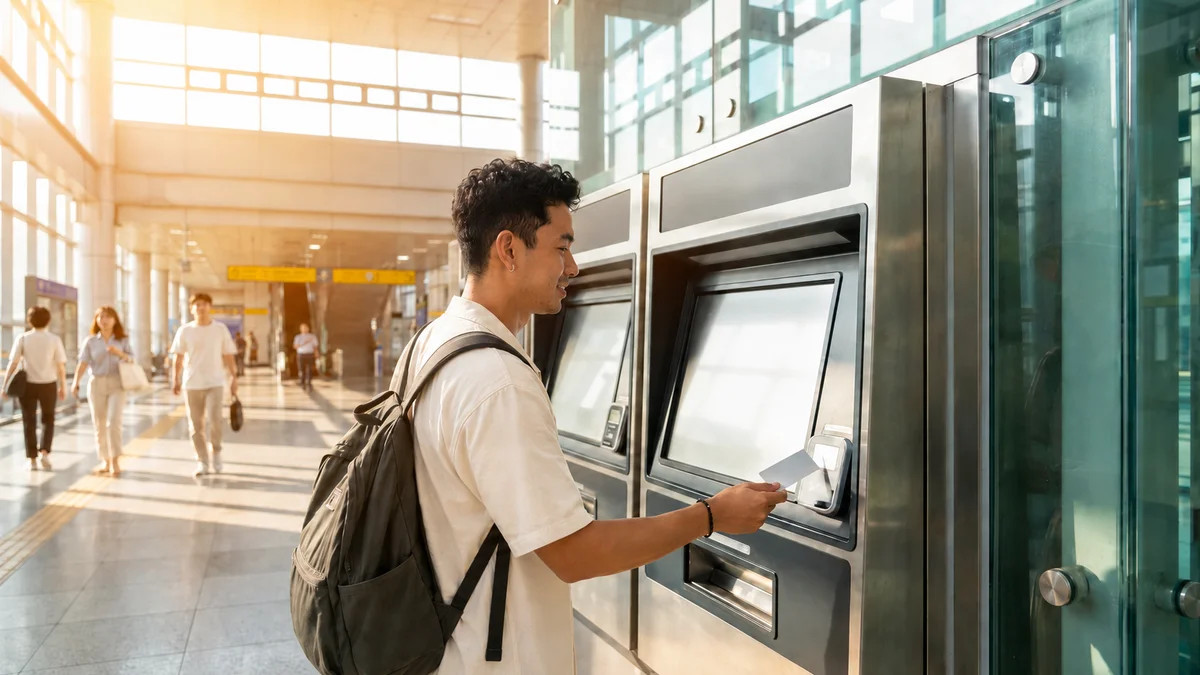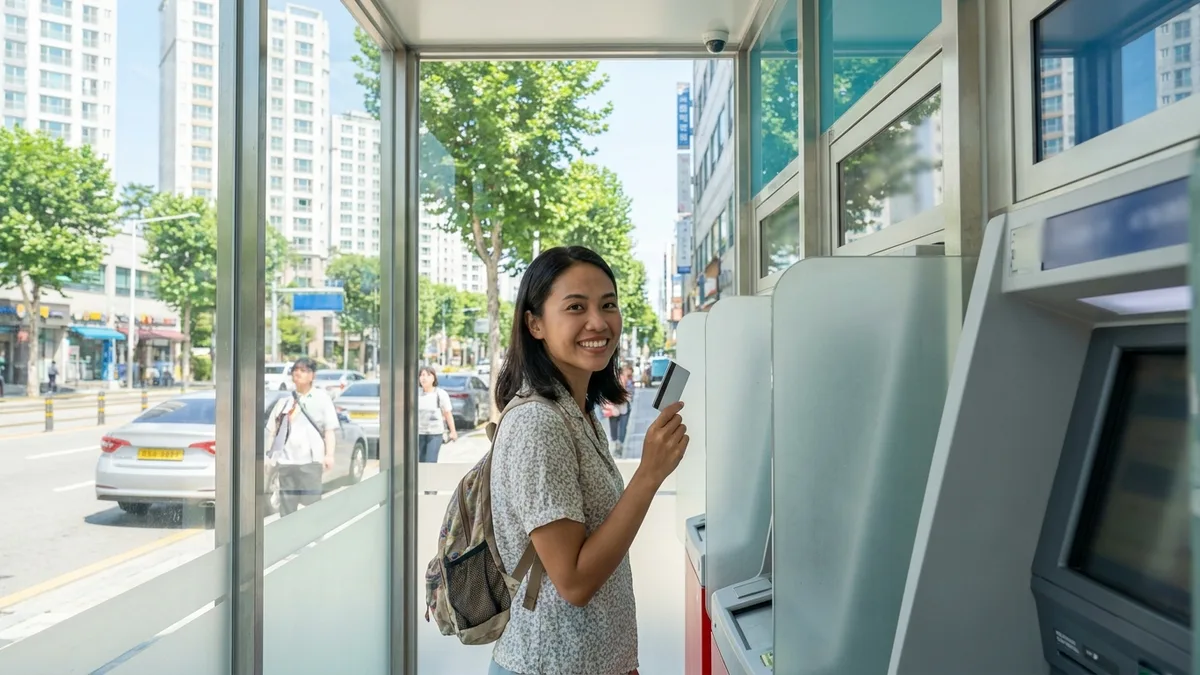
You bought a T-money card at a convenience store, tried to reload it, only to be told "card won't work, cash only"—and walked out empty-handed. If it's your first time in Korea, you've probably been there. Even more so if you just landed without a local SIM or bank account.
Korean convenience stores aren't just snack shops—they're 24-hour life infrastructure for payment, transit-card top-ups, parcel shipping, cash withdrawal, and even meals. But each function has its own requirements, and not knowing where the lines are drawn can leave you stuck at the register or kiosk. This guide covers everything from choosing a chain to using payment methods, T-money, parcels, and ATMs—what works and what doesn't, all in one place.
The fees and services below are based on publicly available info as of 2026-08. Convenience store fees and payment policies change frequently, so always double-check with official CU (cu.bgfretail.com) and GS25 (gs25.gsretail.com) websites or in-store before using. For T-money questions, call the T-money customer center at ☎1644-0088.
The Big Four Chains — Similar Features, Different Parcel Services
Korea's convenience-store landscape is basically covered by four major chains. Basic functions (payment, T-money sales, ATM) are similar everywhere, but you'll want to pick a specific chain for these purposes:
| Chain | Store-pickup parcel (half-price) | Unmanned parcel kiosk | Store count | Chain app |
|---|---|---|---|---|
| CU | ○ CU Half-Price Parcel | CU Postbox | Top tier | Pocket CU |
| GS25 | ○ Half-Price Parcel | GS Postbox | Top tier | Woori-Dongne GS |
| 7-Eleven | ✕ (regular parcel only) | Counter-based mostly | ~3rd largest | 7-Eleven app |
| emart24 | ✕ (regular parcel only) | Counter-based mostly | ~4th largest | emart24 app |
○=available, ✕=not available. As of 2026-08; services and apps may change (verify officially).
- In downtown areas, you'll see one every few steps, but density drops sharply in rural towns and outskirts. Before long-distance travel, stock up on necessities at convenience stores near terminals or stations.
- Bags cost extra at all chains. Due to environmental regulations, single-use plastic bags aren't sold; paper bags, volume-based waste bags, or biodegradable bags cost 100 KRW to a few hundred KRW (as of 2026-08). Bring a shopping bag or backpack.
Where to go for what?
- Cash withdrawal: The machine matters more than the brand. Look for a "Global ATM" label; stores near stations, airports, and major commercial areas have higher odds.
- Store-pickup parcel (half-price): GS25 and CU only. 7-Eleven and emart24 only handle regular parcel services.
- Alipay / WeChat Pay: CU and GS25 are most reliable.
- Late night: 24-hour status is store-specific, not brand-wide. Stores inside buildings or near universities may close at night—check hours on a map app before going.
Payment
Convenience-store payment is fairly accessible for foreigners. Here's the breakdown as of 2026-08:
| Payment method | Works? | Notes |
|---|---|---|
| Foreign Visa/Mastercard (IC chip insert) | ○ | Accepted at most major-chain locations |
| Contactless (tap) foreign card, Apple Pay, Google Pay | △ | Mostly works, but depends on the terminal at each location |
| Alipay/Alipay+, WeChat Pay, UnionPay | ○ | Widely supported at CU, GS25, and other major chains |
| Asian e-wallets (AlipayHK, GCash, Touch 'n Go, TrueMoney, etc.) | △ | CU and others are expanding support via Alipay+ partnerships (varies by store and time) |
| Foreign card for T-money top-up | ✕ | Top-ups are cash-only — see T-money section below |
○=supported, △=varies by store/time, ✕=not possible. As of 2026-08; may vary by terminal and location. Among Asian e-wallets, Taiwan LINE Pay is accepted at designated merchants like 7-Eleven, CU, and emart24 via QR code, but Japan LINE Pay ended service in 2025, so it varies by country. See LINE Pay Korea Guide for details (as of 2026-08, verify officially).
- If contactless tap fails, try inserting the card (IC chip) in the terminal. If self-checkout won't work, head to the staffed register—it often goes through.
- How to use Alipay / WeChat Pay: Before paying, say "Alipay" (or show the app), then open your app's payment code (Pay / 付款码) screen and show it to the cashier—they'll scan it. At self-checkout, you'll need to select a QR/e-payment menu; if that doesn't work, go to the staffed register. Payment is processed in KRW, and exchange rates follow your wallet app's policy (as of 2026-08).
- Asian e-wallets (AlipayHK, GCash, Touch 'n Go, TrueMoney, etc.) vary by store and time. Before paying, show your payment-code screen and ask if it's accepted—it's the fastest way to find out.
- Cigarettes and some gift cards may have payment-method restrictions.
- ID required for alcohol and tobacco. You'll need to show a physical passport or Alien Registration Card (ARC) to verify you're an adult; photos or copies often won't be accepted (varies by store).
- Carry cash mainly in 10,000 KRW notes. 50,000 KRW notes can cause change shortages for small purchases (varies by store).
T-money — You Can Buy with a Card, But Top-Up Is Cash Only
Convenience stores are the most common place to buy and reload a T-money transit card. Since reloads require cash, it's safest to exchange at least 30,000~50,000 KRW in cash at the airport. That way, even if ATMs fail, this flow won't break.
These phrases work at the counter if you read them aloud or show them on your screen:
- "T-money juseyo" — Give me one T-money card
- "Man-won chungjeon-hae juseyo" — Top up 10,000 KRW (reloads are usually in 1,000 KRW increments)
- "Bongtu juseyo" — Give me a bag
If speaking feels awkward, hand over the card and cash together and point at the amount—it usually gets through. If the clerk asks a question in Korean, they're usually asking "how much to top up," so showing the bill will work.
- Buying the card: Basic cards cost around 2,500~4,000 KRW; the standard design runs about 3,000 KRW. Character or collaboration goods can exceed 10,000 KRW (as of 2026-08, varies by store and product). This card fee is not a deposit and is non-refundable. Some stores accept card payment for the card purchase itself. For card selection and refund (balance return) rules, see the T-money Purchase, Top-Up & Refund Guide.
- Top-up: Tell the cashier the amount and reload—top-up payment is cash only (as of 2026-08). Even Korean credit cards are usually blocked for convenience-store top-ups, let alone foreign cards. Single top-ups typically range from 1,000 to 90,000 KRW (as of 2026-08). If card price or top-up limits confuse you, call the T-money customer center at ☎1644-0088.
- If you don't have cash, the fastest route is "ATM withdrawal → reload" using a foreign card at an in-store ATM. But not all machines accept foreign cards, so check the ATM section below first.
- Methods to reload with a foreign card (mobile app, unmanned kiosk, etc.) have their own conditions, covered in How to Reload Transit Cards with Foreign Cards.
Convenience Store Parcels
If you need to send luggage or packages within Korea, you don't have to go to the post office—you can ship from a convenience store. There are two ways:
1) Store-Pickup Parcel — GS25 Half-Price Parcel / CU Half-Price Parcel
- You send from a convenience store, and the recipient picks it up at another convenience store. No home delivery, but lower rates.
- GS25 Half-Price Parcel: Weight-based pricing; mainland zones have flat rates regardless of distance. ≤500g 1,900 KRW · ≤1kg 2,300 KRW · ≤5kg 2,700 KRW; Jeju↔mainland or island routes run 4,000~4,400 KRW (as of 2026-08, verify officially). Delivery usually takes 2~4 days.
- CU Half-Price Parcel (formerly "Kkiri Parcel" / "Affordable Parcel"): CU's version of the same concept; the name has changed several times, so look for "Half-Price Parcel" on in-store kiosks. Since 2026, the carrier has unified and delivery speed has improved; rates run ≤500g 1,800 KRW, ≤1kg 2,100 KRW (as of 2026-08, verify officially—zone-specific rates shown on the submission screen).
- For the same weight, this is over 1,000 KRW cheaper than a regular parcel (~3,400 KRW+) — roughly 60~70% of the regular price. But it doesn't go to your door and takes a few extra days.
- When it arrives, the recipient gets an SMS notification (with QR/pickup number). Show that to the store clerk and pick it up.
What to bring before submission: Recipient's name and mobile number, the pickup store (branch name or address), and your own mobile number. For regular parcel, you'll also need the recipient's Korean street address in Hangul.
Submission is done at the in-store unmanned kiosk (GS Postbox / CU Postbox) in this order:
- On the screen, tap Parcel Submission → select Half-Price Parcel (store pickup)
- Search and select the pickup store where the recipient will collect (search by region or branch name)
- Enter recipient name, mobile number, and sender info
- Place item on the scale to measure weight → fee is auto-calculated
- Pay the fee — pay by card directly at the kiosk, or take the printed receipt to the counter. Unlike T-money top-ups, card payment often works here (varies by store/kiosk, verify officially)
- Stick the printed shipping label on the item and place it in the designated area or hand it to staff—submission complete
Plan B if stuck: Kiosk screens are mostly in Korean; if you can't proceed, bring your item and a note with recipient info to the staffed counter and ask for help (may not be possible during peak hours or at some stores). Get the recipient's Korean address in Hangul from Naver Map/Kakao Map search or from your lodging/friend. How to use map apps is covered in the Naver Map & Kakao Map Foreigner Guide.
2) Regular Parcel — Home/Lodging Delivery
- Submit via GS Postbox, CU Postbox unmanned kiosk or counter, and the courier picks it up and delivers to the address. Both chains have unmanned kiosks, so there's no need to hunt for a specific brand.
- Rates start from ~3,400 KRW based on weight and region (GS25 0~350g same zone 3,400 KRW, different zone 3,900 KRW, Jeju 6,600 KRW; CU domestic parcel also starts around 3,400 KRW). Weigh at the kiosk and it auto-calculates. Latest rate tables: GS Postbox (cvsnet.co.kr), CU Postbox (cupost.co.kr) (as of 2026-08, verify officially).
- Kiosks are often Korean-language-focused. Prepare the recipient address in Korean street address (Hangul) for smooth processing.
- Convenience-store parcel is domestic shipping only. International shipping to your home country is usually not accepted at convenience stores. For international, Korea Post EMS (ems.epost.go.kr) is most common, with counter hours typically weekday 09:00~18:00 (Saturday hours and closing times vary by branch). Bring your passport and English recipient address/contact; country/weight-based rates can be checked on the website (as of 2026-08, verify officially). For large items like suitcases or airport shipping, see the Luggage Storage & Delivery Guide.
⚠️ What foreigners should know in advance: Submission and arrival notifications are SMS-based via mobile, so you (or the recipient) need a number that can receive texts in Korea.
Convenience Store ATMs — You Need a "Global ATM" Label for Foreign Cards
Convenience-store ATMs offer 24-hour cash access, but not every machine accepts foreign cards. Only machines with a "Global ATM" label or foreign-card logos (Visa, Mastercard, Cirrus, PLUS) will take foreign cards. Unlike currency-exchange counters, exchange rates follow your card issuer's policy and separate foreign-withdrawal fees apply; convenience-store machines are open 24/7 but tend to have higher fees than bank ATMs (as of 2026-08, verify officially).
- The operator name (whether it's a bank ATM or convenience-store partner machine) is printed on the side or bottom of the screen. Even within the same brand store, operators vary by location, so the next store's machine often works.
- Machines without international card-brand logos may allow balance inquiry only but reject withdrawal. Don't keep trying the same machine—find a different one.
- Even 24-hour machines can briefly pause for maintenance or run out of cash, especially late at night (varies by machine).
Plan B when withdrawal fails
- Try one or two more locations — As noted above, operators vary by store, so nearby convenience stores often work right away.
- Bank ATMs or currency exchanges — Bank-branch ATMs, airport/Myeongdong currency exchanges, or station exchange kiosks are alternatives.
- If cash takes too long, skip T-money — Check whether you can use foreign cards directly for public transit in Using Foreign Credit Cards on Korean Transit and How to Reload Transit Cards with Foreign Cards.
Details on fee structures, per-transaction limits, and what to do when the screen asks you to choose a KRW exchange rate are in the ATM Foreign-Card Cash Withdrawal Guide.
Ready-to-Eat Food & Daily-Life Tips
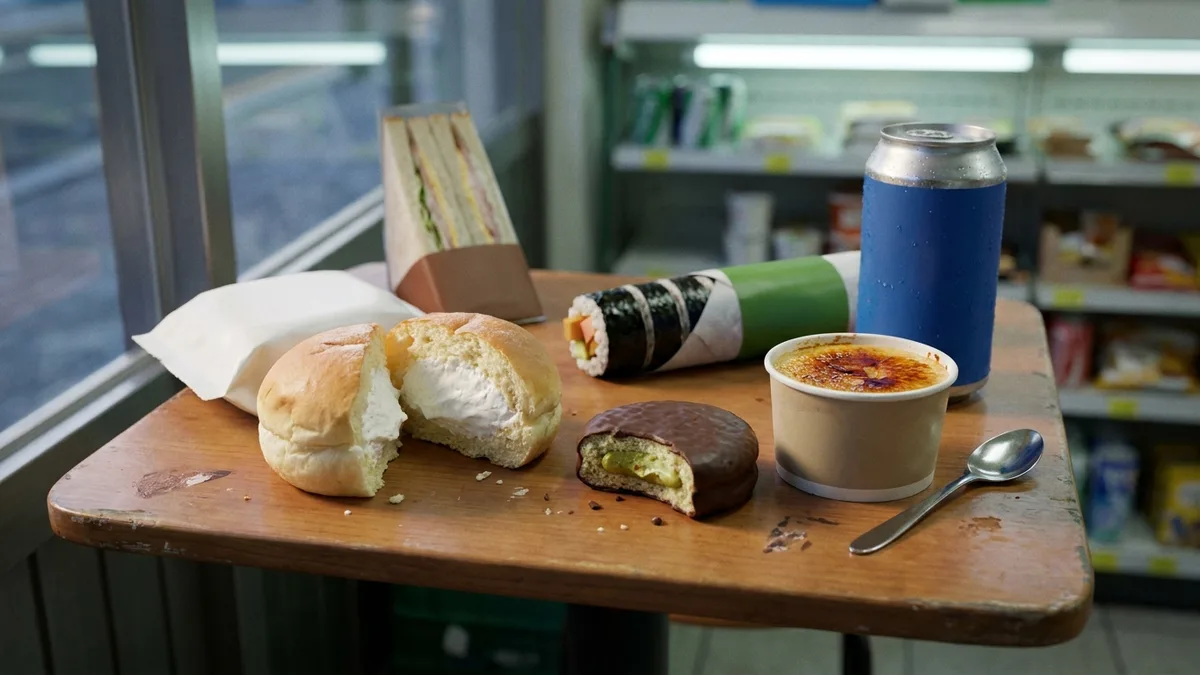
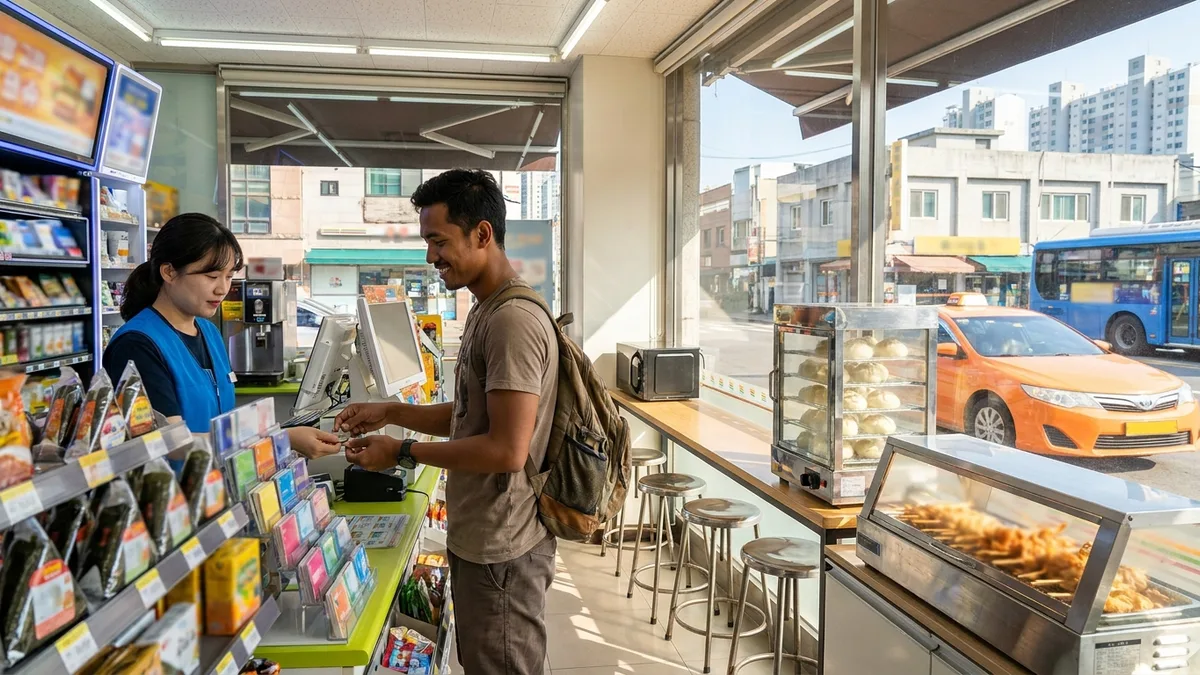
- Meal solution: Triangular kimbap, kimbap rolls, lunch boxes, sandwiches, and cup noodles—use the in-store hot water and microwave freely. If the store has an eat-in area, you can eat on the spot.
- 1+1 / 2+1 promotions: These labels on price tags mean "buy one, get one" or "buy two, get one." Drinks and snacks are quite affordable if you stick to promo items.
- Daily necessities: Umbrellas, charging cables, socks, OTC meds (some over-the-counter items), toiletries—most emergency needs are covered. Many stores also sell local volume-based waste bags (varies by store).
- Utilities & others: Some stores support prepaid mobile top-ups and various bill-payment services (varies by store and service, verify officially).
- Membership points: Show your chain app's (Pocket CU, etc.) membership barcode at checkout to earn points and app-exclusive discounts. But most domestic membership apps require Korean mobile-number verification, so you may hit a wall at signup if you don't have a number yet (arrival period, short-term travel). Sign up once you have a number; until then, it's faster to ask at the counter if telecom or credit-card partner discounts apply. Activation process: Foreigner Mobile-Plan Guide; services available without a number: Korea Services Without Korean Phone Number.
- If you arrive late on your first night, order matters. ① Withdraw cash at ATM → ② Buy T-money card → ③ Reload with that cash → ④ Water/simple meal—finish in that sequence and next morning's commute will be much smoother. A first reload of 10,000~20,000 KRW covers several days of city travel.
Transit & Payment Connection Tips
Convenience stores are lifesavers right after arrival, but they have clear limits. Long-distance travel like KTX or express bus can't be booked there. And many Korean transit/booking apps require Korean mobile-number verification, which can block you early in your stay or during travel.
Of course, Korail's English site and official express-bus channels sometimes accept passport and foreign cards. But app verification requirements vary, so having one transit/payment app designed to work without identity verification makes it easy to bridge from convenience stores to wider travel.
Want Korea's transit and payments in one app — without a Korean phone number or bank account? Check out LACHA.
Built to work without a Korean phone number or bank account, with overseas payment methods like Alipay, WeChat Pay, and Apple Pay. Taxi hailing plus KTX, express bus, and airport railroad (AREX) booking — all in one app.
KTX now up to ₩10,000 off. Enter code at sign-up for 3,000P on top
Download now


Frequently Asked Questions (FAQ)
Q1. Can I pay with a foreign credit card at convenience stores? Yes, most locations at major chains (CU, GS25, 7-Eleven, emart24) accept foreign-issued Visa and Mastercard. Contactless (tap) also works in many places, but may fail depending on the terminal. If tap fails, try inserting the card or use the staffed register.
Q2. Can I reload T-money with a foreign card at convenience stores? No. Convenience-store T-money top-ups are cash only (as of 2026-08). Card purchase may accept card payment at some stores, but reload payment requires cash. If you don't have cash, withdraw from a Global ATM in-store first.
Q3. Can I pay by card for a single 1,000 KRW item? Is there a minimum? Yes. In Korea, merchants can't refuse card payment due to low amounts, so even a single drink can be paid by card. Convenience stores don't set minimum purchase amounts. But foreign cards or e-wallets may fail due to terminal issues, so carrying small change is safer (as of 2026-08).
Q4. Can I return or exchange items bought at a convenience store? If you bring the receipt to the store where you bought it, exchange/refund is usually possible. But convenience stores are franchises run by owners, so store discretion is high, and opened products, refrigerated/frozen foods, cigarettes, and gift cards are generally not eligible. Other branches typically won't process it, so remember which store you bought from and keep your receipt (varies by store).
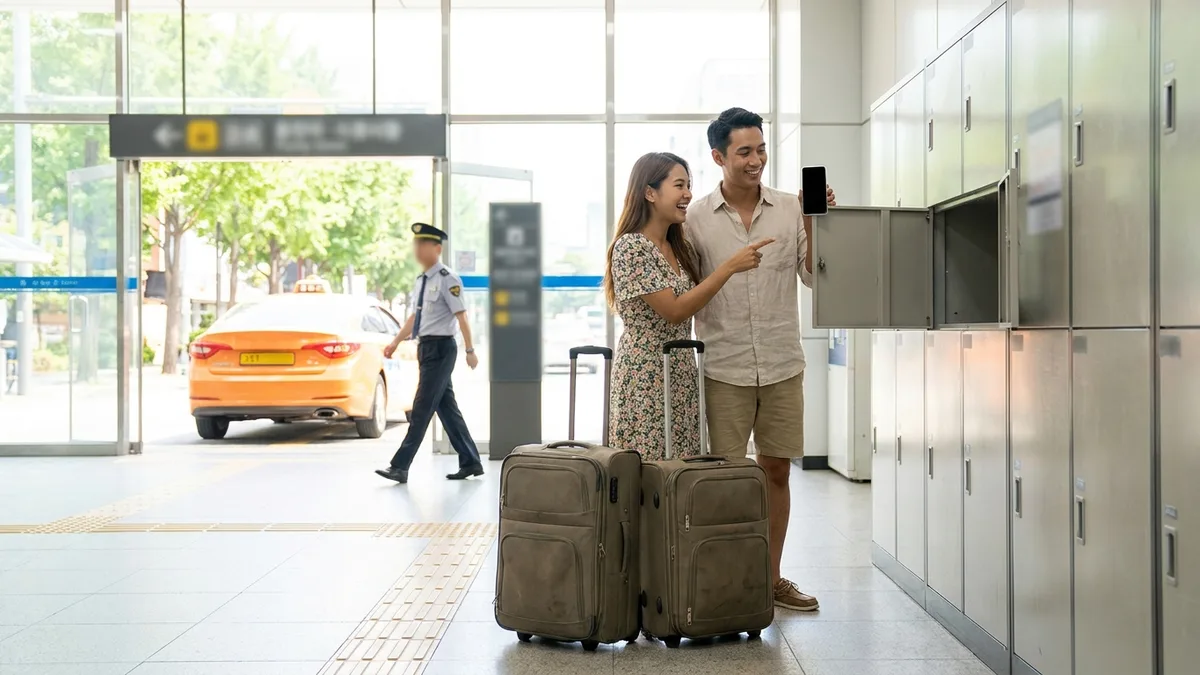
Q5. Can I leave luggage temporarily at a convenience store? No. Convenience stores don't offer luggage-storage services as a rule, so asking to leave a suitcase usually gets refused. Some stores have partner storage services, but it's uncommon. Using station/terminal lockers or dedicated storage/delivery services is more reliable—see the Luggage Storage & Delivery Guide.
Disclaimer: This article is for general information only. Convenience-store fees, payment support, parcel rates, and ATM fees vary by chain, store, and time and change frequently, so verify before use via official CU (cu.bgfretail.com), GS25 (gs25.gsretail.com) websites; for parcel rates, CU Postbox (cupost.co.kr), GS Postbox (cvsnet.co.kr); for T-money, call ☎1644-0088. Figures in this article are based on publicly available info as of 2026-08. Actual payment/withdrawal availability, fees, and exchange rates depend on card-issuer and ATM-operator policies. LACHA does not process payments/withdrawals, guarantee success, or assume responsibility for outcomes from this guide.