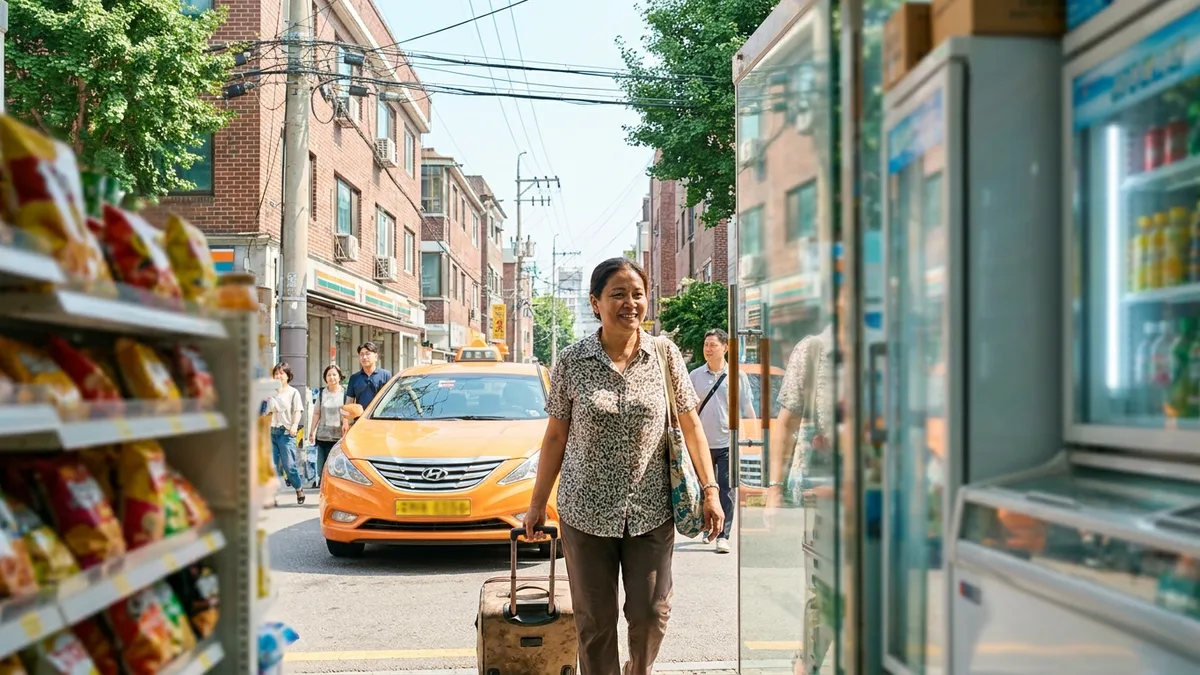
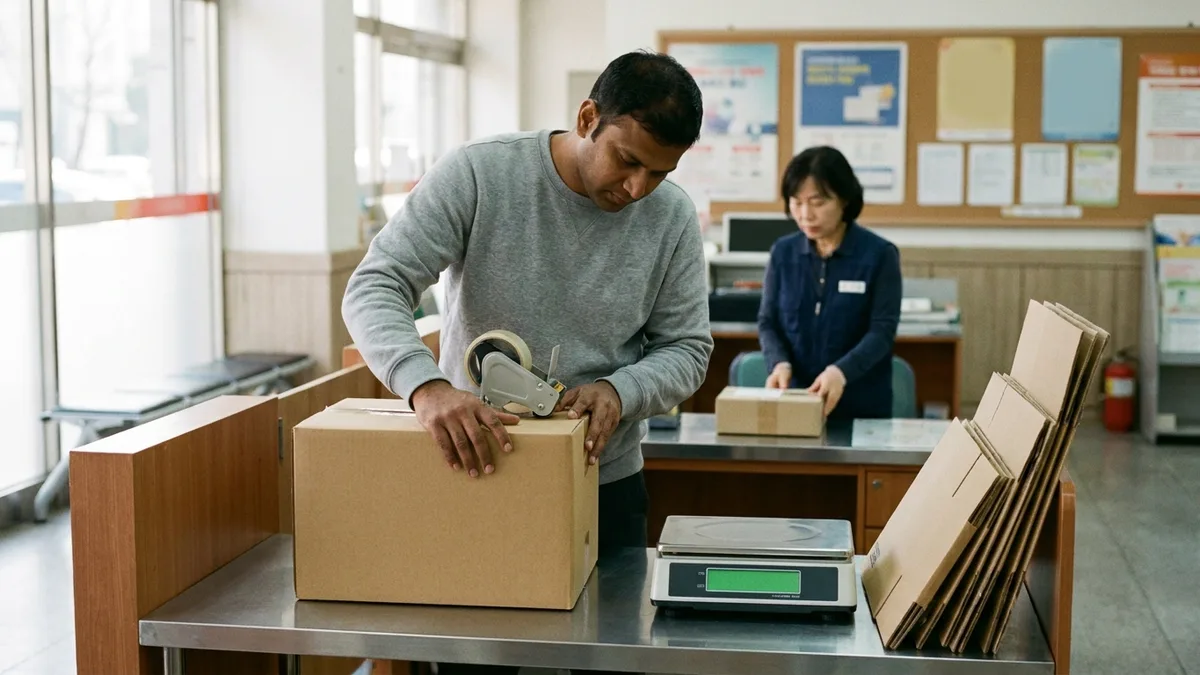
Picture a worker who just finished a four-year contract and flies home next month. Two suitcases are already stuffed full, and there's still a pile in the corner of the room: a comforter, an electric blanket, clothes, boxes of gifts. Paying the airline's excess baggage fee for all of it would hurt, but throwing it away feels like a waste. So they haul a 25kg box to the post office — and get told, "Air parcels only go up to 20kg." Cue repacking the box right there at the counter. That's what actually happens when you don't know the international shipping rules.
This guide is specifically about sending things from Korea to another country. If you're traveling and just need to store bags or forward them to an airport or hotel inside Korea, that's covered separately in our luggage storage and delivery guide. Here we'll walk through the post office's three options (EMS, air parcel, surface parcel) — price and speed, weight and size limits, what you can't send, customs declarations, and the point where a private company starts to make more sense.
The rates, transit times, and rules below reflect publicly available information as of 2026-08. International postal rates change often — there was another overhaul in July 2026 — so before you ship, double-check with the rate calculator on the Internet Post Office EMS site (ems.epost.go.kr) and the Postal Customer Center at ☎1588-1300 (weekdays 09:00–18:00).
The three post office options — what's the difference?
There are basically three ways to send a package abroad through the Korean post office. From fastest and priciest to slowest and cheapest: EMS (express), air parcel, and surface parcel.
For light items under 2kg, there are also separate services called K-Packet and Small Packet (as of 2026-08). This guide compares the three main options assuming a "moving box" of around 20kg.
| Service | Speed | Weight cap | Best for |
|---|---|---|---|
| EMS | 2–8 days to major countries | 30kg (20kg for some countries) | Urgent items, documents, last-minute shipping before you fly |
| Air parcel | Typically 1–2 weeks (reported) | 20kg | Not urgent, but you can't wait a month |
| Surface parcel | Typically 1–3 months (reported) | 20kg | Bulk shipments where a late arrival is fine |
EMS publishes official delivery estimates by country: roughly 3–4 days to Vietnam, 5–8 days to the Philippines, and 3–4 days to the US (varies with customs clearance, as of 2026-08). Air and surface parcels have no official transit estimates, so you're going by user reports — and some people have reported surface shipments to the US taking 50–60 days. Build in plenty of buffer.
One change worth knowing about: as of July 1, 2026, the EMS rate structure switched from "base rate + transport surcharge" to a single all-in rate by weight, and most countries got more expensive. The US rate at 0.5kg went from 29,500 KRW to 39,000 KRW (per the official notice), so if you're budgeting based on what you paid last time you shipped, you'll come up short.
Rate comparison: Vietnam, the Philippines, and the US at 20kg
The same 20kg box can cost several times more or less depending on the service and destination. These figures come from the official rate tables and calculator as of 2026-08.
| Service (20kg) | Vietnam | Philippines | United States |
|---|---|---|---|
| EMS | 93,500 KRW | 131,500 KRW | 441,000 KRW |
| Air parcel (total incl. surcharge) | 88,500 KRW | 114,000 KRW | 362,500 KRW |
| Surface parcel | 58,500 KRW | 58,500 KRW | Appears unavailable* |
*The US isn't on the list of countries accepting surface parcels (as of 2026-08). We couldn't find an official suspension notice, so confirm at the counter.
One thing to watch out for: the air parcel rate table excludes the transport surcharge. The table alone makes 20kg to the Philippines look like 78,000 KRW, but a per-kg surcharge (200 KRW for Vietnam, 1,800 KRW for the Philippines, 6,000 KRW for the US, per the rates in effect since 2025-12) gets added, which is how you land on the totals above. The online calculator shows the all-in total, so trust the calculator's number.
Here's how EMS rates move as weight changes (as of 2026-08). For reference, 20kg runs 98,500 KRW to Japan, 114,000 KRW to Thailand, and 103,000 KRW to China.
| EMS weight | Vietnam | Philippines | United States |
|---|---|---|---|
| 5kg | 36,000 KRW | 44,500 KRW | 128,500 KRW |
| 10kg | 53,500 KRW | 71,500 KRW | 233,500 KRW |
| 30kg (cap) | 131,000 KRW | 193,500 KRW | 650,000 KRW |
Surface mail isn't priced per country — it uses four zones (20kg, as of 2026-08):
- Zone 1 (Japan, Hong Kong, Taiwan): 57,000 KRW
- Zone 2 (Vietnam, the Philippines, Thailand, Indonesia, and most of Southeast Asia): 58,500 KRW — 10kg costs 35,500 KRW
- Zone 3 (Europe, Australia, Canada, India, etc.): 74,000 KRW
- Zone 4 (Brazil, South Africa): 89,000 KRW
Bulky items get charged by volumetric weight
Take length × width × height (cm) and divide by 6,000 — that's the volumetric weight in kg. For EMS and air parcels, you're charged on whichever is greater: actual weight or volumetric weight. Light-but-bulky things like comforters and stuffed animals are the trap here.
For example, a post office box No. 5 (48 × 38 × 34cm) has a volumetric weight of about 10.4kg, so even if you only put 5kg of bedding inside, you can end up billed at the 10kg tier. When you're shipping light items in a big box, vacuum-compression bags are where the real savings are.
For surface parcels, the official calculator has the volumetric weight field disabled, which suggests pricing is by actual weight — but we couldn't confirm a written rule, so ask at the counter if your shipment is bulky.
Before you go, measure your box and weigh it, then plug the numbers into the rate calculator (ems.epost.go.kr) to see the all-in total in advance. It's the surest way to avoid a budget surprise at the counter.
Weight and size limits, and prepping your box
- Weight: international air and surface parcels max out at 20kg; EMS goes up to 30kg (20kg for some countries such as Myanmar and Mongolia). Above that, EMS Premium (in partnership with UPS) accepts up to 70kg (as of 2026-08).
- Size: EMS allows up to 1.5m in length and 3m in length plus girth (2.75m for the US). International parcels are limited to 1.05m in length and 2.0m in length plus girth. Because the parcel limits are tighter, oversized boxes can sometimes only go by EMS.
- Boxes: post offices sell boxes in sizes No. 0 to No. 5 for roughly 500–1,800 KRW (per a 2025 summary; stock and prices vary by branch). The largest, No. 5, is 48 × 38 × 34cm, so for a 20kg load you're better off buying a sturdy moving box separately. Pack it so nothing gets crushed and use plenty of tape.
What you can't send — batteries, aerosols, food
Read this list before you head to the post office. Every international shipment goes through X-ray security screening, and if a prohibited item is caught, the package is returned to the accepting post office, where you'll have to go pick it up in person.
- Lithium batteries and battery-powered devices are completely prohibited: laptops, phones, tablets, vapes, Bluetooth earbuds, and anything else with a built-in battery cannot be sent (as of 2026-08). If the battery is removable, you can send the device body with the battery taken out, and non-rechargeable AA/AAA batteries are fine.
- No aerosols or pressurized containers: insecticides, aerosol pain-relief sprays, sunscreen sprays and similar metal pressurized cans, perfume, disposable lighters, butane canisters, acetone, and alcohol over 60% ABV are all banned. Products in plastic or glass containers, and unopened commercially bottled alcohol under 60% ABV, are allowed.
- Stick to commercially packaged food: anything you've repacked or portioned yourself requires an accompanying 품목제조보고서 (pummok jejo bogoseo, product manufacturing report), and seeds need a phytosanitary certificate. Packing sealed, store-bought items like instant noodles and snacks is the safe route.
The prohibited and restricted items guidance is available in five languages — Korean, English, Chinese, Japanese, and Thai (ems.epost.go.kr). Destination countries have their own bans on top of that, so check both when you drop off your package.
Filling out the customs form and duties in the destination country
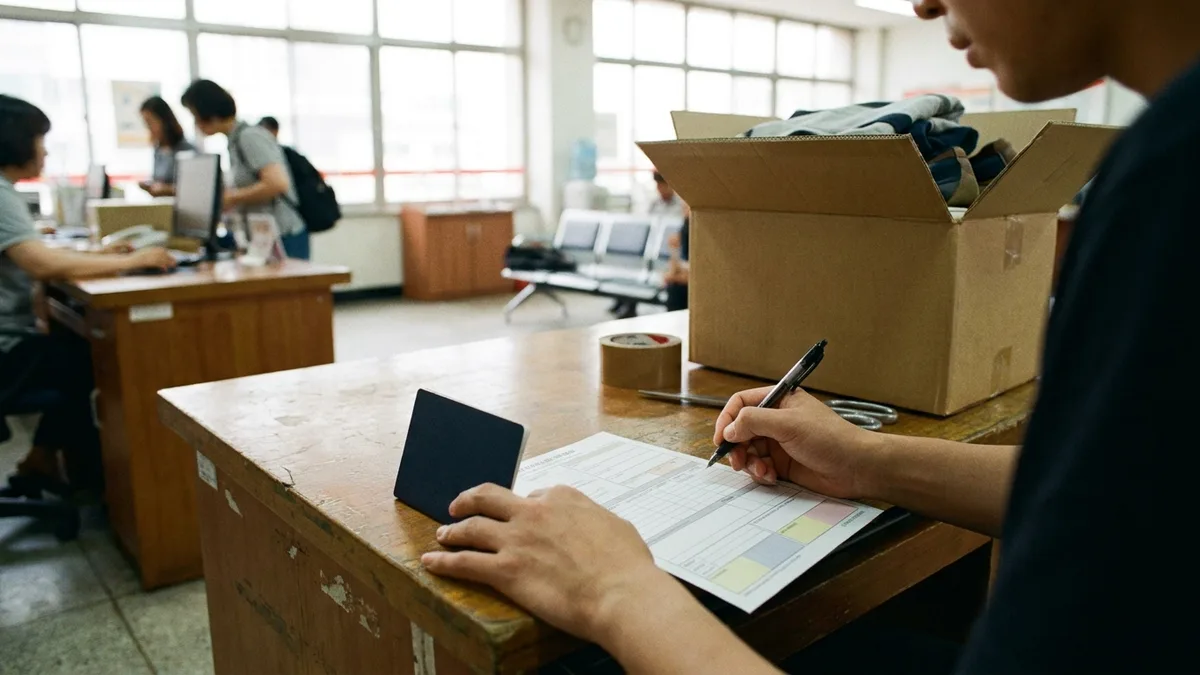
International shipping always comes with a customs declaration. Here's how the post office's guidance breaks it down (worth confirming officially).
- Shipments valued at 300 SDR or less use a CN22 (customs label); above that, a CN23 (customs declaration) applies.
- For EMS and international parcels, the address label already has the CN23 printed on it — you write in the item description (in English), quantity, value, and country of origin.
- Be specific in English — "clothes," "books" — to speed up clearance. The post office website has a lookup tool for English item names and HS codes.
Duties are assessed by the receiving country. This matters especially for the US, where the elimination of the de minimis exemption in August 2025 made postal shipments subject to duty as well. Mail from Korea to the US was suspended for a period and resumed on October 22, 2025, and since then, for EMS, international parcels, and K-Packet sent through the post office, the sender prepays the duty and fees when dropping off the package (duty prepayment). If the declared value is USD 2,500 or less (for items arriving from July 24, 2026; USD 800 or less before that), the recipient has nothing extra to pay, and gifts between individuals worth USD 100 or less are exempt from duty. Items over USD 2,500, shipments to US territories such as Guam, and EMS Premium (UPS) can still leave the recipient with a duty bill (rules can change, so confirm before you ship). For used personal belongings, just declare their real value.
When a private international courier or moving company wins
The post office isn't always the best answer. The bigger your shipment and the less urgent it is, the more private companies pull ahead.
- The Philippines: private sea-freight courier services — the "balikbayan box" — are well established here. LBC Korea's jumbo box, for instance, measures 75 × 55 × 75cm, holds up to 80kg, and reportedly runs around 110,000 KRW to Manila and Luzon (posting date unknown — you must confirm pricing and terms with the company). Since the post office charges 58,500 KRW for 20kg by surface mail, anything well above 20kg is dramatically cheaper per box this way. They deliver an empty box to you, you pack it at home, and they come pick it up — door to door.
- Vietnam: cargo companies serving the Korean-Vietnamese community reportedly charge around 3,000–4,000 KRW per kg for sea freight (10kg minimum, roughly one month), with air express running from just under 20,000 up to about 30,000 KRW per kg. These are company-reported prices and vary a lot, so treat them as a ballpark only.
- International moving (household goods): if you're relocating appliances and furniture wholesale, that's territory for an international moving quote. The company handles the customs paperwork for you, but the cost is a different order of magnitude — for just a few boxes, the post office or a cargo company is plenty.
The simplest rule of thumb: 1–3 boxes at 20kg or less each, go with the post office. Anything bigger, or 80kg-class boxes, get quotes from private sea-freight couriers and moving companies and compare.
The post office process, plus discount tips
- Pre-registration (International Mail Smart Booking, 국제우편 스마트접수): you can enter the address and contents for EMS and international parcels in advance through the Internet Post Office or the post office app. It's available 24 hours and you don't need an account. EMS pre-registration reportedly comes with a 3% discount (as of 2026-08, worth confirming officially). If explaining things at the counter feels daunting, entering the address in English at this stage is by far the easiest route.
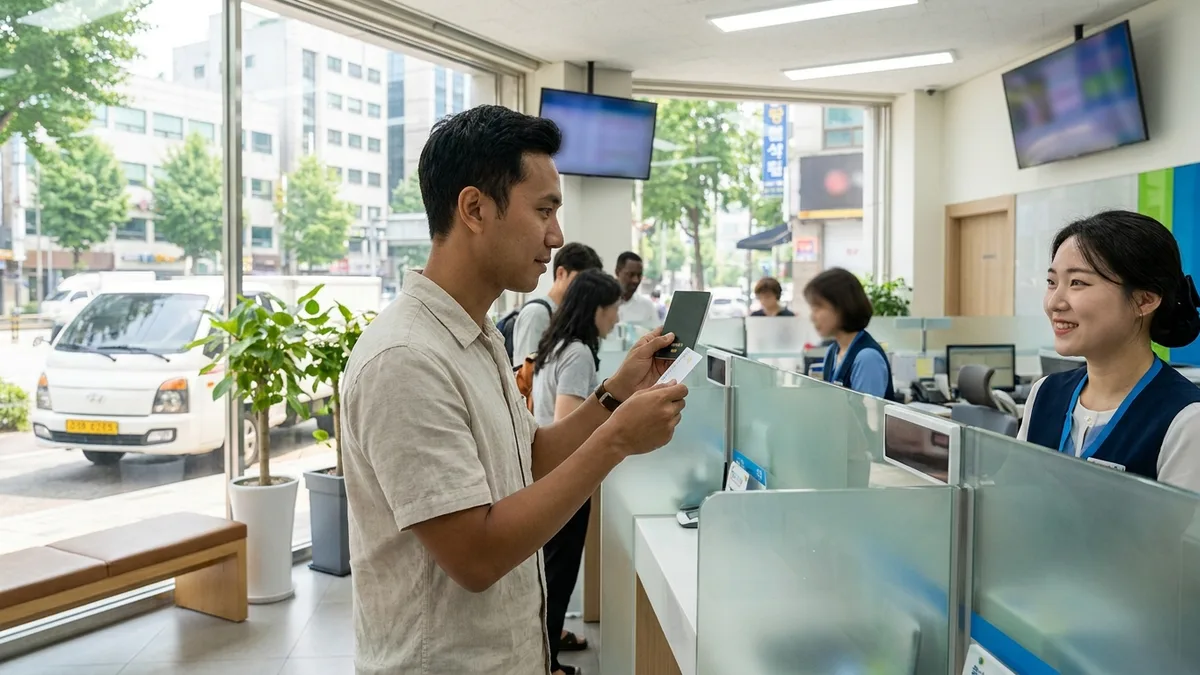
- At the counter: they weigh your package and you pay. Staff English varies by branch, but the post office publishes a Postal Service Guide for Foreigners and a prohibited-items page in five languages, so you can just show them the screen.
- Home pickup: for heavy items, you can request a post office pickup. It's 3,000 KRW per visit plus 1,000 KRW for each additional item, capped at 5,000 KRW (as of 2026-08).
- Insurance: valuables can be insured. Coverage up to 65.34 SDR costs 2,800 KRW, with 550 KRW added for each bracket above that (as of 2026-08).
- Discounts: marriage migrants and other multicultural families get a 10% EMS discount by showing their Alien Registration Card (외국인등록증), and Gyeonggi Province announced that from 2025 it would extend this to foreign residents including E-9 and D-2 visa holders. Eligibility and continuation vary by region, so ask your local post office before shipping.
- For high-volume shippers: an EMS service contract based on monthly spend can go up to an 18% discount (worth confirming officially), but that's aimed at businesses shipping regularly, not individuals sending their belongings home.
Timeline for E-9 workers shipping before departure
Shipping your stuff home is simple if you count backward from your flight date. The schedule below is our own suggestion derived from the transit times — adjust it to your situation.
- 4–8 weeks before departure: send the surface-mail batch first. It typically takes 1–3 months, so this is for bedding, books, and out-of-season clothes that can arrive after you do. If you're sending a large load to the Philippines, book your balikbayan box now.
- 2–3 weeks before departure: send the air parcel batch. At a typical 1–2 weeks, arrival lines up roughly with your own.
- 1 week before departure to the day itself: send whatever's left by EMS. At 3–4 days to Vietnam and 5–8 days to the Philippines, shipping right before you fly still works (as of 2026-08).
- Write down the contents of each box and photograph them. It speeds up the customs form and gives you something to point to if you need to chase a shipment.
- Sort out your money over the same period. The National Pension lump-sum refund has its own pre-departure application process, and getting your remaining savings home is covered in how to send money abroad from Korea. The order matters: finish your transfers and cancel your auto-payments before you close the account.
Those last few weeks involve a lot of back-and-forth between the post office and the airport. Carrying a 20kg box onto a bus isn't realistic, so it ends up being taxis — but many Korean apps require identity verification through a Korean phone number, so once you've cancelled your Korean line ahead of your flight, you can get blocked at the "request a ride" step.
Having one transport and payment app that's built to work without identity verification makes this stretch much easier. Even after your Korean number is gone, you can still call a taxi and pay with a foreign payment method — which takes the box-hauling post office runs and that final airport trip off your worry list.
Want Korea's transit and payments in one app — without a Korean phone number or bank account? Check out LACHA.
Built to work without a Korean phone number or bank account, with overseas payment methods like Alipay, WeChat Pay, and Apple Pay. Taxi hailing plus KTX, express bus, and airport railroad (AREX) booking — all in one app.
Up to 60% off Korea transit with a coupon (max ₩3,000): enter code at sign-up. KTX gets up to 18% off on top
Download now


Frequently asked questions (FAQ)
Q1. Can I mail a laptop or phone through the post office? No. Devices with built-in lithium batteries cannot be shipped by either EMS or parcel (as of 2026-08). If the battery is removable, you can send the device body with the battery taken out. Plan to carry battery-powered devices with you on the plane.
Q2. What's the cheapest way to ship? At 20kg, surface parcel is the cheapest. It's 58,500 KRW to Southeast Asia — less than half the EMS rate to the Philippines (131,500 KRW), as of 2026-08. The tradeoff is 1–3 months in transit. In countries like the Philippines where private sea freight is well developed, private companies can beat it on large loads, so compare quotes.
Q3. Will the recipient have to pay duty on a shipment to the US? Usually not, if you use EMS, international parcels, or K-Packet through the post office. Since October 22, 2025, the sender prepays the duty and fees at drop-off, and with a declared value of USD 2,500 or less (for items arriving from July 24, 2026), the recipient owes nothing. If the value is over USD 2,500, the destination is a US territory such as Guam, or you use EMS Premium (UPS), the recipient may be billed, so for expensive items, check at the post office counter first.
Q4. How do I send something over 30kg? The EMS cap is 30kg, so above that you're looking at EMS Premium via UPS (up to 70kg) or a private cargo or international moving company (as of 2026-08). Splitting your load across several boxes is another option, but international parcels have to stay within 20kg each.
Q5. What value should I put on the customs form? Describe the items specifically in English and declare their actual value. For used personal belongings, it's standard practice to declare their secondhand value (clearance standards differ by destination country — worth confirming officially). Above 300 SDR in declared value, guidance says a CN23 customs declaration applies.
Once the boxes are gone, the rest is money
When your boxes ship out, you're halfway done getting ready to leave. The other half is your finances — apply for your National Pension lump-sum refund before departure, move your savings with an international transfer, then cancel your phone plan and auto-payments, in that order. The rates here reflect the time of writing, so on the day you ship, treat the number from the rate calculator (ems.epost.go.kr) as final.
Note: This article is intended as general living information. Rates, transit times, prohibited items, and customs rules reflect publicly available information as of 2026-08 and change frequently. Before shipping, always confirm current rates and rules on the Internet Post Office EMS site (ems.epost.go.kr) or with the Postal Customer Center at ☎1588-1300. Private company pricing is per the companies' own postings and is subject to change. LACHA has no partnership with Korea Post or any private carrier and does not guarantee customs clearance or delivery outcomes.