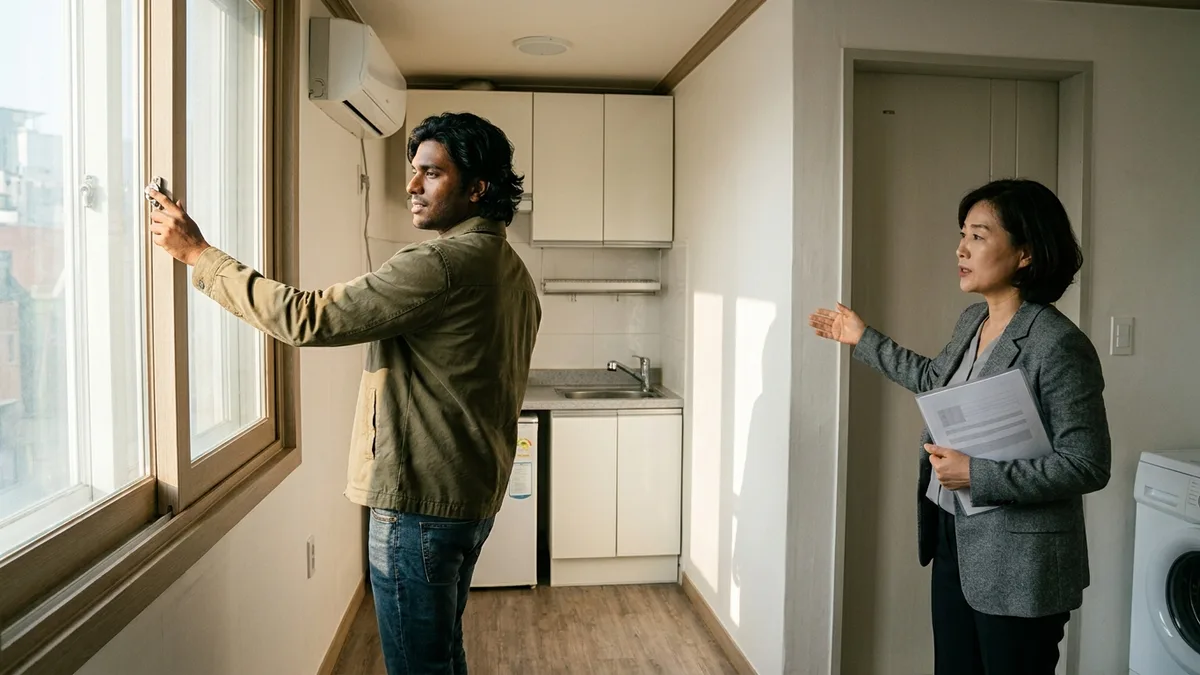
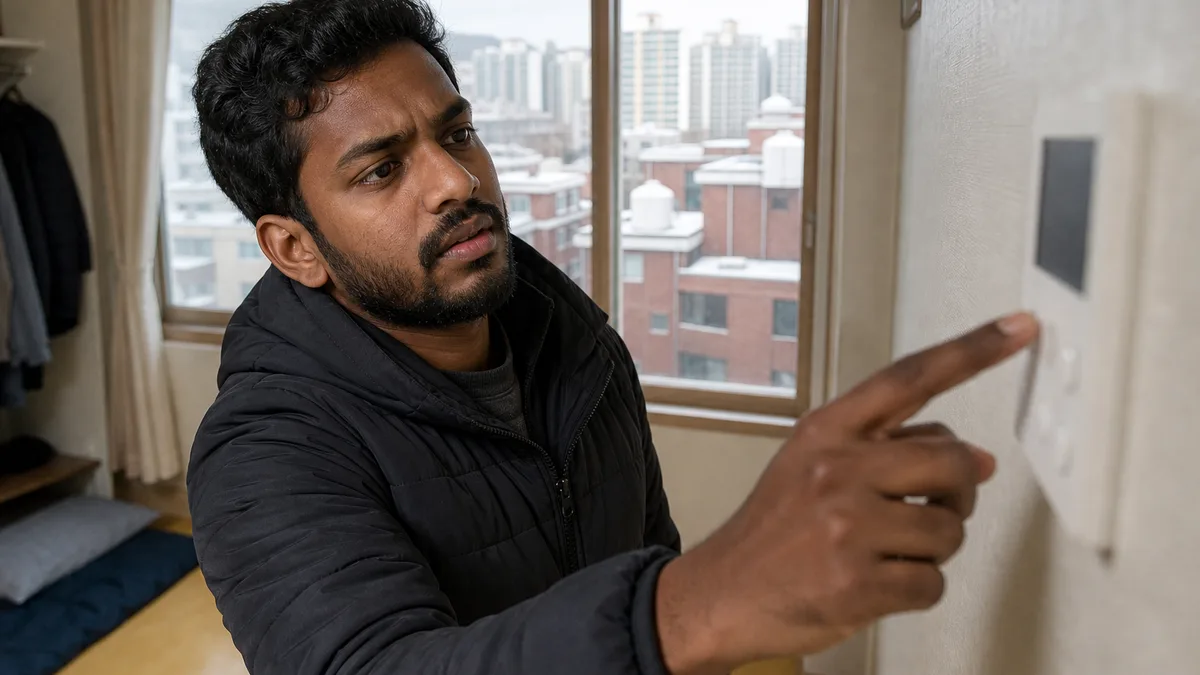
In a Korean home with individual heating, a controller on the wall runs a gas boiler, and the water the boiler heats circulates through pipes under the floor to warm the room. Where people get stuck in their first winter is usually the same. The controller's buttons are labeled only in Korean, the city gas bill arrives in Korean, electricity gets more expensive per unit the more you use, and when a cold wave hits, the water meter freezes. Official guidance and boiler manufacturers agree on one thing: don't turn the boiler off in winter.
Some hurdles are higher only for foreigners. If you switch the boiler off when you leave, the way you did back home, the indoor temperature can drop sharply in severe cold and freeze bursts can happen (water pipes, meters, or boiler pipes freezing and bursting) (Kiturami guidance). You can pay the city gas bill at a convenience store using the QR code on the bill even without a Korean bank account (based on Seoul City Gas), but if you don't know that, you may pay late and get charged late fees. Stuffing the meter box (the box that holds the water meter, which Seoul city guidance also calls a 'protective casing') with old clothes and leaving a faucet running in a thin stream is common knowledge for Koreans, so few people bother to tell you, but in Seoul, if your meter freezes because you didn't insulate it, the user pays for the replacement.
This article is about getting through winter after you've moved in. Deposits, maintenance-fee listings, and contract riders are covered in the foreigner's monthly-rent lease guide, and the order for settling utility bills when you leave Korea is in the final 30-day settlement checklist before leaving Korea. Rates differ by region, so wherever we used Seoul figures, we say so.
Note: The rates, rules, and guidance below were checked as of 2026-09 against public materials from the Seoul Metropolitan Government, Korea Electric Power Corporation (KEPCO), Korea District Heating Corporation, city gas suppliers, and the National Law Information Center, as well as news reports relaying Korea Energy Agency guidance and industry recommendations. Adjustments to city gas and district heating rates for the 2026-27 winter and Seoul's freeze-prevention schedule haven't been announced yet. Things may change, so check again against your bill and each organization's official channels. Sources are collected at the end of the article.
How to read the Korean buttons on a boiler controller
The main functions of a home boiler's room thermostat are indoor heating, hot water, ondol, timer, away, and power (Gas News, 2021-03-18, revised 2022-12-01). The most confusing pair is indoor and ondol. Indoor heating mode runs on the air temperature around the controller, while ondol mode runs on the temperature of the water inside the boiler. Set ondol to 70℃, for example, and 70℃ water circulates under the floor to heat the room.
| Button / display | What it means | How to use it |
|---|---|---|
| Power (전원) | Turns the boiler on and off | Don't switch it off in winter (switch it off and have it checked if it overheats or makes unusual noise or vibration) |
| Indoor (실내, also shown as 실내난방 or 실온) | Keeps the air around the controller at the set temperature | Well-insulated homes (ondol is fine in these homes too) |
| Ondol (온돌) | Sets the temperature of the water circulating under the floor (heating water) | Drafty homes (cold air coming in through gaps in windows and walls), rooms left empty for a long time |
| Away (외출) | Minimal heating to prevent freeze bursts | When you'll be away for two days or more (during a cold wave advisory or warning, see the table in the next section) |
| Timer (예약) | Works differently depending on the model | Check your controller's manual |
| Hot water (온수) | Temperature of the water for showers and dishes | Set it to low or medium |
Button combinations differ by company. In the diagram in the manual for Rinnai's RM550N room thermostat, the way to switch between indoor and ondol is written under the away button and the 'Auto|Save' button as 'hold room temp-ondol for 3 seconds'. Because you switch by pressing a combination of buttons, it's hard to find without the manual. Check the manufacturer's name printed on the controller or on the boiler itself, and look it up in that company's manual or with its customer service center.
Insulation decides which mode to use. According to industry advice reported by Gas News (2021-03-18), in a well-insulated home either one is fine, but in a drafty home, even setting indoor mode to 25-26℃ won't hold the warmth and the heating just keeps running, so it's better to mostly use ondol mode. The same article gives ondol 40-50℃ and indoor 20-22℃ as appropriate winter settings, and says to warm a room that hasn't been used at ondol 60-65℃ for 1-2 hours and then turn it down.
The numbers differ by source. Korea Energy Agency guidance (cited in the trade paper Gigyeseolbi Sinmun, 2023-01-30) says to keep the heating water at around 55℃, puts the appropriate indoor temperature at 20℃, and says lowering it by just 1℃ cuts energy consumption by 7%. Kiturami recommends an indoor temperature of 18-21℃ as the most economical. In indoor mode, start from 20℃, the Energy Agency's recommendation; in ondol mode, start from 40-50℃, the figure Gas News reported; then adjust 1℃ at a time.
Shower hot water is a different setting from the floor heating water. The Gas News article (2021-03-18) says 36-42℃ is good for shower water and that above 50℃ there's a risk of burns, and relays an expert's advice to keep hot water on low or medium, since raising the hot water temperature and using strong water pressure is what runs up the gas bill the most.
On the first day you turn it on, check safety first. Across 21 gas boiler accidents from 2017 to 2021, there were 46 casualties (17 deaths), and 45 of them were from carbon monoxide poisoning (Korea Policy Briefing, 2022-10-24). Government guidance says to check that the flue pipe hasn't come loose or been dented, keep the boiler room's vent open, and keep a carbon monoxide alarm indoors. If overheating, noise, or vibration is different from usual, switch the power off and have it inspected by an after-sales (A/S) repair technician or your gas supplier. If you smell gas or suspect carbon monoxide, get outside first and then call 119 (Korea emergency phone map).
Today, find the manufacturer's name next to the controller or on the boiler itself and take a photo of it.
How to decide when to turn on away mode and when not to
Away mode is not a way to switch the boiler off; it's minimal heating to prevent freeze bursts. Kiturami's official guidance explains that away mode keeps the indoor temperature at around 8℃ to prevent freezing, and lets the boiler bring the room back up to the set temperature with low output when you return. According to reports, it generally holds only a low temperature of 10℃ or below (MBC, 2023-01-26).
How it works differs by company. According to an Asia Business Daily report (2023-01-26), Kyungdong Navien's runs only when the temperature falls below a certain level, Rinnai's runs the heating for 10 minutes every 4 hours, and Kiturami's keeps the indoor temperature at 8℃. Only Kiturami's has been checked against the original manual, and it may differ by model, so check your boiler's manual or the manufacturer's customer service center.
Guidance on when to turn it on varies a little.
| Situation | What the guidance says | Source |
|---|---|---|
| Going out for a few hours, like to work or school | Lower the set temperature by 2-3℃ rather than using away mode | Korea District Heating Corporation official (MBC, 2023-01-26) |
| Out for 6-8 hours | Turning on away mode can waste gas bringing a much-dropped temperature back up | Asia Business Daily, 2023-01-26 |
| Away for two days or more | Away mode is useful | Asia Business Daily, 2023-01-26 |
| Well-insulated home with individual heating | Don't switch it off; keep it on away mode or a low temperature | Korea Energy Agency |
| District-heated home (the whole complex receives heat together) | For short outings, lower it by 2-3℃; for 3 days or more, away mode | Korea Energy Agency |
| During a cold wave advisory (e.g., when a morning low of -12℃ or below is expected for 2 days or more) | An opinion that the timer and away functions do little and keeping indoor heating at 15-17℃ is better | Gas News |
In short: if you're out briefly, lower it by 2-3℃; if you're away for two days or more, use away mode (for district heating, 3 days or more). But if a cold wave advisory, or the colder cold wave warning, is in effect, go with keeping indoor heating at 15-17℃ instead of away mode, even on days you'll be away for a long time (the opinion Gas News reported). On days you're away for a long time, if Seoul's freeze forecast is at 'Alert' or higher, also leave a faucet open just a tiny bit (see the cold wave section below). Kiturami's freeze-prevention tips (2020-12-28) say not to switch the boiler off when you go out, to keep the boiler's power plug connected at all times, and to keep both the gas valve and the distributor valves open.
MBC (2023-01-26) introduced humidifiers, bubble wrap (the air-cushion film used for packing) stuck on north-facing windows, and thermal underwear (a warming effect of about 2.4℃) as ways to save. Clothes to layer are covered separately in what to wear in winter and what to buy locally.
Before you head out, pick a mode by checking just how long you'll be away and whether a cold wave alert is in effect. Cold wave emergency alert texts on your phone come in Korean, so also check alerts in a weather app or on the Korea Meteorological Administration website. Leave the power button and the plug as they are.
How to check the distributor valves when just one room is cold
A distributor is the device that splits the water heated by the boiler into underfloor pipes for each room, and it has a valve for each room that opens and closes. If you come from a country without ondol, it may be a device you've never seen. Its location varies by home, so look near the boiler or in the lower kitchen cabinets, and if you can't find it, ask your landlord where it is.
If one room is unusually cold, first check that its valve isn't closed. Conversely, closing the valves for rooms you don't use can save gas. Korea Energy Agency guidance (cited in Gigyeseolbi Sinmun, 2023-01-30) says that in buildings with individual heating, a little heat keeps flowing even if you turn the controller off or shut it, so if the building is well insulated, close the distributor valves for rooms you don't use.
The Energy Agency's heating-cost saving tips (Gas News, 2025-02-28) state that closing the valves for rooms you don't use cuts monthly city gas use by 4.4%, saving 4,160 KRW. We couldn't confirm the household conditions this figure was based on, so treat it only as an example. For district-heated homes, the guidance says to adjust each room's manual valve as needed, and when closing off unused rooms, to also adjust the flow coming in through the main shut-off valve (Korea Energy Agency, cited in Gigyeseolbi Sinmun, 2023-01-30). But ask the management office first before touching the main shut-off valve.
It's the opposite when a cold wave hits or you're away for a long time. Kiturami's freeze-prevention tips say to leave all the distributor valves open. In a room whose valve is closed, warm water doesn't circulate, so that room's pipes can freeze.
| Situation | Distributor valve | Basis |
|---|---|---|
| Normal times, unused rooms in a well-insulated home | You can close them | Korea Energy Agency |
| Only one room is cold | Check that the room's valve is open | Each room opens and closes with its own valve |
| Cold wave forecast, long time away | Leave them all open | Kiturami freeze-prevention tips |
Find out where the distributor is ahead of time, and when a cold wave forecast comes out, open any valves you've closed first.
How to find out whether your heating cost comes on a gas bill or in the maintenance fee
Heating costs reach you in one of two ways. If you have individual heating with a gas boiler inside your home, a separate bill comes from the city gas company. If you have district or central heating, where the whole complex or building is heated together, the heating cost is included in the maintenance fee bill. With district heating, the heat charges of the company supplying the heat, and with central heating, the cost of running the building's boiler, go into the heating line of the maintenance fee.
- Is there a gas boiler inside your home? If so, just wait for the city gas bill.
- Can't see a boiler? Ask the management office or your landlord what type of heating you have and whether heating is included in the maintenance fee.
- Look at the maintenance fee box in your contract. The Ministry of Justice's standard housing lease contract (Article 1) has you write in the amount if it's a fixed sum, and if not, the items and calculation method of the maintenance fee.
With one-rooms, the contract sometimes doesn't say whether heating, electricity, and gas are included in the maintenance fee, and since it varies from home to home, there are no official statistics either. Keep your landlord's answer in a text message.
When you move into a home with individual heating, apply for city gas service with the city gas company for that area. The gas company's guidance calls this '전입' (moving in), but it's separate from the move-in report you file when you change your address (for foreigners, the change-of-residence report). Seoul City Gas has you book a visit by phone, website, or app before you move in, and at the visit they check the meter reading and any unpaid charges from the previous occupant. Gas only flows once you sign a supply contract, so if phoning is hard, ask your landlord to make the booking.
Complexes that get their heat from Korea District Heating Corporation follow its residential heat rates (effective 2024-07-01, excluding VAT), and SR Times (2026-09-13) reported that these rates have been frozen since July 2024. Complexes supplied by other companies may have different rates, so ask the management office which company supplies yours. Whether heat rates will be adjusted for the 2026-27 winter hasn't been announced yet.
Your bill can grow even when rates stay the same. By Korea Real Estate Board K-apt figures, nationwide apartment heating costs in January 2026 rose 13% from the same month a year earlier, from 393 KRW to 444 KRW per ㎡ (Asia Business Daily, 2026-03-04), and the article cited the cold and higher usage as the reasons heating costs rose. That January, the nationwide average low was minus 6.8℃, lower than the year before (minus 5℃), and Korea District Heating Corporation's January heat sales rose 11.2%. In cold months, your bill grows with what you use, so start with the thing you can control: the set temperature.
If you live in an officetel, check whether the usage type on your city gas bill says residential or commercial. In Seoul, the commercial rate is 29.0762 KRW/MJ from 2026-09-01, higher than the residential rate. We couldn't confirm which usage type officetels are assigned, so if yours says commercial, ask the company on the bill. For electricity, KEPCO includes residential officetels in the household rate (residential low-voltage), but we couldn't confirm whether you need to apply for it, so check whether your electricity bill comes out at the residential rate.
Before your first bill arrives, check whether your city gas service application went through and which bill your heating cost comes on.
How to read a city gas bill and pay it without a Korean bank account
First, look at the company name at the top of the bill. Seoul alone has several city gas companies, and each has its own call center and payment channels.
| Company | Call center | Notes |
|---|---|---|
| Seoul City Gas | 1588-5788 | Offers convenience store QR payment |
| Kowon Energy Service | 1599-3366 | Estimates usage when the meter can't be read |
| Yesco | 1544-3131 | Supplies Seoul and Gyeonggi |
| Daeryun E&S | 1566-6116 | Supplies Seoul and Gyeonggi |
| Kiturami Energy | Number printed on the bill | Supplies Guro, Geumcheon, and Yangcheon districts |
Charges are based not on the volume you use but on heat content (MJ). According to Yesco, the bill shows a 'weighted average calorific value' for each period. On the bill, find the fields for usage, heat content, unit price, basic charge, payment due date, dedicated deposit account, and QR code. Field names and layout may differ by company.
If the meter can't be read because you were away for a holiday or a trip, you're billed for deemed usage. Yesco says it charges based on usage in the same month last year or in the previous month and settles it at the next month's meter reading.
Unit prices differ by city and province. City gas rates are Korea Gas Corporation's wholesale rate plus the retail supply cost, which is the city gas company's share, and the retail supply cost is set by each city or province. In Seoul, the residential rate from 2026-09-01 is 22.5268 KRW/MJ with a basic charge of 1,250 KRW a month, and the change in this adjustment is 0%. It's a single unit price with no seasonal difference. Jeonbuk (North Jeolla) raised its residential retail supply cost by an average of 9.66% on 2026-09-01. That doesn't mean the whole rate went up by that much: for a four-person household using 50㎥ a month, the bill went up by 279-574 KRW a month depending on the city gas company (Newspim, 2026-08-28). Gyeongbuk (North Gyeongsang) raised its residential basic charge from 750 KRW to 1,000 KRW on 2026-07-01 while lowering the usage charge, effectively freezing rates.
Seoul's rate table doesn't say whether VAT is included, and Yesco says its basic charge excludes VAT. Rather than calculating from the unit price yourself, go by the amount printed on your bill.
If you're a Seoul City Gas customer, you can pay without a Korean bank account. Seoul City Gas lets you have the QR code printed on the bill read by the checkout scanner at a convenience store (CU, GS25, 7-Eleven) and pay in cash or with a debit card, and says this works nationwide, 24 hours a day, 365 days a year. If you don't have a bank account, bringing cash is the sure option. We couldn't confirm whether cards issued abroad work. Other options include the dedicated deposit account, giro, automatic transfer, and credit card payment.
In your first winter, make convenience store QR payment your default. Bank transfer on the website or app requires a Korean bank account in your own name and ARS (automated phone) verification, and card auto-payment requires a card from a Korean card company. The official pages don't say what identity verification foreigners need to use the app or automatic transfer, so we couldn't confirm it, and mobile phone identity verification may be required. We couldn't confirm whether other companies accept convenience store payment either, so check the back of your bill or ask the call center. For an account to use for automatic transfer, see the foreigner's bank account opening guide.
Seoul City Gas sends bills at least 7 days before the payment due date, and the due date depends on your meter reading date. The late fee is 2% a month, prorated by the number of days. If you still don't pay after receiving two or more reminder notices, your gas supply may be cut off. Kowon Energy Service says a reconnection fee applies when service is restored. If your gas is cut off in the middle of winter, heating and hot water stop together.
When the bill arrives, take the side with the QR code to a convenience store, and mark the payment due date on your calendar.
How to avoid fires and higher rate tiers when using an electric blanket or heater
KEPCO's residential (low-voltage) rate is what's charged to households such as apartments and residential officetels. Each time your usage crosses into a higher tier (the progressive rate system), both the per-kWh rate and the basic charge go up. In winter, there's no tier relief like there is in summer.
| Tier (outside summer, including winter) | Basic charge | Energy charge |
|---|---|---|
| 200kWh or less | 910 KRW | 120.0 KRW/kWh |
| 201-400kWh | 1,600 KRW | 214.6 KRW/kWh |
| Over 400kWh | 7,300 KRW | 307.3 KRW/kWh |
Only in summer (July 1 to August 31) do the tiers widen to 300kWh and 450kWh (KEPCO residential (low-voltage) rate table, as of 2026-09). In winter (December to February), there's also a super-user rate that charges 736.2 KRW/kWh on the portion above 1,000kWh a month, but what matters in a one-room is the 200kWh and 400kWh tiers.
A climate and environment charge and a fuel cost adjustment charge are also added to your electricity bill, and on 2026-09-21 KEPCO announced it would keep the fuel cost adjustment rate for October to December 2026 at +5 KRW per kWh (Money Today, 2026-09-21). We couldn't confirm in the original documents how the tier rates are split and applied, so we haven't included a calculation example. Check how much you'd pay with KEPCO's electricity bill calculator.
You'll often hear that running an electric blanket is cheaper than gas, but we couldn't confirm any comparison figures. If you run an electric heater for long hours in a one-room, you can cross the 200 and 400kWh tiers, and the unit rate and basic charge can jump together. If your unit has its own meter, the tiers apply to your own unit's usage, but in buildings where several households share one meter, KEPCO's billing method and the way the landlord splits the bill can differ. In a building like that, ask your landlord how the electricity bill is split.
Fires also rise in winter. On 2026-01-12, as expanded cold wave alerts pushed up the use of heating appliances, the National Fire Agency issued a nationwide fire risk alert at the 'Alert' level, and said that data from the last five years showed that, starting in December, fires rise 20% and deaths 42% compared with the month before (MBC, 2026-01-12). Fires from electric mats and blankets numbered 242 in 2022 alone (Consumer 24, 2023-11-09).
- Don't use it folded: Storing it folded for a long time also damages the heating wires and can cause a fire, so roll it up for storage.
- Switch it off when you go out: This is a Ministry of Trade, Industry and Energy (2024-11-07) safety rule, and the National Fire Agency also stressed cutting the power to heating appliances you're not using.
- Use it on low, and not directly against bare skin: Using a high-temperature mat at 40℃ or above for long periods can cause low-temperature burns (burns from long contact with low heat), such as heat-induced redness, pigmentation, or blisters.
- Don't use it on a latex mattress, don't pile bedding on top in layers, and don't put the temperature controller on top of the product: These are what the Ministry of Trade, Industry and Energy and Consumer 24 list as prohibited practices or causes of fire.
- Check the cord and plug before use, and look for KC certification (Korea's safety certification mark) when buying: The first is a Ministry of Trade, Industry and Energy rule, the second a Consumer 24 rule.
- Plug heaters into a wall outlet, not a power strip: Consumer 24 (2025-09-04) says high-wattage products like heaters should go into a dedicated wall outlet.
According to the same Consumer 24 guidance, there were 387 safety incidents involving power strips, outlets, and plugs from 2020 to 2024, and 44.7% of them (173 cases) were electric shocks, current leaks, or short circuits. Don't go over a power strip's rated capacity, and don't plug a power strip into another power strip. You can report product defects to the Product Safety Information Center (1670-4920).
If you come from a hot country, electric heating appliances themselves may be new to you. The warnings come in a Korean-language manual, so on the day you buy one, read the warning section with a translation app, and each month, check where the usage on your bill sits relative to 200 and 400.
How to keep water pipes and meters from freezing on days a cold wave is forecast
Seoul runs a four-level freeze forecast for water meters based on the daily minimum temperature. The table below follows the table in Seoul's 2024-12-03 guidance.
| Level | Daily minimum temperature | What to do |
|---|---|---|
| Attention | Above -5℃ | Fill the meter box (protective casing) with insulation such as old clothes and cover the lid with plastic |
| Caution | -5℃ to -10℃ | Check the insulation again |
| Alert | -10℃ to -15℃, lasting 2 days or more | When you'll be away for a long time, leave a faucet open just a tiny bit, even if you've insulated |
| Serious | -15℃, lasting 2 days or more | Leave a faucet open just a tiny bit even when you won't use water for a short time, like a quick trip out or overnight |
The temperatures that divide the levels are copied as they appear in Seoul's table, so some values, like -10℃ and -15℃, fall under two levels. On days like that, also do what the colder level calls for, and if temperatures colder than -15℃ continue, do what the highest level, Serious, calls for. The levels are set by the daily minimum temperature, so even if you don't know where the forecast is sent, check tomorrow's low in a weather app and find what to do in this table. In an announcement on 2025-11-14, Seoul said it would include freeze-prevention notices with its bills from November of that year (2025). Cold wave emergency alert texts on your phone come in Korean, and to receive translations you have to install the Emergency Ready App for foreigners and set it up (how to set it up is covered in the cold wave and heavy snow alert article dated 2026-10-15).
Seoul's three freeze-prevention rules are:
- Fill: Fill the meter box with dry insulation such as old clothes or bubble wrap.
- Run: If a cold wave lasts two days or more, leave a faucet running in a thin stream.
- Thaw: If it's frozen, thaw it slowly with a warm wet towel, or with lukewarm water first, moving gradually to warm water.
How much water to let run has differed from year to year. The most recent Seoul guidance, from 2025-11-14, says to let about one paper cup's worth run every 2 minutes when a cold wave lasts two days or more. The earlier 2024-12-03 guidance gave one cup every 45 seconds when the daily low is 0℃ to -10℃ and one cup every 33 seconds when it's below -10℃, and noted that even running it like that for 10 hours costs less than 300 KRW a day in household water charges. The standard for the 2026-27 winter hasn't been announced yet (last winter's guidance was announced on 2025-11-14), so check Seoul's announcements from November onward.
When thawing, avoid hot water and start with lukewarm water, thawing slowly. Don't use open flames or heat sources like a torch or hair dryer either. Seoul's 2018-12-27 guidance said open flames risk fire and damage to the meter and that water at 50 degrees or hotter can break the meter, and the 2025-11-14 guidance says to thaw it slowly with heat of 50℃ or below. Kiturami's freeze-prevention tips say to wrap the pipes connected to the boiler in insulation and replace worn-out insulation.
Seoul ran its freeze-prevention measures last winter (2025-26) from 2025-11-15 to 2026-03-15. According to its 2025-11 announcement, there were 2,046 freeze bursts in the 2024-25 winter, down 33% from the year before that, and 97% of them occurred in households with inadequate insulation or long absences. The period for the 2026-27 winter hasn't been announced yet.
If something freezes or bursts, in Seoul you can call the 120 Dasan Call Foundation (02-120). You can also report it through the water supply complaint chatbot 'Arisu Talk' (Arisu is the name of Seoul's tap water), the Arisu Cyber Customer Center, or your local waterworks office. If you're outside Seoul, check the rules and channels with your local waterworks office. Before the first cold wave forecast, open the meter box lid and check that there's insulation inside. Its location varies by home, so if you don't know where it is, ask your landlord.
How to tell who pays for repairs when pipes freeze or the boiler breaks down
First of all, tell your landlord right away. Article 634 of the Civil Act requires that when leased property needs repair, the lessee (tenant) notify the lessor (landlord) without delay (except when the lessor already knows). If you're late to tell them and the damage grows, you may be at a disadvantage in a dispute over responsibility, so send a text with photos to keep a record.
Article 623 of the Civil Act requires the landlord to keep the home in a condition fit to live in during the lease. Under Supreme Court ruling 94Da34692 of 1994-12-09, the landlord has no duty to repair minor things the tenant can easily fix without much cost, but must repair things so serious that, unless fixed, you can't live there as the lease intended.
Repairs can be shifted to the tenant through a special clause (rider). However, the same ruling said that unless there are special circumstances, such as the rider spelling out the scope, only minor repairs are shifted, and large-scale repairs such as replacing basic fixtures remain the landlord's responsibility. The case involved an inn building, and even though there was a rider saying 'the tenant pays half or all of boiler repair costs', it didn't spell out the scope specifically, and the pipes and boiler system were damaged badly enough to need full replacement, so the court held that the landlord had to fix them. Conversely, if the rider does spell out the scope, that rider may apply first. This was a case at the full-replacement level, so don't assume every boiler breakdown falls under it.
Article 4 of the Ministry of Justice's standard housing lease contract has the parties agree on and write down who bears repair costs, and repair costs they haven't agreed on follow the Civil Act, court precedents, and custom. If the tenant has paid repair costs that are the landlord's responsibility, the tenant can claim reimbursement (Article 4 ④).
| Situation | Standard | Basis |
|---|---|---|
| Major facilities such as heating, water and sewage, or electrical systems break down from age | Interpreted as the landlord's (lessor's) cost | Examples in Article 4 of the standard lease contract, Civil Act Article 623 |
| The tenant damages it intentionally or through negligence | Interpreted as the tenant's (lessee's) cost | Examples in Article 4 of the standard lease contract |
| Simple repairs like light bulbs, replacing consumables | Interpreted as the tenant's (lessee's) cost | Examples in Article 4 of the standard lease contract |
| The rider spells out the scope of repairs | The rider may apply first | 94Da34692 |
| Seoul, meter freezes and bursts due to a natural disaster | Repaired and installed at the city's expense | Seoul Metropolitan Government Water Supply Ordinance Article 42 ② |
| Seoul, not insulated, or the protective casing damaged, exposed, or dislodged | Paid by the water user | Proviso to the same article |
This provision of the Seoul water supply ordinance (Article 42 ②) applies to costs incurred on or after 2021-12-01. Based on Seoul's 2022-11-09 guidance, replacing a 15mm household meter cost around 41,000 KRW, the meter at 27,000 KRW plus 14,000 KRW for installation, but the current amount may differ. Cities and counties outside Seoul have different rules, so check with your local waterworks office. Issues tied to your deposit, like condensation and mold or restoring the unit when you move out, are covered in the monthly-rent lease guide.
This section is not legal advice. If there's a rider, the rider may apply first, so reread your contract first, and if you can't reach an agreement with your landlord, look into the Housing Lease Dispute Conciliation Committee or counseling at your district office.
Where to turn when you're stuck, and Korean phrases to show your landlord
If it's hard to explain in words, send photos first. With photos of the controller, the meter box, and the bill, both your landlord and the supplier can see right away what the problem is.
| Problem | Contact | How to reach them |
|---|---|---|
| Gas smell, suspected carbon monoxide, fire | 119 | Get outside, then dial 119 (no area code needed) |
| Boiler overheating, noise, vibration, breakdown | Boiler manufacturer's A/S, gas supplier | Look them up by the manufacturer's name on the controller or boiler |
| City gas charges, moving in, supply cut-off | The city gas company on your bill | Seoul City Gas 1588-5788, or the number on your bill |
| Frozen water meter in Seoul | 120 Dasan Call Foundation, local waterworks office | 02-120, Arisu Talk |
| Electric blanket or power strip defect | Product Safety Information Center | 1670-4920 |
| Repair cost dispute with your landlord | Housing Lease Dispute Conciliation Committee, district office | Check the riders in your contract first, then ask for counseling |
| Energy voucher eligibility | Energy Voucher consultation | 1600-3190 |
When you message your landlord or the management office, copy the phrases below and use them as they are.
- "보일러가 켜지지 않아요. 확인해 주실 수 있나요?" (The boiler won't turn on. Could you check it?)
- "수도계량기가 얼었어요. 사진 보내 드려요." (The water meter is frozen. I'm sending a photo.)
- "수도계량기는 어디 있나요? 보온재가 들어 있나요?" (Where is the water meter? Is it insulated?)
- "방 하나만 따뜻해지지 않아요. 분배기는 어디 있나요?" (One room won't warm up. Where is the heating distributor?)
- "난방비가 관리비에 포함되어 있나요?" (Is heating included in the maintenance fee?)
- "전기요금은 어떻게 나눠서 내나요?" (How is the electricity bill split?)
- "이 집 도시가스 회사는 어디인가요?" (Which city gas company supplies this home?)
- "보일러 설명서가 있나요? 외출 모드는 어떤 버튼인가요?" (Is there a boiler manual? Which button is away mode?)
Don't delete the texts and photos you send, since you can show them as they are to a counseling service later.
Want Korea's transit and payments in one app — without a Korean phone number or bank account? Check out LACHA.
Built to work without a Korean phone number or bank account, with overseas payment methods like Alipay, WeChat Pay, and Apple Pay. Taxi hailing plus KTX, express bus, and airport railroad (AREX) booking — all in one app.
Up to 60% off Korea transit with a coupon (max ₩3,000): enter code at sign-up. KTX gets up to 18% off on top
Download now


Frequently Asked Questions (FAQ)
Q1. Can I turn the boiler off when I go to work? A. It's safer not to. Both official guidance and manufacturers say not to switch it off, and Kiturami says to keep the power plug connected at all times too. The recommendation in reports is to lower the set temperature by 2-3℃ when you're out for a few hours (Korea District Heating Corporation official, MBC, 2023-01-26) and to use away mode when you're away for two days or more. There's an opinion that during a cold wave advisory, keeping it at 15-17℃ is better than away mode, even if you'll be away for a long time.
Q2. I don't have a Korean bank account. How do I pay my city gas bill? A. Seoul City Gas lets you have the QR code on the bill read by the scanner at a convenience store (CU, GS25, 7-Eleven) and pay in cash or with a debit card. If you don't have a Korean bank account, pay in cash. We couldn't confirm whether cards issued abroad work. What requires an account in your own name and ARS verification is bank transfer via the website or app. For other companies, check the back of your bill or ask the call center whether convenience store payment works. The late fee is 2% a month, and if you still don't pay after receiving two or more reminder notices, your supply may be cut off (Seoul City Gas).
Q3. I was away over the holidays, but my gas bill came out as usual. A. When the meter can't be read, you're charged for deemed usage (usage in the same month last year or in the previous month), which is settled at the next meter reading (per Yesco). Check whether it's been corrected on next month's bill, and if not, contact the call center of the company on your bill.
Q4. My water meter froze in a cold wave. Do I pay for the replacement? A. In Seoul, the city pays if the meter froze and burst due to a natural disaster, but if it wasn't insulated or the protective casing was damaged, exposed, or dislodged, the water user pays (Seoul Metropolitan Government Water Supply Ordinance Article 42 ②). Report it to the 120 Dasan Call Foundation (02-120) or your local waterworks office, and tell your landlord without delay too (Civil Act Article 634). Outside Seoul, check with your local waterworks office.
Q5. Can foreigners get heating support like the energy voucher? A. Eligibility is narrow. The 2026 Energy Voucher covers households that receive livelihood, medical, housing, or education benefits under the National Basic Living Security Act and in which the recipient or a household member listed on the resident registration record is an older person, an infant, a registered person with disabilities, a pregnant woman, or similar, and the official page says nothing about foreigners. Applications run from 2026-06-15 to 12-31, so if you're not sure whether you qualify, check with 1600-3190. This article couldn't confirm whether foreigners can get city gas or electricity bill discounts.
Note: This article is intended to provide general information. Rates and rules were checked as of 2026-09 against Seoul Metropolitan Government price information, KEPCO's residential (low-voltage) rate table, Korea District Heating Corporation's heat rate table, guidance from Seoul City Gas, Kowon Energy Service, Yesco, and Daeryun E&S, the original texts of the Civil Act, the Seoul Metropolitan Government Water Supply Ordinance, and Supreme Court ruling 94Da34692 on the National Law Information Center, the Ministry of Justice's standard housing lease contract, Seoul's freeze guidance (2018-12-27, 2022-11-09, 2024-12-03, 2025-11-14), Korea Policy Briefing, Consumer 24, and the Energy Voucher website. Temperature recommendations and away mode rely on Gigyeseolbi Sinmun and Gas News citing Korea Energy Agency guidance, reports by MBC and Asia Business Daily (2023-01-26), and public materials from Kiturami and Rinnai, while rate trends and the fire risk alert follow reports by Asia Business Daily, Newspim, SR Times, Money Today, and MBC (2026). We couldn't confirm the following, so we didn't state them definitively: how away mode works for each manufacturer, identity verification requirements for foreigners using the app or automatic transfer, whether cards issued abroad work for convenience store payment, convenience store payment for other suppliers, whether VAT is included, how progressive tiers apply in one-rooms that share a meter, the city gas usage type for officetels and the procedure for the residential electricity rate, rates at district heating companies other than Korea District Heating Corporation, meter rules outside Seoul, and where the distributor is located. City gas and district heating rate adjustments and Seoul's freeze-prevention schedule for the 2026-27 winter haven't been announced yet. Things may change, so check again against your bill and the official channels of each organization and supplier before use. The section on repair responsibility is not legal advice, and if your contract has a rider, the rider may apply first.