According to the Korea Meteorological Administration (KMA) climate normals (1991-2020), January in Seoul has an average temperature of -1.9°C and an average low of -5.5°C. The -10°C and the -20°C wind chill in the title are not everyday weather; they describe the few days when a cold wave hits. On January 8, 2021, Seoul's low was -18.6°C, the strongest cold snap in 20 years, and the daytime high that day was also forecast at around -10°C. Aju Business Daily reported that strong winds would make it feel about 10 degrees colder still. If you prepare separately for ordinary winter days and cold-wave days, you'll end up buying neither too little nor too much.
If you come from a country without winter, you don't have a reference point to begin with. If you've never used thermal underwear (naebok), hot packs, winter boots or earmuffs, it's hard to judge what to wear and how many layers. The Kyunghyang Shinmun (2024-10-10) reported from the field that seasonal workers, whose stay lasts eight months at most, bring little more than short-sleeved shirts and shorts. Even when you go shopping, you hit another wall: Korean clothes list sizes as a chest measurement number alongside S, M and L, and shoes are sized in mm.
This guide covers the order in which to buy and wear things locally after you arrive in Korea. Home heating and gas bills are covered separately in the boiler and gas bill guide.
Note: Temperatures come from KMA climate normals (1991-2020) and past cold-wave reports, and prices are the online listed prices on Uniqlo Korea and Daiso Mall as of 2026-09 (checked on 2026-09-28; Daiso cold-weather accessories rechecked on 2026-10-02). Prices, stock and event dates can vary by season and store, so please check the official channels again before buying. Sources are collected at the end of this guide.
Gauge the Korean winter cold by adding the wind to the temperature
January is Seoul's coldest month. Looking at the monthly temperatures in the KMA normals gives you a feel for when you'll need what.
| Month (Seoul, 1991-2020 normals) | Average temperature | Average low |
|---|---|---|
| November | 7.5°C | 3.5°C |
| December | 0.2°C | -3.4°C |
| January | -1.9°C | -5.5°C |
| February | 0.7°C | -3.2°C |
January's average high is 2.1°C. Even in the coldest month, daytime temperatures are above freezing on average, and the cold is concentrated in the mornings. In Seoul the normal date of the first frost is October 28, the first ice November 3 and the first snow November 20, so if you arrive in early November, it will be around the time of the first ice.
The reason you can't go by temperature alone is the wind. Here are a few cells taken from the KMA wind chill chart.
| Temperature | Wind (per second) | Wind (per hour) | Wind chill |
|---|---|---|---|
| 0°C | 8.3 m | 30 km | -6°C |
| -5°C | 5.6 m | 20 km | -12°C |
| -5°C | 8.3 m | 30 km | -13°C |
| -10°C | 2.8 m | 10 km | -15°C |
| -10°C | 5.6 m | 20 km | -18°C |
| -10°C | 8.3 m | 30 km | -20°C |
| -10°C | 11.1 m | 40 km | -21°C |
Seoul's average wind speed in January is 2.3 m/s. The -20°C wind chill in the title is the value for a day when a temperature of -10°C is combined with an 8.3 m/s wind, and even at -5°C, close to the normal low, a 5.6 m/s wind brings the wind chill down to -12°C. Since the wind is what pulls the wind chill down, the first thing to cover is your ears, hands and neck, which are fully exposed to the wind. The Korea Disease Control and Prevention Agency (KDCA) cold-wave health guidelines (2025-12-31) also list gloves, a scarf, a hat and a mask along with warm clothes.
The numbers also show that cold-related illnesses happen most often in the morning. In the KDCA's emergency room surveillance of cold-related illnesses (2025-12-01 to 2026-02-28), there were 364 patients (up 9% from 334 the year before), and 14 of them died. Hypothermia accounted for 79.7% and outdoor cases for 75%; by place, roadsides (23.6%) and areas around homes (19.8%) were the most common, and by time, 6 to 9 a.m. was the highest at 20.9%. Dress most warmly for your commute to work or school.
Regional differences are large too. If you pack based on Seoul, you'll have too much in the south and too little in the Gangwon mountains.
| Region (January, 1991-2020 normals) | Average temperature | Average low |
|---|---|---|
| Jeju | 6.1°C | 3.7°C |
| Busan | 3.6°C | -0.1°C |
| Seoul | -1.9°C | -5.5°C |
| Chuncheon | -4.1°C | -9.3°C |
| Daegwallyeong (Pyeongchang, ski resort area) | -6.9°C | -12.2°C |
Daegwallyeong's average January wind speed is 4.8 m/s, more than twice Seoul's. If you're planning a trip to a ski resort, add one more layer and extra accessories to what you wore in Seoul; how to get there is covered in How to get to a ski resort without a Korean phone number. Crampons and trail closures for winter mountain hikes are in Winter national park closures and crampons.
The KMA issues cold wave alerts when, among other conditions, a morning low of -12°C or below (advisory) or -15°C or below (warning) is expected to last two days or more. What to do when an alert is issued is covered separately in the cold wave and heavy snow alert guide.
What to do: In the weather forecast, check the wind speed next to the temperature and match it against the wind chill table above. If your weather app shows the wind in km/h, use the per-hour column. If the morning low is forecast at -10°C or below, head out that day dressed for a "cold-wave day" as described below.
It's hot indoors and cold outside, so wear layers that are easy to take off and put on
In a Korean winter, the first place that catches people off guard is surprisingly often indoors. Many subways, shopping malls and restaurants are strongly heated, so if you walk in wearing a single thick outfit meant for outside, you soon get hot. We couldn't find official figures measuring indoor heating temperatures, but once you experience it, you'll see that layers you can take off one at a time are easier than one outfit you can't remove. At restaurants where you sit on the floor, you'll also need to take off your shoes.
Layering is easier if you think of it as three layers plus accessories. A padded jacket in the table below means a quilted outer garment filled with batting or duck down.
| Layer | What | How to choose |
|---|---|---|
| Base layer | Thermal underwear top and bottoms | Close-fitting; on cold-wave days, a thicker grade (Extra Warm or Ultra Warm in the price table below) |
| Mid layer | Knit sweater, fleece, thin padded jacket | Clothes you'd be fine wearing on their own indoors |
| Outer layer | Windproof padded jacket or coat | One that opens and closes at the front with a zipper or buttons |
| Accessories | Gloves, scarf or neck warmer, earmuffs, hat | Ones you can fold into your bag |
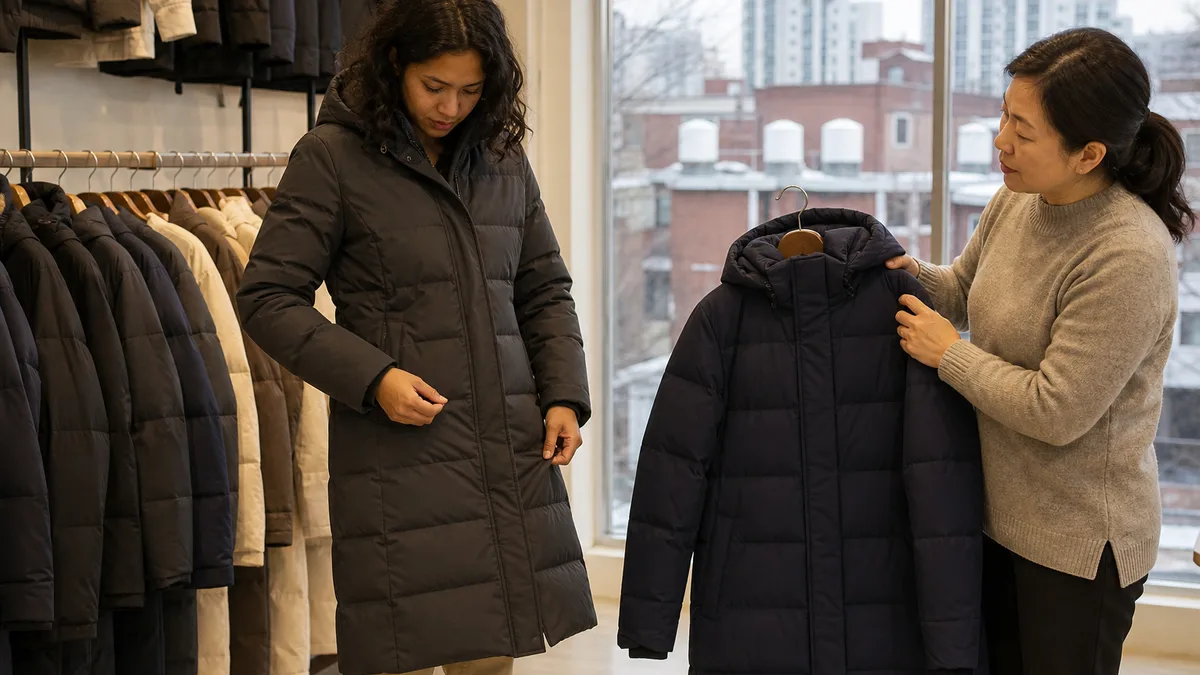
A thin padded jacket is a mid layer. It's light and warm, so you'll be tempted to use it as your outer layer, but don't count on that one piece to block the wind on a cold-wave day; wear a separate windproof outer layer on top of it. On the other hand, on days when you're indoors for a long time, you can take off the outer layer and keep just the mid layer. In Korea, a knee-length padded coat is called a "long padding" (롱패딩).
Here's when to add or remove layers depending on the weather.
| Weather | What to wear |
|---|---|
| Typical January daytime (average high 2.1°C) | Thermal underwear + mid layer + outer layer |
| Typical January morning (average low -5.5°C; with a 5.6 m/s wind, it feels like -12°C) | The outfit above plus gloves and a scarf |
| Cold-wave day (-10°C or below; with an 8.3 m/s wind, it feels like -20°C or below) | Thicker thermal underwear (Extra Warm or Ultra Warm if it's Uniqlo) + mid layer + long outer layer + ears, hands and neck all covered + hot packs |
Take care of your feet separately. When it snows or the roads freeze, it's easy to slip, so choose shoes with deep treads that are less slippery, and since some restaurants and indoor spaces require you to take your shoes off, it's easiest to pick ones that slip on and off easily from among those and wear them with thick socks. If your socks and gloves get wet in snow or rain, don't keep wearing them; put a spare pair of each in your bag so you can change.
What to do: When you leave home, zip your outer layer all the way up, and when you go indoors, take the outer layer off first and carry it. Once the order of putting things on and taking them off becomes a habit, you can feel less cold and less hot in the same clothes.
If it's urgent on your first day, buy gloves, earmuffs, a scarf and hot packs first
On your first day, when there's no time to choose an outer layer, accessories that cover the parts exposed to the wind are the cheapest and can be used right away. Here are the prices of cold-weather accessories listed on the online mall of Daiso, the discount household goods store (Daiso Mall).
| Item | Daiso Mall listed price (2026-10-02) | Good to know |
|---|---|---|
| Winter gloves | 3,000-5,000 KRW | Basic winter gloves in M/L 3,000 KRW; men's thermal gloves and two-tone ski gloves 5,000 KRW |
| Earmuffs | 1,000-3,000 KRW | For days when your ears get cold first |
| Scarf | 2,000-5,000 KRW | Wrap it around your neck and tuck it inside your coat collar |
| Neck warmer | 1,000-3,000 KRW | Neck warmer with ear flaps 3,000 KRW |
| Winter hat (beanie) | 2,000-3,000 KRW | Fur-lined beanie 2,000 KRW, fur beanie 3,000 KRW |
These are online listed prices, so in-store stock and displays vary from store to store. At the cheapest listed prices, gloves at 3,000 KRW, earmuffs at 1,000 KRW and a scarf at 2,000 KRW, plus a 5,000 KRW bag of hot packs, come to around 11,000 KRW.
Hot packs with similar names are actually different products used in different places. The instructions and warnings on the package are in Korean, so people sometimes stick one on bare skin without knowing what they bought.
| Type | Daiso Mall listed price (2026-09-28) | How to use |
|---|---|---|
| Large pocket hot pack | 5,000 KRW for a pack of 15 | Shake it and squeeze it repeatedly to warm it up; lasts up to 14 hours, reaches up to 70°C |
| Large hand-warmer hot pack | 5,000 KRW for a pack of 15 | Hold it in your hand or put it in your pocket; check the package for how long it lasts |
| Adhesive hot pack | 5,000 KRW for a pack of 15, 2,000 KRW for 3, 2,000 KRW for a pack of 6 minis | Peel it and stick it on top of your clothes; 12 hours, 60°C (for the 15-pack) |
| Insole hot pack | 1,000 KRW for a pack of 2 | Separate versions for 230-250 mm and 260-280 mm |
| Foot-warmer hot pack | 1,000 KRW for a pack of 4 | For warming your feet; check the package for how to use it and don't put it directly on bare skin |
Insole hot packs are divided by shoe size, so read how to read shoe sizes in mm below before choosing. Convenience stores also sell hot packs and cold-weather items, but we couldn't confirm convenience store prices. For paying at and using convenience stores, see Complete guide to Korean convenience stores.
What to do: In typical weather, on your first day just buy gloves, earmuffs or a neck warmer, a scarf and one bag of hot packs at a Daiso store or a convenience store; you can buy thermal underwear and an outer layer the next day after checking sizes. If you have no outer layer at all, or the next morning's low is forecast at -10°C or below, buy an outer layer and thermal underwear on your first day as well.
Set a price range for thermal underwear and padded jackets, then choose where to buy
The base layer and the outer layer are easy to buy in one go at a large clothing chain such as Uniqlo. Taking Uniqlo Korea's online regular prices as an example:
| Category | Product (Uniqlo Korea) | Online regular price (2026-09-28) |
|---|---|---|
| Thermal underwear, basic | HEATTECH Crew Neck T-shirt | 16,900 KRW |
| Thermal underwear, basic | HEATTECH Tights (men's bottoms) | 16,900 KRW |
| Thermal underwear, one grade up | HEATTECH Cotton Crew Neck T-shirt (9/10-length sleeves) Extra Warm | 24,900 KRW |
| Thermal underwear, top grade | HEATTECH Ultra Warm Crew Neck T-shirt (long sleeves) and Tights | 34,900 KRW each |
| Accessories | HEATTECH Socks | 7,900 KRW |
| Accessories | HEATTECH Gloves and Mittens, HEATTECH Scarf | 29,900 KRW each (gloves may vary by product) |
| Outer layer | PUFFTECH Parka and Jacket | 89,900 KRW each |
| Outer layer | Light Down Volume Jacket (men's) | 129,000 KRW |
| Outer layer | Seamless Down Parka (men's) | 169,000 KRW |
| Outer layer | Seamless Down Coat (men's) and Seamless Down Long Coat (women's) | 199,000 KRW each |
Even within HEATTECH there are three grades, Basic, Extra Warm and Ultra Warm, at different prices. If you work outdoors for long hours or have plans in Gangwon, go for Extra Warm or Ultra Warm; if you spend most of your time indoors, buy several of the basic one. Among the women's products, the item listed as "히트텍타이즈" (HEATTECH Tights, 19,900 KRW) is a stocking-type product and not the same thing as the men's tights (long-john bottoms). A search on 2026-09-28 didn't return any product called "Ultra Light Down", and PUFFTECH doesn't have "down" in its name. If you want to know the filling (the batting or duck down inside), check the product description, and choose by layering structure rather than by product name.
To estimate a budget: a basic HEATTECH top at 16,900 KRW, tights at 16,900 KRW, HEATTECH socks at 7,900 KRW and a PUFFTECH parka at 89,900 KRW add up to 131,600 KRW (based on online regular prices on 2026-09-28; there may be seasonal discounts or price changes). Add the roughly 11,000 KRW of first-day accessories above and you have a rough basic outfit for typical weather. Fill the mid layer with a sweater or fleece you already have, and if you expect cold-wave days or have plans in Gangwon, budget separately for a warmer grade of thermal underwear and a long outer layer.
Markets are an option too. The Korea Tourism Organization's travel site VisitKorea (대한민국 구석구석) says Namdaemun Market draws an average of 300,000 visitors a day, with close to 10,000 shops selling some 1,700 kinds of goods. However, opening hours and closing days differ from alley to alley and shop to shop, so check the hours of the specific shop or alley you want to visit before you go.
Before you count on a tax refund, check whether you qualify. Tax refunds (after-purchase tax refunds) are only for short-term travelers. A single transaction of 15,000 KRW or more (tax included) qualifies, and instant in-store refunds are limited to less than 1,000,000 KRW per transaction and up to 5,000,000 KRW in total after entry. Foreigners who work in Korea or have stayed 6 months or more are treated as residents under Article 10, Paragraph 1, Item 4 of the Enforcement Decree of the Foreign Exchange Transactions Act and are not eligible. Workers living in Korea and international students who have stayed 6 months or more won't get a refund even if they hand over their passport at the register. For detailed limits and procedures, see How to get a tax refund in Korea.
Even if you want to buy used clothes cheaply, your options are limited right after you arrive. The secondhand trading app Karrot (당근) only opens up after you verify a Korean mobile number and also complete neighborhood verification, which confirms that you're in the neighborhood where you live. The sign-up requirements are summarized in Essential apps for foreigners living in Korea. Until you have a number, stores selling new clothes are the realistic option.
What to do: Set your budget first, then buy several base layers and one proper outer layer. Before paying, double-check the amount on the price tag and the size on the label.
How to read Korean clothing sizes 95, 100, 105 and shoe sizes in mm
Numbers like 90, 95, 100 and 105 on the label of a top are the chest measurement (cm). The basic rule is that tops list the chest measurement first, and trousers or skirts list the waist measurement first (Digital Chosun Ilbo, 2017-12-14). S, M, L and XL are labels for a body-size range, so they don't match the numbers one to one. Whether 95 is an M or an L differs by brand, so don't guess the letter size from the number alone.
The numbers are in cm under the national standards (KS K 0050 for men's clothing, KS K 0051 for women's clothing), and according to the same Digital Chosun Ilbo article, sizes are listed in 3 cm or 5 cm steps depending on whether the garment needs a close fit or not.
The 55 and 66 you hear in women's clothing stores are old labels created in 1981 by the then Industrial Advancement Administration, taking the last digit, 5, from the average height of women in their 20s at the time (155 cm) and their average chest measurement (85 cm). They disappeared in 1999 when the KS standard switched to listing body measurements as numbers, but stores still use them out of habit (OhmyNews, 2019-08-30).
| Label | Meaning | What to check |
|---|---|---|
| 90, 95, 100, 105 (tops) | Chest measurement in cm | Measure your chest and compare |
| 73-105 (some trousers) | Waist measurement in cm | Measure your waist and compare (e.g., Uniqlo Warm Smart Pants 73-105) |
| S, M, L, XL | Labels for a body-size range | Check the brand's size chart |
| 55, 66 (women's clothing) | Old labels dropped from the standard in 1999 | Ask again using chest cm or S, M, L |
| 24, 25, 26, 28 cm (socks) | Sock sizes (cm) | Uniqlo HEATTECH socks are divided into women's 24 and 25 and men's 26 and 28 |
Shoes are sized in mm (KR). Taking Nike Korea's men's shoe size chart as an example:
| KR (mm) | US men's | UK | EU |
|---|---|---|---|
| 250 | 7 | 6 | 40 |
| 260 | 8 | 7 | 41 |
| 270 | 9 | 8 | 42.5 |
| 280 | 10 | 9 | 44 |
| 290 | 11 | 10 | 45 |
| 300 | 12 | 11 | 46 |
In Nike's chart, US sizes differ by 1.5 between men and women. The same KR 250 is US men's 7 and US women's 8.5. A woman who usually picks shoes by US size and looks only at the men's column will end up buying shoes a size and a half too big, so when you choose by US size, always look at the men's and women's columns separately. This chart is Nike Korea's, so at other brands you need to check that brand's chart.
Measuring your foot length yourself is the most accurate. Nike advises standing on a sheet of paper, marking the tip of your big toe and the outermost point of your heel to measure the length, going by the longer of your two feet, and choosing one size up if you fall between sizes. The same guide also says that the CM size printed on the box and label is not the same as your foot length (cm). Don't read the cm on the label as your foot length; compare the foot length you measured with that brand's size chart, or show it to a staff member and ask which KR number fits.
What to do: Before shopping, measure your chest and waist with a tape measure and the length of both feet on paper, and save the numbers in your phone's notes. In the store, compare those numbers with the labels for clothes, and for shoes, compare your foot length with the size chart or show it to a staff member.
Find large sizes and wide shoes through online options and around Itaewon
Store displays are geared toward Korean body types, so large sizes and shoes for wide feet (wide across the ball of the foot) are often hard to find in stores. A reporter for Stripes Korea, the newspaper of the US military in Korea, also wrote that Korean clothes generally run small.
Check the online size options first. On Uniqlo Korea's online store on 2026-09-28, men's outerwear came in S to 4XL, men's HEATTECH in XS to 4XL, and women's products in XS to 3XL (it varies by product). The women's Seamless Down Long Coat came only in S to XL. We couldn't confirm whether 3XL and 4XL are also sold in stores or only online. Before going to a store, check online whether your size exists, and ask staff about in-store stock.
There's also a neighborhood where large-size shops are clustered. Stripes Korea (2026-06-20) described a few blocks between Itaewon Station and the Yongsan base, around Itaewon-ro, where shops selling large-size men's and women's clothing, winter coats and shoes are gathered. For example, Kukje Bigsize (국제큰옷) (148 Itaewon-ro, near Itaewon Station Exit 4), mentioned in the article, is closed on Thursdays according to the article. The reporter wrote about her husband buying a shirt for 30,000 KRW and a jacket for 75,000 KRW, and said that some shops may prefer cash. Shops may have closed or moved since the article, and closing days can change, so check on a map app whether it's still open before you go, and bring a little cash.
If you have wide feet, look for wide models rather than going up in length. By Nike's standard, wide shoes are about 6.35 mm roomier around the toe box than regular ones, and extra wide shoes about 1.7 cm roomier. The standards and names for wide fits differ by brand, so ask in the store.
If you're stuck for words, show the phrases below on your screen.
- "한 치수 큰 거 있어요?" (Do you have this one size up?)
- "제 발 길이는 ○○mm예요. 맞는 사이즈가 뭐예요?" (My foot is ○○ mm long. Which size fits?)
- "발볼 넓은 모델 있어요?" (Do you have a wide-fit model?)
- "입어 봐도 돼요?" (Can I try it on?)
- "이 사이즈는 온라인에만 있나요?" (Is this size only sold online?)
- "현금으로 계산할게요." (I'll pay in cash.)
What to do: For large sizes, first check whether they exist as an online option, then go to a store or the Itaewon area and try them on before you buy. For shoes, try them on both feet and walk around to check that the width fits too.
Don't put hot packs on bare skin, and check the airline's rules before taking them on a plane
Even a hot pack can burn you if it stays against you for a long time. According to a Korea Consumer Agency consumer safety alert (2018-12-05), 226 cases of harm from hot packs were reported from 2015 to June 2018, and of the 133 cases where the timing was known, 65.4% happened in winter (December to February). Of the 128 cases where the severity of the burn could be confirmed, 49.2% (63 cases) were second-degree burns and 43.0% (55 cases) were third-degree burns. Hot packs heat up to as much as 70°C and stay at 40-70°C on average for a long time.
Here are the usage rules from the Korea Consumer Agency.
- Don't stick it directly on your skin. Adhesive hot packs are made to be peeled and stuck on top of your clothes.
- Don't use it while you sleep. Inside bedding, it can get hotter than its average temperature.
- Don't use it together with other heating products such as electric blankets.
- Infants, older people and people with sensitive skin are better off not using them.
- If you notice anything unusual, remove it right away and get treatment at a hospital.
- If you rub it too hard, the nonwoven fabric can tear and the contents can leak out.
- When buying, check that it has the KC mark (Korea's product safety certification mark) and a safety confirmation report number.
Even when it's stuck over your clothes, take it off right away if it feels hot or stings.
Whether you can take them on a plane is hard to say for sure. We couldn't find primary sources from the Ministry of Land, Infrastructure and Transport or airports on whether disposable hot packs containing iron powder can be carried on board or checked in.
Rechargeable hand warmers call for even more care. Jeju Air's guide to restricted items says that integrated electronic devices that generate heat and whose battery can't be removed can be neither carried on board nor checked in (it gives cordless hair irons and cordless clothes irons as examples). The guide doesn't use the words hot pack or hand warmer, so you need to check the restricted items page of the airline you're flying with to see how a rechargeable hand warmer is classified.
If something goes wrong with your body, dealing with it comes before clothing. If you suspect hypothermia or frostbite, don't try to tough it out alone; call 119 or get medical care as soon as possible. While waiting, a person who is with the patient should, following KDCA guidance, move the patient to a warm place, remove all of their wet clothing and wrap their body in blankets or clothes. If you're alone, go into a warm place, take off your wet clothes first and wrap yourself in dry clothes or a blanket. Soak frostbitten areas in warm water that isn't hot. Emergency numbers for each situation are in Korea's emergency phone map.
What to do: Use hot packs over your clothes or in gloved hands, and take them off right away if they feel hot or sting. Take them off before you go to bed, too. Before you fly out, check the hot pack and hand warmer rules on your airline's website.
If you work in Korea, look into winter clothing giveaways and cold-weather gear from your employer
There's a way to get winter clothes without buying everything. In past years, local centers and nonprofits have held winter clothing giveaways for foreign workers in October and November. According to a preview report by Asia A (2025-10-15), the Jeonnam Labor Rights Center planned an event on October 19, 2025 at the Jindo-gun indoor gymnasium to give Southeast Asian foreign workers donated clothing that had been professionally washed and dried. At the previous year's event in 2024, about 2,000 foreign workers in Jeonnam received about 10,000 pieces of winter clothing and work clothes. In 2024, the schedule was to collect clothes from September to October 25 and hand them out on November 9. According to Maeil Labor News (2026-10-02), the 2026 giveaway is set for November 15 at the Autovalley Welfare Center (오토밸리복지센터) in Buk-gu, Ulsan. Sixty-one labor and civic groups, including four labor rights foundations, plan to give about 3,000 foreign workers in Ulsan, Busan, Yangsan and Gyeongju four to five pieces of winter clothing each, and the article presented the event as following the giveaways in Yeongam in 2024 and Jindo in 2025. The Ministry of Employment and Labor also said it plans to hold a winter clothing and cold-weather supplies giveaway for foreign workers with these foundations in November (Yonhap News, 2026-09-29). We couldn't confirm whether a separate event will be held in Jeonnam this year.
Nationwide, there's the 첫겨울 나눌래옷 campaign (roughly "sharing coats for a first winter"). It's a campaign that gives winter coats to foreign neighbors who come from countries without winter and are facing their first winter in Korea. The official site (lovecoat.co.kr) lists the 9th round in 2026 as running from September to November 2026 and has put "Coming Soon 2026.11" on its front page. As of 2026-10-02, the dates for coat applications have not been released yet. The last two rounds opened on November 11, so check the front page of lovecoat.co.kr for this year's application dates.
| Round | Online coat-sharing period | Coats donated / applicants |
|---|---|---|
| 8th (2025) | November 11 to November 17 | 8,496 coats / 4,248 people |
| 7th (2024) | November 11 to November 22 | 9,840 coats / 4,078 people |
Here's how applying works, based on the official site's program overview and FAQ. Donated coats are washed, sorted and posted in an online store, and each person chooses and applies for 2 coats, which are delivered by courier. The FAQ lists the eligible groups as foreign workers, migrant women and international students staying in Korea. You apply only in your own name and go through a verification step using your alien registration number, so short-term visitors can't apply. If you don't have a phone in your own name, you can enter a friend's or coworker's number for the delivery notifications. Once you've applied, you can't change your application. The site has a KOR/ENG toggle. We couldn't confirm whether people who have just arrived and don't have their alien registration card yet can also apply.
Notices like these are often posted first in Korean on the bulletin boards of support centers and local governments. It's faster to ask your local Foreign Workers' Support Center or the foreign resident section of your city, county or district office from October. In 2026 the Ministry of Employment and Labor held another open call under its Foreign Workers' Regional Settlement Support Project and selected local governments to provide residence support such as counseling and Korean language education (notice of 2026-02-23), but support facilities exist in some areas and not in others, so first ask your city, county or district office whether there's one near you. The Foreign Worker Counseling Center (1577-0071), a phone line for counseling in your native language, and other offices are laid out in Four types of foreigner employment support agencies.
There's also something you can get at work. Article 39, Paragraph 1 of the Occupational Safety and Health Act requires employers to take health measures to prevent health impairment, and includes among these health impairment caused by cold (Item 2) and health impairment caused by working long hours in heat waves or cold waves (Item 7). Item 7 was added by an amendment on 2024-10-22 and took effect on 2025-06-01. Article 572 of the Rules on Occupational Safety and Health Standards requires employers to provide winter hats, winter boots, winter gloves and winter clothing to workers who handle large amounts of cold objects or work in significantly cold places, and to have them wear it, and requires the protective gear to be issued for each worker's personal use.
That doesn't mean employers have to give every worker a winter padded jacket. The law gives no number for which workplaces count as "significantly cold places." If you work somewhere cold, such as outdoors or in a freezer warehouse, you have grounds to ask for it, and if it's unclear whether your workplace counts, ask the Ministry of Employment and Labor Customer Center at 1350 or a Foreign Workers' Support Center. Contacts for other labor problems such as wages and dismissal are gathered in Labor and residence complaint counseling contacts.
The government's winter measures start with clothing, too. The five basic cold-wave safety rules that the Ministry of Employment and Labor announced last winter (press release of 2025-11-17) listed "warm clothing" first, and the same release said the ministry would distribute cold-related illness prevention guidelines in 18 native languages to 20,000 workplaces that employ foreign workers and to Foreign Workers' Support Centers and foreign communities, and would provide supplies such as hot packs and ear covers to construction and street-cleaning workers. Ask your nearest Foreign Workers' Support Center whether they have the prevention guidelines in your language. As of 2026-10-02, the measures for the 2026-27 winter have not been announced yet.
A draft amendment to the rules was pre-announced for legislation on 2026-07-14 (Ministry of Employment and Labor Public Notice No. 2026-364). Under it, for outdoor work in areas under a cold wave alert, employers would have to tell workers in advance about the symptoms of cold-related illness and first-aid steps, guide them to wear warm clothing, gloves, shoes, and a hat that covers the head and ears, and divide work and rest and adjust work hours. As of early October 2026, the promulgated version hasn't appeared on the National Law Information Center yet (the amendment is still in progress). The draft is set to take effect on the day it's promulgated, so if it's promulgated this winter, the grounds for what you can ask for change from that day. The full five basic rules and what you can ask for in outdoor work when an alert is in effect are covered separately in the cold wave and heavy snow alert guide.
When you ask your employer, show them the phrases below.
- "방한모·방한화·방한장갑·방한복을 개인 전용으로 받을 수 있나요?" (Can I get my own winter hat, boots, gloves and jacket for work?)
- "한파 때 쉬는 시간과 따뜻한 쉼터가 있나요?" (Is there a warm rest area and break time during cold waves?)
What to do: If you work in a cold place, first ask your employer whether you can get a winter hat, winter boots, winter gloves and winter clothing for your personal use. If the answer is unclear or you're turned down, get advice from 1350 or your local Foreign Workers' Support Center, and from October, ask the same offices about the schedules for winter clothing giveaways too.
Want Korea's transit and payments in one app — without a Korean phone number or bank account? Check out LACHA.
Built to work without a Korean phone number or bank account, with overseas payment methods like Alipay, WeChat Pay, and Apple Pay. Taxi hailing plus KTX, express bus, and airport railroad (AREX) booking — all in one app.
Up to 60% off Korea transit with a coupon (max ₩3,000): enter code at sign-up. KTX gets up to 18% off on top
Download now


Frequently Asked Questions (FAQ)
Q1. Can I get through a Korean winter with just one thin Uniqlo down jacket? A. Layering is safer than a single piece. Treat a thin padded jacket as a mid layer, and wear thermal underwear and a windproof outer layer separately. In Seoul in January, the normal average low is -5.5°C, and on a cold-wave day, when a temperature of -10°C combines with an 8.3 m/s wind, the wind chill is -20°C (KMA chart). Choose by layering structure rather than by product name.
Q2. Do I need a long padded coat if I go to Busan or Jeju? A. Going by the normals, they're warmer than Seoul, so a windproof outer layer and layering come before a long padded coat. By the 1991-2020 normals, the January average temperature is 3.6°C in Busan and 6.1°C in Jeju, above freezing. Busan's January average low is still -0.1°C, so mornings are chilly. If you have plans in the Gangwon mountains, Daegwallyeong's January average low is -12.2°C, so pack separately with that in mind.
Q3. Can I get a tax refund on winter clothes I buy in Korea? A. Only short-term travelers can, and foreigners who work in Korea or have stayed 6 months or more are treated as residents under the Enforcement Decree of the Foreign Exchange Transactions Act and are not eligible. The amount thresholds and procedures are in How to get a tax refund in Korea.
Q4. I work in a cold place, but my company doesn't give me winter clothing. What should I do? A. Article 572 of the Rules on Occupational Safety and Health Standards requires employers to provide winter hats, winter boots, winter gloves and winter clothing for personal use to workers who work in significantly cold places, and to have them wear it. However, there's no numerical standard for what counts as a "significantly cold place," so check with the Ministry of Employment and Labor Customer Center at 1350 or your local Foreign Workers' Support Center whether your workplace qualifies. When you ask, bring notes on where you work and for how many hours at a time, and the consultation will go faster.
Q5. Can I take hot packs on a plane? A. It's hard to say for sure. We couldn't find primary sources from the Ministry of Land, Infrastructure and Transport or airports that set rules on carrying disposable hot packs on board or checking them in. Rules for rechargeable hand warmers may differ by airline, and Jeju Air says integrated electronic devices that generate heat and whose battery can't be removed can be neither carried on board nor checked in. Before you fly out, check the restricted items page of the airline you're flying with.
Note: This guide is for general information only. Temperatures and wind chill are from the climate normals (1991-2020) and the wind chill chart on the KMA Open MET Data Portal and the regional climate characteristics on KMA Weather Nuri; the cold wave alert criteria are from the KMA's guide to alert criteria; the 2021-01-08 cold wave is from reports by the Hankook Ilbo and Aju Business Daily (2021-01-08); and the cold-related illness statistics are from Newspim and Asia Economy (2026-03-10) reports citing KDCA announcements and a KDCA press release (2025-12-31). Prices are the online listed prices on Uniqlo Korea's official online store and Daiso Mall on 2026-09-28 (2026-10-02 for Daiso cold-weather accessories), and convenience store hot pack sales are from a Pinpoint News (2025-02-08) report. Clothing sizes follow the information on KS K 0050 (established 1994-12-08, revised 2025-09-17) and KS K 0051 (established 1994-12-08, ages 18 to 59) on e-Nara Standards Certification and articles by OhmyNews (2019-08-30) and Digital Chosun Ilbo (2017-12-14); shoe sizes follow Nike Korea's men's shoe size chart; large-size shops in Itaewon follow Stripes Korea (2026-06-20); and Namdaemun Market follows the Korea Tourism Organization's VisitKorea (대한민국 구석구석) and the Namdaemun Market website. Hot pack safety is from a Korea Consumer Agency consumer safety alert (2018-12-05), the airline rules are from Jeju Air's guide to restricted items, and tax refund eligibility is from the Enforcement Decree of the Foreign Exchange Transactions Act on the National Law Information Center and Korea Tourism Organization guidance. Worker-related information is based on the original texts of the Occupational Safety and Health Act and the Rules on Occupational Safety and Health Standards on the National Law Information Center, a Ministry of Employment and Labor press release (2025-11-17) and Ministry of Employment and Labor Public Notice No. 2026-364 (pre-announced for legislation on 2026-07-14), the Foreign Workers' Regional Settlement Support Project is based on Ministry of Employment and Labor notices (2026-01-07 and 2026-02-23), the Foreign Worker Counseling Center's phone number is from the center's official site, and winter clothing giveaways are based on the 첫겨울 나눌래옷 official site's program overview and FAQ and reports by Asia A (2025-10-15), Kyunghyang Shinmun (2024-10-10), Korea Economic Daily and Asia Economy (2025-12-24), Yonhap News (2026-09-29) and Maeil Labor News (2026-10-02), all compiled as of 2026-09. We couldn't confirm, and therefore did not state as fact, the price of convenience store hot packs, in-store stock of large Uniqlo sizes, the carry-on rules for disposable hot packs, the 2026 application dates for 첫겨울 나눌래옷 and the 2026 giveaway schedule in Jeonnam, the government's 2026-27 cold-wave measures, the promulgation date of the cold-work rule amendment, and whether people can apply for the giveaway before alien registration. Prices, stock, opening hours, event dates and laws can change, so please check the official channels of each store, organization and airline again before using them. This guide is not legal advice.