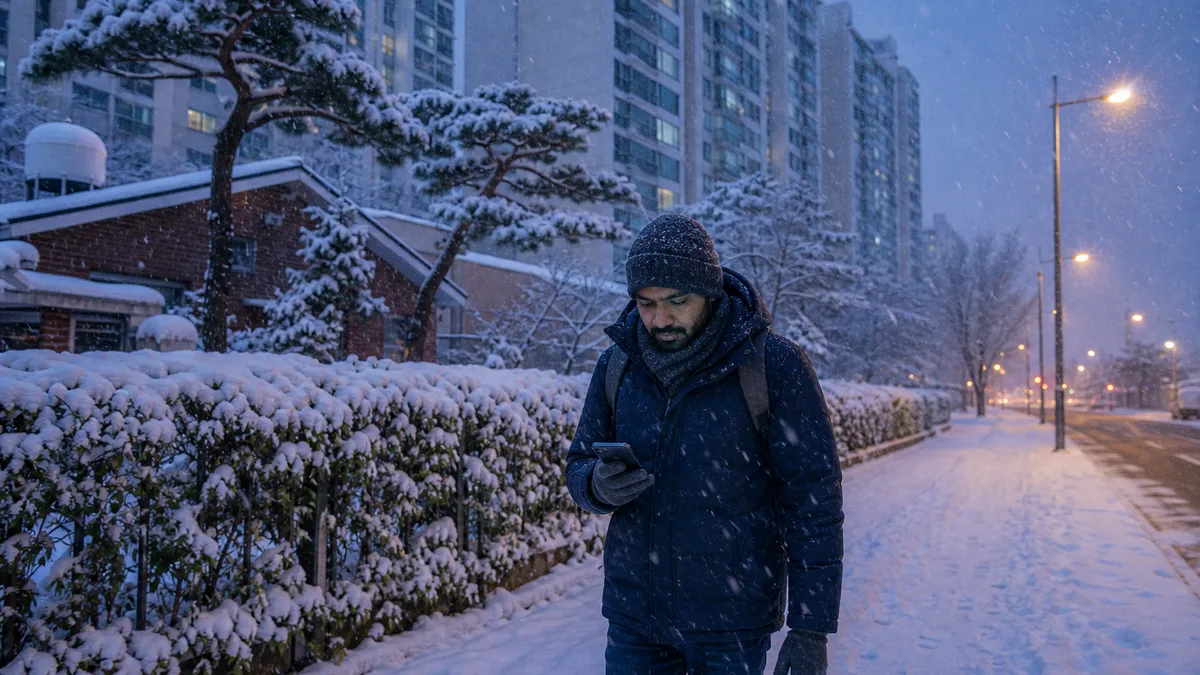
The cold wave and heavy snow weather alert texts that reach your phone in winter (a weather alert here is the umbrella term for the advisories and warnings issued by the Korea Meteorological Administration) come only in Korean. Following a February 28, 2024 announcement by the Ministry of the Interior and Safety and the Korea Meteorological Administration, critical and emergency disaster texts, the ones that sound an alarm, show key words such as the type of disaster in English as well. But cold wave and heavy snow alert texts sit one level below those, as safety guidance texts, so no English is added. Safety guidance texts can be turned off on your phone, so if you switch them off because you keep getting Korean texts you can't read, you'll miss the alerts entirely.
There's also a way to get them in English or some native languages through an app for foreigners. However, even though the Ministry of the Interior and Safety said it expanded supported languages to 22, disaster text translation has been confirmed in only 5 languages so far, and the app stores list an older app with the same name side by side, so even choosing which one to download is confusing. What you can ask for regarding pay when you're late because of snow, or when working outdoors in a cold wave, is also grounded in Korean-language laws, and prevention rules in your native language are hard to get unless your employer hands them out.
This article starts with how to set up and read the texts, then covers what to do on heavy snow days in this order: commuting, deliveries, outdoor work, and dormitories. What to wear is covered separately in how to buy and wear winter clothes locally, and boilers, gas bills, and responsibility for frozen water pipes in the article on heating bills in your first Korean winter.
Note: The rules and figures below were checked against the original texts on the National Law Information Center and public materials from the Ministry of the Interior and Safety, the Korea Meteorological Administration, the Ministry of Employment and Labor, the Korea Disease Control and Prevention Agency, and the Seoul Metropolitan Government as of 2026-09. The 2026-27 winter measures from Seoul and the Ministry of Employment and Labor and the 8th Fine Dust Seasonal Management System haven't been announced yet, so we used last winter's (2025-26) figures. These may change after November, so please check official channels again.
Reading Disaster Texts in Three Levels: Cold Waves and Heavy Snow Are Safety Guidance Texts
Disaster texts on your phone are divided into three levels by severity: critical disaster texts, emergency disaster texts, and safety guidance texts (Annex 1 of the Ministry of the Interior and Safety directive "Regulations on Standards and Operation of Disaster Text Broadcasting," effective 2026-02-04). Each level differs in whether you can opt out and how you're alerted.
| Level | When it's sent | Opt out | Alert | English text |
|---|---|---|---|---|
| Critical disaster text | When a large-scale disaster or loss of life is feared and everyone must receive it without exception | Not possible | Phone's maximum volume (at least 40dB) | Disaster type and magnitude shown in English too |
| Emergency disaster text | Terrorism, expected radioactive material leaks, evacuation orders, heavy rain (sent directly by the KMA Administrator), flood information (severe), landslide warnings, etc. | Possible | Phone's maximum volume (at least 40dB) | Disaster type and magnitude shown in English too |
| Safety guidance text | Advance evacuation advisories, lifting of evacuation orders, disaster warnings and advisories other than critical and emergency ones | Possible | Follows your regular text notification settings | None (Korean only) |
Under the operating regulations, cold wave and heavy snow alert texts fall into the safety guidance text level. If you think of every disaster text as an "emergency alert," it's hard to notice when safety guidance texts are switched off.
Check right now whether safety guidance texts are turned on on your phone.
- iPhone: Turn them on or off under "Government Alerts" at the very bottom of Settings > Notifications. Government alerts are supported when you use a SIM or eSIM from a supported carrier (Apple Support document).
- Android: Menu locations differ by manufacturer and model. In Settings, find the item for receiving disaster texts and check that safety guidance texts are turned on.
- Phones bought abroad, foreign SIMs, and roaming: We couldn't find an official source on whether Korean disaster texts arrive. They may not arrive depending on the device and carrier, so also receiving them through the Emergency Ready App below will make it less likely that you miss them.
English text also splits at this level. Critical and emergency texts show the type of disaster, such as "Earthquake" or "Heavy rain," and the earthquake magnitude ("M") in English as well, but safety guidance texts aren't covered (announced 2024-02-28, and still the same in September 2026 reports). That's why cold wave, heavy snow, and fine dust texts come only in Korean.
The square brackets at the end of a text show the agency that sent it. Cold wave and heavy snow alert texts are sent by the Ministry of the Interior and Safety and the city/province and city/county/district governments, so you'll see something like [행정안전부] (Ministry of the Interior and Safety) or [○○구청] (○○-gu Office).
The same Annex 1 also sets separate time slots for sending texts for each weather alert.
| Weather alert | Weekday commute hours (06:00-10:00, 16:00-21:00) | Other daytime hours (06:00-21:00 outside those hours, including weekend daytime) | Night (21:00 to 06:00 the next day) |
|---|---|---|---|
| Heavy snow advisory | Sent | Not sent | Not sent |
| Heavy snow warning | Sent | Sent | Sent |
| Cold wave advisory | Not in the sending criteria | Not in the sending criteria | Not in the sending criteria |
| Cold wave warning | Sent | Sent | Not sent |
| Fine dust warning / emergency reduction measures | Sent | Sent | Not sent |
So no text doesn't mean no alert. Cold wave advisories aren't in the text criteria at all, heavy snow advisories are texted only during weekday commute hours, and cold wave warnings only during the day. That said, you may still get a text during a cold wave advisory. Local governments can send texts separately from the sending criteria (Articles 9 and 12 of the operating regulations). To check whether an alert is in effect right now, go directly to the Weather > Weather Alerts menu on the KMA's Weather Nuri website (www.weather.go.kr) (menu names may change).
How to Get Disaster Info in Your Language with Emergency Ready App When Cold Wave and Heavy Snow Texts Come Only in Korean
The Ministry of the Interior and Safety said its June 15, 2026 overhaul expanded the supported languages of Emergency Ready App, its disaster and safety app for foreigners, to 22. It's the foreigner version of "Anjeon Didimdol," the app for Korean nationals, and the ministry explained that 97% of the roughly 2.87 million foreigners staying in Korea would be able to get disaster and safety information in their own language. The 22 languages listed in an attachment to the ministry's press release on the overhaul are English, Chinese, Vietnamese, Thai, Japanese, Russian, Uzbek, Nepali, Indonesian, Tagalog, Khmer, Mongolian, Burmese, Sinhala, Bengali, Urdu, French, Arabic, Spanish, German, Portuguese, and Hindi. According to the same announcement, the app's information on facilities near your location now includes cold-weather shelters, so you can also use it to find a nearby shelter during a cold wave. Emergency numbers such as 119 are covered separately in Korea's emergency phone map.
One thing is confusing when you install it. The app stores list two apps with the same name, and the old one has "(Old)" in its name (checked 2026-09-28).
| Item | App to download | Old app |
|---|---|---|
| Name shown in the store | Emergency Ready App | (Old)Emergency Ready App |
| iPhone App Store | id6748374479, released 2026-02-16 | id826120919, released 2014 |
| Google Play package | kr.or.klid.newengsafekorea2025 | kr.go.nema.disasteralert_eng |
| Languages listed on the App Store | English | English, Japanese, Chinese, Thai, Vietnamese |
| Google Play downloads | 1K+ | 50K+ |
We recommend downloading the new app without "(Old)." However, the store listings alone don't tell you which one is the 22-language version. The new app lists only English, and the descriptions of both apps still use the old wording, so after installing, check for yourself whether your language is in the language list in the app's settings. To get it right away, open the new app on the App Store or the new app on Google Play.
According to Ministry of the Interior and Safety guidance from August 2024, simply installing the app didn't let you receive disaster texts; you had to turn on notifications. With the new app too, check the notification settings first after installing. The setup steps in that guidance are as follows.
- Go to "Settings" at the bottom of the home screen.
- Switch the disaster text push notification "Emergency Alert" from Off to On.
- Set the receiving area "Receive Region" to nationwide or the area where you live.
- On Android, turning on cell-tower-based reception, "Location-based Service," lets you keep receiving texts even when you move to another area.
- On iPhone, the app language follows your phone's language. To change it, go to your device's Settings > EmergencyReadyAPP > Language.
That guidance also mentions a voice notification (TTS) feature that reads disaster texts aloud. The menu names above come from the 2024 guidance for the old app, so they may differ depending on the app version.
Also know how far the translation goes. As of the August 26, 2024 announcement, disaster text translation covered 5 languages (English, Chinese, Vietnamese, Thai, and Japanese) on the app at that time (the one now marked "(Old)"), and as of September 2026 the Ministry of the Interior and Safety's introduction page also still lists these 5 languages for disaster texts. We couldn't confirm whether the expansion to 22 languages also applies to disaster text translation, so try receiving a text, and if it doesn't come in your language, read it alongside the English version.
Reading Cold Wave and Heavy Snow Advisories and Warnings by the Numbers
The criteria for KMA weather alerts are set out in law (Annex 1 of the Enforcement Decree of the Weather Act, amended 2026-06-23). For cold waves the measure is the morning low temperature, and for heavy snow it's the new snow expected to accumulate within 24 hours.
| Weather alert | Issued when this is expected |
|---|---|
| Cold wave advisory (October to April) | The morning low drops by 10℃ or more from the previous day to 3℃ or below while also being 3℃ or more below normal, or a morning low of -12℃ or below continues for 2 days or more |
| Cold wave warning (October to April) | The morning low drops by 15℃ or more from the previous day to 3℃ or below while also being 3℃ or more below normal, or a morning low of -15℃ or below continues for 2 days or more |
| Heavy snow advisory | 5cm or more of new snow accumulating within 24 hours |
| Heavy snow warning | 20cm or more of new snow accumulating within 24 hours (30cm or more in mountain areas) |
Cold wave alerts come in two forms: "cold that drops suddenly from the day before" and "cold that lasts for several days." So even if it doesn't get down to -12℃, an advisory can be issued when the morning low drops by 10℃ or more from the previous day to 3℃ or below and is 3℃ or more below normal. The value used to decide the alert is the morning low. It isn't decided by the midday temperature or the wind chill.
Heavy snow alerts are issued when the amount of new snow falling and accumulating within 24 hours is "expected" to reach 5cm or 20cm or more. So even if a lot of snow has already piled up, there may be no alert if little new snow is coming. Piled-up snow and icy patches stay even on days without an alert, so take shorter steps and wear low-heeled shoes when walking (the icy road advice in the standard disaster text wording).
If you want to see these criteria in English, open the "Issuance criteria for weather advisories and warnings" page on the KMA English website (kma.go.kr/neng/forecast/warning.do). The numeric criteria for Heavy Snowfall and Cold wave there are the same as the Korean criteria. However, the Cold wave rows on the English page still list a third condition, ③ "... damage is expected due to a rapid drop in temperature" (checked 2026-10-02). That condition isn't in Annex 1 of the current Enforcement Decree of the Weather Act, so go by the table above for the conditions.
The text wording is based on the standard wording in the Ministry of the Interior and Safety directive (Annex 2). Match the Korean text you receive against the table below.
| Korean you'll see in the text | Meaning | What to do |
|---|---|---|
| 대설주의보 발효 (Heavy snow advisory in effect) | Please help clear the snow in front of your home, avoid driving when commuting, use public transport | Clear the snow in front of your home and take the subway or bus instead of a car |
| 대설경보 발효 (Heavy snow warning in effect) | Avoid outdoor activities and driving, heavy traffic expected at commute times, use public transport | Go out less, and for work take the subway or bus instead of a car and leave earlier than usual |
| 한파경보 발효 (Cold wave warning in effect) | Keep warm, avoid outdoor activities if possible, wrap your water meter in old clothes or similar to keep it from freezing and bursting | Wrap your meter and go out less |
| 1일 이상 외출 시 수도꼭지를 약하게 (When away for a day or more, leave the tap running slightly) | Advice to leave a tap running slightly when you're away from home for a day or more, to keep pipes from freezing and bursting (sometimes added to cold wave warning texts) | If you'll be away for a day or more, leave a little water running |
| 발효 (In effect) | Means the alert has taken effect | Treat it as being under the alert from now on |
| 동파 (Freeze-burst) | Water pipes or meters freezing and bursting | Wrap the meter box in old clothes |
The stage-by-stage wording also includes lines like these: advice to report breakdowns of gas, electricity, or district heating to the Korea Gas Safety Corporation (1544-4500), Korea Electrical Safety Corporation (1588-7500), or Korea District Heating Corporation (1688-2488), and advice to keep warm with thermal underwear, a scarf, a hat, and gloves if you really must go out. If you smell gas or suspect carbon monoxide, get outside first and call 119.
This is the standard wording, and under Article 10(2) of the operating regulations, agencies can adjust it to the situation before sending, so the actual text wording varies a little. When you get a text, first look for the name of the alert and the word '발효' (in effect), then run the remaining lines through a translation app and match them against the table above. How to wrap the meter and who pays for repairs if it freezes are covered in the heating bill article.
When You Have to Commute on a Heavy Snow Day: Transit Notices and Handling Late Arrival or Absence
The standard wording for heavy snow advisories and warnings recommends avoiding driving and using public transport when commuting. When heavy snow was forecast for the night of February 1 to the early morning of February 2, 2026, the Seoul Metropolitan Government's measures for the February 2 morning commute were as follows.
- Extended the morning rush-hour intensive service period, normally 07:00-09:00, by 30 minutes and kept it until 09:30
- Ran 20 more trips than usual on Subway Line 2 and Lines 5 to 8
- Kept city buses at their minimum intervals until 09:30 as well
- Anti-slip measures at subway station entrances and bus stops, and quick snow removal together with the district offices on sections that are hard to operate
The city said it would share traffic conditions through bus information displays at stops, electronic road signs, the TOPIS website, subway apps, and social media. These numbers were one day's measures, so they don't mean the same will apply for the next heavy snowfall. We couldn't confirm heavy snow measures for other cities, so check the disaster texts and local government notices for where you live. If heavy snow is forecast the night before, it's safer to check the commute notices and leave earlier than usual.
Pay when you're late or can't make it rests on different grounds depending on the situation. Article 46(1) of the Labor Standards Act requires the employer, when business is suspended for reasons attributable to the employer, to pay a shutdown allowance of at least 70% of average wages for the suspension period. If the business can't continue due to unavoidable reasons and the Labor Relations Commission approves, the employer may pay less than that (paragraph 2 of the same article).
Whether a day when the company stopped work because of snow falls under this needs to be looked at separately. The Ministry of Employment and Labor has interpreted a case where an employer stopped work due to rain under safety rules as a reason beyond the employer's control, meaning it wasn't a business suspension and there was no obligation to pay 70% (Labor Standards Policy Division-2175, 2021-07-21). That interpretation reflects the standards of 2021 and comes with the caveat that the facts can't be confirmed from an inquiry alone, so it can't be assumed to fit snow cases as-is.
| Situation | Pay | Basis |
|---|---|---|
| A day off due to the company's circumstances (suspension attributable to the employer) | Shutdown allowance of at least 70% of average wages | Labor Standards Act Article 46(1) |
| A suspension approved by the Labor Relations Commission due to unavoidable reasons | May be less than 70% | Paragraph 2 of the same article |
| A day the employer stopped work because the weather made it dangerous | There's an interpretation that it isn't a suspension (rain case) | Labor Standards Policy Division-2175 (2021-07-21) |
| A day you were late or couldn't come because of snow | Follows company rules (rules of employment, employment contract) | We couldn't find a legal provision that specifically covers lateness due to heavy snow |
Days when you're late or can't come follow company rules. We also couldn't find any rule saying such days are always unpaid, and some companies may treat them as paid. So if you think you'll be late, message your manager before your start time and keep a record. You can send something like this.
- "눈 때문에 출근이 늦어질 것 같습니다. ○시쯤 도착할 예정입니다." (I'll be late because of the snow. I expect to arrive around ○.)
- "폭설로 오늘 출근이 어렵습니다. 처리 방법을 알려 주세요." (I can't get to work today because of heavy snow. Please tell me how this will be handled.)
If a dispute arises over pay, ask the Ministry of Employment and Labor Customer Center at 1350. The answer depends on company rules and the facts, so it helps to have the messages you sent and your attendance records ready. Labor counseling channels, including 1350, are gathered in the article on help desks for labor and residence issues.
When Delivery Apps and Mail Stop on Snowy Days
When heavy snow fell nationwide from the night of February 1 to the early morning of February 2, 2026, delivery platforms restricted deliveries (News1 report, 2026-02-02).
| Platform | What it did that day |
|---|---|
| Baedal Minjok (Baemin) | Limited the orderable distance depending on the area, due to icy roads and black ice |
| Coupang Eats | Said it would "consider" temporarily suspending operations if needed, notified riders to stop driving in areas where danger was expected, move to a safe place, and then contact customer service, and told customers in advance when deliveries would be late |
| Yogiyo | Suspended its Yogi Delivery service in most areas with heavy snow |
Even if a shop you usually order from disappears from the list or orders are blocked, it may not be an app error. We couldn't confirm whether these restrictions are standing rules or measures for that day only. Changed terms related to delivery range are covered in the guide to delivery apps for foreigners. On days with snow in the forecast, order early and mostly from nearby shops, and expect it to take longer than usual.
Little has been confirmed about mail. In its November 2023 winter safety measures, Korea Post advised that when visibility is poor or the risk of accidents is high due to icy roads and the like, mail carriers may temporarily suspend mail delivery. We couldn't confirm the heavy snow criteria of private courier companies. Send or receive urgent documents and items before snow is forecast.
If you work in delivery, do what Coupang Eats told riders that day: stop in dangerous places and move somewhere safe. In last winter's measures (2025-11-17), the Ministry of Employment and Labor said it would share the locations and hours of 133 rest stops for mobile workers through delivery apps, and Seoul planned to extend 4 hub rest stops (Seocho, Bukchang, Hapjeong, Sangam) and 2 subway rest stops (Sadang Station, Jonggak Station) so they would also open on weekends from December 2025 to February 2026. First check whether delivery work is allowed under your status of stay in the article on visa status for foreign delivery riders.
What You Can Ask Your Employer for When Working Outdoors in a Cold Wave
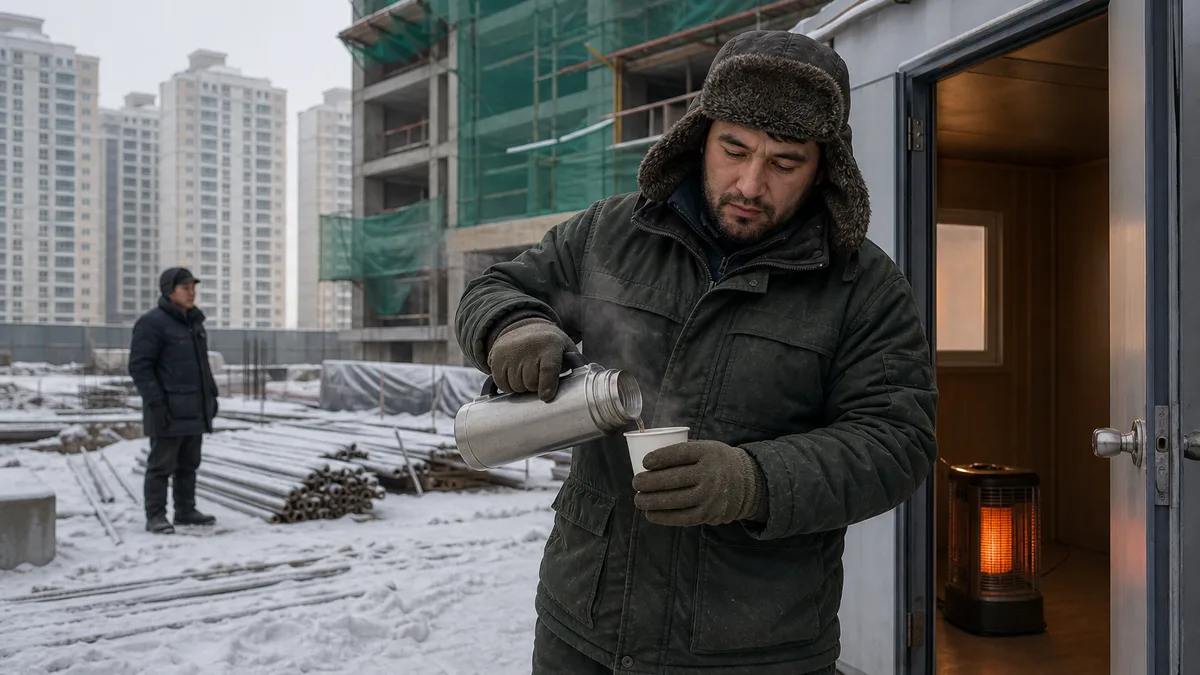
Since Article 39(1)7 of the Occupational Safety and Health Act took effect on June 1, 2025, health measures to prevent "health problems caused by working long hours in heat waves or cold waves" have been part of employers' obligations (Act No. 20522, promulgated 2024-10-22). The details are to be set by an Ordinance of the Ministry of Employment and Labor (paragraph 2 of the same article).
However, the current version of the subordinate Rules on Occupational Safety and Health Standards doesn't contain the word for "cold wave" even once. For heat waves there are numbers, such as giving at least 20 minutes of rest within every 2 hours when the perceived temperature is 33 degrees or higher (Article 560(3)), but there are no such numbers for cold waves. So if you point to "20 minutes every 2 hours during cold waves too," it's unlikely to be accepted. A draft amendment to the rules was pre-announced for legislation on 2026-07-14 (Ministry of Employment and Labor Public Notice No. 2026-364). Under it, for outdoor work in areas under a cold wave alert, employers would have to tell workers in advance about the symptoms of cold-related illness and first-aid steps, guide them to wear warm clothing, gloves, shoes, and a hat that covers the head and ears, and divide work and rest and adjust work hours. Even this draft has no "X minutes of rest every Y hours" figure like the one for heat waves. As of early October 2026, the promulgated version hasn't appeared on the National Law Information Center yet (amendment in progress). The draft is set to take effect on the day it's promulgated, so if it's promulgated this winter, the grounds for what you can ask for here change from that day. Check again at that point.
Even without numeric standards, you still have grounds to ask.
| What you can ask for | Basis | Nature |
|---|---|---|
| Measures to prevent health problems from long hours of work in a cold wave | Occupational Safety and Health Act Article 39(1)7 (effective 2025-06-01) | Employer obligation; the rules set no numeric cold wave standard |
| Stopping work when snow, wind, etc. make it dangerous | Rules on Occupational Safety and Health Standards Article 37(1) | Employer obligation (urgent recovery work, such as after a typhoon, is an exception) |
| Stopping work such as assembling or dismantling work platforms at height (scaffolding), formwork and its supporting posts (shoring), and assembling cranes, lifts, and elevators | Same rules, Articles 57, 141, 156, 162, and 333 | Employer obligation when the weather is very bad due to snow and the like |
| Warm clothes, a warm rest area, warm water, adjusted work hours, calling 119 | Ministry of Employment and Labor "Five Basic Rules for Cold Wave Safety" (2025-11-17) | Not a statutory provision but a guidance and inspection standard |
| Cold-related illness prevention rules in your own language | Distributed by the Ministry of Employment and Labor (18 languages, announced 2025-11) | Ask your employer or the Employment Center |
| Stopping work, evacuating, and reporting when there's an imminent danger of an industrial accident | Occupational Safety and Health Act Article 52 | Unfavorable treatment is prohibited if there's a reasonable ground. We couldn't confirm whether physical problems caused by the cold count here |
Last winter's Ministry of Employment and Labor measures (measures period 2025-11-15 to 2026-03-15) stated a plan to guide workplaces with construction and street-cleaning workers to adjust work hours during a cold wave advisory, for example by pushing early-morning work from 06:00 to 09:00, and to minimize outdoor work during a cold wave warning. This is a guidance policy, which is different from something the law bans or makes mandatory. As of early October 2026, the 2026-27 winter measures haven't come out yet.
There are native-language materials too. The Ministry of Employment and Labor said it would distribute cold-related illness prevention rules in 18 languages to 20,000 workplaces employing foreigners, including in agriculture and livestock, as well as to Foreign Workers' Support Centers and foreign communities (2025-11-17). In January 2024 it also posted a prevention guide in the languages of 16 sending countries plus English on its website. If your employer hasn't handed them out, these are materials you can ask for in your own language.
Cold wave impact levels by region can be found on the KMA's Weather Nuri (www.weather.go.kr) > Weather > Weather Alerts > Impact Forecast > "Industry" (this path is from a December 2024 Ministry of Employment and Labor guide, so the menu names may have changed).
The right to stop work comes with conditions. Article 52 of the Occupational Safety and Health Act lets workers stop work and evacuate when there's an imminent danger of an industrial accident, then report without delay to a supervisor or similar, and it bars the employer from dismissal or other unfavorable treatment if there's a reasonable ground to believe that danger existed. An amendment the National Assembly passed on October 1, 2026 widens this so workers can also stop work and evacuate when such a danger is "feared." However, it takes effect 6 months after promulgation, so for this winter, go by the current article. We couldn't find grounds that cold by itself counts as an imminent danger. If something goes wrong with your body, such as shivering that won't stop or losing feeling in your hands and feet, stop work and report it right away.
Some support payments are closed to foreigners. Last winter, Seoul's "Construction Worker Relief Allowance," which topped up pay to the Seoul-set living wage level on days work stopped because of a cold wave alert (up to 4 hours' worth a day), covered only Korean national workers earning at or below the living wage who worked 8 or more days a month on projects worth 50,000,000 KRW or more ordered by the Seoul Metropolitan Government or its invested and funded institutions. Even if they stopped work together at the same site, foreign workers weren't eligible.
When you ask on site, show sentences like these.
- "쉬는 시간에 몸을 녹일 따뜻한 쉼터가 어디에 있나요?" (Where is a warm place to rest during breaks?)
- "따뜻한 물을 준비해 주실 수 있나요?" (Could you provide warm water?)
- "제 나라 말로 된 한랭질환 예방수칙을 받을 수 있을까요?" (Can I get the cold-illness prevention rules in my language?)
- "몸이 계속 떨리고 손 감각이 없습니다. 작업을 멈추고 쉬어야겠습니다." (I keep shivering and can't feel my hands. I need to stop and rest.)
If your requests aren't accepted, or you're treated unfavorably for making them, get counseling at 1350. The procedure for filing an industrial accident claim when you're injured or become ill at work is in the industrial accident claim article.
When Your Body Feels Wrong in the Cold or Your Dormitory Is Cold
The Korea Disease Control and Prevention Agency (KDCA) calls illnesses in which cold directly harms the body cold-related illnesses, and names hypothermia (whole body) and frostbite and chilblains (local) as the main ones. Hypothermia is when the core body temperature drops below 35℃, and it shows up as hard-to-explain mood changes or irritability, fatigue, and impaired judgment.
If someone near you has been in the cold and their shivering won't stop, or even if they aren't shivering they seem irritable for no reason, look extremely exhausted, or seem to have clouded judgment, move them somewhere warm and follow KDCA's first aid steps.
- Call 119.
- Take off their wet clothes and wrap them in a warm blanket.
- Place a hot pack or hot water bottle wrapped in a towel or clothing under the armpits and on the stomach. Don't let it touch the skin directly, and warm the core, such as the chest and stomach, rather than the ends of the arms and legs.
- Don't handle the person roughly.
Also call 119 if you suspect frostbite because you've lost feeling in your fingers or toes. What to do while you wait is laid out, following KDCA guidance, in the winter clothes article.
It also helps to know when and where cold injuries happen most. In KDCA's emergency room surveillance last winter (December 2025 to February 2026), of 364 patients with cold-related illness, 79.7% had hypothermia and 75.0% of cases occurred outdoors. The most common place was the roadside (23.6%), and the most common time was 06:00-09:00 (20.9%). These are overall figures not broken down by nationality, but on mornings with a cold wave warning, bundle up before you head out.
There are places to warm up, too. Last winter (2025-26), Seoul said it would expand cold-weather shelters from 1,360 to 1,457, and that 452 "Climate Companion Shelters," run with participating convenience stores, banks, KT dealerships, and others, could be used by anyone without buying anything. Their Korean name resembles that of the Climate Card, Seoul's public transport pass, but the two have nothing to do with each other. The number of shelters for the 2026-27 winter may change after the measures are announced in November.
If your dormitory is cold, start with the standards set by law. Article 55 of the Enforcement Decree of the Labor Standards Act requires an employer who provides a dormitory to keep bedrooms to 8 people or fewer and to have lighting and ventilation facilities along with "appropriate cooling and heating facilities or equipment." The provision gives no temperature figure, so it's hard to present "at least X degrees in winter" as if it were a legal standard. Article 22-2 of the Act on the Employment of Foreign Workers requires employers who provide a dormitory to foreign workers to meet these standards and to give information on the dormitory's structure, facilities, location, living environment, and floor area in advance when signing the employment contract. An amendment to that Act promulgated on June 9, 2026 adds a requirement that the use recorded for the housing in the building register (including the register for temporary buildings) must suit residential facilities, but that part takes effect on June 10, 2027, so the current standards apply this winter.
If you work under the Employment Permit System, the order of steps matters. Article 5-2 of Ministry of Employment and Labor Notice No. 2021-30 recognizes it as a reason for changing workplaces when an employer who violated the dormitory standards received a correction request from the Employment Center and still didn't fix the problem within the deadline without a justifiable reason. A broken heater doesn't mean you can move to another workplace right away.
| Step | What to do |
|---|---|
| 1 | Tell your employer the heating is broken and ask them to fix it (keep the dates and photos) |
| 2 | If it isn't fixed, inform your local Employment Center (call 1350 if you don't know which one) |
| 3 | If the Employment Center finds a violation of the dormitory standards, it requests a correction from the employer |
| 4 | If the employer doesn't fix it within the deadline without a justifiable reason, it becomes a reason for changing workplaces |
If you use heating devices while waiting for repairs, be aware of the carbon monoxide risk as well. If you smell gas or suspect carbon monoxide, get outside first and call 119. What to check when turning on a boiler is in the heating bill article.
Being housed in a vinyl greenhouse or in a temporary structure that violates the Building Act, the Farmland Act, or similar laws is listed separately as a reason for changing workplaces under Article 5(5) of the same notice. For a heating breakdown, if you skip the steps above and quit or stop showing up at work, there's a risk of being treated as having left without permission. Even while you're going through the steps, if your room is too cold, don't put up with it; tell your employer that same day, and call 119 if something goes wrong with your body. The procedure and deadlines for applying for a workplace change are in the E-9 workplace change article.
When Fine Dust Seasonal Management Texts Arrive from December to March
In winter you get fine dust texts on top of cold wave and heavy snow ones. The Fine Dust Seasonal Management System runs every year from December to March of the following year, and last winter's 7th round ran from December 1, 2025 to March 31, 2026 (agenda of the Special Committee on Fine Dust Measures, 2025-11-25). The implementation plan for this winter's 8th round hasn't been announced as of early October 2026, so check the details again before December.
The text criteria are the same as in the sending criteria table above. Texts go out for fine dust warnings and emergency reduction measures only during the day, not at night. Like cold wave and heavy snow texts, they're safety guidance texts with no English, so if you see the words '미세먼지 경보' (fine dust warning) or '비상저감조치' (emergency reduction measures) in a text, check the guidance in the body with a translation app.
If you don't drive, there's just one line to know about driving restrictions. Last winter, Seoul enforced restrictions on grade-5 emission vehicles without low-emission retrofits on weekdays from 06:00 to 21:00, and getting caught meant an administrative fine of 100,000 KRW (vehicles fitted with a diesel particulate filter, emergency vehicles, vehicles for people with disabilities, and others were exempt).
Where to Ask When You're Stuck
On alert days, most of what gets you stuck comes from Korean-language notices and Korean-language counseling. Here are the channels by situation.
| Situation | Where to go | Good to know |
|---|---|---|
| You feel physically unwell from the cold, or you see someone who has collapsed | 119 | The last of the Five Basic Rules for Cold Wave Safety is also calling 119 |
| You smell gas or suspect carbon monoxide | 119 | Get outside first, then call. Same guidance as in the heating bill article |
| Pay for absence or lateness, shutdown allowance, outdoor work conditions | Ministry of Employment and Labor Customer Center 1350 | The answer depends on company rules and the facts |
| Dormitory heating isn't fixed (Employment Permit System) | Your local Employment Center | Follow the order: correction request, then non-compliance |
| Gas equipment breakdown | Korea Gas Safety Corporation 1544-4500 | This number appears in the standard disaster text wording (the stage-by-stage wording for heavy snow and cold waves). For boiler checks, see the after-sales service info in the heating bill article |
| Electrical breakdown | Korea Electrical Safety Corporation 1588-7500 | Same standard wording |
| District heating breakdown | Korea District Heating Corporation 1688-2488 | Same standard wording |
| You want to see alert criteria in English | KMA English website (kma.go.kr/neng/forecast/warning.do) | Heavy Snowfall and Cold wave criteria |
| Seoul commute traffic conditions | TOPIS website, subway apps, bus information displays at stops | During the February 2026 heavy snow, Seoul said it would provide real-time traffic information through these channels |
We couldn't confirm in this article whether each channel offers counseling in foreign languages. If a phone call is hard, call together with a coworker who speaks Korean, or ask for help at a Foreign Workers' Support Center, where the Ministry of Employment and Labor distributed native-language prevention rules (support facilities exist in some areas but not in others, so first ask your city, county, or district office whether there's one near you). If you see someone who's physically unwell, don't worry about whether you'll be understood; call 119 first.
Want Korea's transit and payments in one app — without a Korean phone number or bank account? Check out LACHA.
Built to work without a Korean phone number or bank account, with overseas payment methods like Alipay, WeChat Pay, and Apple Pay. Taxi hailing plus KTX, express bus, and airport railroad (AREX) booking — all in one app.
Up to 60% off Korea transit with a coupon (max ₩3,000): enter code at sign-up. KTX gets up to 18% off on top
Download now


Frequently Asked Questions (FAQ)
Q1. I heard a cold wave advisory was issued, but no text came to my phone. Is something broken? A. Not necessarily. In the sending criteria, cold waves are included only at the warning level, and only in the daytime, so cold wave advisories aren't in the text criteria to begin with, and heavy snow advisories are texted only during weekday commute hours (local governments can still send texts separately). Check that safety guidance texts are turned on, and check alerts currently in effect on the KMA's Weather Nuri (www.weather.go.kr) > Weather > Weather Alerts.
Q2. My disaster texts don't come with English. Is there a way to get them in English or my own language? A. English is shown only for the disaster type and magnitude in critical and emergency texts, which sound an alarm, and cold wave and heavy snow texts are safety guidance texts, so they come only in Korean. To receive them in English or your own language, install the Ministry of the Interior and Safety's Emergency Ready App (the one without "(Old)") and set up disaster text notifications ("Emergency Alert") and the receiving area ("Receive Region") (these follow the 2024 guidance for the old app, so the menu names may differ in the new app). The languages confirmed for disaster text translation, based on the old 2024 app, are 5: English, Chinese, Vietnamese, Thai, and Japanese, and the new app's translation languages haven't been confirmed. The Ministry of the Interior and Safety said its June 15, 2026 overhaul expanded the supported languages to 22, and the list appears in an attachment to its press release, but we haven't checked it on the app screen ourselves, so after installing, check whether your language is in the language list and whether the texts you receive come in that language.
Q3. Do I get a shutdown allowance (70% of average wages) on a day the company closed because of heavy snow? A. It's hard to say for certain. The shutdown allowance (Labor Standards Act Article 46) applies when you're off for reasons attributable to the employer, and the Ministry of Employment and Labor has interpreted a case of stopping work due to rain as not being a business suspension (Labor Standards Policy Division-2175, 2021-07-21). It can vary with the facts and company rules, so organize your situation and ask 1350.
Q4. If a cold wave warning is issued, does that mean I don't have to do outdoor work? A. A cold wave warning alone doesn't legally ban outdoor work ("minimizing outdoor work during warnings" is a Ministry of Employment and Labor guidance policy). Instead, if snow or wind makes it dangerous, the employer must stop work (Rules on Occupational Safety and Health Standards Article 37), and if there's an imminent danger, workers can stop work, evacuate, and then report (Occupational Safety and Health Act Article 52). If something goes wrong with your body, stop and report it.
Q5. My dormitory heating broke. Can I change workplaces right away? A. Not right away. If you're an Employment Permit System worker, under Article 5-2 of Notice No. 2021-30 it becomes a reason for changing workplaces when the Employment Center requested a correction and the employer didn't fix it within the deadline without a justifiable reason. Tell your employer first, and if it isn't fixed, follow the order by informing your local Employment Center (or 1350 if you don't know which one). If you skip the steps and quit or stop showing up at work, you may be treated as having left without permission.
References: This article is for general information. Rules and figures were confirmed as of 2026-09 from the original texts on the National Law Information Center (Annexes 1 and 2 of the Regulations on Standards and Operation of Disaster Text Broadcasting, Annex 1 of the Enforcement Decree of the Weather Act, the Occupational Safety and Health Act and its standards rules, the Labor Standards Act and its Enforcement Decree, the Act on the Employment of Foreign Workers, and Ministry of Employment and Labor Notice No. 2021-30), public materials from the Ministry of the Interior and Safety, the Korea Meteorological Administration, the Ministry of Employment and Labor, the Korea Disease Control and Prevention Agency, the Seoul Metropolitan Government, and Korea Post, Apple Support documents, and Korea Policy Briefing and media reports. App information is based on App Store and Google Play checks on 2026-09-28. We couldn't confirm the following, so we don't state them definitively: the languages you can actually select in the new app, its settings screens, and its disaster text translation languages; whether phones from abroad receive disaster texts; the promulgation date of the amendment to the Rules on Occupational Safety and Health Standards on cold wave work (pre-announced for legislation on 2026-07-14); pay treatment for lateness and absence due to heavy snow; heavy snow measures of private courier companies and cities outside Seoul; and foreign-language counseling at each channel. The 2026-27 winter measures haven't been announced, so we used last winter's figures; please check again on each agency's official channels before relying on them. This article is not legal or medical advice.