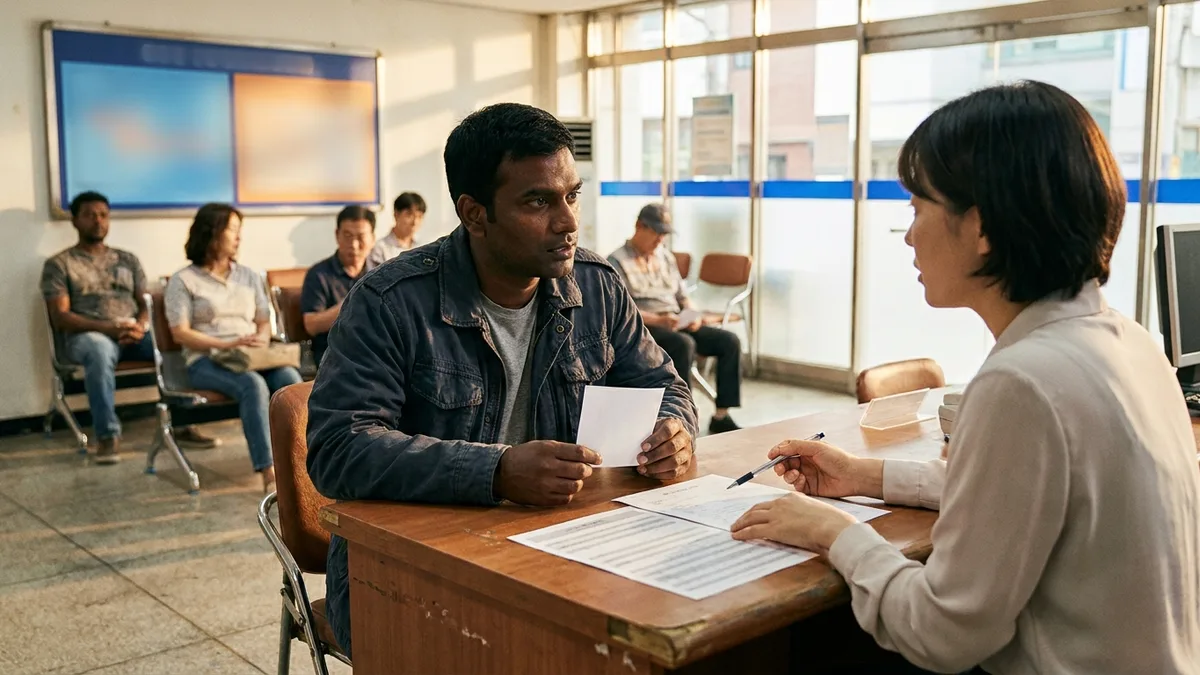
Over the five months from January to May 2026, the Ministry of Justice caught 734 unauthorized foreign delivery riders along with 16 delivery businesses. Only 67 people were caught in the preceding year, so that's roughly an 11-fold jump. Of the 734, 410 (56%) held student (D-2) status, 149 (20%) held overseas Korean (F-4) status, and 99 (14%) held job-seeker (D-10) status.
The numbers didn't pile up because enforcement suddenly got harsher. In Korea, there's "a visa status that lets you work" and then there's "a visa status that lets you deliver" — and they're not the same thing. D-2 students clearly have a door open to them in the form of a part-time work permit, yet delivery work specifically is carved out as a restricted occupation. F-4 holders have nearly every activity open to them, yet delivery is singled out as a restricted job. It's a double gate that simply doesn't exist for Korean nationals.
And the consequences don't stop at a single fine. Sixty-eight people were deported (removal orders), and 643 people were assessed summary fines (notice dispositions) totaling 1.6287 billion KRW. Individual amounts ranged from a minimum of 1,000,000 KRW to a maximum of 10,000,000 KRW, and the primary reason for that spread is that Appendix 7 of the Enforcement Rules of the Immigration Act sets summary fine brackets based on "how long you did it." That said, the "minimum 1,000,000 KRW" in the announcement isn't a value found in that table (a violation of Article 18(1) starts at 2,000,000 KRW for under one month), so it's best understood as either a violation of Article 18(2) — working outside your designated workplace, where the under-three-months bracket is 1,000,000 KRW — or a case where the one-half reduction under Article 86(2) of the Enforcement Rules was applied.
Note: This article is not legal advice. Visa status outcomes turn on your specific sub-category (the "item" letter) and your permit history, and the official notices get amended, so confirm which side you fall on with the Immigration Contact Center ☎1345 (multilingual) or your local immigration office. What follows is a summary of the original statutes, notices, and Ministry of Justice press releases as of 2026-08.
734 People Caught in Five Months — Half of Them Were Students
The Ministry of Justice released these enforcement results in a press release on July 7, 2026. One thing stands out: those caught weren't scattered randomly — they were heavily concentrated in a handful of visa statuses.
| Visa status | People caught | Share |
|---|---|---|
| Student (D-2) | 410 | 56% |
| Overseas Korean (F-4) | 149 | 20% |
| Job-seeker (D-10) | 99 | 14% |
| Other | 76 | 10% |
Nationalities were similarly concentrated: Vietnam 444 (61%), China 164 (22%), Uzbekistan 86 (12%). Students, overseas Koreans, and job seekers were precisely the groups targeted. Which also means the feeling of "everyone around me is doing it" is, statistically, the feeling of the highest-risk group.
The Ministry of Justice cited violations of Article 17 (Stay and Scope of Activities of Foreigners) and Article 18 (Restrictions on Employment of Foreigners) of the Immigration Act as the legal basis. The operation itself was literally titled "foreign riders making illegal deliveries using other people's accounts." As a follow-up measure, the Ministry recommended that delivery platform companies introduce facial recognition authentication in their rider apps and tighten management of delivery businesses.
Can I Deliver on My Visa Status? — Eligibility by Status, on One Page
It's faster to look at the whole map first. The table below reflects what we verified in the original statutes and official notices as of 2026-08 — please treat it as a starting point, not a ruling.
| Visa status | Delivery work | Basis |
|---|---|---|
| Student (D-2) / General Trainee (D-4) | Not allowed | The restricted occupations for part-time work include workers in special types of employment (courier drivers, delivery riders, etc.) |
| Overseas Korean (F-4) | Not allowed as a rule (only a regional exception) | Attachment 1 of Ministry of Justice Notice No. 2026-65 lists 29 simple-labor occupations including courier, express (quick-service) delivery worker, and restaurant delivery worker |
| Permanent Resident (F-5) | Not subject to restrictions on scope of activities | Immigration Act Article 10-3(1) |
| Marriage Migrant (F-6) | Not subject to employment restrictions | Enforcement Decree of the Immigration Act Article 23(2) |
| Residence (F-2) | Depends on the sub-category (item letter) | Only the items enumerated in Article 23(2) of the Enforcement Decree are exempt from restrictions |
| Non-professional Employment (E-9) | Working outside the designated workplace is a violation | Immigration Act Article 18(2) |
| Work and Visit (H-2) | Needs confirmation | After the permitted industries switched to a negative-list system, we could not verify the original exclusion list |
| Job-seeker (D-10) | Needs confirmation | We only confirmed that 99 people were caught; we could not obtain the original guidelines on permitted/restricted occupations |
Let's revisit two lines. "Needs confirmation" does not mean "probably fine." It means we could not confirm it against the original text — and if you start working while it's unconfirmed, the risk stays entirely with you. For H-2 and D-10, don't rely on this table; ask 1345 or your local immigration office directly.
Residence (F-2) also calls for care. Article 23(2) of the Enforcement Decree enumerates, among the Residence (F-2) categories in Appendix 1-2, items (a) through (c) and items (i) through (p), plus items (d) and (f) (where the person continues activities in the field of their previous visa status), as persons not subject to employment restrictions. In other words, even within the same F-2, a different item letter next to your status can change the conclusion. The fastest approach is to bring exactly what's printed on your alien registration card when you inquire.
D-2 and D-4 Students — Even With a Part-Time Work Permit, Delivery Is a "Restricted Occupation"
For a student to work part-time, you need a part-time work permit. This is a "permit for activities outside your visa status" under Articles 18(1) and 20 of the Immigration Act. Meaning: it's a procedure for exceptionally allowing an activity that isn't part of your original status (study).
Here's where many people get it wrong. People assume that once you have the permit, you can do any kind of work — but the permit system itself has a separate list of restricted occupations. And that list includes "activities of workers in special types of employment (courier drivers, delivery riders, etc.)." So it's not that you can't get a permit for delivery work — it's that delivery work isn't even an eligible field to apply for.
This distinction matters because it changes which penalty provision applies. If you engage in an activity belonging to a different visa status without permission, Article 94(12) of the Immigration Act imposes imprisonment of up to three years or a criminal fine of up to 30,000,000 KRW, and you become subject to deportation under Article 46(1)8.
📌 For reference: We haven't written out the weekly hour limits or the Korean-proficiency requirement figures for part-time work in this article. Government guidance and university notices give conflicting numbers, and we couldn't verify against the original text whether the July 9, 2026 amendment is reflected. What doesn't change, though, is that delivery work is an excluded field regardless of the hour requirements. Check the hour conditions with your university's international office or 1345.
The part-time work permit application itself can be handled through HiKorea's e-Application service. We've covered the application screens and required documents separately in How to Apply Through HiKorea e-Application.
F-4 Overseas Koreans — Almost Everything Is Open, but Delivery Is Blocked (Notice No. 2026-65)
F-4 is a status with a broad employment scope. That makes it easy to think, "I'm an overseas Korean, so pretty much anything goes" — but delivery is precisely on the blocked side.
The basis isn't a statute; it's an official notice. The scope of employment restrictions for overseas Koreans is set by Ministry of Justice Notice No. 2026-65, promulgated and in effect as of February 12, 2026. The enabling provisions are Article 18(1) of the Immigration Act, Article 23(3) of its Enforcement Decree, and Article 27-2 of its Enforcement Rules. The previous notice (No. 2023-187, dated 2023-05-01) was repealed when this one took effect. So if you read an article based on the 2023 notice today, the values won't match.
Attachment 1 of the notice enumerates 29 simple-labor occupations. Pulling out only the delivery-related entries:
- (3) Courier
- (4) Express delivery worker ("neulchan baedalwon") — the job examples explicitly list "quick-service delivery worker" and "delivery agency rider"
- (8) Restaurant delivery worker
- (9) Other delivery workers
"Neulchan baedalwon" is probably a term you've never seen. It's a purified Korean coinage for quick-service delivery — and this one unfamiliar word is the crux of whether F-4 holders can deliver. It's information you only find by opening the notice PDF and reading down into the occupational classification entries in the attachment, so if Korean isn't comfortable for you, it's easy to miss that it even exists.
There is one exception, and its condition is regional rather than occupational. Only if you have your place of residence in a si/gun/gu designated by the Minister of Justice as a target area for the region-specific visa program, among the population-declining areas under Article 2(12) of the Special Act on Local Autonomy, Decentralization and Balanced Regional Development, and you work within the metropolitan city or province that your place of residence belongs to, are you exempt from the restrictions in Attachment 1 (simple labor) and Attachment 2. The restrictions related to public morals still apply even under this exception.
Note: Both conditions apply together. Your place of residence has to be in a target si/gun/gu, and where you work also has to be inside the metropolitan city/province that residence belongs to. Simply moving your registered residence to a rural area so you can deliver in Seoul doesn't work. On top of that, the current list of target si/gun/gu isn't included in the body of the notice — it only says "as designated by the Minister of Justice" — so you'll have to confirm with your local immigration office whether your residence qualifies.
E-9, H-2, D-10 — "Designated Workplace" and "Brokering" Are the Forks in the Road
E-9 (Non-professional Employment) is a status that permits employment activity. So it's easy to think, "I have work authorization, so a little delivery on weekends should be fine" — and that's the trap. E-9 is a status with a designated workplace.
Even a foreigner holding a status that permits employment activity violates Article 18(2) of the Immigration Act by working somewhere other than the designated workplace. The penalty under Article 95(5) is imprisonment of up to one year or a criminal fine of up to 10,000,000 KRW, and the summary fine under Appendix 7 of the Enforcement Rules starts at 1,000,000 KRW even for under three months. The formal procedure for changing workplaces (Article 21) is a separate matter — for that, see E-9 Workplace Change Procedures.
H-2 (Work and Visit) and D-10 (Job-seeker) remain exactly as marked "needs confirmation" in the table above. For H-2, it's known that permitted industries switched to a negative-list system in 2023, but we couldn't verify the original list of excluded mid-level categories. For D-10, beyond the fact that 99 people were caught, we couldn't obtain the original official guidelines specifying permitted and restricted occupations for part-time work. Writing "it's allowed" without the original text would push that risk onto the reader, so we'll hand both statuses over to 1345.
Another frequent question: what happens if you register a business and work as a business-income earner? On this point, we could not obtain an official authoritative interpretation. Whether the contract is an employment contract or a service/consignment contract, the fork is whether it counts as "employment activity" under the Immigration Act — so don't decide for yourself. Explain the facts exactly as they are to your local immigration office and ask.
How Much If You Get Caught — Summary Fines Are Calculated by "How Long You Did It"
Why the Ministry of Justice's figures range from "a minimum of 1,000,000 KRW to a maximum of 10,000,000 KRW per person" mostly becomes clear once you look at the Enforcement Rules. Summary fine brackets are set by the duration of the violation, not the number of violations. Below are the assessment standards for violations of Article 18(1) under Appendix 7 of the Enforcement Rules of the Immigration Act (as amended 2026-01-23).
| Duration of violation | Summary fine |
|---|---|
| Under 1 month | 2,000,000 KRW |
| 1 month to under 3 months | 3,000,000 KRW |
| 3 months to under 6 months | 4,000,000 KRW |
| 6 months to under 1 year | 7,000,000 KRW |
| 1 year to under 2 years | 10,000,000 KRW |
| 2 years to under 3 years | 15,000,000 KRW |
| 3 years to under 5 years | 20,000,000 KRW |
| 5 years to under 7 years | 25,000,000 KRW |
| 7 years or more | 30,000,000 KRW |
Here's how to read that table. "I only tried it a couple of times, briefly" isn't a circumstance that erases the amount — it's a circumstance used to determine which bracket you fall into. Even if you don't reach a full month, the starting point is 2,000,000 KRW. Conversely, once you pass a year, you move up to the 10,000,000 KRW bracket.
One thing worth flagging. The lowest figure in this table is 2,000,000 KRW, yet the Ministry of Justice announcement mentions "a minimum of 1,000,000 KRW per person." There are two paths by which 1,000,000 KRW could arise: either the violated provision was Article 18(2) (working somewhere other than the designated workplace) rather than Article 18(1), landing in the under-three-months bracket of 1,000,000 KRW, or the one-half reduction described just below was applied. In other words, you won't find "minimum 1,000,000 KRW" anywhere in this table.
There is some room for adjustment. A summary fine is "an amount equivalent to a criminal fine" imposed via a notice disposition under Article 102(1) of the Immigration Act, and Article 86(2) of the Enforcement Rules allows the standard amount to be reduced or increased by up to one-half, taking into account age, circumstances, the motive and consequences of the violation, ability to pay, and the number of violations. That said, this is the outcome of a review, not a bargaining chip.
Here's a one-page summary of who falls under which provision.
| Situation | Violated provision | Penalty provision | Statutory penalty |
|---|---|---|---|
| Working without work authorization | Article 18(1) | Article 94(8) | Up to 3 years' imprisonment or a criminal fine of up to 30,000,000 KRW |
| Engaging in activities of another visa status without permission | Article 20 | Article 94(12) | Up to 3 years' imprisonment or a criminal fine of up to 30,000,000 KRW |
| Working somewhere other than the designated workplace | Article 18(2) | Article 95(5) | Up to 1 year's imprisonment or a criminal fine of up to 10,000,000 KRW |
| Lending out an account or employing someone | Article 18(3) | Article 94(9) | Up to 3 years' imprisonment or a criminal fine of up to 30,000,000 KRW |
| Brokering or soliciting as a business | Article 18(4) | Article 94(10) | Same as all items of Article 94 (up to 3 years' imprisonment or a criminal fine of up to 30,000,000 KRW) |
The heaviest part of this table isn't actually the penalty column. The violations above make you subject to deportation under Article 46(1)8. Something that ends with a fine for a Korean national becomes a question of your very right to stay if you're a foreign resident. In practice, 68 of the 734 people were removed from the country. Your studies, your EPS re-entry, your plans to change visa status can all collapse at once — so this isn't something to judge by the money alone.
If You're Using a Korean National's Account — Both the Borrower and the Lender Get Caught
The title of this enforcement operation was literally "foreign riders making illegal deliveries using other people's accounts." With platform registration blocked, using accounts registered in Korean nationals' names spread as a workaround, and the Ministry of Justice aimed precisely at that point.
The problem with this workaround is that two people, not one, become subject to punishment. The person who worked using a borrowed account violates Article 18(1) (penalty under Article 94(8)), and the person who lent the account or employed them violates Article 18(3) (penalty under Article 94(9)). The employer's summary fine, under Appendix 8 of the Enforcement Rules, is 3,000,000 KRW even for one person and under three months — and if you broker or solicit employment "as a business," Article 94(10) applies, starting at 10,000,000 KRW per person.
That's exactly what happened this time, too. Separately from the 734 riders, 16 owners of delivery businesses who provided accounts were caught and are under investigation. Which means "my boss said it was fine" is no shield — and that the boss himself becomes a suspect in the same case.
Note: This article does not cover how to obtain accounts or evade authentication. Given that the Ministry of Justice has recommended delivery platforms introduce facial recognition in rider apps, this route is closing — and if you've already started working, remember that the longer it goes on, the higher your summary fine bracket climbs. Don't figure out how to wind things down on your own: talk it through with 1345, your local immigration office, and the counseling channels listed in Where to Get Help With Labor Problems as a Foreigner.
Even If You Clear the Visa Gate, Two More Remain — a Motorcycle License and Paid-Transport Insurance
Sorting out your visa status doesn't mean you can start right away. For foreign residents, two more gates remain.
The first is a motorcycle license. Article 2(19) of the Road Traffic Act defines a motorized bicycle as a motorcycle of 125cc or less (or, for electric models, a maximum rated output of 11 kW or less), and Appendix 18 of the Enforcement Rules (as amended 2024-11-14) provides that a Class 2 Ordinary license allows you to operate a motorized bicycle. So if you have a Class 2 Ordinary license obtained by exchanging a foreign license, you can ride up to 125cc, and for anything above that you'll need to newly obtain a Class 2 Small license in Korea. Note, though, that this is a "vehicle class" standard. We could not verify from original sources whether separate restrictions attach when operating for commercial purposes, like delivery — so please also ask at a police station or the Korea Road Traffic Authority. License classes and exchange procedures are covered in Scooter and Motorcycle Rentals and Licenses.
If you arrived with only an International Driving Permit (IDP), the conditions are stricter. Article 96(1) of the Road Traffic Act allows driving on an IDP or a mutually recognized foreign license for only one year from the date of entry into Korea, and limits the vehicle classes you may drive to those written on the permit. Paragraph 2 of the same article provides that such a license does not allow you to drive commercial vehicles under the Passenger Transport Service Act or the Trucking Transport Business Act — but we could not verify whether a delivery motorcycle counts as a commercial vehicle in that sense. Please confirm directly with a police station or the Korea Road Traffic Authority whether delivery riding is possible on an IDP alone.
The second is paid-transport insurance. Effective June 3, 2026, amendments to the Enforcement Decree and Enforcement Rules of the Act on the Development of the Living Logistics Service Industry made paid-transport insurance mandatory for delivery workers. Unless you're covered by a policy providing unlimited bodily injury liability and at least 20,000,000 KRW in property damage liability, you cannot conclude an employment contract or a transport consignment contract with a delivery business — and existing contracts are terminated. It's shifted from "nice to have insurance" to "without it, the contract can't exist at all."
For foreign residents, that adds another layer of paperwork. The practical requirements for getting insured (alien registration number, license class, each insurer's underwriting criteria) can differ by company, so we couldn't generalize. If you're still waiting for your alien registration card to be issued, just factor in ahead of time that none of these steps can move forward until then.
To sum up, the order is:
- Confirm your visa eligibility — check your status, item letter, and permit history with 1345 or your local immigration office
- Motorcycle license — check whether your class matches the engine displacement, and whether you need an exchange or a new license
- Paid-transport insurance — get covered with unlimited bodily injury and at least 20,000,000 KRW property damage
- Sign the contract — without insurance, the contract stage never opens
Most of this confirmation process means showing up in person on weekdays during business hours. And your local immigration office, the driver's license testing center, and the employment center are often in completely different neighborhoods. If you don't have a Korean phone number or a Korean card yet, you may get stuck at the booking stage before you even travel. Having one transport-and-payment super app for foreigners that works without a Korean bank account or Korean phone number makes these trips much simpler. That said, LACHA does not handle motorcycle rentals or any delivery-related services.
Need transit and payments while you wait for your residence card? Check out LACHA.
Built to work without a Korean phone number or bank account, with overseas payment methods like Alipay, WeChat Pay, and Apple Pay. Taxi hailing plus KTX, express bus, and airport railroad (AREX) booking — all in one app.
Up to 60% off Korea transit with a coupon (max ₩3,000): enter code at sign-up. KTX gets up to 18% off on top
Download now


Frequently Asked Questions (FAQ)
Q1. I have a part-time work permit — can I really not do delivery work? Correct, you can't. Part-time work is a permit for activities outside your visa status under Articles 18(1) and 20 of the Immigration Act, and its restricted occupations include "activities of workers in special types of employment (courier drivers, delivery riders, etc.)." It's not that you can't get the permit — delivery work isn't an eligible field to apply for in the first place. Engaging in activities of another visa status without permission carries up to 3 years' imprisonment or a criminal fine of up to 30,000,000 KRW under Article 94(12), and makes you subject to deportation under Article 46(1)8.
Q2. I'm on F-4 — can I deliver if I register my residence in a rural area? Just moving your residence isn't enough. The exception in Ministry of Justice Notice No. 2026-65 applies where you have your residence in a si/gun/gu designated by the Minister of Justice as a target area for the region-specific visa program among population-declining areas, and you work within the metropolitan city/province that residence belongs to. Both your residence and your workplace have to satisfy the conditions. On top of that, the list of target si/gun/gu isn't in the body of the notice, so you'll need to confirm with your local immigration office whether your residence qualifies.
Q3. If I only do it for a day or two, will I still get a summary fine? Appendix 7 of the Enforcement Rules of the Immigration Act sets summary fines for violations of Article 18(1) by duration of violation, and the shortest bracket, "under 1 month," is 2,000,000 KRW. It's not a structure where a short duration gets you an exemption — it's a structure where duration determines which bracket you land in. That said, under Article 86(2) of the Enforcement Rules, the standard amount can be reduced or increased by up to one-half in consideration of age, circumstances, motive, consequences, ability to pay, and number of violations.
Q4. If I use a Korean friend's account, does my friend get punished too? Yes — both sides get caught separately. The person who worked using the borrowed account violates Article 18(1) (Article 94(8)), and the person who lent the account or employed them violates Article 18(3) (Article 94(9)). The employer's summary fine under Appendix 8 of the Enforcement Rules is 3,000,000 KRW even for one person and under three months, and brokering or soliciting as a business falls under Article 94(10), starting at 10,000,000 KRW per person. In the 2026 crackdown as well, 16 delivery business owners who provided accounts were caught and are under investigation.
Q5. I only have a car license (Class 2 Ordinary) — can I ride a delivery motorcycle? Appendix 18 of the Enforcement Rules of the Road Traffic Act provides that a Class 2 Ordinary license allows you to operate a motorized bicycle, and a motorized bicycle is 125cc or less (or, for electric models, a maximum rated output of 11 kW or less). So if you have a Class 2 Ordinary license obtained by exchange, you can ride up to 125cc, and above that you need a Class 2 Small license. Note that this is a "vehicle class" standard, and we could not verify from original sources whether separate restrictions attach to commercial-purpose operation like delivery — please also confirm with a police station or the Korea Road Traffic Authority. If you only have an International Driving Permit, you're limited to one year from your entry date and to the vehicle classes written on the permit, and whether delivery riding is allowed likewise requires separate confirmation.
Reference: This article is intended to provide general information and is not legal advice. The statistics, provisions, and amounts in the text were verified as of 2026-08 against the Ministry of Justice press release (2026-07-07) and the original texts on the Korea Law Information Center of the Immigration Act and its Enforcement Decree and Enforcement Rules, the Road Traffic Act and its Enforcement Rules, and Ministry of Justice Notice No. 2026-65. Whether delivery work is allowed on Work and Visit (H-2) and Job-seeker (D-10) status, the list of si/gun/gu where the F-4 exception applies, how business registration arrangements are treated, whether delivery riding is possible on an International Driving Permit, and whether separate commercial-operation restrictions attach to a Class 2 Ordinary license obtained by exchange could not be confirmed against original texts, so we've left them marked "needs confirmation." Visa status restrictions change frequently through amendments to notices and guidelines, so please be sure to re-confirm with ☎1345 and your local immigration office before you start working. LACHA does not provide motorcycle rentals or delivery services.