
There are three things in Korea's criminal process that only work if you speak up. An interpreter (Article 91(1) of the Rules on Police Investigation), having a defense lawyer sit in on your questioning (Article 243-2(1) of the Criminal Procedure Act), and notifying your own country's consular post (Article 36(1)(b) of the Vienna Convention on Consular Relations). You'll be informed about all three, but none of them starts until you ask.
The timing is already fixed, too. Once you're arrested, whether a detention warrant will be requested is decided within 48 hours (Criminal Procedure Act Article 200-2(5), as of 2026), and once a warrant is requested, a judge questions you in person by the following day unless there are special circumstances (Article 201-2(1) of the same Act).
Please note: this article is general information compiled from publicly available statutes, treaty texts, and court decisions, and it is not legal advice. It doesn't cover sentencing ranges for specific offenses or how likely you are to be held in custody. For a judgment that fits your own case, please confirm with a lawyer and through the official channels listed below.
The three sentences you need to say on the spot
Let's start with what to memorize. The background comes after.
| Sentence to say | Legal basis | What it sets in motion |
|---|---|---|
| "Please call an interpreter." | Rules on Police Investigation Article 91(1) | A foreign national being questioned must be given interpretation in a language they can understand |
| "I'm going to call a lawyer. Please let my lawyer sit in on the questioning." | Criminal Procedure Act Article 243-2(1) | On request, you must be allowed to meet your lawyer, and absent a legitimate reason your lawyer must be allowed to attend the questioning |
| "Please notify my country's consular post." | Vienna Convention Article 36(1)(b) · Rules on Police Investigation Article 91(2) and (3) | The notification only goes out if you request it |
Don't turn down an interpreter just because you speak some Korean. Article 91(1) of the Rules on Police Investigation is written as a duty — interpretation "shall be provided in a language the person can understand." Being able to hold an everyday conversation is not the same as understanding criminal procedure terminology, and once you've signed the written record, it's hard to undo. The trial stage has its own provision: Criminal Procedure Act Article 180 requires that statements by a person who is not proficient in Korean be interpreted by an interpreter.
That said, we won't flatly tell you "interpretation is free." We weren't able to confirm from primary sources who ultimately bears the cost. What the provisions establish is that you can request an interpreter and that one must be provided — the cost question is one to put to your lawyer separately.
If you're asked to sign a document you can't read, ask for an interpreter first, right there. An investigative agency that has advised you of your rights before questioning is required to ask whether you intend to exercise them, write your answer into the record, and then obtain your signature or seal (Criminal Procedure Act Article 244-3(2)). The important thing is not to fill in that box without knowing what you're signing.
A lawyer who sits in on questioning may state an opinion once the questioning ends, and may object mid-questioning to improper questioning methods (Criminal Procedure Act Article 243-2(3)). Your lawyer's participation, and any restriction placed on it, gets written into the suspect interrogation record (paragraph 5 of the same Article). That's why the sooner you ask for a lawyer, the more the record left behind changes in your favor.
Consular notification isn't automatic — it only goes out if you ask
The Vienna Convention on Consular Relations was adopted in 1963 and entered into force internationally on March 19, 1967; for the Republic of Korea it entered into force on April 6, 1977 as Treaty No. 594. That means it has the same effect as domestic law.
Article 36(1)(b) provides that when a foreign national who has been arrested, committed to prison, or detained so requests, the authorities of the receiving state must inform that person's home-country consular post without delay, and must also inform the person of that right without delay. Subparagraph (c) of the same paragraph sets out consular officers' right to visit and converse with a detained national of their own country and to exchange correspondence.
The domestic rules are built the same way. Article 91(2) of the Rules on Police Investigation (Ordinance of the Ministry of the Interior and Safety No. 629, effective July 1, 2026) requires judicial police officers arresting or taking a foreign national into custody to inform them that they may freely communicate and meet with a consular officer and that they may request notification. Paragraph 3 of the same Article requires that, if the person requests it, the officer complete Form No. 93, the "Notification of Arrest or Detention to a Consular Post," and send it to the relevant consular post without delay. We couldn't verify the actual fields on the physical form, so the surest way to know whether the notification really went out is to check through your lawyer. Paragraph 4 of the same Article separately requires notification without delay using Form No. 94, the notification of death to a consular post, when a foreign national dies an unnatural death.
There's one especially dangerous misunderstanding here. Supreme Court Decision 2021Do17103 of April 28, 2022 held that where investigative authorities fail to advise a person of the right to consular notification and related rights without delay, that arrest or detention procedure violates Article 36(1)(b) of the Convention and is therefore unlawful. But the very same decision went on to hold that where the substance and degree of the procedural violation cannot be regarded as grave, and cannot be regarded as substantially infringing the rights and legal interests the provision protects, evidence collected after the arrest or detention may still be used as evidence of guilt. Online summaries clip only the first sentence, which makes it read as "they didn't advise me, so I go free" — but that isn't what the decision says.
📌 Important: for some countries, we're told there are separate arrangements under which notification goes out even without the person's request. Which countries those are varies by nationality and we weren't able to confirm a list, so please ask your own mission directly. How to find your mission is laid out in How to find your country's mission in Korea.
What your mission does and doesn't do while you're detained
A consular officer showing up doesn't resolve the case itself. The scope that missions from many countries commonly state is visits and interviews, contacting your family, providing a list of local lawyers, and helping pass along money sent by your family. Plenty of governments write for themselves that they will not demand your release, intervene in the investigation, judge guilt or innocence, give legal advice, or pay your lawyer's fees or a deposit for you. The differences country by country, with sources, are set out separately in What your country's mission in Korea actually does.
So it's more accurate to think of a consular visit and retaining a lawyer as two separate processes. A consular visit is the channel that gets word of where you are and what condition you're in to your home country and your family; contesting the outcome of the case is the lawyer's job. Best of all is to start both on the same day.
So where do you find a lawyer — that's what the next two sections are about.
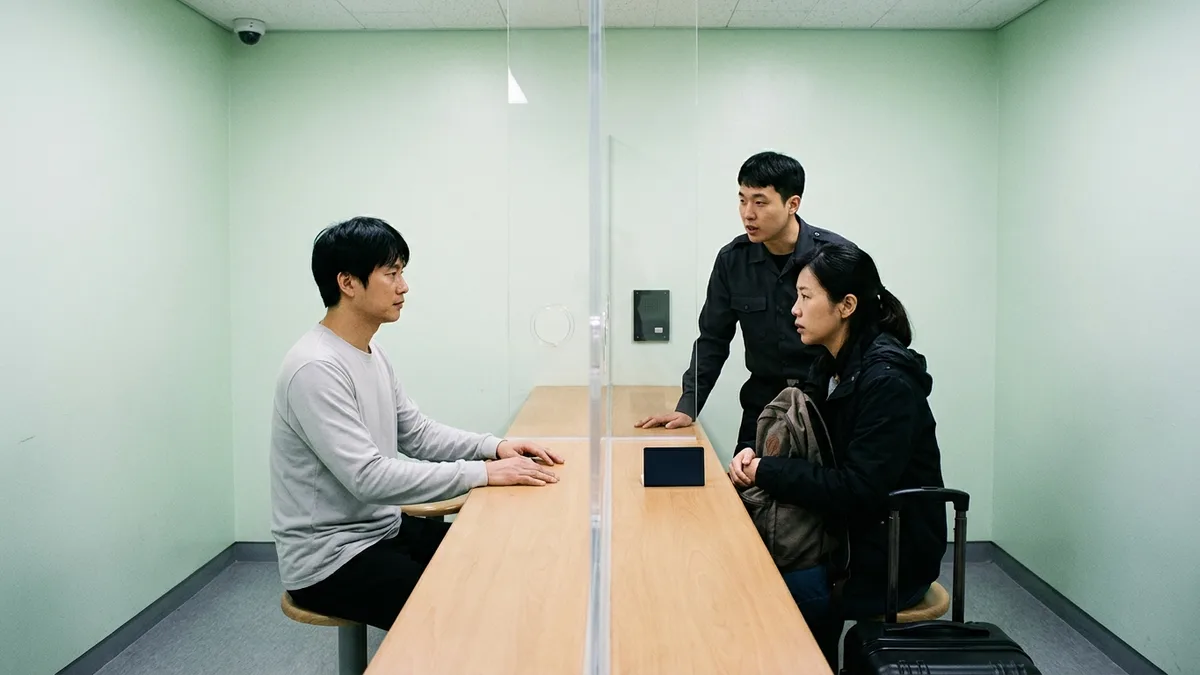
The clock on the first few days — 48 hours, questioning the next day, and 30 days at most
| Stage | Deadline | Legal basis (as of 2026) |
|---|---|---|
| Arrest → request for a detention warrant | Within 48 hours from the time of arrest; if no request is made, immediate release | Criminal Procedure Act Article 200-2(5) |
| Emergency arrest | The same 48 hours. If no warrant is requested, or none is issued, immediate release | Article 200-4(1) and (2) of the same Act |
| Questioning by a judge (the detention warrant hearing) | By the day after the warrant is requested, absent special circumstances | Article 201-2(1) of the same Act |
| Custody at the police stage | Release unless the person is handed over to a prosecutor within 10 days | Article 202 of the same Act |
| Custody at the prosecutor stage | Release unless an indictment is filed within 10 days | Article 203 of the same Act |
| Extension | Once only, with a judge's permission, for a period not exceeding 10 days | Article 205(1) of the same Act |
Added up, that's a maximum of 30 days at the investigation stage. But it does not mean "after 30 days you automatically walk out." This is the custody period for the investigation stage; once you're indicted, the calculation changes. Check the schedule after that point with your lawyer.
You don't face the hearing alone. The judge must immediately notify the prosecutor, the suspect, and defense counsel of the date and place of the hearing, and the prosecutor and defense counsel may appear on that date and state their opinions (Criminal Procedure Act Article 201-2(3) and (4)). So whether you have a lawyer in place before this hearing is the first fork in the road. Separately, a person released after an emergency arrest cannot be arrested again for the same alleged offense without a warrant (Article 200-4(3) of the same Act).
The advisements don't all come at once, either. It isn't the American TV structure where the right to silence gets recited at the moment of arrest — the statute splits it into two points in time.
| Moment | What must be told to you | Legal basis |
|---|---|---|
| At the time of arrest | The gist of the alleged offense, the reason for the arrest, that you may retain defense counsel, and an opportunity to explain yourself | Criminal Procedure Act Article 200-5 (applied to custody as well via Article 209) |
| Before questioning | That you may decline to make a statement, that declining carries no disadvantage, that a statement made after waiving the right may become evidence of guilt in court, and that you may have the assistance of defense counsel | Criminal Procedure Act Article 244-3(1) |
Emergency arrest isn't available anytime, either. Criminal Procedure Act Article 200-3(1) sets the requirements as there being substantial reason to suspect the person committed an offense punishable by death, life imprisonment, or imprisonment with or without labor for a maximum term of three years or more, plus urgency making it impossible to obtain an arrest warrant from a judge. Not meeting those doesn't make an arrest automatically unlawful, and meeting them doesn't make it automatically lawful. Where your own case falls is for your lawyer to judge.
Defense counsel — when a court-appointed lawyer is assigned, and when one isn't
Let's clear up the most common misunderstanding first. "Foreign nationals automatically get a court-appointed lawyer" is not true. The six grounds for court-initiated appointment under Criminal Procedure Act Article 33(1) are: being held in custody, being a minor, being 70 or older, having both hearing and speech impairments, being suspected of a mental or physical disability, and being indicted for an offense punishable by death, life imprisonment, or imprisonment with or without labor for a minimum term of three years or more. Nationality isn't on that list, and neither is not speaking Korean.
At the suspect stage, there are two points where a court-appointed lawyer is assigned on the court's own initiative. One is the detention warrant hearing: if the suspect to be questioned has no defense counsel, the district court judge must appoint one ex officio (Article 201-2(8)). The other is the review of the legality of arrest or detention, where Article 214-2(10) of the same Act applies Article 33 mutatis mutandis. Beyond those, you have to apply for one yourself (Article 33(2)) or retain one directly.
The statute also sets out routes for people on the outside to act. A legal representative, spouse, lineal relative, or sibling may retain defense counsel independently (Article 30(2)), and a lawyer or "a person who intends to become defense counsel" may meet a person in custody and exchange documents or items with them (Article 34). Those entitled to seek review of the legality of arrest or detention include not just family but a cohabitant and an employer (Article 214-2(1)), which makes those two words a real route for someone with no family in Korea. The court must question the person and rule within 48 hours of the petition being filed, and a suspect in custody may be ordered released on condition of paying a deposit (paragraphs 4 and 5 of the same Article).
Tip: paying money and getting out at the suspect stage isn't "bail" — it's release conditioned on payment of a deposit under the review of the legality of detention (Article 214-2(5)). Bail is a post-indictment mechanism at the defendant stage, so mixing up the terms leads to filing the wrong application.
There's a gap in the custody notice, too. When someone is taken into custody, written notice must be given without delay to defense counsel if there is one, and otherwise to a family member the person designates (Article 87, applied via Article 209) — but if there's no one in Korea to designate, that notice effectively reaches nobody. That's exactly why requesting consular notification matters more. Free legal consultation is ☎132 (Korea Legal Aid Corporation), and foreign nationals living in Korea are included among those eligible for legal aid. Criminal defense, however, is limited to eligible legal aid recipients, so ask first whether you qualify.
While you're inside — visits, letters, money, and where to file a complaint
| Item | How it works | Legal basis |
|---|---|---|
| Lawyer visits | No limit on the length or number of visits, and correctional officers may not sit in, listen in, or record what is said | Correctional Act Article 84(1) and (2) |
| Family and friend visits | Once a day for unsentenced detainees. Lawyer visits don't count toward that number | Enforcement Decree of the Correctional Act Article 101 |
| Letters | You can send and receive them, and as a rule the contents aren't censored (the Act does set out exceptions) | Correctional Act Article 43(1) and (4) |
| Money and items sent in from outside | Unless one of the grounds for refusal set out in the Act applies, the warden must approve them | Correctional Act Article 27(1) |
| When a no-visit order is in place | Defense counsel is the exception, and clothing, food, and medical supplies can't be barred or seized | Criminal Procedure Act Article 91 |
It helps to know the underlying principles above that table, too. A person in custody may, within the scope set by law, meet others, exchange documents or items, and receive treatment from a doctor (Criminal Procedure Act Article 89). Article 91 that follows is the exception provision allowing those visits to be restricted where there is a risk of flight or destruction of evidence. Both Articles apply to the custody of suspects as well via Article 209. The same goes for letters. Letters exchanged between an unsentenced detainee and defense counsel cannot be censored, except where the correctional facility is unable to confirm that the other party is defense counsel (Correctional Act Article 84(3)).
There's one more thing that exists on paper and almost nobody knows about. A warden holding foreign inmates is required to designate a correctional officer fluent in foreign languages as a dedicated officer, tasked with individual interviews, resolving grievances, interpretation and translation, and liaison with diplomatic missions, consulates, and other relevant agencies (Enforcement Rules of the Correctional Act Article 56(1)). Paragraph 2 of the same Article requires the dedicated officer to assist foreign unsentenced detainees, including by providing the legal knowledge needed to move their case forward. If you don't ask, it just passes you by — so learn that this role exists.
If you experience unfair treatment, you can file a complaint with the National Human Rights Commission of Korea from inside the facility. Article 31 of the National Human Rights Commission of Korea Act requires that when a person held in a facility wishes to file, the public officials there provide the time, place, and facilities needed to write the complaint; that if the person wishes to file in the presence of a commissioner or staff member, the Commission be notified immediately; and that the complaint be forwarded immediately and a receipt certificate be issued to the complainant. The main consultation and complaint line is ☎1331, and you can also use the complaint boxes installed at each facility or file in person.
"Custody" under criminal procedure and "detention" under the Immigration Act are different tracks
Translate them into English or Vietnamese and both come out as "detention," but in Korea they are completely different systems.
| Category | "Custody" (구속) in criminal procedure | "Detention" (보호) under the Immigration Act |
|---|---|---|
| Governing law | Criminal Procedure Act Articles 202, 203, and 205 | Immigration Act Article 63 (Act No. 20992, effective 2026-01-23) |
| Duration | Up to 30 days at the investigation stage | Detention within a limit of 2 months; even with extension it may not exceed 9 months in total as a rule (up to 20 months on specific grounds set out in the Act) |
| Notice to family | In writing, without delay (Article 87) | In writing within 3 days (Article 54(1)) |
| Consular notice | When the person requests it (Rules on Police Investigation Article 91(3)) | When the person wants it (Immigration Act Article 54(2)) |
The cap on the detention period didn't originally exist — it was added later. Constitutional Court Decision 2020Hun-Ga1 and 2021Hun-Ga10 (consolidated) of March 23, 2023 declared the old provision, which set no upper limit, constitutionally nonconforming for violating the principle against excessive restriction and the principle of due process, and the law was amended accordingly.
The point where criminal punishment meets residence status is a single line of statute. Article 46(1)13 of the Immigration Act designates "a person who has been sentenced to imprisonment without labor or a heavier punishment and then released" as subject to deportation. Being under investigation and having a sentence become final are different stages, and individual determinations are the province of the competent immigration office. Article 84(1) of the same Act also separately requires public officials who, in the course of their duties, find a person believed to be in violation of the Act to report it to the head of the regional immigration office, and paragraph 2 requires the heads of prisons and detention centers to give notice in cases such as a decision to release. So we're not going to reassure you here, and we're not going to scare you either. If you're not sure which side of this you're on, check first with ☎1345 and a lawyer. If you've overstayed your period of stay, see What you can do when you've overstayed; if unpaid wages are tangled up in it, see Wage and industrial accident rights for undocumented workers alongside this.
Numbers you can call at night and on weekends — and a different path if you're the victim
| Situation | Number | What to know |
|---|---|---|
| Emergency report | 112 | 24 hours. Since March 18, 2024 the foreign language interpretation center has run three-way calls 24 hours a day, 365 days a year (the languages at the time of that expansion were English and Chinese) |
| Residence and visas | 1345 | Weekdays 09:00–22:00 in 20 languages, but after 18:00 the evening hours are Korean, English, and Chinese only. From overseas, +82-1345 |
| Free legal consultation | 132 | Korea Legal Aid Corporation (main line 054-810-0132). Foreign nationals living in Korea are included among those eligible for legal aid |
| Crime victims | 1577-2584 | Connects you to the victim support office at a nearby prosecutors' office, where you can talk with a victim support officer |
| Human rights violations in detention | 1331 | National Human Rights Commission of Korea. You can also use the complaint boxes inside the facility or file in person |
We'll say this plainly rather than hide it. Arrests happen more often at night, but ☎1345 closes at 10 p.m. and after 18:00 the languages narrow to three. That means there is effectively no official channel where you can ask questions in your own language during those hours. So the order changes at night — first, right there, ask to have things interpreted in a language you can understand (Rules on Police Investigation Article 91(1)), request consular notification, and save the consultation call for the morning. If you need interpretation for a ☎132 consultation, ask whether you can use the three-way interpretation support from ☎1345 alongside it.
If you're the victim rather than the suspect, the path is entirely different. You'll be connected to the prosecutors' office victim support room at ☎1577-2584, and for victims of violent crime who have suffered psychological trauma, and their families, Smile Centers provide counseling, psychological care, and temporary housing free of charge. Local Crime Victim Support Centers provide counseling, transport to hospitals, medical and living cost support, and accompaniment to investigative agencies and court. Note that a "state-appointed victim's attorney" isn't assigned to every victim — it's limited to specific offenses — so check with the competent prosecutors' office whether your case qualifies. We weren't able to confirm the scope of foreign language support at these channels, so it's best to ask by phone first.
Need transit and payments while you wait for your residence card? Check out LACHA.
Built to work without a Korean phone number or bank account, with overseas payment methods like Alipay, WeChat Pay, and Apple Pay. Taxi hailing plus KTX, express bus, and airport railroad (AREX) booking — all in one app.
Up to 60% off Korea transit with a coupon (max ₩3,000): enter code at sign-up. KTX gets up to 18% off on top
Download now


Frequently Asked Questions (FAQ)
Q1. The police didn't tell me about the right to consular notification. Does that mean I go free? No. Supreme Court Decision 2021Do17103 of April 28, 2022 held that where investigative authorities fail to advise a person without delay of the right to consular notification and related rights, that arrest or detention procedure is unlawful — and in the same decision it also held that where the substance and degree of the procedural violation cannot be regarded as grave, and cannot be regarded as substantially infringing rights and legal interests, evidence collected afterward may be used as evidence of guilt. The two sentences have to be read together. Telling your lawyer that no advisement was given is meaningful, but on its own it does not result in release or acquittal.
Q2. Do foreign nationals automatically get a court-appointed lawyer? No. Nationality isn't among the six grounds for court-initiated appointment under Criminal Procedure Act Article 33(1), and neither is not speaking Korean. At the suspect stage, the two points where one is appointed ex officio are the detention warrant hearing (Article 201-2(8)) and the review of the legality of arrest or detention (Article 214-2(10), applying Article 33 mutatis mutandis); beyond those, you have to apply yourself (Article 33(2)) or retain someone directly. If you assume one will show up if you just wait, nothing happens. Start with ☎132 for free legal consultation.
Q3. Do I automatically get out once the 30 days at the investigation stage are up? No. Those 30 days are the investigation-stage custody period, made up of 10 days for the police (Article 202), 10 days for the prosecutor (Article 203), and one 10-day extension with a judge's permission (Article 205(1)). Once you're indicted the calculation changes, so check the schedule after that with your lawyer. One way to contest it before then is the review of the legality of arrest or detention, where the court must question the person and rule within 48 hours of the petition being filed (Article 214-2(4)).
Q4. My family isn't in Korea. Can anyone on the outside act for me? A legal representative, spouse, lineal relative, or sibling can retain defense counsel independently (Article 30(2)). Those entitled to seek review of the legality of arrest or detention include a cohabitant and an employer in addition to family (Article 214-2(1)), so if you have no family in Korea, that's the realistic route. Money and items can be sent in from outside, and unless one of the grounds for refusal set out in the Act applies, the warden must approve them (Correctional Act Article 27(1)). Your mission may help pass along money sent by your family, but it won't pay your lawyer's fees or a deposit on your behalf.
Q5. I'm in an immigration detention center. Does everything in this article apply to me? No. "Custody" in criminal procedure rests on the Criminal Procedure Act, while "detention" under the Immigration Act is a separate system resting on Article 63 of that Act. The durations differ too (detention within a limit of 2 months; even with extension, 9 months in total as a rule, and up to 20 months on specific grounds set out in the Act), and notice to family is in writing within 3 days (Article 54(1)). The structure where consular notice happens when the person wants it is the same (Article 54(2)). If you're unsure which side of this you're on, check first with ☎1345 and a lawyer.
Note: This article is general information compiled from publicly available statutes, treaty texts, and court decisions, and it is not legal advice. The provisions, deadlines, and contact details in the text were confirmed as of 2026-08 against the original statutory texts on the Korea Law Information Center (the Criminal Procedure Act; the Rules on Police Investigation; the Act on the Administration and Treatment of Correctional Institution Inmates and its Enforcement Decree and Enforcement Rules; the National Human Rights Commission of Korea Act; the Immigration Act), the text of Supreme Court Decision 2021Do17103 of April 28, 2022, Constitutional Court Decision 2020Hun-Ga1 and 2021Hun-Ga10 (consolidated) of March 23, 2023, treaty information from the Ministry of Government Legislation's World Law Information Center, and guidance from the Ministry of Justice, the Korea Legal Aid Corporation, the National Human Rights Commission of Korea, and the Supreme Prosecutors' Office. Laws get amended and phone numbers and operating hours change, so before you act, please re-confirm for your own situation at ☎112 (emergency), ☎1345 (residence and visas), ☎132 (legal consultation), ☎1577-2584 (crime victims), and ☎1331 (human rights complaints). We weren't able to confirm from primary sources who bears the cost of interpretation or the fees of court-appointed counsel, so ask your lawyer or the court directly, and check contact details and available languages for individual countries' missions through the Ministry of Foreign Affairs directory of missions in Korea and your own mission's official guidance. LACHA is a transport and payment service, is unrelated to criminal procedure or consular affairs, and does not handle any of these procedures on your behalf.