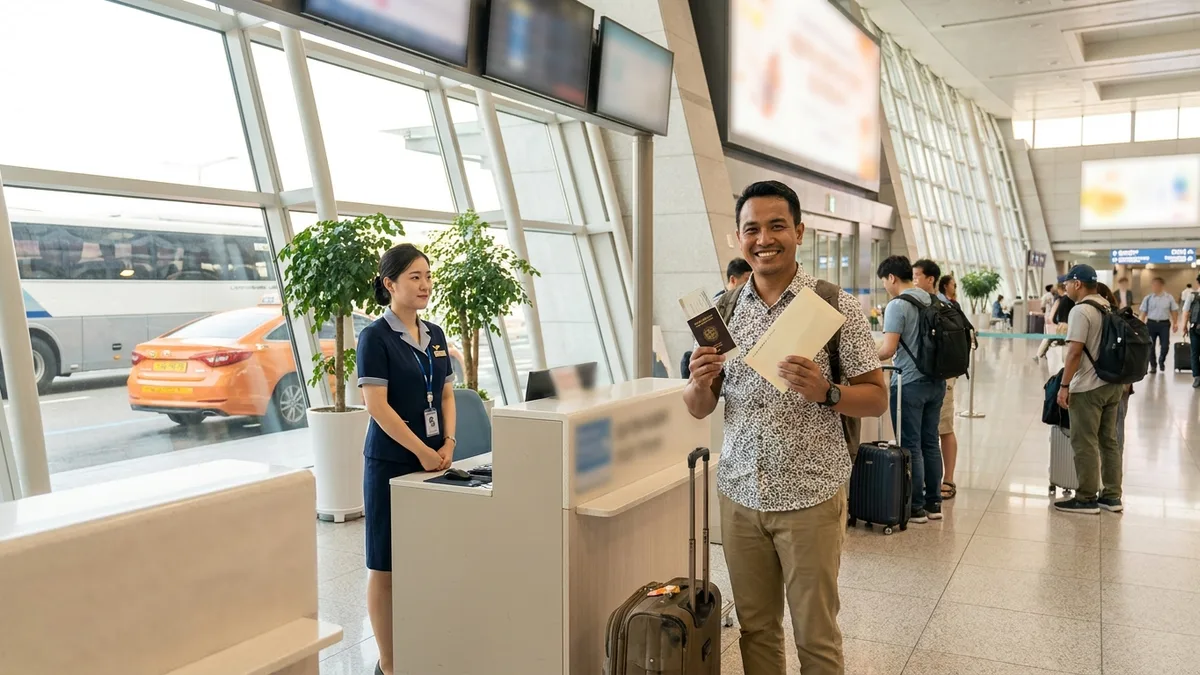
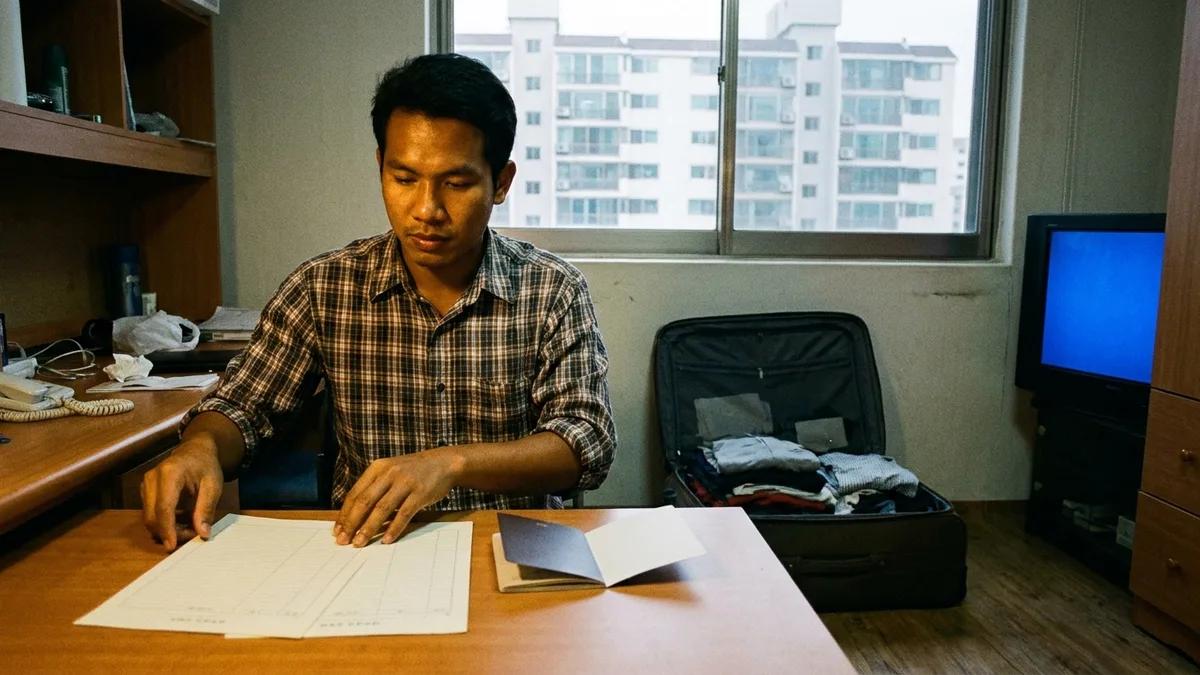
Return cost insurance is a policy you sign up for yourself, not your company. Article 15(1) of the Act on the Employment, etc. of Foreign Workers states that "a foreign worker shall subscribe to insurance or a trust to cover the expenses necessary for returning home" (Act No. 18929, in force as of 2022-12-11). Because it sounds so similar to the departure guarantee insurance your company takes out (Article 13(1) of the same Act) — and the sign-up timing is close too — it's easy to shrug and assume "the company must have taken care of it."
The amount you pay is set by country. Under the Ministry of Employment and Labor's public notice, it's 400,000 KRW for Group 1 (China, the Philippines, Indonesia, Thailand, Vietnam), 500,000 KRW for Group 2 (Mongolia), 600,000 KRW for Group 3 (Sri Lanka), and 500,000 KRW for all other countries, paid either in a lump sum or in up to three installments within 3 months from the effective date of your labor contract (Enforcement Decree Article 22(1) and (3)).
And here's the most important part of this article. People online say "if you don't claim it within 3 years, the money disappears," but Articles 13(4) and 13-2 of the Act say exactly the opposite. When the 3-year statute of limitations on your claim expires, the insurer does not get to keep the money — it must transfer it to the Human Resources Development Service of Korea within 1 month, and the agency must use those funds "primarily for the insured persons, etc." Even after 3 years, it remains as dormant insurance money, so don't give up.
A fair amount of money really does go unclaimed. According to press coverage citing data submitted to the National Assembly (The Korea Economic Daily, 2025-10-21), as of June 2025 the accumulated balance of dormant insurance money for foreign workers stood at 30.76 billion KRW, and out of the 5.852 billion KRW newly converted to dormant status in 2024, only 1.779 billion KRW (about 30%) was actually claimed back.
Note: The articles, amounts, and deadlines below were verified as of 2026-08 against the original statutory texts on the Korean Law Information Center and guidance from the Ministry of Government Legislation and the Ministry of Employment and Labor. This article is general information compiled from public sources, not legal or administrative advice — please re-confirm whether you're covered, and how much you owe by when, at the contact points listed below.
What Is Return Cost Insurance — A Policy "You," Not Your Company, Sign Up For
Just as the name says, it's money set aside in advance to cover the costs of leaving Korea. It applies to foreign workers employed under the Non-professional Employment (E-9) or Working Visit (H-2) status of stay (per government guidance as of 2026-08). If the Employment Permit System itself is new to you, reading the Employment Permit System (EPS) process first will help you see the bigger picture.
Let's start with the point that confuses people most. The money that works like severance pay is departure guarantee insurance, not return cost insurance. Departure guarantee insurance is a policy your employer (the company) funds at 8.3% of your average monthly wage (Article 13(1) of the Act), while return cost insurance is a return-expense fund you pay into with your own money. The two are completely separate, so you need to claim each one individually when you go home. The procedure for claiming departure guarantee insurance, and how to ask your company for the difference when it falls short of your statutory severance pay, is covered separately in How to Get Your Severance Pay and Departure Guarantee Insurance.
Misunderstanding who signs up costs you twice. If you assume the company handled it, you not only miss out on the payout later — the administrative fine for failing to subscribe is imposed on you, not the company (Article 32(1)6 of the Act).
Caution: There are foreign nationals to whom this Act doesn't apply at all. The proviso to Article 3(1) of the Act states that the Act does not apply to foreign seafarers serving on vessels covered by the Seafarers Act, or to the owners of those vessels. If you fall under the Seafarers Act system — for example on a Vessel Crew (E-10) visa — don't judge your situation by the dedicated insurance rules in this article; check with the Ministry of Justice Immigration Contact Center at ☎1345 and the relevant seafarer authority.
The Four Dedicated EPS Insurance Policies — Who Signs Up and Who Pays
The Employment Permit System has four dedicated insurance policies. All four have similar names, but the person who signs up and the deadline differ.
| Insurance | Who subscribes | Deadline | Legal basis |
|---|---|---|---|
| Departure guarantee insurance | Employer (company) | Within 15 days from the effective date of the labor contract | Act Art. 13(1), Enforcement Decree Art. 21(2) |
| Guarantee insurance for unpaid wages | Employer (company) | Within 15 days | Act Art. 23(1) |
| Return cost insurance | The worker | Within 3 months from the effective date of the labor contract | Act Art. 15(1), Enforcement Decree Art. 22(1) |
| Casualty insurance | The worker | Within 15 days from the effective date of the labor contract | Act Art. 23(2), Enforcement Decree Art. 28(2) |
The only two the worker pays for directly are the last two: return cost insurance and casualty insurance. But even these two have different deadlines — 15 days for casualty insurance, 3 months for return cost insurance. People really do remember only "15 days" and miss the return cost insurance, or assume "3 months" and put off the casualty insurance.
Those four aren't just examples — they're the complete set of dedicated EPS insurance policies. That said, not being on this list doesn't mean other systems like the National Pension or health insurance are waived; coverage can also vary depending on your workplace's situation. For an individual determination, checking with the Ministry of Employment and Labor Customer Center at ☎1350 is the accurate route.
How Much by When — The 3-Month Deadline and Amounts by Country
The deadline is within 3 months from the effective date of the labor contract (Enforcement Decree Article 22(1)). Be sure to remember that the clock starts from the contract's effective date, not your arrival date. You can pay it all at once, or split it into up to three installments (Subparagraph 1 of the same paragraph).
The amount is announced by country by the Minister of Employment and Labor under Enforcement Decree Article 22(3).
| Group | Countries | Amount |
|---|---|---|
| Group 1 | China, the Philippines, Indonesia, Thailand, Vietnam | 400,000 KRW |
| Group 2 | Mongolia | 500,000 KRW |
| Group 3 | Sri Lanka | 600,000 KRW |
| Other countries | Every country not named in Groups 1–3 — check your insurance agreement or ask at the counter to see which group applies to you | 500,000 KRW |
Don't read this table as "my country isn't listed, so I'm not covered." Countries not in Groups 1–3 aren't excluded — they fall into the last row, "other countries, 500,000 KRW." Regardless of nationality, if you're employed on an E-9 or H-2, you're required to subscribe.
The amounts above are based on Ministry of Labor Public Notice No. 2004-28 (in force 2004-08-17), and as of 2026-08 the same table appears in the Ministry of Government Legislation's Easy-to-Find Practical Laws service and the Ministry of Employment and Labor's Employment24. However, public notices can be amended, and the amount you actually owe is the amount printed on your own insurance agreement. If the table and your agreement differ, follow the agreement.
Know the payment method in advance, too. Premiums are paid by cash deposit or bank transfer to the personal designated account number printed on your insurance agreement. It isn't just any account — it's one assigned to you alone, so if you lose the agreement, you have no way of knowing on your own how much to send or where.
Tip: Right after arriving, many people have neither a Korean bank account nor a debit card. Yet payment must be made by cash deposit or bank transfer, so you'll need to visit a bank branch at least once. If your alien registration and account opening get delayed, 3 months goes by fast — so photograph your agreement the day you receive it and separately note down the designated account number and the payment deadline. The order of steps for opening an account is covered in Opening a Bank Account as a Foreigner.
Even if you miss the deadline, guidance says depositing into that designated account is still possible (per the Ministry of Employment and Labor's Q&A materials). Don't give up just because you're late — ask at the counter first.
When Can You Receive It — The 3 Grounds for Payout, and Why "A Quick Trip Home on Vacation" Doesn't Count
Enforcement Decree Article 22(2) limits the cases in which you can claim the insurance money to three.
- ① When you're leaving the country because your period of stay has expired
- ② When you're leaving before your period of stay expires for personal reasons — temporary departures are excluded
- ③ When a foreign worker who had left their business or workplace intends to depart voluntarily or is forcibly deported
The proviso in the second line matters. A short trip home on vacation is not a ground for payout. Because the provision explicitly excludes temporary departures, you can't claim if you plan to come back to Korea.
The third line is widely misunderstood too. Some people who have left their workplace or overstayed their period of stay think "I'll never get this money now" and don't even go near the counter — but under the text of the law, voluntary departure after leaving your workplace and forcible deportation are both grounds for payout. That said, the residence issue itself is a separate procedure, so in that situation the right order is to check ☎1345 and our piece on What to Do If You've Overstayed before worrying about the insurance money.
Those three are an exhaustive list, not examples. But a situation that doesn't fit neatly isn't automatically approved or rejected either, so it's safest to leave the determination on your own case to the counter.
And there's one structural point you absolutely need to know. Enforcement Decree Article 22(1)3 requires the insurer to pay the lump sum only after confirming your departure with the head of the competent Immigration Office or Immigration Branch Office.
Caution: That means you can't use this money at the point when you need to buy your ticket home. Despite the name "return cost," it isn't a system that hands you cash inside Korea before departure. Budget for your airfare separately and plan around this insurance money as funds that arrive after your departure is confirmed. Not knowing this structure is exactly what leads to "I applied, so why hasn't it come?" at the counter.
What Changed on December 16, 2024 — Automatic Payout of Return Cost Insurance
The automatic payout system for return cost insurance took effect on 2024-12-16. Per notices from the Ministry of Employment and Labor's regional offices and guidance from the Korea Federation of SMEs, for policies where the employment start date is on or after 2024-12-16, the insurance money is paid out automatically when you depart Korea permanently or change your status of stay. Policies taken out before 2024-12-15 can also be covered if the foreign worker applies separately.
Under the same overhaul, casualty insurance was changed so that it renews automatically without a re-subscription procedure when you're rehired after your employment activity period (3 years) ends.
The catch is that this system hinges on a single line: "employment start date of December 16, 2024." And surprisingly few people remember their own employment start date precisely. Pull out your labor contract and insurance agreement and start by checking the employment start date, then ask at the counter which side you fall on.
📌 Important: Don't take "automatic payout" to mean "it just lands in my account with zero effort." We weren't able to confirm from primary sources whether there are requirements such as consenting to automatic payout or pre-registering a remittance account, or whether automatic payout actually kicks in upon a change of status of stay (unverified as of 2026-08). Please confirm by phone with Samsung Fire & Marine's dedicated insurance for foreign workers or the Human Resources Development Service of Korea whether you're eligible for automatic payout and whether your account is registered.
What Happens After 3 Years — The Money Doesn't Disappear; It Goes to the Human Resources Development Service of Korea
The statute of limitations on your claim is 3 years from the date the ground for payout arises (Act Article 13(4), applied mutatis mutandis by Article 15(3)). Up to here, it matches what circulates online. What comes next is different.
Once the limitation period is complete, the financial institution handling the insurance must transfer the insurance money to the Human Resources Development Service of Korea within 1 month (Act Article 13(4)). It's not a structure where the insurer pockets it. Article 13-2 then establishes a Dormant Insurance Money Management Committee within the agency (paragraph 1) and requires the transferred funds to be used "primarily for the insured persons, etc." (paragraph 2).
To sum it up:
- If you claimed within 3 years: you receive a lump sum from the insurer
- If more than 3 years have passed: it remains as dormant insurance money at the Human Resources Development Service of Korea, and you can still claim it
- Cases where the money disappears: the law simply isn't structured that way — completion of the limitation period is less about extinction than about a change in who manages the money
The limitation period used to be 2 years. The 2014-01-28 amendment (in force 2014-07-29) extended it to 3 years and, at the same time, introduced the dormant insurance money management system that sends time-barred funds to the agency rather than letting insurers keep them.
That said, "it doesn't disappear" doesn't mean "you can get it easily anytime." Once you've left Korea, your Korean phone number and bank account are gone, which makes identity verification and registering a remittance account far harder. The press report cited earlier also listed the reasons for unclaimed money as forgetting about the policy and departing, leaving before maturity, and complicated refund claim procedures. If at all possible, start the process through a counter before you leave.
Tip: An online channel for checking and claiming dormant insurance money has existed in the past, but as of 2026-08 we couldn't confirm that the same address is still live, so we haven't included the URL here. Inquiring first by phone (Samsung Fire & Marine ☎1600-0266, from abroad 82-2-2261-8400, or the Human Resources Development Service of Korea) is the more reliable route.
If You Don't Subscribe — An Administrative Fine (Act Art. 32(1)6), and Different Sanctions per Policy
A foreign worker who fails to subscribe to return cost insurance faces an administrative fine of up to 5 million KRW (Act Article 32(1)6). The authority to impose and collect it rests with the Minister of Employment and Labor (paragraph 2 of the same Article).
Here you need to keep the terms straight. An administrative fine is not a criminal fine — it's an administrative order penalty that leaves no criminal record. Because the amount happens to be the same 5 million KRW, the two get mixed up easily, but their legal nature is different.
| Who failed to do what | Nature of the sanction | Legal basis |
|---|---|---|
| Employer fails to subscribe to departure guarantee insurance | Criminal fine of up to 5 million KRW (criminal punishment) | Act Art. 30(1) |
| Failure to subscribe to guarantee insurance / casualty insurance | Criminal fine of up to 5 million KRW (criminal punishment) | Act Art. 30(2) |
| Worker fails to subscribe to return cost insurance | Administrative fine of up to 5 million KRW (administrative order penalty) | Act Art. 32(1)6 |
All of the amounts above are the statutory maximums. How much is actually imposed varies by factors such as the number of violations under the Enforcement Decree's imposition criteria, but we weren't able to obtain the original text of that appended table, so this article lists only the ceilings (as of 2026-08). Specific amounts floating around online may mix in outdated standards, so don't take them at face value.
If you've missed the deadline, the right order is to pay first and get your subscription back in order before worrying about sanctions. As noted above, guidance says depositing into the designated account remains possible even after the payment period has passed.
Official Contact Points for Checking Whether You're Covered and for How Much
The fact that verification is split across two organizations — leaving you unsure who to even call — is the real practical barrier of this system. Here's an easy way to divide it up.
- Samsung Fire & Marine dedicated insurance for foreign workers — ☎1600-0266 within Korea, 82-2-2261-8400 from abroad. This is the contact point for subscription status, payment history, and payout applications (www.samsungfire.com)
- Human Resources Development Service of Korea — handles guidance on return cost insurance and management of dormant insurance money. For cases past the 3-year mark, this is where to go
- Ministry of Employment and Labor Customer Center ☎1350 — general consultations on the Employment Permit System and dedicated insurance overall
- Ministry of Justice Immigration Contact Center ☎1345 — for questions about status of stay, departure, and period of stay
You can confirm your subscription by contacting the Human Resources Development Service of Korea or Samsung Fire & Marine from the day after you pay your premium (per the Ministry of Employment and Labor's Q&A materials).
There are four things worth having in hand before you call: your passport number and alien registration number, the employment start date on your labor contract, your insurance agreement (the designated account number is printed on it), and your workplace name. With these four, the call goes much faster.
If consultations conducted mainly in Korean feel daunting, one approach is to sort out your situation first at ☎1350 or ☎1345, which offer multilingual support, and then call the insurer. Supported languages and operating hours by contact point are covered separately in Labor and Daily-Life Help Lines for Foreign Residents.
Note: Some sources indicate that E-9 workers complete the insurance procedures as part of post-arrival employment training, but because H-2 (Working Visit) holders enter through a different route, we couldn't confirm whether the timing and place of subscription are the same. If you're working on an H-2, start by asking the contact points above whether you're already subscribed.
Pre-Departure Settlement Checklist — Every Item Has a Different Agency
When your departure date is right around the corner, one or two items always get missed. That's because each type of money involves a different agency and a separate application channel.
| Money to claim | Nature | Where to ask |
|---|---|---|
| Return cost insurance | Return-expense fund you paid in yourself | Samsung Fire & Marine ☎1600-0266 · Human Resources Development Service of Korea |
| Departure guarantee insurance | Severance-type money funded by the company (8.3% of average monthly wage) | Your company · Samsung Fire & Marine |
| National Pension lump-sum refund | Pension contributions you paid | National Pension Service ☎1355 |
| Health insurance settlement | Settlement and refund of premiums paid in advance | National Health Insurance Service ☎1577-1000 |
Among these, eligibility for the National Pension lump-sum refund depends on your nationality and status of stay, and there's even a way to receive it the same day at Incheon Airport, so it's covered separately in How to Get Your National Pension Lump-Sum Refund.
Put in order, it looks like this:
- Once your departure date is set, dig out your labor contract and insurance agreement first and check your employment start date and designated account number
- Call Samsung Fire & Marine and the Human Resources Development Service of Korea to confirm whether you're subscribed and whether you qualify for automatic payout
- Sort out in advance the account you'll receive the payout in (an account capable of receiving overseas remittance, or a Korean account)
- Apply separately for the National Pension, health insurance, and departure guarantee insurance
- Before canceling your Korean phone number, organize how you can be reached and your email address

Plan Your Ride to the Airport on Departure Day in Advance
Once you've finished all the settlement phone calls, what's left is your luggage and getting there. Departure day is the day you have the most bags, and if your workplace is outside the capital region, getting to the airport easily turns into two or three transfers by train, bus, and taxi. On top of that, many people cancel their Korean phone number or close their bank account in that final month, which means the apps that require domestic verification won't open right when you need to travel.
LACHA is a transport and payment super app for foreign visitors that you can use right away without Korean identity verification. You can book KTX, express buses, taxis, the Airport Railroad, and transit cards all in one place, and pay with overseas simple-pay services like Alipay and WeChat Pay or with an overseas card. If you have a lot of luggage, you can also call a 5- or 6-seater VAN. Your return cost insurance money arrives in a designated bank account and has nothing to do with LACHA — but the ride to the airport you need to take before that money lands is something you can lock in ahead of time.
Need transit and payments while you wait for your residence card? Check out LACHA.
Built to work without a Korean phone number or bank account, with overseas payment methods like Alipay, WeChat Pay, and Apple Pay. Taxi hailing plus KTX, express bus, and airport railroad (AREX) booking — all in one app.
Up to 60% off Korea transit with a coupon (max ₩3,000): enter code at sign-up. KTX gets up to 18% off on top
Download now


Frequently Asked Questions (FAQ)
Q1. Doesn't the company sign up for return cost insurance on my behalf? No. Under Article 15(1) of the Act, the foreign worker subscribes to return cost insurance personally. What the company subscribes to is departure guarantee insurance (Act Article 13(1)) and guarantee insurance for unpaid wages (Act Article 23(1)). If you mix them up and let it slide, you not only miss the payout — the administrative fine for non-subscription (Act Article 32(1)6, up to 5 million KRW) is imposed on you. Check whether you're subscribed with Samsung Fire & Marine at ☎1600-0266 or the Human Resources Development Service of Korea.
Q2. More than 3 years have passed — is it too late? The statute of limitations on the claim is 3 years, but the money doesn't disappear. Once the limitation period is complete, the financial institution must transfer it to the Human Resources Development Service of Korea within 1 month (Act Article 13(4)), and the agency must use those funds primarily for the insured persons, etc. (Act Article 13-2(2)). It remains as dormant insurance money, so contact the agency or Samsung Fire & Marine. That said, going through the process from abroad isn't simple, so it's best to prepare your documents and means of identity verification in advance.
Q3. I'm going home briefly on vacation — can I get the payout? No. Enforcement Decree Article 22(2) limits the grounds for payout to three — ① departure upon expiry of the period of stay, ② departure before expiry for personal reasons (temporary departures excluded), and ③ voluntary departure or forcible deportation after leaving the workplace — and it explicitly excludes temporary departures. If you plan to come back to Korea, you're not eligible to claim.
Q4. I can't afford a plane ticket — can I receive the money in advance? It isn't a system for advance payment. Under Enforcement Decree Article 22(1)3, the insurer pays the lump sum only after confirming your departure with the competent Immigration Office (branch office), so you can't receive it in cash inside Korea before leaving. Budget for your airfare separately, and if things are difficult, consult the Ministry of Employment and Labor at ☎1350 or see Labor and Daily-Life Help Lines for Foreign Residents.
Q5. I lost my insurance agreement. What should I do? Since payment goes to the personal designated account number printed on the agreement, without it you can't determine the account or the amount on your own. Give Samsung Fire & Marine (☎1600-0266) or the Human Resources Development Service of Korea your passport number, alien registration number, employment start date, and workplace name, and ask them to confirm your subscription status and designated account. Guidance says depositing into that account is still possible even after the payment period has passed.
Note: This article is general information compiled from publicly available laws and government guidance, not legal or administrative advice. The articles, amounts, and deadlines in the text were verified as of 2026-08 against the Korean Law Information Center's text of the Act on the Employment, etc. of Foreign Workers (Act No. 18929, in force 2022-12-11) and its Enforcement Decree, the Ministry of Government Legislation's Easy-to-Find Practical Laws service, the Ministry of Employment and Labor's Employment24 and regional office notices, and guidance from the Human Resources Development Service of Korea and Samsung Fire & Marine. The amounts by country are based on Ministry of Labor Public Notice No. 2004-28 (in force 2004-08-17) and may change if the notice is amended; the amount you actually owe is the one printed on your own insurance agreement. We could not verify the actual administrative fine amounts in the Enforcement Decree's appended table, the detailed requirements for automatic payout, whether the online dormant insurance money channel is currently operating, or whether the amended Act scheduled to take effect on 2026-12-10 changes the provisions above, so those points are hedged in the text. Before you leave Korea, please re-confirm your eligibility, amounts, and procedures with Samsung Fire & Marine's dedicated insurance for foreign workers (☎1600-0266, from abroad 82-2-2261-8400), the Human Resources Development Service of Korea, the Ministry of Employment and Labor at ☎1350, and the Ministry of Justice at ☎1345. LACHA is unaffiliated with the above organizations and is a private transport and payment service that does not handle insurance payouts, currency exchange, or remittances on your behalf.