This article is general information, not legal advice. For your own situation (unpaid amounts, contract terms, visa status, etc.), please check with the official government channels listed below.
Korea's minimum wage for 2026 is 10,320 KRW per hour. If you work 8 hours a day, 5 days a week, the monthly floor is 2,156,880 KRW. In 2027 it rises to 10,700 KRW per hour, or 2,236,300 KRW per month.
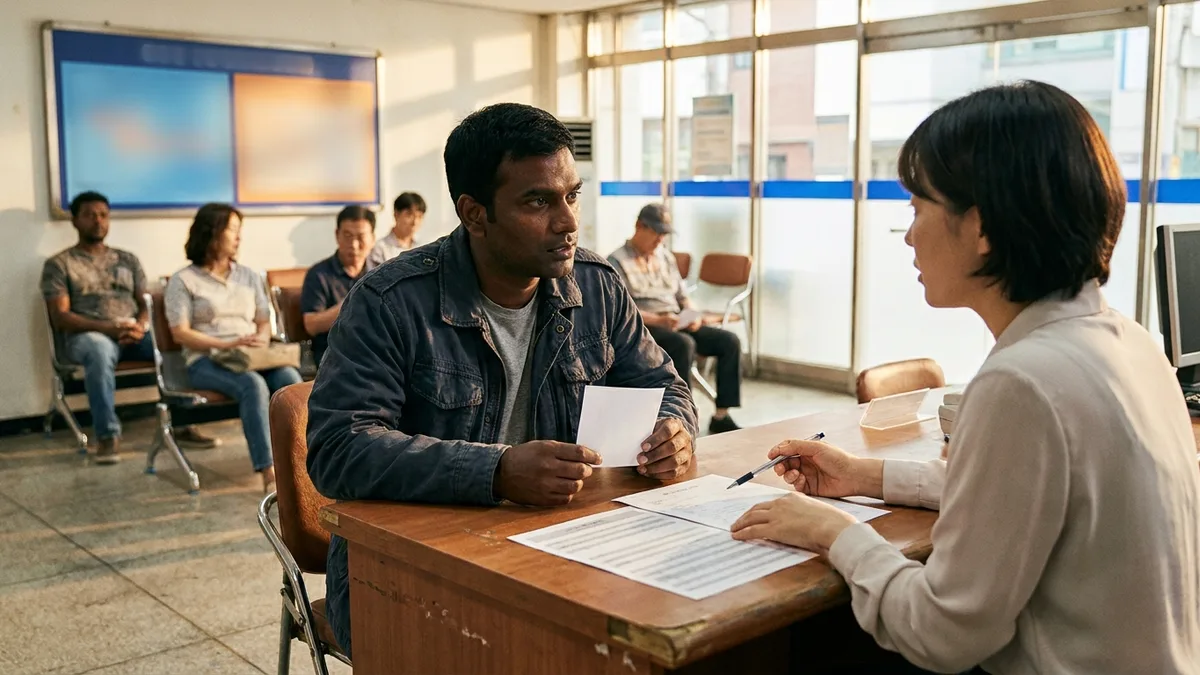
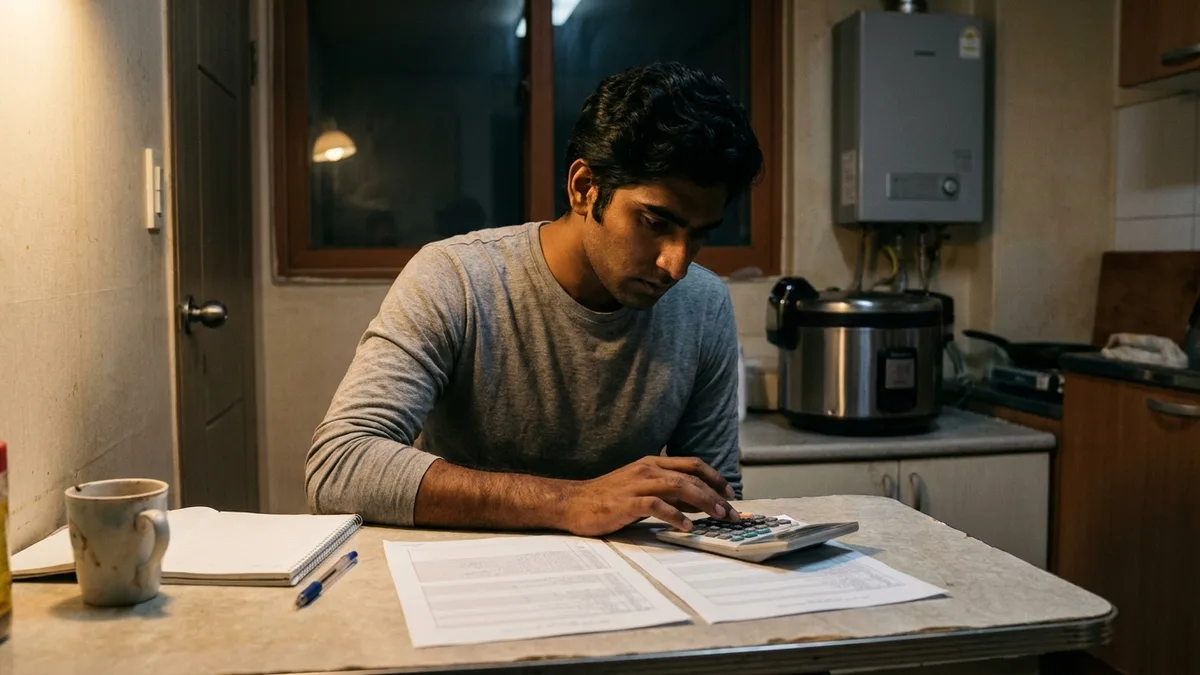
When you go for a consultation or file a complaint about wages, the first question is almost always the same: "How much were you underpaid?" What the counter needs is a number, not the statement "I wasn't paid." And you only need three figures to calculate that number: ① total wages before deductions, ② hours worked that month, and ③ that year's minimum wage.
This baseline does not change based on nationality or visa status. Article 3(1) of the Minimum Wage Act defines its scope as "all businesses or workplaces that employ workers" — it sets no condition regarding nationality or visa type. Article 6 of the Labor Standards Act prohibits discrimination in working conditions on the grounds of nationality, and Article 22 of the Act on the Employment, etc. of Foreign Workers likewise prohibits unfair discrimination on the grounds of being a foreign worker (as of 2026).
The complications start after that. The minimum wage amount is the same for everyone, but what you include when calculating against it — and whether you're entitled to premium pay — varies by industry, workplace size, and whether you're in a probationary period. Get this math wrong and you either give up money you're entitled to, or mistake a perfectly lawful situation for wage theft.
Note: The figures and provisions in this article are current as of 2026-08. The next year's minimum wage is newly announced each year in early August, so before you calculate, first confirm which year's rate applies to your period of work.
The 2026 and 2027 Minimum Wage — It Doesn't Vary by Industry
| Applicable year | Hourly rate | Monthly equivalent (40 hrs/week, 209 hrs/month) | Public notice | Effective date |
|---|---|---|---|---|
| 2026 | 10,320 KRW | 2,156,880 KRW | Ministry of Employment and Labor Notice No. 2025-47 (announced Aug 5, 2025) | January 1, 2026 |
| 2027 | 10,700 KRW | 2,236,300 KRW | Ministry of Employment and Labor Notice No. 2026-60 (announced Aug 5, 2026) | January 1, 2027 |
The increase for 2026 is 290 KRW (2.9%) over 2025's 10,030 KRW, and 2027 is up 380 KRW (3.7%) over 2026. Each takes effect on January 1 of the following year (Minimum Wage Act Article 10(2)).
Let me nail down the most common misconception right away. There is no industry-specific minimum wage in Korea for 2026 or 2027. Both years' notices explicitly state that the wage "applies identically to all workplaces without distinction by type of business." Farm, factory, restaurant, construction site — the minimum hourly amount you must be paid is the same. The "industry exceptions" covered later in this article are not exceptions to the minimum wage amount; they're exceptions to the working-hours rules.
If the amount you agreed to is below this baseline, that agreement loses its effect. Article 6(3) of the Minimum Wage Act renders void the portion of an employment contract that sets wages below the minimum wage, and the voided portion is deemed to have set wages equal to the minimum wage. In other words, even if you signed the contract, the shortfall is money you already have a right to. If it isn't paid, that's wage theft.
The penalties aren't light either. An employer who pays less than the minimum wage or who lowers previous wages on account of the minimum wage faces imprisonment of up to 3 years or a criminal fine of up to 20 million KRW, and both may be imposed together (violation of Minimum Wage Act Article 6(1) and (2); penalty under Article 28(1) of the same Act, as of 2026).
Conversely, there are cases where the Minimum Wage Act doesn't apply at all. Businesses that employ only domestic workers (household help) or only relatives living together are covered by neither the Minimum Wage Act nor the Labor Standards Act (Minimum Wage Act Article 3(1) proviso; Labor Standards Act Article 11(1) proviso), and seafarers subject to the Seafarers Act, along with their ship owners, are also outside the Minimum Wage Act's scope (Minimum Wage Act Article 3(2)).
Caution: The exception list above is a set of criteria, not examples. Not being on the list doesn't automatically mean the Act applies, and looking similar to a listed case doesn't mean you're excluded. Your competent Regional Employment and Labor Office decides which category your workplace falls into, so if it's ambiguous, call ☎1350 (Ministry of Employment and Labor Customer Service Center) first.
Converting a Monthly Salary to an Hourly Rate — Where Does 209 Hours Come From?
If you're paid monthly, you have to convert to an hourly rate to compare. The 209 hours used here isn't just custom — it's the result of the formula set out in Article 5(1)3 of the Enforcement Decree of the Minimum Wage Act. Here's how it's derived, step by step.
- Step 1: Start with 40 contractual working hours per week — the hours you agreed to work, as written in your contract.
- Step 2: Add 8 hours of weekly paid holiday time (Labor Standards Act Article 55(1)). 40 + 8 = 48 hours.
- Step 3: Scale up to a year, then divide into a month. 48 × 365 ÷ 7 ÷ 12 = 208.57 hours.
- Step 4: Round up to 209 hours.
The check works out: 10,320 KRW × 209 = 2,156,880 KRW, and 10,700 KRW × 209 = 2,236,300 KRW. Those match the Ministry of Employment and Labor's monthly equivalents down to the won. So if you work 40 hours a week, your monthly salary ÷ 209 is your hourly rate, and if that figure is below that year's minimum wage, you're being underpaid.
Caution: If you don't work 40 hours a week, using 209 throws the whole calculation off. The 209-hour figure was built on the assumption of a 40-hour week. If your contractual hours are different — 30 hours a week, 20 hours a week — you need to recalculate using your own contract's hours plus the corresponding weekly holiday hours. If that conversion confuses you, checking with ☎1350 is the accurate route.
Here's where to find the three numbers you need. For foreign workers, this is usually where things get stuck.
| What to find | Primary source | If you don't have it |
|---|---|---|
| ① Total wages before deductions | Pay statement (Labor Standards Act Article 48(2)) | Work backward by adding the deducted amounts back onto your bank deposit |
| ② Hours worked that month | Contractual hours in your employment contract, attendance records | Starting today, photograph or note your clock-in and clock-out times every day |
| ③ Comparison baseline | 10,320 KRW in 2026 / 10,700 KRW in 2027 | If your work period spans both years, split the calculation by year |
Let me flag one frequent misunderstanding. Judging by the amount that shows up in your bank account is wrong. Since room-and-board costs and insurance premiums are taken out before the deposit, the minimum wage comparison must use total wages before deductions. As for room and board itself, item 10 of the standard employment contract has a blank for the worker's share and it's meant to be set by agreement — but whether the amount actually deducted is at a lawful level is a case-by-case judgment, so check with ☎1350.

Which Parts of My Pay Count Toward the Minimum Wage — The Scope of Inclusion
With the same monthly salary, whether you're underpaid can depend on what you count. Wages included in the minimum wage are those paid regularly, at least once a month (Minimum Wage Act Article 6(4)).
| Item | Counts toward the minimum wage? | Basis |
|---|---|---|
| Base pay | Yes | Paid regularly at least once a month (Article 6(4)) |
| Bonuses paid monthly | Fully counted since 2024 | Act No. 15666 of June 12, 2018, Addenda Article 2(1) |
| Welfare benefits such as meal, housing, and transportation allowances | Fully counted since 2024 | Same Addenda, Article 2(2) |
| Overtime, night, and holiday premium pay | No | This is money you receive separately from the minimum wage |
Originally, under the main text of the Act, bonuses and welfare benefits were counted only after subtracting portions equal to 25% and 7% of the monthly equivalent. But the 2018 amendment's addenda lowered those ratios year by year, setting them at 0/100 from 2024. So in 2026 and 2027, monthly bonuses and meal/transportation allowances count in full toward the minimum wage.
The other direction matters too. Overtime, night, and holiday premium pay is not included in the minimum wage. Even if lots of night work makes your total monthly pay look large, you have to strip out the premium pay and recalculate your hourly rate on what's left to get the real answer. Leaving that pay in makes it look like you're not underpaid when you actually are.
If Your Pay Was Cut Because You're on Probation — When a Reduction Is Allowed and When It Isn't
Being paid below the minimum wage during a probationary period isn't always illegal. But all three of the following conditions must be met (Minimum Wage Act Article 5(2); Enforcement Decree Article 3).
- ① The contract must be for a term of one year or more. If the contract term is under one year, no reduction is permitted at all.
- ② It must be within 3 months from the day probation began. There's no basis for a reduction after 3 months.
- ③ The job must not be in a simple labor occupation. Workers in simple labor occupations designated by the Minister of Employment and Labor cannot have their pay reduced even during probation (Article 5(2) proviso).
The size of the reduction is also capped: at most 10/100 off the hourly minimum wage. For 2026, that means the floor is 9,288 KRW, or 90% of 10,320 KRW. Anything below that is underpayment, probation or not.
For condition ③, Ministry of Employment and Labor Notice No. 2018-23 (enacted March 19, 2018; still in force as of 2026) defines simple labor occupations as "persons falling under Major Group 9 (Elementary Occupations) of the Korean Standard Classification of Occupations." But it's hard to judge on your own whether your job is in Major Group 9. Even in manufacturing or construction, the classification depends on the actual work you do. Definitely ask ☎1350 about this one.
📌 Important: The E-9 standard employment contract has a separate blank for "wages during the probationary period," so many workers have already signed off on a lower amount regardless of whether the reduction is lawful. Even if you signed, if the reduction doesn't meet all three conditions above, that portion is void under Minimum Wage Act Article 6(3), and it's deemed that wages equal to the minimum wage were agreed to.
If You Work in Agriculture, Forestry, Livestock, or Fisheries, the Calculation Structure Changes — Labor Standards Act Article 63
First, let's clear up a misconception. This exception applies only to the rules on working hours, breaks, and holidays. It does not lower the minimum wage.
Article 63 of the Labor Standards Act provides that the rules on working hours, breaks, and holidays do not apply to workers engaged in agriculture and forestry — cultivating and reclaiming land, planting, growing, and harvesting plants (item 1) — or in livestock, sericulture, and fisheries — raising animals, and gathering, catching, or farming marine plants and animals (item 2) (as of 2026). The Ministry of Government Legislation's Easy-to-Read Laws portal gives foreign workers the same guidance, and this point is also printed on Form No. 6-2 attached to the Enforcement Rules of the Act on the Employment of Foreign Workers (the standard employment contract for agriculture, livestock, and fisheries).
| Item | In agriculture, forestry, livestock, and fisheries | Basis |
|---|---|---|
| The minimum wage amount itself | Applies as normal | Minimum Wage Act Article 3(1) |
| 40-hour weekly cap, break, and holiday rules | Do not apply | Labor Standards Act Article 63(1) and (2) |
| 50% overtime premium | Does not apply | Labor Standards Act Article 63 |
| Holiday work premium | Does not apply | Labor Standards Act Article 63 |
| 50% night work premium (22:00–06:00) | Applies as normal | Labor Standards Act Article 56(3) |
That last row is the key. Since Article 63 only excludes working hours, breaks, and holidays, the 50% night work premium survives. The wage section of the Ministry of Employment and Labor's standard employment contract (agriculture, livestock, fisheries) even states that "for night work, an additional 50% of the hourly wage must be paid as premium pay." Note, though, that the same box adds in parentheses, "not applicable to workplaces with 4 or fewer regular employees" — so you have to check workplace size too.
Caution: Article 63 also includes item 3 (workers in surveillance or intermittent work who have received approval from the Minister of Employment and Labor) and item 4 (duties prescribed by Presidential Decree). Item 3 requires separate approval and item 4 is specified in the Enforcement Decree, so don't look at the list and decide for yourself, "we probably fall under this too." Your competent Regional Employment and Labor Office makes that determination.
Also, know in advance that a contract alone makes it hard to prove your hours. On the agriculture/livestock/fisheries standard contract, the working-hours box only says "( ) hours per month," with daily hours and days off left to agreement — so the worker ends up with no record supporting how many hours were actually worked. If you photograph or note your clock-in and clock-out times every day starting today, you'll have a basis for the calculation later. If your working conditions differ significantly from your contract, take a look at grounds and procedures for changing workplaces as well.
If Your Workplace Has Fewer Than 5 Employees — The Minimum Wage Applies, Premium Pay Doesn't
Here again, the two laws have different scopes. The Minimum Wage Act applies in full even to workplaces with fewer than 5 employees (Minimum Wage Act Article 3(1)). The Labor Standards Act, by contrast, applies only some provisions to workplaces with 4 or fewer regular employees (Labor Standards Act Article 11(2); Enforcement Decree Article 7 and Attached Table 1).
- Applies: minimum wage, payment of wages in full and at regular intervals (Labor Standards Act Article 43), breaks (Article 54), and weekly paid holidays (Article 55(1)).
- Does not apply: the 40-hour weekly cap (Article 50) and overtime, night, and holiday premium pay (Article 56).
Caution: Those two lines aren't exhaustive — they're just the items that come up most often. Which Labor Standards Act provisions apply to workplaces with 4 or fewer regular employees is set out in Attached Table 1 of the Enforcement Decree, so a provision not listed here doesn't automatically apply either. Your competent Regional Employment and Labor Office determines your headcount and which category you fall into, so check with ☎1350.
So at a workplace with 4 or fewer regular employees, not receiving premium pay for night work isn't illegal. But if your hourly rate is below the minimum wage, that is a violation in itself, and failing to pay wages in full is also a violation — so you can file a complaint even at a workplace with fewer than 5 employees.
Misjudgments happen in both directions here. Some people think "I've been cheated" when the absence of premium pay is perfectly lawful; others give up on a 50% night premium they're entitled to, saying "farms never pay that anyway." Either way, the answer depends on pinning down the workplace's regular employee count and type of business — and since the method for counting regular employees is itself set by regulation, it's hard to determine on your own. Explain your workplace situation exactly as it is to ☎1350 and get confirmation.
Once the Math Is Done — Evidence and the 3-Year Limitation Period
Once you have a number, it's time to gather the material that backs it up. Five things are enough.
- Employment contract: For E-9, this is the standard employment contract in the attached forms of the Enforcement Rules of the Act on the Employment of Foreign Workers. If you signed a separate contract after changing workplaces, include that too.
- Pay statements: These list wage components, calculation methods, and deductions — the primary source for your calculation.
- Bank deposit records: The amounts and dates actually received. If you were paid in cash, note down the date and amount.
- Attendance records: A work schedule, entry logs, daily photos or notes — anything that shows your hours works.
- Messages exchanged with your employer: Screenshot any conversations about wages or working hours.
If you've never received a pay statement, that alone is a violation. Employers must issue a pay statement in writing (including electronic documents) every time they pay wages (Labor Standards Act Article 48(2)), and a violation carries an administrative fine of up to 5 million KRW (Article 116(2)2 of the same Act, as of 2026). Without statements, your only option is to work backward from bank deposits and attendance records — so when you go for a consultation, mention that "I'm not receiving pay statements" as well.
Failing to inform you of the minimum wage is a separate violation. Employers must tell workers four things — ① the minimum wage amount applicable to the worker, ② wages not included in the minimum wage, ③ the scope of workers excluded from minimum wage application, and ④ the effective date of the minimum wage — and must do so by the day before it takes effect (Enforcement Decree of the Minimum Wage Act Article 11(1) and (2)). A violation carries an administrative fine of up to 1 million KRW (Minimum Wage Act Article 31(1)1).
There's also a time limit. Under the Labor Standards Act, wage claims are extinguished by prescription if not exercised within 3 years (Labor Standards Act Article 49). That means shortfalls from the oldest months disappear first, so once you've finished calculating, don't put it off. If you've already left the job, the employer must pay all wages and other money within 14 days of the date the obligation arises (Article 36 of the same Act).
Tip: The figure you come up with here is a draft to present at a consultation or with a complaint. The final amount can change depending on whether there's an inclusive wage agreement, how contractual hours were set, whether you were on probation, and how big the workplace is. Writing out your calculation on a single sheet of paper makes the consultation go much faster.
What You Shouldn't Decide Based on This Article — Where to Ask
On this topic there are at least five points where the conclusion differs from person to person. None of them can be determined by a reader alone.
- Whether your job falls under Major Group 9 of the Korean Standard Classification of Occupations — this decides whether a probationary reduction is allowed.
- Whether your workplace has 5 or more regular employees — this decides whether you get premium pay.
- Whether your business falls under Labor Standards Act Article 63(1) or (2) — this decides whether overtime and holiday premiums apply.
- Whether approval was obtained from the Minister of Employment and Labor for surveillance or intermittent work — this is a Labor Standards Act Article 63(3) matter.
- Whether there's an exclusion authorization under Minimum Wage Act Article 7 — authorization is confirmed by documents, not by the workplace's word.
Check all five with ☎1350 (Ministry of Employment and Labor Customer Service Center). If you need interpretation and can't get connected, one option is to first ask ☎1345 (Immigration Contact Center), which supports 20 languages, or ☎1577-0071 (Foreign Workers' Counseling Center) for guidance. Judgments involving visa status aren't covered in this article, so please check those with ☎1345.
You can also file a complaint online through the Ministry of Employment and Labor's Labor Portal (labor.moel.go.kr). It's a relatively low barrier to entry, since you can get started without facing your employer. The filing procedure and the role of each office are laid out in detail in a complete guide to official counseling channels for labor and residence issues. If the E-9 system itself is new to you, start with the basic structure of the Employment Permit System (EPS) — it'll make everything easier to follow.
Note: From December 8, 2026, the term "labor inspector" (근로감독관) in the Minimum Wage Act changes to 노동감독관 (Act No. 21534, amended by other act on April 7, 2026). Even if you hear a different title at the counter, it's the same agency and the same officials.
While You're Shuttling Between the Labor Office and the Employment Center — Travel and Payments
Wage consultations and complaints usually mean moving around on weekday afternoons. If your competent Regional Employment and Labor Office is far from where you live, it eats a whole day, and if visa issues are involved too, you'll need another trip to the immigration office. For people working outside the metro areas, round trips by KTX or express bus are common.
To avoid getting stuck on transportation and payments, it helps to set up in advance a service designed so that no separate identity verification is needed as part of the formal process. LACHA is a transportation and payment super app for foreigners that you can use right away without identity verification. You can get started with just your passport — no Korean bank account or phone number needed — and handle taxi hailing, KTX, express buses, the Airport Railroad, and transit cards all in one place. It won't solve your wage problem, but it will make the trips between offices a lot less of a hassle.
Need transit and payments while you wait for your residence card? Check out LACHA.
Built to work without a Korean phone number or bank account, with overseas payment methods like Alipay, WeChat Pay, and Apple Pay. Taxi hailing plus KTX, express bus, and airport railroad (AREX) booking — all in one app.
Up to 60% off Korea transit with a coupon (max ₩3,000): enter code at sign-up. KTX gets up to 18% off on top
Download now


Frequently Asked Questions (FAQ)
Q1. Do foreigners receive the same minimum wage as Koreans? Yes, exactly the same. Article 3(1) of the Minimum Wage Act defines its scope as "all businesses or workplaces that employ workers," with no condition regarding nationality or visa status. Article 6 of the Labor Standards Act prohibits discrimination in working conditions on the grounds of nationality, and Article 22 of the Act on the Employment of Foreign Workers prohibits unfair discrimination on the grounds of being a foreign worker. The 2026 rate of 10,320 KRW per hour and the 2027 rate of 10,700 KRW are the same baseline regardless of nationality.
Q2. I heard the minimum wage is lower if you work on a farm or in livestock. Is that true? No. Both the 2026 and 2027 notices explicitly state the wage "applies identically to all workplaces without distinction by type of business," so there is no differentiated minimum wage by industry. What differs in agriculture, forestry, livestock, and fisheries are the rules on working hours, breaks, and holidays (Labor Standards Act Article 63(1) and (2)). Overtime and holiday premiums don't apply, but the minimum wage amount itself applies as normal. The 50% night work premium (Article 56(3)) also survives — though at a workplace with 4 or fewer regular employees even that doesn't apply, so you need to check the workplace size as well (☎1350).
Q3. Can I calculate using the amount deposited in my account after room and board is deducted? No. The minimum wage comparison must use total wages before deductions. Calculating from a deposit that's had room-and-board costs or insurance premiums taken out gives a lower figure than reality and leads to a wrong conclusion. For room and board, item 10 of the standard employment contract has a blank for the worker's share and it's meant to be set by agreement — but whether the amount actually deducted is at a lawful level is a case-by-case judgment, so check with ☎1350.
Q4. I was paid only 90% because I was on probation, and I signed a contract saying so. Is there nothing I can do? Even if you signed, if the conditions aren't met, that portion is void. A reduction is only possible when all three of these hold: ① the contract term is one year or more, ② it's within 3 months from the start of probation, and ③ the job isn't in a simple labor occupation (Minimum Wage Act Article 5(2); Enforcement Decree Article 3). If even one is off, that contract provision is void under Minimum Wage Act Article 6(3) and is deemed to have set wages equal to the minimum wage. Ask ☎1350 whether your job counts as a simple labor occupation.
Q5. I've never received a pay statement — can I still calculate? Yes, you can. Add the deducted amounts back onto your bank deposits to establish total wages, then count your hours from attendance records, and you'll have a draft. That said, failing to provide pay statements is itself a violation of Labor Standards Act Article 48(2) and subject to an administrative fine of up to 5 million KRW (Article 116(2)2 of the same Act), so mention this fact at your consultation too. If you start photographing or noting your clock-in and clock-out times every day from today, the records will build up.
Note: This article is general information, not legal advice. The amounts, provisions, and administrative fines in the text are current as of 2026-08, verified against Ministry of Employment and Labor notices (No. 2025-47 and No. 2026-60), the original texts of the Minimum Wage Act, Labor Standards Act, and Act on the Employment of Foreign Workers on the Korea Law Information Center, and the Ministry of Government Legislation's Easy-to-Read Laws portal. The next year's minimum wage is newly announced each year in early August and the statutes are amended too (for example, the term change from 근로감독관 to 노동감독관 on December 8, 2026), so please check again before calculating or filing. Items such as the cap on room-and-board deductions, determining shortfalls where an inclusive wage agreement exists, and the standard occupational classification of your job are case-by-case matters and are not determined in this article. For wages and working conditions call ☎1350, for residence and visas call ☎1345, for the Foreign Workers' Counseling Center call ☎1577-0071, and for online complaints use the Labor Portal (labor.moel.go.kr) — always confirming based on your own situation. LACHA is unaffiliated with the public agencies above; it is a private service providing transportation and payment convenience.