
The Supreme Court answered this 30 years ago. Supreme Court Decision 94Nu12067, September 15, 1995 held that even when a foreign national without work authorization signs an employment contract, that contract cannot be treated as automatically void — and that someone who provided labor in a relationship of subordination and was paid wages for it is a worker under the Labor Standards Act, and therefore eligible for medical care benefits under the (former) Industrial Accident Compensation Insurance Act.
The Ministry of Government Legislation's guidance reads the same way. The employment restriction in Article 18 of the Immigration Act prohibits only "the factual act of employing a foreign national without work authorization" — it's hard to read it as also canceling rights under labor law that arise from work already performed (Ministry of Government Legislation, Easy-to-Find Practical Laws, "Employment of Foreign Workers," as of 2026-08). Put simply, what you already earned is still owed to you.
That said, "you have the right" and "exercising that right is safe for your residency" are two different sentences. As of November 6, 2025, Article 70-2, Subparagraph 5 of the Enforcement Rule of the Immigration Act added the investigation and supervision of workplace violations such as unpaid wages to the list of duties exempt from the reporting obligation — but Article 46 of the Immigration Act, which defines who is subject to deportation, is unchanged. Reading those two sentences as one will lead you badly astray.
And there's a clock. Wage claims disappear after 3 years (Article 49, Labor Standards Act), severance pay after 3 years as well (Article 10, Act on the Guarantee of Employees' Retirement Benefits), and industrial accident insurance benefits after 3 years (5 years for disability benefits, survivors' benefits and the like — Article 112(1), Industrial Accident Compensation Insurance Act). Once that window closes, the right itself is gone.
Heads-up: This article is general information compiled from publicly available laws and government guidance, and it is not legal advice. It covers only claims for wages and accident compensation that have already accrued, and lawful ways to sort things out — it does not cover how to stay or stay hidden without status. Conclusions change depending on your residency status, nationality, type of work, and the size of your workplace, so be sure to confirm your own case with the official hotlines listed below.
Read This First — Don't Bundle Two Separate Problems Together
The most common reason people never even start a consultation is that they treat "money I'm owed" and "residency status" as one lump. These are separate tracks, handled by different agencies under different laws. Wages and workplace accidents go to the Ministry of Employment and Labor and the Korea Workers' Compensation & Welfare Service under the Labor Standards Act and the Industrial Accident Compensation Insurance Act; residency goes to the Ministry of Justice under the Immigration Act.
- What this article covers — the legal grounds and deadlines for claiming wages and severance you already earned, how workers' comp coverage is structured, where to file, and the scope of the penalties written into the statutes.
- What this article does not cover — calculation formulas or self-assessments for unpaid amounts, severance, or accident benefits. A calculation used directly as the basis of a claim can go badly wrong, so we've left the numbers for the responsible agency to determine.
- What it does not cover in any form — how to stay or stay hidden without status, tips on working without authorization, or how to use a broker.
Working without work authorization is itself subject to penalties under the statute. Violating Article 18(1) of the Immigration Act (in force 2026.1.23., Act No. 20992) makes you subject to imprisonment of up to 3 years or a criminal fine of up to 30 million won under Article 94, Subparagraph 8, and you also fall under the deportation category in Article 46(1)8. This means "the statute allows it to go up to this level." In practice, prosecutorial decisions and immigration administrative measures proceed separately, and outcomes vary a great deal depending on whether it's a first offense, the circumstances, and your residency history.
📌 Important: Penalties don't apply only to the person working. An employer who hires someone without authorization (Article 18(3)), someone who brokers or solicits such work as a business (paragraph 4), and someone who controls others for brokering purposes (paragraph 5) are each subject to imprisonment of up to 3 years or a criminal fine of up to 30 million won under Article 94, Subparagraphs 9, 10, and 11. Watch out for unlicensed brokers who ask for a fee saying "I'll collect it for you." Every official channel listed later in this article is free.
The Myth That "No Residency Status Means You're Not a Worker"
The line you hear most often on the ground is "you're illegal, so the Labor Standards Act doesn't apply to you." Employers say it, and people from the same home country pass it around as common knowledge. But the case law and the government's own guidance point the other way.
The logic of 94Nu12067 is simple. Whether someone is a worker under the Labor Standards Act is decided not by the form of the contract or by residency status, but by whether they actually provided labor in a relationship of subordination. So even without work authorization, someone who took instructions, did the work, and was paid is a worker — and the claims that come with that status remain.
The Ministry of Government Legislation's reasoning matches. Article 18 of the Immigration Act is a provision prohibiting "the factual act of employment"; it's hard to read it as a provision that erases compensation for labor already performed. Read the other way, you'd get the strange result that an employer who hired someone without status wouldn't have to pay them at all.
Tip: You can quote this part word for word on a consultation call. Jotting down the two phrases "Supreme Court 94Nu12067" and "worker under the Labor Standards Act" keeps the meaning intact even when it goes through an interpreter.
This Is Where the Answers Diverge — "Pay for Work Already Done" vs. "The Right to Keep Working"
Read the holding in isolation and it's easy to conclude "so I can keep working, then" — but that's not right. The same guidance from the Ministry of Government Legislation attaches a caveat you have to read alongside it: unless an employment relationship has already been formed, the employment relationship with someone lacking work authorization is suspended, and both employer and worker may terminate the employment contract at any time on the grounds of that lack of authorization.
So the answer changes depending on which question you're asking.
| Question | Answer |
|---|---|
| Can I claim wages for work I already did | Yes — you're treated as a worker under the Labor Standards Act, so the claim survives |
| Can I file for workers' comp for an injury | 94Nu12067 held that you are eligible for medical care benefits under the (former) Industrial Accident Compensation Insurance Act |
| Can I keep doing that job | No. The employment relationship is suspended and either side may terminate it |
| Does this give me residency status | No. Residency status is entirely separate from this determination |
The third and fourth rows are the heart of it. Saying the right survives means a settling-up for the past — it does not guarantee future work or future residency.
Unpaid Wages and Severance — By When, and Under Which Articles
Even how wages must be paid is set out in law. Article 43 of the Labor Standards Act (in force 2026.8.20., Act No. 21373) requires wages to be paid in currency, directly to the worker, in full, at least once a month on a fixed date. The boss "holding it for you," lumping it into next month, or paying you in goods all run against this article.
If you've left the job, the deadline is even shorter. Article 36 of the same act requires all money and valuables — wages, compensation and the rest — to be settled within 14 days of the date the cause arises when a worker dies or resigns. Violating Article 36 or Article 43 makes an employer subject to imprisonment of up to 3 years or a criminal fine of up to 30 million won under Article 109(1).
Severance pay is covered by the Act on the Guarantee of Employees' Retirement Benefits (in force 2026.7.1., Act No. 21475). Article 9(1) sets payment within 14 days of the date the cause of retirement arises. There is an exception in the proviso to Article 4(1), though: if continuous service is under 1 year, or if contractual working hours average under 15 hours a week over 4 weeks, there is no obligation to set up a retirement benefit plan.
| Item | Legal basis | Payment deadline | Statute of limitations |
|---|---|---|---|
| Wages | Labor Standards Act Articles 43 and 36 | Regular payday; within 14 days of leaving | 3 years (Article 49) |
| Severance pay | Act on the Guarantee of Employees' Retirement Benefits Article 9(1) | Within 14 days of the date the cause of retirement arises | 3 years (Article 10) |
| Industrial accident insurance benefits | Industrial Accident Compensation Insurance Act Article 41 | Apply when medical care is needed | 3 years (Article 112(1)) |
| Disability benefits, survivors' benefits, etc. | Industrial Accident Compensation Insurance Act Article 112(1) | Apply after the cause arises | 5 years |
The criminal process has one distinctive feature. Under Article 109(2) of the Labor Standards Act, violations of Articles 36 and 43 cannot be prosecuted against the victim's expressly stated wishes. If you get your money and say you don't want the employer punished, the criminal process stops. The exception, under Article 43-2, is an employer already named on the public list of wage defaulters who violates again during the disclosure period (amended 2024.10.22.).
Heads-up: How the limitation period is counted depends on the case. Whether the clock starts from your last day of work or from each wage's due date changes how much time you have left. If you're unsure, don't put it off — call first. For wages it's ☎1350; for litigation and legal aid it's ☎132.
What Happens to a Waiver Saying You Won't Claim Your Pay
Sometimes when you leave, someone slides a piece of paper written in Korean across the table and asks you to sign. If you signed without knowing what it said, look at this. Article 15 of the Labor Standards Act makes an employment contract that sets working conditions below the standards of the act void as to that portion, and the void portion is replaced by the standards set in the act. That means an agreement to give up wages or severance can be void as to that portion.
If your hourly rate was written in below minimum wage, the Minimum Wage Act kicks in separately. Article 6(3) of that act makes void the portion of an employment contract setting wages below the minimum wage, and treats the parties as having agreed to pay wages equal to the minimum wage. Whatever the contract says, the statutory standard steps in instead.
"We pay you less because you're a foreigner" is blocked by statute too. Article 6 of the Labor Standards Act bars an employer from discriminating in working conditions on grounds of nationality, religion, or social status, and a violation is subject to a criminal fine of up to 5 million won under Article 114, Subparagraph 1.
Tip: If you're asked to sign a document you don't understand, photograph it right there. Whether or not you sign, what was written on that paper becomes important material later. If you want to know what it says, call ☎1350 and ask them to connect an interpreter to read it to you.
If You Get Hurt on the Job — Workers' Comp Is Something the Employer Signs Up For
Workers' comp gets less frightening once you understand its structure. Article 6 of the Industrial Accident Compensation Insurance Act (in force 2026.7.1., Act No. 21375) provides that the act applies to all businesses or workplaces that employ workers, but under the proviso to the same article certain businesses prescribed by Presidential Decree are excluded. The Ministry of Government Legislation's guidance likewise states that the act applies to foreign workers employed at any business or workplace covered by it. Don't try to judge from the list whether your own workplace falls under that exclusion — check with ☎1588-0075 (Korea Workers' Compensation & Welfare Service).
The contrast with other social insurance programs is stark. Article 109(2) and (3) of the National Health Insurance Act and Article 10-2 of the Employment Insurance Act explicitly specify residency status in the eligibility requirements for foreigners, whereas Article 6 of the Industrial Accident Compensation Insurance Act only defines coverage at the business level and does not make a worker's residency status a requirement.
The person paying the premiums isn't the worker either. Under Article 5(3) of the Act on the Collection of Insurance Premiums for Employment Insurance and Industrial Accident Compensation Insurance, the policyholder is the employer who employs workers. An application for medical care benefits goes to the Korea Workers' Compensation & Welfare Service under Article 41(1) of the Industrial Accident Compensation Insurance Act.
Even if you're told "our company never signed up for workers' comp," don't give up on the spot. Article 26(1)1 of that same premium collection act provides that for an accident occurring during a period when the employer neglected to report the establishment of the insurance relationship, the Service may pay the industrial accident benefits and then collect all or part of that amount from the employer. The structure puts the burden of non-enrollment on the employer's side.
The harder part for foreigners isn't the law — it's the hospital. A workers' comp claim needs medical records showing when and how the accident happened and whether it was work-related, but without health insurance the bill is heavy enough that people put off going to the hospital at all. Wait a few days and even "was this a work injury?" gets murky. Get treatment the day you're hurt, and when you check in, describe exactly where you were and what you were doing when it happened so it goes into the record. We've covered hospital procedures separately in How Foreigners Use Hospitals in Korea.
Heads-up: The exemption from the immigration reporting obligation discussed below concerns the work of labor inspectors and others investigating and supervising workplace violations such as unpaid wages. The industrial accident benefit work of the Korea Workers' Compensation & Welfare Service is not among the items listed in Article 70-2 of the Enforcement Rule. We were not able to confirm from primary sources what happens when you file a workers' comp claim, so check with both ☎1345 and ☎132.
The Biggest Fear — Will Reporting Get Me Caught?
This is the part of the article to read most carefully. Neither "you'll definitely never be caught" nor "report it and you'll be deported for sure" is true. What's accurate is exactly what changed as of November 6, 2025.
The legal chain has three steps. The proviso to Article 84(1) of the Immigration Act carves out grounds prescribed by Presidential Decree as exceptions to the reporting obligation; Article 92-2, Subparagraph 5 of the Enforcement Decree passes the scope over to duties prescribed by Ministry of Justice Ordinance; and Article 70-2 of the Enforcement Rule lists those duties. Into that Article 70-2, Subparagraph 5, the investigation and supervision of violations such as unpaid wages at businesses or workplaces under the acts referred to in Article 6-2(1), Subparagraphs 1 through 19 of the Act on Persons Performing the Duties of Judicial Police Officers and the Scope of Their Duties was added by Ministry of Justice Ordinance No. 1103, effective November 6, 2025.
Nailing the boundary down in one sentence: what is exempted is the reporting obligation in the work of labor inspectors and others investigating and supervising workplace violations such as unpaid wages (Article 70-2, Subparagraph 5 of the Enforcement Rule, in force 2025.11.6.), and Article 46 of the Immigration Act, which defines who is subject to deportation, is unchanged.
Heads-up: This means the reporting obligation of the officials performing that particular work is waived — not that you gain residency status or drop out of the deportation category. The 2025 amendment touched only the reporting obligation provision; Article 46 was not amended. For what this means in your own case, check with both ☎1345 and ☎132.
If You Get Fired for Reporting
The second fear that stops people from starting is retaliation. There's a provision for this too. Article 104(1) of the Labor Standards Act allows a worker to report a workplace's legal violations to the Minister of Employment and Labor or a labor inspector, and paragraph 2 bars an employer from dismissing the worker or otherwise treating them unfavorably because of that report. A violation is subject to imprisonment of up to 2 years or a criminal fine of up to 20 million won under Article 110, Subparagraph 1.
Unfavorable treatment isn't only dismissal. Suddenly giving you no work, telling you to move out of company housing, or delaying payment of your remaining wages can also count. If any of that happens, write down the date and what happened that same day and report it to ☎1350.
📌 Important: An employer holding on to your passport or Alien Registration Card and refusing to return it is a separate matter with its own potential illegality. Because it blocks your proof of identity and your ability to move at the same time, don't try to handle it alone — tell ☎1350 and ☎1345 immediately.
Where and How to File
There are two routes for a wage-arrears complaint: filing online through the Labor Portal (labor.moel.go.kr), or visiting the regional labor office with jurisdiction over where your workplace is located. Once it's filed, a labor inspector investigates the facts under Article 102 of the Labor Standards Act, and if the employer ignores the corrective order, the case is booked as a criminal matter and referred to the prosecution. Plan on the investigation typically taking several weeks.
The online route can actually be the one that's blocked for foreigners. Online filing may require a means of identity verification, so without a Korean mobile number or a joint certificate you'll have to fall back on filing in person. The complaint itself also has to be written in Korean, laying out the facts, periods, and amounts in chronological order. That's why the practical order is to make your first call to ☎1350, get an interpreter on the line, and start by finding out what to prepare.
More evidence is better, but not having it isn't the end of the road.
| Evidence | What it proves | If you don't have it |
|---|---|---|
| Employment contract | Working conditions, wages, period of employment | Even if the employer took it back, you can argue your worker status with other materials |
| Pay slips, bank deposit records | Amounts actually paid and amounts outstanding | If you were paid in cash, notes, photos, or messages from the time you received it become substitute evidence |
| Attendance records, photos of the worksite | Actual working days and hours | The capture dates left in photos are themselves evidence, so don't delete the originals |
| Messages and call logs with the employer or manager | The chain of instruction and promises to pay | Leaving a chat room makes recovery hard, so keep it as is |
| Coworkers' statements | The fact of the work and the period of employment | Get contact details in advance, before people move on |
If you had no Korean bank account and were paid in cash, you're missing the strongest evidence there is — the deposit record. In that case, day-by-day notes of the date and amount you received, photos of the envelope, and messages saying "I sent you this much today" take its place. Starting a record even now is worth doing.
| Agency | Number | What for |
|---|---|---|
| Ministry of Employment and Labor Customer Service Center | 1350 (weekdays 09:00–18:00) | Counseling on unpaid wages and labor issues; guidance on the complaint process and whether the law applies |
| Korea Legal Aid Corporation | 132 (klac.or.kr) | Free legal counseling; whether your wage or severance civil case qualifies for litigation representation |
| Korea Workers' Compensation & Welfare Service | 1588-0075 | Applying for industrial accident medical care benefits and how the process works |
| Ministry of Justice Immigration Contact Center | 1345 | Residency and visas; guidance on lawful ways to sort things out |
This information was verified as of 2026-08, and numbers, hours, and programs can change.
Free legal aid comes with set conditions. If you ① are a worker who suffered unpaid wages or severance and ② your average monthly wage for the final 3 months at the time of the arrears was under 4 million won, you qualify for free legal counseling from the Korea Legal Aid Corporation and free litigation representation in civil cases over wages and severance (foreigners residing in Korea included). Check whether that applies to you at ☎132.
The Ministry of Employment and Labor also issues a "Certificate of Unpaid Wages and Employer," which you apply for at a regional labor office. Its guidance says the certificate must be submitted to the Korea Workers' Compensation & Welfare Service within 6 months of the issue date. That said, we were not able to confirm from primary sources how the follow-on programs that flow from this certificate apply to someone without residency status. You'll need to check directly with ☎1588-0075.
Your Case Might Fall on a Different Side of the Line
From here on, don't read the list and judge for yourself. The list below is not exhaustive, and the determination for your workplace has to come from ☎1350. Even within the same industry, the answer splits depending on the form of the contract and the number of regularly employed workers.
- Domestic workers in a private household — under the proviso to Article 11(1) of the Labor Standards Act, the act does not apply. If you work caring for a household inside a private home, this may be the first fork you hit.
- A business or workplace employing only relatives living in the same household — this is a separate branch set out in that same proviso to Article 11(1). Read it as one lump together with domestic workers above and the conclusion flips, so look at it on its own.
- Workplaces with 4 or fewer regular employees — under Article 11(2), only some provisions prescribed by Presidential Decree apply. Which provisions those are is set out in an appended table, so it has to be checked workplace by workplace.
- Agriculture, forestry, livestock, and fisheries — under Article 63, Subparagraphs 1 and 2, the rules on working hours, breaks, and holidays do not apply. That's a different matter from wages themselves disappearing, so don't confuse the two.
- Workers' comp splits separately — the four branches above are about the Labor Standards Act. Under the proviso to Article 6 of the Industrial Accident Compensation Insurance Act, certain businesses prescribed by Presidential Decree are excluded from workers' comp coverage, so check separately with ☎1588-0075 whether your workplace is affected.
Once more: not being on this list doesn't mean everything applies, and being on it doesn't mean you have no rights at all. The determination is made by ☎1350, not by you. For workers' comp coverage, call ☎1588-0075, and if residency status is tangled up in it, call ☎1345 as well.
Residency Is a Completely Separate Track
Sorting out wages and workers' comp, and deciding what to do about your residency, are two different decisions. Solving one does not bring the other along with it. Lawful routes such as advance notification of voluntary departure are laid out step by step in What You Can Do If You've Overstayed, and for what's possible in your own case, checking with ☎1345 is the accurate route.
There's a timing issue too. Once you've left the country, appearing for investigation and supplementing documents gets hard, so the process effectively stops. If circumstances mean you have to go, settle a power of attorney or designated representative, a way to reach you, and the account to be paid into before you leave. Leaving without preparing makes it hard to undo.
If you're looking for a lawful way to work going forward, the starting point is different. The Employment Permit System is covered in How the Employment Permit System (EPS) Works, and changing workplaces while already working on an E-9 is covered in Changing Workplaces on an E-9. If you're not sure which office to ask about what, start with Official Support Hotlines for Foreigners: A Complete Guide.
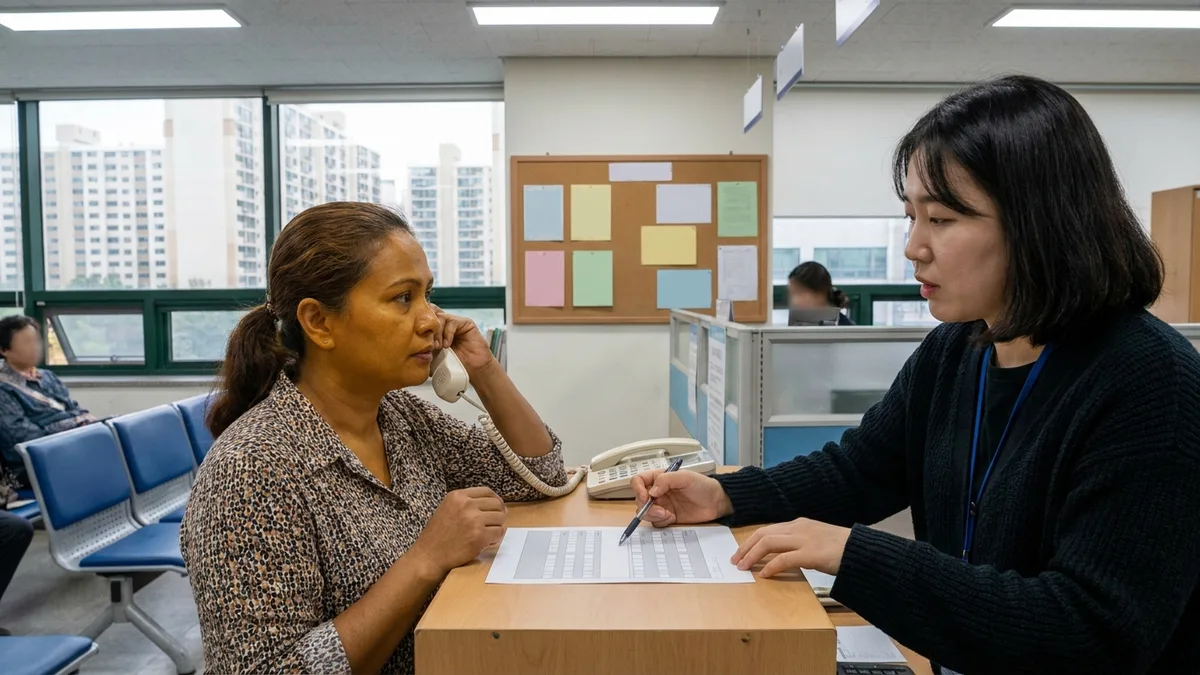
There's one more practical wall. Regional labor offices, the Korea Workers' Compensation & Welfare Service, and the Korea Legal Aid Corporation can only be visited during weekday business hours, so you have to take a day off work — and if your workplace is out in the provinces, just getting there is a burden. Locking down that day's travel in advance takes a bit of that weight off. LACHA is a transport-and-payment super app for foreigners that you can use right away without identity verification, letting you pay for KTX, express buses, taxis, the Airport Railroad, and transit cards all in one place. That said, LACHA is a private transport and payment service with no connection whatsoever to remedy procedures. Counseling, filing, and determinations happen only at the public agencies above.

Need transit and payments while you wait for your residence card? Check out LACHA.
Built to work without a Korean phone number or bank account, with overseas payment methods like Alipay, WeChat Pay, and Apple Pay. Taxi hailing plus KTX, express bus, and airport railroad (AREX) booking — all in one app.
Up to 60% off Korea transit with a coupon (max ₩3,000): enter code at sign-up. KTX gets up to 18% off on top
Download now


Frequently Asked Questions (FAQ)
Q1. I don't have residency status — can I still claim my back pay? Supreme Court Decision 94Nu12067, September 15, 1995 held that an employment contract with a foreign national lacking work authorization cannot be treated as automatically void, and that someone who provided labor in a relationship of subordination and received wages is a worker under the Labor Standards Act. The Ministry of Government Legislation's guidance likewise concludes that Article 18 of the Immigration Act is hard to read as also prohibiting rights under labor law arising from work already performed. But wage claims lapse after 3 years under Article 49 of the Labor Standards Act, so if you're unsure how much time is left, call ☎1350 or ☎132 first.
Q2. If I file a complaint, will immigration be notified? As of November 6, 2025, Article 70-2, Subparagraph 5 of the Enforcement Rule of the Immigration Act placed the investigation and supervision of workplace violations such as unpaid wages on the list of duties exempt from the reporting obligation. But this means the reporting obligation of the officials performing that work is waived — not that you gain residency status or drop out of the deportation category. Article 46 of the Immigration Act, which defines who is subject to deportation, was not amended. Neither "you'll definitely never be caught" nor "you'll be deported for sure" is true, so check your own case with both ☎1345 and ☎132.
Q3. I signed a waiver saying "I will not claim my wages." Is that the end of it? Article 15 of the Labor Standards Act makes an employment contract setting working conditions below the act's standards void as to that portion, and the void portion is replaced by the standards set in law. Article 6(3) of the Minimum Wage Act likewise treats a portion setting an amount below the minimum wage as void and treats the parties as having agreed to pay wages equal to the minimum wage. That said, the assessment changes with the content of the document you signed and the circumstances, so take a photo of the document and consult ☎1350.
Q4. My company says it never enrolled in workers' comp. Does that mean I can't file? Workers' comp is a program the employer enrolls in, not the worker. Under Article 5(3) of the premium collection act, the policyholder is the employer who employs workers, and Article 26(1)1 of the same act provides that for an accident occurring during a period when the employer neglected to report the establishment of the insurance relationship, the Service may pay the benefits and then collect all or part of that amount from the employer. An application for medical care benefits goes to the Korea Workers' Compensation & Welfare Service (☎1588-0075) under Article 41(1) of the Industrial Accident Compensation Insurance Act. The claim to benefits has a 3-year limitation period, and disability benefits, survivors' benefits and the like have 5 years (Article 112(1)).
Q5. I have to leave Korea soon — will the process continue after I'm gone? Once you leave, appearing for investigation and supplementing documents becomes difficult, so the process effectively stops. If circumstances require you to go, it's best to arrange a power of attorney or designated representative, a way to reach you, and the account to be paid into before departure. Consultations and filing a complaint cost nothing, and a worker whose average monthly wage for the final 3 months at the time of the arrears was under 4 million won qualifies for the Korea Legal Aid Corporation's free legal counseling and litigation representation — foreigners residing in Korea included. Check whether that applies to you at ☎132.
Note: This article is general information compiled from publicly available laws and government guidance, and it is not legal advice. The articles, deadlines, limitation periods, and contact details in this piece were verified as of 2026-08 against the original statutory text on the Korea Law Information Center, the Ministry of Government Legislation's Easy-to-Find Practical Laws ("Employment of Foreign Workers"), the Ministry of Employment and Labor's Labor Portal (labor.moel.go.kr), and Government24. Laws and programs get amended and phone numbers and hours can change, so before you act, confirm the details for your own situation with ☎1350 (unpaid wages and labor), ☎132 (legal aid), ☎1588-0075 (workers' comp), and ☎1345 (residency and visas). Conclusions change depending on residency status, nationality, type of work, and workplace size, and prosecutorial decisions and immigration administrative measures proceed separately. LACHA is a private transport and payment service unaffiliated with the public agencies above, and it does not handle remedy procedures on your behalf.