If you lose your passport, calling Korea's ☎1345 hotline won't get you a new one. Issuing passports is the authority of your country of nationality. The Vienna Convention on Consular Relations (in force in the Republic of Korea from 1977-04-06, Treaty No. 594) spells out in Article 5(d) that "issuing passports and travel documents to nationals of the sending State" is a consular function. It's not that the Korean hotline won't help you — it's that this is another government's job to begin with.
So where is your country's mission? There's exactly one official source: the Ministry of Foreign Affairs' "Directory of Foreign Missions in Korea" (mofa.go.kr). As checked on 2026-08-25, what you can get there is the mission name, head of mission's name, date of credentials presentation, postal code, address, email, phone number, fax number, and date last updated. Website addresses, office hours, booking methods, and jurisdictions are not included. That's exactly why people who trust the directory alone end up turned away at the door.
The locations are also more concentrated than you'd expect. As checked on the same day, among the missions listed in the directory, the only ones outside Seoul were in Busan (8), Jeju (2), and Gwangju (1) — just three cities. That said, which countries maintain regional missions varies completely by country, so never assume "there's probably one in Busan too."
Note: This article is general information, not legal or administrative advice. All addresses, phone numbers, office hours, booking methods, and jurisdictions in this text are as checked on 2026-08-25 and change frequently. Before visiting, check both ① the Ministry of Foreign Affairs directory of foreign missions and ② the notices on that mission's official website, on the same day.
Korea's Hotline and Your Own Country's Mission Are Two Different Places
This is where foreign residents in Korea waste the most time — taking a passport or nationality issue to a Korean government office. The two channels handle fundamentally different things.
| What you need | Where to go | Basis / contact |
|---|---|---|
| Stay, visa, alien registration, residence report | Korea Immigration Contact Center (Ministry of Justice) | ☎1345 (dial as-is, caller pays); from overseas +82-2-1345 or +82-2-6908-1345~6 |
| Passport issuance/reissuance, travel documents | Your own country's mission in Korea | Authority of the country of nationality under Article 5(d) of the Convention |
| Nationality, home-country identity documents, home-country registration | Your own country's mission in Korea | Scope of service differs by country, so check with your own mission |
| Consular notification upon arrest or detention | You must request it → Korean authorities then notify the mission | Article 36(1)(b) of the Convention; Article 91(2) and (3) of the Police Investigation Rules |
For ☎1345, just dial the number as-is with no area code; call charges are on you. Operating hours and supported languages are covered separately in The Complete Guide to Official Help Desks for Foreigners.
Visit appointments for Korean administrative procedures are booked through HiKorea, and that process is explained in How to Book a HiKorea Visit Appointment. Mission appointments and HiKorea appointments are completely separate systems. Booking on one side leaves no record on the other.
Tip: If you're unsure which side your issue falls on, call ☎1345 first. Even just hearing "that's embassy business" saves you a wasted day.
The Right Way Is Two Steps — Find It in the Directory, Then Double-Check on the Mission's Website
The order matters. Look at only one source and you'll always be missing something.
Step 1. Check your country's mission location, phone number, and email in the Ministry of Foreign Affairs' Directory of Foreign Missions in Korea (mofa.go.kr). It's the only official list maintained by the Korean government.
Step 2. Go to that mission's official website and re-check the office hours, booking method, jurisdiction, and closure notices. The directory doesn't list website addresses, so search by the mission's name — but make sure you land on the site run by that country's government, not the agencies or blogs sitting at the top of the search results.
The key is doing both steps on the same day. A note you jotted down a few months ago may already be out of date.
| Item to check | MOFA Directory of Foreign Missions | Mission's official website |
|---|---|---|
| Location, postal code | Provided | Provided (including relocation notices) |
| Phone, fax, email | Provided (Seoul numbers are missing the 02) | Provided |
| Office hours, closures | Not included | Provided |
| Booking method, links | Not included | Provided |
| Jurisdiction | Not included | Provided |
| Emergency contact | Not included | Some missions post it |
The first column to look at in the directory isn't the address — it's the "date last updated." Each entry carries the date it was last touched, and the list isn't sorted newest-first. When checked on 2026-08-25, the Vietnam entry was stuck at 2024-04-26, and the Russia entry and the Consulate-General of Japan in Busan entry at 2023-03-29. If the update date is old, treat those values as reference only and give priority to the mission's website.
Phone numbers won't connect if you dial them as printed. Numbers for missions in Seoul are listed without the area code (02). The Philippine Embassy entry reads "788-2100/1," while the embassy's own official site lists the same number as "+82-2-788-2100." Add 02 in front when calling from inside Korea, or +82-2 from abroad.
There are blanks, too. The Philippine Consulate-General in Busan is listed at "7F Shindong Building, 267 Jungang-daero, Dong-gu, Busan (temporary address)," and the phone number field was empty except for a single period (".") (last updated 2026-03-27). The actual contact details and booking method could only be confirmed on the Philippine Embassy's official site. Even the official directory can look like this, so don't set out trusting a single source.
There are also cases where everything lines up nicely. For the Chinese Consulate-General in Gwangju, both sources matched exactly: "413 Daenam-daero, Nam-gu, Gwangju (61610), 062-385-8874." And yet there's still a reason not to skip Step 2. The consulate-general's website separately posts a 24-hour emergency line (+82-62-361-8880) that isn't in the directory. The number you need when the building is closed is often only on the website.
Caution: Some mission websites are only in their own language or in English and write the Korean address as a romanized lot-number address (e.g., "1147-13, Choryang-dong, Dong-gu, Busan"). Addresses like that won't come up right away if you paste them into Naver Map or KakaoMap. If a road-name address is also listed, use that one; if not, copy the Korean-script address from the directory into the map app.
Where They Are — Concentrated in Seoul, and Outside It Only Busan, Jeju, and Gwangju
As checked on 2026-08-25, the only missions listed outside Seoul in the directory were 8 in Busan, 2 in Jeju, and 1 in Gwangju. Everything else is in Seoul.
Don't read that backwards. "Outside Seoul means Busan, Jeju, and Gwangju" is just a list of city names — it does not mean your country's mission is in one of those three cities. The Chinese Embassy's website links to three consulates-general in Korea (Busan, Gwangju, Jeju), but plenty of countries maintain no regional missions at all. Check the directory by your country's name to see where and how many missions there are.
Sometimes you need to check the floor inside the building, too. The Vietnamese Consulate-General in Busan operates out of Suite 718, Byucksan e-Centum Class One, 99 Centum dong-ro, Haeundae-gu, Busan (directory last updated 2026-03-04) — and Suite 1410 in the same building houses the Mongolian Consulate in Busan. Go by building name alone and you'll be wandering between floors, so note the suite number too, and re-check this address before visiting.
📌 Important: I'm not going to list every mission outside Seoul in this article. Openings, relocations, and moves to temporary premises happen often, so a memorized list turns into misinformation on its own. It's safer to pull it fresh from the directory each time you go.
Jurisdiction — Where You Live Determines Where You Go
Consular services come with a jurisdiction. It's not that the embassy in Seoul serves the whole country; a specific mission is designated to cover the area where you live. Go to a mission outside your jurisdiction and they may not accept your application at all.
Take this as one country's example only. In guidance dated 2026-06-26, the Philippine Embassy in Korea states that you should "apply at the mission with jurisdiction over your place of residence or where the event occurred," and the Philippine Consulate-General in Busan officially announces that it covers the four metropolitan cities of Busan, Daegu, Gwangju, and Ulsan, plus the Gyeongsang and Jeolla provinces and Jeju Special Self-Governing Province.
That's the Philippines' jurisdiction, and only that. The lines are completely different from country to country, and even within one country, jurisdiction can split by type of service. Always confirm your own country's jurisdiction in your mission's official guidance.
Sorting out jurisdiction in advance solves other procedures too. The embassy certificate required when converting a foreign driver's license into a Korean one is, in the end, a document you get from your jurisdictional mission. The required documents and the order of steps are laid out in How to Exchange a Foreign Driver's License for a Korean One.
Booking — Only Follow Links from the Mission's Own Website
Many missions run their consular services by appointment only. Show up without one and you may not be able to file anything, so the first step is checking whether your service needs an appointment. Whether walk-ins are accepted varies by mission, so confirm with your own country's guidance.
Don't panic if the booking page opens at an unfamiliar address. Missions really do use outside booking platforms. Checking the Philippine Embassy in Korea on 2026-08-25, it broke down like this:
- Passport appointments open through the Philippine Department of Foreign Affairs' Global Online Appointment System (www.passport.gov.ph).
- Other consular services route to the external booking service Setmore.
- The Philippine Consulate-General in Busan was taking applications through a Google Form (forms.gle).
All three paths sit outside the embassy's own domain. Other countries' missions use yet other methods, so treat this only as an example of "it can be split up this much," and confirm the booking channel through your own mission's guidance.
That's why the rule "only book on the mission's domain" is actually dangerous — it makes you suspect the real booking channel of being fake. There's one safe standard: only follow links posted on the mission's official website. Don't start from a link at the top of search results or one sent to you over a messenger app.
Impersonation sites really do exist. The Ministry of Justice's HiKorea posts a "Warning about sites impersonating the electronic arrival card" right on its front page, noting that the official site is www.e-arrivalcard.go.kr, that the service is free of charge, and that any site asking you to enter payment information is not the official service.
Caution: If an "official" procedure asks for your card number up front, stop right there. And when booking happens on a third-party platform, you'll need an email account to receive the confirmation. If you only use a work email, set up a personal address so you don't get stuck at the confirmation step.
Three Office-Hour Traps — Operating Days, Holidays in Both Countries, and Phone Hours
When someone burns a vacation day and finds the door closed, it's almost always one of these three.
| Trap | What happens | Confirmed example (as checked 2026-08-25) |
|---|---|---|
| Operating days | It may not be Monday–Friday | The Philippine Embassy's consular section: Sunday–Thursday 09:30–16:30, closed Friday, Saturday, and holidays |
| Home-country holidays | Closed on days not on the Korean calendar | Closure notice for 2026-08-31 (Mon), Philippine National Heroes Day (posted 2026-07-30) |
| Host-country holidays | Closed, but people with appointments may be an exception | Chinese Embassy notice of 2026-07-15 on Constitution Day — closed Friday, July 17; those with appointments still processed as normal |
| Phone inquiry hours | They run on a different clock than the counter | Chinese Embassy consular inquiries: weekdays 09:00–12:00 and 13:30–17:00 |
Here's each one in turn.
Operating days are the first thing that clashes with the Korean workweek. Some places, like the Philippine Embassy's consular section, open on Sunday and close on Friday. Take time off on a Friday or Saturday and you've wasted the trip; conversely, for someone working at a Korean company, Sunday is actually an opportunity.
Home-country holidays don't appear on the Korean calendar at all. 2026-08-31 is an ordinary Monday in Korea, but in the Philippines it's National Heroes Day, so the embassy is closed. Book your vacation day off the Korean calendar alone and the whole day is gone.
Korean holidays close missions too — but there can be exceptions. When the Chinese Embassy's consular section announced its Constitution Day closure, it also advised that anyone who had already booked passport, travel document, or marriage registration services should come in as scheduled. Don't cancel preemptively just because it's a holiday; read the full notice to the end.
Phone hours are yet another matter. Even when the counter is open, there are time slots when inquiry calls aren't answered. If it's hard for you to make calls during work hours, don't just aim for your lunch break — check that mission's phone hours first and pick your calling day around them.
📌 Important: I'm not going to include a country-by-country holiday calendar here. Lunar and Islamic calendar holidays and the way substitute holidays are applied change every year, so keeping a list is risky. Open the mission's notice page one more time the day before your visit.
What Missions Can and Can't Do — The Line the Convention Draws
The scope of consular assistance is set by treaty text, not by custom. Issuing passports and travel documents is a consular function defined in Article 5(d) of the Vienna Convention on Consular Relations (Treaty No. 594), so Korean offices cannot make a passport for a foreign national — and conversely, a mission cannot process your status of stay or alien registration.
Arrest and detention is where the misunderstandings run deepest. Article 36(1)(b) of the Convention and Article 91(2) and (3) of Korea's Police Investigation Rules provide that Korean authorities must notify the consular post without delay if you request it. It does not happen automatically.
Caution: If you're arrested or detained, there's one thing you need to say — "Please notify my embassy (consulate)." Without saying it, the notification may never go out.
Consular functions article by article, the things many countries commonly state they "cannot do," the line that consular officers do not act as your defense lawyer, and home-country registration obligations (such as Japan's residence report) are all covered in one place in What Your Country's Mission in Korea Can Do for You. This article stops at "where it is and how to get there."
Mobile Consular Services — Before You Burn a Vacation Day on a Seoul Trip
If you live outside Seoul, check this first: missions sometimes run Consular Outreach services that travel out to the regions.
As checked on 2026-08-25, notices from the Philippine Embassy in Korea listed a Consular Outreach Mission on 2026-08-15 (Sat) in Bupyeong-gu, Incheon, and on 2026-07-25 (Sat) in Yangju, Gyeonggi-do. Both dates have already passed, so you'll need to check the notice page directly for upcoming sessions. Still, it's worth remembering that both were on Saturdays — no weekday leave needed, and less round-trip travel time.
That said, outreach services aren't permanent. Schedules and the services offered are announced only as they come up, and pre-registration is often required. Getting into the habit of opening your mission's notice page before you buy that train ticket to Seoul will save you time.
Tip: Bookmark the Announcements page on your mission's website, and while you're there, save the emergency contact number in your phone book. Some places post a separate 24-hour line, like the Chinese Consulate-General in Gwangju above — and when the building is closed, that number is your only channel.
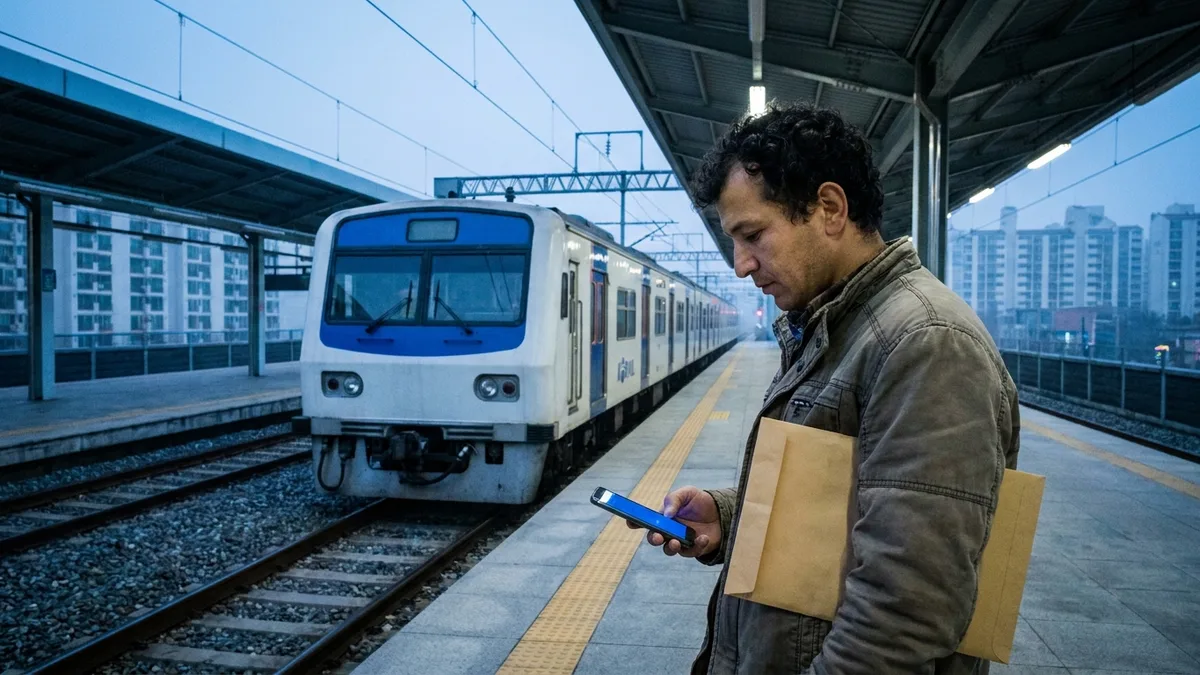
A Weekday Morning Appointment from Outside Seoul — Bundle Travel and Payment in Advance
If your country has no mission outside Seoul, visiting means a round trip to Seoul. If your appointment time is a weekday morning, you need to work backward from the first train of the day — not from the night before.
Here's a safe order of operations.
- Lock in the appointment first. You can't choose transport until the time is fixed.
- Aim to arrive one hour before your appointment. Building entry, waiting, and fixing missing documents all take time.
- Check the last leg from the station or terminal to the mission. If public transit is awkward, you'll need a taxi.
- Book the return trip with plenty of margin, or check in advance which time slots still have seats.
A comparison of the ways to travel between Seoul and the regions is laid out in How to Get from Seoul to Other Cities. Here I'll just flag where foreigners get stuck at the booking stage.
| Booking method | What you can book | Where foreigners get stuck |
|---|---|---|
| Korail+ (formerly Korail Talk) | KTX | Works with a passport and overseas card, but some people get blocked at the payment step |
| Kakao T | Taxis, trains, intercity buses | Requires Korean mobile number verification |
| In-person ticket counter | Trains, express buses | For a weekday morning appointment, time spent in line is itself a risk |
| LACHA | KTX, express buses, taxis, VAN (5–6 seaters), Airport Railroad, transit cards | Does not handle mission appointments or consular matters |
The appointment and the paperwork are things you have to do yourself either way. But the travel wrapped around them can be arranged ahead of time. LACHA is a transport-and-payment super app for foreigners that you can use right away without Korean identity verification. You can start with just your passport — no Korean bank account or phone number needed — and pay with overseas simple-payment services like Alipay and WeChat Pay, or with an overseas card. Even during the period before you've received your residence card and have no Korean number, you can book KTX, express buses, and taxis all in one place, which takes a lot of pressure off a tight schedule like a weekday morning appointment.
Need transit and payments while you wait for your residence card? Check out LACHA.
Built to work without a Korean phone number or bank account, with overseas payment methods like Alipay, WeChat Pay, and Apple Pay. Taxi hailing plus KTX, express bus, and airport railroad (AREX) booking — all in one app.
Up to 60% off Korea transit with a coupon (max ₩3,000): enter code at sign-up. KTX gets up to 18% off on top
Download now


Frequently Asked Questions (FAQ)
Q1. I lost my passport. Should I call ☎1345? ☎1345 is the desk for stay, visa, and alien registration matters. Passport issuance and reissuance are the authority of your country of nationality (Article 5(d) of the Vienna Convention on Consular Relations), so you need to go to your own country's mission in Korea. That said, you may also need to complete Korean-side procedures first, such as filing a loss report — so get guidance from your mission, confirm which Korean documents are required, and then act.
Q2. I called the number in the MOFA directory but it won't connect. Numbers for missions in Seoul are listed without the area code (02). Add 02 in front from within Korea, or +82-2 from abroad. The Philippine Embassy's "788-2100/1" is the same number as "+82-2-788-2100." If it still won't connect, check that entry's update date and give priority to the number posted on the mission's official website.
Q3. How do I find out which mission has jurisdiction over my area? Jurisdiction isn't in the MOFA directory. It's only confirmed in the guidance on the mission's official website. For example, the Philippine Consulate-General in Busan officially announces that it covers Busan, Daegu, Gwangju, and Ulsan plus the Gyeongsang and Jeolla provinces and Jeju Special Self-Governing Province — but that's the Philippines' arrangement. The lines differ by country, so read your own mission's guidance directly.
Q4. The booking link is an unfamiliar address like setmore.com or forms.gle. Isn't that a scam? Missions really do use outside booking platforms. The Philippine Embassy in Korea was taking passport bookings through the Philippine DFA system (www.passport.gov.ph), other consular services through Setmore, and the Consulate-General in Busan through a Google Form (confirmed 2026-08-25). The test isn't the domain, it's the path — all that matters is whether you got there by clicking a link posted on the mission's official website. And be suspicious if an official procedure asks for payment information.
Q5. If I'm arrested by the police, does the embassy get contacted automatically? No. Article 36(1)(b) of the Vienna Convention on Consular Relations provides for notification if you request it. You have to say "please notify my embassy" first, and if you can't communicate, asking for an interpreter comes first. Korean authorities have a duty to inform you of that right without delay. Note, though, that a consular officer coming does not mean they'll act as your defense lawyer — the treaty text, case law, and the scope of what consular officers can do are laid out in What Your Country's Mission in Korea Can Do for You, so read that, and confirm your specific response with a lawyer and your own mission.
Note: This article is intended as general information and is not legal or administrative advice. The addresses, phone numbers, office hours, booking methods, and jurisdictions in this text are as of 2026-08 (checked 2026-08-25) and were verified against the Ministry of Foreign Affairs' Directory of Foreign Missions in Korea, each mission's official website, the Korean-language translation of the Vienna Convention on Consular Relations on the Ministry of Government Legislation's National Law Information Center world law information center, and the Ministry of Justice's HiKorea. Mission information changes frequently due to relocations, temporary closures, and changes in booking methods, and the Philippine, Chinese, and Vietnamese examples in this text are given only to show "how much missions differ from one another" — don't apply them directly to your own country. Before visiting, re-check both the MOFA Directory of Foreign Missions in Korea and your own mission's official website on the same day. LACHA is a private transport and payment service unaffiliated with government agencies or foreign missions, and does not handle mission appointments or consular matters on your behalf.