

The Supreme Court's Guidelines on Handling International Marriages Between Koreans and Foreign Nationals nail it down in a single line: "When an international marriage report has been accepted, the marriage report form shall not be forwarded to the foreign national's home country" (Family Relations Registration Directive No. 635, Sec. 1-B(3), effective 2024-06-27). Meaning that even after you finish your marriage report at a Korean district office, Korean authorities send nothing at all to your spouse's home country.
On the birth side, the reason is different in kind. With marriage, the system exists but nothing gets forwarded; with birth, Korea has no system that can take in a foreign child at all. The proposed Act on Birth Registration of Foreign Children (bill no. 2214674) is still pending before the Legislation and Judiciary Committee as of August 2026 and is not yet law in force (bill information, Ministry of Government Legislation Public Participation Legislation Center). What your baby does get instead is a Korean deadline of its own: 90 days from the date of birth (Immigration Act Article 23(1)1, as of 2026).
Either way, the conclusion is the same. You have to go to the Korean office and to your own country's mission separately, and neither one tells the other.
Heads-up: This article is general information compiled from publicly available laws and government guidance, not legal advice. Please confirm anything that applies to your own situation with the official channels listed below. Procedures split sharply from country to country, so the official guidance from your own country's mission in Korea is the final word.
Split It Up First — Who Handles What
| Where | What it does |
|---|---|
| Korean immigration (regional office, branch office, field office) | Granting status of stay to a baby born in Korea; alien registration |
| Korean city, gu, eup, or myeon office | Accepting the marriage report; issuing the receipt and the certificate of acceptance |
| Your country's mission in Korea | Your child's nationality and passport, birth registration back home, certificate of eligibility to marry, marriage registration back home |
None of these three rows covers for another. Article 5 of the Vienna Convention on Consular Relations (Treaty No. 594, in force 1977-04-06) lists passport issuance and civil registration among consular functions, but the treaty only defines the scope of consular functions — it does not create an individual right to demand any particular service. How much a mission actually does for you varies by country. The dividing line is laid out in what your home country's mission in Korea actually does, and how to find yours is in where is my country's embassy in Korea.
Being Born in Korea Does Not Make Your Child Korean
Let's clear away the most dangerous misunderstanding first. Being born in Korea does not, on its own, give a child Korean nationality. Nationality Act Article 2(1) grants nationality to ① a person whose father or mother is a national of the Republic of Korea at the time of birth, ② a person whose father was a national at the time of his death, where the father died before the person was born, and ③ a person born in the Republic of Korea where both parents are unknown or stateless. A foundling discovered in the Republic of Korea is presumed to have been born in the Republic of Korea (paragraph 2 of the same article).
If both parents are foreign nationals with a clear nationality, that third branch doesn't catch. Which is why your child's nationality and passport can only be created at your own country's mission. If the parents hold different nationalities, each country's law decides separately, so it's safer to check with both missions.
90 Days After Birth — The Korean Deadline Attached to Your Baby
When a foreign baby born in Korea stays on in Korea without a status of stay, the baby has to obtain a status of stay within 90 days from the date of birth (Immigration Act Article 23(1)1). The "one month after birth" figure people often mix this up with is the birth-report deadline for Korean nationals and does not apply here.
| Who | Deadline | Legal basis |
|---|---|---|
| A foreign baby born in Korea | 90 days from the date of birth | Immigration Act Article 23(1)1 |
| Someone who loses or renounces Korean nationality while staying in Korea | 60 days from the date the ground arises | Subparagraph 2 of the same paragraph (amended 2025-07-22, effective 2026-01-23) |
| Birth report for a Korean national | Within one month of birth | Family Relations Registration Act Article 44(1) |
Once the status of stay is granted, alien registration has to be done right then as well. The clock starts not from "the date of entry" but from "the time the status of stay is granted," which is different from the general rule (Immigration Act Article 31(3)). The procedure is covered separately in how to get your alien registration card.
| Fee item | Amount | Legal basis (amended 2024-12-24) |
|---|---|---|
| Grant of status of stay | KRW 80,000 (KRW 40,000 for marriage migrant F-6) | Enforcement Rule of the Immigration Act Article 72(4) |
| Alien registration card issuance or reissuance | KRW 35,000 | Article 72(10) of the same Rule |
Heads-up: Some public guidance pages still carry the old amounts. Please check again on HiKorea or Gov24 before you go. Photo requirements are also written up differently from one notice to the next in both size and number of copies, so take away only that a color photo is required and check the exact specs on HiKorea before you have them taken.
The schedule has to be worked backward. Granting a status of stay is an in-person matter that can't be applied for online, it needs a HiKorea visit reservation, and Gov24 lists a processing time of typically three weeks to three months (Enforcement Decree of the Immigration Act Article 29). But to apply you need your baby's passport, and the passport only comes out after the birth registration at your home country's mission is finished. If you wait until the baby's passport is in hand to book the appointment, you'll run past the 90 days. Run the consular procedure and the immigration booking side by side from right after the birth. Booking is covered in how to book a HiKorea appointment.
It's worth knowing where you stand if you do miss the deadline. A violation of Article 23 carries up to three years' imprisonment or a criminal fine of up to KRW 30 million (Article 94(15)), and a violation of the registration duty under Article 31 carries up to one year's imprisonment or a criminal fine of up to KRW 10 million (Article 95(7)). That said, the head of a regional immigration office may issue a notice requiring payment of a 범칙금 (beomchikgeum) — a penalty payment equivalent to the fine that substitutes for criminal prosecution (Article 102(1)) — so the statutory penalty and what actually gets imposed are two separate things. Which status of stay your child is granted depends on the parents' status and on the review, so check with ☎1345.
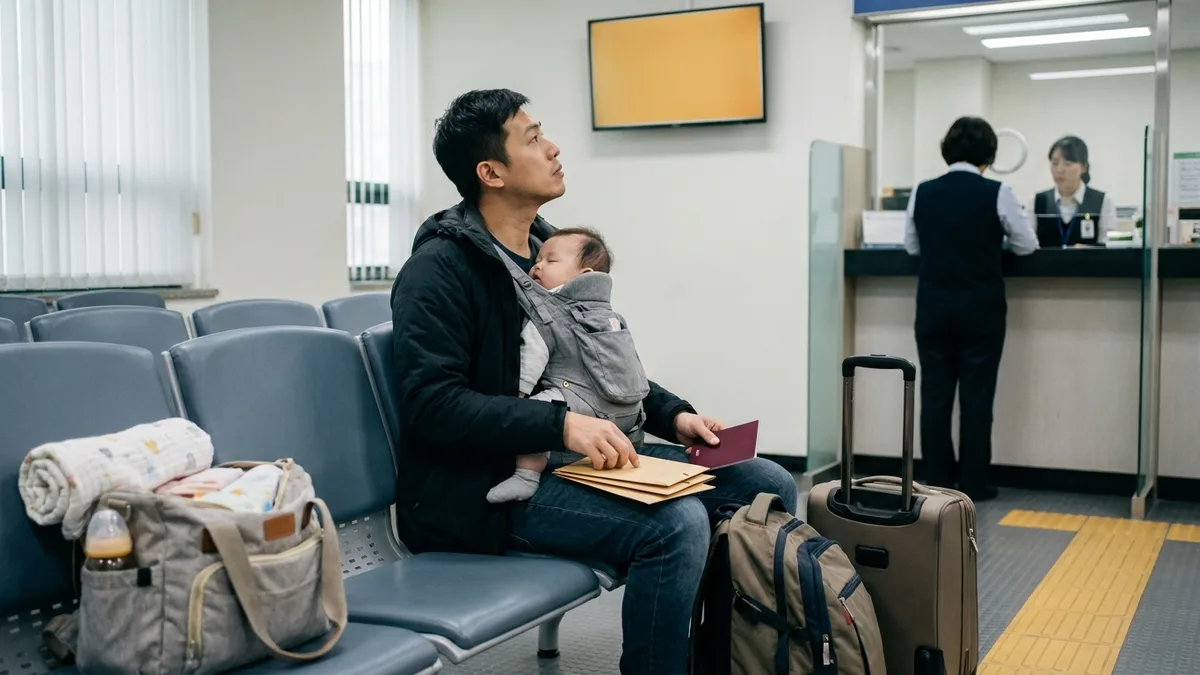
Your Child's Birth Registration Happens Only at Your Home Country's Mission — Korea Has No Such System
The Act on Registration of Family Relations is a law for registering the birth, marriage, and death "of nationals" (Article 1). A foreign national is not entered on the register under their own name; when recorded as a family member of a national, only name, sex, date of birth, nationality, and alien registration number are entered (Article 9(2)4).
Which is why the birth notification system doesn't reach here either. Medical institutions send birth information to the Health Insurance Review and Assessment Service, HIRA notifies the head of the city, eup, or myeon, and that head, after issuing a demand, records the birth ex officio (Articles 44-3 and 44-4 of the same Act) — but the endpoint of that chain is the family relations register. For a foreign child, for whom no register is created at all, there's nowhere for this flow to land. It means the hospital does not file the report for you.
The birth certificate you get from the hospital has to be submitted to your home country's mission. Translation and authentication may be attached at this point: Korea's accession to the Apostille Convention took effect on 2007-07-14, so between member states a single apostille finishes it, while for non-member states you go through two steps — verification by the issuing country, then consular authentication at the other country's mission. The competent apostille authorities for Korean documents are the Overseas Koreans Agency and the Ministry of Justice. What's required is decided by the receiving side, your own country's mission, so look at their guidance first.
Health insurance comes later in the order. The six-month residence requirement doesn't apply to a workplace subscriber's children under 19 (proviso to Article 109(4)3 of the National Health Insurance Act), but registering a dependent requires documents confirming alien registration (Article 61-3 of the Enforcement Rule of the same Act). If the grant of status of stay and the alien registration run late, you pay the full cost of any medical care in the meantime. Details are in health insurance for foreigners in Korea.
Marriage — Korean Offices Look First at "A Certificate Issued by Your Home Country"
The requirements for a valid marriage follow each party's own national law (Act on Private International Law Article 63(1)). That's why Korean city, gu, eup, and myeon offices ask a foreign party for a certificate of eligibility to marry issued by their home country. The name varies by country — certificate of single status, marriage eligibility certificate, and so on — and the issuing body splits too: in some countries it's a home-country government office, in others the mission in Korea.
The directive leaves a route open for when you can't get the certificate.
| Situation | What to submit | Legal basis (Directive No. 643, effective 2025-11-27) |
|---|---|---|
| Your country has such a certificate | The certificate issued by your home-country office or by your mission in Korea | Sec. 2-A |
| Your country has no such system | An affidavit sworn before a consul or equivalent officer at your country's mission in Korea | Sec. 2-B |
| Neither works, e.g. no diplomatic relations | A notarized document plus proof of identity and family status such as a birth certificate and a copy of your passport | Sec. 2-C |
The notarized document has to spell out each requirement specifically; an abstract statement like "meets all requirements under the governing law" is not enough (Sec. 2-D of the same directive). And the main text of Sec. 2 of that directive says "between a Korean national and a foreign national, or between foreign nationals." Meaning two foreign nationals can also file a marriage report in Korea. Marriage takes effect upon the report — it's a constitutive report, so there's no filing deadline — and it's made in writing signed jointly by both parties and two adult witnesses (Civil Act Article 812).
Reporting in Korea Sends Nothing to Your Home Country
The sentence quoted at the top hooks in right here. Directive No. 635, Sec. 1-B(3) provides that the marriage report form is not forwarded to the home country, which means you have to create the home-country record yourself, through your home country's own procedure. This is exactly where trouble surfaces years later, when something like inheritance, a pension, or registering a child comes up back home and the spousal relationship can't be proven.
Know in advance what paperwork you'll actually receive, too. No family relations register is created for the foreign spouse, so no marriage relationship certificate comes out. What you do get is a receipt handed over immediately when you file (Directive No. 618 Article 8), and you can request a certificate of acceptance or of non-acceptance (Family Relations Registration Act Article 42). Check with the city, gu, eup, or myeon office with jurisdiction for exactly which document, under which name, comes out.
Requirements can also split in opposite directions from one country to the next.
| Item | Chinese party (Directive No. 635, Sec. 1-A) | Vietnamese party (Directive No. 647, Sec. 4-A and 4-B) |
|---|---|---|
| Certificate | A certificate of single status issued by a competent Chinese authority with an apostille — consular authentication by the Korean mission in China is not needed | A marriage eligibility certificate issued in the name of the Vietnamese ambassador or consul in Korea (Form No. 9), plus documentary proof of Vietnamese nationality and a Korean translation |
| Marriageable age | Even below the home country's marriageable age, acceptance cannot be refused if the party meets the Civil Act Article 807 age (18), and a parental consent form cannot be demanded from anyone aged 18 or over | Below Vietnam's marriageable age (20 for men, 18 for women), the report cannot be accepted even with a parental consent form attached |
The same cells, exact opposites. This is an area where the Supreme Court keeps separate handling guidelines country by country, so none of it carries over to another country as-is. Check where your own country falls with both the city, gu, eup, or myeon office with jurisdiction and your country's mission in Korea.
Filing the Report Does Not Bring a Status of Stay With It
The marriage report and the status of stay are different laws and different agencies. A residence visa for the purpose of marital cohabitation (F-2 (a)) or a marriage migrant visa (F-6 (a)) requires an invitation from the spouse, and the inviter becomes the guarantor (Enforcement Rule of the Immigration Act Article 9-4(1)). Where the case falls under the requirements published by the Minister of Justice, proof that the inviter has completed the international marriage guidance program is also required (paragraph 2 of the same article).
The head of the overseas mission may review and verify how the couple met and their intent to marry, whether the marriage is validly formed under the laws of the countries concerned, whether the inviter has invited another spouse within the past five years, the income requirement published annually by the Minister of Justice, mutual disclosure of health status and criminal record, the ability to communicate in Korean at a basic level or above, and whether normal housing has been secured for living together on an ongoing basis (Article 9-5(1) of the same Rule). If refused, in principle you can reapply only after six months have passed (paragraph 3 of the same article). Whether you personally meet each requirement is decided by ☎1345, not by this article.
A false marriage report is heavy. Making a false report to a public official so that a false statement is entered in an authentic deed carries up to five years' imprisonment or a criminal fine of up to KRW 10 million (Criminal Act Article 228(1)), and that record is itself listed as a visa review item (Enforcement Rule Article 9-5(1)12).
What This Article Can't Decide for You
What happens when undocumented parents go through the procedures for their child is not something this article rules on. The grounds for exemption from the immigration notification duty are exhaustively listed in Article 92-2 of the Enforcement Decree of the Immigration Act and Article 70-2 of the Enforcement Rule, and birth and marriage report counters are not on that list. But there's also no basis for stating flatly that "you will definitely be reported" — Article 84(1) of the Act rests on the condition "upon discovering a person deemed to be in violation," and the exemption grounds are likewise qualified by "where it is deemed." We also weren't able to confirm the practice for cases where the baby leaves Korea within the 90 days. Ask about both of these in advance, at ☎1345 and at your own country's mission in Korea.
| What | Where |
|---|---|
| Stay, visas, alien registration | Immigration Contact Center ☎1345 |
| Multicultural family and marriage migrant counseling | Danuri Call Center ☎1577-1366 |
| Legal counseling | Korea Legal Aid Corporation ☎132 |
| Nationality, passports, home-country civil registration | Your country's mission in Korea (official guidance is the final word) |
There will be days when you make the rounds of the district office, immigration, and the mission all in one go. Many countries have only one mission in Korea, in Seoul, so if you live outside the capital the travel is the first thing to plan around — and more so with a baby along. LACHA is a transport and payment super app for foreigners that you can use right away without Korean identity verification, so you can book KTX, express buses, taxis, and the airport railroad in one place. That said, LACHA has nothing to do with birth or marriage reports or consular business, and doesn't handle those procedures on your behalf.

Need transit and payments while you wait for your residence card? Check out LACHA.
Built to work without a Korean phone number or bank account, with overseas payment methods like Alipay, WeChat Pay, and Apple Pay. Taxi hailing plus KTX, express bus, and airport railroad (AREX) booking — all in one app.
Up to 60% off Korea transit with a coupon (max ₩3,000): enter code at sign-up. KTX gets up to 18% off on top
Download now


Frequently Asked Questions (FAQ)
Q1. My child was born in Korea, so doesn't that make them Korean? No. Nationality Act Article 2(1) sets the rule as a father or mother being a national of the Republic of Korea at the time of birth, and the only cases where being born in Korea alone confers nationality are where both parents are unknown or stateless (subparagraph 3) and the foundling presumption (paragraph 2). If both parents are foreign nationals, your child's nationality and passport can only be created at your own country's mission. If the parents hold different nationalities, each country's law decides separately, so check with both missions.
Q2. My baby's passport isn't out yet and the 90 days are closing in. Granting a status of stay is an in-person matter that can't be applied for online, so it needs a HiKorea reservation, and Gov24 lists a processing time of typically three weeks to three months. If you book only after the passport arrives, it's easy to run past the 90 days (Immigration Act Article 23(1)1). Run the mission's birth registration and passport process and the immigration booking at the same time, and if the time you have left looks tight, don't put it off — call ☎1345, explain your situation, and get guidance.
Q3. If I file a marriage report in Korea, does it register automatically in my home country too? No. Family Relations Registration Directive No. 635, Sec. 1-B(3) expressly provides that when an international marriage report is accepted, the marriage report form is not forwarded to the foreign national's home country (effective 2024-06-27). Home-country registration has to be done separately, through your country's mission in Korea or your home country's own procedure — and conversely, if you married in your home country first, the Korean side is a separate procedure too. The required documents and deadlines differ by country, so follow your own mission's guidance.
Q4. My home country has no certificate of eligibility to marry. Does that mean I can't get married? There's a separate route. Family Relations Registration Directive No. 643, Sec. 2-B allows an affidavit sworn by the person concerned before a consul or equivalent officer at the Korea mission of the country whose law governs to take the place of the certificate. If you can submit neither the certificate nor the affidavit, then under Sec. 2-C you submit a notarized document together with documents proving identity and family status, such as a birth certificate and a copy of your passport. Note that the notarized document has to be specific about each requirement — an abstract statement is not enough (Sec. 2-D). Before you start preparing, check with both your country's mission in Korea and the city, gu, eup, or myeon office with jurisdiction.
Q5. If I file a marriage report, do I get an F-6 visa? The validity of the marriage and the status of stay are separate procedures. A marriage migrant visa (F-6 (a)) requires an invitation and a guarantee from the spouse (Enforcement Rule of the Immigration Act Article 9-4(1)), and the head of the overseas mission may review and verify how the couple met and their intent to marry, the income requirement, the ability to communicate in Korean at a basic level or above, whether normal housing has been secured, and more (Article 9-5(1) of the same Rule). The income requirement amount is published annually by the Minister of Justice, so it isn't written into this article. Check whether you personally qualify with ☎1345.
Note: This article is general information compiled from publicly available laws and government guidance, not legal advice. The provisions, deadlines, and amounts in the text were confirmed as of 2026-08 against the original text of the Nationality Act, the Immigration Act together with its Enforcement Decree and Enforcement Rule, the Act on Registration of Family Relations, the Act on Private International Law, the Civil Act, the Criminal Act, and the National Health Insurance Act on the Korea Law Information Center; the text of Supreme Court Family Relations Registration Directives Nos. 618, 635, 643, and 647; and guidance from Gov24, HiKorea, and the Overseas Koreans Agency. The Act on Birth Registration of Foreign Children is pending in the National Assembly, so the birth section will change if that system comes into being. Laws and fees get amended and phone numbers and operating hours change, so before you move, please confirm again for your own situation with ☎1345 (stay, visas, alien registration), ☎1577-1366 (multicultural families, marriage migrants), ☎132 (legal counseling), and your own country's mission in Korea. Nationality, passports, and home-country civil registration cannot be handled on your behalf by any Korean office, and for country-by-country procedures the official guidance of your own mission is the final word. LACHA is a private transport and payment service unaffiliated with the organizations above and does not handle reporting procedures on your behalf.