
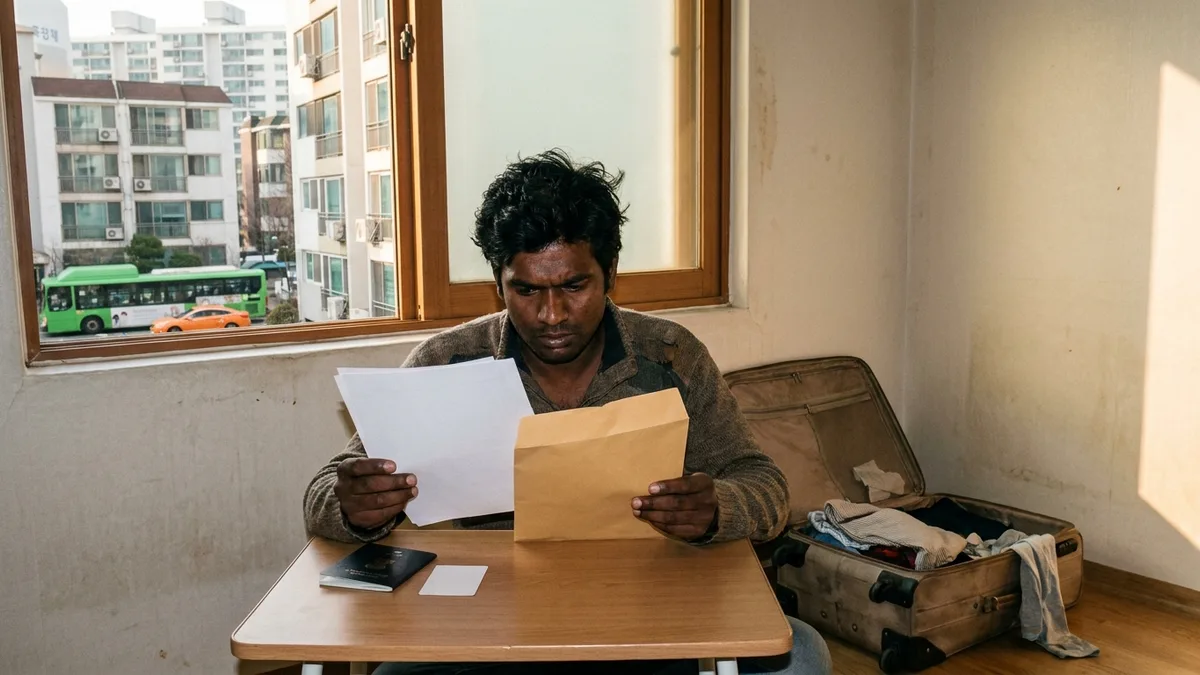
If the money you receive from departure guarantee insurance is less than your statutory severance pay, the company has to pay you the shortfall separately. That's the employer's duty under Article 21(3) of the Enforcement Decree of the Act on the Employment, Etc. of Foreign Workers. But a lot of people board their flight without ever knowing this gap exists, thinking "I got the insurance payout, so my severance is settled."
The gap happens because the two amounts are calculated on different bases. Departure guarantee insurance sets aside 8.3% of your monthly ordinary wage each month (EPS guidance, as of 2026-08). Statutory severance pay, on the other hand, is at least 30 days' average wage for each year of continuous service (Employee Retirement Benefit Security Act, Article 8(1)). Average wage can include bonuses and overtime or night-shift allowances, so the more of those allowances you've been receiving, the more likely it is that insurance accrued on the ordinary-wage basis falls short of your statutory severance pay.
Another issue is that the money doesn't come from one place. Severance pay (departure guarantee insurance), unpaid wages and allowances, return cost insurance, and the National Pension lump-sum refund all come from four different institutions. Receiving one doesn't automatically bring the others. Let's go through where to apply for each of the four, the deadlines, and the exact spots where foreign workers actually trip up.
Note: The information below is organized based on statutory provisions and official institutional guidance as of 2026-08, and is not legal advice. Notified amounts, country-specific amounts, and phone numbers can change, so please re-check your own case with the official channels listed in this article before you actually apply.
The money doesn't come from one place — it splits across four institutions
Let's nail this down from the first line. It is not settled all at once. The four payments have different legal bases, different people who paid in, and different places to apply.
| What | Legal basis | Where to apply | Claim deadline |
|---|---|---|---|
| ① Severance pay — departure guarantee insurance lump sum plus any shortfall | Foreign Workers Employment Act Art. 13 · Retirement Benefit Act Art. 8(1) | Insurance company (filed by fax); shortfall from the company | 3 years (Act Art. 13(4) · Retirement Benefit Act Art. 10) |
| ② Unpaid wages and allowances | Labor Standards Act Art. 36 · Foreign Workers Employment Act Art. 23 | Ministry of Employment and Labor ☎1350 → Seoul Guarantee Insurance | 3 years (Labor Standards Act Art. 49) |
| ③ Return cost insurance | Foreign Workers Employment Act Art. 15 | Insurance company | 3 years (Act Art. 15(3)) |
| ④ National Pension lump-sum refund | National Pension Act | National Pension Service ☎1355 | Check with the Service's guidance |
- Of the four, the only one the worker personally is required to sign up for is ③ return cost insurance (Foreign Workers Employment Act, Article 15(1)). Of the rest, ① and ② are money the company must insure or pay, and ④ the National Pension lump-sum refund comes back together with contributions that the worker and the company each paid half of.
- ① and ③ are both foreign worker insurance products, so they share the same insurance company channel, but the National Pension is run by an entirely different institution, so you must apply for it separately.
- Each channel has different multilingual support and operating hours. If you're not sure where to call, one option is to first ask at ☎1345 (Foreigner Comprehensive Information Center, 20 languages as of 2026-08).
Caution: The above are typical cases. Something not listed here isn't automatically eligible or ineligible — please check your own situation with the Ministry of Employment and Labor at ☎1350 or the Foreigner Comprehensive Information Center at ☎1345.
① Severance pay — the departure guarantee insurance lump sum isn't the whole story
Departure guarantee insurance is not "some other money given instead of severance pay." When a company enrolls in this insurance, it is deemed to have established a severance pay system under Article 8(1) of the Employee Retirement Benefit Security Act (Foreign Workers Employment Act, Article 13(2)). It's easier to understand if you think of it as a container that holds your severance pay.
So what happens if the container is too small? Article 21(3) of the Enforcement Decree of the Foreign Workers Employment Act provides that if the lump sum is less than the severance pay amount under Article 8(1) of the Retirement Benefit Act, the employer must pay the difference to the foreign worker.
Important: The same provision also tells you how to check whether there's a gap. Both the employer and the worker may ask the insurance provider to confirm the lump sum amount (Enforcement Decree of the Foreign Workers Employment Act, Article 21(3)). The order is: first confirm how much the insurance payout is, then if that amount falls short of your statutory severance pay, ask the company for the difference.
This article can't calculate your statutory severance pay for you. Average wage produces different results depending on how your bonuses and allowances are structured. The EPS mobile app is described as having a severance pay estimator (as of 2026-08), so check your total wages for the three months before leaving and run the numbers. If the figures look ambiguous, the accurate move is to take your pay statements and call the Ministry of Employment and Labor Customer Service Center at ☎1350.
Payment deadlines are also set by law. Severance pay must be paid within 14 days from the date the payment obligation arises (Retirement Benefit Act, Article 9(1)). Other money and valuables such as wages and compensation must, as a rule, also be settled within 14 days from the date of separation (Labor Standards Act, Article 36). That said, there's a proviso allowing the payment date to be extended by agreement between the parties if there are special circumstances.
First, whether you're eligible — 1+ year of service, 15+ hours a week
The proviso to Article 4(1) of the Retirement Benefit Act excludes workers with less than one year of continuous service and workers whose contractual working hours average less than 15 hours per week over a four-week period. Read the other way around, it means you're eligible if you have one year or more of continuous service + an average of 15 or more hours per week over four weeks.
The amount standard is at least 30 days' average wage for each year of continuous service (Retirement Benefit Act, Article 8(1)). Average wage here is a different concept from ordinary wage, so if your pay statements showed bonuses or overtime/night-shift allowances, the calculation result changes. If the statement is in Korean and you can't read the line items, one approach is to ask the company staff for the name of each item, write them down, and check them exactly as written with ☎1350.
There's one wrong statement people hear most often: "Our company only has a few employees, so there's no severance pay." Workplaces with four or fewer regular employees (fewer than five) are also subject to statutory severance pay.
The Employee Retirement Benefit Security Act was extended to workplaces with four or fewer employees from 2010-12-01. For the period from 2010-12-01 to 2012-12-31, at least 50% of statutory severance pay applied, and from 2013-01-01, 100% applies.
If your continuous service is less than one year, the departure guarantee insurance lump sum reverts to the employer (proviso to Article 21(2) of the Enforcement Decree). However, the judgment can differ depending on where your service period is counted from and to, so if you're right around the one-year mark, don't give up on your own — take your employment contract and pay statements and check with ☎1350.
Caution: If you left your workplace or have an issue with your residence status, whether you can receive departure guarantee insurance varies case by case. There are parts where the EPS guidance and the Enforcement Decree provisions can be read differently, so this article won't make a definitive statement. Don't judge on your own — call ☎1345 or ☎1350 and describe your situation exactly as it is.
Departure guarantee insurance timeline — report 1 month ahead, file 7 days ahead
The thing most people miss here is that there isn't one deadline, there are two. The report to the employment center and the claim to the insurance company go to different institutions with different deadlines. The later you book your flight, the more likely you are to get caught by the second deadline.
| When | What to do | Where |
|---|---|---|
| At least 1 month before your planned departure date | Report of planned departure | Local employment center |
| At least 7 days before your planned departure date | File the insurance claim | Insurance company (by fax) |
| Within 14 days from the date of departure | Insurance payout | By the receiving method you designated when applying |
| If you apply after your departure date | Paid within 14 days from the application date | Insurance company |
The last row of the table is an important safety net. If you apply due to a change of residence status, death, and so on, or if you apply after your departure date, the payment deadline changes to "within 14 days from the application date" (Foreign Workers Employment Act, Article 13(3)). That means even if you couldn't apply before leaving, your claim isn't over. Realistically, though, it gets far more troublesome — you still have to send documents from your home country and complete identity verification. If you can, finish it while you're still in Korea.
Filing is done by fax. From within Korea it's 0505-161-1421, and from overseas it's 82-505-161-1421 (as of 2026-08). These days finding a place to send a fax is the harder part, so ask in advance whether you can use your company office's fax machine, or find a shop that offers printing and copying services.
Here are the documents listed as required (as of 2026-08).
- Insurance claim form and consent form
- Certificate of planned departure — you can only get this after the employment center report of planned departure is completed
- Copy of your passport
- Copy of your alien registration card
- Additional documents depending on the receiving method (copy of bank account, flight ticket, etc.)
You can choose from three receiving methods.
| Receiving method | What to prepare | Good to know |
|---|---|---|
| Transfer to a domestic account | Copy of a Korean bank account in your own name | If you close the account before leaving, the deposit route disappears |
| Transfer to an overseas account | Home country account details | If the spelling differs from the romanized name on your passport, processing can be delayed |
| Cash at an airport exchange counter | Proof of departure (flight ticket, etc.) | Order: bank exchange counter in the 3rd-floor departure hall at Incheon Airport → exchange counter in the duty-free area |
If you choose airport pickup, be sure to remember that the route has two stages. First you get a currency exchange voucher at the bank exchange counter in the 3rd-floor departure hall at Incheon Airport, then after you clear departure procedures you receive the cash at the exchange counter in the duty-free area. You need time for this step on the 3rd floor, so it's safer to arrive earlier than usual.
Tip: The application forms are in Korean, so filling them out alone can be hard. Get help from your company staff or the employment center, and once everything is filled in, read the romanized name on your passport and your account number out loud, character by character, to compare. With overseas transfers, even a one-letter difference in the name can block processing.
② Unpaid wages and allowances — 14 days after separation, and guarantee insurance if the company can't pay
As a rule, money and valuables such as wages and severance pay must be settled within 14 days from the date of separation (Labor Standards Act, Article 36). E-9 and H-2 workers must also be paid at or above the minimum wage under Article 6 of the Minimum Wage Act, so that line becomes your reference point when calculating what you're owed.
The mechanism for cases where the company can't pay is wage arrears guarantee insurance. The employer must enroll within 15 days from the effective date of the employment contract (Foreign Workers Employment Act, Article 23(1); Enforcement Decree, Article 27), and the guaranteed amount per insured person is 4,000,000 KRW (Ministry of Employment and Labor Notice No. 2021-15, effective 2021-02-01 — applies to employment contracts that took effect on or after 2021-02-01).
The claim has three steps, and you can't skip the order.
- Report the wage arrears to the Ministry of Employment and Labor — ☎1350 or your local labor office
- Obtain the "Confirmation of Unpaid Wages, Etc. and Employer"
- Apply for the insurance payout at Seoul Guarantee Insurance
Even if the arrears exceed 4,000,000 KRW, you can receive up to the limit. For the excess, you can claim directly against the employer or inquire at the Ministry of Employment and Labor's labor inspection channel. The statute of limitations for wage claims is 3 years (Labor Standards Act, Article 49), so the claim itself stays alive even after you leave the country.
Caution: Many people can't bring themselves to start because they worry that reporting while still employed will sour relations with the company. This article only explains the institutional route of reporting and filing a complaint. The safest approach for deciding what to do first and when is to explain your situation to ☎1350 and get advice. For a full map of labor support channels, see Where foreigners in Korea can get help with labor problems.
③ Return cost insurance — getting back the money you paid in
Of the four, this is the only one the worker personally is required to sign up for (Foreign Workers Employment Act, Article 15(1)). You must enroll within three months from the effective date of the employment contract (Enforcement Decree, Article 22), and the payment ranges from 400,000 to 600,000 KRW depending on your country, payable as a lump sum or in up to three installments (as of 2026-08).
We won't pin down your country's amount in a table here. The country-group assignments are described differently across sources and are revised often. Please check your own country's amount through EPS (Employment Permit System) guidance or the insurance company you're enrolled with.
There are three typical grounds for payout.
- Departing because your period of stay has expired
- Departing for personal reasons before your period of stay expires (temporary departures excluded)
- A worker who left the workplace departing voluntarily or being forcibly deported
The above are typical cases. Something not listed here isn't automatically eligible or ineligible — please check your own case with ☎1345 or ☎1350. The claim deadline is three years from the date the payout ground arises (Foreign Workers Employment Act, Article 15(3), applying Article 13(4) mutatis mutandis), and insurance money past the statute of limitations is transferred by the financial institution to the Human Resources Development Service of Korea within one month.
Caution: A worker who fails to enroll in return cost insurance faces an administrative fine of up to 5,000,000 KRW, and an employer who fails to enroll in departure guarantee insurance (Act, Article 13(1)) or guarantee insurance and accident insurance (Act, Article 23) faces a criminal fine of up to 5,000,000 KRW. That said, the article numbers for penalties and administrative fines can change with amendments, so only the amounts are listed here — please confirm the exact provisions at the Korean Law Information Center (law.go.kr).
④ National Pension lump-sum refund — here we'll just point you to the right channel
The National Pension lump-sum refund is administered by the National Pension Service, so you must apply completely separately from departure guarantee insurance. Receiving the insurance payout doesn't bring the pension along with it.
Whether you're eligible depends on your nationality and residence status. Some countries are excluded under social security agreements or reciprocity, so only the National Pension Service at ☎1355 can confirm which side you fall on. Since agreements keep changing, this article won't list the countries again.
The actual procedures — when to apply, what documents you need, conditions for airport pickup — are laid out step by step in How to get your National Pension lump-sum refund. When you issue your flight ticket and whether the company has reported your separation both factor into the conditions, so we recommend reading it before you set your departure schedule.
Easy to mix up — these three are not "money you get when you leave"
| Item | What it is | When you depart |
|---|---|---|
| Accident insurance | Enrolled by the employer to cover injuries and illnesses other than work-related accidents (Foreign Workers Employment Act, Article 23(2); Enforcement Decree, Article 28) | It's not a product that refunds accumulated contributions |
| Industrial Accident Compensation Insurance | A system that compensates you if you suffer a work-related accident | If there was no accident, it's not money that gets settled because you're leaving |
| Health insurance | National Health Insurance enrollment and payments | For settlement or refunds, ask ☎1577-1000 |
People misunderstand the accident insurance amounts especially often. The structure pays up to 30,000,000 KRW only in cases of death or permanent disability, and 15,000,000 KRW for death from illness (Enforcement Decree of the Foreign Workers Employment Act, Article 28(2)2, as of 2026-08). It absolutely does not mean "you get 30,000,000 KRW when you leave the country."
We couldn't verify the health insurance premium settlement and refund procedures through primary sources. If you have premiums paid in advance, contact the National Health Insurance Service at ☎1577-1000 before you depart (official confirmation needed). Taxes are also outside the scope of this article, so for retirement income tax or year-end tax settlement refunds, please contact your company's year-end settlement staff or the National Tax Service's consultation channel.
Final checks before departure — accounts, contact details, documents
This is where the accidents of losing money by doing things in the wrong order happen most often. If you close your Korean bank account and cancel your phone first, you lose both the deposit route and your means of identity verification at the same time. Cancellations always come last.
- Fix your planned departure date — you need a flight ticket to calculate the 1-month-ahead report and 7-days-ahead filing schedule
- File the report of planned departure at your local employment center → get the certificate of planned departure
- Ask the insurance company to confirm the lump sum amount — this is the number you'll compare against statutory severance pay
- If it falls short of statutory severance pay, ask the company for the difference (Enforcement Decree, Article 21(3))
- If you have unpaid wages or allowances, report to ☎1350 first
- For the National Pension lump-sum refund, inquire separately at ☎1355
- File your insurance claim with the insurance company — by 7 days before departure, by fax
- Write the email address and phone number where you can be reached in your home country accurately on the application
- Keep copies of every document you submit — you'll need them when making inquiries after departure
- Close your Korean bank account and cancel your phone service only after all deposits and communications are done
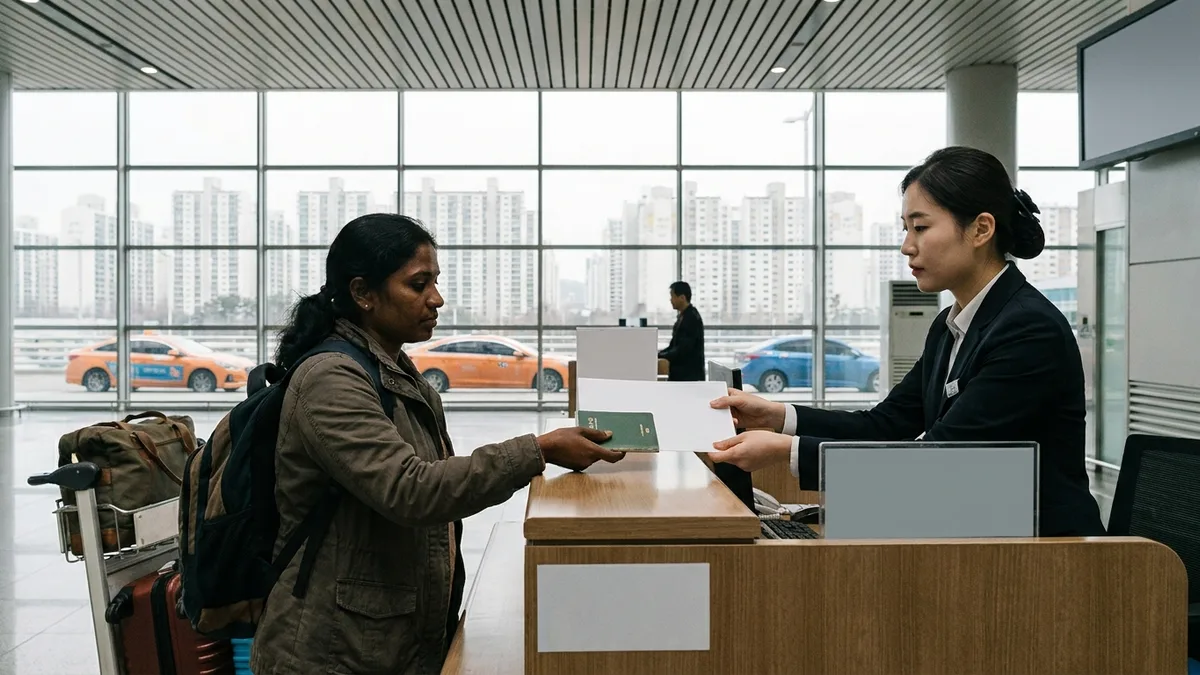
Because the statute of limitations is three years, the claim itself stays alive even after you leave (Foreign Workers Employment Act, Article 13(4); Retirement Benefit Act, Article 10; Labor Standards Act, Article 49). But pursuing a complaint or claim from your home country still requires document delivery and identity verification, which makes it much harder in practice. Finish what you can while you're still in Korea.
Who to ask — 1345 · 1350 · 1355
The four payments have different channels, so it's convenient to save the numbers in advance.
- ☎1345 Foreigner Comprehensive Information Center — residence status and visas, and when you're not sure which channel to use (20 languages as of 2026-08)
- ☎1350 Ministry of Employment and Labor Customer Service Center — severance pay, wage arrears, employment contracts
- ☎1355 National Pension Service — lump-sum refund eligibility and procedures
- ☎1577-1000 National Health Insurance Service — health insurance premium settlement and refund inquiries
Departure guarantee insurance and return cost insurance are handled at the insurance company's channel. You can find the filing procedures and forms on Samsung Fire & Marine's foreign worker insurance guidance page, but the call center number differs across sources, appearing as both 02-2261-8400 and 1600-0266. Both are listed, so try whichever connects, and do your final check on the official Samsung Fire & Marine foreign worker insurance page and the official EPS (Employment Permit System) guidance.
If you want to review how the Employment Permit System works, see A guide to the Employment Permit System (EPS) process, and for sending the money you received back home, see How to send money overseas from Korea.
Your last day is tighter than you'd think. If you decided to receive your insurance payout in cash at the airport exchange counter, you have to budget time for getting the exchange voucher on the 3rd floor, and if you have a lot of luggage, a taxi or van beats the subway. LACHA is a transport and payment super app for foreigners that you can use right away without identity verification. It's designed so you can start with just your passport — no Korean bank account or phone number needed — so even after you've already cancelled your phone service or closed your account, you can book a taxi to the airport, the Airport Railroad, KTX, and express buses all in one place.

Need transit and payments while you wait for your residence card? Check out LACHA.
Built to work without a Korean phone number or bank account, with overseas payment methods like Alipay, WeChat Pay, and Apple Pay. Taxi hailing plus KTX, express bus, and airport railroad (AREX) booking — all in one app.
Up to 60% off Korea transit with a coupon (max ₩3,000): enter code at sign-up. KTX gets up to 18% off on top
Download now


Frequently Asked Questions (FAQ)
Q1. Once I receive the departure guarantee insurance payout, is my severance pay settled? No. If the lump sum is less than the severance pay amount under Article 8(1) of the Employee Retirement Benefit Security Act, the employer must pay the difference (Enforcement Decree of the Foreign Workers Employment Act, Article 21(3)). The accrual basis is 8.3% of your monthly ordinary wage, while statutory severance pay is 30 days' average wage, so if you've been receiving bonuses or overtime allowances there can be a gap. Both the employer and the worker may ask the insurance provider to confirm the lump sum amount, so check the number first and compare.
Q2. My company has fewer than five employees — do I still get severance pay? Yes. Workplaces with four or fewer regular employees are also subject to statutory severance pay. The Employee Retirement Benefit Security Act was extended to workplaces with four or fewer employees from 2010-12-01; from 2010-12-01 to 2012-12-31 at least 50% of statutory severance pay applied, and from 2013-01-01, 100% applies. The eligibility requirements are one year or more of continuous service and an average of 15 or more hours per week over four weeks (proviso to Article 4(1) of the Retirement Benefit Act).
Q3. I left the country without applying. Is it too late? Not yet. If you apply after your departure date, payment is set to be made within 14 days from the application date (Foreign Workers Employment Act, Article 13(3)), and the statute of limitations on the insurance claim is three years from the date the payout ground arises (same Article, paragraph 4). That said, you still have to send documents from your home country and complete identity verification, which is much more of a hassle. Once the limitation period passes, the insurance money is transferred to the Human Resources Development Service of Korea, so don't put it off.
Q4. My company didn't pay my wages — where do I start? First, report the wage arrears to the Ministry of Employment and Labor (☎1350). Then obtain the "Confirmation of Unpaid Wages, Etc. and Employer" and apply for the insurance payout at Seoul Guarantee Insurance. The guaranteed amount per person under wage arrears guarantee insurance is 4,000,000 KRW (Ministry of Employment and Labor Notice No. 2021-15, effective 2021-02-01), and for amounts above that you can claim directly against the employer or inquire at the Ministry of Employment and Labor's labor inspection channel. The statute of limitations for wage claims is three years (Labor Standards Act, Article 49).
Q5. How much do I get back from return cost insurance? The payment ranges from 400,000 to 600,000 KRW depending on your country, and you enroll yourself within three months from the effective date of your employment contract (Foreign Workers Employment Act, Article 15(1); Enforcement Decree, Article 22). However, we won't state your country's amount definitively in this article — the country-group assignments are described differently across sources and are revised often. Please check the figure for your own case through EPS (Employment Permit System) guidance or the insurance company you're enrolled with. The claim deadline is three years from the date the payout ground arises.
Note: This article is intended to provide general information and is not legal or labor-affairs advice. The provisions, amounts, deadlines, and phone numbers in this article were verified as of 2026-08 against the original statutory texts at the Korean Law Information Center, the Ministry of Government Legislation's Easy-to-Find Practical Law service, the Human Resources Development Service of Korea's EPS (Employment Permit System) guidance, and Samsung Fire & Marine's foreign worker insurance guidance. Notified amounts, country-specific payment amounts, article numbers for penalties and administrative fines, and insurance company and institutional contact details can change with amendments and institutional circumstances. The amount you actually receive varies with your length of service, wage composition, and any record of leaving your workplace, so before applying please re-check your own case with the Ministry of Employment and Labor at ☎1350, the Foreigner Comprehensive Information Center at ☎1345, the National Pension Service at ☎1355, and the official EPS and Samsung Fire & Marine pages. LACHA does not handle severance pay or insurance claims on your behalf and does not guarantee payment.