Two people with the same disability who have lived in Korea for the same length of time can still end up on opposite sides of the line: one can register as a person with a disability, the other cannot. The dividing line is visa status. Article 32-2, Paragraph 1 of the Act on Welfare of Persons with Disabilities lists exactly five categories among overseas Koreans and foreign nationals, and you have to fall inside that list to register under Article 32.
Here are the five. A person who has filed a domestic residence report under Article 6 of the Overseas Koreans Act; a person registered as an overseas national under Article 6 of the Resident Registration Act; a person who has completed alien registration under Article 31 of the Immigration Act and holds a status of stay that permits permanent residence in Korea; a marriage immigrant under Article 2, Subparagraph 3 of the Framework Act on the Treatment of Foreigners Residing in Korea; and a recognized refugee under Article 2, Subparagraph 2 of the Refugee Act. F-5 and F-6 are inside this list, while E-9, E-7, D-2, and D-10 are, in principle, outside it.
But there's one more wrinkle. The Ministry of Health and Welfare and Government24 explain that disability registration has been open to foreign nationals and overseas Koreans since January 27, 2013 — yet they describe the eligible group as only four categories: "overseas nationals with resident registration, foreign nationals of Korean descent (F-4), permanent residents of Korea (F-5), and marriage immigrants (F-6)." Recognized refugees, who are in the statute, are missing from the guidance text.
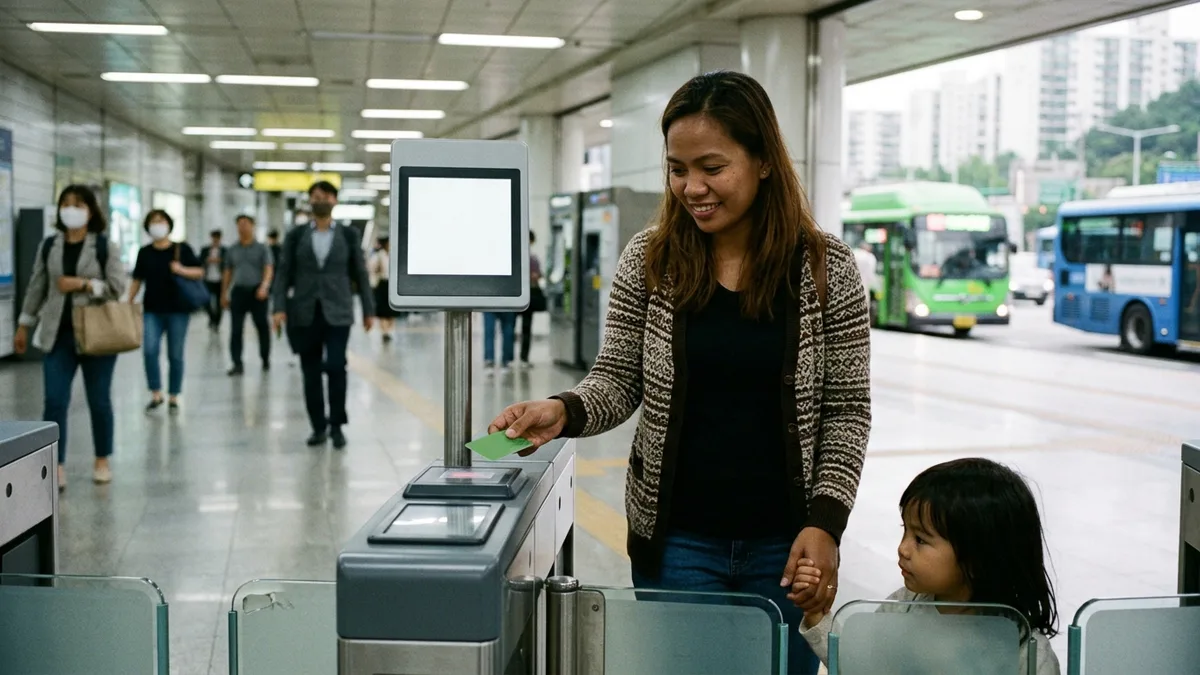
Once you're registered, your transportation costs genuinely change. Urban rail (subway) is 100% free, and intercity rail is discounted by up to 50%. But the only proof accepted for those discounts is the disability registration card (welfare card) — nothing else. If your visa status blocks registration, there's no way to substitute a passport or an alien registration card. You end up paying full price on the very same train.
Note: This article organizes statutes and official guidance as general information; it is not legal advice. Whether a specific individual is eligible to register should be confirmed with your city/county/district office, the community service center for your eup, myeon, or dong, or the Korea Immigration Contact Center (1345).
The Short Answer — Which Visa Statuses Qualify and Which Don't
Translating the statute and official guidance into visa status codes, here's how it breaks down.
| Visa status | Registration path | Basis and extra conditions |
|---|---|---|
| F-5 Permanent Residence | Open | Article 32-2 (1) 3, "status of stay that permits permanent residence." Also listed as "permanent resident of Korea" in Ministry of Health and Welfare and Government24 guidance |
| F-6 Marriage Immigrant | Open | Paragraph 1, Subparagraph 4 — marriage immigrant (Framework Act on the Treatment of Foreigners Residing in Korea, Article 2 (3)) |
| F-2 (spouse of a Korean national) | Included in overseas mission guidance | Ministry of Foreign Affairs overseas mission guidance describes marriage immigrants as holding "F-6 or F-2 visas." Ministry of Health and Welfare guidance mentions only F-6 |
| F-4 Overseas Korean | Requires a completed domestic residence report | Paragraph 1, Subparagraph 1 covers "a person who has filed a domestic residence report," so the visa alone doesn't put you on this path |
| Overseas national (resident registration) | Open | Paragraph 1, Subparagraph 2 — overseas national resident registration under Article 6 of the Resident Registration Act |
| Recognized refugee | Listed in the statute | Paragraph 1, Subparagraph 5 (Refugee Act, Article 2 (2)). However, it is missing from the government guidance text |
| E-9, E-7, D-2, D-10, etc. | In principle outside the list | Not included in the statutory list. That said, there is no separate provision explicitly excluding them, so check with your local office |
One caution when reading this table: don't read the last row as "E-9 is absolutely impossible." Article 32-2 works by enumerating who qualifies, so the accurate phrasing for a status that isn't on the list is "in principle not eligible." If you're planning to change your visa status, take a look at the visa extension application process first.
The most common mismatch involves F-4. Even if you enter on an overseas Korean visa, if you put off filing your domestic residence report, you don't meet the Subparagraph 1 requirement of being "a person who has filed a domestic residence report." In other words, the requirement is the report, not the visa. Deadlines and documents are covered separately in how to get a domestic residence report certificate.
The Basis Is Article 32-2 — A Door with Five Categories
When explanations at the counter conflict, the statute is what you can bring with you. Here are the five categories set out in Article 32-2, Paragraph 1, as written.
- Subparagraph 1 — A person who has filed a domestic residence report under Article 6 of the Overseas Koreans Act
- Subparagraph 2 — A person registered as an overseas national under Article 6 of the Resident Registration Act
- Subparagraph 3 — A person who has completed alien registration under Article 31 of the Immigration Act and holds a status of stay that permits permanent residence in Korea
- Subparagraph 4 — A marriage immigrant under Article 2, Subparagraph 3 of the Framework Act on the Treatment of Foreigners Residing in Korea
- Subparagraph 5 — A recognized refugee under Article 2, Subparagraph 2 of the Refugee Act
Subparagraph 3 is the tricky one. Whether "a status of stay that permits permanent residence" extends beyond F-5 requires checking the appended tables of the Enforcement Decree of the Immigration Act, which we were not able to verify in the original text. If you hold a permanent-residence-related status other than F-5, it's safest to ask your local immigration office directly.
There's one more line in the same article. Paragraph 2 states that "the State and local governments may restrict support for disability welfare programs for persons with disabilities registered under Paragraph 1, taking budget and other factors into account." It's a caveat that receiving a registration card does not automatically bring every welfare program with it. This provision applies to foreign and overseas Korean registrants, so it's a variable that doesn't exist for Korean nationals with disability registration.
📌 Tip: When counter guidance and the statute seem to say different things, ask by citing the exact provision — "Article 32-2, Paragraph 1, Subparagraph __." The guidance text is an abbreviated summary; the statute is the standard for the decision.
Where Government Guidance and the Statute Diverge
As we saw, the Ministry of Health and Welfare and Government24 guidance lists four categories: overseas nationals, F-4, F-5, and F-6. The fifth one in the statute — recognized refugees — does not appear in that text.
Here's what that means in practice. When a recognized refugee visits a community service center, the guidance the staff member is looking at may well show the same four-category list. What's needed at that moment isn't persuasion — it's the provision number. Pointing out that Paragraph 1, Subparagraph 5 explicitly names recognized refugees under Article 2 (2) of the Refugee Act moves the conversation to a verification step.
F-2 is similar. Ministry of Foreign Affairs overseas mission guidance describes the marriage immigrant category as "F-6 or F-2 visa," meaning a spouse of a Korean national might hold a status code other than F-6. That said, we found this wording in only one place — overseas mission guidance — and could not cross-verify it. If you're a marriage immigrant holding F-2, we recommend asking your local community service center about eligibility before applying.
There's one thing worth preparing before you head to the counter: open Article 32-2 of the Act on Welfare of Persons with Disabilities on the Korean Law Information Center site and print out all of Paragraph 1. When the guidance text and the statute differ, this shifts the conversation from "can I or can't I" to "please check which subparagraph my case falls under."
The Second Wall — Diagnoses Issued Abroad Are, in Principle, Not Accepted
Even if you clear the visa status door, there's another wall. Ministry of Foreign Affairs overseas mission guidance on disability registration explicitly states that medical records issued abroad are in principle not accepted during the assessment.
That's a heavy condition for anyone who already received a disability determination in their home country. Even with a determination document in hand, you may have to build your medical record from scratch at a Korean medical institution. There are some exceptions. The same guidance notes that for certain permanent conditions — such as amputation, congenital cerebral palsy, and organ transplants — overseas medical documents may be accepted if accompanied by a notarized translation.
The documents submitted for the disability severity assessment break down like this.
| Document | Contents | What to know |
|---|---|---|
| Disability diagnosis certificate | Must state the affected area, cause, onset date, and treatment period | Issued by a medical institution qualified to make the diagnosis |
| Test results | CT, MRI, X-ray, etc. | Required tests vary by disability type |
| Medical records | Materials confirming the course of treatment | The required period varies by type |
| One photo | Taken within the last 6 months, 3.5cm × 4.5cm, front-facing upper body | Submitted with the application form |
| Proof of identity | Passport, etc. for foreign nationals | There is no fee |
| Application form | Application for disability registration and services | Available at the community service center |
For the "period varies by type" in the third row, we won't put a number on it. The guidance says it depends on the type, but we could not verify the periods in the original text of the Ministry of Health and Welfare's "Disability Severity Determination Criteria" notice. Asking both the hospital where you'll be diagnosed and the community service center, "How much medical record history is needed for my disability type?" will save you a wasted trip. If this is your first time using a Korean hospital at all, read our hospital guide for foreigners alongside this.
Tip: If you're planning to bring documents from abroad, bring both the originals and notarized translations. Whether they're accepted is decided during the assessment, but at the diagnosis stage they make it far easier to explain your history to the doctor.
The Application Process — From the Community Service Center to the National Pension Service Assessment
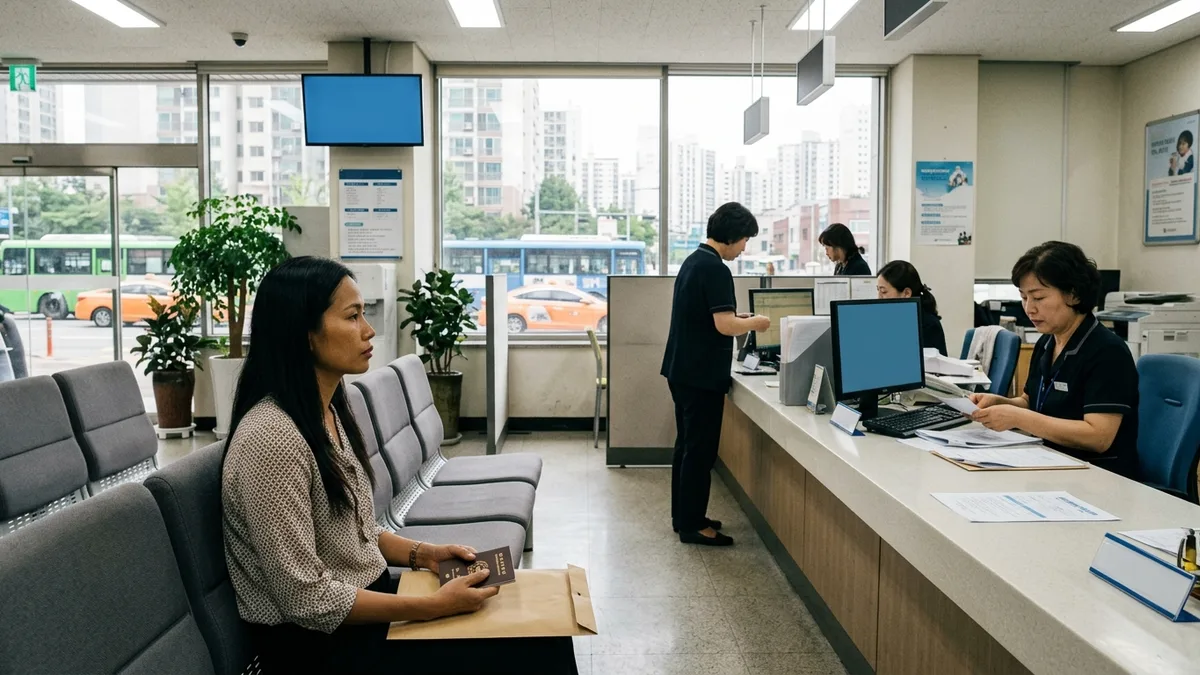
The application can be filed by you, a legal representative, or a guardian. The intake point is the community service center (jumin center) for your eup, myeon, or dong of residence. Importantly, this starts at an in-person counter, not an online portal.
| Step | Where | What happens |
|---|---|---|
| 1. File the application | Community service center for your area | Submit the form, photo, and proof of identity. There is no fee |
| 2. Consultation | Same counter | Confirm your disability type and the required documents |
| 3. Referral for diagnosis | Medical institution | Prepare the diagnosis certificate, test results, and medical records |
| 4. Severity assessment | National Pension Service | Reviewed at a medical advisory meeting with two or more specialists |
| 5. Registration and issuance | Community service center | After registration, you receive your disability registration card (welfare card) |
The reason this process is especially heavy for foreign nationals isn't Step 4 — it's where Steps 1 and 3 overlap. A Korean-language application form, a diagnosis certificate from a Korean medical institution, and a Korean administrative counter all hit you at once. This stretch is hard to get through alone without interpretation, so if you don't have someone to accompany you, we recommend calling 1345 (Korea Immigration Contact Center, multilingual support) to confirm the process first.
Government24's service guide lists the processing time as roughly 30 days, but we could not confirm this with a second independent source (provisional). It can take longer if the assessment requires supplementary documents, so if you're on a schedule, ask the counter again for an expected timeline when you file.
Tip: Ask three things at once at the Step 1 counter. ① Which subparagraph of Article 32-2 (1) does my visa status fall under? ② Which medical department should issue the diagnosis certificate for my disability type? ③ How much medical record history is needed? You can't book a hospital appointment until these three are settled.
What Changes for Transportation Once You're Registered — The Discount Table and the "Support Restriction" Caveat
First, terminology. The disability grading system was abolished on July 1, 2019, so grades like Level 1 through Level 6 are no longer used. The determination system now has two categories: "person with a severe disability" and "person with a non-severe disability." If you've seen discount rates by grade on an old blog, that's no longer the current standard.
| Mode of transport | Discount |
|---|---|
| KTX / Saemaeul-ho | Severe disability — 50% for the traveler and one accompanying caregiver / Non-severe disability — 30%, weekdays only (excludes Saturdays, Sundays, and public holidays) |
| Mugunghwa-ho / commuter trains | Severe disability — 50% for the traveler and one accompanying caregiver / Non-severe disability — 50% |
| Urban rail (subway) | 100% discount (free). Guidance says to present your disability registration card (welfare card) when riding |
| GTX trains | Listed as a 50% discount in the Ministry of Health and Welfare's public utility discount guidance (noted differently from the free urban rail fare) |
| Express buses | Not included in the transportation section (rail, urban rail, highway tolls) of the Ministry of Health and Welfare's public utility discount guidance |
The second and third rows are what you'll feel most. If you commute by subway every day, free urban rail alone completely reshapes your monthly transportation budget. Express buses, on the other hand, aren't on the guidance list above. We were unable to confirm whether individual carriers offer their own discounts, so read that as "not confirmed on this list" rather than "no discount exists."
The "one accompanying caregiver" in the first row also makes a real difference. A person with a severe disability gets the same discount rate extended to one caregiver traveling with them, so if two people take the KTX from Seoul to Busan, both tickets get cheaper. Conversely, the 30% KTX/Saemaeul-ho discount for people with non-severe disabilities applies on weekdays only, so it doesn't apply if you travel on Saturdays, Sundays, or public holidays.
The proof method converges on a single path. For both intercity rail and urban rail, you present your disability registration card (welfare card). There is no published alternative using a passport or alien registration card. Registration eligibility is effectively fare-discount eligibility — which is why the first half of this article ultimately comes back to fares.
Two things we'll leave unconfirmed. First, whether foreign registrants can obtain a preferential (free-ride) transit card is unclear, since the issuance requirements are described on a resident registration basis. That said, free urban rail itself is described as working by presenting the welfare card, so the gate here is registration eligibility, not card issuance. Second, whether an account registered on the Korail+ app with an alien registration number can have the welfare card discount applied is internal app behavior we couldn't verify. We recommend contacting Korail directly to confirm whether buying at a station counter is the reliable route.
📌 Tip: Keep the "support restriction" caveat in Article 32-2 (2) in mind. The discounts above are published for registered persons with disabilities in general, but the provision allowing the State and local governments to restrict support based on budget and other factors applies specifically to foreign and overseas Korean registrants. Local government programs also vary by region, so check with your city, county, or district office.
If Your Visa Status Blocks Registration — What's Still Open, and What Isn't
Let's be straightforward. If you can't register, the discounts above won't open through any route, because the welfare card is the sole form of proof. That's why someone working on an E-9 with the same disability pays full price on the same KTX.
There is one exceptional provision. The Seoul Facilities Corporation's disability call taxi "Usage Criteria" lists "foreign nationals with a disability who use a wheelchair" as a separate item among eligible users, and states that they may ride after their foreign identification documents (passport, etc.) are verified.
However, the "Registration Guide" on the same site requires a welfare card, a disability severity determination notice, and a supplementary notice on the severity assessment results as submission documents — with no mention of foreign nationals. The two pages rest on different premises, so web guidance alone doesn't tell you what to prepare. We couldn't confirm whether membership registration is required, how long intake takes, or whether you can register before entering the country.
Note: If you plan to use the disability call taxi in Seoul, don't head out relying on the Usage Criteria wording alone — call 1588-4388 (Seoul Facilities Corporation disability call taxi) first and confirm the procedure for foreign users. The required documents and processing time may differ from the web guidance.
To sum up:
- Rail and urban rail discounts — Not applied without a registration card. No alternative proof route is published
- Seoul disability call taxi — The usage criteria include a foreign national item, but you need to confirm what to bring by phone
- Change of visa status — If your status changes, eligibility to register is reassessed as of that point

If your visa status isn't eligible for registration, the remaining question becomes "how do I pay full price?" Not getting a discount and not being able to book at all are two different problems, but foreign travelers often run into both at once. Situations where you get stuck at the booking stage because you don't have a Korean bank account or phone number are covered separately in booking KTX without Korean identity verification. LACHA is a transportation and payment super app for foreigners that you can use right away without identity verification. It's designed so that identity verification isn't required as part of the official process, so you can get started with just your passport and pay for KTX, express buses, taxis, the Airport Railroad, and transit cards all in one app. But let's be clear about one thing: the disability discount is a public program applied by verifying a welfare card, so no app can apply it on your behalf.

Need transit and payments while you wait for your residence card? Check out LACHA.
Built to work without a Korean phone number or bank account, with overseas payment methods like Alipay, WeChat Pay, and Apple Pay. Taxi hailing plus KTX, express bus, and airport railroad (AREX) booking — all in one app.
Up to 60% off Korea transit with a coupon (max ₩3,000): enter code at sign-up. KTX gets up to 18% off on top
Download now


Frequently Asked Questions (FAQ)
Q1. I'm working on an E-9 visa. Can I register as a person with a disability? E-9 isn't among the five categories set out in Article 32-2, Paragraph 1 of the Act on Welfare of Persons with Disabilities, so in principle you're not eligible to register. That said, the statute doesn't contain a separate provision saying "E-9 is excluded" — it works by enumerating who qualifies — so decisions based on individual circumstances should be confirmed with your city/county/district office, the community service center for your eup, myeon, or dong, or the Korea Immigration Contact Center (1345). The outcome can change if your visa status changes.
Q2. If I have an F-4 visa, can I register right away? The visa alone isn't enough. Paragraph 1, Subparagraph 1 specifies "a person who has filed a domestic residence report under Article 6 of the Overseas Koreans Act," so you must complete the domestic residence report to qualify through this path. Even with the same F-4 visa, if you've put off the residence report, this registration path stays closed. Deadlines and required documents are covered in our article on getting a domestic residence report certificate.
Q3. I already received a disability determination in my home country. Can I register with those documents? In principle, it's difficult. Ministry of Foreign Affairs overseas mission guidance explicitly states that medical records issued abroad are not accepted in principle. Only certain permanent conditions — such as amputation, congenital cerebral palsy, and organ transplants — may be accepted with a notarized translation attached. Otherwise, you'll need to prepare a new diagnosis certificate, test results, and medical records at a Korean medical institution. We couldn't verify the required medical record period by disability type, so ask the hospital and the community service center first.
Q4. Once I'm registered, is the subway automatically free? Urban rail fares are published as a 100% discount (free), and you present your disability registration card (welfare card) when riding. However, Article 32-2, Paragraph 2 states that the State and local governments may restrict welfare program support for registered persons with disabilities based on budget and other factors. Registration doesn't automatically mean every form of support applies, so it's worth checking your local government's guidance too. We couldn't confirm whether foreign registrants can obtain a preferential transit card.
Q5. My visa status doesn't allow registration — can I still use the Seoul disability call taxi? The Seoul Facilities Corporation disability call taxi "Usage Criteria" includes an item stating that "foreign nationals with a disability who use a wheelchair" may ride after verification of documents such as a passport. But the "Registration Guide" on the same site requires a welfare card and a disability severity determination notice with no mention of foreign nationals, so the two sets of guidance conflict. The actual intake process and timeline can't be determined from the website, so confirm directly at 1588-4388.
Note: This article is intended as general information and is not legal advice. The provisions, procedures, and discount rates in this article are current as of 2026-08 and were verified against Article 32-2 of the Act on Welfare of Persons with Disabilities, Ministry of Health and Welfare guidance on disability registration and public utility discounts, Government24 service guides, Ministry of Foreign Affairs overseas mission guidance, and Seoul Facilities Corporation disability call taxi guidance. Some items (the F-2 marriage immigrant notation, processing time, medical record periods by disability type, whether foreign registrants can obtain a preferential transit card, and the disability call taxi process for foreign users) could not be cross-verified and are marked as provisional. Programs and fares can change, so please confirm again with your local community service center, 1345, or each agency's official channels before applying or traveling.