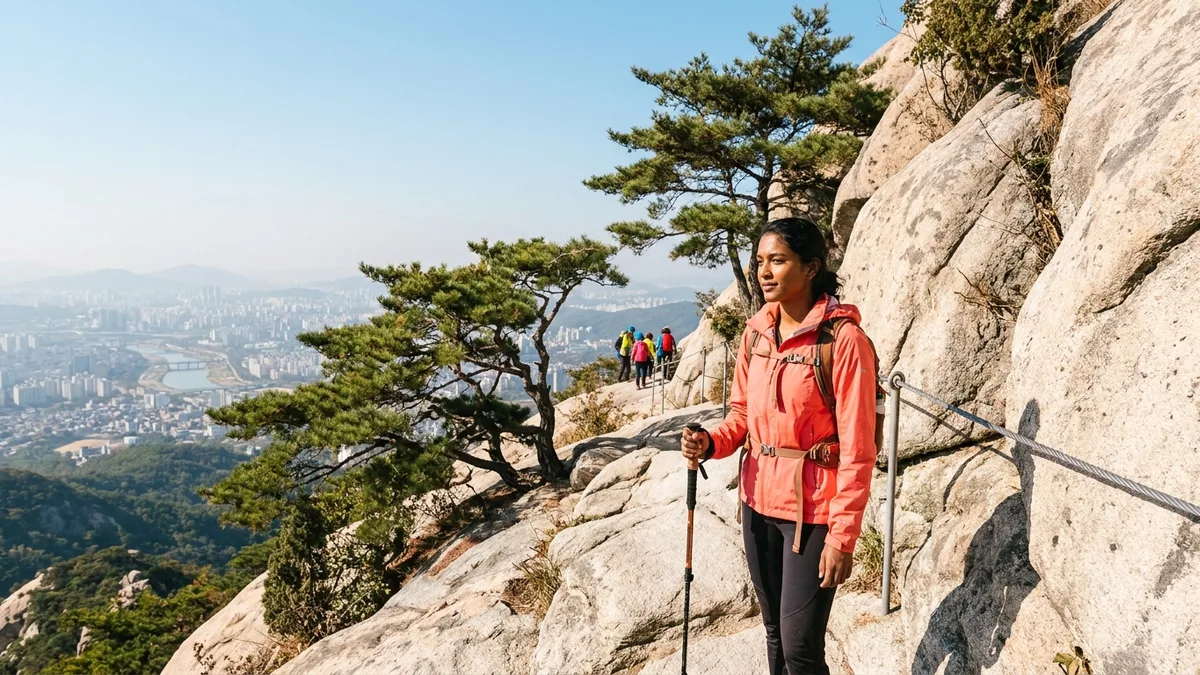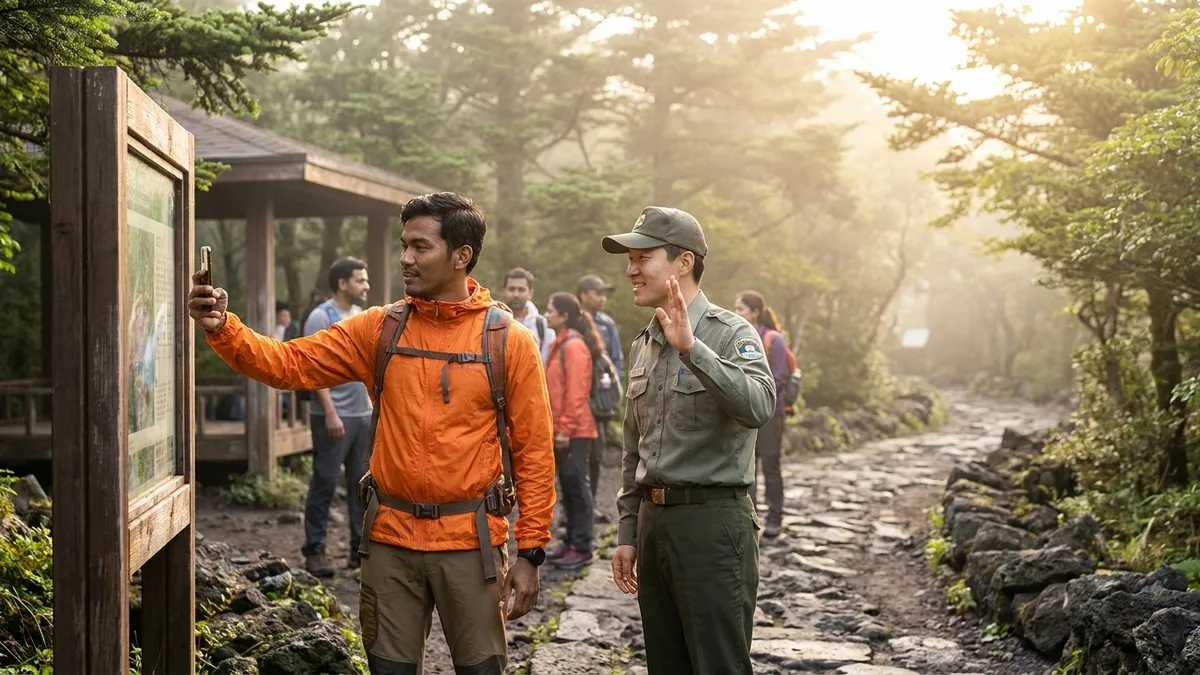
Korea's national parks don't shut for the whole winter. They close by trail, by time of day, and by weather. What gets closed is the high-elevation trails leading to the summits, the hours outside the set entry times, and days when a weather alert has been issued. Seoraksan closed the trails leading to Daecheongbong from November 15 to December 15 in both 2024 and 2025, and kept lower trails like Biseondae and Ulsanbawi open during that time. Sort out which trail closes when, match the day's weather and your gear, and you can still get into the mountains in winter.
The dates are easy to mix up from the start. Korean news tends to lead with stories that the "wildfire precaution period" has begun, but that's the nationwide wildfire-precaution period set by the Korea Forest Service (the fall period began on November 1 in 2024 and on October 20 in 2025, and both years it ran to December 15). National park trail closures started on November 15 in 2025 (and in 2024 too, for Seoraksan). Judge by one machine-translated line of a news article and you may call off a late-October or early-November trip for nothing.
For foreigners, the checking itself is the hurdle. Closure notices are posted in Korean (we couldn't find an official foreign-language channel) and are sometimes updated overnight. The Hallasan reservation page shows an old timetable alongside the current one, and the places in Seoul that rent gear aren't open yet at pre-dawn entry times.
The route from Seoul to Seoraksan and the cable car basics are in How to Get to Seoraksan, and the Hallasan booking process is in the Hallasan Reservation Guide (for passage cutoff times, the table in this article is the most current). What follows is about whether you can actually get onto the mountain that day.
Note: The closure periods, entry times, and administrative fines below were checked as of 2026-09 against the official pages of the Korea National Park Service and Hallasan National Park, the original legal texts on the National Law Information Center, and press reports. The fall 2026 closure notice and the 2027 New Year measures had not been released when this article was written, so we've given values from previous years. Check the official channels again before you go.
Even when the Daecheongbong trails close from mid-November, the lower trails stay open
In 2025, national park fall trail closures ran from November 15 to December 15 at every one of the 18 parks, including Seoraksan, Jirisan, and Bukhansan, and Seoraksan had the same period in 2024 as well. Each park closed only some sections. In 2025, Bukhansan and Chiaksan closed 1 section each, and Jirisan closed 26.
In 2025, the Seoraksan National Park Office closed the high-elevation trails running from the trailheads to Daecheongbong during this period, including Daecheongbong, Gongnyong Ridge, and Hangyeryeong. The Yeongsiam Junction to Bongjeongam section closed early, from November 10, for bridge replacement work. During the same period, lower-elevation trails such as Biseondae, Ulsanbawi, the Towangseong Falls Observatory, and Jujeongol were left open (Kyunghyang Shinmun report, 2025-11-06). The fall 2024 announcement likewise listed 10 sections as open, including Seorak-dong to Ulsanbawi and Sogongwon to Biseondae to Geumganggul Cave.
The number of closed sections changes from year to year. For Seoraksan, the closed sections in the announcements were 10 routes in fall 2024, 11 sections in spring 2025, and 8 sections in spring 2026, so check the section list in that year's notice.
As of 2026-09, the fall 2026 national park trail closure notice has not been released yet. It was reported on November 10 in 2024 and on November 6 in 2025, so open the Seoraksan National Park Office notices in early November. In past years the fall closure ended on December 15, and after that you mainly need to watch entry times and weather-related closures. Some sections may still close separately, for construction for example, so keep checking the notices. In spring the trails close again. For Seoraksan it was March 4 to May 15 in both 2025 and 2026, and the 2025 notice stated that the shelter and trail reservation systems could not be used during this period.
| Period | Set by | Dates in past years | What changes on the mountain |
|---|---|---|---|
| Nationwide wildfire-precaution period (fall) | Korea Forest Service | October 20 to December 15, 2025 (November 1 to December 15 in 2024) | National park trail closures started later, on November 15 (2025) |
| National park fall trail closures | Korea National Park Service (individual park offices) | November 15 to December 15, 2025 (also 2024 for Seoraksan) | Some sections closed at each park (at Seoraksan, the high-elevation trails toward Daecheongbong) |
| Seoraksan spring trail closures | Seoraksan National Park Office | March 4 to May 15, 2025 and 2026 | High-elevation closures, shelter and trail reservations suspended (2025 notice) |
Don't enter closed trails. If you enter a restricted area, you'll pay an administrative fine under Article 86 of the Natural Parks Act. It's an administrative penalty, not a criminal punishment, and the amounts under Annex Table 3 of the Enforcement Decree are as follows.
- Entering a restricted area: ₩200,000 for a first violation, ₩300,000 for a second, ₩500,000 for a third or later (the count goes up if you've been fined for the same violation within the past year)
- Smoking outside designated areas: ₩600,000 for a first violation, ₩1,000,000 for a second, ₩2,000,000 for a third or later
- The authority imposing the fine can reduce or increase these amounts by up to one half, but it can't go above the legal cap (₩500,000 for entry, ₩2,000,000 for smoking)
If your travel dates fall within the closure period of past years (November 15 to December 15), first plan your itinerary around lower trails like Biseondae and Ulsanbawi instead of Daecheongbong, then check it against that year's list of open sections once the notice comes out.
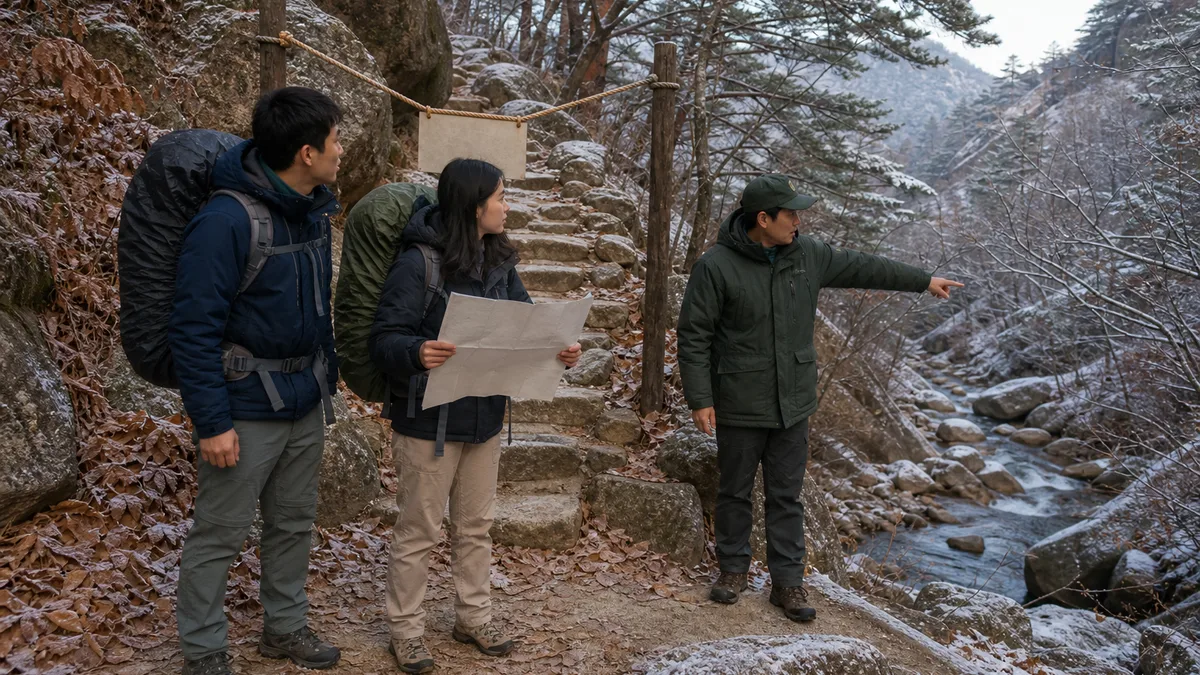
Read Korean-only closure notices by their section names
Closure notices are posted in Korean on the Korea National Park Service website (knps.or.kr) and on each park office's notice board. An English-language hiking blog that covers how to check Korean national park closures (The Girl with a Big Bag, updated 2025-11-07) also notes that the notices are written only in Korean and that the Service recommends using a browser translator. The same post says closure updates are sometimes posted between 10 PM and 4 AM, and advises checking again on the day during snowy or rainy periods.
We couldn't find an official foreign-language closure channel. The Service's English site would not open when we checked in 2026-09.
The trick is not to translate the section names. Notices name each closed section by the places at either end. The spring 2026 Seoraksan closure announcement, for example, listed 8 sections this way: Madeungnyeong to Hangyeryeong, Daeseung Falls to Daeseungnyeong, Biseondae to Huiungak, Biseondae to Yeongsiam, Baekdam to Daecheongbong, Namgyo-ri to the Hangyeryeong junction, Osaek to Daecheongbong, and Oseam to Bongjeongam (Kyunghyang Shinmun report, 2026-02-13). Copy these place names in Hangul, exactly as they appear in the notice, paste them into a map app, and see whether the trail you plan to walk passes between the two points. The Hangyeryeong junction on this list (한계령갈림길) is the same place as Hangyeryeong Junction (한계령삼거리) in the entry-time table below.
Here's how to read the words that come up often in notices.
| Korean in the notice | Meaning | When reading |
|---|---|---|
| 통제 (tongje) | You can't enter | Look at the section name and the period together |
| 전면 통제 (jeonmyeon tongje) | The whole section is closed | Avoid everything between the two end points |
| 부분 통제 (bubun tongje) | Only part of the section is closed | Check on a map how far it's open |
| 개방 (gaebang) | Open | Check the entry times separately |
| 입산시간 / 통제시간 (ipsan sigan / tongje sigan) | The first time / the last time you can start heading up | It's not a descent deadline |
| 기상특보 (gisang teukbo) | Weather advisories and warnings from the Korea Meteorological Administration | If one is issued, trails may close that day |
| 탐방지원센터 (tambang jiwon senteo) | Park information and management facility at a trailhead (visitor support center) | Some of them rent out gear |
For on-site operations at trailheads such as Osaek and Baekdam, the Seoraksan National Park Office (033-801-0900) gives the most accurate answers. If a phone call in Korean is hard for you, you can ask the 1330 travel helpline (tourist interpretation service), but we couldn't confirm whether 1330 will check closure status for you.
Open the notices twice, the night before and at dawn on the day, and paste the place names at both ends of each section into a map app to compare them with your route.
Work backward from winter entry times to set your departure time
Under the national park entry time system, each trail has a window running from its entry time to its cutoff time, and hikers are let in only during that window. It has been in place at every national park except Taeanhaean National Park since May 16, 2015. The cutoff time here is the last time you can start heading up in that direction. It isn't the time you have to be back down. In winter, on many courses, going in right before the cutoff means coming down after dark. If you read it through a translation like "opening hours", it's easy to mistake for a descent deadline.
When "winter" runs also differs by park. Going by the header of each park's table, it's mostly November to March, but Bukhansan and Mudeungsan use December to February, and Hallyeohaesang uses November to April.
| Trail (uphill direction) | Winter (Nov to Mar) | Summer (Apr to Oct) |
|---|---|---|
| Osaek (Namseorak Visitor Center) → Daecheongbong | 04:00-11:00 | 03:00-12:00 |
| Hangyeryeong → Hangyeryeong Junction | 04:00-10:00 | 03:00-12:00 |
| Biseondae → Yangpok | 04:00-12:00 | 03:00-14:00 |
| Biseondae → Madeungnyeong | 04:00-10:00 | 03:00-11:00 |
| Biseondae → Geumganggul Cave (return the way you came) | 04:00-14:00 | 03:00-14:00 |
| Baekdam → Suryeomdong Shelter → Socheong | 04:00-13:00 | 03:00-14:00 |
The table above shows the values in the Korea National Park Service entry time table for Seoraksan, checked on 2026-09-28. The times for the trails toward Daecheongbong apply on days outside the fall (mid-November to mid-December) and spring (early March to mid-May) trail closure periods. If you've reserved a shelter, the cutoff is pushed back by 1 to 2 hours depending on the visitor center. For Namseorak and Hangyeryeong, it's 1 hour for those with a Socheong or Huiungak shelter reservation.
The lower trails work differently. The routes from Sogongwon in Seorak-dong to Ulsanbawi, the Towangseong Falls Observatory, and Biseondae, and the route from Osaek Mineral Spring to Yongso Falls, are listed not with times but as "access restricted from sunset until 2 hours before sunrise the next day". That means you can go in while the sun is up and during the 2 hours before sunrise.
Bukhansan sets its winter as December to February. Every trail in its table, including Baegun Visitor Center to Baegundae, Bukhansanseong Entrance to Wimun, and Sagimakgol Entrance to Baegundae, is 04:00-16:00 in winter and 04:00-17:00 in summer. So in November, Bukhansan is still on the 17:00 cutoff. The explanatory text on the same page says "winter (November to March)" in the same way for every park, so if you view it through a translator or screen reader, it's easy to read November as 16:00. Go by the table header. Choosing a course is covered in the Bukhansan Hiking Guide.
Hallasan is managed by Jeju Province, so it has its own table. The current table in the Reservation Guide of the Hallasan trail reservation system splits the year into winter (October to March) and summer (April to September). So from October 1, 2026 to March 31, 2027, the winter times below apply (per the Hallasan National Park Management Office, as reported by Financial News on 2026-09-28).
| Hallasan control point | Winter (Oct to Mar) | Summer (Apr to Sep) |
|---|---|---|
| Seongpanak entrance and Jindallaebat checkpoint, Gwaneumsa entrance and Samgakbong checkpoint (entry cutoff) | 11:30 | 12:30 |
| Baengnokdam summit, East Ridge (descent cutoff) | 13:30 | 14:30 |
| Jindallaebat and Samgakbong shelters (descent cutoff) | 15:30 | 16:30 |
| Witse Oreum (Eorimok and Yeongsil trails) (descent cutoff) | 15:00 | 17:00 |
The table above shows the two-season table on the Reservation Guide page, checked again on 2026-10-02. The entry cutoff is the last time you can pass that point and continue upward. Treat the descent cutoff as the time by which you must pass that point on your way down, and plan your day around it. At the Baengnokdam summit (East Ridge), you must start heading down by 13:30 in winter and 14:30 in summer. There are two summit trails: Seongpanak (9.6km one way, about 4 hours 30 minutes) and Gwaneumsa (8.7km one way, about 5 hours). Since May 3, 2025, you can walk as far as Jindallaebat Shelter and Samgakbong Shelter without a reservation. Reservations are checked only on the stretch from the shelters to Baengnokdam.
The same page still shows the old three-season table (winter = January, February, November, and December, passage cutoff 12:00) and the entry text "winter 06:00, spring and fall 05:30, summer 05:00". Through a translator there's no way to tell which is current, so read them like this.
- Passage cutoff: The two-season table above (winter 11:30) is the current value.
- Entry start: It's 05:00 regardless of season. When the Hallasan National Park Management Office announced that winter hours apply from October 2026, it said the entry start stays at 5 a.m., the same as now (Financial News report, 2026-09-28). The 06:00 text dates from before Jeju Province unified the entry start to 05:00 from 2024 (Kyunghyang Shinmun 2023-12-05, report on the administrative pre-announcement).
Set your departure time by counting backward from whichever of the two limits comes earlier.
- Find your course's cutoff time in the table. Going from Osaek to Daecheongbong, it's 11:00 in winter. This is the last time you can go in. Going in at this time doesn't mean you can get back down before dark.
- Subtract your course's round-trip time from sunset. Calculated from coordinates, sunset around Daecheongbong is around 5:18 PM on January 1, 2027 (a calculated value that doesn't account for elevation), and sunset times change from day to day, so check the value for your hiking date separately. Round-trip times for courses like Osaek to Daecheongbong are in How to Get to Seoraksan. Take whichever of 1 and 2 is earlier as your baseline.
- Check the travel time from your lodging to that visitor center with a map app's public transit search, and subtract it.
- Subtract a generous extra margin for putting on crampons and using the restroom at the entrance, and that gives you the time to leave your lodging.
If you plan a day trip from Seoul to Sogongwon and want to climb beyond Biseondae (winter cutoff 12:00 toward Yangpok, 10:00 toward Madeungnyeong), add about 2 hours 30 minutes by express bus to Sokcho plus the time on city bus 7 or 7-1 to Sogongwon. If even the first bus won't get you there before that cutoff, switch to a plan where you stay in Sokcho the night before. If you'll only walk trails that are open from 2 hours before sunrise until sunset, such as Sogongwon to Biseondae or Ulsanbawi, you don't need the cutoff calculation. Just watch the sunset.
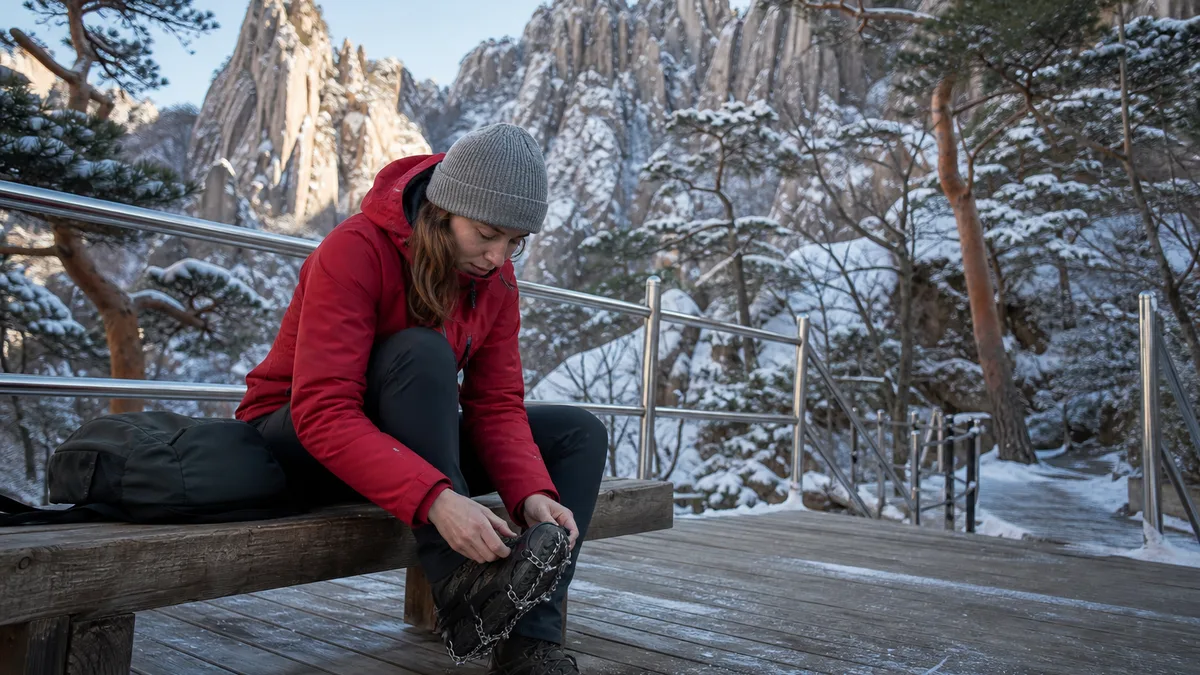
Rent or buy crampons the day before
Most January accidents in national parks were slips. According to Korea National Park Service figures, of the 25 safety accidents in national parks in January from 2022 to 2024, 92% were slips and falls resulting in fractures and injuries. The Service urged hikers to bring safety gear such as crampons and trekking poles on New Year hikes and to stick to official trails with a low risk of getting lost.
We couldn't confirm whether you'll be turned back at the entrance without crampons. The official guidance from the Service and Hallasan National Park stops at telling you to "prepare" crampons, and we found no explicit rule that you can't enter without the gear. That said, on sections with snow build-up or ice, on-site staff can stop you from going in, so don't make a plan that involves showing up without crampons and testing whether you'll get through at the entrance.
The Korea National Park Service lends safety gear for free at visitor support centers and other spots in mountain-type national parks. There are 9 items (hiking boots, trekking poles, backpacks, knee braces, first-aid kits, seat pads, trail maps, crampons, and hand warmers), and what's available varies by location. You fill out a rental application and a consent form for the collection and use of personal information, and return the items the same day. In May 2026, the Service announced it would expand the service to 20 mountain-type national parks and 27 offices.
Seoraksan is one of the 6 parks that have offered this service since it launched in July 2024. In 2025, there were 6,600 rentals across all 12 parks (this is not a Seoraksan-only figure), crampons made up 19% of them, and there were also 158 rentals by foreigners. So foreigners have used it, but we couldn't confirm whether the application and consent forms are available in foreign languages. We also couldn't confirm the exact location of Seoraksan's rental desk, its winter crampon stock, or its hours on the official pages, so ask the park office before you go.
If you're getting gear in Seoul, there's the Seoul Hiking Tourism Center. It has three locations (Bukhansan, Bugaksan, and Gwanaksan), all open 09:00-18:00. Regular closing days are Monday for Bukhansan, Tuesday for Bugaksan, and Wednesday for Gwanaksan, and all three are closed on January 1 (per the 2026 closing-day notice). Rentals are for foreign tourists and for Koreans accompanying a foreign visitor, and each center has a Klook booking link. If you plan to start at 4 AM, the center won't be open yet, so rent the day before (check the return conditions with the center) or buy crampons at an outdoor gear store. Whether a convenience store carries crampons varies by store, so don't count on it.
| Where | Hours | Good to know |
|---|---|---|
| Free national park safety gear rental (visitor support centers, etc.) | Check by phone with the park office (Seoraksan 033-801-0900) | Which of the 9 items are available varies by rental desk; rental application and personal information consent form; same-day return |
| Seoul Hiking Tourism Center (Bukhansan, Bugaksan, Gwanaksan) | 09:00-18:00, closed January 1 (per the 2026 notice) | For foreign tourists, Klook booking, weekly closing day differs by center |
| Outdoor gear stores and convenience stores | Varies by store | You're buying, so no worries about returns; convenience stores may be out of stock |
If you're starting before dawn, get your crampons in hand during the day before, and if you'll use a park's free rental, call first to confirm where the rental desk is and what items it has.
On days with heavy snow or strong wind alerts, trails can close even if you have a reservation
The Korea National Park Service entry time table for Seoraksan carries a footnote: "entry restricted when a KMA weather alert is in effect or during weather deterioration equivalent to an alert". In its New Year safety management announcement on December 30, 2025, the Service also said trails may be closed during heavy snow, strong wind, and cold wave alerts, and told hikers to check the latest information on its website (knps.or.kr).
Hallasan is managed by a different body: Jeju Special Self-Governing Province's Hallasan National Park Management Office. When a weather alert is issued, such as a heavy rain or heavy snow advisory or warning or a typhoon or storm advisory or warning, or when there's severe weather deterioration or a risk of accidents, it closes trails partially or fully, and these closures apply even if you have a reservation. The official guidance says to check the "real-time trail status" on the Hallasan National Park website on the day.
At Hallasan, even the road to the trailhead can close. The Hallasan National Park guidance says to check winter icing closures on the 1100 Road and the 5.16 Road through the Jeju Provincial Police Agency's traffic notices.
| Where | Managed by | Closure conditions (per official wording) | Where to check on the day |
|---|---|---|---|
| Seoraksan, Bukhansan, etc. | Korea National Park Service | Entry restricted when a weather alert is in effect or during equivalent weather deterioration | Korea National Park Service website (knps.or.kr) notices |
| Hallasan | Hallasan National Park Management Office, Jeju Special Self-Governing Province | Heavy rain, heavy snow, and typhoon (storm) advisories and warnings, etc.; partial or full closure | Real-time trail status on the Hallasan National Park website |
| Roads to Hallasan | Jeju Provincial Police Agency | Icing closures on the 1100 Road and 5.16 Road | Jeju Provincial Police Agency traffic notices |
Hallasan summit reservation holders need to keep one more thing in mind. If you book and then don't show up without canceling, you're blocked from booking for 3 months after the first time and for 1 year after the second. We couldn't confirm how days missed because of an alert closure are handled, so if you've decided on your own not to go, cancel your reservation first. Even on days when a closure is expected because of an alert, cancel ahead if you can, and ask the Hallasan National Park Management Office (064-713-9950) how it's handled.
Summit reservation holders also go through an ID check when they enter. If the personal details on your trail QR code don't match your ID, you're refused entry and get a 1-year entry ban penalty (Hallasan trail reservation system notice, 2026-06-05). If you're a foreigner, book under the exact name in your passport and bring your passport.
On your hiking day, check the forecast the evening before, and before leaving your lodging on the day, open the park notices and real-time status once more.
If the Gwongeumseong cable car stops for wind, switch to the lower trails
The Seorak Cable Car (Sogongwon to Gwongeumseong) has no advance reservations and sells tickets only on site on the day. It sells round-trip tickets only (adults ₩16,000, children ₩12,000). The operator says there's no hiking trail for walking down from Gwongeumseong and tells riders to take the cable car back down as well. One way takes about 5 minutes, and cars run every 10 to 15 minutes when it's quiet and every 5 minutes when it's busy.
The operator says service may stop because of unexpected strong winds or bad weather, and that unused tickets are fully refunded. It doesn't publish threshold figures, such as the wind speed in m/s at which it stops. Operating hours vary by season and weather and are posted daily on the homepage's front page, which has fields for operating status, operating hours, wait time, and ticket sales cutoff.
The website has English, Chinese, and Japanese menus. However, we couldn't confirm whether the real-time operating status also appears on the foreign-language screens. Open the Korean front page with a translator and check the operating status field first. Check once before leaving Sokcho for Sogongwon, and once more after you arrive at Sogongwon.
Even on days the cable car is stopped, there are trails you can walk in on from Sogongwon: toward Biseondae, Ulsanbawi, and the Towangseong Falls Observatory. On the entry time table these are trails you can enter "from 2 hours before sunrise", and they're lower trails that also stayed open during the fall 2025 trail closures. However, if the wind that stopped the cable car reaches alert level, these trails can be closed too, so check the Service's notices first. Even if they're open, on a windy day choose a trail that follows a valley, like Biseondae, over one that climbs a high rock peak, like Ulsanbawi. Distance and difficulty for the Biseondae and Ulsanbawi courses are summarized in How to Get to Seoraksan.
There's no national park entrance fee, and the cultural heritage admission fee at Sinheungsa Temple's ticket office at the Sogongwon entrance has also been waived since May 4, 2023 (fees mentioned in older English sources date from before that). What costs money is parking and the cable car.
If the cable car is the centerpiece of your plan, decide in advance on one lower trail to walk if it stops. Before you set out, check the operating status on the homepage, and before walking that trail, check the Service's notices to see whether it's closed.
To watch the sunrise at a national park on New Year's Day, check the entry times first
Even if you go because an article recommends a New Year sunrise hike, you can't enter a national park before its entry time. For the most recent New Year, 2026, the Korea National Park Service did not open trails early on New Year's Day and kept the usual winter entry hours. Instead, it deployed 599 safety staff on the summits and main trails of 57 sunrise spots across 22 national parks, and urged hikers to bring cold-weather gear, headlamps, and anti-slip gear such as crampons.
It used to be different. In an announcement on December 24, 2020, the Ministry of Environment noted that in previous years national parks had temporarily moved the entry time up from 4 AM to 2 AM for sunrise hikers. We couldn't confirm whether the same easing applied for the New Years of 2022 to 2025. For New Year 2027 measures, check the Service's announcement in late December (in 2025, it was reported on December 30).
Here's the math for Seoraksan. Winter entry is 04:00, and sunrise on January 1, 2027, calculated from coordinates, is around 7:40 AM (check the exact time in the Korea Astronomy and Space Science Institute's December announcement). Go in at 04:00 and you have about 3 hours 40 minutes until sunrise. The route from Osaek to the Daecheongbong summit has long stretches of steep climbing, so even going in at 04:00, it's hard to reach the summit before sunrise. Pick a viewpoint partway up where you'll watch the sunrise ahead of time. While you wait for the sun on the mountain you're fully exposed to the wind, so bring extra layers and gloves to keep from getting chilled. Lower trails like the ones from Sogongwon, which open "2 hours before sunrise", can be entered from about 5:40 AM on January 1. At the summit, the sun rises a few minutes earlier because of the altitude.
Hallasan does it differently. For three New Years in a row, 2024, 2025, and 2026, it ran reservation-based New Year sunrise night hikes. On January 1, 2026, about 2,650 people took part in the Hallasan sunrise night hike, including 1,500 summit reservation holders (figures from Jeju Province's World Heritage Headquarters).
- New Year 2024: Reservations opened at 09:00 on December 1, 2023, with capacity of 1,000 at Seongpanak and 500 at Gwaneumsa. The province announced that it would open Eorimok and Yeongsil at 04:00, earlier than the usual entry time of 06:00 (as reported November 16, 2023, before the administrative pre-announcement unifying entry at 05:00), and that it would fully close trails under a heavy snow warning and partially close them under a heavy snow advisory.
- New Year 2025: Reservations opened at 09:00 on Monday, December 2, 2024, with the same capacity. Entry was 01:00-11:30 at Seongpanak and Gwaneumsa, 04:00-12:00 at Eorimok and Yeongsil, and 04:00-10:00 at Donnaeko.
As of 2026-09, the New Year 2027 sunrise hike has not been announced. Here's how past years went.
- When it's announced: In past years it was announced between mid- and late November (reported November 16, 2023 and November 30, 2024).
- When reservations open: The next month's slots open at 09:00 on the first business day of each month (if that falls on a weekend or public holiday, the next weekday). December 1, 2026 is a Tuesday, so it's likely to be that day, but confirm with the notice. It's Korea time, so if you're booking from abroad, work out the time difference in advance. On the day reservations open, you may have to wait in a queue, and there's scheduled system maintenance from 8 p.m. to 10 p.m. on that day and the day before (Hallasan trail reservation system notice, 2026-06-05).
- If there's no sunrise hike: Even going in at the usual entry time (05:00), the one-way trip from Seongpanak to Baengnokdam takes about 4 hours 30 minutes, so you won't reach the summit in time for the Baengnokdam sunrise on January 1 (in the mid-7:30s AM, calculated from coordinates). If you want to see the sunrise from the summit, wait for the sunrise night hike announcement.
| Where | Operation confirmed for New Year 2026 | New Year 2027 | What to prepare |
|---|---|---|---|
| Seoraksan and other Korea National Park Service parks | No early opening; usual winter entry time kept (Seoraksan 04:00) | Check the Service's announcement in late December | Headlamp, crampons |
| Hallasan summit (Seongpanak, Gwaneumsa) | Reservation-based sunrise night hike (run in 2024, 2025, and 2026) | Not yet announced; announced mid- to late November in past years | If it's held, book at 09:00 on the first business day of December as in past years (check the notice) |
Sunrise hikes on Seoul city mountains like Achasan and Inwangsan fall outside the national parks, so this article doesn't cover them. Courses on those two mountains are in Seoul Half-Day Hikes. All Seoul Hiking Tourism Center locations close on January 1 (per the 2026 notice), so rent or buy your New Year hiking gear on or before December 31, and check the center's notices once more in December for closing days.
Getting back the same day when a closure breaks your plans
At Seoraksan, on a day when the summit trails are closed or the cable car has stopped, and it isn't an alert closure, first try switching to the lower trails from Sogongwon. If your day is still empty after that, heading back early is the better call. Weekend afternoon buses from Sokcho to Seoul often sell out, so if you start looking for tickets after coming down, late-night departures may be all that's left (see the return ticket section of How to Get to Seoraksan). Sokcho has separate express bus and intercity bus terminals. City buses 7 and 7-1 run from the intercity bus terminal past the express bus terminal to Sogongwon, so on the way back, check which terminal your bus leaves from and get off near it.
Seoul to Sokcho takes about 2 hours 30 minutes by express bus and about 2 hours 10 minutes by intercity bus, with departures about every 30 minutes. Express buses and intercity buses use separate booking systems. The difference and how to book in English are in the Express Bus Booking in English Guide. Buses from Dong Seoul to the Osaek (Namseorak) and Hangyeryeong trailheads are intercity buses, so you'll need to follow that system's booking or on-site ticketing.
At Hallasan, on a day closed by an alert, first sort out your way back to downtown Jeju. According to Hallasan National Park guidance, the Seongpanak trail is reached by bus 281 (about 40 minutes from Jeju Intercity Bus Terminal) or by taxi (about 40 minutes from Jeju Airport).
If you've rebooked for another day, this time the problem is getting to the entrance before dawn. The first limited-stop bus 181 from Jeju Airport to Seongpanak leaves around 6 AM (as of 2026-08; it changes by day of the week and season, so check the day's timetable), which doesn't work for a pre-dawn start, so a taxi is the realistic choice. How to call a taxi without a Korean phone number is in How to Call a Taxi in Korea Without a Korean Phone.
When your Seoraksan plans fall apart and you head back from Sokcho to Seoul early, you can book a new express bus ticket with LACHA. LACHA is a transport app for foreigners that works without identity verification, and the express bus routes linking Sokcho and Seoul (Dong Seoul Bus Terminal and Seoul Express Bus Terminal) show up in the app (checked 2026-09 for buses going from Seoul to Sokcho). Weekend afternoon buses often sell out, so if your plans look like they're going sideways, check the remaining seats on return buses in the app before you start down. Intercity buses from Dong Seoul to Osaek and Hangyeryeong, Dong Seoul to Sokcho intercity buses, Sokcho to Osaek and Gangneung intercity buses, Sokcho city buses 7 and 7-1, and Jeju buses can't be booked on LACHA. LACHA also doesn't tell you about trail closures or whether the cable car is running, so check the official channels above.
Want to handle everything from your first ride after landing in one app? Check out LACHA.
Built to work without a Korean phone number or bank account, with overseas payment methods like Alipay, WeChat Pay, and Apple Pay. Taxi hailing plus KTX, express bus, and airport railroad (AREX) booking — all in one app.
Up to 60% off Korea transit with a coupon (max ₩3,000): enter code at sign-up. KTX gets up to 18% off on top
Download now


Frequently Asked Questions (FAQ)
Q1. If I go to Seoraksan in early November, can I climb Daecheongbong? A. Going by past years, you could. National park fall trail closures began on November 15 in 2025 (and in 2024 too, for Seoraksan). However, in 2025 the Yeongsiam Junction to Bongjeongam section closed earlier, from November 10, for bridge replacement work, so also look in the notices for sections closed separately for construction. The "wildfire precaution period" you see in the news first is the Korea Forest Service's nationwide wildfire-precaution period, which starts on a different date (November 1 in 2024, October 20 in 2025). The fall 2026 national park trail closure notice, though, had not been released as of 2026-09; in past years it came out in early November (reported November 6, 2025 and November 10, 2024). Once it's out, check the period and sections, and keep in mind that trails can be closed on days with weather alerts.
Q2. How much do I have to pay if I enter a closed trail? A. Entering a restricted area costs ₩200,000 for a first violation, ₩300,000 for a second, and ₩500,000 for a third or later, and smoking outside designated areas costs ₩600,000 for a first violation, ₩1,000,000 for a second, and ₩2,000,000 for a third or later (Natural Parks Act Article 86, Annex Table 3 of the Enforcement Decree). It's an administrative fine imposed by an administrative authority, not a criminal punishment. The authority imposing the fine can reduce or increase these amounts by up to one half, but it can't go above the legal cap (₩500,000 for entry, ₩2,000,000 for smoking).
Q3. Will I be turned back at the entrance if I don't have crampons? A. We couldn't confirm any explicit rule to that effect. Official guidance goes as far as telling you to prepare crampons. That said, on snowy or icy sections on-site staff can stop you from going in, and 92% of national park safety accidents in January from 2022 to 2024 were slips and falls. Get ready the day before through the free national park safety gear rental (items vary by rental desk), the Seoul Hiking Tourism Center, or an outdoor gear store.
Q4. What time can I start climbing Seoraksan on New Year's Day? A. For New Year 2026, the Korea National Park Service didn't open trails early on New Year's Day and kept the usual winter entry time. Seoraksan's high-elevation trails open from 04:00 in winter, and the lower trails from Sogongwon open "2 hours before sunrise", which on January 1 means from about 5:40 AM. If a weather alert is issued, trails can be closed even at these times. For New Year 2027 measures, check the Service's announcement in late December.
Q5. The Hallasan reservation page shows a 06:00 entry line and a table with 12:00. Which one is right? A. The Reservation Guide page shows the old three-season table (winter = January, February, November, and December, passage cutoff 12:00) and the 06:00 entry text together with the current two-season table. The current table sets the passage cutoff at Seongpanak's Jindallaebat and Gwaneumsa's Samgakbong at 11:30 in winter (October to March) and 12:30 in summer (April to September). The entry start is 05:00 regardless of season. When the Hallasan National Park Management Office announced that winter hours apply from October 2026, it said the entry start stays at 5 a.m., the same as now (Financial News report, 2026-09-28), and the 06:00 text dates from before the 2024 change.
Note: This article is for general informational purposes. Closure periods, entry times, gear rental, and New Year operations were checked as of 2026-09 against the Korea National Park Service "Entry Time System" page (Seoraksan, Bukhansan, and Gyeongju tables, checked 2026-09-28), Seoraksan National Park Office notices, the "2025 National Park Trail Closures During the Wildfire-Precaution Period" table (as posted on a third-party site), the Natural Parks Act (version in force from 2026-07-07) and Annex Table 3 of its Enforcement Decree (version in force from 2026-09-18) on the National Law Information Center, the Hallasan trail reservation system's Reservation Guide and notices (2026-06-05), the Hallasan National Park FAQ, the Seorak Cable Car usage guide, the Seoul Hiking Tourism Center, Korea Policy Briefing (2020-12-24 and 2024-08-27), a Korea Forest Service notice (2025-10-14), and reports from Kyunghyang Shinmun, G1, Newsis, YTN, Seoul Shinmun, Headline Jeju, Etoday, ZDNet Korea, Yonhap News, and Financial News. The foreign hiker's experience of checking closures comes from the English-language hiking blog The Girl with a Big Bag (updated 2025-11-07). Sunrise and sunset times are calculated from coordinates and may differ by a few minutes from the Korea Astronomy and Space Science Institute's figures. We couldn't confirm the following and so haven't stated them as fact: the fall 2026 closure period and sections, New Year 2027 national park entry times and Hallasan sunrise hike operations, exactly how the Hallasan descent cutoffs are enforced, any rule barring entry without crampons, the location and winter stock of Seoraksan's free rental desk, real-time operating status on the cable car's foreign-language screens, and an official foreign-language closure channel. Closures and operating hours change with notices and the weather, so check again through the official channels of the Korea National Park Service (knps.or.kr), Hallasan National Park, and each operator before you go. LACHA doesn't provide information on trail closures, whether you can enter, or cable car operation, and doesn't handle gear rental or hiking reservations for you.