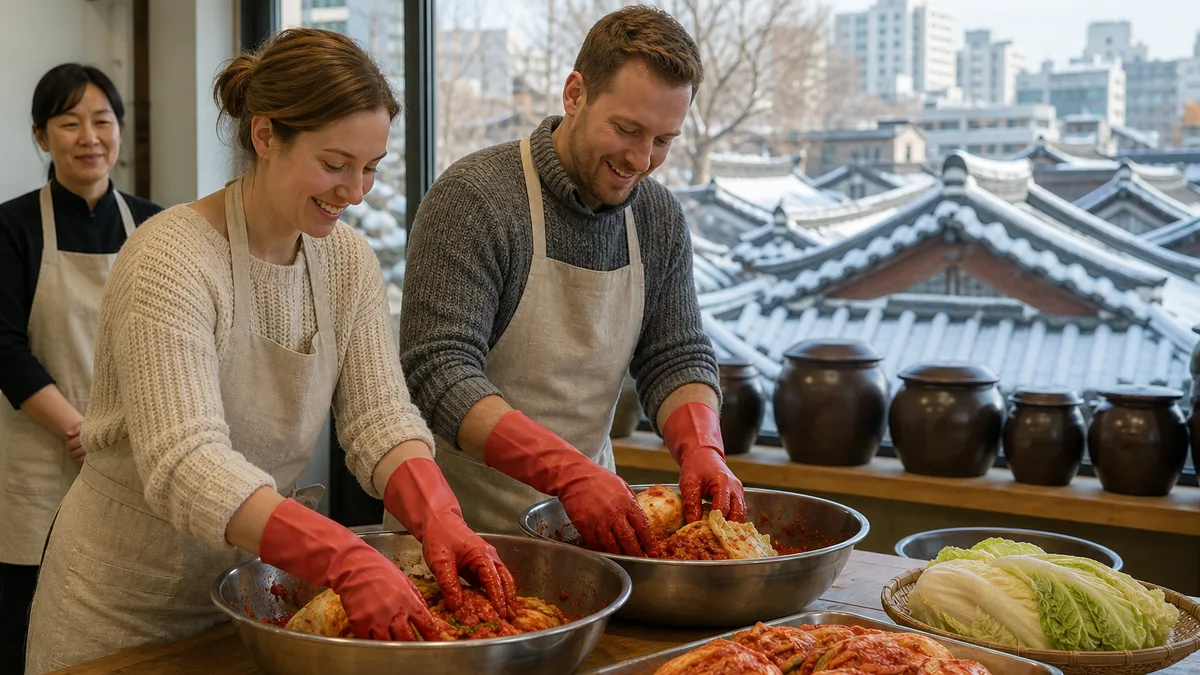
When November comes, people in Korea make a big batch of kimchi to eat through the winter, tossing salted napa cabbage with seasoning. If you head to Seoul's kimjang festival hoping to try this kimjang yourself, you may hit a wall. The 2025 Korea Kimjang Festival held in Seoul did not offer kimchi making for the general public because space at the venue was limited, and that notice only came out in Korean. The "kimjang space for foreigners" that still shows up in search results is from a 2019 event at Seoul Plaza.
If you want to make kimchi yourself, a class you book in advance gives you a better chance than the festival. Museum Kimchikan in Insadong, Seoul runs individual classes in English, but the Korean version of its booking page requires a Korean mobile number. You have to go through the English version to book without a number, using email verification, and you also need to check the 4-person minimum and the 3-day cancellation deadline against your travel plans.
The tricky part comes after you've made your kimchi. Incheon Airport treats kimchi under the liquids rules, so if a container holds more than 100ml, you can't take it on board. Korea Post EMS accepts kimchi to only 12 countries as of the 2025-11 notice, and neither the airport nor the post office tells you about quarantine in the country you're arriving in. EMS rates and steps for shipping things other than kimchi are in How to Ship Your Stuff Home from Korea. This guide covers everything from booking a kimjang class to getting your kimchi all the way home.
Note: Class prices and booking conditions are from Museum Kimchikan's official website (checked 2026-09-28), carry-on rules are from Incheon International Airport Corporation's guidance, and the countries that accept kimchi by EMS and the packing rules are from Korea Post's 2025-11-03 notice, all summarized as of 2026-09. Sources are collected at the end of this article. Programs, eligible countries, and quarantine rules change often, so check the official channels again before you book or ship.
You may not be able to make kimchi yourself at Seoul's kimjang festival
According to Seoul Metropolitan Government's announcement (revised 2025-11-18, by the Administration Bureau's External Cooperation Division), the 2025 Korea Kimjang Festival took place on 2025-11-22 (Sat) at the aT Center in Yangjae-dong, Seoul. The programs were a kimchi culture promotion hall, a kimchi sales hall, and a direct-sale market for kimjang ingredients, and the announcement stated: "Due to limited space at the venue, kimchi making for the general public will not be held." You could look at kimchi, buy it, and buy ingredients, but there was no place to make it yourself.
Wasted trips come from old information. The 2019 Seoul Kimjang Culture Festival was held from 2019-11-01 to 11-03 around Seoul Plaza and Mugyo-ro, and Seoul's announcement included "a kimjang space for foreigners where they can experience Korea's traditional kimjang culture." This 2019 announcement still shows up in search results, and some overseas blogs have copied it as is, so if you trust only those posts and go to Seoul Plaza, you may find no event at all.
As of 2026-10-02, the 2026 event has not been announced yet. The 2025 announcement page was revised on November 18, 2025, four days before the event, so this year's announcement may not come out until November either. We can't say for sure there will be no hands-on kimchi making this year, but it's too uncertain to hang the kimjang part of your trip on one festival.
When Seoul's announcement comes out, check whether it includes kimchi making before looking at the date and venue. If making kimjang with your own hands is the goal, book one of the reservation-based classes in the next section first, and treat the festival as a chance to look around and shop. Other November festival dates are in November 2026 Korea Festivals & Events Guide.
How to choose a kimchi class foreigners can book on their own
In central Seoul, Museum Kimchikan is a place where you can make kimchi in English. It's a kimchi museum run by Pulmuone (opened in 1986), on the 4th to 6th floors of the main building of Insadong Maru, 35-4 Insadong-gil, Jongno-gu, Seoul. It's about a 10-minute walk from Exit 3 of Jonggak Station (Line 1) or Exit 6 of Anguk Station (Line 3). The regular adult classes at this museum that individual foreign travelers can book directly, alone or in small numbers, are shown in the table below.
| Program | Length and language | Price (admission included) | Capacity | November to December content |
|---|---|---|---|---|
| Kimchi! Basic [Individual] | 60 min, English | Adults 40,000 KRW, youth 38,000 KRW, children 37,000 KRW | Minimum 4 to maximum 24 people | Making napa cabbage kimchi, tasting aged kimchi with tofu and kimchi pancake |
| Kimchi All-in-one [Individual] | 90 min, English | Adults 65,000 KRW, youth 63,000 KRW, children 62,000 KRW | Minimum 4 to maximum 12 people | Making cheese kimchi fried rice and napa cabbage kimchi |
The price is the class fee (Basic 35,000 KRW, All-in-one 60,000 KRW) plus admission (adults 5,000 KRW, youth 3,000 KRW, children 2,000 KRW). In Basic, the kimchi you make changes with the season: napa cabbage kimchi from March to May, kkakdugi (cubed radish kimchi) from June to October, and napa cabbage kimchi in November and December. The official guidance doesn't say what you make in January and February, so check the booking calendar. All-in-one is a class where you cook a Korean dish using kimchi and also make kimchi, and there are separate discounts for groups of 20 or more and for travel agencies. The curriculum may change depending on operations, and prices and conditions are based on the official website as of 2026-09-28.
Both programs are "open to both foreigners and Koreans," and they're taught in English (Korean is also possible when a group books a private session). The same museum's Children's Kimchi School is a Korean-language program for Koreans, and "It's Kimchi" (40 min) is only for groups of 16 to 24, so neither is a program for individual travelers. Basic and All-in-one also have separate group versions, so when you book, check that the name ends in [Individual] on the English screen, or [개인] on the Korean screen ([Group] or [단체] is for groups).
Some English-language travel sites still carry old information with prices, days, and program names that differ from the current ones. Use the museum's official website (kimchikan.com) as the reference for conditions. The free class for foreigners (DIY Kimchi 101), scheduled over two days on 2026-09-29 and 30 to mark the museum's 40th anniversary, was a one-off event that ended before this article was published, so you can't sign up for it.
If you only want to see the exhibits without a class, you can just walk in without booking. It's open Tuesday to Sunday, 10:00-18:00 (last entry 17:30), and closed every Monday, on January 1, during the Seollal (Lunar New Year) and Chuseok holidays, and on December 25.
There are also regional festivals where you make kimjang with salted cabbage, such as the Pyeongchang Highland Kimjang Festival in Pyeongchang, Gangwon. In 2026 it runs from 2026-11-04 (Wed) to 11-16 (Mon), and the cabbage kimjang experience is 69,000 KRW (7kg of salted cabbage and 3kg of seasoning). It's open 09:00-17:00, and you can sign up on site at the ticket booth without booking (until 16:00; the premium experience is booking only). Online booking opens on October 20 (the English text on the site says October 16). You need to create a member account, finish booking at least 5 days before the day you go, and the payer's name on the bank transfer has to match the name on the booking. The official website tells foreigners to book by phone at +82-33-336-4000 (033-336-4000 within Korea; phone booking 09:00-16:00 Korea time). All of this is from the official website (gimjang700.co.kr) as of 2026-10-02.
The festival grounds are at the Jinbu-myeon Residents' Sports Park (진부면민체육공원) in Jinbu-myeon, Pyeongchang. According to the official guide, take the KTX from Seoul Station or Cheongnyangni Station to Jinbu (Odaesan) Station, and from there it's 10 minutes by bus or taxi. You can send the finished kimchi by courier from the site (at your own cost), but we couldn't confirm whether they can send it to an overseas address.
If your trip includes November or December, start by looking for Basic [Individual] sessions for napa cabbage kimchi. Choose All-in-one only if you also want to cook a kimchi dish.
How to book a class without a Korean phone number
Museum Kimchikan's booking page has different input fields depending on the language version. On the Korean screen, the mobile phone number field is marked as required, and you have to pick the first digits from 010, 011, 016, 017, 018, or 019, so if you don't have a Korean number, you get stuck here.
The English screen is different. The "Mobile Phone" field isn't marked as required, and it comes with an international number input where you pick a country code. Based on the screen as of 2026-09-28, the number format is only checked when you enter one, so the form is set up to let you enter a foreign number or leave it blank.
On the English screen, book in this order.
- From the English program list at www.kimchikan.com/en/rsv/info, choose a program whose name ends in [Individual]. If you open the application page address (/en/rsv/apply) on its own, it sends you back to this list.
- On the booking calendar of the application page that opens, choose an open date.
- Leave the phone field blank, or choose a country code and enter your foreign number.
- Enter your email address and verify yourself with the 6-digit code sent to you by email.
- Fill in the remaining required fields, such as nationality, and complete the application.
- You pay on the day of the class, on site, by card or cash. You don't enter a card number when booking, so a foreign card won't block your booking. However, we couldn't confirm whether foreign cards are accepted on site, so bring some cash too.
| Item | Korean screen | English screen (/en) |
|---|---|---|
| Mobile phone number | Required, Korean prefixes such as 010 only | Not marked as required, international numbers accepted |
| Email and nationality | Required | Required |
| Identity verification | 6-digit code sent by email | 6-digit code sent by email |
| Payment | On site, by card or cash | On site (the screen says "Please pay the fee on-site") |
When booking, use an email address where you're sure to receive the verification code, and if you don't see the email, check your spam folder too. There's no official guidance on how the museum notifies you when a session doesn't open because the minimum number wasn't reached, so if you leave the phone field blank, email may be the only way they can reach you. For questions, you can call the main line at 02-2088-8531, email museum@pulmuone.com, or search for "Museum Kimchikan" (or '뮤지엄김치간' in Korean) on KakaoTalk and ask by chat.
Check open dates, the minimum number, and the cancellation deadline before you book
The program guidance lists Basic as "every Tuesday to Friday, morning 10:00-11:00 / afternoon 14:00-15:00," and All-in-one as the same days, morning 10:00-11:30 / afternoon 14:00-15:30. In practice, though, you can only book the dates and sessions the museum opens. On the booking calendar as of 2026-09-28, individual sessions were opened date by date, with only one session per date. Individual sessions in November and December numbered only a handful even with both programs combined, and some were on Saturdays. Each session is released at a different time, so more may open later.
So the order matters. If you fix your flights and accommodation first and try to squeeze the class in, there may be no date that fits, so check the open dates on the booking calendar first and plan the rest of your trip around them.
Next is the minimum number. The guidance states: "The minimum number for a booking is 4 people; if fewer than 4 people book, the class will not open (separate notice)." On the booking calendar as of 2026-09-28, sessions with only 3 people booked were still accepting bookings. It's safest to assume that bookings for one or two people are accepted, but the session may be canceled if the total for the session falls short of 4 people. We couldn't confirm how many days in advance or in what way they notify you of a cancellation, so ask the museum directly after you book.
The cancellation rules weigh especially heavily on travelers with a fixed return date.
- Cancellations and changes to the number of people must be made by 10:59 a.m. three days before your visit.
- After that, you have to pay for the number of people you booked.
- If you cancel after the deadline, you can't book for 6 months, regardless of the reason, such as illness, transport problems, or personal schedule.
If you schedule the class in the last few days before you leave Korea, you'll carry the kimchi around for a shorter time, but if the session is canceled, there may be no session left to move to. Look at one more backup date on the calendar, and check whether the class is going ahead before the 3-day deadline.
Also decide where you'll keep the kimchi when you book. You have to take the kimchi you make home the same day, and the museum gives you a container to take your kimchi home in, a bag for the kimchi container, a certificate of completion, and a recipe postcard. There's no separate container for taking home the kimchi dish you make in All-in-one. Most luggage storage services list perishable food as prohibited or excluded from compensation in their terms (see luggage storage and delivery in Korea), so leaving your kimchi container with them while you go around is hard. Check first whether your accommodation has a fridge.
Why kimchi in your carry-on gets thrown out at security screening
Incheon Airport's restricted items guidance allows liquids in the cabin on international flights only in containers of 100ml or less each, packed in one 1L resealable plastic bag (20.5cm×20.5cm or 15cm×25cm) per person (domestic flights have no limit). It also states that the same liquids rules apply to "foods that contain liquid or are in gel form, such as gochujang and kimchi." Kimchi is even named.
So whether it's vacuum-packed, a small amount, or drained of its liquid, the standard is the same. Regardless of how it's packed, what counts is whether a single container is over 100ml, and the call is made on the spot at security screening. If you walk up to security with the kimchi container from your class in your hand luggage, you may end up giving it up right there.
Some English-language travel posts and AI answers describe kimchi as a solid food based on US airport security standards. Security screening for flights departing from Incheon follows Incheon Airport's rules.
The amounts thrown away aren't small either. According to Incheon International Airport Corporation's figures, kimchi that passengers gave up at security screening in 2024 and that was then donated came to 10.7 tonnes for the year, and from January to June 2026, kimchi was again the top food item passengers gave up, at 5.1 tonnes (the figures don't break down by nationality).
| How you take it | Kimchi | Where to check |
|---|---|---|
| Carry-on | Only containers of 100ml or less each, within one 1L resealable bag | Incheon International Airport Customer Center (1577-2600) |
| Checked baggage | Allowed with no liquid volume limit; seal it so it won't leak | Your airline |
| Korea Post EMS | Only 12 countries as of the 2025-11 notice, packed in an aluminum can | Postal Customer Center 1588-1300 |
There is an exception: liquids bought at a duty-free shop can be carried on regardless of volume if they stay sealed in the dedicated duty-free liquids bag until you board the flight to your final destination. However, we couldn't confirm whether kimchi is sold in the duty-free area of the departure hall, and if you transfer at an overseas airport, you may have to give it up under that country's rules (using duty-free shops in Korea). Checking kimchi in with your checked baggage is the safer choice.
Put any kimchi container over 100ml inside your checked bag before you go to the check-in counter. If several people in your group are splitting the packing, also confirm whose bag the kimchi container ended up in before you check the bags.
How to pack kimchi so it won't leak in checked baggage
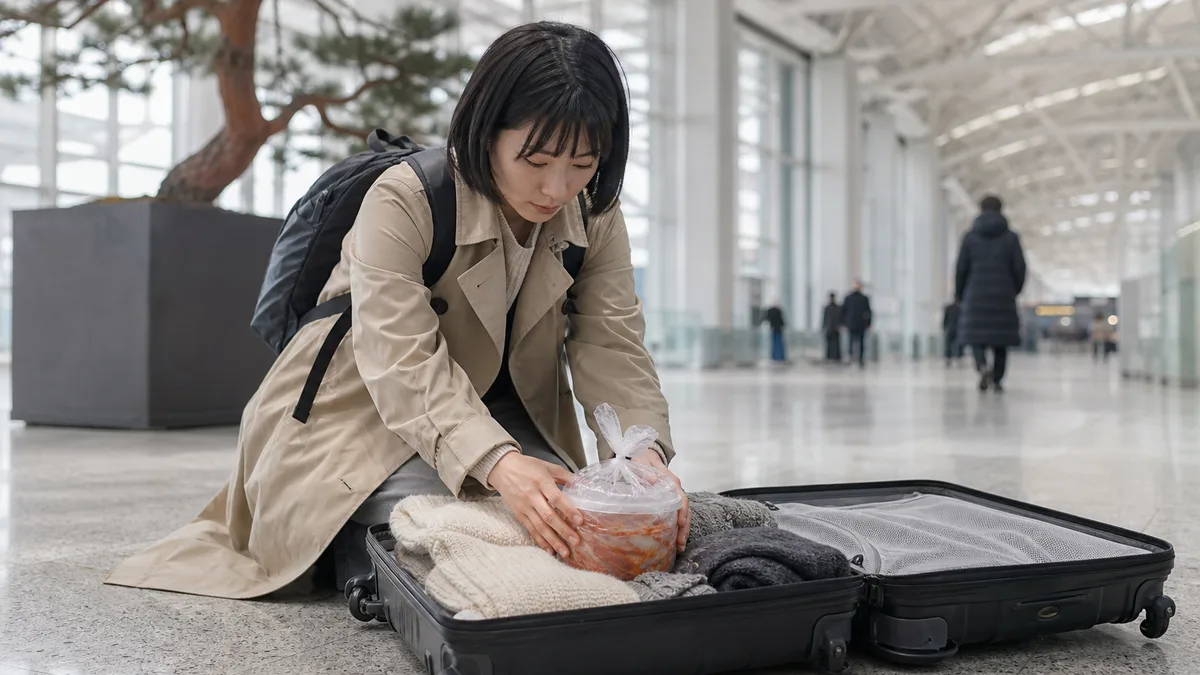
You can put kimchi in checked baggage with no liquid volume limit (per Incheon Airport's guidance). The problem is leaks. Korean Air Newsroom advises that "liquids such as kimchi must be sealed so they won't leak even if placed upside down." In other words, pack it on the assumption that the container may flip over in your bag.
For packing, it works well to take the method the post office requires for kimchi sent by EMS and adapt it to airline baggage. The 2 to 3 layers of plastic, the 70% fill limit, and the complete seal in steps 1 to 3 below come from the post office method (the post office requires an aluminum can instead of a container), and steps 4 and 5 are added to suit airline baggage. It isn't a procedure set by the airlines, but it's a useful standard for packing kimchi so it won't leak.
- Wrap the kimchi in 2 to 3 layers of kimjang bags (the thick, large plastic bags used for making kimjang).
- Put it in a container with a tight-fitting lid, filling it no more than 70% to leave some room.
- Close the lid and seal it completely so there are no gaps.
- Put the container in another plastic bag and tie the opening shut.
- Stand it upright between clothes in your bag so it doesn't move around.
The official guidance doesn't say how many liters the kimchi container from the museum's Basic class holds or whether it's airtight. If you plan to take it on a flight, check the container's size and lid on the day of the class, and if it looks like it might leak or you're not sure the lid closes tightly, bring a separate airtight container and transfer the kimchi into it.
If your bag is soaked with kimchi juice when you arrive, take photos and tell the airline. If you spot it right at the baggage claim carousel, it's quicker to tell a nearby airline staff member on the spot. A Korean Air article says to report damage within 7 days of the day you received your baggage, but since it's an article from 2019-11-11, check the actual deadline again against your airline's current guidance. We couldn't confirm whether damage caused by food the passenger packed leaking is covered. Tilting your bag once before check-in to see whether anything leaks can help you avoid this.
How to declare kimchi to customs and quarantine in the country you arrive in
The Korean-side guidance from the airport and the post office only covers the rules for leaving Korea. Whether you can bring kimchi into the country you arrive in is decided by that country's customs and quarantine authorities. If you're taking kimchi, the basic step is to declare that you have food when you enter.
The US asks you to declare a wide range of items. U.S. Customs and Border Protection (CBP) requires every traveler entering the US to declare meat, fruit, vegetables, plants, seeds, soil, and animals, as well as plant and animal products (including soups), and this applies to both checked baggage and carry-on bags. Undeclared prohibited items are seized and destroyed, and undeclared prohibited agricultural items in non-commercial quantities can bring a civil penalty of up to $1,000 for a first violation. The same penalty applies to prohibited agricultural items sent by international mail. CBP's guidance doesn't address kimchi specifically. If you bring it, declare that you have food when you enter and tell the inspector it's kimchi. Whether it can come in is up to the inspector.
For Japan, be careful with processed products that contain meat. The Animal Quarantine Service of Japan's Ministry of Agriculture, Forestry and Fisheries treats meat and organs from cloven-hoofed animals such as cattle and pigs, and from poultry, as subject to animal quarantine in any form, whether raw, chilled or frozen, or processed by heating, and also includes processed products made from them. Items that are clearly shown, considering the manufacturing process and other factors, to pose no risk of spreading pathogens are treated as outside the scope.
Bringing items in illegally is punishable by a criminal fine of up to 3 million yen or imprisonment of up to 3 years. This guidance has no sentence about kimchi, but it's the reason that for kimchi made with pork or meat broth, you need to check the ingredients first. We couldn't confirm the plant quarantine standards for the vegetables or the rules for seafood ingredients such as jeotgal (salted fermented seafood).
For other countries (Australia, Taiwan, New Zealand, the Philippines, Malaysia, China, Thailand, Vietnam, and others), we couldn't confirm the conditions for bringing in kimchi from primary sources this time. Don't guess whether it's allowed or not; check the official page of that country's customs and quarantine authorities, and if in doubt, declare it.
One advantage of kimchi you make yourself is that you can find out what went into it. During the class, ask the instructor whether ingredients such as jeotgal or broth were used and write it down, and it'll be easier to explain when you declare it on arrival. Korean phrases for asking at a restaurant whether kimchi contains jeotgal are in our vegetarian, halal, and food allergy ordering guide.
How to send kimchi by Korea Post EMS and which countries you can send to
You'll still hear people say "you can't send kimchi by EMS." Korea Post stopped accepting kimchi entirely in 2020-11, then reopened step by step, starting with parts of Japan in 2022-11, but the "acceptance suspended" notices issued in between and the Internet Post Office's old "Items you can't send" page (which lists "food (especially kimchi)") still show up in search results. As of our check on 2026-09-28, the most recent kimchi notice is Korea Post's 2025-11-03 notice.
| Region | Countries accepting kimchi by EMS (2025-11-03 notice) |
|---|---|
| North America | United States (excluding Alaska and Hawaii), Canada |
| Oceania | Australia, New Zealand |
| East Asia | Japan (excluding Okinawa), China, Hong Kong, Taiwan |
| Southeast Asia | Thailand, Singapore, Malaysia, Philippines |
New Zealand, Malaysia, and the Philippines were newly added with this notice, and the other 9 countries were already eligible. The notice says acceptance will "continue unless otherwise announced." However, the list of eligible countries changed several times between 2023 and 2025, and a new notice came out every kimjang season. The kimjang-season notice came out on October 23 in 2024 and on November 3 in 2025, so the 2026 notice may come out in late October or early November, after this article is published. Before you ship, check the notice board at ems.epost.go.kr again for the latest notice with "kimchi" (김치) in the title.
You also need to pack it as the notice says, or the counter won't accept it.
- Wrap it in 2 to 3 layers of kimjang bags.
- Put it in an aluminum can, filling it no more than 70%.
- Seal the lid completely.
- Put the can in a box and repack it.
- Adding an ice pack or oxygen absorber inside the can is recommended.
When you drop it off, the staff will attach a separate EMS sticker. Since the 2024-10 notice, containers have been limited to metal cans, so the plastic containers and styrofoam packaging you see on old blogs aren't accepted. Neither the notices nor news reports say whether post office counters sell aluminum cans, so ask the Postal Customer Center in advance.
If you're sending from outside the Seoul metropolitan area (Seoul, Incheon, Gyeonggi), drop it off Monday to Thursday, as the notice recommends. According to news reports, items dropped off on Friday may be delayed because of limited air transport over the weekend. Weekly Kyunghyang (2025-11-12), reporting Korea Post's announcement, gave EMS transit times for mail that doesn't need to go through customs inspection as 2 to 3 days to nearby countries such as Hong Kong and Singapore and 3 to 5 days to other countries. Rates vary by weight and country, so check with the Internet Post Office rate calculator (for US-bound duties, see the US section below).
Even if the Korean post office accepts it, you won't be compensated if it's held and destroyed by customs in the destination country. The notice states: "Customers must check the customs requirements of the destination country before sending, and compensation is not available for spoilage or disposal of food due to customs holds, delivery delays, etc." A supplementary notice on 2024-10-25 added: "In particular, China, Vietnam, and others have stricter customs rules, so extra caution is needed."
It's also unclear whether kimchi you made yourself needs paperwork. The Internet Post Office's new "Items you can send" page lists homemade food separately as "food product manufacturing report (a report food manufacturers submit to the authorities for each product) needs to be checked" and kimchi as "kimchi accepted only for eligible countries," while the 2025-11 kimchi notice doesn't require any documents. The countries and packing rules for sending kimchi are in the Korean-language notices, and the body of the guidance-materials page for foreigners doesn't mention kimchi (we couldn't check the downloadable guide files), so call the Postal Customer Center at 1588-1300 (caller pays, weekdays 09:00-18:00, closed Saturdays and public holidays) before you go to the counter.
Extra steps when sending to the US
When EMS to the US resumed accepting items on 2025-10-22, it switched to duties prepaid (DDP). The sender pays duties and fees at drop-off, and if the declared value is within the amount covered by sender prepayment (see below), the recipient has nothing more to pay. The resumption notice says "food such as kimchi can also be sent," and the counter will have you sign a prior consent form. If you leave out or falsify the contents information, the item will be returned or destroyed with no compensation, so write accurately that it's kimchi. From 2025-12-08, you can also pay with a physical credit card (mobile payment services such as "pay" apps aren't accepted).
The duty rules changed again for items arriving in the US from 2026-07-24: the range for which the sender prepays duties widened from $800 or less to $2,500 or less. Duty rates also changed from 13:00 (Korea time) the same day. According to Korea Post's 2026-07-24 notice, a rate of at least 12.5% is charged under the US Section 301 tariffs, and if the tariff rate for an item category is higher than 12.5%, that rate applies. What percentage applies to kimchi depends on how it's classified, and we couldn't confirm it, so check at the counter or by calling 1588-1300.
For gifts between individuals with a total item value of $100 or less, the same notice says duties are waived "as before." Even then, you pay a declaration fee of $1.04 (VAT not included). However, this exemption applies very narrowly. The 2025-10-22 notice says items are not recognized as gifts if the contents are new products (in a packaging box, plastic wrapping, with tags attached, etc.), if the sender's name or the box shows a company name, if one person sends the same item to multiple people, or if the items are freebies or samples received with a purchase. So don't count on the gift exemption for new packaged kimchi bought at a store, even at $100 or less. Even for kimchi you made yourself, US customs decides whether it counts as a gift, and if it isn't recognized and is returned or destroyed, you can't get compensation.
You also need to think about US Food and Drug Administration (FDA) Prior Notice. According to Internet Post Office guidance, sending food to the US requires FDA Prior Notice, and mail sent without it may be returned or destroyed. However, it says "food made at home for non-commercial purposes" (for example, homemade side dishes) is exempt from Prior Notice, and that for non-commercial food sent from one individual to another, filing is the rule, but enforcement is relaxed even without a filing. We couldn't confirm whether kimchi made in a class counts as home-made food. If you do file, complete it on the FDA site (access.fda.gov) before you drop the item off, and write the confirmation number you receive on the address label (the postal waybill where you write the sender's and recipient's addresses).
When you need to take kimchi to a country not on the EMS list
The 12 countries in the 2025-11 notice don't include Uzbekistan, Mongolia, Nepal, Indonesia, Cambodia, or Myanmar, countries with many people working or studying in Korea. Alaska and Hawaii in the US and Okinawa in Japan are also excluded.
Vietnam is easy to get confused about. It was listed as an eligible country for kimchi in the 2024-10 notice and supplementary notice, but the 2025-11-03 notice listed 9 countries as "existing" without Vietnam. Searching the notice list for "Vietnam" turns up no notice removing it from kimchi shipping either, so we couldn't confirm whether it's possible now. If you're thinking of sending kimchi to Vietnam, call 1588-1300 first before going to the counter.
The way that won't get you stopped on departure from Korea is checked baggage. Under Incheon Airport's rules, checked baggage has no liquid volume limit (weight follows your airline's baggage rules). However, we couldn't confirm whether you can bring kimchi into that country, so before you leave, check the official page of that country's customs and quarantine authorities, pack and check it in following the steps above, and declare it when you arrive.
It's also unclear whether packaged kimchi bought at a store can be sent by EMS to a country not on the list. The new items page lists finished products sold in stores as "allowed" and kimchi separately as "only for eligible countries," while the old items page lists labeled finished food products as allowed, so the guidance conflicts. Call 1588-1300 first before you go to the counter.
If you're wrapping up your life in Korea and heading home, there's a lot more to take care of besides kimchi. What to settle first is in our Final 30-Day Settlement Checklist Before Leaving Korea.
Where to ask at each step where you might get stuck
Rather than acting on guesswork, check with the contacts below first.
| Where you might get stuck | Who to ask | How to reach them | Good to know |
|---|---|---|---|
| Class dates, cancellations, containers | Museum Kimchikan | 02-2088-8531, museum@pulmuone.com, KakaoTalk "Museum Kimchikan" ('뮤지엄김치간') | Runs English classes; you can also ask by email |
| Carry-on rules | Incheon International Airport Customer Center | 1577-2600 (07:00-22:00, open all year) | We couldn't confirm whether they answer in foreign languages |
| EMS countries, packing, documents, US duties | Postal Customer Center | 1588-1300 (weekdays 09:00-18:00) | Caller pays, closed Saturdays and public holidays; we couldn't confirm whether they answer in foreign languages |
| Whether you can bring it in | Customs and quarantine authorities of the country you arrive in | Each authority's official website | Varies by country |
Want to handle everything from your first ride after landing in one app? Check out LACHA.
Built to work without a Korean phone number or bank account, with overseas payment methods like Alipay, WeChat Pay, and Apple Pay. Taxi hailing plus KTX, express bus, and airport railroad (AREX) booking — all in one app.
Up to 60% off Korea transit with a coupon (max ₩3,000): enter code at sign-up. KTX gets up to 18% off on top
Download now


Frequently Asked Questions (FAQ)
Q1. Can I take kimchi in my carry-on if it's vacuum-packed or drained of its liquid? A. Packaging alone doesn't change anything. Incheon Airport treats "foods that contain liquid or are in gel form, such as gochujang and kimchi" exactly the same as liquids. The standard is 100ml or less per container, in one 1L resealable bag per person, and the call is made on the spot at security screening. Put any container over 100ml in your checked baggage before check-in.
Q2. If I go to the Korea Kimjang Festival in Seoul in November, can I make kimchi myself? A. The 2025 event (2025-11-22, aT Center) did not offer kimchi making for the general public because of limited space. As of 2026-10-02, the 2026 event hasn't been announced, so when Seoul's announcement comes out, check first whether hands-on kimchi making is included. If making kimchi yourself is the goal, you're better off booking a reservation-based class such as Museum Kimchikan's first. However, a session may not open if it has fewer than 4 people.
Q3. Can I book a kimchi class without a Korean phone number? A. Book through Museum Kimchikan's English screen (choose a program at www.kimchikan.com/en/rsv/info). Based on the screen as of 2026-09-28, the phone field isn't marked as required and you can enter an international number, and identity verification is done with a 6-digit code sent by email. The Korean screen requires a Korean number such as 010. You pay on the day, on site, by card or cash, but we couldn't confirm whether foreign cards are accepted, so bring some cash too.
Q4. Can I send kimchi by EMS to family in Vietnam or Uzbekistan? A. Uzbekistan is not among the 12 countries in the 2025-11-03 notice. Vietnam was in the 2024-10 notice but isn't on the 2025-11 notice list, and we couldn't find a notice removing it either, so we couldn't confirm whether it's possible now. Before shipping, ask the Postal Customer Center at 1588-1300, and if it's not possible, first check on the official page of the destination country's authorities whether that country allows kimchi to be brought in, then take it in your checked baggage and declare it when you enter.
Q5. Can I bring kimchi into the US? A. It's hard to say in advance whether it's allowed or not. CBP asks you to declare all agricultural items, such as meat, vegetables, plants, and animal products, and doesn't address kimchi specifically. Undeclared prohibited agricultural items in non-commercial quantities can bring a civil penalty of up to $1,000 for a first violation, and the same penalty applies to international mail, so if you bring it, be sure to declare that you have food. Whether it can come in is up to the inspector.
Note: This article is intended to provide general information. Festival information comes from the Seoul Metropolitan Government news portal's announcement for the 2025 Korea Kimjang Festival (revised 2025-11-18) and its announcement for the 2019 Seoul Kimjang Culture Festival (2019-10-24), and class prices, booking conditions, and visitor information were checked on Museum Kimchikan's official website, including its program guide, booking page, and booking calendar (checked 2026-09-28). Carry-on rules are based on Incheon International Airport Corporation's restricted items guidance, the volume of items passengers gave up is based on Incheon International Airport Corporation's figures as reported by Asia Economy (2025-02-03 and 2026-07-30), YTN (2025-02-04), and Hankook Ilbo (2026-07-29), and packing for checked baggage relies on Korean Air Newsroom (2019-11-11). The countries accepting kimchi by EMS, the packing rules, and their history are based on the Internet Post Office EMS notices (the 2025-11-03 expansion of countries for kimchi, the 2024-10-23 and 2024-10-25 notices, and the 2020 to 2024 notices on suspending and resuming acceptance) and its guide to items you can send; EMS transit times are from Weekly Kyunghyang (2025-11-12); US-bound procedures are from the same site's notices on international mail to the US (2025-10-22, 2025-12-08, 2026-07-20, and 2026-07-24) and its guide to prior notice for food sent to the US; and destination country rules were checked against U.S. Customs and Border Protection (CBP) guidance on bringing in agricultural items and the guidance of the Animal Quarantine Service of Japan's Ministry of Agriculture, Forestry and Fisheries. The Pyeongchang Highland Kimjang Festival information was checked against the 2026 guidance on its official website (gimjang700.co.kr), covering dates, prices, booking conditions, and directions. The Pyeongchang festival and whether the 2026 Korea Kimjang Festival has been announced are as of 2026-10-02, and everything else is as of 2026-09. We couldn't confirm the following, so we didn't state them as fact: the 2026 dates for the Korea Kimjang Festival, the online booking start date for the Pyeongchang Highland Kimjang Festival (October 20 in the Korean guidance, October 16 in the English guidance) and whether its on-site courier service can ship overseas, how Museum Kimchikan notifies class cancellations and the size of its class containers, whether foreign cards are accepted on site, whether EMS kimchi to Vietnam is possible, whether packaged kimchi bought in a store can be sent by EMS to countries not on the list, where to buy aluminum cans, the paperwork requirements for homemade kimchi, whether the downloadable multilingual guide files for foreigners mention kimchi, the item-specific duty rate on kimchi sent to the US, whether kimchi made in a class qualifies for the FDA Prior Notice exemption, whether kimchi is sold in the duty-free area of the departure hall, whether baggage damage caused by leaking food is compensated, whether phone support is available in foreign languages, and the conditions for bringing kimchi into countries other than the US and Japan. Whether you can bring kimchi into the country you arrive in is decided by that country's customs and quarantine authorities, and this article only covers the duty to declare and where to check. Programs, prices, eligible countries, and quarantine rules may change, so check each organization's official channels again before you book or ship. LACHA does not offer kimchi class booking, packing, shipping, or customs clearance services.