Hotel checkout is at 11am, your flight is at 9pm. Nothing ruins a trip quite like dragging a 24-inch suitcase through Myeongdong alleyways and subway stairs for those eight hours in between. Same goes for arriving in the morning and wandering around with your luggage until check-in time (usually 3pm).
The good news is Korea has pretty solid infrastructure for "leaving your luggage behind." From quick storage at your accommodation's front desk to unmanned subway station lockers, staffed storage at Seoul Station and airports, same-day delivery services that send your bags straight from the airport to your hotel, and luggage storage apps that connect you with nearby shops—there are plenty of options. The problem is they're scattered everywhere, so it's hard to know what to use when. This guide sorts it all out by situation.
Rates and operating hours below are based on publicly available information as of 2026-08. Luggage storage and delivery rates change frequently, so always double-check the latest rates on each service's official site or app before you go.
At a Glance
| Method | Rate Range | Foreign Card | Booking/App | Best For |
|---|---|---|---|---|
| Hotel/hostel front desk | Usually free | No payment involved | Not needed (just ask) | Checkout day / waiting for early check-in |
| Subway station lockers (T-Locker) | 2,200~4,400 KRW for 4hrs weekday (by size) | △ Some card networks rejected | New models require app | Short-term storage, just a few hours |
| Staffed station storage (T-Luggage) | 3,000~6,000 KRW for 4hrs~ (by size) | Check on-site (cash also accepted) | Not needed (reservation available) | Oversized bags that won't fit in lockers |
| Incheon Airport baggage storage | ~5,000~12,000 KRW per day (by size) | Check on-site | Not needed | Layovers / day trips to Seoul |
| Airport↔hotel luggage delivery | ~30,000 KRW per bag standard route (15,000~45,000 KRW range by size/route) | ○ When booking via travel platforms | Online booking required | Hands-free arrival day / departure day |
| Luggage storage apps (Bounce, Radical) | Flat daily rate, varies by provider | ○ Designed for foreign payment | App/web booking | When lockers are full or you're in the middle of tourist areas |
Rates vary by size, weekday/weekend, and peak season. The table shows the most common range; 28-inch and larger bags go up one tier. △ in the foreign card column means "works for some, rejected for others," so have a backup ready.
The first place to ask is your accommodation's front desk. Many hotels and guesthouses will hold your luggage even after checkout, usually for free. Before hunting for paid storage, just ask "Can I leave my luggage until 8pm?" Note that unmanned check-in accommodations and Airbnbs may not have anyone to receive bags, so if that doesn't work, move to the options below.
Broken down by situation:
- Morning arrival / before check-in: Ask your accommodation first → if not, use airport→hotel luggage delivery
- After checkout / late flight: If before 11am, T-Luggage airport delivery; if later, station lockers or luggage storage apps
- City-to-city travel day: Store at departure station, pick up at arrival station (operators and payment methods vary by station)
Two key criteria: a few hours → storage, start-to-end of the day → delivery. And lockers have limited space, so during peak season have a backup plan (reservations via app, staffed storage, or luggage apps).
How much luggage is "a lot"? Incheon International Airport Corporation uses 20kg+ per person as the guideline for call-van (cargo van) services. This isn't so much a service condition as a legal requirement for cargo vehicles to carry passengers (Trucking Transport Business Act Enforcement Rule Article 3-2), but flip it around: once you cross 20kg per person, regular taxis start to struggle. Beyond that line, storing or shipping luggage often ends up cheaper than calling a bigger car.
Subway Station Lockers — How to Use T-Locker
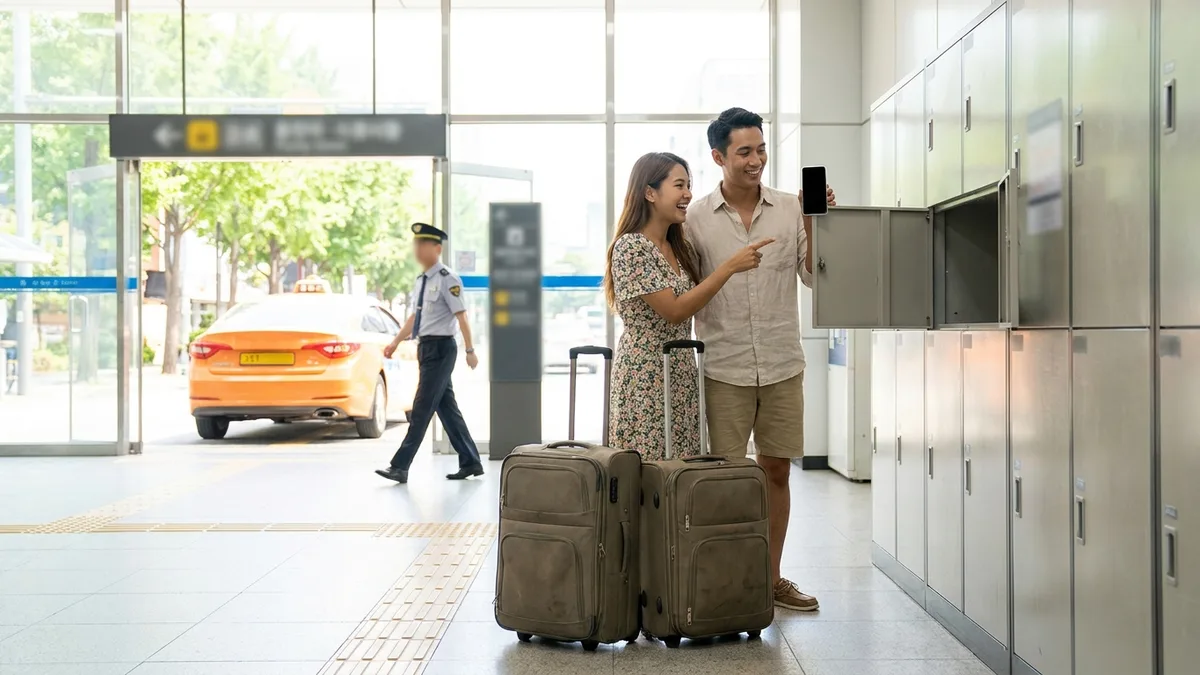
The unmanned lockers scattered throughout Seoul's subway are called T-Locker. Operated by Seoul Metro, they're installed in about 270 stations across Seoul's subway system according to official info. You'll find them at nearly all major tourist stations like Myeongdong, Hongik University, and Gangnam.
- What you need: Recently installed lockers only open via the T-Locker app. You can download the app from the App Store or Google Play even without a Korean account. According to official info, you can reserve and pay directly without separate membership registration, but some steps may require Korean mobile phone verification depending on the app version (check official sources). Older lockers with physical locks can take card payment on-site without the app, so if the app blocks you, check if the locker screen has a card slot. If that doesn't work either, skip this method and go straight to staffed storage (T-Luggage) or luggage storage apps to save time.
- Rates (calculate total cost): Small, medium, and large compartments with a 4-hour base rate + hourly overage. Weekday base rates are small 2,200 KRW, medium 3,300 KRW, large 4,400 KRW; overage is small 500 KRW/hr, medium 800 KRW/hr, large 1,000 KRW/hr (weekends/holidays cost more). So a medium locker for 8 hours = 3,300 KRW + 800 KRW×4 = about 6,500 KRW. Use this total when comparing to 30,000 KRW-range delivery. Note that 28-inch+ large suitcases may not fit even in large compartments.
- Payment methods (most common sticking point): App-based reservation and prepayment. Official payment methods listed are credit card and simple payment services. Whether foreign-issued cards, Alipay, or WeChat Pay work depends on the device and card network (check official sources). On-site machines are cashless so you can't substitute coins; have staffed storage or storage apps as backup if your card is rejected.
- How to use (app-based): Select station and locker size in app → prepay base rate → enter the one-time OTP code into the locker lock within the time limit → put in your luggage. To retrieve: "Retrieve item" in app → pay overage → enter new OTP. Screenshot the OTP and payment screens. If the app logs out or your battery dies, you may not be able to see the code again.
- Space competition: Large compartments are scarce and often sold out by morning at tourist stations. The app lets you check and reserve available lockers, so check before you move; if you're on the train, reserve at your arrival station from the train.
Similar unmanned lockers exist in other cities' subways like Busan and Daegu (operators and apps vary by region).
Station Luggage Storage
Stations with heavy luggage traffic like Seoul Station have staffed, large-item storage services beyond unmanned lockers. A major one is T-Luggage operated by Seoul Metro. It handles both storage where you drop off suitcases and delivery services to accommodations or airports. The website has a separate English (ENG) screen, and staff handle check-in, so you don't need Korean—just tell them size and pickup time.
Seoul Station T-Luggage — Here's What to Do
- Location & hours: The Seoul Station location is in the corridor from Exit 1 toward Exit 2. Operating hours are 09:00~22:00 (as of 2026-08). Walk-ins are fine, or you can book ahead via the website (tluggage.co.kr) or call center ☎02-6110-2977.
- What you need to check in: You'll write basic info on a receipt. If you don't have the receipt when picking up, they may ask for ID verification like a passport, so bring your passport.
- Rates: Calculated in 4-hour blocks; weekday base is small (under 20 inches) 3,000 KRW~, large (23~27 inches) 6,000 KRW~; overage is about 1,000 KRW/hr according to official info (may vary by size). A large suitcase for 8 hours = 6,000 KRW + 1,000 KRW×4 = about 10,000 KRW.
- Payment: They accept both cash and card according to official info. But whether foreign-issued cards work needs on-site confirmation, so if you were rejected at a locker with the same card, you might face the same issue here. Have cash or another card ready.
- Advantage: Virtually no size limit, and staff handle it so you won't get stuck with OTP or machine issues. The most straightforward choice when you want to free up your hands before or after taking KTX.
KTX Stations Outside Seoul — Busan, Dongdaegu, Daejeon
Most KTX stations have unmanned lockers, but operators and payment methods vary by station.
- Busan Station: Besides unmanned lockers, there's a Zimcarry counter where you can handle both staffed storage and station→accommodation luggage delivery in one go. The walking distance from the platform to the lockers is also short, making it great for dropping off luggage right after arrival and starting your itinerary.
- Dongdaegu Station, Daejeon Station, Gwangju Songjeong Station, etc.: Mostly unmanned lockers. Foreign card payment may not work depending on the machine, so if it's rejected, ask at the station office or information center.
- Oversized luggage: If your bag won't fit in a locker, first check if that station has staffed storage; if not, look for partner shops near the station on the luggage storage apps below.
Incheon Airport Baggage Storage — For Layovers & Day Trips
Incheon Airport has staffed baggage storage counters operated by companies like Hanjin Express in each terminal. Once you've collected your luggage, go up to the 3rd floor (departure level) and find the counter. In T1, it's near Counters B and N; in T2, near Counter H. Some counters are listed as 24-hour operation (check official sources). T2 also has a counter on the 1st floor west side (near Gate 1), which is closer if you're on the arrivals level.
- What you need to check in: You write your name and contact info on a receipt and hand over your bags, so you don't need separate documents, but bring your passport for ID verification when picking up. Walk-ins are fine; during peak season, online reservations can reduce wait time. Ask at the counter first whether foreign-issued cards are accepted (check official sources).
- Size & duration conditions: Rates are calculated per day by bag size. Oversized items exceeding 180cm total dimensions or 30kg can reach the 20,000 KRW range, and each day beyond 24 hours adds another daily charge. Long-term storage of dozens of days requires prior inquiry. (Incheon Airport airport.kr)
- Operating hours: Vary by terminal and counter (T1 roughly 07:00~22:00 range, T2 listed as longer hours). If you have a late flight, make sure pickup time falls within operating hours.
- The same counters also handle domestic courier shipping and packing services, so you can ship luggage from the airport to city accommodations or other cities.
Here's the fork in the road: Coming back to the airport? → Airport storage (luggage needs to be at the airport). Not coming back to the airport, going straight to city accommodation? → Airport↔hotel delivery below. If your layover is under 5 hours, factor in round-trip to storage and re-entry procedures. Depending on terminal and counter location, the round trip alone can take 30+ minutes.
Airport↔Hotel Luggage Delivery
Same-day luggage delivery services that send your bags straight to your hotel on arrival day have taken off in recent years. Major providers are SAFEX, Zimcarry, Goodlugg, and you can book ahead on travel platforms like Klook and KKday.
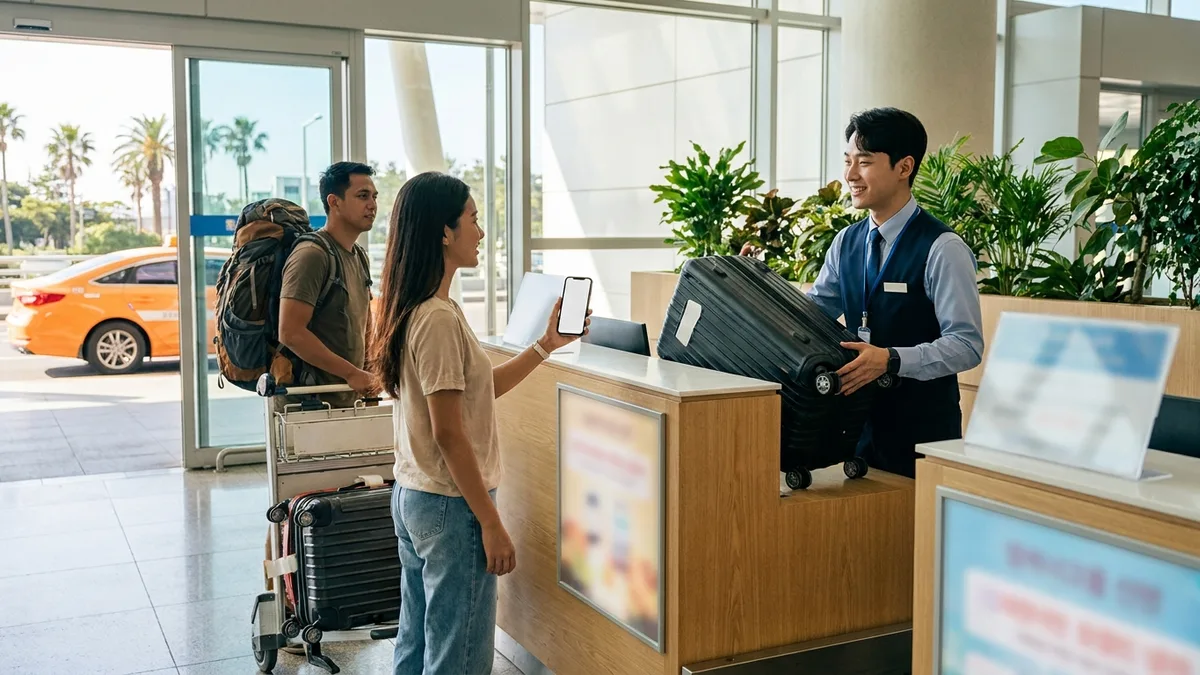
- Flow: Online booking → drop off bags at designated airport arrivals counter → pick up at hotel front desk in the evening. SAFEX, for example, lists 07:00~15:00 check-in at Incheon/Gimpo airports, with hotel pickup after 19:00 the same day.
- Pre-booking check ① Accommodation type: Most hotels with 24-hour front desks will receive bags on your behalf. However, Airbnbs and unmanned check-in accommodations may have no one to receive deliveries. Ask the host if luggage receipt is possible before booking; if not, switch to airport storage or luggage storage apps.
- Pre-booking check ② Required info: The booking form will ask for accommodation name, Korean address, reservation name (same spelling as hotel booking), and contact info. Have this ready in advance for a quick process. If you don't have a Korean number, check whether they accept alternative contact methods like email, KakaoTalk, or WhatsApp during booking.
- Rates & limits: Vary by luggage size, route, and provider. The booking screen shows the final price and pickup time—use that as your reference. Some providers also set per-bag size and weight limits.
- Reverse direction (hotel→airport) also works. Send your bags on departure morning, spend your last day hands-free, then pick up at the airport counter.
- City-to-city delivery: Some providers offer same-day or next-day delivery between cities like Seoul↔Busan.
- Subway station→airport delivery: T-Luggage's airport delivery lets you check in bags at locations like Seoul Station, Hongik University, Myeongdong, Jamsil, Gimpo Airport Station, etc. by morning (roughly before 11am) and pick up at Incheon Airport's Hanjin Express counter (after 4pm) the same day. Locations change periodically, so check the latest list at tluggage.co.kr.
One thing to watch: Check-in deadline is everything. It varies by provider—SAFEX lists 3pm for airport check-in, T-Luggage airport delivery lists 11am. If your flight arrives after the deadline, use storage instead of delivery.
If you need to get from the airport to the city with luggage in tow, it starts with choosing the right vehicle. What to call based on group size and luggage is covered in How to Call Large Taxis & Vans at Incheon Airport, and how to spot unofficial touting vehicles when you have lots of luggage is in Incheon Airport Call-Van Official vs. Touts.
Luggage Storage Apps & Platforms — When Lockers Are Full
When lockers are full or there's no station nearby, shop-sharing luggage storage apps are the alternative. These global platforms are built with English interfaces and foreign card payment in mind, making them the last resort for travelers who got blocked by Korean app sign-ups and payment.
- Bounce: A global luggage storage network with many partner locations in Seoul. Full English support on app/web and designed for foreign-issued card payment.
- Radical Storage: Operates partner shops near Seoul Station and Myeongdong. Also English and foreign card ready.
- Usage flow (common): Search location on app/web → select storage hours and prepay → hand bags to shop staff → show booking screen/code when picking up. Even first-timers finish in 5 minutes. Screenshot the booking screen.
- Rates: Typically flat daily rates, varying by provider and city. Settle on a pickup time before booking for better value.
- Note: Shop business hours = when you can drop off and pick up. If you're picking up late at night, always check that shop's closing time before booking.
LugStay, a Korean service widely used for a while, is no longer operating as of 2026-08 based on its official site. Don't waste a trip based on old reviews.
If your luggage is parcel-sized rather than suitcase-sized, convenience store courier (half-price courier, etc.) can be much cheaper. You check in at one convenience store and pick up at another, so rates are low but delivery takes a few days. Details are in the Convenience Store Guide.
When You Can't Find Your Luggage
The scariest travel moment is when you can't find your bags. If you have the contact info, most issues get solved on the spot.
- Locker won't open: The operator's customer service number is posted on the locker or machine screen. Call that first; if you can't get through, go to the nearest station office. Subway station staff can connect you directly with the locker operator.
- Didn't receive OTP or input time expired: You can reissue the code from the app's usage history. If the app won't open, take your payment records (card approval text, app receipt) and contact customer service.
- Shop I left bags at closed early: Call the shop phone number on the booking screen first; if no answer, file a report via app customer service chat or email. Global platforms have English support.
- Bags didn't arrive at hotel by evening: Inquire using the confirmation email's provider contact and booking number. Ask the hotel front desk first—they often already have it in storage.
- Don't know who to ask: Call Korea Travel Hotline ☎1330 (24hrs, multilingual) and they'll interpret the situation and tell you who to contact.
Common prep item: screenshot booking screens, receipts, and OTP codes as you go. One screenshot solves most issues.
Luggage Tips When Taking KTX
KTX doesn't have airline-style checked baggage where the train carries passengers' luggage separately. All luggage travels with you, so knowing where to put it in advance makes things much easier. There are delivery services like KTX Express that ship luggage station-to-station separately, which can be an option if you have a lot (check handling stations, rates, and deadlines on Korail's official site and operator websites).
- Overhead rack: Up to 20~22-inch suitcases fit comfortably. 24-inch and up gets tight or won't fit.
- Between-car luggage space: Large suitcases go in the luggage storage area at the back of each car or between cars. Space size varies by car, so after booking on Korail+ (formerly Korail Talk), check the "luggage storage" location on the train facility map.
- Seat selection tip: Pick front or back seats in the car closest to luggage space so you can keep an eye on your bags.
- If you have standing/free seating: No seat means put your suitcase in the between-car storage area and stand nearby. Suitcases in the aisle block cart and passenger movement.
Transit & Payment Connection Tips
Even after you decide where to store luggage, the real sticking point comes next. If your card gets rejected once for luggage storage, the same thing repeats for KTX, express bus, and taxi payments. Korail's official English booking works with just passport and foreign card, but each service's ID verification requirements are all over the place, so you tend to hit a wall somewhere early on.
In these cases, having a transit and payment app designed to work without Korean verification makes everything simpler. You can book and pay for KTX, express buses, and taxis in one app using foreign payment methods like Alipay without a Korean account or phone number, so you can complete the combo: luggage in storage, travel in one app.
Want to handle everything from your first ride after landing in one app? Check out LACHA.
Built to work without a Korean phone number or bank account, with overseas payment methods like Alipay, WeChat Pay, and Apple Pay. Taxi hailing plus KTX, express bus, and airport railroad (AREX) booking — all in one app.
KTX now up to ₩10,000 off. Enter code at sign-up for 3,000P on top
Download now


Frequently Asked Questions (FAQ)
Q1. What happens if I go over my pickup time? Unmanned lockers charge hourly overage, and you must pay that amount in the app to unlock the door (T-Locker rates: small 500 KRW/hr, medium 800 KRW/hr, large 1,000 KRW/hr). If abandoned for days, many operators have policies to open the locker and store items separately, so if you'll be late, contact customer service in advance (check official sources). For staffed storage, closing time is the hard deadline, so if you can't make it during operating hours, call ahead to ask if extension is possible.
Q2. Can I get compensation if luggage is lost or damaged? Liability varies by method. Unmanned lockers provide locks and CCTV; staffed storage uses the receipt you get at check-in; delivery uses booking and shipping records as documentation. Most terms have compensation limits and exclude cash, valuables, and electronics, so check each service's terms before leaving bags and keep valuables on you (check official sources).
Q3. Can I put power banks, food, or valuables in? Most storage terms prohibit or exclude from compensation: flammable/explosive items, perishable food, animals/plants, cash, and valuables. Power banks with lithium batteries may also be restricted by provider, so it's safer to carry them. Foods with strong smells or liquids like kimchi can be especially rejected by shop storage apps (check each service's terms).
Q4. Can someone else pick up my luggage? Unmanned lockers open with just the OTP code and payment screen, so anyone can retrieve them—which means don't share screenshots carelessly. Conversely, staffed storage and luggage delivery may require the check-in name and ID verification, so if someone else will pick up, mention it at check-in.
Q5. Will large suitcases (28 inches+) fit in subway lockers? Often not. Even large compartments may not match suitcase dimensions—28-inch bags won't close the door even laid down in some cases, and 26-inch+ varies by station and machine generation. Check the compartment size for that station in the app first; if it's borderline, going straight to staffed storage saves hassle.
Note: This guide is for general travel information. Rates, operating hours, check-in deadlines, and compensation policies for luggage lockers, baggage storage, and delivery services change frequently, so always confirm the latest information on each service's official channels (T-Luggage tluggage.co.kr / ☎02-6110-2977, Incheon Airport airport.kr, Korail korail.com, each delivery provider's site/booking platform) before use. If issues arise during use, you can get assistance from Korea Travel Hotline ☎1330 (24hrs, multilingual). LACHA does not act as an agent for or guarantee individual storage and delivery services.