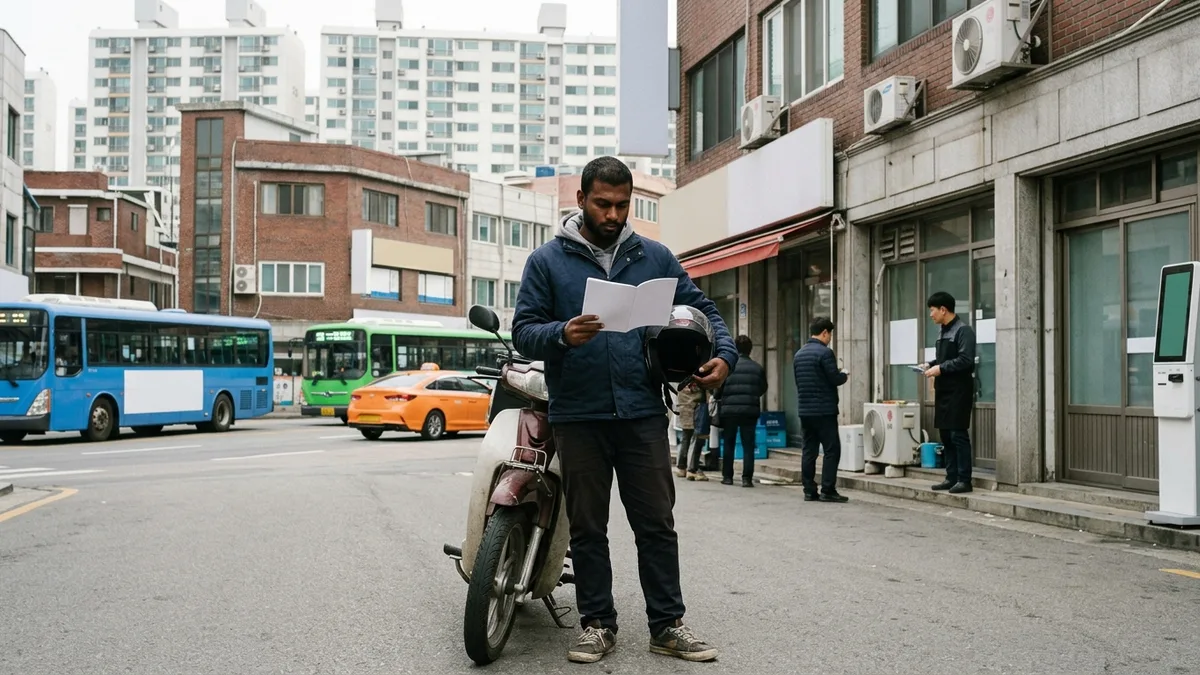

There are only four grounds under Article 96(1) of the Road Traffic Act that let you drive in Korea on a foreign license. ① The 1949 Geneva Convention ② the 1968 Vienna Convention ③ a bilateral treaty, agreement, or arrangement that mutually recognizes international driving permits ④ a bilateral treaty, agreement, or arrangement that mutually recognizes the other country's domestic driver's license itself. If your case doesn't fall under one of these four, there is simply no legal basis for recognition.
That's why there are countries whose citizens can't drive here even with an International Driving Permit (IDP) properly issued by their own national police. China has joined neither the Geneva nor the Vienna Convention, and KoROAD (the Korea Road Traffic Authority) explicitly states that China is not a party to the Geneva or Vienna Conventions. Indonesia only signed the 1968 Vienna Convention on 1968-11-08 without ratifying it, so it isn't a party, and Nepal doesn't appear on either convention's list at all.
Even if you're from a recognized country, the clock runs shorter than you'd expect. What governs validity in Korea isn't the expiration date printed on your IDP — it's one year from the day you entered the country (Article 96(1)). Even if you arrive with a three-year IDP issued by a Vienna Convention country, you get one year of use in Korea.
And there's one more layer on top. Whether your IDP is recognized, and whether the written test is waived when you exchange your license for a Korean one, only sound similar — they are two completely different lists. A Russian license lets you drive for a year on an IDP, but you have to take the test to exchange it; Uzbekistan isn't a Geneva Convention member, yet its citizens get the test waived when exchanging.
Note: Convention membership, recognized countries, and statutory penalties in this article are as of 2026-08, verified against the UN treaty depositary lists, the text of the Road Traffic Act, KoROAD (safedriving.or.kr), and the Ministry of Foreign Affairs' overseas travel safety guidance. Convention parties and the National Police Agency's notified list of recognized countries change from year to year, and some countries are split by state or region — so before you take the wheel, check your own country and state directly with a driver's license examination office.
Korea Recognizes Foreign Licenses on Only Four Grounds — How to Read Article 96 of the Road Traffic Act
Article 96(1) states that a person holding an international driving permit issued by a competent foreign authority, or a mutually recognized foreign driver's license, may drive for one year from the day they entered Korea — and right before that, it lists the four grounds for recognition. Once you understand this structure, you can judge for yourself whether your country qualifies.
| Grounds for recognition | When it applies | Examples |
|---|---|---|
| ① 1949 Geneva Convention | Korea succeeded to this convention on 1971-06-14, so IDPs issued by parties to it are recognized | Japan, Thailand, the Philippines, Singapore, Malaysia, India, Hong Kong, Macau |
| ② 1968 Vienna Convention | Korea is not a party, but since 2002-01-01 it has also recognized IDPs from parties to this convention | Russia, Vietnam, Uzbekistan, Kazakhstan, Mongolia, Myanmar, Pakistan |
| ③ Bilateral IDP mutual recognition agreements | Cases where IDPs are mutually recognized under a bilateral agreement or arrangement — as of 2026-08, only two | Taiwan, Vietnam |
| ④ Mutually recognized foreign license agreements | Cases where you drive in Korea on your home country license itself | Whether any country actually falls under this needs to be confirmed with official guidance |
That fourth row is easy to misread. The 26 countries with bilateral agreements or arrangements listed by the Ministry of Foreign Affairs (as of 2026-08; in Asia, only Uzbekistan and the Kyrgyz Republic) have a relationship in which the test is waived when you exchange a license — it does not mean you can drive on Korean roads with your home country license as-is. We were not able to confirm through official documents whether any country currently falls under Article 96(1)(4), so if you're planning to come with only your home country license, ask an examination office first.
Here's the order to work through.
- Step 1 — Check whether your home country is a party to the 1949 Geneva Convention or the 1968 Vienna Convention. If it's either one, you can drive for one year from your entry date on an IDP issued in your home country.
- Step 2 — If not, check whether you're from Taiwan or Vietnam. These two are separately recognized under bilateral agreements.
- Step 3 — If nothing above applies, there's no basis for recognition. Your only remaining options are to exchange your foreign license for a Korean one or get a new license here in Korea.
Caution: Only an International Driving Permit issued by a national government or a government-authorized body is recognized. Privately issued "international licenses" that arrive in a few days after an online order (IAA and similar) have no legal effect in Korea. Check the issuing authority on the cover of the document first.
Geneva (1949) and Vienna (1968) — Korea Joined Only One, So Why Do Both Work?
Korea is a party to the 1949 Geneva "Convention on Road Traffic" (succeeded on 1971-06-14). By contrast, Korea only signed the 1968 Vienna "Convention on Road Traffic" on 1969-12-29 and never ratified or acceded to it, so it is not a party.
Even so, IDPs issued by Vienna Convention countries work in Korea. That's because Korea decided, effective 2002-01-01, to also recognize IDPs issued by Vienna Convention countries for driving here. The recognition period is exactly the same as for a Geneva IDP: one year from your date of entry. Membership counts differ slightly depending on the source, so it's enough to keep in mind roughly 100-plus countries for Geneva and about 90 for Vienna (based on the UN treaty depositary lists).
The reverse direction isn't symmetrical. IDPs issued by Korea follow the Geneva Convention format, so they can only be used in Geneva member countries and in countries with a bilateral agreement (Taiwan, Vietnam) — they may not work in countries that joined only the Vienna Convention. This is where people who get a Korean license, then obtain a Korean IDP to take home, run into trouble. If your home country is a Vienna-only country such as Uzbekistan, Kazakhstan, Mongolia, or Myanmar, whether that IDP works there is a matter of that country's domestic law, so check directly with your home country's traffic authority.
The Vienna Convention also has one rule that Korea doesn't apply. Article 41(6) and Annex 7 of the convention provide that an IDP has no effect in the territory of a contracting party where the holder has their normal residence. That's why in Vienna Convention countries like Türkiye, your IDP stops working the moment you obtain a residence permit. Because Korea isn't a Vienna party, the one-year-from-entry rule applies instead. In other words, registering as a foreign resident doesn't kill your IDP that day.
Foreigners can also get an IDP issued in Korea. Government24 lists eligibility as Korean nationals or foreigners, the fee is 9,000 KRW, and validity is one year from the issue date. However, under Article 98-2 of the Road Traffic Act, if you have unpaid summary fines (notice disposition) or administrative fines for road traffic law violations, it will only be issued after you pay them. Official guidance isn't clear on whether a foreigner can complete the online application from start to finish without Korean-style identity verification, so it's safer to plan on applying in person at an examination office with your original passport.
Countries With No IDP Route at All — China, Indonesia, Nepal (But Hong Kong and Macau Do Work)
This is the most important section in this article, because it's a wall that hits Korea's largest foreign communities directly.
China (mainland) appears on neither the Geneva nor the Vienna party lists in the UN depositary records, and KoROAD explicitly states that it is not a convention country. So neither a Chinese license nor an international permit issued in China has any effect in Korea. A Korea–China mutual license recognition agreement has still not been concluded. Talks that stalled in 2019 reportedly resumed at the Korea–China police chiefs' meeting in 2024-05 and were at the working-level stage as of 2024-09, but China appears nowhere on the Ministry of Foreign Affairs' mutual recognition list or the National Police Agency's notified list of recognized countries (as of 2026-08).
Indonesia only signed the 1968 Vienna Convention on 1968-11-08 without ratifying it, so it isn't a party, and it isn't a party to the 1949 Geneva Convention either. Even if you bring the SIM Internasional issued by the Indonesian police, it doesn't fall under any of the four grounds in Article 96. Nepal doesn't appear on either convention's party list. That said, unlike China there's no document that specifically singles them out as ineligible — this is a conclusion drawn from the convention party lists and the structure of Article 96.
There are also places where the result is the exact opposite. International driving permits issued in Hong Kong (returned 1997-07-01) and Macau (returned 1999-12-20) continue to be recognized in Korea as before, under the one country, two systems policy. If your passport is Chinese but your license was issued in Hong Kong or Macau, the conclusion changes completely — so start by checking which authority issued your license.
The remaining path is the same for all three countries: exchange for a Korean license, or get a new one here. But China, Indonesia, and Nepal also aren't on the list of countries with recognized domestic licenses we'll look at below, so even when exchanging, you'll generally have to take the written test (unless your visa status falls under the exemptions covered later). Hong Kong and Macau are the reverse: their IDPs are recognized and the written test is waived when exchanging.
Caution: For Chinese licenses, the notarization step is different from other countries. Both the original and the duplicate copy must be notarized and submitted together, so if you bring only one, your application won't be accepted that day. On top of that, the Korean Embassy in China has suspended issuing confirmation letters, so you'll need to go the apostille route.
Why Taiwan and Vietnam Are Separate — What a Bilateral Mutual Recognition Agreement Actually Does
Korea has concluded IDP mutual recognition agreements (arrangements) with only two places: Taiwan and Vietnam (as of 2026-08). From the name, you'd think these two get special treatment — but what the agreements actually do is a bit different.
Start with Vietnam. Korea began recognizing IDPs from Vienna Convention countries on 2002-01-01, and Vietnam joined the Vienna Convention later, on 2014-08-20. The later of those two dates is the actual start point, so Vietnamese-issued IDPs have been recognized in Korea since 2014-08-20 — long before the Korea–Vietnam agreement existed. The agreement's real effect runs the other way. Korea issues only Geneva-format IDPs, and because Vietnam is a Vienna country, Korean IDPs didn't work there. The Korea–Vietnam agreement was reported as signed on 2023-06-23 and effective 2023-07-23 (based on media reports citing the National Police Agency, so treat it as provisional), and the ones who benefit are Koreans who want to drive in Vietnam.
Taiwan's situation is different again. Taiwan sits outside the UN convention system, so a bilateral arrangement is the only channel. However, the signing and effective dates of this arrangement couldn't be verified in any official document from the Ministry of Foreign Affairs, the National Police Agency, or KoROAD. Take it that only the fact that Taiwan is an agreement partner is certain.
To sum up: for Vietnamese nationals, what actually matters is Vienna Convention membership, not the agreement; for Taiwanese nationals, the agreement is the sole basis. Both are also on the exchange recognition list (25 countries and regions in Asia), so the written test is waived when converting to a Korean license.
The Most Common Mix-Up — IDP Recognition and the Written Test Waiver Are Two Different Lists
This single misunderstanding is what wrecks embassy certificate fees and vacation schedules. The two systems rest on different legal grounds and use different lists.
IDP recognition turns on convention membership. The list of countries with recognized domestic licenses — the one that waives the written test when exchanging — is a reciprocity list that the National Police Agency compiles and notifies each year based on whether the counterpart country exchanges Korean licenses (Road Traffic Act Article 84, and Article 52 and Annex 3 of its Enforcement Decree). Based on the National Police Agency notice dated 2026-04-06, there are 133 countries and regions in total: 25 in Asia, 22 in the Americas, 36 in Europe, 12 in the Middle East, and 38 in Africa (as posted by KoROAD).
| Your country type | Drive 1 year on an IDP | Written test when exchanging | Examples |
|---|---|---|---|
| Both apply | Yes | Waived | Japan, Thailand, the Philippines, Vietnam, Taiwan, Hong Kong, Uzbekistan, Kazakhstan, Myanmar |
| IDP only | Yes | Must take it | Russia, Mongolia, Pakistan, Sri Lanka, Bangladesh, Singapore, Laos |
| Neither applies | No basis for recognition | Must take it | China, Indonesia, Nepal |
The second row is the real trap. Russia is a party to both the Geneva and Vienna Conventions, so you can drive for a year on an IDP — but it's not among the 36 European entries on the 133-country list. Mongolia (Vienna, joined 1997-12-19), Pakistan (1986-03-19), Sri Lanka (Geneva, 1957-07-26), and Bangladesh (1978-12-06) are in the same position. Conversely, Uzbekistan, Kazakhstan, and Myanmar aren't Geneva members but are Vienna members, so their IDPs work — and they're on the recognized-country list too, so the test is waived as well.
Some countries are split by state or region. The United States, Canada, India, Mexico, and Iraq are recognized regionally rather than nationally. For Mexico it's Nuevo León state only; for Iraq, Erbil only; for India, five states: Goa, Gujarat, Madhya Pradesh, Telangana, and Maharashtra. For the United States, the number of recognized states differs between KoROAD (as posted from the National Police Agency notice) and Ministry of Foreign Affairs materials, so we won't put a figure in this article. Check directly with an examination office whether your state is on the list. Even if it is, there's an exception note saying Oregon, Idaho, Utah, and Nevada require the written test.
Important: Nationality isn't the only fork in the road. Even with a license from a non-recognized country, the written test is waived for holders of visa status A-1, A-2, A-3, D-7, D-8, D-9, E-1, E-3, E-4, E-7, or F-4, plus their spouses and unmarried children under 19 (per KoROAD guidance). E-9 (non-professional employment), H-2 (working visit), D-2 (study), F-6 (marriage migrant), F-2, and F-5 are not on that list. So among people from the very same country, a corporate expat gets the waiver while a migrant worker or student has to take the test — check with an examination office how it applies to your specific visa.
Why You Can't Trust the Expiration Date Printed on Your IDP — the Clock Is One Year From Entry
The validity printed on the document and the period you can actually use it in Korea are two separate things. This is what long-term residents get caught on most often.
| Type | Validity printed on the document | Effect inside Korea |
|---|---|---|
| Geneva-format IDP | 1 year from issue date | 1 year from the day you entered Korea |
| Vienna-format IDP | 3 years from issue date, or your home license expiry — whichever comes first | 1 year from the day you entered Korea |
| IDP issued in Korea | 1 year from issue date (fee 9,000 KRW) | It's Geneva format, so it may not work in Vienna-only countries |
Look at the second row. An IDP issued by a Vienna Convention country is a three-year document, but in Korea it's one year. Even with two years left on the permit, you're driving unlicensed from the one-year mark after entry. Nothing feels different to you — only your legal status changes — so nobody tells you until there's an accident or a traffic stop.
That means the date you need to track is on your passport, not your license. Write down exactly when you entered Korea using your entry stamp or a certificate of entry and exit, and count one year from there. We couldn't confirm from official guidance whether this one year restarts if you leave and re-enter, so in that case be sure to ask an examination office or a police station.
There are also cases where driving is blocked even with time left. Under Article 97 of the Road Traffic Act, a metropolitan or provincial police commissioner may prohibit driving on an IDP for a period not exceeding one year if you ① failed to take or failed an aptitude test ② caused a traffic accident intentionally or negligently ③ are within a disqualification period following the revocation or suspension of a Korean license ④ violated the Road Traffic Act. If you receive such a prohibition, you must surrender the permit without delay.
What You're Allowed to Drive — Only the Listed Vehicle Classes, and No Commercial Vehicles
Article 96(1) doesn't just set the period — it also limits vehicle classes. The vehicles you may drive are limited to those listed on the document. If you only hold a passenger-car class at home, you can't drive large or special vehicles in Korea. The class stamps are on the inside pages of your IDP, so when it's issued, check on the spot that every class you need is included.
The more decisive limit is Article 96(2). With an IDP issued abroad or a mutually recognized foreign license, you may not drive commercial vehicles (taxis, buses, trucks) under the Passenger Transport Service Act or the Trucking Transport Business Act. There's one exception: renting a vehicle from a car rental business and driving it yourself. But what the law permits and what rental companies will actually hand over are different matters, so counter requirements like age, IDP class, Korean-language communication, and name matching are covered separately in rental car pickup requirements for foreigners.
For anyone hoping to make a living behind the wheel, this is effectively a roadblock — it's a restriction Korean license holders don't face. To drive a taxi, bus, or truck, you need to obtain a Korean license first and then separately meet the commercial qualification requirements.
Tip: This restriction is about being the driver. Calling and riding a taxi as a passenger has nothing to do with licenses. You don't need a driver's license to hail a taxi in an app or book KTX and express bus tickets, so don't get the two confused.
Because of the listed-classes-only rule, a lot of people also get stopped at shared electric scooters. Personal mobility devices require at least a motorized bicycle license, and how Korea treats the A, A1, and AM categories on an IDP as qualification to ride a scooter isn't settled by primary sources. Scooter license requirements and the summary fines (notice disposition) for each violation are covered separately in electric scooter licensing and per-violation summary fines.
Driving on an Expired IDP — the Second Risk That Only Foreigners Face
Driving a car without a driver's license, or without an IDP or mutually recognized foreign license under Article 96, carries up to 1 year in prison or a criminal fine of up to 3,000,000 KRW under Article 152(1) of the Road Traffic Act. This explicitly includes cases where driving has been prohibited and cases where the validity period has expired. In other words, "I had the permit, it had just expired" is not a defense that works.
For a Korean national, that's where it ends. For a foreigner, a second risk follows. A criminal record can count against you in visa status reviews and re-entry screening. That said, there is no publicly available standard for which sentence leads to which immigration outcome. Numbers circulating online — "a fine above X means a departure order" and the like — have no verified official basis, so don't take them at face value; if something actually happens, check your individual case with an immigration office or a legal advisor.
Insurance deserves a mention too. We weren't able to verify from the original standard policy text how far auto insurance is excluded when an accident happens while driving unlicensed. But if the license you submitted when renting a car had already lost its effect, the contract itself can be shaken — so if your timing is unclear, hold off on driving and check with the insurer and rental company first. It's far cheaper that way.

Getting Around While Your License Doesn't Work — Riding Out the Gap on Public Transit
Whichever way your assessment lands, there will be a stretch when you can't drive. For Chinese, Indonesian, and Nepalese nationals it's from day one; for everyone else it's from the one-year mark after entry. And that gap isn't short — because the real bottleneck in the exchange process isn't the examination office, it's your home country's diplomatic mission.
- The Russian and Ukrainian embassies in Korea, the British Embassy, the Korean Embassy in China, and the Korean Consulate General in Hong Kong, among others, have suspended issuing license confirmation letters, so you'll have to go the apostille route. Just mailing documents back and forth eats up weeks.
- You must apply in person at a driver's license examination office anywhere in the country; proxy applications aren't accepted. Go by 17:00, one hour before closing — and if you need to take the written test, arriving before 16:00 is recommended. If you have fixed working hours, this means using a day of leave.
- The Mungyeong, Gangneung, Taebaek, Gwangyang, Chungju, and Chuncheon offices have no on-site medical examination facility, so you'll need to visit a nearby hospital separately. KoROAD's Korean and English guidance also differ on the medical exam fee, so budget roughly 7,000–8,000 KRW and confirm at the office.
- The written test is available in only four languages: Korean, English, Chinese, and Vietnamese (40 multiple-choice questions; pass at 60 points for Class 2, 70 for Class 1). The very people who have to take it — Nepalese, Indonesian, Mongolian, Sri Lankan, and Bangladeshi nationals — have no native-language option (unless they hold an exempt visa status).
Documents, fees, and the step-by-step procedure are covered separately in the foreign license exchange guide, so head there for that. What matters here is how you get around in the meantime. Rental cars and car sharing aren't much of an alternative either — the rental side also ends up requiring a valid IDP or Korean license, so with no basis for recognition you're blocked from the start. If you need to travel to regional cities, start with how to reach regional cities by train and bus, and if taxi calls keep failing, see how to call a taxi without a Korean phone number.
| Transport option | What it solves | Where foreigners get stuck |
|---|---|---|
| Rental cars / car sharing | Driving yourself | Requires a valid IDP or Korean license — with no basis for recognition, it's a no-go from the start |
| Korail+ (formerly Korail Talk) | KTX | Works with a passport and overseas card, but some users get blocked at the payment step |
| Kakao T | Taxis, trains, intercity buses | Requires Korean mobile number verification |
| LACHA | KTX, express buses, taxis, VAN, Airport Railroad, transit cards | Doesn't handle rental cars, intercity buses, or flights |
If you have to fill weeks or months of waiting on public transit until your license situation is settled, an option where booking and payment happen in one place is far easier. LACHA is a transport-and-payment super app for foreigners that you can use right away without identity verification. It's designed so that, under the official process, no Korean-style identity check is needed — you can start with just your passport, no Korean bank account or phone number required — and you can book KTX and express bus tickets, hail taxis, and top up transit cards using overseas payment services like Alipay and WeChat Pay or an overseas card. What does and doesn't work when you don't have a Korean number is laid out in what you can do without identity verification.
Want to search and book KTX and express buses in one app? Check out LACHA.
Built to work without a Korean phone number or bank account, with overseas payment methods like Alipay, WeChat Pay, and Apple Pay. Taxi hailing plus KTX, express bus, and airport railroad (AREX) booking — all in one app.
Up to 60% off Korea transit with a coupon (max ₩3,000): enter code at sign-up. KTX gets up to 18% off on top
Download now


Frequently Asked Questions (FAQ)
Q1. My country issues international driving permits, so why can't I use mine in Korea? Because Korea's grounds for recognizing foreign licenses are fixed at the four listed in Article 96(1) of the Road Traffic Act, and your country isn't covered by any of them. China has joined neither the Geneva nor the Vienna Convention, and KoROAD states it is not a convention country. Indonesia only signed the Vienna Convention on 1968-11-08 without ratifying it, and Nepal appears on neither convention's list. Even a genuine IDP issued by your own government has no effect in Korea, so you'll need to exchange for a Korean license or obtain a new one.
Q2. My IDP has two more years on it — can I keep driving? No. What governs validity in Korea is not the date printed on the document but one year from the day you entered the country (Road Traffic Act Article 96(1)). Vienna-format IDPs are issued for three years from the issue date, but in Korea it's one year. Driving after that period counts as driving without a license and carries up to 1 year in prison or a criminal fine of up to 3,000,000 KRW under Article 152(1) of the Road Traffic Act. Confirm your entry date first using your passport entry stamp or a certificate of entry and exit.
Q3. I've been driving on an IDP for a year — does that mean the test is waived when I exchange for a Korean license? No, the two systems use different lists. IDP recognition turns on convention membership, while the written test waiver for exchange turns on the National Police Agency's reciprocity-based list of 133 countries and regions with recognized domestic licenses (notice dated 2026-04-06, as posted by KoROAD). Russia, Mongolia, Pakistan, Sri Lanka, and Bangladesh can drive on an IDP but must take the test to exchange; conversely, Uzbekistan, Kazakhstan, and Myanmar aren't Geneva members yet still get the waiver when exchanging. Check which side your country falls on before you start gathering documents.
Q4. Can I drive a taxi, bus, or truck in Korea on an international permit? No. Article 96(2) of the Road Traffic Act provides that you may not drive commercial vehicles under the Passenger Transport Service Act or the Trucking Transport Business Act on an IDP or mutually recognized foreign license issued abroad. The one exception is renting a car and driving it yourself. To drive professionally, you need a Korean license first and then the relevant commercial qualification requirements. Riding a taxi as a passenger or hailing one in an app has nothing to do with licenses.
Q5. I have a U.S. license — how do I check whether my state is recognized? The United States, Canada, India, Mexico, and Iraq are recognized by state or region rather than nationally. However, the number of recognized U.S. states differs between KoROAD (as posted from the National Police Agency notice) and Ministry of Foreign Affairs materials, so we haven't put a figure in this article. The surest approach is to check your state directly with the driver's license examination office you plan to visit. Even if it's on the list, there's an exception note saying Oregon, Idaho, Utah, and Nevada require the written test — so ask about that too.
Note: This article is for general informational purposes. Convention membership, recognized countries, periods, and statutory penalties in the text are as of 2026-08, verified against the UN treaty depositary lists, Articles 96, 97, 98-2, and 152 of the Road Traffic Act, and materials published by KoROAD (safedriving.or.kr) and the Ministry of Foreign Affairs' overseas travel safety service. Convention parties are added over time, and the exchange recognition list changes because the National Police Agency surveys and re-notifies it every year. Items where sources disagree or where we couldn't obtain the original text — the number of recognized U.S. states, the medical exam fee, the signing date of the Korea–Taiwan arrangement, total convention membership counts — are left in the text as items to verify rather than stated definitively. Please re-confirm with a driver's license examination office and official KoROAD guidance before driving and before preparing documents. LACHA does not issue or exchange driver's licenses and does not handle rental cars.