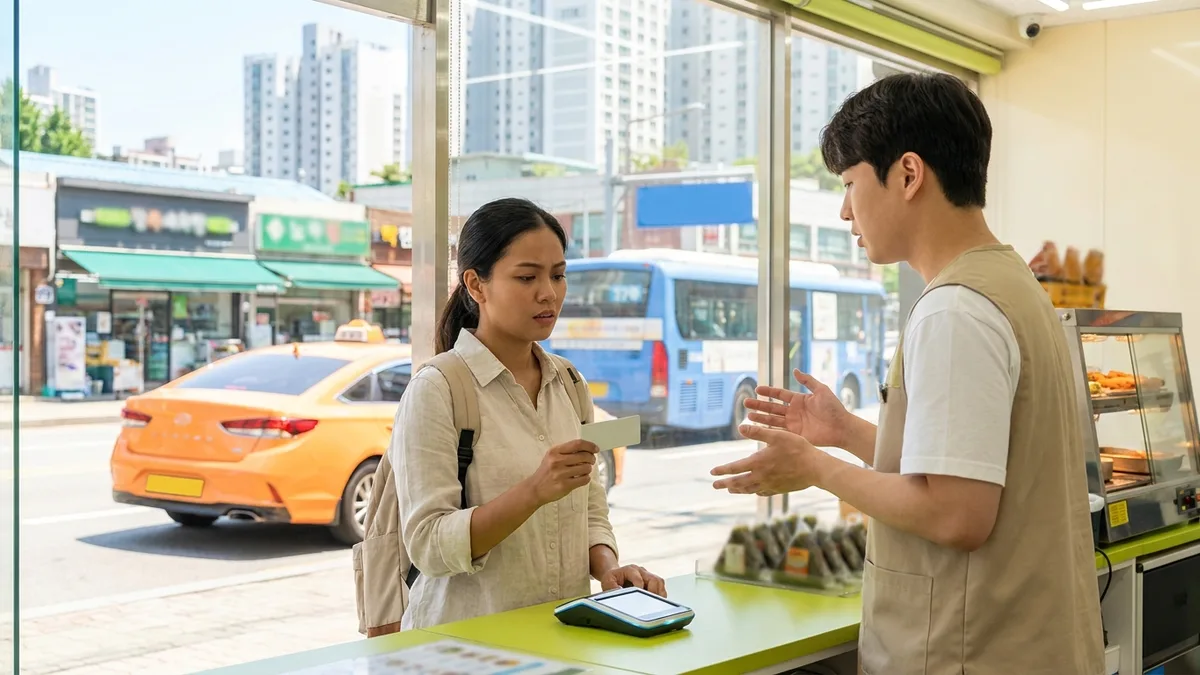
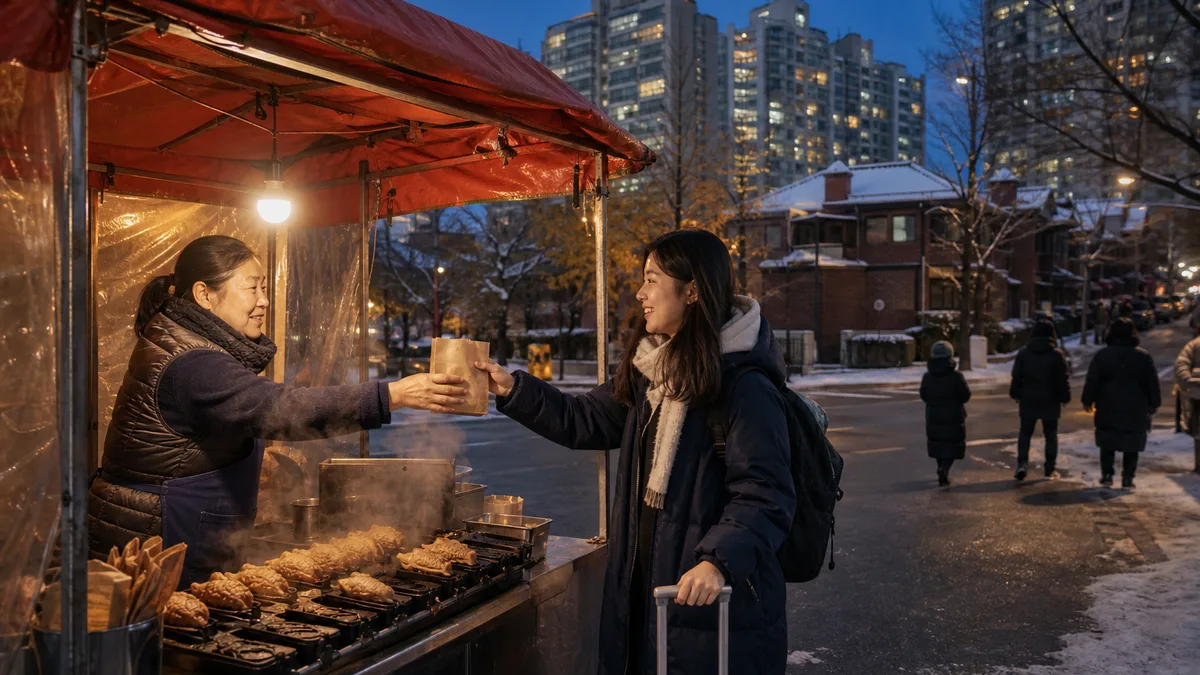
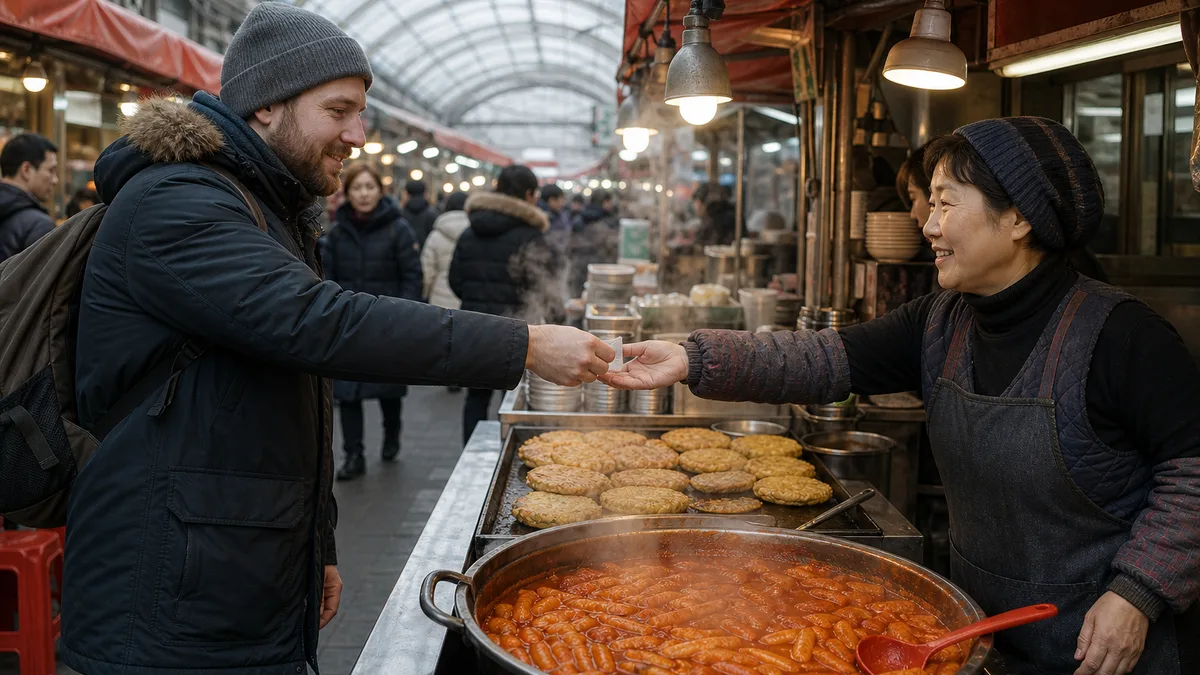
On a winter evening, if you hold out your card at a bungeoppang (a pastry baked in a fish-shaped mold and filled with red bean paste or custard cream) stall, it's common to hear back "Cash or bank transfer." For Koreans, if a card doesn't work they just send a transfer from their phone, so nobody bothers to explain, but a bank transfer only works if you have a Korean bank account and mobile banking (or a money transfer app like Toss). Foreign cards, travel cards and Apple Pay have nowhere to go at a stall with no card terminal, and QR payments like Alipay only work if the stall has that QR code posted. For travelers, what's left is realistically either cash or a different shop.
Prices are confusing too. Overseas blogs and videos still circulate prices like "2 bungeoppang for 1,000 KRW," but in 2025 Korean news reports, vendors said they had changed what was originally 2 for 1,000 KRW to 3 for 2,000 KRW, or to 700 KRW each and 3 for 2,000 KRW (one vendor since 2024). If you go by the old price, you might mistake a normal price for a rip-off (being charged an inflated price), or you might let a high price at a tourist spot slide, thinking that's just how it is.
Street snacks like bungeoppang and hotteok (a pancake filled with sugar and pressed flat on a griddle) are also winter treats that travelers seek out on purpose. Korea JoongAng Daily (2025-12-02) featured Chinese tourists who came looking for bungeoppang stalls in central Seoul that had become known on TikTok and Xiaohongshu. This guide covers the moment you pay at stalls like those and at traditional market stands. How far the rules reach when a restaurant turns down your card is covered in When You Get Stuck at a Korean Restaurant Menu or Counter, and how to withdraw cash with a foreign card is in How to Withdraw Cash with a Foreign Card at Korean ATMs.
Note: The price, rule and hotline information below was checked as of 2026-09 against news reports and public materials from the Seoul Metropolitan Government, the Korea Tourism Organization, the Bank of Korea and others. Sources are collected at the end of this guide, and since things can change, please check official channels again before you go.
Knowing why stalls don't take cards makes it less stressful
When a stall says it doesn't take cards, it's usually because of how the business is set up for payments, and Korean customers get the same answer. That's why preparing cash in small bills ahead of time is the surest way to be ready.
There are structural reasons stalls don't have card terminals. Seoul's Jung-gu district first pushed for business registration (registering as a business with the tax office) in order to install card terminals at Myeongdong's street stores (거리가게, the administrative term for street stalls). As of April 2024, by the Jung-gu Office's estimate, only 69 of the 350 Myeongdong stalls had completed registration, and about 13% of all the stalls had installed a card terminal (News1 2024-04-07). That was the case even in Myeongdong, which sees a lot of tourists. We couldn't find figures on how much the number of Myeongdong stalls taking cards has grown since then. An on-site report from March 2026 found that many Myeongdong stalls accepted QR payments such as Alipay, aimed at Chinese tourists, but some stalls had discreetly covered up their card payment signs and seemed reluctant when customers held out a card (Financial News English edition 2026-03-08).
Even among stalls without business registration, some do take cards. Jongno-gu said that through a program from July to September 2024 to sign up Gwangjang Market stalls for credit card payments, 77 non-business stalls that found business registration difficult newly adopted a card payment agency service (a way of receiving card payments through a payment agency company) (Herald Economy 2025-11-06). However, that's 77 out of the 192 stalls inside the market that the district surveyed in full, so it doesn't mean every Gwangjang Market stall takes cards.
Because of this setup, the steps that work at a restaurant often don't reach stalls. The Credit Finance Association (여신금융협회, CREFIA) report for merchants that refuse transactions or treat customers unfairly is a channel for reports about card merchants (shops that have a contract with card companies to accept cards) refusing card payment, passing fees on to customers, or giving discounts only to customers who pay in cash, and the association's guidance says that "cases such as some small businesses that are not registered as merchants with a card company are not subject to reporting." In other words, a stall that isn't a card merchant not taking cards isn't something this channel handles. The rules for places that are card merchants, like restaurants, and the question of how they apply to foreign cards are covered in the restaurant guide.
Vendors have their own reasons too. Asia Economy (2023-11-20) passed on online comments from people who said they had heard from vendors why stalls came to insist on cash. The stories were that some customers sent just 200~300 KRW by bank transfer, knocking a zero off the price of their bungeoppang, or walked off during a busy moment claiming they had already transferred the money. The same article relayed one commenter's claim that there's also a scheme where someone deposits money into a vendor's account, reports it as voice phishing to get the account frozen, and then demands money to have it unfrozen; read that as a rumor going around rather than a confirmed fact.
It's not just Seoul's tourist spots, either. Kyeonggi Ilbo (2026-05-28) reported demands at Suwon's Paldalmun Market and Yeongdong Market like "We don't take cards. Send a bank transfer," with vendors citing the lack of card terminals and the burden of card fees and tax reporting. The same article also covers a case at Yongin Jungang Market where a vendor steered customers toward cash by saying "10% VAT gets added" for card payments, and some shops that charged 500 KRW more for paying by card. If a card merchant added money on top of a card payment, see the steps in the restaurant guide above.
What you can do when you hear "Bank transfer only"
This has come up in the news more than once. In September 2024, when a YTN crew visited 5 shops at Gwangjang Market, 3 refused card payment, and one vendor said, "Cards don't work, you have to do a bank transfer, I'm not good with (the card machine)" (Seoul Shinmun 2024-09-30). The merchants' association explained that card terminals had only arrived at the start of that month and older vendors weren't used to the machines. In April 2026 as well, when a reporter from The Fact asked about card payment at Gwangjang Market, vendors just kept repeating "bank transfer" and answered that only cash or bank transfer was accepted (The Fact 2026-04-27).
Myeongdong is similar. When Jung-gu announced its plan to reorganize Myeongdong's street stores in August 2025, it listed a "ban on using accounts in other people's names" as something to pursue going forward, alongside expanding card payment (Newsro and Money Today 2025-08-01). You can read that as a sign that bank-transfer payments at stalls are common enough to make it into policy wording.
For travelers, a bank transfer is a method that requires a Korean bank account and mobile banking. The conditions for opening an account and the limits of accounts opened with a passport are covered in How Foreigners Can Open a Bank Account in Korea. At a stall, you can usually just pay in cash or move on to another shop.
| What you hear at the stall | What it means | What a traveler can do |
|---|---|---|
| "Cash only" | There's no card terminal | Pay in cash or move on to another shop |
| "Cash or bank transfer" / "Please send a bank transfer" | They want you to send money from a Korean bank account to the vendor's account | Say you don't have a Korean account and take out cash |
| "We take cards" | There's a card terminal | There's no confirmed information on whether foreign cards work. If yours is declined, pay in cash |
Why foreign cards get declined and what to do about it are covered in When Your Foreign Card Is Declined in Korea.
If the shop has a QR sticker showing the logo of a payment app you normally use, it's worth asking once. It was reported in May 2026 that Suwon handed out QR payment kits linked with Alipay, Alipay+ and WeChat Pay to 1,269 Zero Pay (Korea's QR payment system for merchants) merchants in 8 neighborhoods (dong) (Etoday 2026-05-13). However, Zero Pay assumes a registered business merchant, so it doesn't cover unregistered stalls, and we couldn't find an official list of which foreign apps can be used nationwide.
We don't recommend handing cash to a stranger and asking them to make the transfer for you, or trying to send money on the spot with a money transfer app you haven't confirmed works. Disputes over confirming deposits have been reported as one reason stalls want cash, so if a transfer goes wrong, both the vendor and the customer end up in a bind. If you get stuck for words, show the phrases below in order.
- "카드 돼요?" (Do you take cards?)
- "현금만 돼요?" (Cash only?)
- "한국 계좌가 없어요. 현금으로 낼게요." (I don't have a Korean bank account. I'll pay in cash.)
Carry cash split into 1,000 KRW and 5,000 KRW bills
The Bank of Korea issues four banknotes: 1,000 KRW, 5,000 KRW, 10,000 KRW and 50,000 KRW. Bungeoppang prices in news reports last winter were 700~1,500 KRW for one and around 2,000 KRW for three, so splitting your cash into 1,000 KRW and 5,000 KRW bills makes paying easier.
For example, 3 bungeoppang for 2,000 KRW plus 1 hotteok for around 2,000 KRW comes to around 4,000 KRW. With a few 1,000 KRW bills and one 5,000 KRW bill, you'll hardly ever have to worry about change. If you buy something that costs 1,000~2,000 KRW with a 50,000 KRW bill, the vendor may not have enough change and things can get awkward (Koreans run into the same thing).
If you only have large bills, buy something small at a convenience store with a 50,000 KRW or 10,000 KRW bill before heading to a stall, and get 1,000 KRW bills back as change. Those 1,000 KRW bills become your way to pay at the stall.
How to withdraw cash at ATMs with a foreign card and the fees involved are covered in How to Withdraw Cash with a Foreign Card at Korean ATMs, and comparing exchange rates at exchange offices and apps is in How to Get a Good Exchange Rate in Korea. How much to keep in your wallet at all times depends on your itinerary, so decide with the help of the cash preparation part of When Your Foreign Card Is Declined, and set aside small bills just for stalls.
How to find bungeoppang and hotteok stalls and avoid wasted trips
The stalls themselves are becoming fewer. According to Kuki News (2025-11-28), citing Seoul Metropolitan Government data, there were 4,741 street stores in Seoul as of 2024, down 22% from 6,079 in 2020. This number covers all street stores, including bungeoppang stalls. Bungeoppang and hotteok stalls mostly open in winter and sometimes move to a different spot. Last year, a report said more vendors started selling as the weather turned chilly in late October (Herald Economy 2025-10-22), so before then, many spots may not be open yet.
가슴속3천원 is a free app listed on the App Store under the name "가슴속3천원-붕어빵&두바이쫀득쿠키 지도" (a map for bungeoppang and Dubai chewy cookies). Its supported languages are Korean and English, and the app description says it uses GPS to show the nearest places selling bungeoppang in order of distance. The store page doesn't say whether you need to log in or verify a phone number, so we couldn't confirm that. In the App Store search box, paste the Korean name "가슴속3천원" exactly as written to find it.
Karrot's bungeoppang map (당근 붕어빵 지도) is a map that opens for the winter season only in the Neighborhood Map tab of Danggeun (English name Karrot), a secondhand marketplace app. It opened in late November 2024, and users could register, edit and delete stall locations themselves and see opening hours, prices and reviews on the pins posted by neighbors (Maeil Shinmun 2024-11-26 and Chungnyeon Ilbo 2024-12-02). That season's run was scheduled to last until late March to early April of the following year, and we couldn't confirm whether it reopened for winter 2025-26 or will reopen this winter. In 2024, the season we confirmed, it opened in late November, so before then the map may not be in the app yet.
Karrot may be hard for travelers to use. Seoulstart (updated 2026-08), an information site for foreigners, says signing up for Karrot requires phone identity verification through a Korean mobile carrier, that for foreign residents the line must be opened under an alien registration number rather than a passport number, and that no way to sign up with an overseas number is described. It also says that even if you switch the menus to English, posts stay in whatever language their authors wrote them in. We couldn't confirm this through Karrot's official guidance, so please check for yourself whether you can sign up.
Whichever map you use, it's built from user reports, so it may not match reality. On the afternoon of December 15, 2025, a Korea Economic Daily reporter visited 7 locations in the Yeongdeungpo-gu and Yongsan-gu area shown on a bungeoppang app, and not a single stall was open (Korea Economic Daily 2025-12-16). The article doesn't name the app, and a stall moving or taking a day off showing up late on the map can happen with any app.
To cut down on wasted trips, go about it like this.
- Two or three candidates: Don't travel far for just one stall; line up several stalls along your way.
- Recent reviews first: Try places with recently posted reviews or price information first.
- A backup nearby: In case a stall turns out to be empty, check where the nearby convenience stores or cafés are too. Alternatives are covered later in this guide.
How to judge a fair price using last winter's prices
Prices at bungeoppang and hotteok stalls for this winter (2026-27) had not been reported as of early October 2026. Last year, price reports were already out in late October (Herald Economy 2025-10-22), so this winter's prices may have been reported by the time you read this. So the figures below are based on last winter (2025-26). Even in the same winter, prices differed from stall to stall and neighborhood to neighborhood, so look at them as a range rather than a single price.
| What was reported | Price in winter 2025-26 | Source |
|---|---|---|
| Interview with a bungeoppang stall vendor | 700 KRW each, 3 for 2,000 KRW (the price charged since 2024) | Korea Economic Daily 2025-12-16 |
| Going rate for bungeoppang, including unregistered stalls | About 733 KRW each, around 3 for 2,000 KRW (the article's estimate) | Korea Economic Daily 2025-11-30 |
| A stall listing red bean and cream bungeoppang at 1,000 KRW | 1,000 KRW each | Korea Economic Daily 2025-11-30 |
| Bungeoppang in major downtown Seoul areas such as Gangnam and Myeongdong | 1,000~1,500 KRW each | Segye Ilbo 2025-12-10, Newsis 2025-12-18 |
| Stall bungeoppang near Konkuk University Station, Seoul (2026-01) | 3 for 2,000 KRW | Money Today 2026-01-20 |
| Red bean bungeoppang at a café in the same article | 2 for 2,700 KRW (1,350 KRW each) | Money Today 2026-01-20 |
| Hotteok in major areas of Seoul | Up to around 2,000 KRW each | Newsis 2025-12-18 |
The 733 KRW per piece is an estimated average from the Korea Economic Daily article, which didn't disclose how it was calculated, and it doesn't quite add up with the same article's 3 for 2,000 KRW either, so treat it only as a rough baseline. Segye Ilbo reported that bungeoppang that had been 2 for 1,000 KRW in 2024 jumped to 1,000~1,500 KRW each in 2025, and vendors in the Korea Economic Daily articles (2025-11-30 and 12-16) also said they had originally sold them at 2 for 1,000 KRW. Going by these reports, the "2 for 1,000 KRW" you may have seen in overseas posts is mostly an old price.
The articles point to the price of red beans as the reason prices went up. Reports that wholesale prices for domestic red beans had risen sharply kept coming from late 2025.
Use these benchmarks to size up stall prices.
- Neighborhood stalls at around 3 for 2,000 KRW or 700 KRW each: This is in line with the prices from last winter's stall interviews.
- Downtown and tourist spots at 1,000~1,500 KRW each: This is within the range reported for downtown Seoul last winter, so this price alone is hard to call a rip-off.
- Café bungeoppang: These cost more than the stall in the same article (3 for 2,000 KRW). A higher price isn't strange here; it's simply a different type of shop.
- A little above the range: This winter's prices may be higher than last winter's. Don't treat a price as a rip-off just because it's a few hundred KRW more than this table; first check whether they charge the price written on the price board.
- Far outside the range: Ask the price before you buy and compare with other stalls nearby.
If a stall has a price board up, read it before you get in line.
How to check prices at stalls in tourist spots like Myeongdong
There are reports that stalls in tourist areas were pricier than a nearby market. These are the prices Segye Ilbo found when it covered Myeongdong stalls together with nearby Namdaemun Market in January 2024. They're from an early-2024 report, so they aren't current prices; use them only to see the gap between the two places.
| Item | Myeongdong stall | Namdaemun Market |
|---|---|---|
| Fish cake skewer | 2,000 KRW each | 1,000 KRW each |
| Chicken skewer | 5,000 KRW | 3,000 KRW for skewers, including chicken skewers |
| Mini gimbap | 6 for 6,000 KRW | 5 rolls for 3,000 KRW |
| Croissant bungeoppang | 4,000 KRW each | Not in the article |
| Tornado potato, tanghulu | 5,000 KRW each | Not in the article |
In the same coverage, most Myeongdong stalls had price tags posted, while a few still didn't. In July 2023, YTN reported a scene where someone paid 10,000 KRW for 4 bungeoppang and 3 dumplings at a Myeongdong stall, along with the reaction of a French tourist who said the same things cost less elsewhere, such as in Bucheon, Gyeonggi Province. At the time, the district office's position was that it couldn't enforce stall prices by law, so it was recommending reasonable selling prices.
The price display system also reached stalls late. Myeongdong stalls were left out of the Myeongdong mandatory price display zone announced ahead of its October 2023 start (Edaily 2023-08-29), but Jung-gu said on August 1, 2025 that in 2024 it had become the first in the country to introduce card terminals at some street stores and implement a price display system. We couldn't confirm whether this price display is a legal requirement. So even if many stalls have price boards, some may still be without one.
At tourist-spot stalls, here's what to do. Choose stalls with a price board first, ask the price before you buy at stalls without one, and when buying several items, check the total first. If the amount you're charged differs from the price board, point to the board and ask them to check, and if you take photos of the price board and the food you received, you can show them exactly as they are when you ask for help later.
- "이거 얼마예요?" (How much is this?)
- "전부 얼마예요?" (How much is it all together?)
- "가격표에는 이 가격인데, 확인해 주시겠어요?" (The price board says this. Could you check?)
What to know when paying at Gwangjang Market stalls
The rules for Gwangjang Market stalls are changing quickly. Jongno-gu introduced road occupancy permits for Gwangjang Market stalls through a public-private task force meeting in November 2025, and since June 2026 it has been running a stall real-name system, registering the real names of stall operators and applying a one-person, one-stall principle (The Fact 2026-04-27 and Wikitree 2026-08-30). On May 20, 2026, the Seoul Metropolitan Government announced that Jongno-gu would give penalty points for real-name system violations, with measures ranging from business suspension up to, at most, cancellation of the road occupancy permit, and that mystery shoppers (people who come in as customers and inspect in secret), including foreigners, would carry out checks. However, Wikitree (2026-08-30), citing reporting by Channel A, reported that not a single stall had received a penalty point in the three months since June. The system and how to read price boards are covered in detail in How to Find Restaurants Where Locals Eat.
Payment is still a mixed picture. Reports on the real-name system (Seoul Shinmun 2025-12-06 and The Fact 2026-04-27) include "securing payment transparency" alongside stronger price display and disclosure of business names, but they don't say whether that means mandatory card payment or a ban on bank transfers. While 77 non-business stalls adopted card payment agency services in 2024, a scene where vendors answered only cash or bank transfer when asked about cards was still reported in April 2026. A month earlier, in March 2026, reporters found that most stalls said they took cards, but some displayed bank account numbers to nudge customers toward paying in cash (Dailian 2026-03-19 and Financial News English edition 2026-03-08). Another report said signs with WeChat Pay QR codes hung at stalls here and there (Nocut News 2025-11-29). At Gwangjang Market, expect to come across both stands that take cards and stands that only mention cash or bank transfer.
Keep an eye on how your food is dished up, too. The Fact (2026-04-27) noted a case in November 2025 where a stall mixed meat into an 8,000 KRW order of sundae without being asked and demanded 2,000 KRW more, and a video posted online of a stall selling a 500ml bottle of water for 2,000 KRW. Things like this are easier to prevent before the food is dished up.
At Gwangjang Market, do it this way.
- Payment method before you sit down: Ask "카드 돼요?" (Do you take cards?) first, and if cards don't work, check that you have cash in your wallet before you sit down.
- What and how much before it's served: Order by pointing at the menu item on the price board, and if they try to add something else, say "주문한 것만 주세요" (Just what I ordered, please).
- Drinks, price first: Before you take water or a drink, ask whether you'll be charged for it.
- The total before you pay: If you ate several things, ask "전부 얼마예요?" (How much is it all together?) to hear the total first.
Where to turn if you're overcharged or pressured to pay by bank transfer
If it's hard to argue your case in Korean, remember 1330 first. It's the 1330 Korea Travel Hotline (관광통역안내전화) run by the Korea Tourism Organization: within Korea, dial 1330 with no area code, and from abroad, +82-2-1330. It provides tourist interpretation for places like restaurants, shops, public transport and accommodation, handles consultations on tourist complaints, and can also connect you to the tourist police. There's a free online voice call you can make over Wi-Fi, as well as 1330 messenger, KakaoTalk, Facebook and LINE channels, and complaints can also be filed at touristcomplaint.or.kr.
The government policy magazine K-Gonggam (2026-02-19) says 1330 consultations are available in 7 foreign languages: English, Japanese, Chinese, Russian, Vietnamese, Thai and Indonesian. According to the same article (2026-02), the hours are 7 a.m. to midnight, but the hours listed differ from one source to another. A local government guide also says some languages, such as Vietnamese, Thai and Indonesian, are only available from 8 a.m. to 7 p.m. If you might need to call late or want help in your own language, check the Korea Tourism Organization's official channels first.
The Seoul Metropolitan Government's guide to reporting overcharging (revised 2026-02-23) says to report restaurants and lodgings where the price list and the actual charge differ, or that don't post a price list, via 1330, 02-120, or the Korea Tourism Organization's tourist complaint website. It says you must attach objective evidence such as receipts, photos, the specific date and time, and the business name, and that simple complaints may be excluded from handling. This guide doesn't explicitly name stalls as covered, so for problems at a stall it makes more sense to consult 1330 about it as a tourist complaint.
| Situation | Where to go | How to reach it | Good to know |
|---|---|---|---|
| Explaining in Korean is hard | Korea Tourism Organization 1330 | 1330 within Korea, +82-2-1330 from abroad, messenger channels | 7 languages, check the operating hours |
| A price different from the price board, or a shop with no price board | 1330, Tourist Complaint Center (also 02-120 in Seoul) | Phone 1330 or 02-120, touristcomplaint.or.kr | Evidence such as photos, date and time, and business name required; not stated whether stalls are covered |
Stalls often don't give receipts. Leave photos as evidence on the spot. Take one photo of the surroundings that shows where the stall is, one of the price board and one of the food you received, and make a note of the time you paid and the amount you paid. Whichever channel you use, handling depends on the agency's judgment and the outcome isn't guaranteed.
Where to buy instead when there's no stall around or you run out of cash
If you don't have cash or the stall is empty, just switch to a shop with a card terminal. The closest option is a convenience store. For the 2026 season, convenience store roasted sweet potatoes are sold by GS25 for 2,000 KRW from August 25 (Seoul Economic Daily 2026-08-23) and by 7-Eleven for 2,200 KRW from September 14 (Wikitree 2026-09-15), and emart24 said it would start selling them from September 19. In late September, emart24 also said it would start selling hoppang (steamed buns) in early October with the Samlip red bean and honey sweet potato series, then expand to vegetable and pizza flavors (ZDNet Korea 2026-09-27). We couldn't confirm this year's prices for emart24's roasted sweet potatoes or for convenience store hoppang.
As a smaller option, GS25 said in September 2025 that it had launched an 80g "bite-size roasted sweet potato" for 700 KRW to sell year-round (Newsis 2025-09-10), but we couldn't confirm whether it's sold at the same price this year. We also couldn't confirm whether every store sells roasted sweet potatoes, so if one doesn't, try another store nearby. At many convenience stores you can pay for them with a foreign card or mobile payment just like any other item, but it can depend on the store's terminal, so check which payment methods work in the payment table of The Complete Guide to Korean Convenience Stores.
If you're craving bungeoppang and hotteok themselves, there are also café chains. EDIYA Coffee said it would sell 6 winter street snacks at its franchise stores nationwide from September 8, 2026: red bean bungeoppang, custard cream bungeoppang, seed hotteok, japchae hotteok, pizza hotteok and ham-cheese egg bread (Insight Korea 2026-09-08). Some items may not be available at every store. Prices weren't given in the launch articles, and although the stores have card terminals, there's no information from EDIYA on whether foreign cards work.
| Alternative | What you can buy | Payment | What to check |
|---|---|---|---|
| Convenience store | Roasted sweet potatoes (2026 season: GS25 2,000 KRW, 7-Eleven 2,200 KRW), hoppang (emart24, from early October) | Card terminal available; foreign cards depend on the store's terminal | Not confirmed whether every store sells roasted sweet potatoes |
| EDIYA Coffee | Red bean and custard cream bungeoppang; seed, japchae and pizza hotteok; ham-cheese egg bread | Card terminal available | Prices and whether foreign cards work not confirmed |
| Stall | Bungeoppang, hotteok | Cash is the surest option | Withdraw cash at an ATM and go back (see the ATM guide) |
If you and the vendor can't agree on the price or payment at a stall, taking photos and consulting 1330 rather than arguing at length on the spot keeps the dispute from escalating. Going through an interpreter also lets you get across the situation you couldn't explain in Korean.
Want to handle everything from your first ride after landing in one app? Check out LACHA.
Built to work without a Korean phone number or bank account, with overseas payment methods like Alipay, WeChat Pay, and Apple Pay. Taxi hailing plus KTX, express bus, and airport railroad (AREX) booking — all in one app.
Up to 60% off Korea transit with a coupon (max ₩3,000): enter code at sign-up. KTX gets up to 18% off on top
Download now


Frequently Asked Questions (FAQ)
Q1. Can I use a foreign card or Apple Pay at a bungeoppang stall? A. Many stalls have no card terminal, so it's often difficult. In Myeongdong, as of April 2024, about 13% of 350 stalls had installed a card terminal (News1), and at Gwangjang Market, 77 non-business stalls out of the 192 stalls the district surveyed in full adopted card payment agency services in 2024. We couldn't find information on whether foreign cards work at stalls that do have a terminal, so bring 1,000 KRW and 5,000 KRW bills.
Q2. What should a traveler do if a stall says "bank transfer only"? A. A bank transfer requires a Korean bank account and mobile banking, so if you don't have an account, the realistic choice is to pay in cash or move on to another shop. Just show them "한국 계좌가 없어요. 현금으로 낼게요." (I don't have a Korean bank account. I'll pay in cash.) We don't recommend asking a stranger to make the transfer for you.
Q3. What's a fair price for bungeoppang this winter? A. As of early October 2026, prices for this winter (2026-27) hadn't been reported. Based on Seoul reports from last winter (2025-26), bungeoppang ranged from 700 KRW each or 3 for 2,000 KRW (stall interview) up to 1,000~1,500 KRW each downtown, and hotteok went up to around 2,000 KRW each. Look at a range rather than a single price, and if a price is far off, ask before you buy and compare. This winter's prices may be higher than these, so first check whether they charge what's on the price board.
Q4. Myeongdong stall prices are high. Is that a rip-off? A. There are reports that stalls in tourist areas were pricier than a nearby market (Segye Ilbo 2024-01-28, comparing Myeongdong stalls with Namdaemun Market). In 2023 the district office's position was that it couldn't enforce stall prices by law, and Jung-gu later said it had implemented a price display system for street stores in 2024. Being expensive alone is hard to call a rip-off; the problem is when they charge differently from the price board or add things you didn't order. In that case, take photos of the price board and the food and consult 1330.
Q5. Is there an app for finding bungeoppang stalls? A. 가슴속3천원 is listed on the App Store as a free app supporting Korean and English, and according to its description, it uses GPS to show nearby places selling bungeoppang in order of distance. We couldn't confirm whether you need to log in or verify a phone number. The Karrot (당근) bungeoppang map is a map where users post locations, but a guide for foreigners says signing up requires identity verification with a Korean phone, so travelers may find it hard to use, and the only season we confirmed it running was winter 2024-25 (opened in late November 2024), so we couldn't confirm whether or when it will reopen this winter. Both rely on user reports, so locations may be wrong; line up several candidates.
Note: This guide is for general information only. Prices, rules and hotlines were checked as of 2026-09 against a Seoul Metropolitan Government press release (2026-05-20) and its guide to reporting overcharging (revised 2026-02-23), the Korea Tourism Organization's VisitKorea and Government24 information on the 1330 Korea Travel Hotline, the government policy weekly K-Gonggam (2026-02-19), Hanam City's English-language guide to 1330, the Bank of Korea's information on banknotes in circulation, the Credit Finance Association's guide to reporting merchants that refuse transactions or treat customers unfairly, App Store app information (viewed 2026-09-28) and Seoulstart's guide for foreigners (updated 2026-08). Stall prices and on-site cases rely on reports by the Korea Economic Daily (2025-11-30 and 2025-12-16), Segye Ilbo (2024-01-28 and 2025-12-10), Newsis (2025-09-10 and 2025-12-18), Money Today (2025-08-01 and 2026-01-20), YTN (2023-07-04), Seoul Shinmun (2024-09-30 and 2025-12-06), The Fact (2026-04-27), Herald Economy (2025-10-22 and 2025-11-06), News1 (2024-04-07), Edaily (2023-08-29), Newsro (2025-08-01), Asia Economy (2023-11-20), Kyeonggi Ilbo (2026-05-28), Kuki News (2025-11-28), Maeil Shinmun (2024-11-26), Chungnyeon Ilbo (2024-12-02), Etoday (2026-05-13), Seoul Economic Daily (2026-08-23), Wikitree (2026-08-30 and 2026-09-15), ZDNet Korea (2026-09-27), Insight Korea (2026-09-08), Korea JoongAng Daily (2025-12-02), Dailian (2026-03-19), Nocut News (2025-11-29) and Financial News English edition (2026-03-08), and since things differ by shop and neighborhood, they don't apply to every stall. We couldn't confirm, and therefore did not state as fact, this winter's (2026-27) stall prices, whether Karrot's bungeoppang map will reopen and its sign-up requirements, the verification requirements of 가슴속3천원, the current number of Myeongdong stalls taking cards and the legal status of price display at street stores, what payment transparency under the Gwangjang Market real-name system means, whether foreign cards work on stall terminals, 1330's operating hours, this year's prices for emart24 roasted sweet potatoes, convenience store hoppang and EDIYA snacks, or whether GS25's bite-size roasted sweet potato is still sold this year. Prices, rules and how hotlines operate can change, so please check the official channels of each organization and store again before using them.