

When a Korean national changes jobs, once the four major insurances are transferred between companies, it's mostly done. For foreigners, two or three additional immigration reports switch on the same day. Some people must obtain permission in advance before changing workplaces (Immigration Act Article 21, Paragraph 1 main text, as of 2026), others must separately report the fact that their job or affiliated organization changed (same Act Article 35), and if you moved dormitories at the same time, one more residence change report attaches (Article 36, Paragraph 1). The deadlines, windows, and consequences when missed all differ — administrative fines, criminal fines, and deportation branch in separate directions.
This article is a map, not a procedure manual. The body of the procedures by visa status already exists elsewhere — E-9 is in E-9 Workplace Change, E-7 and professional workers in E-7 Visa Job Codes and Job Changes, whether you can do that work with your status in Work Permission by Visa Status, and the residence change report procedure in Alien Registration Card Reissue and Address Change. Here we only cover how many clocks start ticking simultaneously from one job change and how those clocks differ from each other.
The most common mistake comes from copying the standard you hear from the person next to you. When E-9, H-2, and E-7 holders are mixed in the same dormitory, the three statuses' governing statutes are completely different — Act on Foreign Workers Employment, Etc. Article 25, same Act Article 12 Paragraph 7, and Immigration Act Article 21 Paragraph 1 proviso, respectively. "You can apply within one month" is E-9 talk, and "job changes are free" is H-2 talk.
Caution: This article is general information organizing published statutes and government guidance and is not legal or visa advice. Conclusions vary by visa status, nationality, employment type, and company circumstances, so please confirm decisions suited to your situation through the official channels below. In particular, do not self-assess whether you are a permission subject or a report subject — ask ☎1345 first.
One employer move scatters reports across six agencies
First confirm with the Foreigner Comprehensive Information Center ☎1345 (20 languages) which row your visa status falls into. Reading the next row's deadline as your own can cost you your visa status.
| Who · What | Where | Deadline | Statutory basis |
|---|---|---|---|
| You — workplace change/addition permission (principle) | Jurisdiction immigration/foreigner office, HiKorea | Before moving | Immigration Act Article 21, Paragraph 1 main text |
| You (E-1~E-7 meeting notification requirements) — workplace change/addition report | Jurisdiction immigration/foreigner office, HiKorea | Within 15 days from change/addition date | Same paragraph proviso, Enforcement Decree Article 26-2, Paragraph 1 |
| You — alien registration item change report | Jurisdiction immigration/foreigner office, HiKorea | Within 15 days from change date | Immigration Act Article 35, Enforcement Rule Article 49-2 |
| You — residence change report (when moved) | New residence city/county/district or township/town/neighborhood, jurisdiction office | Within 15 days from move-in date | Immigration Act Article 36, Paragraph 1 |
| You (E-9) — business or workplace change application | Jurisdiction employment center | Within 1 month from contract termination date | Act on Foreign Workers Employment Article 25, Paragraph 3 |
| Former employer — employment change report (immigration) | Regional immigration/foreigner office | 15 days | Immigration Act Article 19, Paragraph 1 |
| Former employer — employment change report (labor) | Jurisdiction employment center | Within 15 days from occurrence/awareness | Act on Foreign Workers Employment Article 17, Paragraph 1, Enforcement Rule Article 14 |
| New employer (H-2) — work commencement report | Jurisdiction employment center | Within 14 days from work start | Act on Foreign Workers Employment Article 12, Paragraph 4, Enforcement Rule Article 12-3 |
| Company/You — National Health Insurance qualification acquisition/change report | National Health Insurance Service | Each 14 days | National Health Insurance Act Article 8, Paragraph 2, Article 9, Paragraph 2 |
| Company — employment insurance insured qualification acquisition/loss report | Employer reports | By the 15th of the month following the month the event occurred | Employment Insurance Act Article 15, Paragraph 1, Enforcement Decree Article 7, Paragraph 1 |
| Company — National Pension qualification acquisition/loss report | National Pension Service | May not apply under reciprocity (official confirmation needed) | National Pension Act Article 21, Paragraph 1, Article 126, Paragraph 1 |
| Former employer — mid-year departure withholding tax receipt issuance | Company (withholding agent) | By the end of the month following the month containing the payment date of earned income in the departure month | Income Tax Act Article 143, Paragraph 1 proviso |
This table needs to be read twice. Rows where the first column is You won't proceed unless you move, and rows where the first column is Company won't proceed no matter how quickly you act if the company doesn't do it.
The first fork is 'permission in advance' vs. 'report within 15 days after moving' — the order is completely opposite
The 15-day report is the exception. The principle is obtaining permission before moving (Immigration Act Article 21, Paragraph 1 main text), and only those meeting the requirements of Enforcement Decree Article 26-2, Paragraph 1 among E-1~E-7 holders can substitute with the 15-day report. Do not self-assess whether you meet the requirements — confirm with ☎1345 or the jurisdiction immigration/foreigner office.
Enforcement Decree Article 26-2, Paragraph 1 limits the subjects to those holding visa statuses from Professor (E-1) to Specific Activities (E-7) who meet the requirements notified by the Minister of Justice (based on National Law Information Center statutory text). Not every E-7 holder automatically becomes a 15-day report subject; if you don't meet the requirements, you return to the principle of advance permission. We have not verified the original text of what those requirements are as primary sources. (Official confirmation needed)
The results differ greatly when you reverse the order.
| What was violated | Statutory basis | Statutory consequence |
|---|---|---|
| Changed/added workplace without permission | Article 21, Paragraph 1 main text violation, penalty in Article 95, Item 6 | Up to 1 year imprisonment or up to 10 million KRW criminal fine, subject to deportation under Article 46, Paragraph 1, Item 9 |
| Missed the 15-day report (qualified professionals) | Article 21, Paragraph 1 proviso violation, Article 100, Paragraph 1, Item 3 | Up to 2 million KRW administrative fine |
| Did not file alien registration item change report | Article 35 violation, Article 100, Paragraph 2, Item 1 | Up to 1 million KRW administrative fine |
| Did not file residence change report | Article 36, Paragraph 1 violation, Article 98, Item 2 | Up to 1 million KRW criminal fine |
Though they both look like "late," the first row and second row are completely different systems. And Article 21, Paragraph 2 prohibits hiring or arranging employment of foreigners who have not obtained change or addition permission, so "the company said it was okay" doesn't work as a shield.
Caution: The above sentences and amounts are statutory maximums and don't mean they automatically apply. Prosecution disposition and immigration administrative measures proceed separately and results vary by first offense status, circumstances, and residence history. Conversely, the resignation that "you'll get caught anyway" is also inaccurate.
The body of the procedures by status is in these three articles — don't read the next row's deadline as yours
E-9 (Non-Professional Employment) — business or workplace change is governed by Act on Foreign Workers Employment Article 25. You must leave the country if you fail to obtain workplace change permission under Immigration Act Article 21 within 3 months from the application date, or if you don't apply for change within 1 month from the date the labor contract with the employer ended (Article 25, Paragraph 3 main text). If there are circumstances such as industrial accident, illness, pregnancy, or childbirth, each period is calculated from the day those circumstances are resolved (same paragraph proviso). The number of times is also set — in principle 3 times during the initial employment period, and no more than 2 times during the re-employment extension period (same Article Paragraph 4). These numbers are E-9-specific and can't be transferred to other statuses.
There's one more point where E-9 holders frequently get caught. The Easy-to-Find Living Law Information from the Ministry of Government Legislation (as of 2026-07-15) clearly states that separately from applying for workplace change to the employment center, you must obtain advance workplace change permission from the Minister of Justice under the Immigration Act. Explanations that lump the two procedures into one bundle are common, but if you believe them as-is, you'll end up reporting to the new company without permission. The processing period for the employment center side is 15 days from the application receipt date, and can be extended only once within 15 days if there are unavoidable circumstances (Act on Foreign Workers Employment Enforcement Rule Article 16).
H-2 (Visiting Employment) — the structure itself is different. Act on Foreign Workers Employment Article 12, Paragraph 7 does not apply Immigration Act Article 21 to H-2, and the workplace change application system under Article 25, Paragraph 1 also does not target them. So for H-2, the civil petition called 'workplace change permission' doesn't exist. Instead of going to apply for a non-existent petition, see the alien registration item change report in the next section.
E-7 and professional workers — the permission/report fork from the previous section applies as-is. Job codes and requirements assessment are organized in E-7 Visa Job Codes and Job Changes, and whether you can do that work with your status at all is in Work Permission by Visa Status.
There's a report that runs separately from workplace change — alien registration item change report 15 days
Those who have completed alien registration must report to the head of the regional immigration/foreigner office with jurisdiction over the residence within 15 days when name, gender, date of birth, nationality, passport number/issue date/validity period, or matters determined by Ministry of Justice ordinance change (Immigration Act Article 35). Violation subjects you to up to 1 million KRW administrative fine under Article 100, Paragraph 2, Item 1.
The 'matters determined by Ministry of Justice ordinance' here directly mesh with job changes. Among what Immigration Act Enforcement Rule Article 49-2 enumerates, the items related to job changes are as follows (based on National Law Information Center statutory text):
- Item 1 — When those with statuses from Arts and Culture (D-1), Study (D-2), General Training (D-4) through Trade Management (D-9) changed (including name changes) or added affiliated organizations or groups.
- Items 4 and 5 — The fact that an H-2 status holder was first hired by any business (work commencement), and when an already-employed H-2 changed that business. The legal substance of what's commonly called 'H-2 work commencement report' is precisely this registration item change report, and the deadline is Article 35 main text's 15 days.
- Item 6 — Change of occupation or annual income amount. Subjects are limited to those with visa statuses under Enforcement Decree Article 23, Paragraphs 1 through 3 and those with statuses from Intra-company Transfer (D-7) through Trade Management (D-9) (added by 2020. 9. 25. amendment).
In summary, completing workplace change permission or report doesn't also finish this report. The documents to submit are the change report form (Enforcement Rule Annex Form No. 34) and the alien registration card and passport (Enforcement Decree Article 44, Paragraph 1), processed either through HiKorea electronic civil petition or by visiting the jurisdiction office. However, we haven't verified whether the two procedures can be submitted at once or must be submitted separately twice as an operational practice, so asking ☎1345 before visiting saves time.
From January 2, 2026, the Ministry of Justice's online foreigner employment information report was expanded. It's a method to pre-report occupation, industry type, annual income, etc. online through HiKorea or via electronic civil petition. However, the trigger that Korea Policy Briefing explains is visit reservation for stay period extension or visa status change petitions, and we haven't confirmed from this material whether job change itself is a report event. We also haven't connected whether it's the same system as Enforcement Rule Article 49-2, Item 6 above, so don't merge them into one understanding and check each separately. (Official confirmation needed)
If you moved dormitories, one more clock — this is a criminal fine, not an administrative fine
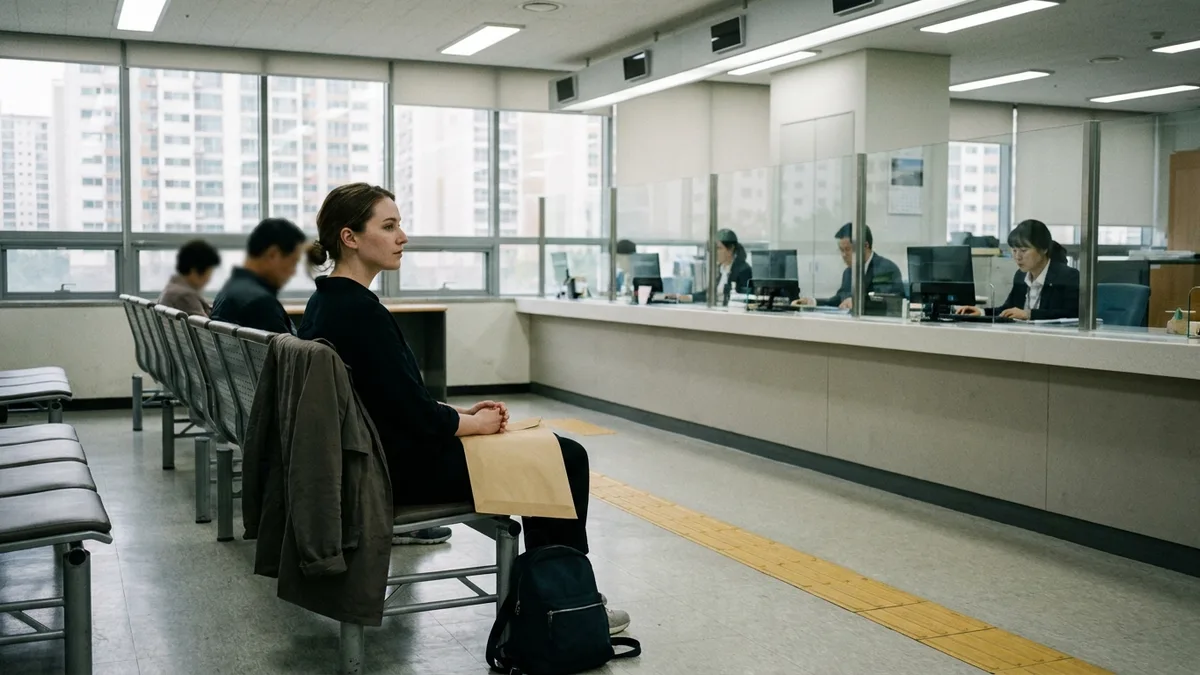
Because employment providing dormitories is common, foreigners' job changes are often simultaneous moves. Then one more report attaches. When someone who has completed alien registration moved residence, they must file a move-in report with the head of the city/county/district or township/town/neighborhood of the new residence or the head of the regional immigration/foreigner office with jurisdiction over that residence within 15 days from the move-in date (Immigration Act Article 36, Paragraph 1).
Here's the easy-to-confuse point from the previous section. Not filing the registration item change report is up to 1 million KRW administrative fine (Article 100, Paragraph 2, Item 1), but not filing the residence change report is up to 1 million KRW criminal fine (Article 98, Item 2). Because the amounts are the same, materials mix the terminology everywhere, but administrative fines are administrative measures and criminal fines are criminal punishment, so their nature differs.
The practical harm comes from elsewhere. If you don't change the address, mail goes to the old dormitory. Because it's a chain structure where you miss other deadlines in series by not receiving notices from the employment center, immigration office, and National Health Insurance Service, the residence change report is closer to the report that lets you keep other deadlines than for its own sake. The procedures and what to prepare are organized step-by-step in Alien Registration Card Reissue and Address Change.
Document bundles are determined by the 'annexes' — memorize where to check, not the list
There's no single common list of attached documents. Immigration Act Enforcement Rule Article 76, Paragraph 2, Item 2 (permission) and Item 3 (report) delegate attached documents by visa status to Annex Table 5-2, so they're set differently for each status. We did not secure the original text of Annex Table 5-2 this time.
Below is an example that the Easy-to-Find Living Law Information from the Ministry of Government Legislation (as of 2026-07-15) guides for E-9 workplace change permission applications. Additional documents attach depending on the jurisdiction immigration/foreigner office and job type, so check the list with HiKorea (hikorea.go.kr) civil petition guidance and the jurisdiction office before submission.
- Workplace change permission application form (Immigration Act Enforcement Rule Annex Form No. 34), passport, alien registration card
- Employment permit and labor contract
- Business registration certificate or corporate registry full certificate, or employer's resident registration abstract
- Guarantor's letter
Again, this isn't everything, and documents for other statuses like E-7 are separately set in Annex Table 5-2. The fee is 120,000 KRW for workplace change/addition permission (Immigration Act Enforcement Rule Article 72, reflecting 2024. 12. 24. amendment). For reference, the fee list in the same Article has no 'report' item. It's a separate civil petition with different basis and amount from visa status change permission (100,000 KRW), so don't mix it with Visa Status Change Procedures. Electronic petition application and visit reservation methods are in HiKorea Electronic Civil Petition Guide.
Three reports the company must do for progress — your procedure stops here
There's a section that stops no matter how quickly you act if the company doesn't do it. But that company is already the company you left, so if you left because the relationship was bad, contact itself is difficult in reality.
| Who · What | Where | Deadline | Basis · Form |
|---|---|---|---|
| Former employer — employment change report | Regional immigration/foreigner office | 15 days | Immigration Act Article 19, Paragraph 1 |
| Former employer — employment change report | Jurisdiction employment center | Within 15 days from occurrence/awareness | Act on Foreign Workers Employment Article 17, Paragraph 1, Enforcement Rule Article 14, Annex Form No. 12 |
| New employer (H-2) — work commencement report | Jurisdiction employment center | Within 14 days from work start | Act on Foreign Workers Employment Article 12, Paragraph 4, Enforcement Rule Article 12-3, Annex Form No. 11 |
The first row's events are dismissal, resignation, death, when the whereabouts of the employed foreigner became unknown, or when important contents of the employment contract changed. The second row's events are enumerated by Act on Foreign Workers Employment Enforcement Decree Article 23, Paragraph 1 as death, cases where continued work is inappropriate due to injury, etc., absence for 5 or more days without legitimate procedures or unknown whereabouts, labor contract termination, employer or workplace name change, work location change without employer change, etc. Employers who do not report or report falsely are subject to administrative fine of up to 5 million KRW (Act on Foreign Workers Employment Article 32, Paragraph 1, Item 7, 2021. 4. 13. amendment). The actual imposed amount is set by separate standards.
Both '14 days' and '15 days' appear, confusing H-2 readers most. 14 days is the employer's work commencement report and the window is the employment center. 15 days is the worker's own alien registration item change report and the window is the immigration/foreigner office. The governing statutes and who receives sanctions also differ. Memorizing "H-2 is report within 14 days" makes you mistake your duty for the company's duty.
Tip: If your former employer is delaying the report and blocking your procedure, directly inform the jurisdiction employment center of the facts and request consultation. If wage and working condition issues are also entangled, you can consult with interpretation through the Ministry of Employment and Labor Customer Service Center ☎1350.
Things that quietly arise during the gap period — insurance, taxes, certificates
National Health Insurance moves first. Workplace subscriber qualification changes on the day following the end of the employment relationship (National Health Insurance Act Article 9, Paragraph 1, Item 3), and at that time the subject who must report within 14 days shifts from the employer to the head of household of the regional subscriber, meaning you (same Article Paragraph 2, Item 2). The new company reports the change on the date you were employed, but the gap in between is your responsibility.
E-9 has one more layer here. For foreigners residing domestically to become regional subscribers, there's in principle a 6-month residence requirement, but permanent residence status, non-professional employment (E-9), marriage immigrants, etc. apply without that period requirement (National Health Insurance Act Article 109, Paragraph 3, Item 1, Enforcement Rule Article 61-2, Paragraph 1). Moreover, premiums for foreign regional subscribers must be paid by the 25th of the month prior to (same Act Article 109, Paragraph 8), and if you're in arrears for a period or more determined by Presidential Decree, insurance benefits are suspended from the arrears date until full payment (same Article Paragraph 10, 2024. 10. 22. amendment). It's a structure where bills come in months without income, and when you fall behind, the hospital gets blocked. Confirm the arrears standard period and your premium amount with the National Health Insurance Service ☎1577-1000.
Employment insurance has many misunderstandings. Though employment insurance law applies to workers subject to the Act on Foreign Workers Employment, unemployment benefits (Chapter 4) and parental leave benefits, etc. (Chapter 5) only apply when there's an application determined by Ministry of Employment and Labor ordinance (Employment Insurance Act Article 10-2, Paragraph 1 proviso, Enforcement Rule Article 2, Paragraph 1). The fact that employment insurance was printed on the pay stub doesn't mean unemployment benefit eligibility. It's safer to budget job-search period living expenses on the premise of no benefits. Loss report is by the 15th of the month following the month when the event occurred, but if the worker requests it be done before that date, the employer must do it without delay (Article 15, Paragraph 1, Enforcement Decree Article 7, Paragraph 1). If the new company hiring is urgent, you can use this demand.
National Pension splits by reciprocity. Foreigners employed at applicable workplaces naturally become workplace subscribers, but if that foreigner's home country law regarding pensions corresponding to the National Pension does not apply to Korean nationals, they're excluded (National Pension Act Article 126, Paragraph 1 proviso). Pay stub composition can differ even between colleagues at the same company, and in some cases it's normal not to see pension deductions. Confirm with the company HR department and the National Pension Service which side your home country is on. For what gets deducted by item, see How to Read Pay Stub Deductions.
Finally, things to get when you leave. It's much easier to collect them while you're still in contact with the company.
| To get | Who gives it | Basis · Timing |
|---|---|---|
| Labor contract (E-9 is standard labor contract) | Former employer | Contracts with the new company are also subject to written delivery (Labor Standards Act Article 17, Paragraphs 1 and 2) |
| Wage statement | Former employer | Keep at least photos of what you received during employment |
| Employment certificate | Former employer | Labor Standards Act Article 39, Enforcement Decree Article 19 — workers employed continuously for 30 days or more can request within 3 years after departure |
| Mid-year departure withholding tax receipt | Former employer | Income Tax Act Article 143, Paragraph 1 proviso — issued by the end of the month following the month containing the payment date of earned income in the departure month |
If you leave without collecting the withholding tax receipt, the new company can't do combined year-end tax settlement the next year. When you submit the earned income earner income and tax credit report including former workplace earned income, the new workplace's withholding agent is supposed to do year-end settlement adding the two places' earned income (Income Tax Act Article 138, Paragraph 1). And when departing, wages, compensation, and all money and goods must be paid within 14 days from when the payment reason arose (Labor Standards Act Article 36). If settlement isn't done even after this deadline passes, consult ☎1350. If you're confused which window to ask what, first see Where Foreigners Get Help with Labor Issues.
The jurisdiction immigration/foreigner office, employment center, and National Health Insurance Service all only open during weekday daytime hours. Situations frequently arise where you need to take two half-days in the first week of the new company. When the windows are in different neighborhoods from each other, movement alone makes half a day disappear. Planning that day's route in advance reduces the burden a bit. LACHA is a foreigner transportation and payment super-app you can use immediately without identity verification, and you can pay for KTX, intercity buses, taxis, airport rail, and transportation cards in one place. However, LACHA is a private transportation and payment service with no relation to reporting or stay procedures. Submission and assessment only happen at the above public agencies.

Need transit and payments while you wait for your residence card? Check out LACHA.
Built to work without a Korean phone number or bank account, with overseas payment methods like Alipay, WeChat Pay, and Apple Pay. Taxi hailing plus KTX, express bus, and airport railroad (AREX) booking — all in one app.
Up to 60% off Korea transit with a coupon (max ₩3,000): enter code at sign-up. KTX gets up to 18% off on top
Download now


Frequently Asked Questions (FAQ)
Q1. Do foreigners just report within 15 days when they change jobs? Generalizing that way is dangerous. The 15-day report is the 'proviso' of Immigration Act Article 21, Paragraph 1, and Enforcement Decree Article 26-2, Paragraph 1 limits the subjects to those among Professor (E-1) through Specific Activities (E-7) status holders who meet requirements notified by the Minister of Justice. If you don't meet the requirements, you return to the principle of advance permission, and if you move first without permission, regardless of the report deadline, Article 95, Item 6 (up to 1 year imprisonment or up to 10 million KRW criminal fine) and Article 46, Paragraph 1, Item 9 (subject to deportation) can apply. Do not self-assess requirements satisfaction — confirm with ☎1345 or the jurisdiction immigration/foreigner office.
Q2. I'm E-9 and applied for workplace change to the employment center. Is that it? No. The Easy-to-Find Living Law Information from the Ministry of Government Legislation (as of 2026-07-15) clearly states that separately from the employment center application, you must obtain advance workplace change permission from the Minister of Justice under Immigration Act Article 21, Paragraph 1 main text. The two procedures have different windows and governing statutes. Also see the deadlines — you must apply for change within 1 month from the date the labor contract ended, and obtain workplace change permission within 3 months from the application date (Act on Foreign Workers Employment Article 25, Paragraph 3). The procedure order is organized in E-9 Workplace Change.
Q3. I'm H-2 and changed companies. Do I need to get workplace change permission? That civil petition doesn't exist for H-2. Act on Foreign Workers Employment Article 12, Paragraph 7 does not apply Immigration Act Article 21 to H-2, and the workplace change application system under Article 25, Paragraph 1 also doesn't target them. Instead, the remaining duty is the alien registration item change report under Immigration Act Article 35. Enforcement Rule Article 49-2, Items 4 and 5 set H-2 work commencement and business change as report subjects, and the deadline is 15 days. The employer's work commencement report 14 days (Act on Foreign Workers Employment Enforcement Rule Article 12-3) is a separate report with different subject and window.
Q4. What happens to National Health Insurance during the job change gap? Workplace subscriber qualification changes on the day following the end of the employment relationship (National Health Insurance Act Article 9, Paragraph 1, Item 3), and at that time the subject who must report within 14 days is not the employer but the head of household of the regional subscriber, meaning you (same Article Paragraph 2, Item 2). E-9 becomes a regional subscriber without the 6-month residence requirement (Enforcement Rule Article 61-2, Paragraph 1), and premiums for foreign regional subscribers must be paid by the 25th of the prior month (Article 109, Paragraph 8). If you're in arrears for a period or more determined by Presidential Decree, insurance benefits are suspended until full payment (same Article Paragraph 10), so check bills even in months without income. Confirm the amount and arrears standards at ☎1577-1000.
Q5. My former company won't file reports or give me documents. Reports the company must do have three branches — employment change report under Immigration Act Article 19, Paragraph 1 (15 days), employment change report under Act on Foreign Workers Employment Article 17, Paragraph 1 (15 days, Annex Form No. 12), and H-2 work commencement report (14 days, Annex Form No. 11). Employers who do not report or report falsely are subject to administrative fine of up to 5 million KRW (Act on Foreign Workers Employment Article 32, Paragraph 1, Item 7). If the company delays, directly inform the jurisdiction employment center of the facts and request consultation. Employment certificates can be requested within 3 years after departure if you worked continuously for 30 days or more (Labor Standards Act Article 39, Enforcement Decree Article 19), and if wage issues are entangled you can consult with interpretation at ☎1350.
Reference: This article is general information organizing published statutes and government guidance and is not legal or visa advice. The statutory articles, deadlines, fees, and administrative fines in the main text are based on 2026-08 National Law Information Center statutory original texts (Immigration Act and same Act Enforcement Decree and Enforcement Rule, Act on Foreign Workers Employment and subordinate statutes, National Health Insurance Act, Employment Insurance Act, National Pension Act, Labor Standards Act, Income Tax Act), Easy-to-Find Living Law Information from the Ministry of Government Legislation "Foreign Worker Employment" (2026-07-15 basis), and Korea Policy Briefing verified content. Statutes and systems are amended and operating methods and phone numbers can also change, so before acting please re-confirm based on your own situation with ☎1345 (stay and immigration reports), ☎1350 (wages, working conditions, employment center procedures), ☎1577-0071 (Foreign Workforce Support Center, four major insurances), ☎1577-1000 (National Health Insurance), HiKorea (hikorea.go.kr), and jurisdiction immigration/foreigner offices and employment centers. This article does not assess visa status maintenance or requirements satisfaction. LACHA is a private transportation and payment service unrelated to the above agencies and does not act as an agent for reports.