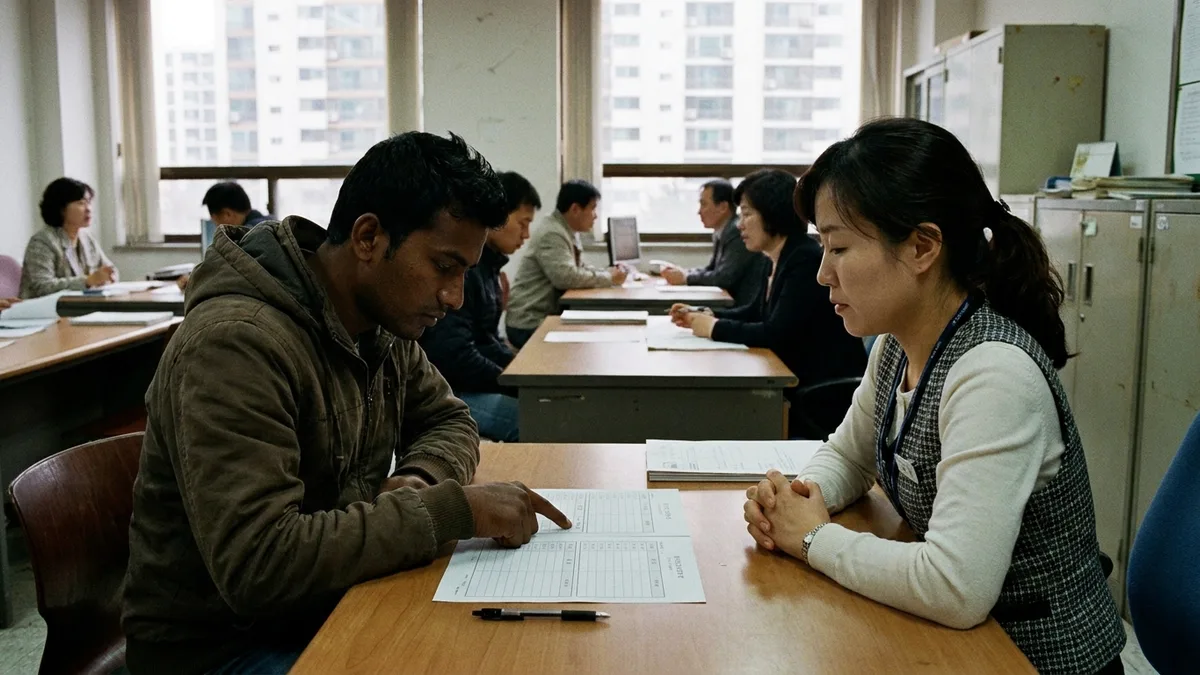

In Korea, there is a legally fixed list of things a job placement ad has to state. Article 25, Subparagraph 4 of the Enforcement Decree of the Employment Security Act requires a fee-charging job placement operator, when advertising, to state the placement agency's name, phone number, location, and registration number (delegated under Article 19(6) of the Act, as of 2026). If a message arrives in your own language with none of those four and nothing but "get in touch," that is not a matter of taste — a disclosure that is supposed to be there is missing.
The timing of payment is fixed too. A placement fee may be collected only after a labor contract has been signed between the employer and the job seeker (Article 25, Subparagraph 6 of the same Enforcement Decree). If someone demands money up front before you have even signed a contract, that alone is a sign that the rules have already been left behind.
That means you do not have to sort this out by feel. What follows is only what you can verify with your own eyes — on the screen and in the office — before you sign, together with the provisions behind each point.
Note: This article is general information compiled from publicly available laws and government guidance, and it is not legal advice. It covers only which acts carry which penalties and what the legal routes are, and it does not cover, in any form, how to work without permission or how to avoid enforcement. Please be sure to check the official channels below for a judgment that fits your own situation.
Placement and Brokering Split Four Ways — Registration, Notification, and Permission All Differ
Introducing or brokering employment requires different procedures depending on the form it takes (Employment Security Act, as of 2026). Placement for a fee requires registration, free placement requires notification, supplying workers requires permission, and providing job listing information requires notification. The penalties for violations differ too, so lumping everything together as "illegal placement" will not do.
| Type | Procedure required | Who may do it | If done without the procedure |
|---|---|---|---|
| Fee-charging job placement (domestic) | Registration with the competent city/county/district office (Art. 19(1)) | A person meeting the registration requirements | Up to 5 years' imprisonment or a criminal fine of up to 50,000,000 KRW (Art. 47, subpara. 1) |
| Fee-charging job placement (overseas) | Registration with the Minister of Employment and Labor (Art. 19(1)) | A person meeting the registration requirements | Up to 5 years' imprisonment or a criminal fine of up to 50,000,000 KRW (Art. 47, subpara. 1) |
| Free job placement | Notification (Art. 18(1)) | Only non-profit corporations and public-interest organizations prescribed by Presidential Decree (Art. 18(2)) | Up to 1 year's imprisonment or a criminal fine of up to 10,000,000 KRW (Art. 48, subpara. 1) |
| Worker supply | Permission from the Minister of Employment and Labor (Art. 33(1)) | Domestic supply only by labor unions (Art. 33(3)) | Up to 5 years' imprisonment or a criminal fine of up to 50,000,000 KRW (Art. 47, subpara. 1) |
| Job listing information provision | Notification to the Minister of Employment and Labor (Art. 23(1)) | Operators that have filed the notification | Up to 1 year's imprisonment or a criminal fine of up to 10,000,000 KRW (Art. 48, subpara. 1) |
The row worth staring at is free job placement. "Don't worry, I'm not taking any money" sounds like a reassuring signal, but free job placement is subject to notification and may be carried out only by non-profit corporations or public-interest organizations. An individual stepping forward to introduce you to a job for free is not, in itself, a normal structure.
📌 Important: Registration, notification, and permission answer only one question — whether this person is qualified to do this work. A registered agency does not thereby guarantee the working conditions or the trustworthiness of the employer.
What to Check on the Listing Screen — Disclosures and the Four Types of "False Job Ad"
Job listing sites have rules to follow as well. A job ad may not be posted if the employer's business name, personal name, or business registration certificate cannot be verified, or if the identity is uncertain because the contact is given as a post office box, and the notification number must be displayed where users can easily see it (Enforcement Decree of the Employment Security Act, Art. 28, subparas. 1 and 5). Job listings below the minimum wage, and ads for establishments where the acts prohibited under Article 4 of the Act on the Punishment of Acts of Arranging Sexual Traffic take place, cannot be carried either (same Article, subpara. 6; Act Art. 25, subpara. 2). If the employer is currently on the published list of wage-defaulting employers, that fact must be posted so job seekers can see it (Act Art. 25, subpara. 1).
The provision that prohibits false job ads is Article 34(1) of the Employment Security Act, and Article 34 of the same Act's Enforcement Decree defines the scope. The penalty is up to 5 years' imprisonment or a criminal fine of up to 50,000,000 KRW (Act Art. 47, subpara. 6, as of 2026).
| Enforcement Decree Art. 34 | What kind of ad |
|---|---|
| Subpara. 1 | An ad that poses as a job offer in order to sell goods, recruit course participants, provide job placement, arrange side work, raise funds, and the like |
| Subpara. 2 | An ad that omits the employer's identity (business name or personal name) for the purpose of a false job offer |
| Subpara. 3 | An ad in which the job type, employment form, working conditions, and the like presented differ markedly from those at the time of application |
| Subpara. 4 | Any other ad in which material content differs from the facts |
Keep Subparagraphs 3 and 4 in mind. If you only found out at the interview that the conditions had changed, you still have grounds to file a report then.
Note: Not appearing on this list does not mean an ad is fine. And conversely, a registration number being written down does not mean it is genuine — numbers can be fabricated or stolen, so final confirmation has to come from the registering authority, the competent city/county/district office (the Ministry of Employment and Labor for overseas placement). Whether a one-off post by an individual in a community forum counts as a job information provision business turns on whether it is "done as a business," so do not decide that for yourself.
The Moment Money Comes Up — When, How Much, and from Whom
The single most practical line in this article is this one. A placement fee may be collected only after a labor contract has been signed (Enforcement Decree of the Employment Security Act, Art. 25, subpara. 6; Public Notice on Domestic Fee-Charging Job Placement Fees, etc., Ⅰ-1 / Ministry of Employment and Labor Public Notice No. 2017-22, in force from July 1, 2017). If someone demands an advance payment or a deposit before the contract, the rules have already been broken at that point.
| Category | Cap | Condition |
|---|---|---|
| Paid by the employer (under 3 months) | Up to 30/100 of the wages for the employment period (up to 10/100 for daily construction work) | After the labor contract is signed |
| Paid by the employer (3 months or more) | Up to 30/100 of three months' wages | After the labor contract is signed |
| Paid by the job seeker | Up to 1/100 of the relevant wages | Requires a written agreement concluded with the job seeker in advance |
| Membership-based day labor (housekeeping, caregiving, etc.) | Membership fee within 4% of the monthly minimum wage equivalent | No additional placement fee beyond the monthly membership fee |
| Overseas job placement | Within 33/100 of three months' wages | Only on or after the date departure procedures are completed and employment is confirmed |
Overseas placement is governed separately by the Public Notice on Overseas Fee-Charging Job Placement Fees, etc. (Ministry of Employment and Labor Public Notice No. 2016-10, in force from February 2, 2016). Public notices can be amended, so please check the current version at the National Law Information Center.
Do not mix up the two numbers. The cap on the ordinary placement fee borne by a job seeker is 1%, while the 4% is the cap on the monthly membership fee when day laborers such as housekeepers and caregivers are handled on a membership basis. They are different items.
Simplifying this to "if they ask for money, it's a scam" backfires — you end up avoiding legitimate agencies and walking into unregistered brokers. A placement fee collected by a registered operator within the range of the public notice is lawful, and the signals of illegality narrow down to four: ① no registration, ② demanding payment before a labor contract is signed, ③ exceeding the public notice cap, ④ collecting from the job seeker without a prior written agreement.
- The sanction for collecting more than the public notice fee is an administrative disposition, not a criminal punishment — under the standards for administrative dispositions in [Appended Table 2] of the Enforcement Rule, it is a 1-month business suspension for the first offense, 2 months for the second, and cancellation of registration for the third (violation of Act Art. 19(3), based on Art. 36(1)).
- A person recruiting workers taking money or goods from applicants is prohibited separately (Act Art. 32; an exception applies where a fee-charging job placement operator recruits or places workers on commission). A violation carries up to 5 years' imprisonment or a criminal fine of up to 50,000,000 KRW (Art. 47, subpara. 5).
- At the office, check whether the registration certificate, fee schedule, and staff roster are posted inside the agency. The fee schedule must be at least 25 cm wide and 36 cm tall ([Appended Table 1-2], subpara. 14 of the Enforcement Rule). The placement fee agreement is drawn up in three copies, one each kept by the employer, the job seeker, and the agency (same Appended Table, subpara. 2, item (d)).
Whether the money you paid falls within the range of the public notice is hard to judge on your own. Write down the amount and the date you paid, and ask the competent city/county/district office.
If Anyone Tells You to Hand Over Your Passport or ARC, End It Right There
You may as well memorize this sentence as it stands. No one may receive a foreigner's passport or alien registration card as a means of securing a contract or the performance of a debt arising from employment, nor may anyone coerce or arrange the handing over of such documents (Immigration Act, Art. 33-3, subpara. 1, as of 2026). A violation carries up to 3 years' imprisonment or a criminal fine of up to 30,000,000 KRW (same Act, Art. 94, subpara. 19). The provision is aimed at the person who receives the documents or who coerces or arranges it.
Attempts to tie you down with money are blocked by provisions too. A contract fixing in advance a penalty or an amount of damages for failure to perform a labor contract is prohibited (Labor Standards Act, Art. 20), and offsetting advances against wages is prohibited as well (Art. 21). A violation of either provision carries a criminal fine of up to 5,000,000 KRW (Art. 114, subpara. 1). A forced savings or savings management contract attached to a labor contract carries up to 2 years' imprisonment or a criminal fine of up to 20,000,000 KRW (Art. 22(1); penalty under Art. 110, subpara. 1), and forcing work against a person's free will through assault, intimidation, or confinement carries up to 5 years' imprisonment or a criminal fine of up to 50,000,000 KRW (Art. 7; penalty under Art. 107).
📌 Important: There is a separate rule barring a placement operator from holding or seizing a job seeker's resident registration card or belongings (Enforcement Rule of the Employment Security Act, [Appended Table 1-2], subpara. 5). That compliance duty, however, applies to job placement operators and their staff. Whether an employer holding a passport falls under the Immigration Act provision above varies case by case, so check with both ☎1345 and ☎1350.
The Provisions Behind "We'll Take Care of the Visa for You"
Not just anyone can act as an agency filing applications on your behalf for things like a change or extension of status of stay or a change of workplace. They must hold a lawyer's or certified administrative agent's qualification, complete the required training, and register with the Minister of Justice (Immigration Act, Art. 79-2(2), as of 2026). A person who is not a certified administrative agent and who carries out, as a business, the services listed in each subparagraph of Article 2(1) of the Certified Administrative Agents Act faces up to 3 years' imprisonment or a criminal fine of up to 30,000,000 KRW (violation of Certified Administrative Agents Act Art. 3(1); penalty under Art. 36(1), subpara. 1).
An offer of "we'll prepare the documents for you" runs into a provision further upstream. Inviting a foreigner, or arranging such an invitation, by improper means such as entering false facts or providing a false identity guarantee, and applying for a visa or a certificate of visa issuance eligibility by false means or arranging such an application, are prohibited (Immigration Act, Art. 7-2) and carry up to 3 years' imprisonment or a criminal fine of up to 30,000,000 KRW (Art. 94, subpara. 3).
| Act | Provisions | Statutory penalty |
|---|---|---|
| Working without a status of stay permitting employment | Art. 18(1) → Art. 94, subpara. 8 | Up to 3 years' imprisonment or a criminal fine of up to 30,000,000 KRW |
| Employing a person without the qualification | Art. 18(3) → Art. 94, subpara. 9 | Up to 3 years' imprisonment or a criminal fine of up to 30,000,000 KRW |
| Arranging or soliciting, "as a business," the employment of an unqualified foreigner | Art. 18(4) → Art. 94, subpara. 10 | Up to 3 years' imprisonment or a criminal fine of up to 30,000,000 KRW |
| Arranging, "as a business," the employment of a foreigner without workplace-change permission | Art. 21(2) → Art. 94, subpara. 13 | Up to 3 years' imprisonment or a criminal fine of up to 30,000,000 KRW |
| Changing or adding a workplace without permission, or employing such a foreigner | Art. 21(1) and (2) → Art. 95, subpara. 6 | Up to 1 year's imprisonment or a criminal fine of up to 10,000,000 KRW |
Look at the rows carrying the words "as a business." Without that element, the case moves to Article 95 and the penalty changes. And the amounts in the provisions are statutory maximums, not the amounts actually imposed — for immigration offenders, the summary fine under a notice disposition is set separately by the assessment standards in an Ordinance of the Ministry of Justice (Arts. 102(1) and 103(1)).
If your first question is whether your own status even allows that work, start with What You Can Do on Each Status of Stay. To confirm whether the other party is a registered filing agency, asking ☎1345 is the accurate route.
There Is No Room for a Broker in EPS (E-9) or Seasonal Work (E-8)
The Employment Permit System prohibits anyone other than an employment security office from intervening in the selection, placement, or other hiring of foreign workers (Act on the Employment, etc. of Foreign Workers, Art. 8(6)). A violation carries up to 1 year's imprisonment or a criminal fine of up to 10,000,000 KRW (Art. 29, subpara. 1). An unqualified person receiving money or goods in return for handling labor contract signing or employment paperwork on someone's behalf is prohibited as well (Art. 27(4)) and carries the same penalty (Art. 29, subpara. 5). A person who obstructs a workplace change faces the same penalty under Art. 29, subpara. 4.
A provision to the same effect took effect for seasonal work on January 23, 2026. Apart from the State, local governments, and designated specialized institutions, no one may intervene in the selection, placement, or hiring of seasonal workers (Immigration Act, Art. 19-5(9)), and a violation carries up to 3 years' imprisonment or a criminal fine of up to 30,000,000 KRW (Art. 94, subpara. 11-2).
The reason broker offers work is time. For an E-9 workplace change, you must leave the country if you fail to obtain workplace-change permission within 3 months from the date of application, or if you do not apply for the change within 1 month from the date the labor contract ended (Act on the Employment, etc. of Foreign Workers, Art. 25(3); the starting point of the period differs where there are grounds such as an occupational accident, illness, pregnancy, or childbirth). Pressed by that deadline, it gets hard to turn down "pay a fee and I'll push it through fast." The place to go at that moment is the Employment Center, not a broker.
The official EPS site (eps.go.kr) has a separate "Report a Broker" menu. The procedure is laid out in Employment Permit System (EPS) Job Procedures, and what to check in the contract is in How to Check the Standard Labor Contract.
You must get a contract, without exception. The employer has to hand the worker a written document specifying wages, contractual working hours, weekly paid holidays, annual paid leave, and the like (Labor Standards Act, Art. 17(1) and (2)), and a violation carries a criminal fine of up to 5,000,000 KRW (Art. 114, subpara. 1). For E-9, use of the standard labor contract is mandatory (Act on the Employment, etc. of Foreign Workers, Art. 9(1)), and failing to use it carries an administrative fine of up to 5,000,000 KRW (Art. 32(1), subpara. 1).
Other Crimes Disguised as Jobs — Bank Account Errands and "High Pay" in a Third Country
"Just lend me your bank account," "just withdraw the money and hand it over" — these are not jobs. Article 6(3) of the Electronic Financial Transactions Act prohibits transferring or acquiring access media (bankbooks, cards, passwords, and the like), lending, storing, delivering, or circulating them in exchange for consideration, lending, storing, or delivering them while knowing they will be used in a crime, and arranging, brokering, advertising, or soliciting any of these acts. A violation carries up to 5 years' imprisonment or a criminal fine of up to 30,000,000 KRW (Art. 49(4)), and imprisonment and a criminal fine may be imposed together (Art. 49(8)).
The same goes for identity. Using another person's alien registration card improperly, or providing your own card while knowing it will be used improperly, is prohibited as well (Immigration Act, Art. 33-3, subpara. 4).
Get to know the heaviest provision in the Employment Security Act too. Job placement, worker recruitment, or worker supply carried out by means of assault, intimidation, confinement, or otherwise unduly restraining mental or physical freedom, and job placement, recruitment, or supply for the purpose of putting someone to work in a business where sexual traffic or other obscene acts take place, carry up to 7 years' imprisonment or a criminal fine of up to 70,000,000 KRW, and attempts are punished as well (Art. 46(1) and (2)).
Offers calling you to a third country come too. On September 26, 2025, the Ministry of Foreign Affairs' Overseas Safety Travel service posted a notice on "Caution regarding job scams and confinement in Cambodia and other Southeast Asian regions," naming Cambodia (Phnom Penh, Sihanoukville, Bokor Mountain in Kampot, Bavet, Poipet), Laos, Myanmar, and Thailand. It explains that people are lured into overseas jobs with the bait of high pay and then forced into illegal acts tied to online crime such as stock-tip chat rooms and voice phishing, and are confined and even assaulted if they refuse. That same notice set out four precautions.
- Be suspicious from the outset of prepaid airfare and the like (to be settled later) or employment terms that are too good
- Find the person in charge at the company you intend to work for, consult them directly, and confirm exactly what the work will involve
- Put every contract term in writing, and never sign a document written in a foreign language without properly checking it
- Be sure to obtain a work visa before departing
That notice was written for Korean nationals, but the same methods reach foreigners living in Korea in exactly the same way.

Where to Report — Filing Splits Four Ways
This is where a lot of wasted trips happen. ☎1350 is a counseling line for wages and working conditions, not the office that takes reports of illegal job placement. Article 2(1) of the Operating Rules on the Reward System for Reporting Illegal Job Placement, etc. (Ministry of Employment and Labor Public Notice No. 2013-12) splits the receiving offices four ways.
| What | Where |
|---|---|
| Matters related to domestic job placement | The mayor, county governor, or district office head with jurisdiction over the location of the business |
| Matters related to overseas job placement | The head of the employment security office (Employment Center) with jurisdiction over the location of the business |
| Matters related to false job ads | Both the head of the competent employment security office and the mayor, county governor, or district office head |
| Criminal complaints and accusations | The investigative agency with jurisdiction over the location of the business |
A report can be filed under your real name by fax, mail, internet, or in person, attaching supporting evidence to the violation report form, and the receiving office must maintain security so that the reporter's identity is not leaked (same Article, paragraphs 2 and 4).
The reward covers a narrower range than you might expect. It applies only to violations of Article 34 of the Employment Security Act (400,000 KRW) and Article 46(1), subparagraphs 1 and 2 (1,000,000 KRW) (Act Art. 45-3; Operating Rules Art. 6(2)), and it is paid only where a prosecution, a suspension of indictment, or an administrative disposition has followed (Art. 5(1)). The report must be filed within 2 years from the date of the violation (Art. 7(1)), and anonymous or pseudonymous reports are not paid (Art. 7(3), subpara. 4). The most common violation of all, unregistered fee-charging job placement (Act Art. 47, subpara. 1), is not eligible for a reward.
If contact happened only through a messenger app, you will not know the location of the business, and you get stuck right here. That is why there are things to gather in advance.
- A screenshot of the original job listing — with the URL and posting date both visible
- The full message history — recovery is hard once you leave the chat room
- Deposit records and the name of the account holder
- Photos of business cards and the business registration certificate, and the address of the office you visited
- The placement fee agreement and the labor contract
Separately, on December 23, 2025, the Ministry of Employment and Labor announced a comprehensive plan for tackling false job ads, saying it would amend the Employment Security Act to place responsibility for reviewing, deleting, and reporting ads on job listing platforms. However, as of August 2026 it has not been confirmed whether that amendment has passed the National Assembly or taken effect. For now, please read it as a plan.
| Issue | Number |
|---|---|
| Stay and visa | ☎1345 (Immigration Contact Center, 외국인종합안내센터) |
| Wages and working conditions | ☎1350 (Ministry of Employment and Labor Customer Support Center) |
| Foreign workforce counseling (18 languages) | ☎1577-0071 (Foreign Workforce Counseling Center) |
| Free legal counseling | ☎132 (Korea Legal Aid Corporation) |
| Multicultural families and migrant women | ☎1577-1366 |
| Emergencies | 112 |
The official job channels are Work24 (work24.go.kr) and EPS (eps.go.kr). If you are not sure which office to ask about what, start with A Complete Guide to Official Support Channels for Foreigners, and if you have already worked and not been paid, Wage and Industrial Accident Rights for Undocumented Workers lays out the grounds for a claim and the deadlines.
District offices, Employment Centers, and immigration offices open only during weekday daytime hours, so a single confirmation often costs you a whole day off. LACHA is a transport and payment super app for foreigners that you can use right away without identity verification, letting you pay for KTX, express buses, taxis, the airport railroad, and transit cards all in one place. That said, LACHA has nothing to do with employment or visa matters — it is a private transport and payment service. Counseling, reporting, and official determinations happen only at the public institutions above.

Need transit and payments while you wait for your residence card? Check out LACHA.
Built to work without a Korean phone number or bank account, with overseas payment methods like Alipay, WeChat Pay, and Apple Pay. Taxi hailing plus KTX, express bus, and airport railroad (AREX) booking — all in one app.
Up to 60% off Korea transit with a coupon (max ₩3,000): enter code at sign-up. KTX gets up to 18% off on top
Download now


Frequently Asked Questions (FAQ)
Q1. If a job ad has no registration number, is it automatically a scam? You cannot conclude that. Ads by a person who does job placement as a business must include the agency's name, phone number, location, and registration number (Enforcement Decree of the Employment Security Act, Art. 25, subpara. 4), but whether a one-off post by an individual in a community forum counts as a job information provision business or worker recruitment turns on whether it is "done as a business." Conversely, a number being written down is no guarantee either, since it can be stolen or fabricated. For final confirmation, ask the registering authority, the competent city/county/district office (the Ministry of Employment and Labor for overseas placement).
Q2. Is it always illegal to ask for a placement fee? No. A placement fee collected by a registered fee-charging job placement operator within the range of the public notice is lawful. There are four signals of illegality: no registration, demanding payment before a labor contract is signed (Enforcement Decree Art. 25, subpara. 6), exceeding the public notice cap, and collecting from the job seeker without a prior written agreement. The cap borne by the job seeker is 1/100 of the relevant wages, and the 4% for membership-based day labor such as housekeeping and caregiving is a monthly membership fee, which is a different item (Public Notice on Domestic Fee-Charging Job Placement Fees, etc., Ministry of Employment and Labor Public Notice No. 2017-22). The sanction for collecting more than the public notice fee is not a criminal punishment but an administrative disposition such as business suspension or cancellation of registration (Enforcement Rule [Appended Table 2]).
Q3. The company says it will hold on to my passport. Can I refuse? The grounds for refusing are in the statute. No one may receive a foreigner's passport or alien registration card as a means of securing a contract or the performance of a debt arising from employment, nor coerce or arrange the handing over of such documents (Immigration Act, Art. 33-3, subpara. 1), and a violation carries up to 3 years' imprisonment or a criminal fine of up to 30,000,000 KRW (Art. 94, subpara. 19). Demands for a deposit or a penalty payment are blocked by Articles 20 and 21 of the Labor Standards Act as well. Whether an individual case falls under these provisions varies with the circumstances, so check with both ☎1345 and ☎1350.
Q4. Where do I go to report an illegal broker? The receiving office depends on the case. Domestic job placement goes to the mayor, county governor, or district office head with jurisdiction over the location of the business; overseas job placement goes to the head of the competent employment security office (Employment Center); false job ads go to both; and criminal complaints and accusations go to the competent investigative agency (Operating Rules on the Reward System for Reporting Illegal Job Placement, etc., Art. 2(1)). ☎1350 is a counseling line for wages and working conditions. Rewards are paid only for violations of Article 34 of the Employment Security Act and Article 46(1), subparagraphs 1 and 2, and they come with real-name and within-2-years requirements. If your status of stay is tangled up in it, split your questions — labor issues to ☎1350, stay issues to ☎1345.
Q5. I got an offer saying "just lend me your bank account and you'll make this much a day." That is not a job, it is a request to take part in a crime. Article 6(3) of the Electronic Financial Transactions Act prohibits transferring or acquiring access media and lending, storing, delivering, or circulating them for consideration, along with arranging, brokering, and advertising such acts, and a violation carries up to 5 years' imprisonment or a criminal fine of up to 30,000,000 KRW, with imprisonment and a criminal fine imposable together (Art. 49(4) and (8)). Using another person's alien registration card improperly, or providing your own card while knowing it will be used improperly, is prohibited too (Immigration Act, Art. 33-3, subpara. 4). If you have already handed something over, do not try to solve it alone — get legal counseling at ☎132, and if the situation is urgent, report it to 112.
Reference: This article is general information compiled from publicly available laws and government guidance, and it is not legal advice. The provisions, penalties, and public notice details in the text were confirmed as of 2026-08 from the original texts of the Employment Security Act and its Enforcement Decree and Enforcement Rule, the Immigration Act, the Act on the Employment, etc. of Foreign Workers, the Labor Standards Act, the Certified Administrative Agents Act, and the Electronic Financial Transactions Act at the National Law Information Center, together with the Public Notice on Domestic Fee-Charging Job Placement Fees, etc. (No. 2017-22), the Public Notice on Overseas Fee-Charging Job Placement Fees, etc. (No. 2016-10), the Operating Rules on the Reward System for Reporting Illegal Job Placement, etc. (No. 2013-12), and the Ministry of Foreign Affairs' Overseas Safety Travel safety notice (2025-09-26). Laws and public notices are amended, and phone numbers and operating hours can change as well, so before you act, please check again against your own situation at ☎1345 (stay and visa), ☎1350 (wages and working conditions), ☎1577-0071 (Foreign Workforce Counseling Center), and ☎132 (legal aid). Do not judge for yourself whether a party is registered, whether they are qualified to file on your behalf, what work your status of stay allows, or whether the money you paid falls within the public notice range — get a determination from the competent authority. LACHA is a private transport and payment service unrelated to the public institutions above, and it does not arrange employment or handle visa procedures on your behalf.