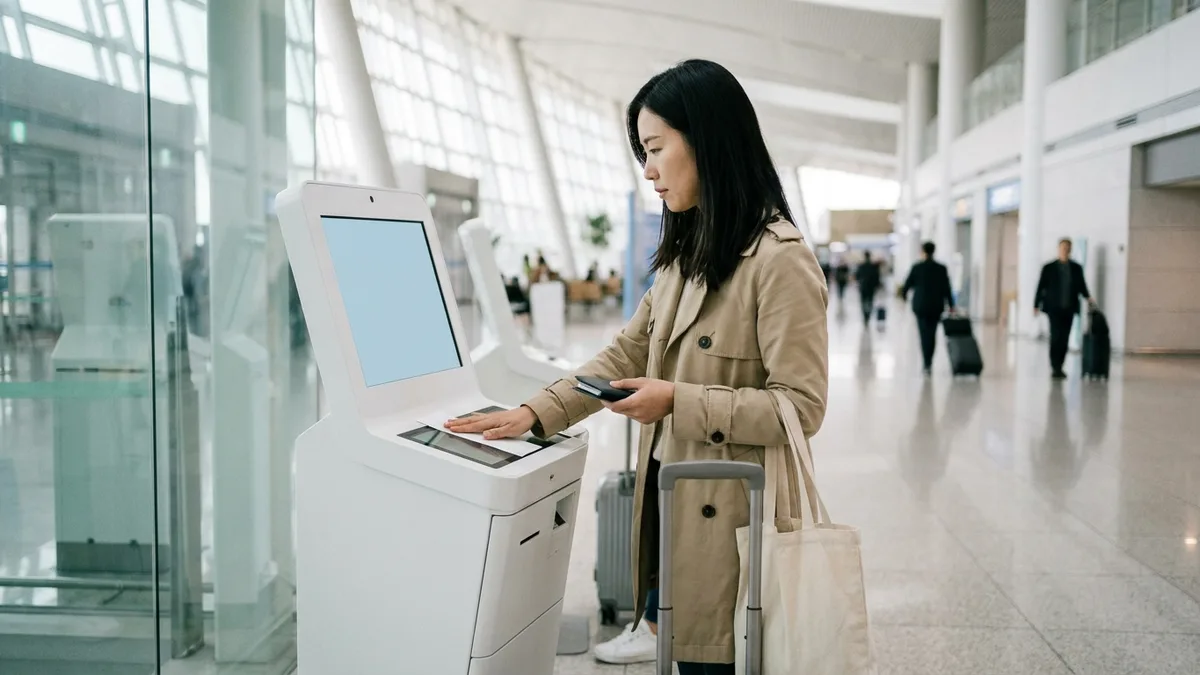
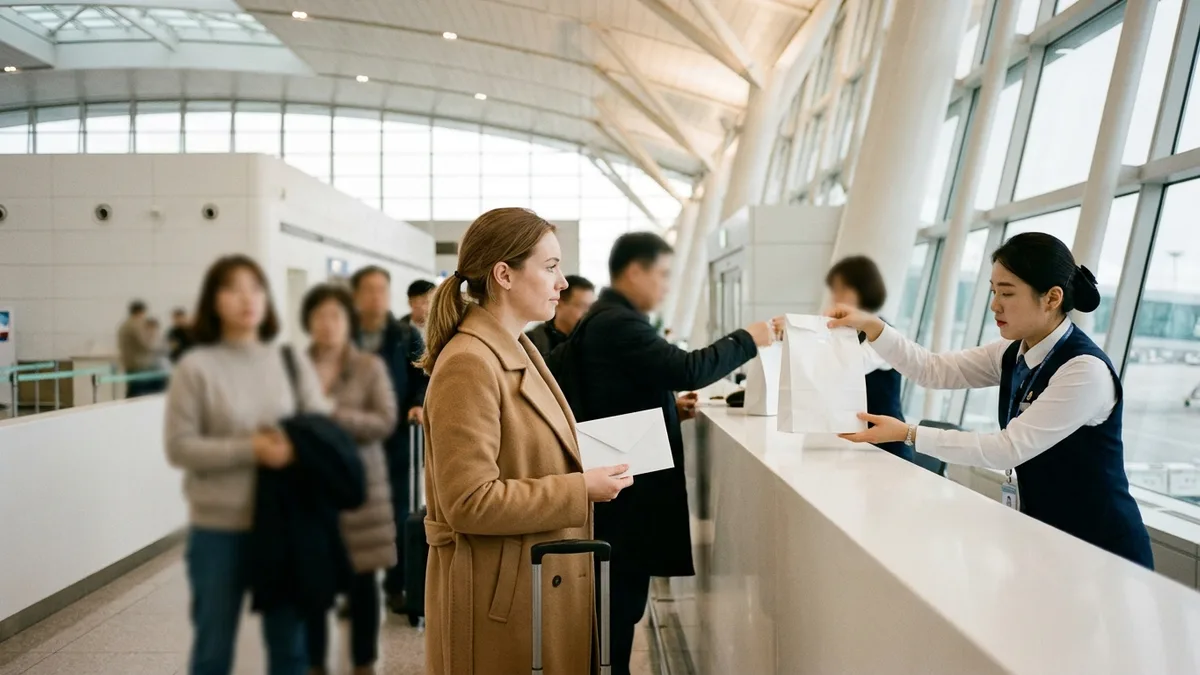
You pay for an imported-brand perfume at a downtown duty-free shop in central Seoul, and instead of the perfume, the staff member hands you a single exchange voucher (교환권). You're told to pick up the item in the airport departure area on the day you leave. Before you paid, they even asked for your passport and the flight number of the plane you're leaving on. This is the moment that catches foreigners using a Korean duty-free shop for the first time most off guard.
This setup comes from the law, not from store policy. The legal name for a duty-free shop is a bonded store (보세판매장), and Article 196 of the Customs Act allows goods to be sold without tax on the condition that the buyer takes them out of the country. That's why the shop checks who is leaving on which flight, and why the goods are handed over inside the departure area, on your way out of Korea.
Note: The provisions and limits below are based on the Customs Act and the Public Notice on the Licensing and Operation of Bonded Stores (보세판매장 특허 및 운영에 관한 고시; Korea Customs Service Public Notice No. 2026-40), among others, as of 2026-09. Pickup counter locations, how far in advance you can buy, and deadlines for changing your departure details are policies each duty-free shop sets, and they change from time to time, so the guidance on the exchange voucher or order history from the shop where you bought comes first.
Duty-Free Shops and Tax Refunds Are Different Systems
A "Tax Free" sign at a store entrance doesn't tell you on its own which system it is. A duty-free shop (사전면세, tax exemption at the point of sale) is where no tax is added to the selling price in the first place, while a tax refund store (사후면세, post-purchase tax exemption) is where you buy at the regular tax-inclusive price and later get back the VAT and individual consumption tax you paid (with an immediate in-store refund, that tax amount is taken off when you pay).
| Category | Duty-free shop (사전면세) | Tax refund (사후면세) |
|---|---|---|
| Price | Price with the tax taken out from the start | Regular tax-inclusive price, refunded after you buy |
| Tax you get back | None | VAT and individual consumption tax |
| Legal basis | Customs Act, Article 196 (bonded stores) | Regulations on Special Cases concerning Value-Added Tax and Individual Consumption Tax for Foreign Tourists, etc. |
| Who uses it | People departing Korea (Korean nationals and foreigners; for downtown, departure-area, and online duty-free shops) | Non-residents under the Foreign Exchange Transactions Act (mainly foreign tourists) |
Mixing the two up costs you money. A duty-free shop receipt has no tax to get back at the airport refund counter, and goods bought at a tax refund store stay taxed if you don't go through the refund procedure.
Who can use them differs too. For tax refunds, foreign tourists are limited to non-residents, and a foreigner who is engaged in business activities in Korea or has stayed in Korea for 6 months or longer is treated as a resident (Enforcement Decree of the Foreign Exchange Transactions Act, Article 10). The Korea Customs Service's Public Notice, on the other hand, defines who downtown and departure-area duty-free shops sell to as departing travelers (출국인), meaning Korean nationals and foreigners leaving Korea, and sets no length-of-stay requirement (online duty-free shops are how these same shops sell by e-commerce, so the same people are eligible). So a foreigner who has worked and lived in Korea for a long time still counts as a departing traveler when leaving for another country. The refund procedure is covered separately in How to Get a Tax Refund in Korea.
There Are Four Kinds of Duty-Free Shops: Downtown, Departure Area, Online, and Arrival
The Korea Customs Service's Public Notice classifies duty-free shops by location and by who they sell to. Travelers come across four: the three types the Public Notice sets out — downtown, departure-area and arrival duty-free shops — plus online duty-free shops, which are how those shops sell over the internet. In-flight duty-free sales are left out of this table.
| Type | Where it is | Who it sells to | Where you get your goods / features |
|---|---|---|---|
| Downtown duty-free shop | Outside the bonded areas of airports and seaports | Departing travelers | Pickup counter in the departure area (Korean-made goods bought by foreigners can sometimes be handed over at the store) |
| Departure-area duty-free shop | Inside the departure area of an airport or seaport | Departing travelers | Right where you buy |
| Online duty-free shop | A duty-free shop's e-commerce (website or app) | Departing travelers | Pickup counter in the departure area |
| Arrival duty-free shop | Along the arrival route at an airport or seaport | Korean nationals and foreigners entering Korea | Sales limit of USD 800 |
Downtown and online duty-free shops let you take your time choosing in advance, but you can't take what you buy with you that day. That's because the Public Notice requires goods sold by downtown duty-free shops (including online sales) to be handed over only after an exchange voucher is issued and the goods are moved to the pickup counter. Goods from a departure-area duty-free shop are handed over on the spot, and in-flight duty-free goods on the plane.
Arrival duty-free shops are used on your way into Korea, so what you buy there is added up when your duty-free allowance on entry is calculated (see the last section). Diplomatic duty-free shops are only for diplomats and foreign mission staff stationed in Korea.
The duty-free purchase limit that applied to Korean nationals departing Korea (USD 5,000) was abolished on March 18, 2022, and the Ministry of Government Legislation's Easy-to-Find Living Law Information says there is now no limit on how much you buy when departing. If you see this limit in older articles, don't read it as the current rule.
Why They Ask for Your Passport and Outbound Flight Details When You Buy
At a downtown duty-free shop's checkout or on an online duty-free shop's order screen, you'll be asked for a passport with the correct issuing country, passport number, and name in English, plus your confirmed departure date, time, and flight number. That's because the Public Notice requires duty-free shops to check the buyer's personal details and entry/exit status with a passport or similar document.
Your flight details are what the goods are shipped by. The Public Notice requires goods sold at downtown duty-free shops to be sealed and moved under bonded transport so that they arrive at the pickup counter by 2 hours before the scheduled departure of the buyer's flight (or by 1 hour before, if the head of customs with jurisdiction allows it in light of distance and traffic). That's why duty-free shops tell you that you need to enter your flight number and time correctly to get your goods.
Your passport details get used once more at the pickup counter. If the passport number on the exchange voucher differs from the passport number of the person departing, the handover can be refused, and under the Public Notice, in that case the goods can only be handed over as instructed by a customs officer, after the officer looks up your entry and exit records and decides whether you are the buyer. If you were issued a new passport after buying, let the duty-free shop where you bought know before you leave and ask how they'll handle it.
When you pay, a downtown duty-free shop has to check that the credit card is in your own name (Public Notice). Reasons an overseas card gets blocked at the payment step are covered in When Your Foreign Card Gets Declined in Korea.
How far in advance you can buy is up to each duty-free shop. Two major duty-free shops say you can buy starting 90 days before your departure date. The online duty-free order cutoff (up to how many hours before departure) differs by shop, departure airport, and departure time, and we couldn't confirm the current values, so enter your departure airport and time on the order screen to check.
Why You Pay but Don't Get the Item: Exchange Vouchers and Pickup Counters
When you pay at a downtown or online duty-free shop, what you get is not the item but an exchange voucher signed by you as the buyer. The goods are shipped to the pickup counter and handed over there, and with an electronic exchange voucher, a number check at the pickup counter takes its place.
Pickup counters are inside the bonded area of the departure area, in the zone where you wait to board. So you get your goods on your departure day, after you've finished departure formalities (security and immigration). Even if you look for the pickup counter near the check-in counters, you can't get to it before departure formalities.
Only the person who bought the goods can receive them. The buyer signs in person, and the staff handing over the goods check that against the signature or personal details from the purchase using the buyer's passport, so someone traveling with you can't pick them up for you.
Don't count on picking them up when you come back into Korea, either. The law does provide for arrival pickup counters, where duty-free goods bought when departing are received in the arrival area when you come back into Korea, and the Korea Customs Service announced in January 2020 that it would introduce them (from July 1 that year). But for Incheon Airport, duty-free shops say goods from downtown and online duty-free shops can't be picked up on entry. Where arrival pickup counters actually operate today still needs to be confirmed.
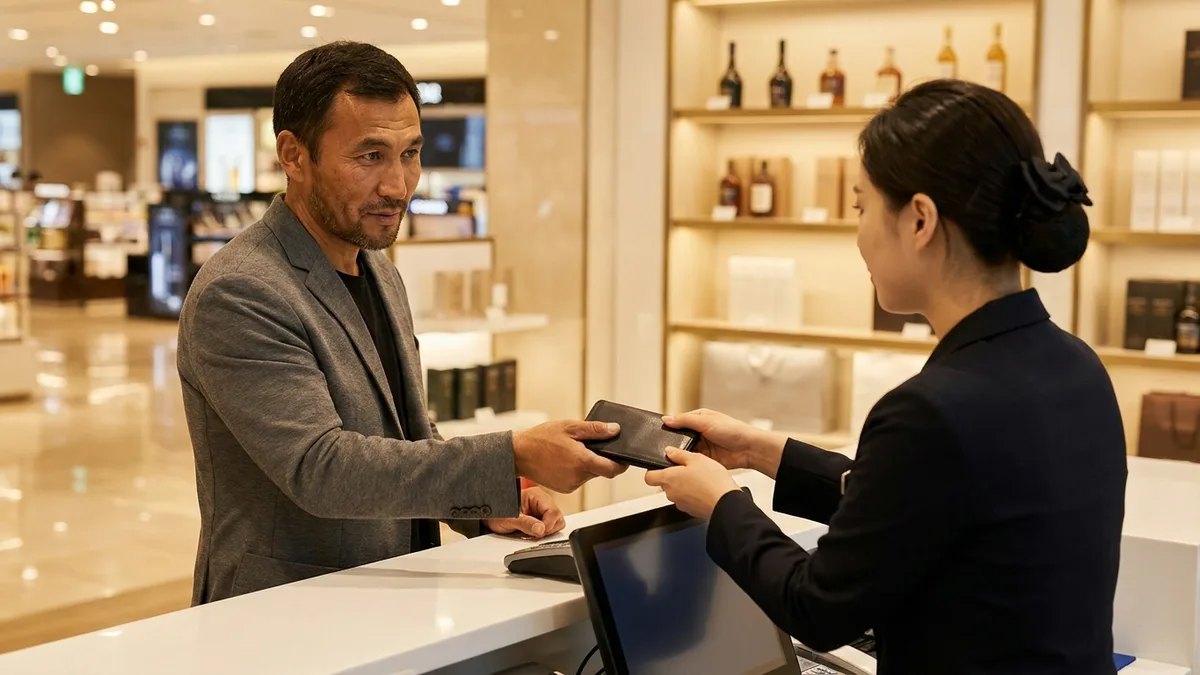
The Order and Locations for Picking Up at the Pickup Counter on Departure Day
On your departure day, move in this order.
- Finish checking in and dropping off your bags. If you have items to get a tax refund on, do the refund kiosk scan and the customs confirmation before you hand over your bags (How to Get a Tax Refund in Korea).
- Finish departure formalities and go into the departure area.
- At the pickup counter, show your exchange voucher (the number, for an electronic voucher), passport, and boarding pass, sign in person, and receive your goods.
- Head to your boarding gate without opening the bag of liquids.
Duty-free shops say pickup counters get crowded on departure day and advise coming early, but the benchmark each shop writes down is different. Hyundai Duty Free's English guidance says at least one hour before the flight's departure time ('at least one hour before your flight'), while the Shilla shops only say 'by 1–2 hours before departure' without naming a reference point. These times are for when you, the customer, reach the pickup counter, while the 2 hours before departure seen earlier is for when the goods reach the pickup counter — they are different things, so follow the time written in the guidance of the shop where you bought. We couldn't confirm official wait-time figures or whether mobile queue tickets (numbered tickets) are currently offered.
| Departing from | Pickup counter location | Notes |
|---|---|---|
| Incheon Airport Terminal 1 | 4F, duty-free area, near Gate 43 | Open 24 hours; inquiries 032-743-2718 |
| Incheon Airport Terminal 2, East side | 2F, down the escalator from near Gate 274 (across from the East Wing of the Korean Traditional Culture Center, 한국전통문화센터) | Check operating hours in the duty-free shop's guidance |
| Incheon Airport Terminal 1 Concourse | Needs to be confirmed | Duty-free shops' guidance conflicts |
| Incheon Airport Terminal 2, West side | Needs to be confirmed | Unclear whether it operates after April 30, 2026 |
| Gimpo, Jeju, Gimhae, and Cheongju airports; Busan Port and Incheon Port International Passenger Terminals, etc. | Which locations have pickup counters differs by duty-free shop | Operating hours need to be confirmed |
We've listed locations only for the two places confirmed as of 2026-09 through Incheon International Airport Corporation and duty-free shop guidance. Going to the wrong place where guidance conflicts costs you time right before boarding, so the day before you leave, check the pickup counter written on your exchange voucher or order history.
Once you factor in the line at the pickup counter, you need to get to the airport earlier than usual. A comparison of transport between the airport and downtown Seoul is in 4 Ways to Get from Incheon Airport to Downtown Seoul, and how to choose an Airport Railroad ticket is in AREX Express vs. All-Stop Ticket. In the LACHA app, you can book Airport Railroad (AREX) tickets, and call taxis and VANs (5- or 6-seaters).
Don't Open the Bag on Liquids Like Alcohol and Cosmetics
Liquids bought at a duty-free shop (alcohol, cosmetics, and so on) can be carried on board regardless of volume only if they stay in the clear sealed bag or security tamper-evident bag (STEB) the duty-free shop gave you, with the receipt inside or attached, and the bag isn't opened before you board the flight to your final destination.
If you open the bag and repack the items, you no longer meet this condition. Ordinary liquids that aren't duty-free goods can be carried on board only in containers of 100 mL or less, placed in one clear 1 L zip-top bag per person.
If you transfer at an airport abroad, you may have to give them up or have them confiscated under that country's security rules, so duty-free shops also say that when you transfer, the rule is to put them in checked baggage. For transfers in the United States, liquids in opaque or metal containers are restricted. But the pickup counter comes after you've checked your bags, so if your itinerary includes a transfer, ask the duty-free shop how you'd receive liquids before you buy them at a downtown or online duty-free shop.
When Your Flight Changed or You Couldn't Pick Up at the Pickup Counter
If your departure date or flight number changed because of the airline, or you changed it yourself, you also have to update your departure details separately with the duty-free shop where you bought. The goods are shipped based on the flight you entered when you bought them. The deadline is up to each shop. One major duty-free shop has you change it yourself in your online order history at least 3 days before departure (up to 3 times) and says last-minute changes may mean you can't pick up your goods, while another shop has you notify its customer center by 3 days before your original departure date.
Some duty-free shops say that if your departure airport or seaport changes, you have to cancel the order and buy again. How the pickup counter handles a flight number that changes on departure day because of a cancellation or delay isn't spelled out in the Public Notice or in duty-free shops' guidance, so it needs to be confirmed. In that case, explain the situation at the pickup counter and also contact the customer center of the shop where you bought right away.
If you lost your exchange voucher, under the Public Notice the pickup counter can reissue it once your name, passport number, and departure flight number (departure date) are checked and you're confirmed as the buyer.
If you end up leaving without your goods, they go back to the duty-free shop. Under the Public Notice, goods not handed over at the pickup counter for 5 days or more are sent back to the shop that sold them (Article 42(1)), and they can be resold once 10 days have passed from the date they were brought back (paragraph (4)). According to duty-free shop guidance, the sale is canceled after the goods go back to the store and are kept there for 10 days, and online duty-free orders are canceled automatically 10 days after the departure date (up to 16 days after, depending on the location).
The Public Notice (Article 42(3)) requires the duty-free shop to confirm the buyer's overseas address without delay and send returned goods by mail or similar means, but duty-free shops' guidance conflicts on whether they actually send them. If you didn't get your goods, give the customer center of the shop where you bought your overseas address right away and ask them to send the goods. Even so, don't put off picking them up on the assumption that you can get them later.
Only for 'Foreigners' Under the Law: On-Site Pickup of Korean-Made Goods at the Store
There's an exception open only to foreigners. Article 196-2 of the Customs Act (added on December 31, 2019) allows a downtown duty-free shop outside an airport or seaport to hand over Korean-made goods (내국물품, domestic goods) sold to a foreigner right at the point of sale. Here, 'foreigner' includes people without Korean nationality as well as Korean nationals living abroad (재외국민) who hold permanent residency or an immigrant visa in their country of residence, holders of a residence passport (PR), and others (Public Notice, Article 2). Korean nationals living abroad and residence-passport holders are Korean citizens, yet this provision treats them as 'foreigners'.
- It works only at downtown duty-free shops. Under the Public Notice, Korean-made goods sold online can also be handed over at a pickup spot inside a downtown duty-free shop, but whether a shop has one needs to be checked shop by shop.
- You have to show your passport and something that confirms your departure booking, such as your flight ticket (Enforcement Decree of the Customs Act, Article 213-3).
- Imported-brand goods aren't Korean-made, so they don't qualify; you pick those up at the pickup counter.
- If you're on a restriction list that the head of customs has sent out based on purchase history, flight bookings and cancellations, and the like, you can't pick up at the store. Domestic goods eligible for refund are also excluded, and 'refund' here means not a tax refund (a refund of VAT and individual consumption tax) but a refund of customs duties and the like on raw materials used for exports (Article 31(2) of the Public Notice cites the Public Notice on the Handling of Refunds of Customs Duties, etc. on Raw Materials for Export, 수출용 원재료에 대한 관세 등 환급사무처리에 관한 고시). The exact scope needs to be confirmed.
- According to duty-free shops, purchases for on-site pickup start 60 days before your departure date. The 90 days mentioned earlier is for regular purchases picked up at the pickup counter; this separate 60 days applies to on-site pickup (both are company rules, not law).
The law says the goods "may be handed over", so it's not a promise that this works at every store for every Korean-made item. Before you pay, ask whether the item qualifies for on-site pickup. How to buy cosmetics at stores that aren't duty-free shops is in Where Foreigners Get Stuck at Olive Young.
Korean-made goods you receive this way must be taken out of Korea. To check whether they were taken out, the head of customs can request the buyer's immigration records from the relevant agencies. Whether on-site pickup works the same way in practice for foreigners living in Korea needs to be confirmed, as we couldn't find published criteria.
Coming Back into Korea: Duty-Free Allowances and Checkpoints for Foreigners Living in Korea
This is the part foreigners living in Korea miss most after a trip. Duty-free goods are, in principle, restricted from being brought into Korea, so if you bring back goods you bought at a Korean duty-free shop when you left, they're added to what you bought abroad, the duty-free allowance is applied, and tax is charged on the amount over it. The duty-free allowance on entry applies per traveler entering Korea, regardless of nationality (Enforcement Rule of the Customs Act, Article 48, as of 2026-09).
| Item | Duty-free allowance | Conditions |
|---|---|---|
| All personal belongings | Total dutiable value of USD 800 or less | Goods bought at Korean duty-free shops count too |
| Alcohol | 2 L or less in volume and USD 400 or less in value | Separate from the USD 800; excludes anyone under 19 |
| Tobacco | 200 cigarettes or 50 cigars, etc. | Separate from the USD 800; only one type if you bring two or more types; excludes anyone under 19 |
| Perfume | 100 mL | Separate from the USD 800 |
| Arrival duty-free shops | No extra allowance (USD 800 is the sales limit) | Imported goods you buy there are added to the USD 800 for personal belongings; Korean-made goods you buy there are deducted from that USD 800 by their price (alcohol, tobacco and perfume are deducted by quantity from their separate allowances) |
Alcohol and tobacco brought in by anyone under 19 (not counting people who have reached January 1 of the year they turn 19) aren't duty-free. Under the law, the limit for the arrival pickup counter system is also USD 800, and if there's an arrival duty-free shop on the same entry route where a pickup counter operates, purchases at the two are combined for a total of USD 800.
If you're over, a voluntary declaration (자진신고) works in your favor. If you declare in the prescribed way, you get 30% off the customs duty that would be imposed, with the reduction capped at 200,000 KRW (Customs Act, Article 96(2)). If you don't declare and are taxed, you pay an additional tax of 40% of the tax payable (customs duty and domestic taxes), and it's 60% only when grounds set by Presidential Decree apply, such as repeatedly failing to declare (Article 241(5), subparagraph 1).
At one major duty-free shop, signing up for its online duty-free shop splits into mobile phone verification for Korean nationals and a separate sign-up route for foreigners, but whether foreigners living in Korea are asked for an alien registration number or Korean mobile phone verification needs to be confirmed. Services that work without a Korean number are in Services You Can Sign Up For and Pay With — No Korean Phone Number Needed. For limits and declarations when you enter another country with Korean duty-free goods, follow the customs rules of the country you're arriving in.
Want to handle everything from your first ride after landing in one app? Check out LACHA.
Built to work without a Korean phone number or bank account, with overseas payment methods like Alipay, WeChat Pay, and Apple Pay. Taxi hailing plus KTX, express bus, and airport railroad (AREX) booking — all in one app.
Up to 60% off Korea transit with a coupon (max ₩3,000): enter code at sign-up. KTX gets up to 18% off on top
Download now


Frequently Asked Questions (FAQ)
Q1. I've been living and working in Korea for more than a year. Can I use duty-free shops? A. If you're leaving for another country, you count as a departing traveler, who duty-free shops sell to. That's because the Public Notice defines eligibility by whether you're departing, not by how long you've stayed. However, if you work in Korea or have lived here for 6 months or longer, you're a resident under the Foreign Exchange Transactions Act, so you're excluded from tax refunds. Please check the sign-up requirements for online duty-free shops with each shop.
Q2. Can I pick up goods I bought at a downtown duty-free shop before check-in? A. No. Pickup counters are inside the bonded area of the departure area, so you receive the goods on your departure day after finishing departure formalities, by showing your exchange voucher, passport, and boarding pass. Korean-made goods bought by foreigners can sometimes be handed over at the store, so ask before you pay.
Q3. I changed my flight date. Do I need to tell the duty-free shop too? A. Yes. The goods are shipped based on the flight you entered when you bought them, so you have to update your departure details separately with the shop where you bought. Some shops only accept changes until 3 days before departure, so contact them as soon as anything changes.
Q4. Can someone traveling with me pick up my duty-free goods for me? A. No. The buyer signs in person and it's checked against their passport, so only the person who bought the goods can receive them. If the passport number on the exchange voucher differs from the passport number of the person departing, the handover can be refused.
Q5. If I bring goods bought at a Korean duty-free shop back into Korea, do I pay tax? A. They're added to what you bought abroad, and if the total dutiable value goes over USD 800, tax is charged on the amount over it. Alcohol (2 L or less and USD 400 or less), tobacco, and perfume (100 mL) have their own separate allowances. If you declare voluntarily, you get 30% off the customs duty, with the reduction capped at 200,000 KRW, and if you don't declare and are taxed, you pay an additional tax of 40% of the tax payable.
Note: This article is for general information. The provisions, limits, and deadlines are values we confirmed as of 2026-09 from the Customs Act and its Enforcement Decree and Enforcement Rule on the National Law Information Center, the Public Notice on the Licensing and Operation of Bonded Stores (Korea Customs Service Public Notice No. 2026-40), the Regulations on Special Cases concerning Value-Added Tax and Individual Consumption Tax for Foreign Tourists, etc., the Enforcement Decree of the Foreign Exchange Transactions Act, and official guidance from the Ministry of Government Legislation's Easy-to-Find Living Law Information, Incheon International Airport Corporation, the Korea Tourism Organization, the Korea Customs Service and Korea Policy Briefing, and Shilla Duty Free, Shilla I'Park Duty Free, and Hyundai Duty Free. We couldn't confirm, and so have not stated definitively, the online duty-free order cutoff, whether the pickup counters in the Incheon Airport Terminal 1 Concourse and on the West side of Terminal 2 are operating, the operating hours of pickup counters outside Incheon, how overseas shipping of uncollected goods works in practice, how pickup counters handle a flight number changed because of a cancellation or delay, where arrival pickup counters operate, the sign-up requirements for online duty-free shops and the application of on-site pickup for foreigners living in Korea, or the scope of domestic goods eligible for refund. Limits, reductions, and additional taxes can change with amendments to the law, and pickup counter locations and change deadlines can change with duty-free shop policy, so before you use them, check again in the guidance from the shop where you bought and on the official channels of each agency and store, such as the Korea Customs Service Customer Support Center. LACHA doesn't sell duty-free goods or pick them up for you, and it doesn't handle duty-free orders, departure detail changes, or customs declarations on your behalf.