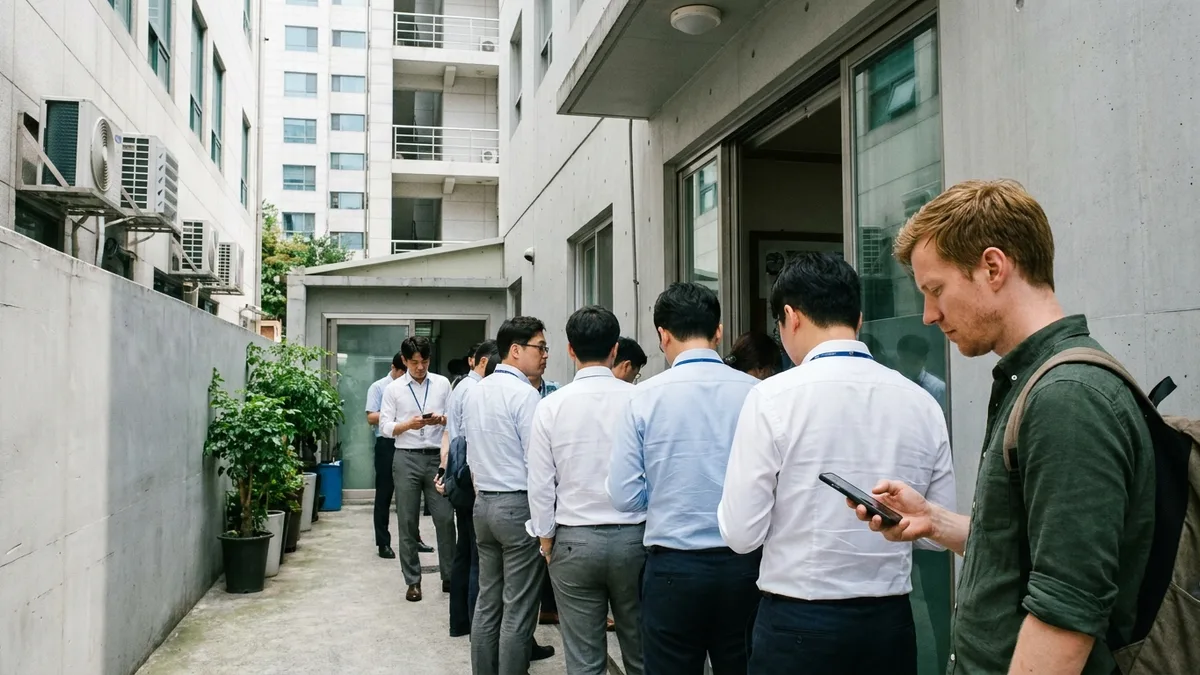
You're standing in front of a restaurant you found on a map app. The app shows no average star rating, every blog post your search turns up is pure praise, and a big English menu is posted at the entrance. Is this a place where people from the neighborhood eat, or one that caters to tourists?
This article doesn't answer that question with restaurant names. Restaurants close or move and prices change, so a way of judging stays useful longer than a list of names. The example restaurants below are there only as evidence of how the method works.
No signal guarantees taste, hygiene, or price. Signals only become grounds for a decision when two or three of them overlap. The order you actually follow when choosing is public selection lists → map-app reviews → storefront signals → an on-the-spot check, but this article starts with map-app reviews and saves public selection lists for the end. What to eat is covered separately in the guide to 12 Korean foods you have to try.
The laws, standards, and figures below were checked against public sources as of September 2026, and the legal explanations are general information, not legal advice. App screens, policies, and restaurant business information change without notice, so check the official channels again before you use them.
Don't judge by a single signal: the order to check things in
The common mistake when looking for local restaurants is staking your whole conclusion on one signal. A long line means it's great, an English menu means it's a tourist restaurant, no star rating means something's wrong with the place. But every signal has things it tells you and things it doesn't.
| Signal | What it tells you | What it doesn't tell you | Where to check |
|---|---|---|---|
| Public selection lists | That the place made a list through an inspection or reader reviews | Whether it still operates in the same place, in the same way | MICHELIN Guide, Blue Ribbon, and Oraegage websites; Baengnyeon Gage (백년가게) plaques and the Seoul Future Heritage list |
| Verified-visit reviews | The experience of someone who actually went | Whether the writer's taste matches yours | Naver Map place reviews |
| Blog posts | Photos and long write-ups of a visit | Whether the writer was compensated (some posts leave the disclosure out) | The disclosure wording in the title and opening |
| Price list | The final price including VAT, and for meat, the price per 100 grams | The taste, or whether the portion lives up to your expectations | At the entrance or inside |
| Lunch line | That people crowd in at that time of day | Taste, price, hygiene | On site, at weekday lunchtime |
That's why you need an order. Narrow down candidates with public lists, read verified-visit reviews in a map app, look at the price list in front of the restaurant, and finally check on the spot. The signals only become grounds for a decision when two or three of these steps point the same way.
This process is hard to do with Google Maps alone. The government conditionally approved exporting Google's 1:5000 high-precision map data out of Korea on February 27, 2026, but the announcement gave no date for when the actual service would start. How to set up Naver Map and Kakao Map is covered in the Naver Map & Kakao Map guide for foreigners.
Naver Map reviews come in two kinds: verified-visit reviews and blog posts
On a restaurant's page in Naver Map, the first thing to sort out is who wrote something and what process they went through. Naver's place reviews (플레이스 리뷰) are a service that gathers reviews from people who used the place through a Naver reservation or order, or who verified their visit with a receipt or card transaction record. Naver introduced receipt reviews, which verify receipts through optical character recognition (OCR), in 2019, and in December 2022 it added a way to verify a visit through card payment records.
Blog posts are a different kind of source. They aren't reviews that went through visit verification but posts that individuals put up on their own blogs, so, as we'll see below, posts written in exchange for compensation can be mixed in. We couldn't check Naver's original help documentation for the official name of the area on the place screen where blog posts are gathered, or for the criteria that decide which posts appear there, so those still need confirming.
The review format has also changed a few times. In July 2021, Naver introduced keyword reviews such as "the ingredients are fresh" (재료가 신선해요), then ended its star-rating feature that October. Then, from April 6, 2026, it brought back star ratings on a 5-point scale for place reviews in categories such as restaurants, and made review text and ratings editable only within 3 months of writing. Depending on when they were written, you may see reviews with and without star ratings side by side.
It also helps to know how much you can read in another language. Since October 2024, Naver Map has used Papago translation technology to show text reviews and place filters in English, Chinese, and Japanese depending on your phone's OS or app language setting. Earlier in 2024 it had already widened the translation to business hours, tab names, amenity information, and the keyword-review graph. That's as far as the announcements went, so for the body text of blog posts or the writing on menus in photos, a translation app's camera is the surer way to read them.
Whether foreigners can leave visitor reviews themselves still needs confirming. On June 4, 2026, Naver introduced passport verification for foreigners, letting you use Naver Map's reservation, ordering, and payment with an overseas-issued passport and no Korean phone number, but the announcement says nothing about whether you're allowed to write reviews. It's best not to judge a restaurant on a low review count alone.
How to spot sponsored posts: where the disclosure should be, and which words to look for
The standard for telling whether a review was written in exchange for compensation is set out in the Korea Fair Trade Commission's Guidelines on Review of Labeling and Advertisements Regarding Recommendations and Endorsements (「추천·보증 등에 관한 표시·광고 심사지침」). They are the detailed criteria for reviewing unfair labeling and advertising under Article 3 of the Act on Fair Labeling and Advertising and Article 3 of its Enforcement Decree, and the current version is Established Rule No. 499 (예규 제499호), in effect since June 1, 2026.
Under the guidelines (section Ⅴ.6.가), when someone who received economic compensation from the advertiser, such as cash, the product itself, gift certificates, reward points, or a discount, or someone directly employed by the advertiser, recommends or endorses something, they must clearly disclose that economic interest every single time. The examples of cases that require disclosure even include "writing a product review after agreeing to write one in return for a discount on the purchase." In other words, it doesn't apply only to posts where money changed hands.
Where the disclosure goes is set out too (section Ⅴ.6.다.(1)). In text posts on blogs and online communities (known in Korea as internet "cafés"), it goes in the title or at the beginning, set apart from the body with a larger font or a different color. Putting it in a comment, or making it visible only after tapping "more" (더보기) or a link, may not count as an appropriate way to disclose. So before translating a whole post, it's faster to check the title and the first line.
| Category | Expressions the guidelines cite |
|---|---|
| Examples of clear disclosure | #광고 (ad), #협찬 (sponsored), 금전적 지원 (financial support), 대가성 광고 (paid advertisement), 상품 협찬 (product sponsorship) |
| Unclear examples | 체험 후기 (trial review), 체험단 (trial reviewer group), 선물 (gift), ~에서 보내주셨어요 ("sent to me by ~"), a bare #BrandName, [BrandName]×[AccountName] |
| Inappropriate examples (for posts aimed at Korean consumers) | Using only notations like AD, PR, Sponsor, spon, Thanks to, or 앰버서더 (ambassador) |
The unclear and inappropriate examples in the table are words the guidelines consider not enough on their own as a disclosure, if the post was in fact compensated. When you see words that hint by themselves that something was provided, such as 체험단, ~에서 보내주셨어요, 선물, AD, Sponsor, or 앰버서더, keep in mind that there may have been compensation. A bare #BrandName or Thanks to can also appear in posts written with no compensation at all, so don't treat those words alone as proof of an ad. There are exceptions, too. In exceptional cases that don't affect the content or its credibility, such as a review written voluntarily after receiving a sample given to every applicant or a souvenir given to every event participant, disclosure may not be required. We couldn't confirm any individual KFTC rulings on review events, where a restaurant offers a drink or a free extra dish in return for a review, or the original text of Naver's operating policy, so this article won't say flatly that such events are fine or that they're violations.
No disclosure is no guarantee that a post wasn't compensated. In the KFTC's monitoring of deceptive social media advertising in 2024, announced in March 2025, 22,011 posts were suspected of undisclosed advertising, and 9,423 of them were on Naver Blog. The most common violation type was improper disclosure placement, at 39.4%, while failing to disclose the economic interest at all accounted for 26.5% (a single post can fall under several types). On Naver Blog, the most common problem was an improper disclosure format, such as tiny text or a blurry image, at 4,526 posts, and by industry, restaurants made up a large share of the 5,097 posts in the other services category.
The final call on whether a given post is a violation belongs to the KFTC. What you as a reader can do is give a post less weight when you see these signals, and compare what it says against the verified-visit reviews for the same restaurant.
Read the gaps in reviews too: hidden star ratings, "reviews not provided," and anonymous reviews
What's missing from the review screen is information too. That said, a gap doesn't mean it's a bad restaurant.
In an announcement on June 1, 2026, Naver said that from July 9 it would show cumulative average star ratings and each user's star rating in the main area of place reviews. Whether the average rating is shown can be switched on or off by the business owner, and for businesses that opened on or after October 25, 2021 and have no accumulated ratings, the default is hidden. We've only checked the announcement itself, so look at the actual screen for yourself. If no average rating is showing, the owner may have turned it off, or the place may have opened after that date.
On Kakao Map, if you see the words 후기 미제공 (reviews not provided) where the reviews and ratings would be, it means the owner used the "Kakao Map review display setting" (카카오맵 후기 노출 설정) in store management to hide all reviews. This setting can't be used to pick out and hide or delete particular reviews. A place marked 후기 미제공 is missing that piece of evidence on Kakao Map, so move on to Naver Map's verified-visit reviews or the signals in front of the restaurant.
On Kakao Map you can leave only one review per place, and reviews with "Write anonymously" (익명으로 작성) checked don't appear on the place's detail page. That means the number of reviews you see can be lower than the number actually written. We couldn't confirm from the original help documentation how Kakao Map displays star ratings.
Signals to read in front of the restaurant: price lists, touting, English menus, and hygiene signs
What to look at in front of a restaurant is less the atmosphere than the notices the rules require. Once you know the rules, you can tell what has to be there and what doesn't.
Price lists are governed by Annex 17, item 7 of the Enforcement Rule of the Food Sanitation Act.
- Restaurants must post a price list showing the actual price you pay, including VAT and similar charges, outside or inside the premises, and charge according to that list (sub-item 아).
- The places that must post it both outside and inside are snack restaurants (휴게음식점) and general restaurants (일반음식점) with a registered business floor area of 150 square meters or more. Smaller places may post it in just one of those spots, so no price list outside doesn't automatically mean a violation.
- Meat such as bulgogi and galbi must be priced per 100 grams, and a restaurant that also wants to show a per-portion price has to state the portion weight along with it, as in "galbi, 100 grams ○○ KRW (1 portion, 150 grams △△ KRW)" (sub-item 퍼). The main ingredients and weight of the food served must not differ from the price list either (sub-item 터).
- Under the amended Annex 23, promulgated and in force on September 1, 2026, the administrative penalty for not posting a price list or charging more than the posted price was toughened to a 5-day business suspension for a first violation, 10 days for a second, and 20 days for a third (previously a corrective order for a first violation, a 7-day business suspension for a second, and 15 days for a third). How the change applies in transition, such as whether it also covers violations from before it took effect, still needs confirming.
Touting falls under two separate sets of rules. Annex 17, item 7, sub-item 하 of the Enforcement Rule of the Food Sanitation Act includes, among the rules food service operators must follow, a ban on operators and their employees enticing customers in. Article 3(1)(8) of the Minor Offenses Punishment Act punishes anyone who noisily calls out to customers for business purposes in a place where many people gather or pass by with a criminal fine of up to 100,000 KRW, detention, or a minor criminal fine, and under the summary fine schedule in the Act's Enforcement Decree, the summary fine (notice disposition) in this case is 50,000 KRW. These rules ban the behavior; they don't define the restaurant as an illegal business, so treat touting as a signal to check the price list before you follow anyone in.
An English menu is not, by itself, a sign of a tourists-only restaurant. Annex 2 of the Enforcement Rule of the Tourism Promotion Act includes, in the designation criteria for tourist restaurants, "a menu that lists dish names and related information in at least one foreign language" (applications for designation go to regional tourism associations). And the Korean Food Promotion Institute offers its guide to foreign-language names for 800 Korean dishes (한식메뉴 외국어표기 길라잡이 800선), with names, pronunciations, and descriptions in English, Japanese, and Chinese (simplified and traditional), as a free download on the Public Data Portal. Read an English menu as a sign that a restaurant is ready to serve foreign customers, and compare prices using the price list.
Hygiene signs aren't a taste signal. On March 16, 2026, the Ministry of Food and Drug Safety merged restaurant hygiene grades from three tiers (매우우수, 우수, 좋음: very excellent, excellent, good) into a single designation, 식품안심업소 (food safety establishment), for places scoring 85 points or more in an on-site evaluation, and required the sign to show the English name along with the date of first designation and the validity period. The sign is posted at the main entrance or somewhere customers can easily see it (Article 61-2(4) of the Enforcement Rule of the Food Sanitation Act). It reflects a hygiene evaluation only, not an assessment of taste or price, and whether the old three-tier signs from before the switch stay up until they expire still needs confirming.
When the bill doesn't match the price list: keep evidence and call 1330
If you take a photo of the price list on your phone before ordering and get a receipt when you pay, you can compare right away if the amount is off. If explaining things in Korean is hard, one option is to call the 1330 Korea Travel Hotline (the tourist interpretation line) right there.
1330 is run by the Korea Tourism Organization (from overseas, +82-2-1330) and provides travel information, tourist interpretation for restaurants, accommodation, public transportation, and more, consultation on and filing of tourist complaints, and connection to the tourist police. The Seoul Metropolitan Government tells people to report overcharging, such as a restaurant not posting a price list or charging something different from the posted price, to 1330 or 02-120 (Seoul's Dasan Call Center), or online through the Korea Tourism Organization's tourist complaint service (관광불편신고), and asks that you submit objective evidence such as the receipt, photos, the date, and the business name along with it. There is no separate information fee for a 1330 consultation, and the call itself costs the same as any ordinary phone call.
A price list that also shows portion size makes comparison easier. In December 2023, as a measure against overcharging at Gwangjang Market, the Seoul Metropolitan Government introduced a quantity-labeling system that puts the portion weight next to the price on menus (the example given was yukhoe at Stall A, 19,000 KRW (200g)), sample models of signature dishes, an advance price council led by the merchants' association, ongoing mystery shopper checks, and training that bans steering customers toward paying cash.
In a Seoul Metropolitan Government announcement on May 20, 2026, Jongno-gu said that from June it would fully roll out a real-name system for Gwangjang Market street stalls, giving penalty points according to the number of violations, and would use mystery shoppers, including foreigners, to carry out undercover checks on food stalls for overcharging, pressure selling, and unfair treatment of foreign customers. It also said serious violations, such as not posting a price list, would be met with penalties such as business suspension.
How to find old-guard restaurants, market eateries, and lunch lines
Long-established restaurants, known in Korean as nopo (노포), can be checked through official designation programs. A plaque in front of the restaurant or the program's official website serves as evidence.
- 100-Year Shops (백년가게): A program designated by the Ministry of SMEs and Startups and run by the Small Enterprise and Market Service (소상공인시장진흥공단). Eligible applicants are small merchants that have been in business for 30 years or more, excluding manufacturing, and designated shops receive a certification plaque and a story board. The plaque is in Korean, so you'll need a translation app to read it, and whether there's an English route for foreigners to look up designated shops still needs confirming.
- Seoul Oraegage (서울 오래가게): The Seoul Metropolitan Government has been designating shops in everyday culture, traditional crafts, and food since 2017, and as of its September 21, 2026 announcement, the total has grown to 150 shops. In the food category, shops that have been in business for 30 years or more are chosen through citizen recommendations, followed by a first-round on-site review and a second-round expert assessment. In the same announcement, the city said it plans to hold an "Oraegage Week" (오래가게 위크) from October 14 to 25, 2026. The Seoul Oraegage website (oraegage.co.kr) can be switched to English, and you can also find the shops by searching "오래가게" in Naver Map. How much English information is available for each shop still needs confirming.
- Seoul Future Heritage (서울미래유산): From among the Seoul Future Heritage sites selected through citizen proposals and review, the Seoul Metropolitan Government introduced 50 long-loved restaurants on November 11, 2021. Yukjeon Hoekwan (역전회관), which opened in 1962, is among them.
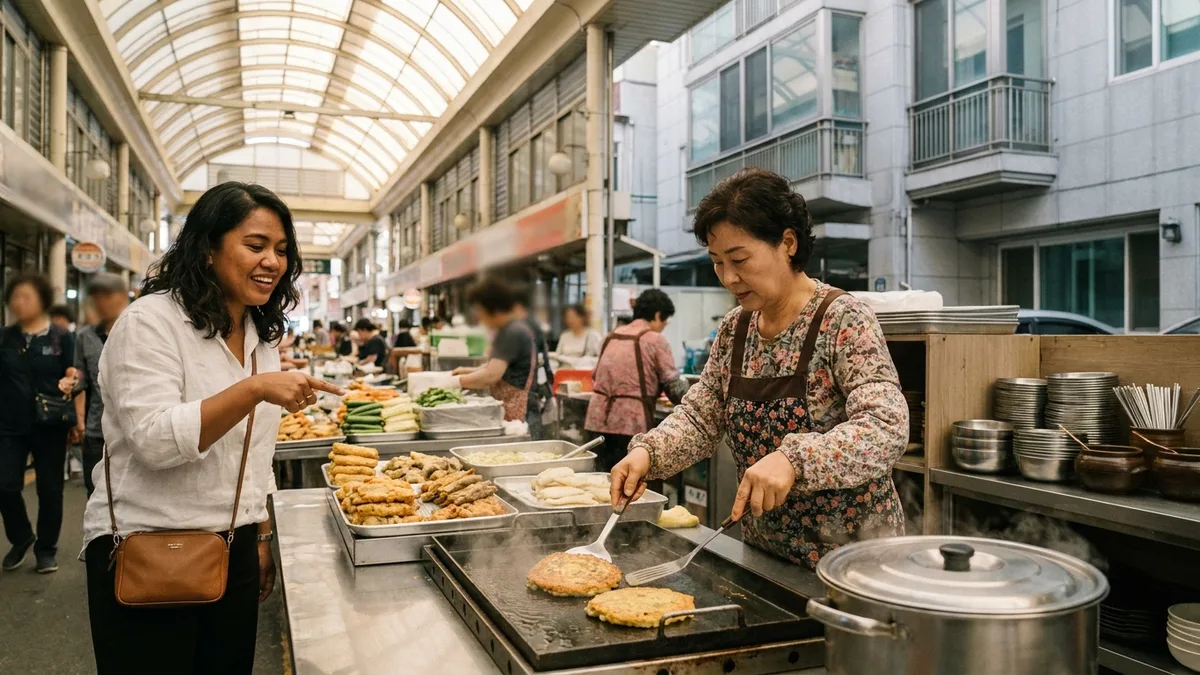
For restaurants inside traditional markets, the easy approach is to search the market's name in a map app and then compare the verified-visit reviews of the shops inside. Which neighborhood markets and alleys to look at is laid out in the guide to 12 Korean foods you have to try. Some places have Korean-only menus or are indoor spaces where you take your shoes off, so be ready to read the menu with a translation app.
A restaurant with only one or two dishes on the menu may be a sign that it concentrates on one thing. That said, the number of menu items doesn't guarantee the food is good.
There are no official statistics on office workers' lunch lines, such as what time they form or how long the wait is, so we'll only describe the method. Walk the alleys of a neighborhood full of offices at weekday lunchtime and you'll see restaurants where nearby office workers are lining up. A line only tells you that people crowd in at that hour, so look the restaurant up in a map app and check the verified-visit reviews and the price list together. How to tell whether a restaurant manages its queue through an app is covered in the CatchTable waiting app guide.
If you leave an old-guard restaurant in an alley or a market eatery late and public transportation is awkward, you'll end up calling a taxi, and LACHA is one of the apps you can sign up for without a Korean phone number and use to call one.
How to use the MICHELIN Bib Gourmand and Blue Ribbon, and their limits
The MICHELIN Guide Bib Gourmand is a list chosen by inspectors from places where you can eat a meal for 45,000 KRW or less per person. The MICHELIN Guide explains that anonymous inspectors who conceal their identity visit and assess the restaurants. In the MICHELIN Guide Seoul & Busan 2026, announced on February 26, 2026, there were 51 Bib Gourmand restaurants in Seoul and 20 in Busan, 71 in all.
The way to use it is to look at the tags on each restaurant's page. Along with cuisine type and price range (the number of ₩ signs), the MICHELIN Guide website attaches tags such as "현지인처럼 즐기는 맛집 탐방" (eating out like a local), "혼자서도 편하게 즐기는 혼밥 맛집" (comfortable for dining alone), "여럿이 함께 즐기기 좋은 곳" (good for groups), and "웨이팅해도 아깝지 않은" (worth the wait). If you're after local restaurants, cross-check places with the first tag against map-app reviews. Keep in mind, though, that these tags are categories MICHELIN assigns to places it considers "suited to" something; they don't measure whether people from the neighborhood actually go there a lot.
The Blue Ribbon Survey is a restaurant guide that started in 2005 and says it uses a survey method that collects the opinions of many people. It gathers reader reviews on its site all year round, publishes a book once a year, and shows on the site the year each restaurant was listed. It explains that more ribbons mean a higher probability that many people will call the food delicious, and that the place meets the conditions for high satisfaction whenever you visit.
| Item | MICHELIN Guide Bib Gourmand | Blue Ribbon Survey |
|---|---|---|
| How places are chosen | Assessment by anonymous inspectors | A survey that gathers reader reviews (whether experts take part needs confirming) |
| Criteria and markings | A meal for 45,000 KRW or less per person | Number of ribbons and year of listing |
| Areas covered | The Korea edition covers only Seoul and Busan | Needs confirming |
| Updates | Annual editions (2026 edition) | A book once a year |
| Using it as a foreigner | Restaurant pages and tags on the website | Multi-filters and map view require a paid premium pass; whether English is supported needs confirming |
Both lists have clear limits. Being selected doesn't mean there's no line or that the restaurant is still operating the same way. Bib Gourmand picks are based on the price condition and inspectors' assessments, not on how uncrowded a place is, and MICHELIN itself notes that the lunch line at Andeok tends to be quite long. Selections are made once a year, so hours, prices, and locations can change in between, and in cities outside Seoul and Busan you can't use Bib Gourmand to find places.
A real example: how to check a place on a public list
Below are examples of applying the checks above to real restaurants. They're not a ranking or recommendations, and all of them were confirmed on the MICHELIN Guide Seoul Bib Gourmand list on September 11, 2026. Hours, closing days, and prices change easily, so we've deliberately left them out.
| Signal it shows | Example (address) | How to check, using this example |
|---|---|---|
| On two public lists | Yukjeon Hoekwan (역전회관), 47 Tojeong-ro 37-gil, Mapo-gu (마포구 토정로37길 47) | Appears on both the MICHELIN Bib Gourmand list and the Seoul Future Heritage restaurant list (the restaurant opened in 1962). Next, check when the verified-visit reviews on Naver Map were written |
| Two places with the same name | Yonggeumok (용금옥), 41-2 Jahamun-ro, Jongno-gu (종로구 자하문로 41-2) | There are now two Yonggeumok, one in Jongno-gu and one in Jung-gu; they branched from the same root that started in 1932 and are run separately. Search by address, not by name |
| Has moved before | Halmaejip (할매집), 1-5 Sajik-ro 12-gil, Jongno-gu (종로구 사직로12길 1-5) | Opened in Naeja-dong in 1975 and moved to its current location in 2006. Posts and reviews written before the move may be about the old location, so check when they were written |
| Lunch line despite being selected | Andeok (안덕), 18 Jahamun-ro 17-gil, Jongno-gu, Seochon (종로구 자하문로17길 18) | Lunch lines here are long enough that MICHELIN recommends arriving at opening time. Check the opening time and how the waiting system works |
Places that serve only one dish, and shops inside markets, make the list too.
Here's what it looks like to take one place, Yukjeon Hoekwan, through the steps above.
- Public lists: It appears on both lists, so the signals overlap.
- Verified-visit reviews: On Naver Map, read what the verified reviews say and when they were written.
- Price list: Take a photo of the final prices on the price list at the entrance or inside.
- On site: MICHELIN recommends booking for dinner, so if you're going in the evening, start by checking how to reserve.
Restaurants may close, move, or change their closing days, so before you go, check the address and whether it's still open again on the MICHELIN Guide page and on Naver Map.
Want to handle everything from your first ride after landing in one app? Check out LACHA.
Built to work without a Korean phone number or bank account, with overseas payment methods like Alipay, WeChat Pay, and Apple Pay. Taxi hailing plus KTX, express bus, and airport railroad (AREX) booking — all in one app.
Up to 60% off Korea transit with a coupon (max ₩3,000): enter code at sign-up. KTX gets up to 18% off on top
Download now


Frequently Asked Questions (FAQ)
Q1. Should I avoid restaurants that don't show an average star rating on Naver Map? A. It's better not to judge on that alone. According to Naver's June 1, 2026 announcement, business owners can switch the average rating display on or off, and for businesses that opened on or after October 25, 2021 with no accumulated ratings, the default is hidden. For the July 9 rollout too, we've only checked Naver's announcement, so look at the actual screen for yourself. Instead, read what the reviews verified through receipts, card records, or reservations say, and when they were written.
Q2. If a blog post has no #협찬 (sponsored) or #광고 (ad) tag, can I take it as a review from someone who paid for the meal themselves? A. You can't conclude that. In the KFTC's 2024 monitoring, 9,423 of the 22,011 posts suspected of undisclosed advertising were on Naver Blog, and the most common violation type was improper disclosure placement at 39.4%, followed by no disclosure of the economic interest at 26.5%. Check whether there's a disclosure in the title and at the beginning, and compare the post with the verified-visit reviews for the same restaurant.
Q3. If a big English menu is posted at the entrance, is it a restaurant for tourists? A. You can't tell from an English menu alone. The designation criteria for tourist restaurants call for a menu with a foreign language alongside the Korean, and the Korean Food Promotion Institute publishes foreign-language names for 800 Korean dishes for free, so plenty of restaurants can have an English menu. Comparing the price list, with final prices including VAT, against nearby restaurants is more useful.
Q4. My bill came out higher than the price list. What should I do? A. Restaurants must charge according to their price list (Enforcement Rule of the Food Sanitation Act, Annex 17, item 7, sub-item 아). Keep a photo of the price list and the receipt, and if explaining in Korean is hard, call 1330 (from overseas, +82-2-1330) to get interpretation or file a complaint. The Seoul Metropolitan Government also points people to 02-120 and the Korea Tourism Organization's online tourist complaint service, and asks for evidence such as the receipt, photos, the date, and the business name.
Q5. What signals should I look for in cities other than Seoul or Busan? A. The Korea edition of the MICHELIN Guide covers only Seoul and Busan, so you can't use Bib Gourmand in other cities. Instead, combine the certification plaque of a 100-Year Shop, which small merchants in business for 30 years or more (excluding manufacturing) can apply for, with verified-visit reviews in a map app and the price list in front of the restaurant. We weren't able to confirm in this article which regions the Blue Ribbon Survey covers.
Note: This article is for general information purposes. The standards and figures in the text were checked as of September 2026 against the original texts, on the National Law Information Center, of the Enforcement Rule of the Food Sanitation Act (Annexes 17 and 23, Article 61-2), the Enforcement Rule of the Tourism Promotion Act (Annex 2), and the Minor Offenses Punishment Act and its Enforcement Decree; the Korea Fair Trade Commission's Guidelines on Review of Labeling and Advertisements Regarding Recommendations and Endorsements (Established Rule No. 499) and its results from monitoring deceptive social media advertising in 2024, announced in March 2025; the Ministry of Food and Drug Safety's revision of the restaurant hygiene grade rules (March 16, 2026); Naver press releases and Kakao customer center help pages; the government's announcement approving the export of Google map data (February 27, 2026); Seoul Metropolitan Government announcements (Gwangjang Market measures, Seoul Oraegage, Seoul Future Heritage, and guidance on reporting overcharging); the Ministry of SMEs and Startups' notice on 100-Year Small Business Owners (백년소상공인); the Korean Food Promotion Institute's public data; and the official MICHELIN Guide and Blue Ribbon Survey websites. The four examples are based on the MICHELIN Guide Seoul pages as of September 11, 2026, and may have closed, moved, or changed their hours since. Legal explanations are not legal advice, and whether a post violated advertising rules is for the Korea Fair Trade Commission to decide. Check each organization's or restaurant's official channels again before use. LACHA does not operate restaurant recommendation, reservation, or review services, and has no partnership with any restaurant or selection-list operator mentioned in this article.