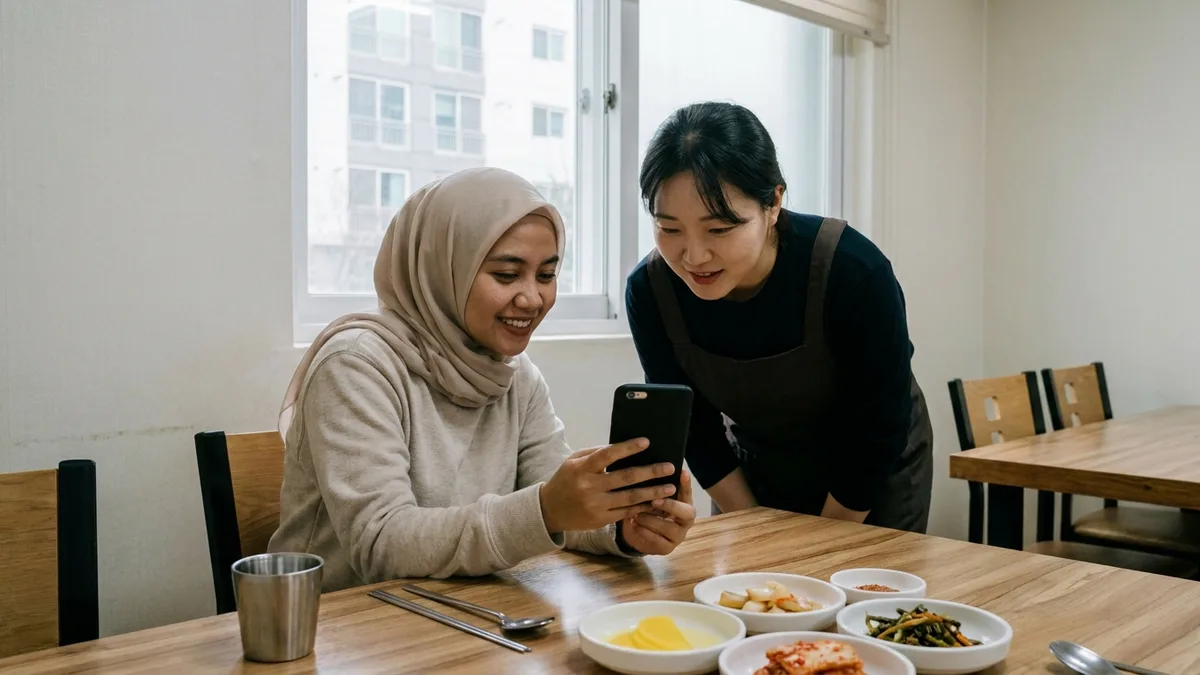
You order doenjang-jjigae (soybean paste stew) and ask them to leave out the meat, but the broth still tastes of anchovy. The kimchi you picked up thinking it was a vegetable side dish turns out to contain saeujeot (salted shrimp). For anyone who's vegetarian, looking for halal food, or living with a food allergy, the wall you hit most often at a Korean restaurant is ingredients that don't show up in the menu name.
The Korea Tourism Organization's vegetarian guide also notes that Korean dishes are often cooked with meat or fish broth and that not many restaurants have a separate vegetarian menu. So instead of a list of restaurants, this article sets out how to ask and check. Ingredients and ordering tips for individual dishes are in the guide to 12 Korean foods you have to try, so we won't repeat them here.
Note: The information below was compiled from public materials by the Korea Tourism Organization, HAI Korea (한국할랄산업진흥원), the National Law Information Center, the Ministry of Food and Drug Safety, the Korea Disease Control and Prevention Agency, and others, as of Sep 2026. The Korea Tourism Organization's Muslim-friendly restaurant guidebook is as of December 2021, and every KMF restaurant halal certification we checked this time had a validity period of one year. Make the final call on whether something is halal by the standard you follow.
Ingredients you can't see in the menu name hide in broth, jeotgal, and garnishes
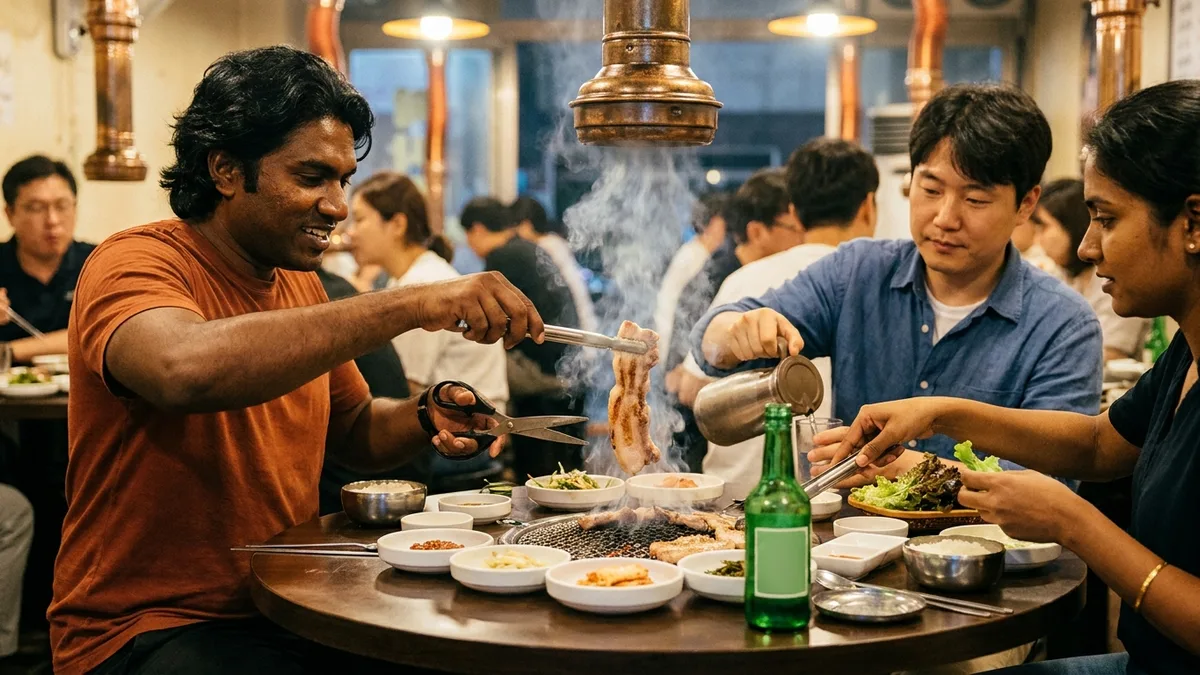
There are three main places animal ingredients hide in Korean food: the yuksu (broth) that forms the base of a soup, the jeotgal (salted fermented seafood) that goes into kimchi and seasonings, and secondary ingredients like egg or ham placed on top of a dish or mixed into batter. A menu name only tells you the main ingredient, so no meat in the name doesn't mean no animal ingredients.
Kimchi is the classic example. The Korea Tourism Organization's Muslim guidebook lists jeotgal in the filling of napa cabbage kimchi and saeujeot (salted shrimp) in kkakdugi (cubed radish kimchi), and a recipe from Pusan National University's Kimchi Research Institute also puts 4 cups of salted shrimp into napa cabbage kimchi and uses myeolchijeot (salted anchovies) in other kinds of kimchi. Even the kimchi that arrives as a side dish without a word is something to check.
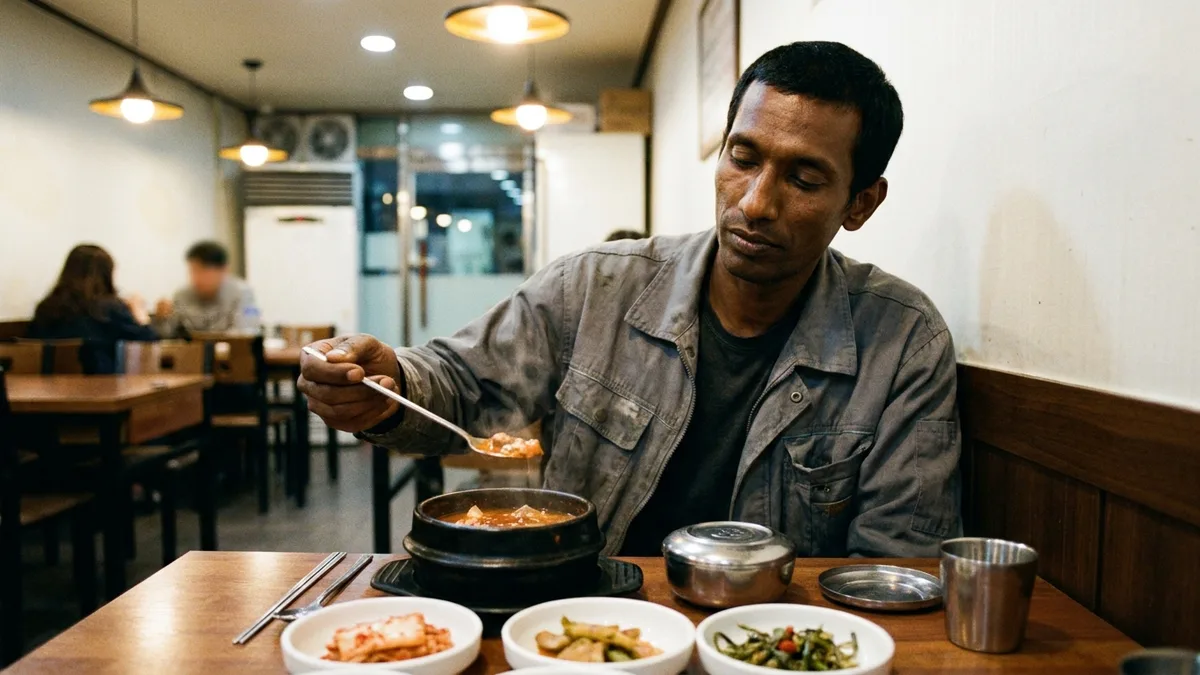
Broth is even harder to spot. The Korea Tourism Organization guidebook describes kalguksu and janchi-guksu (noodle soups) as made with anchovy broth, and the basic broth of doenjang-guk (soybean paste soup) as anchovy and kelp or rice-rinsing water, and it says a clear beef broth is the most common base for tteokguk (rice cake soup). The Korean Food Promotion Institute's doenjang-jjigae recipe also includes 100g of beef sirloin, with anchovy broth or clam broth given as alternative broths.
| Where it hides | Examples in public-agency materials | What to ask before ordering |
|---|---|---|
| Soup & broth | Kalguksu and janchi-guksu (anchovy broth), tteokguk (clear beef broth), sundubu-jjigae (beef, fish, and clams in anchovy broth) | 국물에 멸치나 고기 들어가나요? (Is there anchovy or meat in the broth?) |
| Jeotgal & seasoning | Napa cabbage kimchi (jeotgal), kkakdugi (salted shrimp), sundubu-jjigae and similar stews (usually salted shrimp) | 김치나 양념에 젓갈 들어가나요? (Is there jeotgal in the kimchi or seasoning?) |
| Garnish & batter | Kongguksu garnish and vegetable jeon batter (may contain egg), vegetable gimbap (may contain ham, egg, or imitation crab) | 달걀이나 햄 들어가나요? (Is there egg or ham in it?) |
The examples in the table are typical recipes written in public-agency materials, and actual ingredients differ from shop to shop. In the end, asking at that particular restaurant is how you confirm.
If you're a Muslim reader, ask about pork-derived ingredients such as bacon, sausage, lard, gelatin, shortening, and emulsifiers, and about any alcohol added to the food, as the Korea Tourism Organization's communication sheet does. Whether to treat jeotgal or aekjeot (fish sauce) as halal is for you to judge by the standard you follow. This article only goes as far as how to ask whether they're in a dish.
How to read the Korea Tourism Organization's four Muslim-friendly restaurant tiers
When you look for halal restaurants in English-language travel information, you'll come across labels like Halal Certified, Self Certified, Muslim Friendly, and Pork Free. These are the four tiers the Korea Tourism Organization used when introducing Muslim-friendly restaurants, and VisitSeoul, Seoul's official tourism information site, uses the same four names.
| Tier | Korea Tourism Organization's description | How to read it |
|---|---|---|
| Halal Certified (할랄 공식 인증) | A restaurant certified by an accredited halal certification body such as the Korea Muslim Federation (KMF) | It has certification from an outside body. Check the certificate's validity period |
| Self Certified (무슬림 자가 인증) | A restaurant where all the food is halal and a Muslim owner has certified it as halal themselves | This is the owner's own declaration, not certification from an outside body |
| Muslim Friendly (무슬림 프렌들리) | A restaurant that serves some halal dishes and may sell alcohol | Non-halal dishes and alcohol may be there too |
| Pork Free (포크 프리) | A restaurant with no halal menu that doesn't use pork and may sell alcohol | Not a halal restaurant, but a non-halal restaurant that doesn't use pork |
The Korea Tourism Organization guidebook 'Muslim-Friendly Restaurants in Korea' sorts restaurants into tiers by five criteria: halal certification, a Muslim manager or cook, halal menu items, no alcohol, and no pork. For the Halal Certified tier, it also lists the condition of employing at least one Muslim operator or cook.
The thing to be most careful about is the reference date. This guidebook is the latest list the Korea Tourism Organization has published, and the book itself says its information is as of December 2021 and may have changed since. The Culture Big Data Platform (문화 빅데이터 플랫폼) also states that because the related program ended, the update cycle for its Muslim-friendly restaurant data changed from quarterly to yearly starting in 2022. We couldn't find the Korea Tourism Organization's original source on whether this classification system is still running and, if it has ended, when it ended, so that needs confirming.
So for any restaurant you find on that list or in an old travel article, check in a map app that it's still open, and check the certificate and menu yourself at the restaurant. How to use map apps is covered in the Naver Map & Kakao Map guide for foreigners.
Check KMF halal-certified restaurants against the list and the validity period
The name you'll see most often for restaurant halal certification in Korea is the Korea Muslim Federation (KMF). An English-language press release from the Ministry of Agriculture, Food and Rural Affairs introduces KMF and the Korea Halal Authority (KHA) as Korea's private halal certification bodies. Certification work is handled on KMF's behalf by HAI Korea (한국할랄산업진흥원), an incorporated association under KMF (39 Usadan-ro 10-gil, Yongsan-gu, Seoul; 02-793-6908), and HAI Korea says KMF halal certification began in 1994.
The place to check is the halal certification page on HAI Korea's website (haikorea.org). The KMF halal-certified company list (a Google Sheet) linked from there shows each company's name, category, certification number, and validity period. The list we downloaded on September 11, 2026 had 1,120 rows, and only 5 rows had restaurant as the category (4 businesses). On that day, 2 of those businesses were within their validity period, and all 5 restaurant certifications had a validity period of one year. One of those 2 reached the end of its validity period on September 17, 2026, and the list we downloaded again on October 2, 2026 showed no renewal, so by the list only 1 restaurant business was within its validity period.
Because every restaurant certification we checked ran for one year, the certification labels in tourism guide articles only reflect the moment they were posted. A place the VisitSeoul halal restaurant article (November 2022 edit) introduced as a KMF-certified Korean restaurant wasn't on the September 11, 2026 list either. Look at the validity dates on the certificate rather than the restaurant's name, and if you can't see a certificate, match the business name and period against the list. We weren't able to confirm this time whether the list is kept up to date in real time, or what restaurant certification looks like at other bodies such as KHA.
On mutual recognition with certification from your home country, we'll write only what we could confirm. In an English press release on December 11, 2023, the Ministry of Agriculture, Food and Rural Affairs announced that Indonesia's Halal Product Assurance Organizing Agency (BPJPH) and KMF and KHA signed a halal certification mutual recognition agreement (MRA) in Jakarta on November 18, 2023. HAI Korea says the KMF Halal Committee has also signed mutual recognition agreements and MOUs with bodies such as Malaysia's JAKIM and Singapore's MUIS, but we couldn't view JAKIM's official list itself, so whether it's recognized on the Malaysian side needs confirming.
The area around Seoul Central Mosque in Itaewon, and how to use the halal question sheet
If you're looking for a place where halal restaurants cluster, the area around Seoul Central Mosque is the starting point. The address, the same as HAI Korea's above, is 39 Usadan-ro 10-gil, Yongsan-gu, Seoul, 477m from Exit 3 of Itaewon Station on Subway Line 6. VisitSeoul says halal restaurants, halal butchers, Islamic bookstores, halal supermarkets, and travel agencies are gathered outside the mosque, and restaurants on the same street also appear in the prayer room list in the Korea Tourism Organization guidebook. Even on this street, though, the tier can differ from shop to shop, so check the four-tier classification and the certificate dates just the same.
If you visit the mosque, the guidance is to avoid sleeveless tops, short skirts, and shorts, and not to take photos in front of people who are praying. The mosque phone number (02-794-7307) and opening hours (09:00–19:00) listed in the guidebook are as of December 2021, so please check them again. For a set destination like this, you can also go straight there by taxi. LACHA is a transport and payment app that lets you call a taxi without Korean phone identity verification, but it doesn't search for restaurants or check halal certification.
If asking out loud is hard, use the communication sheet for Muslim visitors and Koreans and the point-and-show phrases in the Korea Tourism Organization guidebook. They're questions and requests written so staff can answer yes or no, so copy them into your notes app and show them.
- 할랄 메뉴가 있나요? — Do you have a halal menu?
- 포크프리 메뉴가 있나요? (베이컨·소시지·라드·젤라틴·쇼트닝·유화제 등 돼지 유래 원료가 전혀 없는 음식) — Do you have a pork-free menu? (food with no pork-derived ingredients at all, such as bacon, sausage, lard, gelatin, shortening, or emulsifiers)
- 이 요리에 돼지고기나 돼지 유래 원료가 들어가나요? — Does this dish contain pork or any pork-derived ingredients?
- 음식에 술 넣지 마세요. — Please don't put alcohol in the food.
- 기도할 공간이 있나요? — Is there a space where I can pray?
Even if staff say it isn't in there, that doesn't guarantee nothing gets mixed in from the same kitchen. If your standard is strict, choosing a restaurant in a certified tier first leaves you less to check.
Korean sentences to tell restaurants, by vegetarian standard
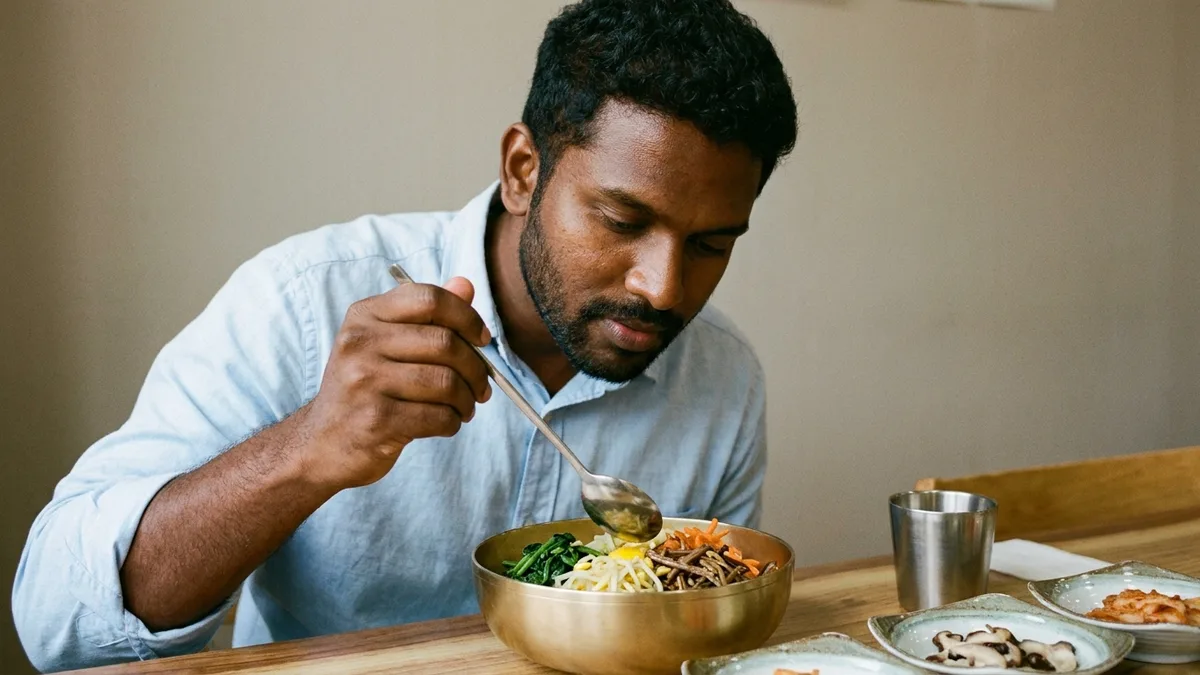
The Korea Tourism Organization's vegetarian guide recommends telling the restaurant about your dietary restrictions in advance and naming the specific ingredients to leave out. If all you say is "고기 빼 주세요" (no meat, please), the pieces of meat may go, but anchovy broth, jeotgal, or egg can stay. Instead of vegetarian category names, we've written sentences that list the ingredients you can't eat, so copy the row that fits your standard into your notes app.
| My standard | Korean sentence to show | Ingredients to point out too |
|---|---|---|
| Meat is the only thing I don't eat | 저는 고기를 못 먹어요. 고기와 고기 육수는 빼 주세요. (I can't eat meat. Please leave out meat and meat broth.) | Beef broth, ham |
| I don't eat meat, fish, or seafood | 저는 고기, 생선, 해산물을 못 먹어요. 멸치 육수와 젓갈도 빼 주세요. (I can't eat meat, fish, or seafood. Please also leave out anchovy broth and jeotgal.) | Anchovy broth, salted shrimp, imitation crab |
| I don't eat any animal ingredients | 저는 고기, 생선, 해산물, 달걀, 우유를 못 먹어요. 육수와 젓갈도 빼 주세요. (I can't eat meat, fish, seafood, eggs, or milk. Please also leave out broth and jeotgal.) | Egg in kongguksu garnish and jeon batter |
| Temple food standard (I don't eat the five pungent vegetables either) | 저는 고기, 생선, 해산물, 달걀, 우유를 못 먹어요. 육수와 젓갈도 빼 주세요. 파, 마늘, 부추, 달래도 빼 주세요. (I can't eat meat, fish, seafood, eggs, or milk. Please also leave out broth and jeotgal. Please also leave out green onion, garlic, garlic chives, and wild chives.) | Osinchae, the five pungent vegetables (green onion, garlic, garlic chives, wild chives, asafoetida) |
Use the sentence asking them to leave out green onion and garlic only if you follow the temple food standard. If you're a vegetarian who does eat the five pungent vegetables, you'd be passing on restrictions you don't need. The sentence to show writes out only four of the five pungent vegetables, so if you want to cover asafoetida too, show the five in the right-hand column as they are.
For dishes, you can look to the alternatives the Korea Tourism Organization's vegetarian guide gives (temple food, bibimbap without meat and egg, kongguksu, vegetable jeon, muk, and tofu). But the same guide notes that kongguksu garnish and vegetable jeon batter can contain egg, so show the sentences from the table even when you order these alternatives.
If you get stuck for words, you can call 1330, the Korea Travel Hotline for tourist interpretation. Within Korea, dial 1330 with no area code; from abroad, dial +82-2-1330. Consultation is offered in English, Japanese, Chinese, Russian, Vietnamese, Thai, and Malay/Indonesian (as of February 2026), and the operating hours for each language need confirming. Chat channels such as KakaoTalk and LINE are also listed (as of March 2023).
Finding vegan and vegetarian restaurants with temple food and vegetarian maps
If asking for ingredients to be left out every time feels like a burden, there's the option of finding places that don't use animal ingredients in the first place. The clearest standard is temple food. The Cultural Corps of Korean Buddhism explains that temple food uses no animal foods and, on top of that, none of the five pungent vegetables (osinchae: green onion, garlic, garlic chives, wild chives, and asafoetida), and the Encyclopedia of Korean Culture likewise says Korean temples don't put the five pungent vegetables in their food.
That said, this is a description of temple food. We found no confirmed source on whether ordinary restaurants advertising a 'temple food style' or a 'vegetarian menu' cook to the same standard, so ask about broth and jeotgal once more at those places too.
You can find restaurant locations with 채식한끼, a vegan and vegetarian restaurant map service. Its web map (oneveganmeal.com/map) lets you filter by vegan or vegan options, and by business type: restaurant, café, bakery, pub, or franchise. The screens are in Korean and we couldn't confirm whether other languages are supported, so turn on your browser's translation feature if you need to. VisitSeoul's 'Vegan Life in Seoul' (edited November 2025) also introduces temple food restaurants in Jongno-gu and vegan restaurants in Itaewon and Haebangchon, but it reflects the time it was edited, so check again whether they're still open.
You can also check whether a product is vegan by its certification logo. The Korea Tourism Organization's vegetarian guide introduces the vegan certification logos of six bodies, including the Korea Agency of Vegan Certification and Services (한국비건인증원), the Vegan Society, and V-Label.

Want to handle everything from your first ride after landing in one app? Check out LACHA.
Built to work without a Korean phone number or bank account, with overseas payment methods like Alipay, WeChat Pay, and Apple Pay. Taxi hailing plus KTX, express bus, and airport railroad (AREX) booking — all in one app.
Up to 60% off Korea transit with a coupon (max ₩3,000): enter code at sign-up. KTX gets up to 18% off on top
Download now


Where allergy labeling is mandatory, and where it isn't
Mandatory allergy labeling at Korean restaurants is narrower than you might think. You shouldn't expect allergy information on every menu, but it isn't true that there's no requirement at all either.
The legal basis on the restaurant side is Article 11-2 of the Special Act on Safety Control of Children's Dietary Life (어린이 식생활안전관리 특별법). It's the provision that has business operators prescribed by Presidential Decree, among establishments that mainly cook and sell foods favored by children, label the names of allergenic ingredients, and Article 8 of the Enforcement Decree of the same Act sets those covered as cafés and snack restaurants (휴게음식점), general restaurants (일반음식점), and bakeries (제과점) that are franchise businesses with 50 or more outlets, counting company-owned and franchised stores together. The threshold was widened from 100 or more outlets to 50 or more on July 13, 2021, so the '100 or more' still seen in older articles is the old standard.
The foods covered are those set by a Ministry of Food and Drug Safety notice: confectionery and bakery products, ice cream products, hamburgers and pizza, plus any other cooked and sold foods for which the business operator chooses to provide allergy labeling. In the store, the information has to be written near the product name or price on the menu, or given in a booklet or poster along with a notice such as 'A booklet with information on allergenic foods is available at the counter' (알레르기 유발 식품에 대한 정보표시 책자가 계산대에 비치되어 있습니다). For delivery ordered through an app, it has to appear near the product name and price in the app; for delivery ordered by phone, on a leaflet or sticker. Whether delivery app platforms themselves carry the obligation needs confirming.
| Where | Allergy labeling required? | Where to look |
|---|---|---|
| Cafés and snack restaurants, general restaurants, and bakeries with 50 or more outlets counting company-owned and franchised stores together | Yes (confectionery and bakery products, ice cream, hamburgers and pizza, etc.) | Near the product name and price on the menu, or a booklet or poster at the counter |
| App and phone delivery orders from the same business | Yes | Near the product name and price in the app; for phone orders, the leaflet or sticker that comes with the food |
| Packaged foods sold at convenience stores and similar shops | Yes (Enforcement Rule of the Act on Labeling and Advertising of Foods, Annex 2) | The allergy labeling box near the ingredient list, and any "may contain" statement |
| Other neighborhood eateries (Korean restaurants, markets, older shops, etc.) | We couldn't find a provision that makes it generally mandatory | Don't rely on labels; ask staff directly |
The compliance requirements for food service businesses in Annex 17 of the Enforcement Rule of the Food Sanitation Act (식품위생법 시행규칙; amended September 1, 2026) don't contain the word 'allergy', and in this research we couldn't find a provision that generally makes allergy labeling mandatory at other neighborhood eateries. That means that at neighborhood Korean restaurants, markets, and older shops, you need to ask staff in Korean. Put your own allergen in the parentheses and show the sentences.
- 저는 (땅콩) 알레르기가 있어요. — I'm allergic to (peanuts).
- 이 음식에 (땅콩) 들어가나요? 국물이나 양념에도요? — Is there (peanut) in this dish? Even in the broth or seasoning?
- 조금만 들어가도 위험해요. 빼 주실 수 있나요? — Even a little is dangerous for me. Could you leave it out?
For packaged foods, Annex 2 of the Enforcement Rule of the Act on Labeling and Advertising of Foods (식품 등의 표시ㆍ광고에 관한 법률 시행규칙) sets the allergens that must be labeled: eggs (알류, poultry only), milk (우유), buckwheat (메밀), peanuts (땅콩), soybeans (대두), wheat (밀), mackerel (고등어), crab (게), shrimp (새우), pork (돼지고기), peach (복숭아), tomato (토마토), sulfites (아황산류, only when the final product contains 10mg or more of sulfur dioxide per 1kg), walnuts (호두), chicken (닭고기), beef (쇠고기), squid (오징어), shellfish (조개류, including oysters, abalone, and mussels), and pine nuts (잣). Different sources count these differently, so the number of types quoted varies; check against this list rather than a number.
The labeling puts an allergy labeling box, set off from the background color, near the ingredient list, and lists every allergen used as an ingredient regardless of the amount (in a form like '달걀, 우유, 새우, 이산화황, 조개류(굴) 함유', meaning "contains egg, milk, shrimp, sulfur dioxide, shellfish (oyster)"). Even if an allergen wasn't used, a statement such as '메밀 혼입 가능성 있음' (may contain buckwheat) has to be added when there's a risk of it getting mixed in through the same workers, equipment, production line, or ingredient storage, so if your allergy is severe, read all the way to the "may contain" statement. Using convenience stores in general is covered in the complete guide to Korean convenience stores.
Pork is on the list, so Muslim readers can use the labeling box as a reference too, but this box doesn't tell you whether something is halal. Alcohol content and slaughter method aren't on the list. Whether this labeling applies to unpackaged products, such as ready-to-eat foods or bread made in the store, also needs confirming.
When an allergic reaction starts: auto-injector, 119, emergency room
The Korea Disease Control and Prevention Agency (KDCA) describes anaphylaxis as a rapidly progressing, life-threatening, whole-body allergic reaction. It says symptoms such as a drop in blood pressure, difficulty breathing, and fainting appear, that the person must go to an emergency room, and that an intramuscular epinephrine injection is needed. As common food causes, it lists egg, milk, walnuts, peanuts, wheat, buckwheat, crustaceans, fruit, beans, and fish. The response steps in KDCA's guidance are as follows.
- Lie down, or lay the person down, on a flat surface.
- If an epinephrine auto-injector is available, inject it into the thigh muscle. The indicated dose is 0.15mg for a body weight of 15–30kg and 0.3mg for more than 30kg (based on the Korean product approval; the Korea Disease Control and Prevention Agency's guidance says '0.3mg for 30kg or more', so the two overlap at exactly 30kg).
- Call 119 at the same time as you inject.
- Get to a hospital even if the symptoms ease.
Warning: If you suspect anaphylaxis, don't hail a taxi to the emergency room; call 119. The basis for foreigners being able to call 119 too is in Korea's emergency phone map, and emergency room costs and medical interpretation lines are covered in How to See a Doctor in Korea.
In Korea, the epinephrine auto-injector Jext Prefilled Pen (젝스트프리필드펜주; 150 micrograms and 300 micrograms) is a prescription-only medicine, so you need a doctor's prescription. You can't buy it at a pharmacy without a prescription while traveling, so if you have a severe allergy, talk to your own doctor before you leave home, get one ready, and learn how to use it. KDCA also advises always carrying an auto-injector and letting restaurants and similar places know about your triggers in advance. How to buy medicine is covered in How to Buy Medicine in Korea.
If it's hard to explain your symptoms and what you ate in Korean, you can get interpretation help from 1330, but in an emergency, 119 is the first number to call. This section relays KDCA's guidance and isn't medical advice. There's also no guarantee that labels or staff answers protect you from cross-contamination.
Frequently Asked Questions (FAQ)
Q1. Is a restaurant labeled Muslim Friendly a halal restaurant? A. No. By the Korea Tourism Organization's definitions, Muslim Friendly means a restaurant that serves some halal dishes and may sell alcohol, and Pork Free means a non-halal restaurant that doesn't use pork. If you want certification from an outside body, look for a Halal Certified (할랄 공식 인증) restaurant and check the certificate's validity period. Also keep in mind that the Korea Tourism Organization's list itself is as of December 2021.
Q2. Is KMF halal certification also recognized under Indonesian or Malaysian standards? A. The mutual recognition agreement (MRA) between Indonesia's Halal Product Assurance Organizing Agency (BPJPH) and KMF and KHA is confirmed by an English press release from the Ministry of Agriculture, Food and Rural Affairs (December 11, 2023). Mutual recognition with Malaysia's JAKIM is presented by HAI Korea, but we couldn't confirm JAKIM's official list itself. Separately from any agreement, make the final call on whether something is halal by the standard you follow.
Q3. Are kimchi and doenjang-jjigae vegetarian? A. As they come, they may not be. The Korea Tourism Organization guidebook lists jeotgal in the filling of napa cabbage kimchi and salted shrimp in kkakdugi, and the Korean Food Promotion Institute's doenjang-jjigae recipe includes beef sirloin, with anchovy broth given as an alternative broth. Ingredients differ by restaurant, so ask "김치에 젓갈 들어가나요?" (Is there jeotgal in the kimchi?) and "국물에 멸치나 고기 들어가나요?" (Is there anchovy or meat in the broth?).
Q4. Do all Korean restaurant menus show allergy information? A. No. The places required to label are franchise-business cafés and snack restaurants, general restaurants, and bakeries with 50 or more outlets counting company-owned and franchised stores together, and the covered foods are items such as confectionery and bakery products, ice cream, and hamburgers and pizza. These stores have to provide the information near the prices on the menu or in a booklet at the counter. For neighborhood Korean restaurants, markets, and older shops, we couldn't find a general labeling requirement, so ask staff directly.
Q5. Can I buy an epinephrine auto-injector at a pharmacy in Korea? A. Not without a prescription. The product in Korea, Jext Prefilled Pen (젝스트프리필드펜주; 150 and 300 micrograms), is a prescription-only medicine, so you need a doctor's prescription. If you have a severe allergy, talk to your own doctor before you leave home and get one ready, and if a reaction starts, use the auto-injector and call 119 at the same time. The steps for getting medical care are in How to See a Doctor in Korea.
Note: This article is for general information purposes. It was compiled as of Sep 2026 from materials by the Korea Tourism Organization (Muslim-friendly restaurant guidebook as of December 2021, vegetarian guide updated October 2023), the Seoul Tourism Organization's VisitSeoul, the Cultural Corps of Korean Buddhism, the Encyclopedia of Korean Culture, the Culture Big Data Platform, the Korean Food Promotion Institute, the Kimchi Research Institute at Pusan National University, and Chaesikhankki (채식한끼); HAI Korea's KMF halal-certified company list (checked 2026-09-11 and 2026-10-02) and press releases from the Ministry of Agriculture, Food and Rural Affairs; Annex 2 of the Enforcement Rule of the Act on Labeling and Advertising of Foods, the Special Act on Safety Control of Children's Dietary Life and its Enforcement Decree, Annex 17 of the Enforcement Rule of the Food Sanitation Act, and a Ministry of Food and Drug Safety notice, via the National Law Information Center; and materials from the Korea Disease Control and Prevention Agency and Uiyakpum Anjeon Nara (의약품안전나라, the Ministry of Food and Drug Safety's drug information portal). We couldn't confirm the following with primary sources, so we left them out: the detailed requirements for KMF restaurant certification, how often the certification list is maintained, whether JAKIM recognizes it, 1330's current operating hours by language, and the amount of the administrative fine for not labeling allergens. This article is not a halal ruling or medical advice, and certification, legal, and shop information can change, so check again on each agency's and shop's official channels before you use it. LACHA does not provide restaurant search or reservations, halal certification checks, allergy information checks, or medical guidance.