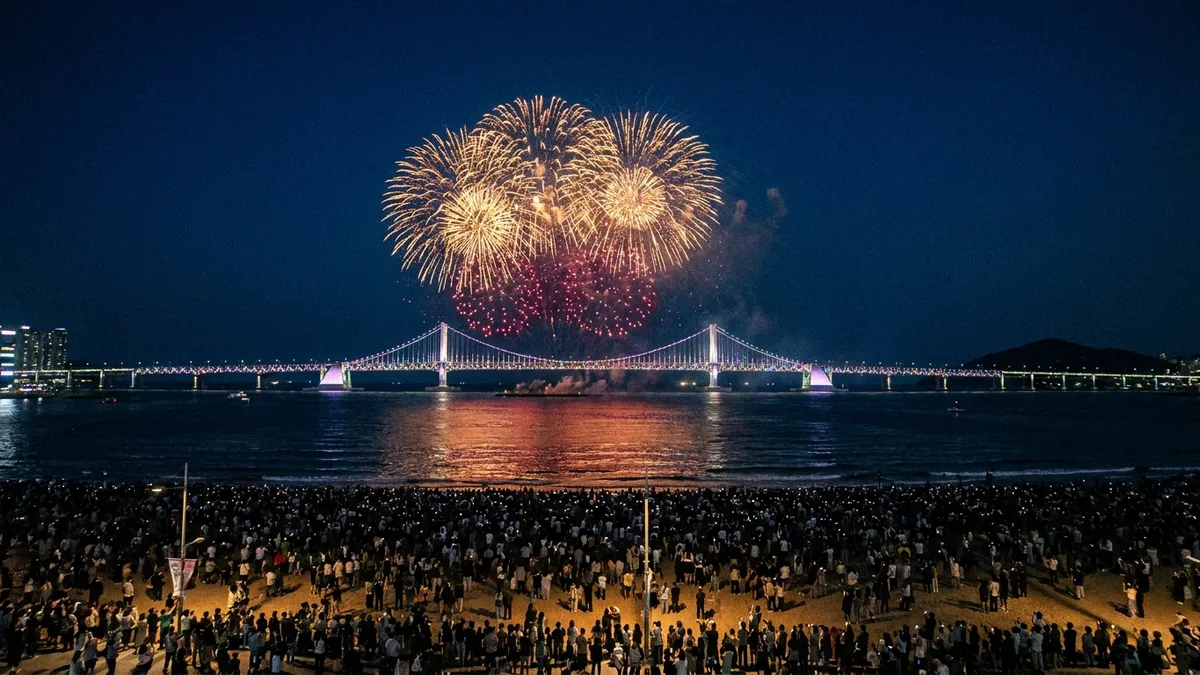
The 2025 Busan Fireworks Festival drew 1.17 million people in a single day (Busan City count, up 140,000 from the previous year's roughly 1.03 million). The 21st edition in 2026 will be held on Saturday, November 7. The moment the fireworks end, all those people stand up from Gwangalli Beach and start walking in the same direction at once.
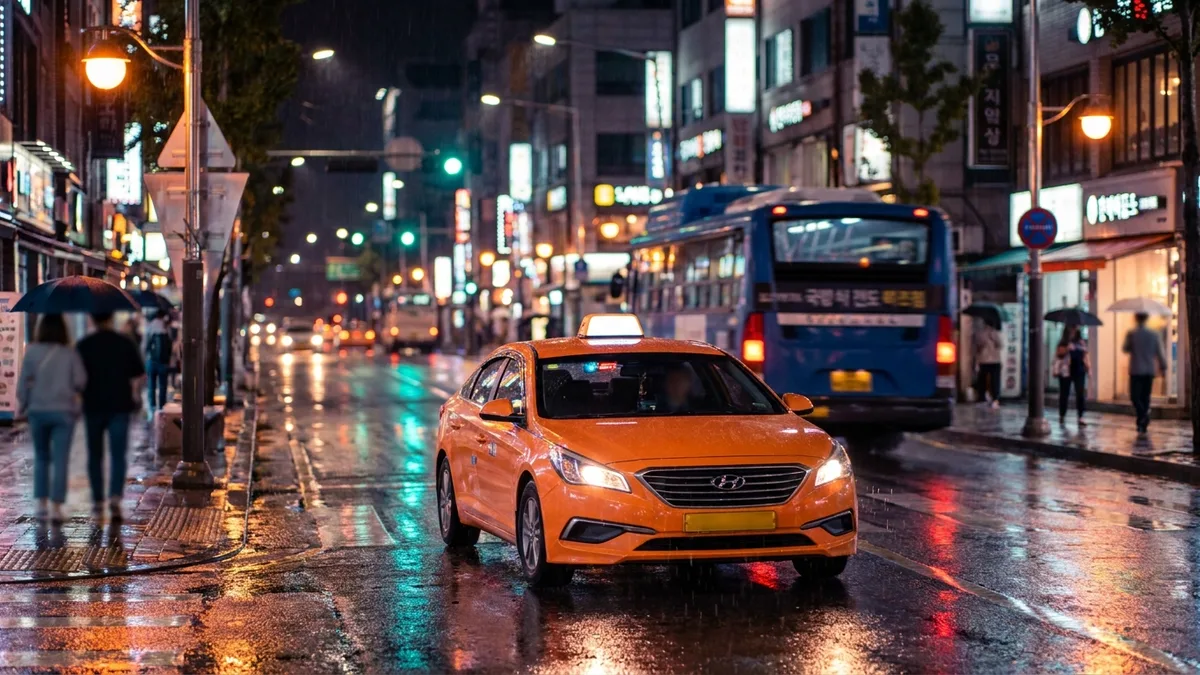
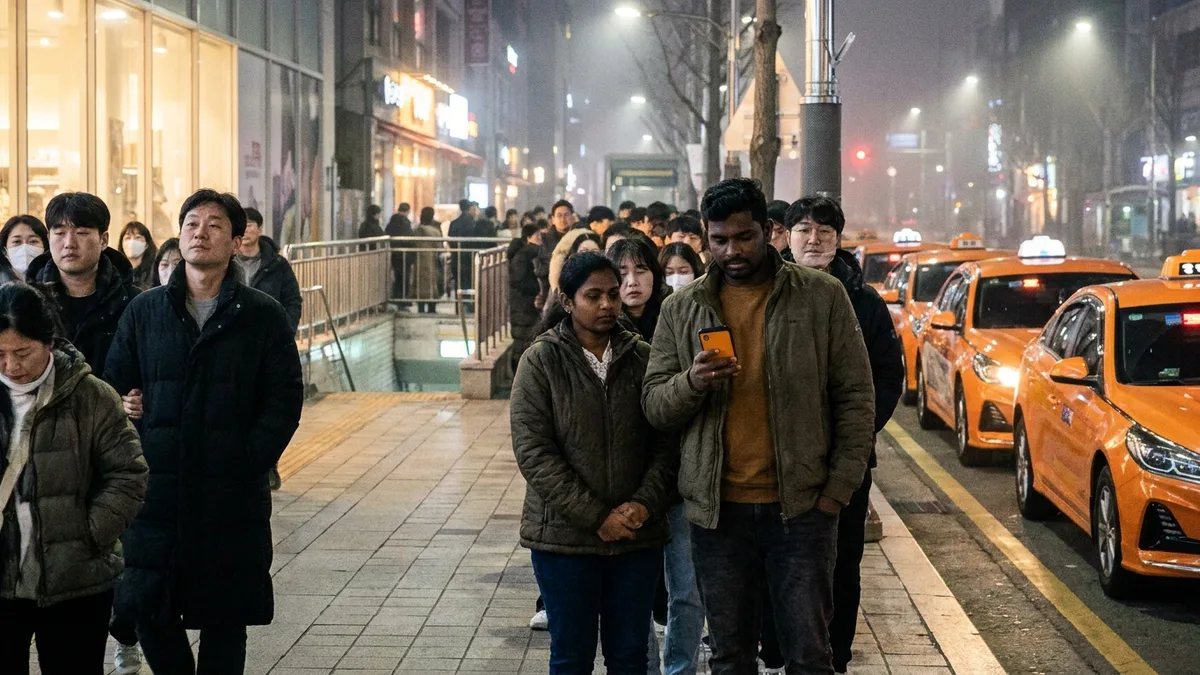
Here's where most travel articles get it wrong. They say "you can't catch a taxi because there are too many people." But if you actually read Busan City's traffic control notices, the reason is different. Based on 2025 data, Gwangan Bridge was completely closed from 15:30 (upper deck) and 18:30 (lower deck) until midnight, and Haebyeon-ro, Gwangnam-ro, and Millak Waterside Road were blocked starting at 17-18:00. In other words, taxis aren't struggling to find passengers — the roads they need to reach you are physically closed.
The Seoul day-trip question also can't be answered with a simple yes or no. Based on 2025 timing, the main fireworks show ended at 20:00, and the last KTX from Busan Station to Seoul departed at 22:10, giving you 2 hours and 10 minutes. But on festival day, subway stations control entry step-by-step starting from outside the gates, adding 30-60 minutes just to get in. The real answer is: "Possible if you book a backup train."
The fare needs updating too. Starting September 1, 2026, KTX and SRT merge, dropping Seoul–Busan economy class fares from 59,800 KRW to 54,400 KRW. If you're planning around the November festival, 59,800 KRW is already an outdated number.
One last thing to be honest about: As of 2026-09-28, the start time (19:00) and paid seat prices and sale period have been announced, but the day-of traffic control plan is still unannounced. Many of the numbers below come from the previous edition (2025's 20th festival), and I've marked that in every relevant sentence.
Note: The traffic control in this article is based on 2025 data and the train timetables are values queried as of 2026-08, while the 2026 start time, seat prices, and sale period were confirmed on the official site and the booking page as of 2026-09-28. They may change when the 2026 traffic control plan comes out, so please reconfirm with Busan City (busan.go.kr), the official Busan Fireworks Festival site, and the Korail+(formerly KorailTalk) app.
November 7, 2026 — What's Confirmed and What's Not
Let's start by separating confirmed from unconfirmed — that's the foundation of any plan.
What's confirmed: the date and location. Both the festival's official site and the Busan Festival Organizing Committee specify 21st edition / Saturday, November 7, 2026. The venue is Gwangalli Beach, Igidae, and Dongbaek Island (Haeundae) areas, with a three-point display launched from barges and Gwangan Bridge continuing the pattern.
The time and tickets came out in September. The official site posted its regular ticket booking notice on 2026-09-04, and the viewing time listed on the booking page is 19:00-20:00 (intermission planned for 19:15-19:25). What's still not out is detailed safety measures such as traffic control and extra public transit service. As of 2026-09-28 there's nothing about them in the official site's notices, and Busan City has said it will announce them separately as the event gets closer.
Warning: Some travel media listed the 2026 event as "20:00-21:30", but that doesn't match the official booking page. The 2026 viewing time of 19:00-20:00 is the same as the 2025 actual (19:00 start, main fireworks show about 1 hour, ~20:00). So all time calculations in this article are simulations based on a 20:00 end time.
"Early November every year" isn't quite accurate either. Here's how the dates actually scatter:
| Edition | Date | Day |
|---|---|---|
| 19th | November 9, 2024 | Sat |
| 20th | November 15, 2025 | Sat |
| 21st | November 7, 2026 | Sat |
There's exactly one pattern: It's always on a Saturday. It could be the first week of November or the third. If you're trying to bundle it with other November plans, see Korea Festivals & Events November 2026.
What 1.17 Million People in One Day Actually Creates
Crowd size is hard to grasp, so let's translate it into response scale. On the 2025 festival day, Busan City deployed about 7,000 personnel including civil servants, fire, and police. Fire and rescue handled 86 calls that day, with 6 people transported to hospitals (as of 21:00, Busan Fire & Disaster Headquarters).
The subway numbers are even more specific. Busan Transportation Corporation added a total of 200 extra train runs across Lines 1-3, and deployed a total of 2,443 staff including 1,362 safety support personnel concentrated at Gwangan, Geumnyeonsan, Suyeong, Seomyeon stations and more.
Here's how they tightened the train intervals:
| Time Period | Normal Interval | Festival Day Interval |
|---|---|---|
| Pre-event 16-19:00 | 5-8 min | 4.5-6 min |
| Post-event 20-22:00 | 8-10 min | 3-5 min |
Here's the key point: Homebound trains come every 3-5 minutes. Yet people still get stuck for an hour — not because trains are missing, but because the path to the platform is blocked. That's what the next section covers.
Tip: The 1.17 million is Busan City's own count. The calculation method (telecom floating population vs. visual estimate) isn't public, so it's safer to read it as "140,000 more than the previous year" rather than an absolute figure.
The Real Subway Bottleneck Is the Gate
When crowds surge, Busan Transportation Corporation controls entry in stages: ① outside entrance → ② turnstiles/gates → ③ platform. They installed 15 portable gates at Gwangan, Geumnyeonsan, and Namcheon stations.
For foreign readers, this functionally means one thing: Waiting in line 30 minutes to 1 hour outside the station isn't a malfunction — it's standard operation. If the line isn't moving and you run to another station, you might end up even later.
About train pass-throughs, let me be precise: Busan City's plan wording is "deploy empty trains to Suyeong, Gwangan, and Geumnyeonsan stations when congestion is expected, and pass through some stations without stopping if crowds pose an accident risk." In other words, it's "may pass through" not "will pass through." Whether it actually happens is a field judgment on the day.
Alternative Stations Designated by Busan Transportation Corporation Itself
Instead of vague advice, I'll copy the official announcement directly. After the event ends, use Suyeong, Geumnyeonsan, or Namcheon stations instead of Gwangan — that's Busan Transportation Corporation's recommendation.
| Station | Line | From Gwangalli | This Guide's Note |
|---|---|---|---|
| Gwangan | Line 2 | Closest | Maximum congestion right after event, subject to staged entry control |
| Suyeong | Lines 2·3 transfer | Walking required | Transfer station gives you more direction options |
| Geumnyeonsan | Line 2 | Right next to Gwangan | Portable gate deployment site and officially recommended |
| Namcheon | Line 2 | West of Gwangalli | Officially recommended, access from western beach |
Warning: Different sources list slightly different recommended combinations. Some summaries cite other stations as alternatives, but this guide adopts the Busan Transportation Corporation announcement original text (Suyeong, Geumnyeonsan, Namcheon). On-site announcements and field staff instructions always take priority.
Last trains need caution too. Gwangan Station's last trains by normal schedule are toward Jangsan 00:20, toward Yangsan 23:26, toward Hopo 23:42 per timetable aggregator sites, but these are tentative values. What was confirmed in 2025 official materials was the extra runs and shortened intervals — subway late-night extension wasn't explicitly stated. Planning based on "the subway runs late on festival day" is risky.
For reference, Busan Metro fares are 1,600 KRW for zone 1, 1,800 KRW for zone 2 on transit cards, and Gwangalli to Busan Station is zone 2. If you're moving around multiple times in one day, the 1-day pass at 6,000 KRW might be worth it.
It's Not That Taxis Can't Pick You Up — They Can't Get In
This is what I most want to say in this article. Traffic control for the 2025 20th edition ran in 3 stages:
| Stage | Start Time | Control Section |
|---|---|---|
| Stage 1 | 10:00~ | Gwangan Haebyeon-ro Eonyang Intersection~Mannam Square (0.82km) |
| Stage 2 | 14:00 / 16:00 | Hwangnyeongsan-ro (2km) at 14:00 · Haebyeon-ro (0.8km), one-way road behind Haebyeon-ro (1.5km), Marine City 1-ro (1.1km), Hwangnyeongsan Loop Road (5.5km) at 16:00 |
| Stage 3 | 17:00~ | Expanded to Haebyeon-ro, Gwangnam-ro (3.0km), Millak Waterside Road (1.4km) |
On top of that, starting at 18:00, 11 bus routes (9 regular, 2 village) passing Gwangnam-ro were completely controlled, and Gwangan Bridge was fully closed upper deck (toward Nam-gu) 15:30-24:00, lower deck (toward Haeundae) 18:30-24:00. In the 5-6 days before the event, there was also partial 1-2 lane control at night.
If you reread this table chronologically, the conclusion emerges: Around 20:00 when the fireworks end, the roads taxis need to enter or stop on around Gwangalli Beach are physically blocked. It's not about tapping the ride-hailing app a few more times — cars literally can't reach the zone. This is an interpretation derived from control zones and times; official measured data like taxi request success rates on festival day hasn't been released.
So the practical prescription is:
- If you must take a taxi, walk outside the control perimeter before calling. Requesting from the beach means even if a car accepts, it can't approach.
- If you're returning to Haeundae accommodations, factor in that Gwangan Bridge is closed until midnight. When that overlaps with late-night surcharges after midnight, the burden grows — see the calculation method at Korea Taxi Fares & Late-Night Surcharges.
- City buses had concentrated deployment on 21 routes near the venue, with some routes extended to midnight. However, from 19-21:00, all city buses passing Gwangnam-ro were detoured to Suyeong-ro (all based on 2025).
The Walk-Out Option
There's experiential wisdom shared among local attendees: Right after it ends, walking is often faster than waiting for public transport.
- Gwangalli to Centum City/Marine City area: about 1 hour at a brisk pace
- Gwangalli to Haeundae new downtown: about 2 hours
- Gwangalli to Seomyeon: about 2 hours
Warning: The above times aren't agency measurements but user-review-based descriptions. Use them only as ranges, and don't push it if traveling with children or elderly.
A realistic compromise is walking just one station and boarding there. Walking to Namcheon or Geumnyeonsan Station lets you skip the entire Gwangan Station queue.
Seoul Day Trip — Answering with Timetables, Calculating the Close Call
"Is a day trip possible?" is better answered with timetables than yes/no. Below is a simulation based on the 2025 end time (20:00).
The starting line is 20:00. Gwangan Station to Busan Station via Seomyeon transfer normally takes 40-50 minutes, so theoretically you could reach Busan Station before 21:00. But you have to add 30-60 minutes waiting to enter the station. That scatters your Busan Station arrival between 21:10 and 21:50.
Here are the trains from Busan Station to Seoul Station (queried 2026-08-23):
| Train | Depart Busan Station | Arrive Seoul Station |
|---|---|---|
| KTX 66 | 21:00 | 23:44 |
| KTX 68 | 21:28 | 00:11 |
| KTX 70 | 21:41 | 00:21 |
| KTX 72 | 22:00 | 00:27 |
| KTX 74 (last) | 22:10 | 00:42 |
Don't relax thinking you have 2 hours 10 minutes to the last train. The wait variance is 30 minutes. So the prescription is book one of 21:00, 21:28, or 21:41 as backup.
Warning: The above timetable was queried on a Sunday (2026-08-23), so Saturday operations may differ. Plus, the September 1 integration brings weekday service from 379→402 runs and weekend from 431→457 runs with a major timetable revision. Train numbers and last train times could change, so reconfirm on the day via Korail+ app.
It's also good to know your options if you miss the last train:
- Express buses: The last bus from Busan Central Bus Terminal (Nopo) to Seoul Express Bus Terminal leaves at 23:50, with 32 runs a day. Nopo-dong is the Line 1 terminal, reachable by subway but quite far from Gwangalli.
- Overnight Mugunghwa trains from Busan to Seoul were abolished on 2019-12-30, so there are no trains after the KTX last train.
The fare is as mentioned earlier: Seoul–Busan economy class is 54,400 KRW starting September 1, 2026 (down from 59,800 KRW, average 10% reduction). First class reduction has been announced but the amount hasn't been disclosed yet (pre-announcement — check needed). Full route details are in Seoul to Busan KTX Guide.
Note: From September 1, SR merges into KORAIL and the SRT brand is absorbed into KTX. Reservations also consolidate into the unified Korail+ app, so old advice like "book via SRT app" won't work anymore.
Paid Seats and Foreign Reservations — This Is the Real Crossroads
For the 2026 21st edition, paid viewing seats are R-seat 100,000 KRW (table+chair) and S-seat 70,000 KRW (chair only), the same as 2025, and the location is again Gwangalli Beach in front of Aqua Palace Hotel and Homers Hotel. The Busan citizen 10% discount introduced this year (R-seat 90,000 KRW, S-seat 63,000 KRW) works by showing an ID with a Busan address at the on-site booth on the day and collecting your ticket there, and foreigners need an alien registration card or a Domestic Residence Report Card. The 2026 seat count couldn't be confirmed in official announcements. In 2025 there were about 14,000 seats in total (R-seat 4,060, S-seat 10,340), and Busan City announced it was preparing about 5,000 seats for foreign tourists (up 600 from the previous year).
For a sense of competition: the 2026 early bird (August 26 at 14:00, some S-seats at 20% off for 56,000 KRW) sold out completely in 1 minute. Regular sale opened September 4 at 14:00 and runs until November 6 at 17:00, but quantities are limited, so it may close before then. In 2025 as well, early bird sold out all seats in 1 minute after opening on August 22, regular sale was September 1 at 14:00, second release opened October 10, and overseas travel agency allocations including Taiwan also sold out early.
Warning: The 2026 prices and sale period above are values confirmed on the official site and the booking page as of 2026-09-28. Check the remaining seats in each zone directly on the booking page. Paid seat entry starts at 15:00, and if you don't reach your seat by 18:00, you can neither enter nor get a refund. Given that in 2025 the Haebyeon-ro control widened from 17:00, going in early is the safe choice.
Here's the critical part for foreign readers: the sales channels have changed. In 2025 it was YES24 Ticket, but the official 2026 booking channel is NOL Ticket (Interpark), and you can also buy on the BNK Busan Bank mobile banking app (until November 1 at 23:59). S-seats are also sold at the counters of all Busan Bank branches (until close of business on November 5). If you're visiting from abroad, look at the English route below before the Korean-language screens.
The English version of the official site links to NOL World (the English NOL Ticket), and this product is for international visitors only and requires passport verification. Prices are the same as domestic, R-seat 100,000 KRW and S-seat 70,000 KRW, and tickets booked from October 12 onward can only be collected at the on-site booth on the day. In 2025, overseas OTAs like Klook, Trazy, and KKday also sold 'Foreigners Only' seat tickets in English, with overseas cards and mobile vouchers. They were typically more expensive than domestic prices, and this article couldn't confirm the prices or conditions of 2026 OTA products, so compare them with the NOL World price before choosing.
| Channel | What You Buy | Payment·Verification | Note |
|---|---|---|---|
| NOL Ticket·NOL World | Paid seats R/S class | Korean NOL Ticket or English NOL World (passport verification) | 9/4 14:00~11/6 17:00, max 4 tickets per person |
| BNK Busan Bank app | Paid seats | Domestic financial procedures | Mobile until 11/1 23:59, S-seats at all branch counters (until close of business 11/5) |
| Klook·Trazy·KKday | Foreigner-exclusive seat tickets | Overseas cards·English payment | Works without verification but higher prices |
| Korail+ | Round-trip KTX | Domestic·overseas cards | SRT also books here from Sep 1 |
| LACHA | KTX·express bus·taxi·transit card | Overseas cards·E-Wallet | No intercity bus or ferry |
And one misconception to clear up: You can watch the fireworks without a paid seat. You can view for free from Gwangalli Beach outside the paid zone, Igidae, Dongbaek Island, and other areas. However, Hwangnyeongsan Loop Road was vehicle-controlled from 16:00 in 2025, so forget about driving up.
Accommodations Are Already Gone 3 Months Out
The 2025 real-case examples are pretty extreme. On festival day, most hotels in the Gwangalli area quoted over 1.5 million KRW, and Gwangan Bridge view rooms that normally go for 500,000-600,000 KRW on weekends hit 1.2-1.5 million KRW on festival day. 20-pyeong (66㎡) 4-person units ran 2.6-3 million KRW, about 4x the September regular weekend rate (600,000-700,000 KRW), and studio/two-room units saw cases up to 4 million KRW reported.
The key isn't the price, it's the timing: All rooms were sold out by late August. With the 2026 festival on November 7, if you're reading this in September, Gwangalli views are realistically gone.
Tip: Give up on Gwangalli and stay in Seomyeon or the Busan Station area and take the subway — that's the practical move. The Busan Station area also shortens next-day Seoul return logistics, doubling the advantage. If you're routing by budget, also see Cheapest Way to Busan.
Warning: The above accommodation prices are platform quotes from press coverage, not actual transaction prices, and they're 2025 values, so take away the timing of "sold out 3 months ahead" rather than the amounts.
BIFF Is a Completely Different Game
Same city, same autumn, but totally opposite transport character. The 31st Busan International Film Festival runs October 6 (Tue) to 15 (Thu), 2026, for 10 days. That's about 3 weeks before the fireworks festival (11/7), so bundling both events in one trip means staying over a month.
Put the numbers side by side and the difference is clear: Fireworks festival is 1.17 million in one day (2025, Busan City count), BIFF is 238,697 total over 10 days (30th edition official result). BIFF's challenge isn't crowd survival but movement design between screening clusters.
By the 30th edition, screenings were at 7 theaters with 31 screens: Busan Cinema Center, CGV Centum City, Lotte Cinema Centum City, Korean Film Council Standard Screening Room, Dongseo University Sohyang Theatre Shinhan Card Hall, Busan Viewers Media Center were the clusters, and Community BIFF was held at Megabox Busan Theater, Busan Catholic Center Space 101.1, and BIFF Square in Nampo-dong.
Here's the transport core: Main screening venues cluster in Centum City (Line 2), while Community BIFF's BIFF Square in Nampo-dong is Line 1 Jagalchi/Nampo area, a completely different axis. Travel between the two axes takes about 40-50 minutes by subway, so scheduling like morning Nampo-dong and afternoon Centum City on the same day collapses if a screening runs even slightly over.
- Busan Cinema Center is about 200m walk from Line 2 Centum City Station Exit 12, and connects underground through Shinsegae and Lotte Department Stores.
- BIFF Square in Nampo-dong is walking distance from Line 1 Jagalchi Station Exit 7 or Nampo Station.
Some 31st edition news is confirmed: The opening film is "Day and Night Belong to Each Other" (announced 2026-08-19), Asian Filmmaker of the Year is Michelle Yeoh, Camellia Award is director Ann Hui, Korean Cinema Award is former chairman Kim Dong-ho. The 21st Asian Contents & Film Market (ACFM) is October 10-13 with Thailand as the first-ever Guest Country of Honor.
Warning: The 31st edition's total number of films, venue list, and reservation schedule are pre-announcement as of 2026-08. Values circulating online like "total 169 films," "reservation opens in September," "ticket 12,000 KRW" aren't officially confirmed. For reference, 30th edition results were 328 films (241 official invitations + 87 Community BIFF), general screening tickets 10,000 KRW.
The reservation method by 30th edition standards was all seats online, max 2 per transaction, reservation site was BIFF official homepage. Cancellation fees were free before opening, 1,000 KRW per ticket after opening. For digitally vulnerable groups like those 65+ or with disabilities, an on-site outdoor BIFF box office at Busan Cinema Center was also operated.
Settling Luggage and Payment in Advance Makes the Day Easier
The two things that most often go wrong on festival day: ending up on the beach with a suitcase, and payment blocking when you urgently need to rebook a train. For luggage, see Luggage Storage & Delivery Services and drop it at Busan Station or your accommodation first.
Getting payment ready in advance makes things much smoother. LACHA is a transport and payment super-app for foreign travelers that you can use right away without identity verification. Inside the app you can book KTX and express buses, hail taxis, and use transit cards for subway and city buses all in one place (check taxi dispatch coverage by region in the app). Payment works by topping up LACHA Money with overseas cards, 17 types of E-Wallets, account transfer, etc., so you won't hit a wall without a Korean account or Korean number. However, it doesn't handle intercity buses, ferries, or car rentals, so prepare other methods for those segments.
Want to search and book KTX and express buses in one app? Check out LACHA.
Built to work without a Korean phone number or bank account, with overseas payment methods like Alipay, WeChat Pay, and Apple Pay. Taxi hailing plus KTX, express bus, and airport railroad (AREX) booking — all in one app.
Up to 60% off Korea transit with a coupon (max ₩3,000): enter code at sign-up. KTX gets up to 18% off on top
Download now


Frequently Asked Questions (FAQ)
Q1. What time does the 2026 Busan Fireworks Festival start? It starts at 19:00. The viewing time listed on the official booking page is Saturday, November 7, 19:00-20:00 (intermission planned for 19:15-19:25), and paid seat entry starts at 15:00. The immediately previous edition in 2025 was also a 19:00 start with the main fireworks show about 1 hour (~20:00), with a pre-event from 14:00 and 3 rounds of preview fireworks at 18:00. Some travel media's "20:00-21:30" doesn't match the official information, so check directly on the official Busan Fireworks Festival site.
Q2. Can you watch the fireworks without a paid seat? Yes. You can view for free from Gwangalli Beach outside the paid zone, Igidae, and Dongbaek Island areas. With the 3-point display at Gwangalli, Igidae, and Dongbaek, there are viewing spots even if you're not facing Gwangalli directly. However, Hwangnyeongsan Loop Road had vehicle control from 16:00 in 2025, so skip plans to drive up.
Q3. Can I buy paid seats without a Korean mobile number? In 2026 there's an official route. The official sales channels are NOL Ticket and BNK Busan Bank, and NOL World (the English NOL Ticket), which the English version of the official site links to, has a product for international visitors only that you book after passport verification. Prices are the same as domestic, R-seat 100,000 KRW and S-seat 70,000 KRW, with a maximum of 4 tickets per person. In 2025, overseas OTAs like Klook, Trazy, and KKday also sold 'Foreigners Only' seat tickets in English with overseas cards, but they were more expensive than domestic prices. This article couldn't confirm the prices or conditions of 2026 OTA products.
Q4. Can I get back to Seoul the same day after the festival ends? Calculating from the 2025 end time (20:00), you have 2 hours 10 minutes until the last KTX from Busan Station to Seoul at 22:10 (arriving Seoul Station 00:42). However, on festival day subway stations control entry step-by-step from outside the gates, adding 30-60 minutes just to get in. I recommend booking 21:00, 21:28, or 21:41 trains as backup. Last train times and train numbers may change with the September 1 timetable overhaul, so reconfirm on the day via Korail+ app.
Q5. Can I see both the Fireworks Festival and BIFF in one trip? Difficult. BIFF's 31st edition is October 6-15, 2026 and the Fireworks Festival is November 7, about 3 weeks apart. Bundling both events in one trip means staying 32 days from opening day (10/6). Their character is also different: Fireworks Festival is 1.17 million in one day requiring crowd response, while BIFF is about 240,000 over 10 days (30th edition results) scattered across two axes — Centum City (Line 2) and Nampo-dong (Line 1) — requiring movement design.
Note: The content of this article is compiled from materials confirmed as of 2026-08, and the 2026 start time, paid seat prices, and sale schedule were rechecked on the official site and the booking page on 2026-09-28. Traffic control is based on 2025 (20th edition) results, and train timetables are query-time values. The 2026 traffic control plan hasn't been announced yet and typically comes out via Busan City, Suyeong-gu, and Nam-gu notices around October. With the September 1 KTX-SRT integration and major timetable revision, last trains and fares may also change, so before visiting please reconfirm the latest information with Busan City (busan.go.kr), official Busan Fireworks Festival site, BIFF (biff.kr), and Korail+ app.