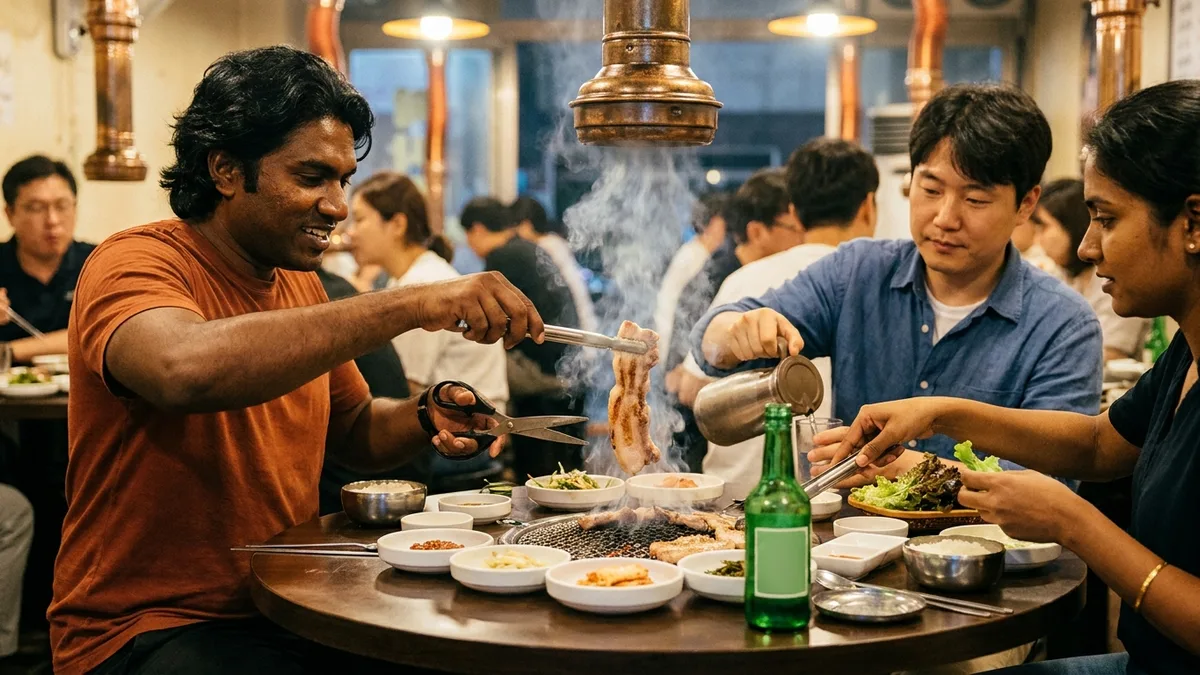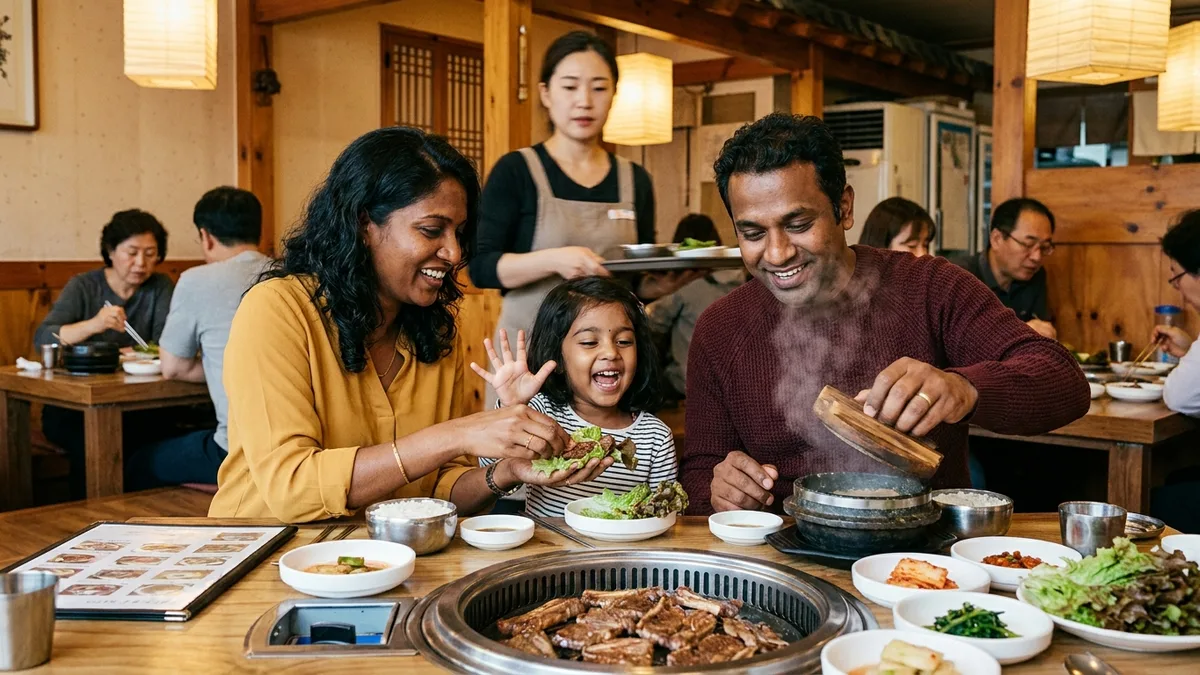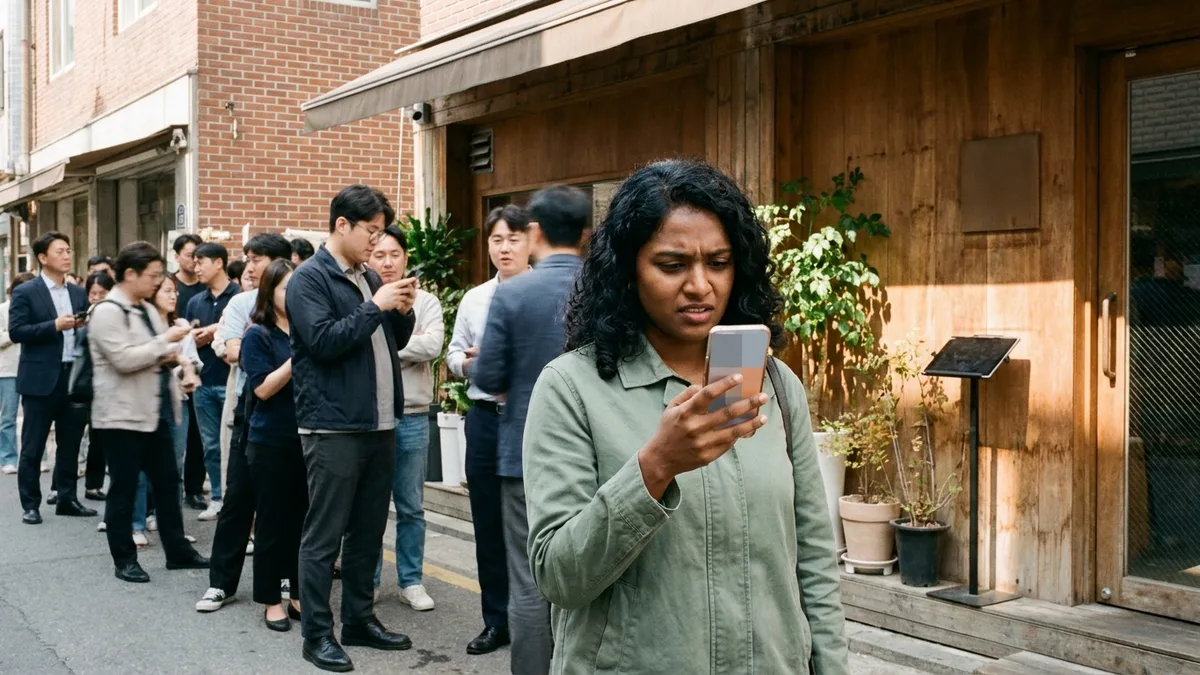
The numbers on a Korean restaurant menu are supposed to be the final price, with value-added tax (VAT) and service charges already included. Final-price labeling took effect on January 1, 2013 under the Enforcement Rule of the Food Sanitation Act, and restaurants have to charge what their price list says. A barbecue restaurant's "orders start at two portions," on the other hand, is a policy the restaurant sets, and according to a Korea Fair Trade Commission official it's hard to see as a violation of the Fair Trade Act (JoongAng Ilbo, reported September 6, 2025). Once you separate the labeling the law requires from the rules a restaurant makes for itself, it becomes clear what to push back on and what to accept.
Some walls are higher only for foreigners. Origin labels are required in Korean while English is optional, so they're hard to read without a translation app, and there's no provision requiring kiosks to support foreign languages. The legal provision that stops card payments from being refused also defines a "credit card member" based on someone issued a card by a card company in Korea, so it may not reach foreign cards as it stands.
The Korea Tourism Organization's VisitKorea says there's no extra charge when you ask for more water or side dishes (March 2023). That's custom rather than a legal rule, though, so it can vary by restaurant, and side dishes that have their own price on the menu are charged at that price. Why you don't need to tip, and restaurant systems like self-serve water and utensils, are covered in the must-eat Korean food guide; which restaurant to walk into is in how to tell where locals eat; and waiting before you get a table is in the restaurant waiting and reservation app guide. What follows is about what happens after you sit down.
Note: The legal provisions and service-channel details below were checked against the original texts on the National Law Information Center and each agency's published materials as of Sep 2026. They can change, so check again on official channels before you use them.
The menu price is the final price: VAT and service charges included
Restaurant operators have to post a price list inside or outside the premises showing the price customers actually pay, including VAT and similar charges, and charge according to that price list (Enforcement Rule of the Food Sanitation Act (식품위생법 시행규칙), Annex 17, subparagraph 7, item 아, as amended September 1, 2026). General restaurants (일반음식점) and light-meal restaurants (휴게음식점) with a reported business floor area of 150 square meters or more must post it both outside and inside.
According to the Seoul Metropolitan Government's food safety information guidance, VAT and service charges can't be written separately on the price list; they have to be shown as a final payable price that includes them in the food price. A "VAT not included" note on a menu, or a service charge newly added as an item on your bill, doesn't fit this rule.
Whether extras like a bowl of rice, extra noodles (sari), or drinks are charged separately varies by restaurant, and we couldn't find any official source that sets out this practice. The confirmed rule goes only as far as charging according to the price list, so if an amount appears under a name that isn't anywhere on the menu, that's a sign it doesn't match the price list.
The numbers on food models or photos can also differ from the bill. It's a gap foreigners fall into especially easily, since they often choose from the models and photos instead of the Korean menu. In a post on PTT, a Taiwanese travel community (February 6, 2020), a traveler at a budae-jjigae restaurant in Myeongdong added ramyeon, shown on the food model as 2,000 KRW, to a 7,500 KRW stew and expected 9,500 KRW, but the bill came to 12,500 KRW. The owner pointed to a menu photo and said that adding ramyeon meant ordering the 5,000 KRW version that comes with ham and sausage, and commenters also said "you can't really tell just from the pictures." Rather than a scam, this was a case where the model's label and the actual add-on item didn't match, so when you pick extra noodles (sari) or other add-ons, first check the total amount as you order.
If the bill is different, the first step is to point to the menu and ask them to check the amount. If you keep a photo of the menu and the receipt, you can show them as they are to 1330 or the Tourist Complaint Center later. A restaurant that doesn't post a price list, or charges more than its posted price, faces administrative action under Annex 23 of the Enforcement Rule of the Food Sanitation Act, as amended September 1, 2026: a 5-day business suspension for a first violation, 10 days for a second, and 20 days for a third.
How many grams is a "portion" at a barbecue restaurant? Reading the price per 100g
Meat such as bulgogi and galbi has to be listed on the menu with a price per 100g (same Annex, subparagraph 7, item 퍼). If it's served cooked, the weight can be given as the weight before cooking, and if a restaurant also wants to list a per-portion price, it has to show the portion weight together with that price.
The examples in the regulation look like "bulgogi 100g ○○ KRW (1 portion 120g △△ KRW)" and "galbi 100g ○○ KRW (1 portion 150g △△ KRW)." The key point is that the law doesn't set a standard weight for one portion. If you compare a place where one portion is 120g with a place where it's 150g using only the per-portion price, you end up comparing different amounts.
| What the menu says | What it means | How to read it |
|---|---|---|
| 불고기 100그램 ○○원 (bulgogi, 100g, ○○ KRW) | The basic labeling the law requires | Compare restaurants using this number |
| (1인분 120그램 △△원) (1 portion, 120g, △△ KRW) | The portion weight and price the restaurant set | Check it against ○○ KRW × 120 ÷ 100 |
| Stews (jjigae), soups (tang), braised dishes (jjim), bossam, jokbal, yukhoe, steak, donkkaseu | Served ready to eat, so not subject to per-100g labeling | Priced per bowl or plate as listed |
| A whole chicken or duck | Sales by the whole bird aren't covered either | Priced per bird as listed |
The exclusions in the bottom two rows of the table follow the Seoul Metropolitan Government's food safety information guidance. If a grill-it-yourself meat item shows only a per-portion price with no weight, ask "How many grams is one portion?" (1인분은 몇 그램인가요?).
The main ingredient and weight of a cooked dish must not differ from what the price list says (same Annex, subparagraph 7, item 터). But because the listed weight may be the weight before cooking, it's hard to conclude that it differs from the label just by looking at the plate after cooking.
Sometimes it's even what the number is the price of that gets read differently. Restaurant menus in China often list the price of one plate of a dish, so travelers from China can easily read a per-portion price on a Korean menu as the price of the whole dish or of a set. A travelogue (November 17, 2023) on Hanyouwang (韩游网), a Chinese travel community, describes going to a gopchang (grilled intestines) restaurant, taking twenty-some thousand KRW to be the price of a set and thinking it was a bargain, then finding out at checkout that it was the price of one portion. If "1인분" (one portion) is written next to a price, it gets multiplied by the number of portions you order, so if you're unsure, ask "Is this price for one portion?" (이 가격은 1인분인가요?) before you order.
"Orders start at two portions" is a restaurant policy, not the law
Even if a restaurant doesn't seat solo diners or takes orders only for two portions or more, the interpretations out there say it's hard to see this as illegal in principle. A Korea Fair Trade Commission official said it "falls under the business's own autonomous decision, so it's hard to see as a violation of the Fair Trade Act" (JoongAng Ilbo, reported September 6, 2025), and a lawyer in a YTN Radio legal commentary (August 22, 2025) likewise explained that it falls under the owner's freedom of contract and freedom to conduct business, so in principle it's hard to see as illegal.
This rule feels especially unfamiliar to travelers from countries where eating alone is common. On Reddit's r/koreatravel, an English-language travel community, someone posted (June 23, 2025) that they had just arrived in Busan and were turned away twice when they tried to have barbecue on their own, and in the comments another person shared that they'd been refused even after offering to order two portions, and that the owner explained "the margin comes from soju, not meat." It's one person's experience, so it can't be taken as the situation at every barbecue restaurant, but it suggests the reason for a refusal may be not that the customer is a foreigner but a restaurant policy that weighs the sales that come from one table. The original poster eventually found a place that would seat them alone on the condition of ordering at least 300g of beef.
So rather than arguing once you're seated, it's easier for everyone to ask "Can I order a single portion?" (1인분 주문 가능한가요?) before you sit down. Types of restaurants that are easy to walk into alone, and tips on call buzzers and paying at the counter, are in choosing a Seoul restaurant by occasion.
If you decide to eat two portions by yourself, you can ask about taking the rest with you. The Enforcement Rule bars restaurants from reusing, re-cooking, or storing food that customers leave behind (Annex 17, subparagraph 7, item 러; food that the Minister of Food and Drug Safety separately designates and posts is an exception), and says they should make an effort to keep take-out containers on hand and let customers know (item 머). Because it's an effort provision, it doesn't mean every restaurant will pack food for you.
Split into legal rules and restaurant policies, the rules you meet at a restaurant look like this.
| Rule you run into at a restaurant | Nature | Basis |
|---|---|---|
| Menu price is the final price including VAT and service charges | Legal rule | Enforcement Rule of the Food Sanitation Act, Annex 17, subparagraph 7, item 아 |
| Meat priced per 100g | Legal rule | Same Annex, item 퍼 |
| How many grams one portion is | Set and labeled by the restaurant | Item 퍼 sets no standard weight |
| Two-portion minimum, turning away solo diners | Restaurant policy (interpreted as hard to call illegal) | Remarks by a Korea Fair Trade Commission official reported by JoongAng Ilbo on September 6, 2025; lawyer's commentary on YTN Radio, August 22, 2025 |
| Origin labeling in Korean | Legal rule | Origin Labeling Act, Article 5, and its Enforcement Rule, Annex 4, subparagraph 1 |
| Foreign-language kiosk screens | No mandatory provision | Enforcement Decree of the Disability Discrimination Act, Article 10-2; Digital Inclusion Act, Article 20 |
| Ban on refusing card payments | Legal rule (application to foreign cards may be limited) | Specialized Credit Finance Business Act, Article 19 |
| Tipping | Not customary | Korea Tourism Organization VisitKorea, Seoul Tourism Organization VisitSeoul |
Reading origin labels: domestic Hanwoo, country of birth, and mixed origins
General restaurants and light-meal restaurants that cook and sell designated agricultural and fishery products have to label their origin, and for beef they must go as far as stating the type of meat (식육의 종류) (Article 5(3) of the Act on the Labeling of Origin of Agricultural and Fishery Products (농수산물의 원산지 표시 등에 관한 법률), the Origin Labeling Act for short). The items covered are beef, pork, chicken, duck, lamb/mutton, and goat meat; the rice in cooked rice, porridge, and nurungji (scorched rice); the napa cabbage and chili powder in napa cabbage kimchi; the soybeans in tofu products, kongbiji (soybean pulp), and kongguksu (cold soybean noodle soup); 20 kinds of seafood including long-arm octopus (nakji), mackerel, hairtail, and squid; and live seafood kept in tanks for cooking (Enforcement Decree, Article 3(5)).
The origin must be written in Korean right next to or below the dish name, and Chinese characters or English are optional additions. The letters have to be the same size as the dish name or larger (Enforcement Rule, Annex 4, subparagraph 1). If it isn't on the menu, look at the wall. A restaurant can skip labeling on the menu if it posts a board titled "원산지 표시판" (origin label board), at least 29cm wide and 42cm tall and meeting the letter-size standards, next to or below its largest display board, or, if there's no display board, straight ahead as you come in through the main entrance (Annex 4, subparagraph 2).
| What the menu says | How to read it |
|---|---|
| 소갈비(쇠고기: 국내산 한우) / beef short ribs (beef: domestic Hanwoo) | It's Hanwoo beef from Korea |
| 삼겹살(돼지고기: 국내산(출생국: 덴마크)) / pork belly (pork: domestic (country of birth: Denmark)) | A pig born in Denmark and raised in Korea for at least 2 months |
| 불고기(쇠고기: 국내산 한우와 호주산을 섞음) / bulgogi (beef: domestic Hanwoo and Australian, mixed) | Two origins are mixed, and domestic Hanwoo, written first, makes up the larger share |
| 배추김치(배추: 국내산, 고춧가루: 중국산) / napa cabbage kimchi (cabbage: domestic, chili powder: Chinese) | Kimchi made in Korea, with domestic cabbage and chili powder from China |
| 배추김치(중국산) / napa cabbage kimchi (Chinese) | Kimchi made abroad and imported, so the country where it was made is listed |
| 넙치매운탕(넙치: 원양산, 태평양산) / spicy flatfish stew (flatfish: distant-water, Pacific) | Distant-water flatfish, caught in the Pacific |
| 부대찌개(햄(돼지고기: 국내산)) / budae-jjigae (ham (pork: domestic)) | For processed ingredients like ham, the origin of their raw material is listed |
A country of birth in parentheses means an imported animal was raised in Korea for at least a set period and then labeled as domestic, and that period is at least 6 months for cattle, at least 2 months for pigs and sheep (including goats and other goat species), and at least 1 month for chickens and ducks. Mixed origins are listed starting with the one that has the higher share, so "호주산과 국내산 한우를 섞음" (Australian and domestic Hanwoo, mixed) means there's more Australian beef. Foreign origins are shown by country name, while domestic origins can instead be shown by the name of a province or metropolitan city (시·도) or of a city, county, or district (시·군·구), or as "연근해산" (coastal and offshore waters) for seafood. Blanket notices like "우리 업소에서는 국내산 쌀만 사용합니다" (We use only domestic rice at this restaurant) are allowed too.
Failing to label or breaking the labeling method brings an administrative fine (과태료) of up to 10,000,000 KRW (Article 18), while false labeling is a criminal offense punishable by up to 7 years in prison, a criminal fine (벌금) of up to 100,000,000 KRW, or both (Article 6(2) and Article 14(1)). Report a suspicious label to the National Agricultural Products Quality Management Service (국립농산물품질관리원, 1588-8112) for agricultural and livestock products, or to the National Fishery Products Quality Management Service (국립수산물품질관리원, 1899-2112) for seafood.

When you get stuck ordering at a kiosk: foreign-language support isn't required
The Korea Tourism Organization's VisitKorea notes that more and more restaurants use self-order machines (kiosks) (updated March 2023). If there's a kiosk or a meal-ticket machine at the entrance, you can take it as a sign that this is a place where you order and pay first. There's no official standard that separates pay-first from pay-later restaurants, so watch what the customers ahead of you do and decide from there.
A screen in Korean only isn't a violation of the rules either. Article 10-2 of the Enforcement Decree of the Disability Discrimination Act (장애인차별금지법) and Article 20(1) of the Digital Inclusion Act (디지털포용법, in force January 22, 2026), which set out kiosk accessibility, only call for accommodations such as voice guidance and assistance staff for people with disabilities and the digitally vulnerable; there's no provision requiring foreign-language support. We also couldn't find any official statistics on what share of restaurant kiosks support foreign languages.
You may run into screens with English words mixed in. When the Korea Consumer Agency examined 20 kiosks in September 2022, 7 of them (35.0%) used English such as "SOLD OUT," "BACK," and "CALL," or loanwords written in Korean such as "카운터" (counter) and "드링크" (drink). The survey was done from the perspective of older consumers, not foreigners.
At small shops, there may be a call buzzer or a staff member to help next to the kiosk. Under Article 10-2 of the Enforcement Decree of the Disability Discrimination Act, small business owners, small table-order devices, and neighborhood facilities with a floor area of less than 50 square meters can provide the accommodation in other ways, such as assigning assistance staff or installing a call buzzer, and the barrier-free kiosk requirement under the same Act took full effect on January 28, 2026. It's an accommodation system for people with disabilities, not a right for foreigners, but you can read it as a sign that there's someone you can ask for help.
If your foreign card is declined, rather than trying again and again at the same machine, go to the staffed counter and ask to pay there. How to narrow down why a card was declined is in what to do when your card is declined. We couldn't confirm any official source on how often or why restaurant kiosks decline foreign cards, or on whether table-tablet ordering accepts foreign cards. For unstaffed shops with no one to help, it's safer to carry another card or some cash as well.
When your card payment is refused: where the rules reach and where they don't
Article 19(1) of the Specialized Credit Finance Business Act (여신전문금융업법, version in force from October 1, 2025) bars credit card merchants from refusing a payment, or treating a member unfavorably, because the transaction is made by card, and paragraph 4 bars them from passing merchant fees on to members. Breaking either paragraph brings not an administrative fine but up to 1 year in prison or a criminal fine of up to 10,000,000 KRW (Article 70(4), subparagraphs 4 and 5).
The problem is foreign cards. The Act counts cards issued by foreign card companies as "credit cards" (Article 2, subparagraph 3), but it defines a "credit card member" as someone who received a card from a credit card business licensed by or registered with the Financial Services Commission. In a legal interpretation dated March 6, 2019, the Financial Services Commission and the Financial Supervisory Service answered that a person holding only a card from a foreign card company is hard to regard as a member, so the fee provision (paragraph 4) is hard to apply, and that a business contracted only with foreign card companies can be seen as not having merchant status.
Needs confirmation: We couldn't find an official interpretation from the financial authorities on whether a shop that doesn't accept foreign card brands violates Article 19(1). So you can't immediately call a refused foreign card illegal. Someone who was issued a credit card by a Korean card company does count as a credit card member under the Act.
Which channel applies depends on what the refusal looks like.
- "We don't take cards, cash only": A card merchant refusing card payment can be reported to the Credit Finance Association (여신금융협회, CREFIA) (places that aren't card merchants are excluded).
- "Extra charge for cards" or "discount for cash": CREFIA also takes reports of fees being passed on and of cash discounts, but if you only have a foreign card, the 2019 interpretation may make the fee provision hard to apply.
- If a card was refused and you paid cash: If the shop is a card merchant in a consumer-facing business category, you can report it to the National Tax Service within 1 month of the transaction date. Being charged more than the list price on a card under the name of fees or VAT is also covered.
- Travelers with only a foreign card: The CREFIA report form asks for your card company name, date of birth, and address, which assumes a member of a card company in Korea. We couldn't confirm whether you can actually file a report.
On the spot, rather than arguing, the realistic move is to finish paying another way and note down the date, amount, and restaurant name. Unlike paying at a restaurant, getting around after your meal is something you can prepare for in advance. LACHA is a transport and payment app for foreigners that works right away without identity verification, and you can pay taxi, KTX, express bus, VAN (5- and 6-seater), and Airport Railroad fares with overseas payment methods like Alipay and WeChat Pay, but it can't be used for ordering at restaurants or paying in shops.
Where to speak up when a bill or label seems wrong
If explaining in Korean is hard, start with 1330. The Korea Tourism Organization's 1330 Korea Travel Hotline (관광통역안내전화; 1330 within Korea, +82-2-1330 from abroad) provides tourism interpretation for restaurants, shops, public transportation, and accommodations, along with counseling on tourist complaints, and its foreign-language service answers in English, Japanese, Chinese, Russian, Vietnamese, Thai, and Malay-Indonesian. You can also reach it by text message and through KakaoTalk, Facebook, LINE, and WeChat, and because operating hours differ from source to source, they need to be checked for each language.
| Situation | Channel | How to reach it | Good to know |
|---|---|---|---|
| Explaining in Korean is hard | Korea Tourism Organization 1330 | 1330 within Korea, +82-2-1330 from abroad, text and messenger apps | Check operating hours for each language |
| An inconvenience you ran into while traveling | Tourist Complaint Center (관광불편신고센터) | touristcomplaint.or.kr, 1330 | Passed to the department in charge, investigated, then answered |
| Card payment refusal, fees passed on, cash-price discounts | Credit Finance Association (CREFIA) | customer.crefia.or.kr, 02-2011-0700 | Card merchants only; 2–3 weeks until you're notified of the result |
| Paid cash after a card was refused, card charge above the list price | National Tax Service | Hometax consultation/appeal/tip-off (상담·불복·제보) menu, Sontax (the Hometax mobile app), written submission at a tax office | Within 1 month of the transaction date |
| Origin of meat, rice, kimchi, or soybeans | National Agricultural Products Quality Management Service | 1588-8112 | Couldn't confirm whether foreign-language service is available |
| Origin of fish and seafood | National Fishery Products Quality Management Service | 1899-2112, e-People (국민신문고), KakaoTalk channel "수산물 원산지표시" | The reporter's identity is kept confidential |
Whichever channel you use, handling depends on the agency's investigation and the outcome isn't guaranteed. We also couldn't confirm whether the origin-report phone lines offer foreign-language service, or whether 1330 connects these kinds of reports through interpretation.
Even if the language barrier kept you from arguing on the spot, you can still report it later. According to a post on PTT, a Taiwanese travel community (November 19, 2019), a traveler was charged 28,000 KRW for fish cake soup (eomuk-tang) at a restaurant in an alley near Gyeongbokgung Palace on October 27, 2019, and paid it as it was because they were short on time to get to the airport. When they reported it to the Korea Tourism Organization's Tourist Complaint Center, the food sanitation department of the Jongno-gu Office replied that the menu outside the restaurant still showed the old prices, while the prices on the menu inside had already been changed. The owner admitted the mistake and fixed the outside menu right away, and the district office issued administrative guidance. The post doesn't say whether there was a refund.
The CREFIA report form asks for the merchant's business name, address, phone number, and business registration number, plus the date and amount of the transaction. Taking photos of the receipt, the menu, and the origin label board on the spot makes it much easier to fill in the Korean form later.
Korean phrases to show staff
If you can't get the words out, pull up the phrases below on your screen and show them.
- "1인분 주문 가능한가요?" (Can I order a single portion?)
- "1인분은 몇 그램인가요?" (How many grams is one portion?)
- "원산지 표시는 어디 있나요?" (Where is the country-of-origin sign?)
- "키오스크에서 해외카드가 안 돼요. 카운터에서 결제할게요." (The kiosk won't take my foreign card. I'll pay at the counter.)
- "메뉴판 가격과 계산 금액이 달라요. 확인해 주시겠어요?" (The bill doesn't match the menu price. Could you check?)
- "남은 음식 포장 가능한가요?" (Can I take the leftovers with me?)
- "영수증 주세요." (Receipt, please.)
The origin and the per-100g price of meat are information the restaurant is required to display, so asking where they are is a perfectly natural question. If that still doesn't sort things out, you can call 1330 for interpretation.
Want to handle everything from your first ride after landing in one app? Check out LACHA.
Built to work without a Korean phone number or bank account, with overseas payment methods like Alipay, WeChat Pay, and Apple Pay. Taxi hailing plus KTX, express bus, and airport railroad (AREX) booking — all in one app.
Up to 60% off Korea transit with a coupon (max ₩3,000): enter code at sign-up. KTX gets up to 18% off on top
Download now


Frequently Asked Questions (FAQ)
Q1. My bill came with VAT or a service charge added separately. Do I have to pay it? A. Restaurants have to display a final payable price with VAT and service charges included in the food price, and charge according to that price list (Enforcement Rule of the Food Sanitation Act, Annex 17, subparagraph 7, item 아; final-price labeling has applied since January 1, 2013). Point to the menu and ask them to check the amount, and if that doesn't resolve it, keep the receipt and a photo of the menu and consult 1330 or the Tourist Complaint Center. How it's handled depends on the agency's investigation.
Q2. I came alone and they told me orders start at two portions. Isn't that illegal? A. The reading out there is that it's hard to call unlawful in principle. According to remarks by a Korea Fair Trade Commission official carried in JoongAng Ilbo reporting on September 6, 2025, turning away solo diners or taking orders only for two portions or more is hard to see as a violation of the Fair Trade Act. Before you go in, ask "1인분 주문 가능한가요?" (Can I order a single portion?), and if you do order two portions, also ask whether they can pack the leftovers.
Q3. One portion at a barbecue restaurant is a different amount from place to place. Is there no standard? A. There isn't. The law only requires meat to be priced per 100g and doesn't set a standard weight for one portion (Annex 17, subparagraph 7, item 퍼). A restaurant that lists a per-portion price also has to list the weight, so convert with "price per 100g × portion weight ÷ 100" to compare. The listed weight may be the weight before cooking.
Q4. Is a restaurant that doesn't accept foreign cards violating the Specialized Credit Finance Business Act? A. It's hard to say for certain. Article 19(1) bans refusing payment because the transaction is by card, but under the Act a credit card member is someone who received a card from a card company licensed by or registered with the Financial Services Commission. The Financial Services Commission and Financial Supervisory Service interpretation of March 6, 2019 said a person holding only a foreign card company's card is hard to regard as a member (regarding the fee provision), and we couldn't confirm any official interpretation of whether a shop that doesn't accept foreign card brands violates paragraph 1.
Q5. The origin isn't written in English. Is that a labeling violation? A. No. Origin labeling is required in Korean, while Chinese characters and English are optional (Enforcement Rule of the Origin Labeling Act, Annex 4, subparagraph 1). If it's not on the menu, look for the "원산지 표시판" (origin label board) on the wall (at least 29cm wide and 42cm tall), and check words like 국내산 (domestic), 한우 (Hanwoo), 출생국 (country of birth), 섞음 (mixed), and 원양산 (distant-water) with a translation app.
Note: This article is for general information purposes. The rules and channels were checked as of Sep 2026 against the original texts, on the National Law Information Center, of the Enforcement Rule of the Food Sanitation Act, Annexes 17 and 23 (as amended September 1, 2026); the Act on the Labeling of Origin of Agricultural and Fishery Products, its Enforcement Decree, and its Enforcement Rule, Annex 4 (as amended January 9, 2025); the Specialized Credit Finance Business Act (version in force from October 1, 2025); the Enforcement Decree of the Disability Discrimination Act; and the Digital Inclusion Act, as well as guidance from Seoul Metropolitan Government food safety information, Government24, the Financial Services Commission and Financial Supervisory Service legal interpretation (March 6, 2019), the Credit Finance Association, the National Tax Service, the National Agricultural Products Quality Management Service, the National Fishery Products Quality Management Service, the Korea Consumer Agency, the Korea Tourism Organization, and the Seoul Tourism Organization. The legal nature of the two-portion policy relies on remarks by a Korea Fair Trade Commission official in JoongAng Ilbo reporting of September 6, 2025 and a lawyer's commentary on YTN Radio (August 22, 2025). The cases from foreign travelers are taken from posts on PTT (November 19, 2019 and February 6, 2020), Hanyouwang (November 17, 2023), and Reddit r/koreatravel (June 23, 2025); they are individual experiences and don't apply to every restaurant. Whether shops that don't accept foreign cards violate Article 19(1), whether foreigners holding only foreign cards can file reports, foreign-language service on the origin-report phone lines, 1330's operating hours, the state of foreign-language and foreign-card support at kiosks, and practices for extra items could not be confirmed, so we haven't stated them as settled. Laws, channels, and operating hours can change, so check again on each agency's and restaurant's official channels before you use them. This article is not legal advice. LACHA does not operate restaurant ordering, payment, or reservation services, so it does not guarantee a shop's payment approval or the accuracy of its labeling, and it does not file reports on anyone's behalf.