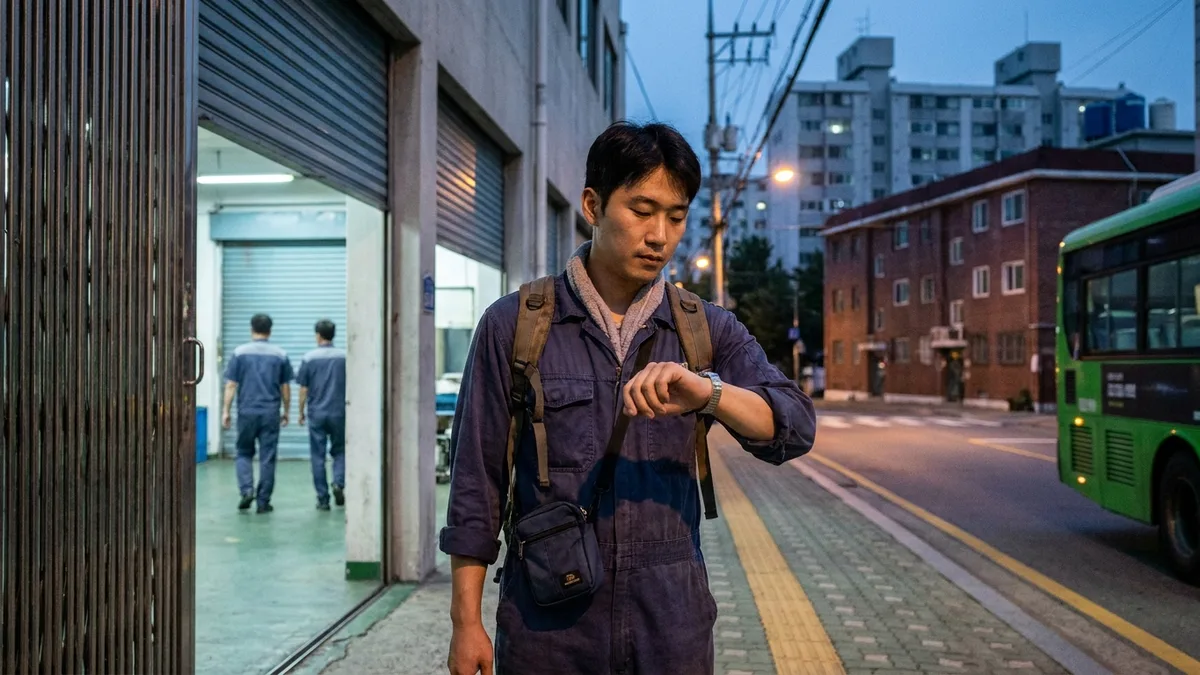
Statutory working hours are 40 hours a week and 8 hours a day (Labor Standards Act Article 50(1) and (2), as of 2026). Both figures exclude break time. On top of that, if the parties agree, hours can be extended by up to 12 hours a week (Article 53(1)), which is why people commonly call it the "52-hour week." The number 52 is not actually written anywhere in the statute.
But this baseline does not apply to everyone in the same way. The answer changes depending on whether you are at a workplace with 4 or fewer regular employees, whether you are a worker covered by one of the subparagraphs of Article 63 of the Labor Standards Act, whether your industry falls under the Article 59 special-case industries, whether your employer got approval for special extended work under Article 53(4), or whether a flexible working hours scheme under Articles 51 to 52 applies. So there is an order to this: first figure out which box you are in, and only then start counting hours.
Note: This article is general information organized from publicly available laws and government guidance, and it is not legal advice. The answer changes with workplace size, industry, and visa status, so please confirm the judgment that fits your own situation at the official channels listed below.
There Are Two Baselines: 8 Hours a Day, 40 Hours a Week
Before you count numbers, you have to sort out what counts as working hours in the first place. Labor Standards Act Article 50(3) provides that standby time spent under the employer's direction and supervision for the purpose of work is treated as working hours (newly inserted February 1, 2012; amended May 26, 2020). Break time, on the other hand, is excluded from working hours and is unpaid.
Breaks must be given during working hours: at least 30 minutes if you work 4 hours, and at least 1 hour if you work 8 hours. The worker must also be free to use that time as they wish (Article 54(1) and (2)).
One more thing that is easy to miss is what "one week" means. Under the Labor Standards Act, one week means seven days including holidays (Article 2(1)7, newly inserted March 20, 2018). That means hours worked on a Sunday or a public holiday count toward that week's total.
| That block of time | Governing provision | Does it count toward weekly working hours? |
|---|---|---|
| Standby time waiting under direction and supervision | Article 50(3) | Yes, it counts |
| Break time you were free to spend as you wished | Article 54(1) and (2) | No, it does not (unpaid) |
| Hours worked on a Sunday or public holiday | Article 2(1)7 | Yes, it counts |
Tip: If your dormitory is inside the workplace or right next door, "standby" and "break" get mixed together. Which side a given block of time falls on is a factual judgment that turns on whether you really were free to use it, so it is hard to decide on your own. Explain your situation exactly as it is and ask at ☎1350 (Ministry of Employment and Labor customer counseling center).
"52 Hours a Week" Is 40 Plus 12: The Agreement and the 5-Employee Threshold
The 12-hour extension comes with conditions. Article 53(1) provides that if the parties agree, working hours under Article 50 may be extended by up to 12 hours a week. The EPS standard labor contract has a pre-printed field about overtime work, so the paper you signed back in your home country is sometimes treated as that agreement. How to find that field in your contract is explained in How to Read the EPS Standard Labor Contract.
You also need to look at scope of application. The Labor Standards Act applies to workplaces that regularly employ 5 or more workers; for workplaces with 4 or fewer, only some provisions designated by Presidential Decree apply (Article 11(1) and (2)). The working-hours cap (Article 50) and premium pay (Article 56) are not on that shorter list. The number of regular employees is calculated by dividing the total headcount over the one month preceding the date the issue arose by the number of operating days (Enforcement Decree Article 7-2), so do not try to judge this yourself.
The 52-hour week was phased in. It started with workplaces of 300 or more on July 1, 2018, and workplaces with 5 or more but fewer than 50 employees came in last on July 1, 2021. As of 2026 it applies to every workplace with 5 or more regular employees.
Note: The line "we have fewer than 30 people, so with a labor-management agreement we can go up to 60 hours a week" is no longer correct. Article 53(3), which allowed an extra 8 hours a week of extension for workplaces with fewer than 30 regular employees, was only valid through December 31, 2022. The text of the provision is still printed in the statute book with only a validity-period note attached underneath, so anyone who simply copies the article ends up presenting an expired rule as current law.
The standard for counting whether the cap was exceeded has also changed. Following the Supreme Court decision of December 7, 2023 (2020Do15393), the Ministry of Employment and Labor changed its administrative interpretation on January 22, 2024: a cap violation is now judged by whether total weekly working hours minus 40 hours exceeds 12 hours.
And this holds even if the worker wanted the hours. The agreement under Article 53(1) is valid only within the 12-hour cap, and anything beyond that is a violation by the employer (Article 110(1)). There is no reason to blame yourself for wanting to earn more and drop the consultation.
Three Things That Change the Cap: Special Extended Work, Special-Case Industries, and Flexible Schemes
All three schemes move the cap, but they share one thing in common: the employer cannot decide on them alone.
| Scheme | Governing provision | Requirements |
|---|---|---|
| Special extended work | Article 53(4), Enforcement Rule Article 9(1) | Requires both approval from the Minister of Employment and Labor and the worker's consent, and the permitted grounds are limited to five |
| Working-hours special cases | Article 59(1) and (2) | Applies to only five industries and requires a written agreement with the worker representative |
| Flexible and selective working hours schemes | Articles 51 and 52 | Must be set out in the rules of employment or in a written agreement with the worker representative, covering who is included, the period, and the hours for each working day |
The five grounds for special extended work are disaster recovery, emergency measures to protect life or secure safety, recovery from a sudden breakdown of facilities or equipment, a sharp increase in workload, and R&D on materials, parts, and equipment (Enforcement Rule Article 9(1)). The approval period is also limited to the minimum necessary.
The special-case industries are five: land transport and pipeline transport (excluding scheduled passenger road transport), water transport, air transport, other transport-related services, and health care. This does not mean "unlimited overtime." Even in these cases, the worker must be given at least 11 consecutive hours of rest between the end of one working day and the start of the next (Article 59(2)).
Under the flexible working hours scheme, the cap is 48 hours in a given week for a unit period of up to 2 weeks, and 52 hours in a given week and 12 hours on a given day for a unit period of up to 3 months (Article 51(1) and (2)). For the selective working hours scheme, if the settlement period exceeds one month, the employer also takes on the duty to give 11 consecutive hours of rest and to pay a premium on hours exceeding a monthly average of 40 hours a week (Article 52(2)).
Where the Money Gets Added: 50% for Overtime, 50% for Night Work, 50% and 100% for Holidays
The "cap violation" question from the previous section and the "premium pay" question in this one are two different stories. Read one as the basis for the other and you end up with the opposite conclusion.
| Category | Premium rate | Governing provision |
|---|---|---|
| Overtime work | At least 50% of ordinary wages | Article 56(1) |
| Night work (10 p.m. to 6 a.m. the next morning) | At least 50% of ordinary wages | Article 56(3) |
| Holiday work, first 8 hours | At least 50% of ordinary wages | Article 56(2)1 |
| Holiday work beyond 8 hours | At least 100% of ordinary wages | Article 56(2)2 |
The overtime premium and the night-work premium are separate duties set out in different paragraphs. So if your overtime runs past 10 p.m., both premiums apply separately.
Following the structure of the provisions, it reads like this. The "overtime work" in Article 56(1) means hours extended under Article 53, and Article 53(1) speaks of extending the working hours under Article 50. Article 50 sets out both 40 hours a week (paragraph 1) and 8 hours a day (paragraph 2), so premium pay reads as applying to the portion beyond 8 hours in a day as well. The January 2024 change was about the standard for judging whether the cap was violated.
This article does not calculate amounts. Hourly ordinary wages are found by dividing the monthly salary by the number of standard hours used to calculate monthly ordinary wages (Enforcement Decree Article 6(2)4), and that standard number of hours differs from person to person. On top of that, the scope of ordinary wages itself is being reorganized in practice following the Supreme Court en banc decision of December 19, 2024 (2020Da247190 and 2023Da302838). If you receive bonuses, the scope may be a matter of dispute.
📌 Important: To substitute leave for premium pay, there must be a written agreement with the worker representative (Article 57, compensatory leave scheme). The hour counts you work out here are a draft to bring to your consultation. The final amount only comes out once ordinary wages are fixed, so ask at ☎1350.
How Days Off Are Counted: Weekly Holidays, Public Holidays, and Annual Leave
A weekly paid holiday must be guaranteed at least once a week on average (Article 55(1)), and it goes to workers who show up for all of that week's contractual working days (Enforcement Decree Article 30(1)).
Turning government office holidays such as Seollal and Chuseok into paid holidays has its own separate basis (Article 55(2), Enforcement Decree Article 30(2)). The start date differed by workplace size: workplaces with 5 or more but fewer than 30 regular employees have been covered since January 1, 2022, and it does not apply to workplaces with 4 or fewer. With a written agreement with the worker representative, the holiday can also be substituted with a specific working day (proviso to the same paragraph).
What that "public holiday" means takes one more step to see. Enforcement Decree Article 30(2) points to each subparagraph of Article 2 of the Regulations on Holidays of Government Offices while leaving out subparagraph 1, and subparagraph 1 is Sunday. So Sunday is not a paid public holiday under this provision. Taking Sunday off belongs to the weekly holiday above (Article 55(1)), which rests on a different basis, and since Article 55(1) does not name a day of the week, your weekly holiday does not have to fall on a Sunday. Going the other way, the substitute holidays under Article 3, which the same paragraph also points to, do count as paid holidays.
Let us count it out with Chuseok 2026. The government office holidays are the day before Chuseok, Chuseok itself, and the day after (Article 2, subparagraph 9 of the same Regulations), which makes three days: September 24 (Thu), September 25 (Fri), and September 26 (Sat). September 27 follows, but it is a Sunday, so as we just saw it is not on this list. No substitute holiday is added either. The Chuseok holidays produce a substitute holiday when they fall on a Sunday (Article 3(1)2) or when they fall on another public holiday on a day other than Saturday or Sunday (subparagraph 3 of the same paragraph), and in 2026 the run is Thursday to Saturday, so neither case applies. Falling on a Saturday alone does not add a substitute holiday for Chuseok. You may see it claimed that September 28 is a substitute holiday, but there is no provision behind that. The government can, however, designate a temporary public holiday separately after deliberation by the State Council (the Cabinet meeting) (Article 2, subparagraph 11 and Article 4 of the same Regulations), and if it does, that day also counts as a paid holiday, so check the government's announcement once just before the holidays.
If you worked on a paid holiday, the money splits in two. The holiday-work premium is at least 50 percent of ordinary wages for the first 8 hours and at least 100 percent for the part beyond 8 hours (Article 56(2)1 and 2). And if any of those hours fell between 10 p.m. and 6 a.m. the next day, the 50 percent night-work premium (Article 56(3)) is added here on top of that, separately.
There is a fixed place to check on your wage statement. It must carry the number of overtime, night, and holiday work hours along with the calculation method (Enforcement Decree Article 27-2(5)). If you worked 10 hours on Chuseok day, the calculation method should apply a premium of at least 50 percent to the first 8 hours and at least 100 percent to the 2 hours beyond 8. If only 50 percent is applied to all 10 hours, or the number of holiday-work hours does not appear at all, take that statement to ☎1350 and ask. If that public holiday was swapped for another working day under a written agreement with the worker representative (the proviso to Article 55(2) seen above), the calculation may differ, so mention that too.
Important: If you work in agriculture or forestry, or in livestock, sericulture, or fisheries, none of this section's holiday rules reach you. Article 63, subparagraphs 1 and 2, provides that the rules on working hours, breaks, and holidays do not apply. The weekly holiday, the government office holidays, and the holiday-work premium all drop out here. If you are an E-9 worker on a farm or at a barn who worked on Chuseok and received no holiday premium, first check whether this provision applies to you. But at a workplace with 5 or more regular employees, the 50 percent night-work premium (Article 56(3)) and annual leave (Article 60) are a separate matter and do not disappear under Article 63. Keep counting what you are owed for night hours and for annual leave. Whether your workplace falls under Article 63, and whether it has 5 or more regular employees, is not something to decide on your own, so check with ☎1350.
Annual leave is 15 days if you attended at least 80 percent of the year (Article 60(1)). But you do not have to complete a full year to earn any. Even if your continuous service is less than one year or your attendance rate falls short of 80 percent, you earn 1 day for each month of perfect attendance (paragraph 2). After 3 or more years of continuous service, 1 more day is added every 2 years, up to a total cap of 25 days (paragraph 4).
There is also a proviso that runs the other way. If your contractual working hours average less than 15 hours a week over 4 weeks, Articles 55 and 60 do not apply (Article 18(3)).
Age and pregnancy also change things. Workers aged 15 or older but under 18 are capped at 7 hours a day and 35 hours a week (Article 69), and to have a woman aged 18 or older work between 10 p.m. and 6 a.m. or on a holiday, the employer must obtain her consent (Article 70(1)). Pregnant and postpartum women and workers under 18 are prohibited from working in that time band, with an exception only where the requirements are met and approval is obtained (Article 70(2)). A woman within one year after childbirth may not be assigned overtime work exceeding 2 hours a day, 6 hours a week, or 150 hours a year (Article 71).
Some People Are Not Covered by These Rules at All
Let me nail this down first. What does not apply here are the provisions on working hours, breaks, and holidays. Your wages for the hours you actually worked do not disappear, and if the workplace has 5 or more regular employees, the 50 percent night-work premium (Article 56(3)) still stands.
Article 63 excludes agriculture and forestry work (subparagraph 1), livestock, sericulture, and fisheries work (subparagraph 2), surveillance or intermittent workers approved by the Minister of Employment and Labor (subparagraph 3), and management, supervision, or confidential-information duties (subparagraph 4, Enforcement Decree Article 34) from the provisions on working hours, breaks, and holidays. What is excluded and what remains in agriculture, forestry, livestock, and fisheries work is covered in The Minimum Wage and Industry Exceptions, and which provisions apply to workplaces with 4 or fewer regular employees is set out with the original text of the provisions in Part-Time Work Permits for International Students.
Seafarer employment (E-10) falls under an entirely different law. Seafarers Act Article 5(1) provides that only the listed provisions of the Labor Standards Act apply, and working hours, overtime work, breaks, and premium pay are not on that list. The whole framework of a "52-hour week" simply does not exist here.
Seafarers work 8 hours a day and 40 hours a week, but by agreement they may work up to 16 hours a week of overtime (Seafarers Act Article 60(1)), and overtime work and holiday work must be paid at least 150 percent of ordinary wages (Article 62(1)). Seafarers Act Article 62(4) also gives you the right to request copies of the records of working hours, rest hours, and overtime work.
Note: Not being on this list does not automatically mean everything applies to you. Even within fishing work, some cases fall under the Labor Standards Act and others under the Seafarers Act, and this article will not settle where that line falls. Start by confirming which law applies to you at ☎1350.
The Line "It's All Included in Your Salary": Comprehensive Wages and the April 9, 2026 Guideline
Let me start with what it actually is. The "Guidance Guideline on Preventing Misuse of Comprehensive Wages to Eradicate Unpaid Labor," which took effect on April 9, 2026, is an administrative guideline of the Ministry of Employment and Labor, not a law. Saying "the comprehensive wage system has been banned" is not yet true; legislation to ban it is at the stage where the government has announced it will push for it starting in the first half of 2026.
Here is the thrust of the guideline. Base pay and allowances must be written separately in the wage ledger and the wage statement; overtime, night, and holiday premiums must be calculated based on actual working hours; and if a fixed overtime allowance agreed in writing in advance falls short of the statutory premium based on actual hours worked, the difference must be paid. In a labor inspection, an unpaid difference is treated as wage arrears.
The Ministry of Employment and Labor runs an anonymous reporting center for misuse of comprehensive wages and fixed OT on its Labor Portal (labor.moel.go.kr). For those on shift or night work who find it hard to call during weekday daytime hours, this route is the realistic one.
That said, what your own contract amounts to and how large the difference is depend on whether working hours can be measured and on your actual hours worked. What to do after reading this far is only this: gather your records and confirm at ☎1350. For reference, as of August 2026 statutory working hours are still 40 hours a week, and the 4.5-day week is at the stage of a 2026 pilot support program (32.4 billion KRW).
Where a Record of Your Hours Survives: Records, Penalties, and Where to Check
The employer must enter in the wage ledger, for each individual worker, the number of working days (Enforcement Decree Article 27(1)6), the number of working hours (subparagraph 7), and, where overtime, night, or holiday work was assigned, the number of such hours (subparagraph 8). The wage statement must also include the number of overtime, night, and holiday work hours along with the calculation method (Enforcement Decree Article 27-2(5)). How to read a wage statement is covered in How to Read Your Korean Payslip.
And here is the biggest gap in this whole article. Article 27(3) of the same Enforcement Decree provides that for workers at workplaces with 4 or fewer regular employees and workers falling under any subparagraph of Article 63, subparagraphs 7 and 8 may be left out. That means if you work on a farm or at a small workplace, it is not unlawful for the ledger to contain no record of how many hours you worked.
This is the structural reason why the record you keep yourself each day becomes the only source of evidence. Write down your start and end times day by day, and if a work schedule is posted, take a photo of it.
| Violation | Governing provision | Penalty |
|---|---|---|
| Working hours, breaks, holidays, annual leave violations (Articles 50, 53(1), 54, 55, 60) | Article 110(1) | Up to 2 years imprisonment or a criminal fine of up to 20,000,000 KRW |
| Failure to pay premium pay (Article 56) | Article 109(1) | Up to 3 years imprisonment or a criminal fine of up to 30,000,000 KRW |
| Failure to issue a wage statement (Article 48(2)) | Article 116(2)2 | Administrative fine of up to 5,000,000 KRW |
Failure to pay premium pay (Article 56) is an offense that cannot be prosecuted against the victim's express wishes (Article 109(2)). There is also a time limit: wage claims are extinguished by prescription after 3 years (Article 49). Discriminating in working conditions on the basis of nationality violates Article 6, and labor laws apply to workers who came through the Employment Permit System exactly as they do to Korean nationals.
| Organization | Number | For what |
|---|---|---|
| Ministry of Employment and Labor Customer Counseling Center | 1350 | Working hours and premium pay counseling, whether the rules apply to you |
| Foreign Workforce Counseling Center | 1577-0071 (weekdays 09:00-18:00) | Multilingual counseling |
| Ministry of Justice Immigration Contact Center | 1345 | Residence and visa questions |
| Ministry of Employment and Labor Labor Portal | labor.moel.go.kr | Online complaints, anonymous comprehensive-wage reporting |
How to file a complaint and which desk to ask what are set out step by step in A Complete Guide to Official Help Desks for Foreigners. Whether reporting will cause problems with your residence status, and whether you can change workplaces, are not decided in this article, so check with both ☎1345 and ☎1350.
Consultations and complaints often require you to move around on weekday daytimes, and if the regional labor office with jurisdiction is far from where you live, it can eat up an entire day. LACHA is a transport and payment super app for foreigners that you can start using right away without identity verification, letting you pay for KTX, express buses, taxis, the Airport Railroad, and transit cards all in one place. It has nothing to do with the working-hours issue itself and is a private service; counseling, filing, and determinations happen only at the public institutions above.
Need transit and payments while you wait for your residence card? Check out LACHA.
Built to work without a Korean phone number or bank account, with overseas payment methods like Alipay, WeChat Pay, and Apple Pay. Taxi hailing plus KTX, express bus, and airport railroad (AREX) booking — all in one app.
Up to 60% off Korea transit with a coupon (max ₩3,000): enter code at sign-up. KTX gets up to 18% off on top
Download now


Frequently Asked Questions (FAQ)
Q1. If I worked more than 52 hours a week, is that automatically illegal? No. The answer changes depending on whether you are at a workplace with 4 or fewer regular employees, whether you are a worker covered by one of the subparagraphs of Article 63 of the Labor Standards Act, whether your industry falls under the Article 59 special cases, whether your employer got approval for special extended work under Article 53(4), or whether a flexible working hours scheme under Articles 51 to 52 applies. Conversely, you also cannot simply take "that's just how our industry works" at face value. The special cases cover only five industries and require a written agreement with the worker representative, and even then the duty to give at least 11 consecutive hours of rest remains (Article 59(2)). Do not judge which box your workplace falls into on your own; confirm at ☎1350.
Q2. I did not go over 40 hours a week, but on some days I worked 10 hours. What about premium pay? "Did I exceed the cap?" and "does a premium apply?" are different questions. The January 22, 2024 change in administrative interpretation was about judging a violation of the overtime cap (12 hours a week) by subtracting 40 hours from total weekly working hours. Premium pay is separate: because Article 56(1) points to Article 53, and Article 53(1) points to Article 50(1) and (2) together, it reads as applying to the portion beyond 8 hours in a day as well. The amount varies with your ordinary wages, so gather your working-hours records and ask at ☎1350.
Q3. My boss says "we have fewer than 30 people, so with a labor-management agreement we can go up to 60 hours a week." Article 53(3) of the Labor Standards Act, which allowed an extra 8 hours a week of extension for workplaces with fewer than 30 regular employees, was a temporary provision and was only valid through December 31, 2022. The text of the provision is still printed in the statute book with only a validity-period note attached underneath, so articles online that simply copy the provision still present this rule as if it were current. As of 2026 it has no legal effect, so compare it against your employer's explanation and ask at ☎1350.
Q4. They tell me "it's all included in your salary." Is there a way to check? Since April 9, 2026, the Ministry of Employment and Labor's "Guidance Guideline on Preventing Misuse of Comprehensive Wages to Eradicate Unpaid Labor" has been in effect. This is an administrative guideline, not an amendment to the law, so you cannot say "comprehensive wages have been banned." What the guideline does say is that if a pre-set fixed overtime allowance falls short of the statutory premium based on actual hours worked, the difference must be paid, and in a labor inspection an unpaid difference is treated as wage arrears. An anonymous reporting center is open on the Labor Portal (labor.moel.go.kr).
Q5. I work on a ship (E-10). Does this article apply to me too? Seafarers Act Article 5(1) provides that only the listed provisions of the Labor Standards Act apply, and working hours, overtime work, breaks, and premium pay are not on that list. Seafarers work 8 hours a day and 40 hours a week, but by agreement up to 16 hours a week of overtime is possible (Seafarers Act Article 60(1)), and overtime work and holiday work must be paid at least 150 percent of ordinary wages (Article 62(1)). Under Article 62(4) you can request copies of the records of working hours, rest hours, and overtime work, so start by requesting them. Even in fishing work, which law applies varies, so confirm at ☎1350.
Note: This article is general information organized from publicly available laws and government guidance, and it is not legal advice. The provisions, rates, and effective dates in the text are as of 2026-08 and were confirmed against the original texts of the Labor Standards Act (in force August 20, 2026, Act No. 21373), its Enforcement Decree and Enforcement Rule, and the Seafarers Act on the National Law Information Center, along with "Employment of Foreign Workers" in the Ministry of Government Legislation's Easy-to-Find Practical Law service, Ministry of Employment and Labor press releases, and the Labor Portal (labor.moel.go.kr). Laws and guidelines get amended, and phone numbers and operating hours can change too, so before you act, please confirm again against your own situation at ☎1350 (working hours and pay), ☎1577-0071 (Foreign Workforce Counseling Center, multilingual), and ☎1345 (residence and visa). The answer changes with workplace size, industry, and visa status, and this article does not determine which hours count as working hours or how much you are owed. LACHA is a private transport and payment service unaffiliated with the public institutions above.