The deadlines the law sets are shorter than you'd think. When a worker leaves a job, the employer must pay out all money owed — wages, compensation and everything else — within 14 days of the event that triggers it (Labor Standards Act Article 36, as of 2026), and severance pay is also due within 14 days of the date the obligation arises (Act on the Guarantee of Employees' Retirement Benefits Article 9(1)). While you're still employed, wages must be paid to you directly and in full, in currency, at least once a month on a fixed date (Labor Standards Act Article 43(1) and (2)). Being in breach of these provisions is exactly what "unpaid wages" (임금체불) means.
But the most important sentence in this article is a different one. Filing a complaint and actually getting the money you're owed are two different things. The procedure the Ministry of Employment and Labor publishes ends at investigation → corrective order → if not complied with, criminal case filing and referral to the prosecution. A labor inspector has no power to enforce against the employer's assets. There are only three routes by which money actually reaches you: ① the employer pays voluntarily, ② you receive Substitute Payment (대지급금), or ③ you win a civil judgment and enforce it.
That's why the order matters. File the complaint → labor inspector's investigation → the Unpaid Wages and Employer Confirmation Letter (체불 임금등·사업주 확인서) → Substitute Payment, or free legal aid and a civil suit. Each stage carries its own deadline, and missing one closes off the whole stage that follows.
Note: This article is general information, not legal advice. Please confirm what applies to your own situation with the official contacts listed below. The conclusion changes depending on your visa status, how you work and the size of the workplace, and even the starting point of each deadline differs from case to case.
A complaint and a criminal charge are two different demands
The Ministry of Employment and Labor draws the line this way. A complaint (진정) is a demand that you be paid the wages you're owed; a criminal charge (고소) is a demand that the employer be punished for violating the Labor Standards Act. Both are filed at the local labor office with jurisdiction over the workplace, but what you're asking for is different, and so is where each one ends.
| Category | Complaint (진정) | Criminal charge (고소) |
|---|---|---|
| What you're asking for | Make them pay the wages I'm owed | Punish them for violating the Labor Standards Act |
| Where it ends | Closed once the corrective order is complied with | Criminal case filed, then referred to the prosecution |
| Does money come in? | Only if the employer pays | Punishment is separate from payment |
| Relevant provisions | Labor Standards Act Articles 36 and 43 | Article 109(1) (up to 3 years in prison or a criminal fine of up to 30,000,000 KRW) |
An employer who fails to pay wages faces up to 3 years in prison or a criminal fine of up to 30,000,000 KRW (Labor Standards Act Article 109(1), as of 2026). However, under paragraph (2) of the same article, this is an offense that cannot be prosecuted against the victim's express wishes. Employers who have been named on the public list of wage defaulters under Article 43-2 and violate again during the disclosure period are excluded from that exception.
This is where people often get confused. The "against the victim's wishes" rule governs only whether there's punishment; it stays separate from getting paid all the way through. Saying you don't want the employer punished doesn't erase your claim to the unpaid wages, and conversely, the employer being punished doesn't automatically deposit your wages. What happens to an already-issued confirmation letter and a Substitute Payment claim if you withdraw the complaint is something we could not verify from primary sources. If you're thinking about withdrawing, call ☎1350 before you decide.
Where and how to file
There are two routes. ① File online through the Ministry of Employment and Labor's Labor Portal (labor.moel.go.kr), or ② visit the customer support office of the local labor office with jurisdiction over your workplace, get preliminary counseling, and then file a complaint or a criminal charge. The online form is titled "Complaint (unpaid wages, workplace harassment, other labor law violations)," and the civil petition form code is SN001, with a stated processing period of 25 days.
Jurisdiction follows the location of the workplace. Office names and jurisdiction boundaries are reorganized often, so it's more accurate to check with the jurisdiction lookup on the Labor Portal.
It's easy to assume online is the default route, but this is where foreigners often get stuck. As verified in August 2026, the Labor Portal is entirely in Korean, and going to the complaint filing page redirects you to a login screen. The personal login options are simple authentication, joint/browser certificates, financial certificates, mobile phone verification, ID and password, and the government integrated login. If you don't have a Korean phone line in your own name or another authentication method, you stop at the very first screen. The notice says you can file a civil petition without signing up for an account, but we could not verify what identity check the non-member route actually requires.
So the realistic order is: call first, then prepare to file in person. ☎1577-0071 (Foreign Workforce Counseling Center, 외국인력상담센터) runs an ARS system that assigns 18 languages, including Korean, to numbered menu options. For wage issues specifically, the counseling line is ☎1350. Checking what to bring before you go to the office saves you a wasted trip.
The primary document for pinning down the amount owed is your pay statement. Every time an employer pays wages, they must give you a written pay statement (electronic documents included) listing the component items, the calculation method and any deductions (Labor Standards Act Article 48(2)), and failing to do so carries an administrative fine of up to 5,000,000 KRW (Article 116(2)2). Failing to specify working conditions (Article 17) carries a criminal fine of up to 5,000,000 KRW, which is a different thing altogether (Article 114(1)). If you weren't receiving pay statements, write that into your complaint as well.
| Document | What it proves | If you don't have it |
|---|---|---|
| Employment contract (standard form contract for E-9) | The agreed wage and working conditions | Even if the employer took it back, you can still argue with other records |
| Pay statement | Wage components and deductions | Not receiving one is itself a violation of Article 48(2) |
| Bank deposit history | What was actually paid and what wasn't | If you were paid in cash, notes on the dates received and photos of the envelopes can stand in |
| Attendance records and worksite photos | Which days and hours you actually worked | The capture date is itself evidence, so don't delete the originals |
| Messages exchanged with your manager | The chain of instruction and promises to pay | Leaving the chat room makes recovery hard, so leave it as it is |
If room and board costs were deducted before the money was deposited, the bank history alone won't give you the amount owed. In many cases you first have to work out whether the hourly rate met the legal standard, and that calculation is laid out in Minimum Wage for Foreign Workers.
What happens after you file
Here is the procedure the Ministry of Employment and Labor publishes. A labor inspector summons both the complainant and the respondent for investigation, and if a violation is confirmed, issues a corrective order to the employer. If it's complied with, the case is closed; if not, a criminal case is filed and referred to the prosecution.
| Stage | Period | What to know |
|---|---|---|
| Filing → investigation | 25 days (excluding Saturdays and public holidays) | Extendable up to twice — the first by the inspector's own authority, the second requires the complainant's consent |
| Corrective order | Closed once complied with | There is no power to enforce against the employer's assets |
| Criminal case filing → referral to the prosecution | 2 months | May be extended at the prosecutor's direction |
| Complainant fails to appear 2 or more times | Closed at that point | Treated as no longer wishing to pursue it. You can file again |
Cases closed because a summons was missed pile up especially among foreigners. When you file, get the contact details of the labor inspector handling your case, and if your address or phone number changes, tell them the same day.
Labor inspectors may conduct on-site inspections of workplaces and dormitories, demand the submission of ledgers and documents, and question employers and workers (Labor Standards Act Article 102(1), as of August 2026), and they perform the duties of judicial police officers in relation to offenses under labor laws (paragraph (5) of the same article). However, from December 8, 2026, this provision is deleted and moves into the Act on the Performance of Duties by Labor Inspectors (Act No. 21534). Even if you hear a different title, "노동감독관," at the counter, it's the same agency.
Retaliating against you for reporting is also blocked. A worker may report a violation of the law at their workplace to the Minister of Employment and Labor or to a labor inspector, and the employer may not dismiss you or otherwise treat you unfavorably because of that report (Labor Standards Act Article 104(1) and (2)). A violation carries up to 2 years in prison or a criminal fine of up to 20,000,000 KRW (Article 110(1)). If it has gone as far as dismissal, the remedy procedure is covered separately in Unfair Dismissal Remedy.
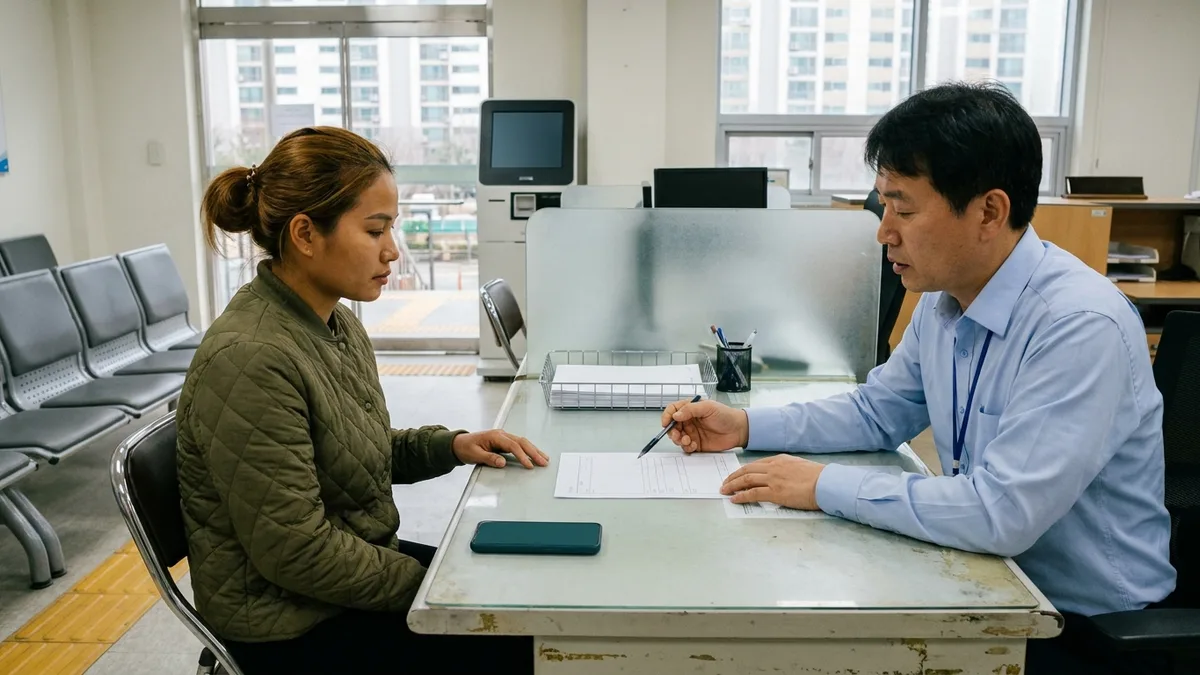
The Unpaid Wages and Employer Confirmation Letter — the one page that opens the next door
A worker who hasn't been paid wages, etc. can apply for this confirmation letter in two situations (Wage Claim Guarantee Act Article 12(1)): ① when it's needed to pursue a claim for Substitute Payment, or ② when it's needed to file a lawsuit through legal aid procedures under Article 22 of the Legal Aid Act. A single sheet of paper opens both branches at once — Substitute Payment and free legal aid.
What matters even more is that the issuance of the letter is itself a ground for Substitute Payment. Wage Claim Guarantee Act Article 7(1)5 lists, as a ground for payment, the case where the Minister of Employment and Labor issues a document under Article 12 certifying the unpaid wages and the defaulting employer, thereby confirming the employer's unpaid wages, etc. In other words, you can claim Simplified Substitute Payment (간이대지급금) on the confirmation letter alone, without a court judgment.
For the mechanics of getting it issued, three things are enough.
- The application form — Submit the "Application for Issuance of the Unpaid Wages and Employer Confirmation Letter" (Attached Form No. 7-2) to the head of the local labor office with jurisdiction. On the Labor Portal, the civil petition form code is AG096 and the stated processing period is 3 days.
- Stating your intent during the investigation counts as applying — If, during the labor inspection process, it's confirmed that you wish to have the letter issued, it's deemed that an application has been made (proviso to Article 9-2(1) of the Enforcement Rule of the Wage Claim Guarantee Act). When you're being interviewed, say that you want the confirmation letter.
- Issued within 3 days — Once your personal details, period of employment, the period and amount of unpaid wages, etc. and the workplace information have all been confirmed in the investigation, the letter is issued in Attached Form No. 7-3 within 3 days of the application date (or, where your intent was confirmed during the investigation, from the day the labor inspection process was completed).
The letter is also a required document at the next stage. It goes into applications for free legal aid from the Korea Legal Aid Corporation (대한법률구조공단), and it's part of the paperwork for the Korea Workers' Compensation & Welfare Service's living-cost loans for workers owed wages.
📌 Important: The particulars entered on the letter include the worker's name, resident registration number and address (Enforcement Rule Article 9-2(2)1(a)). Whether the alien registration number can be used instead, and how it's handled if you have no registration number at all, is something we could not verify. Ask ☎1350 or your local office before you file.
Substitute Payment — money the state pays first and recovers from the employer
Let's straighten out the name first. The older terms 체당금 and 소액체당금 were replaced by "Substitute Payment for Unpaid Wages, etc." (체불 임금등 대지급금, "Substitute Payment" for short) and "Simplified Substitute Payment" (간이대지급금) in the amendment that took effect on October 14, 2021, and are no longer in use. Searching under the old names brings up a mix of old caps and old requirements.
Its nature is easy to misread too. Substitute Payment isn't a subsidy or a consolation payment. When the state pays it, the state is subrogated, up to that amount, to the worker's claim against the employer for unpaid wages, etc. (Wage Claim Guarantee Act Article 8(1)). It is not money you receive and then claim again from the employer, and receiving it by false or fraudulent means carries up to 3 years in prison or a criminal fine of up to 30,000,000 KRW (Article 28(1)1 of the same Act).
| Item | Bankruptcy Substitute Payment (도산대지급금) | Simplified Substitute Payment (간이대지급금) |
|---|---|---|
| Governing provisions | Act Article 7(1)1 to 3 | Act Article 7(1)4 and 5, Article 7-2 |
| When it applies | Decision to commence rehabilitation, declaration of bankruptcy, or recognition of de facto insolvency | Final judgments etc., the Unpaid Wages and Employer Confirmation Letter, currently employed workers |
| Deadline on the worker's side | For recognition of de facto insolvency, apply within 1 year from the day after your last day of employment | On the confirmation letter route, file the complaint within 1 year from the day after your last day of employment (Enforcement Decree Article 7(2)2) |
| Requirements on the employer's side | The business has been closed or is in the process of closing, and has no ability to pay (Enforcement Decree Article 5(1)) | A business covered by industrial accident insurance that has been operating for 6 months or more up to your last day of employment (Enforcement Decree Article 8(3)) |
| Cap (per Ministry of Employment and Labor guidance) | Varies by your age at separation and by item | For leavers, up to 10,000,000 KRW (7,000,000 KRW in wages, etc. plus 7,000,000 KRW in retirement benefits, etc.); for currently employed workers, 7,000,000 KRW |
| Claim deadline | 2 years from the declaration of bankruptcy etc. or the date of recognition of de facto insolvency | 6 months from the date the confirmation letter was first issued; 1 year from the date of the judgment etc. |
| Where to claim and when it's paid | Korea Workers' Compensation & Welfare Service via your local labor office; paid within 7 days of the claim being received | Korea Workers' Compensation & Welfare Service; decision and payment within 14 days of submission |
The cap on Bankruptcy Substitute Payment isn't a single number. The table published by the Ministry of Employment and Labor splits it by your age at separation and by item as follows (unit: 10,000 KRW; wages and shutdown allowance are per one month, retirement benefits etc. are per one year; applies where the declaration of bankruptcy or decision to commence rehabilitation was made, or the application for recognition of de facto insolvency was received, on or after January 1, 2020).
| Age at separation | Wages (1 month) | Retirement benefits etc. (1 year) | Shutdown allowance (1 month) |
|---|---|---|---|
| Under 30 | 220 | 220 | 154 |
| 30 or older but under 40 | 310 | 310 | 217 |
| 40 or older but under 50 | 350 | 350 | 245 |
| 50 or older but under 60 | 330 | 330 | 231 |
| 60 or older | 230 | 230 | 161 |
Don't calculate a total by multiplying the monthly cap by the number of months. We were not able to obtain the original amount table from the underlying public notice (Ministry of Employment and Labor Public Notice No. 2021-81), and the values above all come from the Ministry's guidance pages. It's more accurate to leave the total calculation to ☎1588-0075.
An amendment that took effect on August 20, 2026 (Act No. 21376) widened the scope of Bankruptcy Substitute Payment. Amended Article 7(2)1 sets it at the final 6 months of wages, retirement benefits etc. for the final 3 years, and the final 6 months each of shutdown allowance and of pay during maternity leave. The previous standard was the final 3 months. Simplified Substitute Payment (subparagraph 2), by contrast, remains as before: the final 3 months of wages and retirement benefits etc. for the final 3 years.
Note: Article 2 of the Addenda limits this amendment to cases where the decision to commence rehabilitation or the declaration of bankruptcy is made, or the Minister of Employment and Labor recognizes an inability to pay unpaid wages etc., after the Act takes effect. That means some cases will still be judged under the old standard depending on timing. On top of that, the Ministry's Labor Portal guidance was still written to the old standard (final 3 months) as verified in August 2026. Check which standard applies to your case with ☎1350 and ☎1588-0075.
Getting the confirmation letter doesn't mean Substitute Payment comes out automatically, either. There are separate requirements on the employer's side. It has to be a business to which the Wage Claim Guarantee Act applies (a business under Article 6 of the Industrial Accident Compensation Insurance Act, excluding businesses carried out directly by the state or local governments — Article 3 of the Act), and the employer must have operated that business for 6 months or more up to the day you left (Enforcement Decree Article 8(3)). The letter is a necessary condition, not a sufficient one. Whether your workplace qualifies is hard to judge on your own, so ask ☎1588-0075.
There's also a branch you can use without quitting (Article 7-2 of the Act). It comes with conditions, though. Your employment contract must not have ended at the time the complaint etc. was filed (day laborers on contracts of under 1 month are excluded), and the wage set in your employment contract must be below the amount published by the Minister of Employment and Labor (Enforcement Decree Article 7(3)1 and 2). The Ministry's guidance explains this income requirement as under 110% of the minimum wage on an hourly basis. The cap is 7,000,000 KRW, and you can receive it only once while working at a single business (Article 7-2(4)).
If your company shut its doors in practice without going through court proceedings, apply first for recognition of de facto insolvency. The requirements are ① 300 or fewer regular employees, ② the business has been closed or is in the process of closing, and ③ there is no ability to pay wages etc., or payment is markedly difficult (Enforcement Decree Article 5(1)). You apply within 1 year from the day after your last day of employment, to the head of the Regional Employment and Labor Office or branch office with jurisdiction over the workplace as it was when you left. If 2 or more people have left the same workplace, one of them applying is enough — the rest don't have to submit (Enforcement Rule Article 2(3)).
If you left a workplace with fewer than 30 employees without being paid because of insolvency or the like, there's also Substitute Payment assistance support. Visit the office to have your eligibility checked and get a referral to an assisting certified public labor attorney, and the designated attorney will help you with the recognition of de facto insolvency and the Substitute Payment application (Article 7(5) and (6) of the Act).
There are three clocks
The most dangerous misunderstanding lives here: the summary that goes "the limitation period for wage claims is 3 years, so I just have to report within 3 years." The limitation period and the Substitute Payment eligibility deadlines are different clocks.
| Clock | Period | Starting point | Basis |
|---|---|---|---|
| Limitation period for wage claims | 3 years | When each wage claim could be exercised | Labor Standards Act Article 49 (severance pay: Act on the Guarantee of Employees' Retirement Benefits Article 10) |
| Confirmation letter route — filing the complaint | 1 year | The day after your last day of employment | Enforcement Decree of the Wage Claim Guarantee Act Article 7(2)2 |
| Confirmation letter route — claiming Substitute Payment | 6 months | The date the confirmation letter was first issued | Article 9(1)3 of the same Enforcement Decree |
Here's how to read that. Even if the 3-year wage claim period still has time left, if you file the complaint more than 1 year after the day following your separation, you cannot get Simplified Substitute Payment on the confirmation letter route. The path of claiming the wages themselves in a civil suit remains open, but the route where the state pays first is closed. The same goes if you get the letter and then let 6 months pass before claiming.
The judgment route runs on yet another set of deadlines. Simplified Substitute Payment based on a final judgment etc. is for workers who filed the lawsuit etc. within 2 years from the day after their last day of employment, and the claim must be made within 1 year from the date of the judgment etc. For currently employed workers, the starting point for both deadlines is the day after the date the most recent unpaid wages, etc. arose (Enforcement Decree Article 7(3)3).
The starting point of the limitation period varies from case to case. How much time you have left differs depending on whether it runs from your last working day or from the payday for each wage, so if it's unclear, don't put it off — call ☎1350 first.
If you still don't get paid — legal aid, civil suits, and the leverage added in 2025
Start with free legal aid. Workers whose average monthly wage for the final 3 months at the time of the default was under 4,000,000 KRW qualify for free legal aid from the Korea Legal Aid Corporation, which covers litigation costs and attorney's fees. If you lose, the other side's litigation costs are not covered. The documents required in all cases are the Unpaid Wages and Employer Confirmation Letter and one copy of the worker's resident registration abstract — and since we could not verify what foreigners submit in place of the abstract, ask ☎132 (toll charged to the caller).
For a civil suit, the order is: file with the district court with jurisdiction over the workplace or over your address, obtain a final judgment, and enforce it. A first-instance civil case seeking payment of money where the value of the claim at the time of filing does not exceed 30,000,000 KRW is a small claims case (Rules on Trial of Small Claims Article 1-2), so the court issues a performance recommendation decision, and if there's no objection, you can enforce according to its terms. The Ministry of Employment and Labor advises that because you can only collect unpaid wages through enforcement if the employer has assets, it's important to identify those assets in advance and place a provisional attachment on them.
A final judgment isn't the only thing that grounds a Substitute Payment claim, either. A final payment order, a judicial settlement or acknowledgment of the claim, a conciliation established under Article 28 of the Judicial Conciliation of Civil Disputes Act, a final decision in lieu of conciliation, and a final performance recommendation decision under Article 5-7(1) of the Trial of Small Claims Act are all included (each item of Wage Claim Guarantee Act Article 7(1)4).
The amended Labor Standards Act that took effect on October 23, 2025 added more leverage. None of it works automatically, though.
- Damages of up to 3 times (Article 43-8) — If the non-payment was clearly intentional, if the number of months of non-payment within one year totals 3 or more, or if the total unpaid wages etc. amount to 3 months' or more of ordinary wages, you can claim this in court. The court sets the multiple up to 3 times, looking at the period, circumstances, frequency and scale of the default, the effort made to pay, the amount of delay interest paid, and the financial situation. This isn't money that's paid automatically — you claim it in a civil suit.
- Delay interest of 20% per year (Labor Standards Act Article 37(1), Enforcement Decree Article 17) — Delay interest on wages during employment (Article 37(1)2) was newly added at this point. It doesn't apply, however, in cases such as insolvency, statutory restrictions, or where it's appropriate for the existence of the wage claim to be contested before a court or the Labor Relations Commission (Enforcement Decree Article 18). Whether a labor inspector's corrective order includes delay interest is something we could not verify.
- Public listing, credit sanctions, and requests for departure bans — Public listing requires clearing a threshold: 2 or more convictions finalized within the 3 years before the reference date, and total unpaid wages of 30,000,000 KRW or more within the 1 year before the reference date (Article 43-2(1)). A departure ban is structured as something the Minister of Employment and Labor can request from the Minister of Justice for a defaulting employer who has been listed that way (Article 43-7). The threshold for providing data to credit information agencies is 2 or more finalized convictions within 3 years plus 20,000,000 KRW or more within 1 year (Article 43-3(1)1).
- Designation as a habitual defaulter (Article 43-4) — An employer who defaulted on 3 months' or more of wages in the preceding year, or defaulted 5 or more times with a total of 30,000,000 KRW or more, can be designated, after which exclusion from subsidy and support programs and point deductions in bidding for state and local government contracts can be requested.
It's worth knowing the priority order for repayment, too. Wages for the final 3 months and accident compensation are repaid in priority over secured claims, taxes, public charges and other claims against the employer's total assets (Labor Standards Act Article 38(2)). This priority right survives intact for the rights the state has been subrogated to (Wage Claim Guarantee Act Article 8(2)).
On a construction site, liability can move up the chain. If a subcontractor fails to pay wages due to a cause attributable to the immediately upper-tier contractor, that contractor bears joint liability (Labor Standards Act Article 44), and where a construction project has been subcontracted 2 or more times, if a subcontractor who is not a registered construction business operator fails to pay wages, the immediately upper-tier contractor bears joint liability to pay them (Article 44-2).
Walls only foreigners run into
Language comes first. The complaint form has to set out the amount, period and circumstances of the default in Korean, in chronological order, and the investigation interview is conducted in Korean too. How far the office supports interpretation is something we could not verify. It's safer to arrange an interpreter to go with you, or to call the ☎1577-0071 ARS first and find out what to prepare.
If you're asked to sign a document in Korean, photograph it on the spot first. Signing a voluntary resignation confirmation or a settlement agreement without knowing what it says will hurt you later in the dispute over the amount owed. Any part of an agreement setting working conditions below the standards of the Labor Standards Act is void as to that part only (Article 15), but if you don't know what you signed, disputing it becomes hard in the first place.
Your departure schedule is a variable too. The 25-day processing period can be extended, and the criminal stage can take another 2 months, so if your period of stay expires or your return date falls within that window, the procedure stops midway. Substitute Payment is paid into an account by the Korea Workers' Compensation & Welfare Service, with notice by post or text message. If you close your Korean bank account when you leave the job, how to receive it becomes a problem in itself. We could not verify the procedures for receiving it or delegating authority after you've left the country, so sort out the payment method with ☎1588-0075 before you go.
If your visa status is tangled up in this, separate the questions. Whether and how far something gets reported can differ depending on the case and the agency. Check anonymously first before you report — Ministry of Employment and Labor 1350, Foreign Workforce Counseling Center 1577-0071, Korea Legal Aid Corporation 132, or a migrant worker support organization. For judgments about visa status itself, go only to ☎1345. The background is covered separately in What You Can Still Claim Without a Visa Status.
If you're working on an E-9, one more clock is running. Article 4(1) of the "Grounds for Workplace Change Not Attributable to the Foreign Worker" (Ministry of Employment and Labor Public Notice No. 2021-30) lists unpaid wages as a violation of working conditions. It covers non-payment or delay of 30% or more of monthly wages lasting beyond 2 months, non-payment or delay of 30% or more on 2 or more occasions, 10% or more lasting beyond 4 months, 10% or more on 4 or more occasions, and payment below the minimum wage. Simple calculation errors by the employer are excluded.
The deadline is the key part. You have to apply for the workplace change while the non-payment or delay is ongoing, or before 4 months have passed from the day it ended. Two more separate clocks attach here. If you don't apply within 1 month from the day your employment contract ended, or if you don't obtain permission to change workplaces within 3 months from the day you applied, you have to leave the country (Act on the Employment, etc. of Foreign Workers Article 25(3)).
There's one fact people often miss. Where you moved for a reason not attributable to you, such as unpaid wages, it does not count toward the number of workplace changes (proviso to paragraph (4) of the same article). Don't give up assuming you've used up your allowance. The application procedure is laid out step by step in E-9 Workplace Change.
| For what | Where | Number |
|---|---|---|
| Wages and working conditions, complaint procedure | Ministry of Employment and Labor Customer Counseling Center | 1350 (call charges apply, weekdays 09:00~18:00) |
| Substitute Payment, living-cost loans | Korea Workers' Compensation & Welfare Service | 1588-0075 |
| Free legal aid and civil suits | Korea Legal Aid Corporation | 132 (toll charged to the caller) |
| Residence and visas | Ministry of Justice Immigration Contact Center | 1345 |
| Counseling in your language (ARS in 18 languages) | Foreign Workforce Counseling Center | 1577-0071 (09:00~18:00) |
Online complaints are filed at labor.moel.go.kr, and the full map of official contacts is in Official Support Lines for Foreigners in Korea.
Labor offices, the Korea Workers' Compensation & Welfare Service and the courts are open only during weekday business hours, so you have to take a day off to go, and if your workplace is outside the capital region, the travel alone is a burden. Settling the travel and payments for the day in advance takes a bit of that weight off. LACHA (라차) is a transport and payment super app for foreigners that works right away with no identity verification, letting you pay for KTX, express buses, taxis, the Airport Railroad and transit cards in one place. That said, LACHA is a private transport and payment service with no connection whatsoever to these remedy procedures.
Need transit and payments while you wait for your residence card? Check out LACHA.
Built to work without a Korean phone number or bank account, with overseas payment methods like Alipay, WeChat Pay, and Apple Pay. Taxi hailing plus KTX, express bus, and airport railroad (AREX) booking — all in one app.
Up to 60% off Korea transit with a coupon (max ₩3,000): enter code at sign-up. KTX gets up to 18% off on top
Download now


Frequently Asked Questions (FAQ)
Q1. If I file a complaint, will the labor office get my unpaid wages for me? No. The procedure the Ministry of Employment and Labor publishes ends at the labor inspector's investigation → corrective order → if not complied with, criminal case filing and referral to the prosecution. A labor inspector has no power to enforce against the employer's assets. There are only three routes by which money actually reaches you — voluntary payment by the employer, Substitute Payment, or enforcement after a civil judgment — so filing a complaint is the start, not the end. If you state during the investigation stage that you want the Unpaid Wages and Employer Confirmation Letter, that carries you into the next step.
Q2. What is the Unpaid Wages and Employer Confirmation Letter used for? It has two defined uses: pursuing a claim for Substitute Payment, and filing a lawsuit under Article 22 of the Legal Aid Act (Wage Claim Guarantee Act Article 12(1)). Because the issuance of the letter is itself a ground for Substitute Payment (Article 7(1)5), you can claim Simplified Substitute Payment without a court judgment, and it's also a required document for free legal aid and for living-cost loans for workers owed wages. The application form is the "Application for Issuance of the Unpaid Wages and Employer Confirmation Letter" (Labor Portal civil petition form AG096), and once everything is confirmed in the investigation, it's issued within 3 days.
Q3. It's been more than a year since I left. The 3-year wage claim limitation period is still running, so I'm fine, right? The limitation period and the Substitute Payment deadlines are different clocks. The limitation period for wage claims is 3 years (Labor Standards Act Article 49), but Simplified Substitute Payment on the confirmation letter route is for workers who filed a complaint etc. within 1 year from the day after their last day of employment (Enforcement Decree of the Wage Claim Guarantee Act Article 7(2)2). And even after you get the letter, you have to claim within 6 months from the date it was first issued (Article 9(1)3 of the same Enforcement Decree). The path of claiming in a civil suit remains, but the route where the state pays first may be closed, so check how the starting point is calculated with ☎1350.
Q4. I don't speak Korean. Can I file online? As verified in August 2026, the Labor Portal is entirely in Korean, and going to the complaint filing page redirects you to a login screen. The login options are simple authentication, joint/browser certificates, financial certificates, mobile phone verification, ID, and the government integrated login, so without Korean authentication methods you're blocked at the very first screen. The realistic order is to call ☎1577-0071 (ARS in 18 languages) or ☎1350 first to confirm what to bring, then file in person at the local labor office with jurisdiction over your workplace.
Q5. I'm on an E-9 and my wages are overdue. Can I change workplaces? If your situation meets the standards in Article 4(1) of Ministry of Employment and Labor Public Notice No. 2021-30 (non-payment or delay of 30% or more of monthly wages beyond 2 months or on 2 or more occasions, 10% or more beyond 4 months or on 4 or more occasions, or payment below the minimum wage), it becomes a ground for changing workplaces. But you have to apply before 4 months have passed from the day the default ended, and separate deadlines run alongside it: 1 month from the date your employment contract ended, and 3 months from the date you applied (Act on the Employment, etc. of Foreign Workers Article 25(3)). Moving for this reason doesn't count toward the number of changes (proviso to paragraph (4) of the same article). For a determination of whether you qualify, go to ☎1350 and ☎1577-0071.
Note: This article organizes publicly available statutes and government guidance as general information, and is not legal advice. The provisions, deadlines, amounts and contact details in the text were verified as of September 2026 against the original statutory texts on the National Law Information Center (the Labor Standards Act and its Enforcement Decree, the Wage Claim Guarantee Act and its Enforcement Decree and Enforcement Rule, the Act on the Guarantee of Employees' Retirement Benefits, the Act on the Employment, etc. of Foreign Workers, and the Rules on Trial of Small Claims) and the Ministry of Employment and Labor's Labor Portal (labor.moel.go.kr) guidance. Where we could not obtain the original public notice table, as with the Substitute Payment caps, the text states that the figures come from Ministry of Employment and Labor guidance. Laws and systems get revised, and phone numbers and operating hours can change, so before you act, please re-confirm against your own situation with ☎1350 (wages and working conditions), ☎1588-0075 (Substitute Payment), ☎132 (legal aid), ☎1345 (residence and visas) and ☎1577-0071 (foreign-language counseling). LACHA is a private transport and payment service unaffiliated with the public agencies above, and does not handle remedy procedures on your behalf.