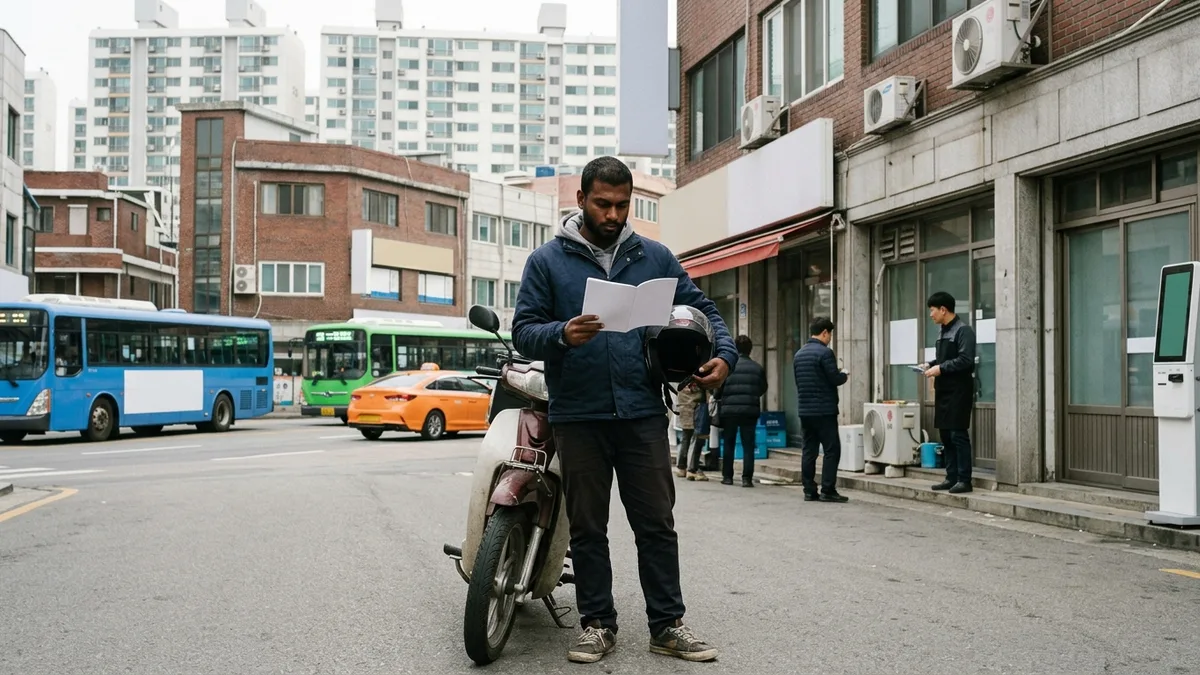
Whether or not you can ride a scooter in Korea isn't decided by engine size — it's decided by a single category letter stamped inside your International Driving Permit (IDP). Article 96(1) of the Road Traffic Act states flatly that the vehicle types you may drive on a foreign-issued IDP are "limited to those listed on that International Driving Permit." Drive a type that isn't listed, and you're riding unlicensed even though you hold a license.
The Korea Road Traffic Authority's official comparison chart spells out what those letters mean. Korea's Class 2 Small license corresponds to category A, and the Class 1 and Class 2 Ordinary licenses correspond to category B. In other words, to ride any two-wheeler you need an A on your IDP — and with a B-only IDP you can't ride a scooter or a moped either.
The problem is that most people only find this out after arriving in Korea. An IDP can only be issued in the country that issued your license, so once you've landed at Incheon Airport there's no way to add category A. Plenty of people get a B-only permit thinking only about cars, and if you don't check before departure, it becomes a problem you simply can't undo from inside Korea.
Penalties split by engine size too. For 125cc and under, it's a criminal fine of up to 300,000 KRW or detention (Article 154, item 2); over 125cc, it's up to one year of imprisonment or a criminal fine of up to 3 million KRW (Article 152, item 1). Below, we'll walk through it in order — from checking for category A all the way to what to do once your first year runs out.
Note: The statutes, fees, and summary fines below reflect what we confirmed in the Road Traffic Act and in the Korea Road Traffic Authority's official guidance as of 2026-08. Laws get amended and fine schedules change, so before you actually ride, please re-check your own case with the Korea Road Traffic Authority (1577-1120) or the Korean National Police Agency.
Does Your International Driving Permit Have an 'A'? This Is Where Most People Get Stopped
International Driving Permits vary in cover color and thickness by country, but the inside layout is similar. The issuing country stamps or marks the vehicle categories it has approved, and each box carries a letter like A, B, C, D, or E. If you want to ride a scooter, only two of those letters matter.
| Category | Scope under the Geneva Convention (1949) | Korean license equivalent |
|---|---|---|
| A | Motorcycles (with or without sidecar), vehicles for disabled drivers, three-wheelers with an unladen weight of 400kg or less | Class 2 Small license |
| B | Passenger cars, goods vehicles up to 3,500kg | Class 1 Ordinary / Class 2 Ordinary license |
Pull out your IDP right now and check whether the A box is marked. If it isn't, you have no legal standing to ride a two-wheeler in Korea, regardless of engine size. Whether or not a rental shop hands you the keys, the moment you're on the road you're riding unlicensed.
Once you have your IDP in hand, check these three things all at once.
- The convention name on the cover — it's printed right there, either 1949 Geneva or 1968 Vienna. Korea recognizes both conventions.
- The A marking in the vehicle category section inside — marking styles differ by country. If the A row is blank or struck through, two-wheelers aren't covered.
- Your original home-country driver's license — you have to present it alongside the IDP during a roadside check, so always carry both.
Korean drivers never run into this issue. Korean licenses list the class in Korean right on the front of the card, and if you need a two-wheeler you just go to a testing center and add a Class 2 Small license. Foreign residents are in a different position. Because an IDP can only be issued in the country that issued your license, once you're in Korea there's simply no office that can add a category.
Heads-up: If you're still in your home country, this is your clearest window. When you apply for the IDP, explicitly ask the issuing office whether the motorcycle category (A) is included. If you're already in Korea, there's no way to add A — you'll need to move on to the path described in the "Once the year is up" section below.
Some Vienna Convention (1968) style IDPs use finer subdivisions such as A1, A2, or AM. We weren't able to obtain official guidance on exactly how Korea recognizes each of these subcategories. Don't decide on your own that "I have A1, so up to 125cc must be fine" — it's safer to read out the exact notation printed on your IDP and confirm with the Korea Road Traffic Authority (needs verification).
125cc Is the Line That Decides Everything — Motorized Bicycle vs. Motorcycle
Korean law splits two-wheelers into two types at the 125cc mark. The names are similar enough that it's easy to skim past, but the consequences if you get stopped are completely different on either side of that line.
Article 2, item 19 of the Road Traffic Act defines a "motorized bicycle" as a motorcycle or similar vehicle with "an engine displacement of 125cc or less (or, if electrically powered, a maximum rated output of 11kW or less)." And item 18 of the same article defines "motor vehicle" to include motorcycles but exclude motorized bicycles. Put simply: a two-wheeler over 125cc is legally a "motor vehicle."
| Category | 125cc and under | Over 125cc |
|---|---|---|
| Legal classification | Motorized bicycle (Art. 2, item 19) | Motorcycle classified as a motor vehicle (Art. 2, item 18) |
| Korean license required | Class 1/2 Ordinary, Class 2 Small, or motorized bicycle license | Class 2 Small license |
| To ride on an IDP | Category A must be listed | Category A must be listed |
| Unlicensed riding penalty | Criminal fine up to 300,000 KRW or detention (Art. 154, item 2) | Up to 1 year imprisonment or criminal fine up to 3 million KRW (Art. 152, item 1) |
The third row is the wall that only foreign drivers hit. Under Attached Table 18 of the Enforcement Rules of the Road Traffic Act, Korea's Class 1 and Class 2 Ordinary licenses include a "motorized bicycle" entry, so Korean license holders can ride anything 125cc and under. The Class 2 Small license covers both "motorcycles (including delivery models)" and "motorized bicycles."
But IDPs don't work that way. Because Article 96(1) says coverage is "limited to those listed," a B-only IDP does not come with a motorized bicycle entry attached. Something a Korean license holder would solve with a single ordinary license becomes a situation where, on a foreign license without A, you can't even ride a 50cc scooter.
Even If a Shop Says "Class 2 Small Starts at 250cc," the Legal Line Is "Over 125cc"
You'll see rental shop notices and community posts saying "a car license covers up to 125cc, and you need a Class 2 Small license from 250cc up." The first half is about Korean licenses (Class 1 and 2 Ordinary do include the motorized bicycle entry), and the second half flatly contradicts the law. The line set by statute is not 250cc — it's anything over 125cc, and the Class 2 Small entry in Attached Table 18 of the Enforcement Rules lists no displacement ceiling at all.
That gap turns into real money and criminal punishment. Going by industry lore, a 150cc or 200cc scooter reads like it falls in "the range a car license covers," but under the law it's already a "motor vehicle" — meaning you're in the Article 152, item 1 range of up to one year imprisonment or a criminal fine of up to 3 million KRW. Not the 300,000 KRW bracket.
It also helps to understand that the rental company's liability and the rider's liability are separate. The fact that a shop checked your documents and handed you the keys doesn't grant you the qualification to ride. The person subject to enforcement out on the road is whoever is holding the handlebars.
Heads-up: The person who told you to ride is also on the hook. Article 154, item 5 of the Road Traffic Act imposes a criminal fine of up to 300,000 KRW or detention on an employer or similar person who lets someone without a motorized bicycle license or an International Driving Permit ride a motorized bicycle. "My boss said it was fine" won't get you off the hook, and your boss faces punishment right along with you.
There's one more thing. A person holding a foreign-issued IDP may not drive commercial vehicles under the Passenger Transport Service Act or the Trucking Transport Business Act (Road Traffic Act, Article 96(2)). The only carve-out is renting a vehicle from a rental business and driving it yourself. If you're thinking about driving a car or two-wheeler for commercial work, you need to check this provision first, separately from the license issue.
The Clock Runs "One Year From Your Entry Date," Not Your IDP's Expiry Date
Even if your IDP's cover says it's valid through 2028, its effect in Korea doesn't follow that date. The standard set by Article 96(1) of the Road Traffic Act is "one year from the date of entry." Vienna Convention style IDPs are sometimes valid for three years, so if you don't know about this difference, you can end up riding unlicensed while believing you still have two years left.
The period after that deadline is especially risky. Article 152, item 1 describes the offense as riding "without having obtained an International Driving Permit," and then adds in parentheses that this "includes cases where driving is prohibited and cases where the validity period has expired." In other words, riding a two-wheeler over 125cc on an expired IDP is handled under the same provision as if you'd never had a license at all.
You'll find posts claiming that leaving the country and re-entering restarts the one-year clock, but that isn't a safe approach. As the year draws to a close, the right move is to shift to the exchange or new-license path below, not to hop across a border.
Calculating your deadline is easy. Take the most recent entry date stamped in your passport and add one year — that's the end. Write that date on your calendar now, and set a reminder two months ahead.
Officers check three documents at a roadside stop.
- International Driving Permit — it must be the original, with category A listed.
- Original home-country driver's license — an IDP is a document that translates and certifies your home license, so it carries little weight on its own.
- Passport — it's the proof of your entry date. The whole "one year from entry" standard is calculated from your passport.
Article 155 of the Road Traffic Act provides for a criminal fine of up to 200,000 KRW or detention if you fail to comply with a police officer's request to present your license or to make statements confirming your identity as the driver. "I left it at my accommodation" doesn't work here. A two-wheeler doesn't have a glove box to stash documents in like a car, so the practical answer is to put all three in a waterproof pouch and keep it on you at all times.
Helmets Are the Rider's Responsibility — Including the Passenger's
Article 50(3) of the Road Traffic Act requires riders of motorcycles and motorized bicycles to wear protective headgear and to make their passengers wear it too. If the person on the back isn't wearing a helmet, the one who bears responsibility is the rider, not the passenger.
The summary fine (notice disposition) for a rider not wearing protective headgear is 20,000 KRW for motorcycles and similar vehicles (Attached Table 8, item 57 of the Enforcement Decree of the Road Traffic Act, as amended 2025-06). There's a separate sanction for an unhelmeted passenger as well, but we couldn't confirm whether the source we had reflects the latest amendment, so we're leaving the amount out — please re-check with official Korean National Police Agency or Korea Road Traffic Authority guidance if you need it.
Tip: If you plan to ride two-up, that means two helmets. Before you put anyone on the back seat, check that a spare helmet is available. The fine may not look like much, but helmet issues feed directly into injury severity and fault assessment if there's a crash.
Two-Wheelers Can't Use Expressways or Motorways
Article 63 of the Road Traffic Act prohibits motorcycles (except emergency vehicles) and motorized bicycles from traveling along or crossing expressways and motorways (automobile-only roads). It applies exactly the same whether the engine is big or small, and whether or not you hold a category A IDP.
This provision genuinely reshapes travel plans. Intercity arterial roads often include motorway-only stretches, which means on a scooter you can't just follow the shortest route your map app suggests. Before you punch in a destination and set off, scan the route once, and if an entrance sign shows the motorway symbol, don't enter — take the detour.
Bottom line: two-wheelers suit short trips within a city. Plan intercity travel by train or bus from the start and use a scooter only within your destination — it's safer legally and faster in practice.
Once the Year Is Up — Your Home-Country Motorcycle License Can't Be Exchanged for a Korean One
When the year ends, you have two options: exchange your home license for a Korean license, or get a brand-new Korean license. But on the two-wheeler side, one of those doors doesn't exist at all.
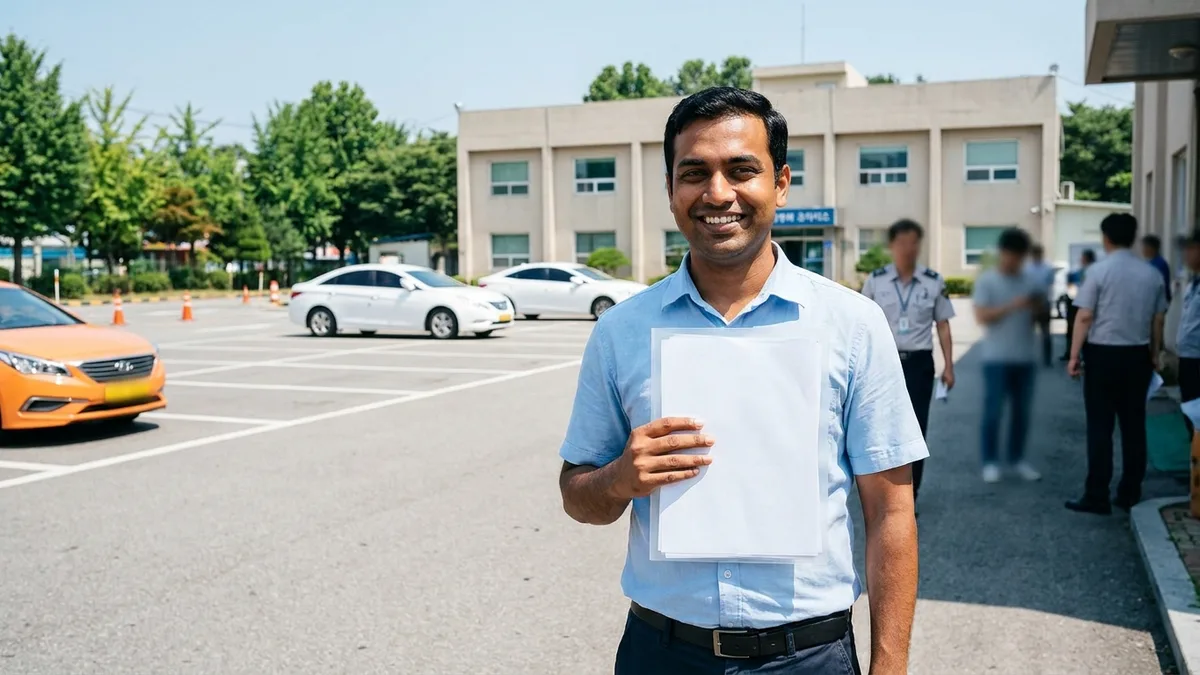
According to Korea Road Traffic Authority guidance, the only Korean license you can receive through foreign license exchange is the domestic Class 2 Ordinary. The sole exceptions are Belgium, Poland, Spain, Italy, and Ireland, which have mutual recognition agreements. In other words, there is no exchange path that produces a Class 2 Small (motorcycle) license. Even if you rode motorcycles for 20 years back home, in Korea you have to start from scratch.
| Item | Details |
|---|---|
| Exchangeable class | Domestic Class 2 Ordinary only (no two-wheeler exchange path) |
| Agreement-exception countries | Belgium, Poland, Spain, Italy, Ireland |
| Fees | Mobile IC driver's license 15,000 KRW / standard driver's license 10,000 KRW |
| Non-recognized countries | Additional 10,000 KRW written test fee |
| Required document for foreigners | Original Alien Registration Card (overseas Koreans: original Domestic Residence Report Card) |
Sequencing it like this keeps things from getting tangled.
- Right after arrival — if you have category A, you can ride on your IDP. The clock runs one year from your entry date.
- Around month 6 — check whether your Alien Registration Card is actually in hand. You need the original to apply for the exchange.
- Around months 8–9 — we recommend applying at a driver's license testing center. If you're from a non-recognized country, you need to factor in the written test schedule to finish within the year.
That last line is a subtle trap. The exchange application requires the original Alien Registration Card, and right after arrival you don't have that card yet. The IDP's one-year window and the ARC issuance timeline often overlap and throw the sequence off, so check the full exchange process first in How to Exchange a Foreign Driver's License for a Korean One. What to tackle first in your opening month in Korea is laid out in the First Month in Korea Checklist.
Electric Kick Scooters Have the Same License Problem — Signing Up in the App Doesn't Make It Legal
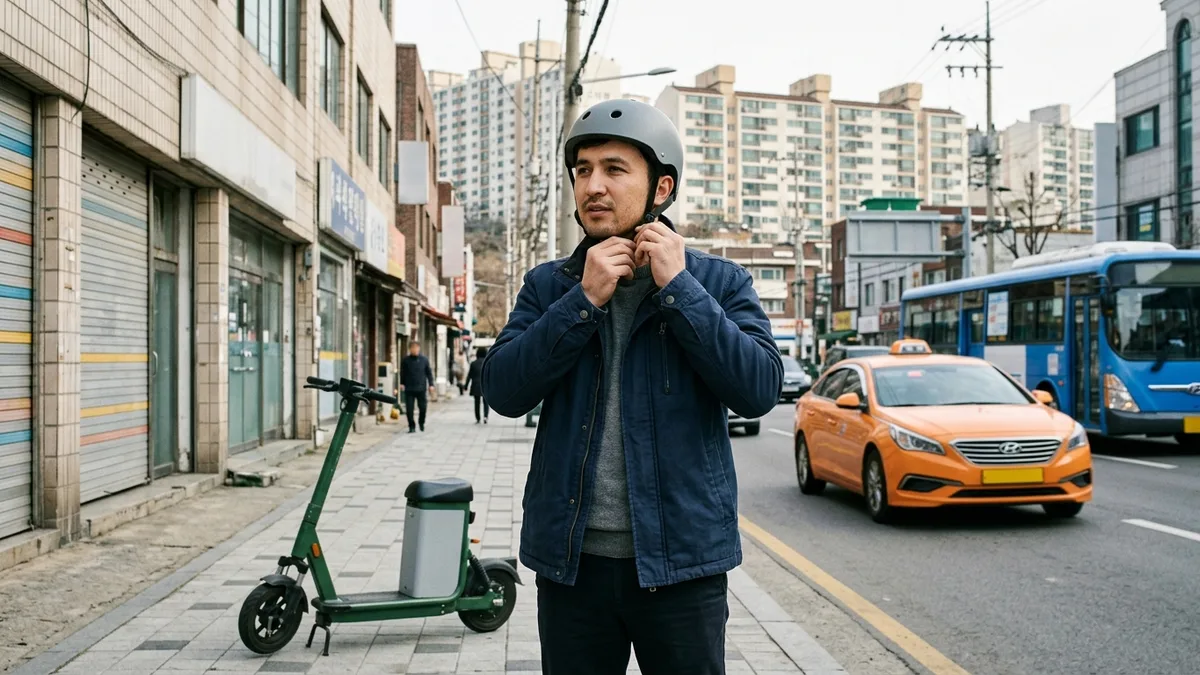
When scooters are off the table, shared electric kick scooters are the natural next thought — but the license issue follows you right over. For personal mobility devices, the summary fine (notice disposition) for unlicensed riding is 100,000 KRW (Attached Table 8, item 1-4 of the Enforcement Decree of the Road Traffic Act). The very existence of that fine item means it's a mode of transport that requires a license. Riding without protective headgear is 20,000 KRW (Attached Table 8, item 38-2).
With shared kick scooter apps, sign-up and payment sometimes go through fine on a foreign card. That makes it easy to assume "the app unlocked it, so it must be okay" — but a payment going through in an app and legality out on the road are two different things. License verification methods differ by app and there's no official guidance on how they handle International Driving Permits, so it's safer to assume that a missing verification screen does not waive the license requirement.
The kick scooter side has its own full set of rules. The statutory requirements for personal mobility devices (25km/h, 30kg), the fine schedule by violation, the bike-lane riding principle, and even pedal-assist (PAS) e-bikes you can legally ride without a license are all laid out with statute citations in Electric Kick Scooter Licenses and Fines by Violation.
Which services work and which are blocked without a Korean phone number is covered separately in What You Can Do Without a Korean Phone Number.
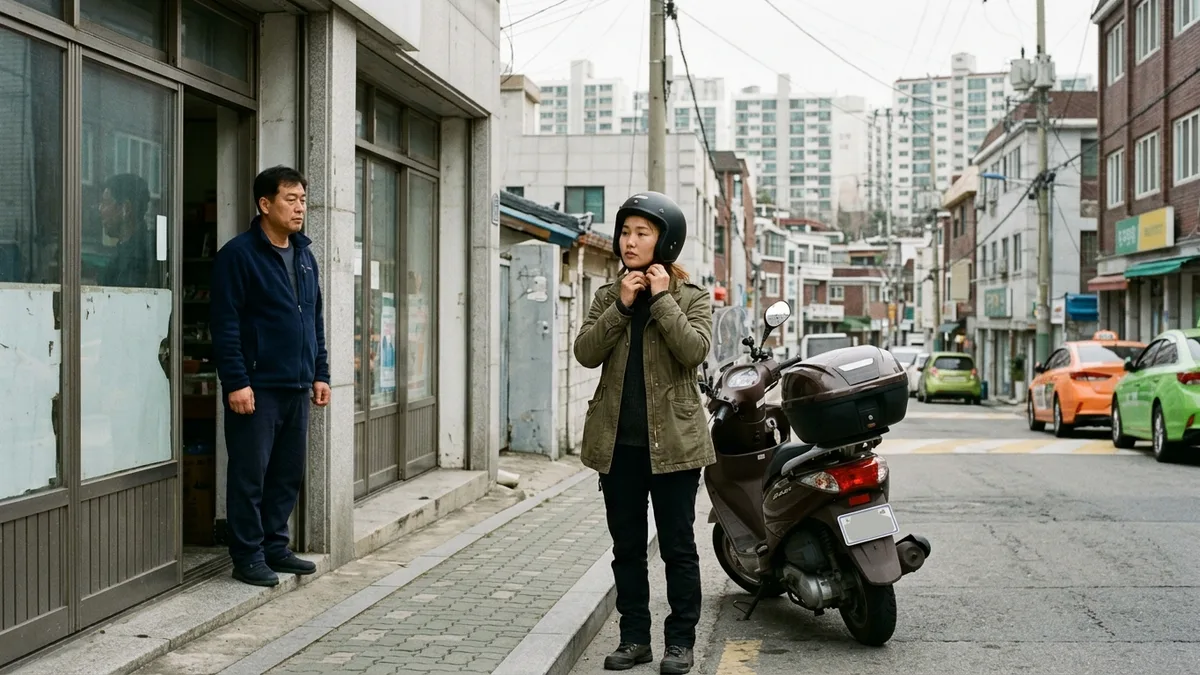
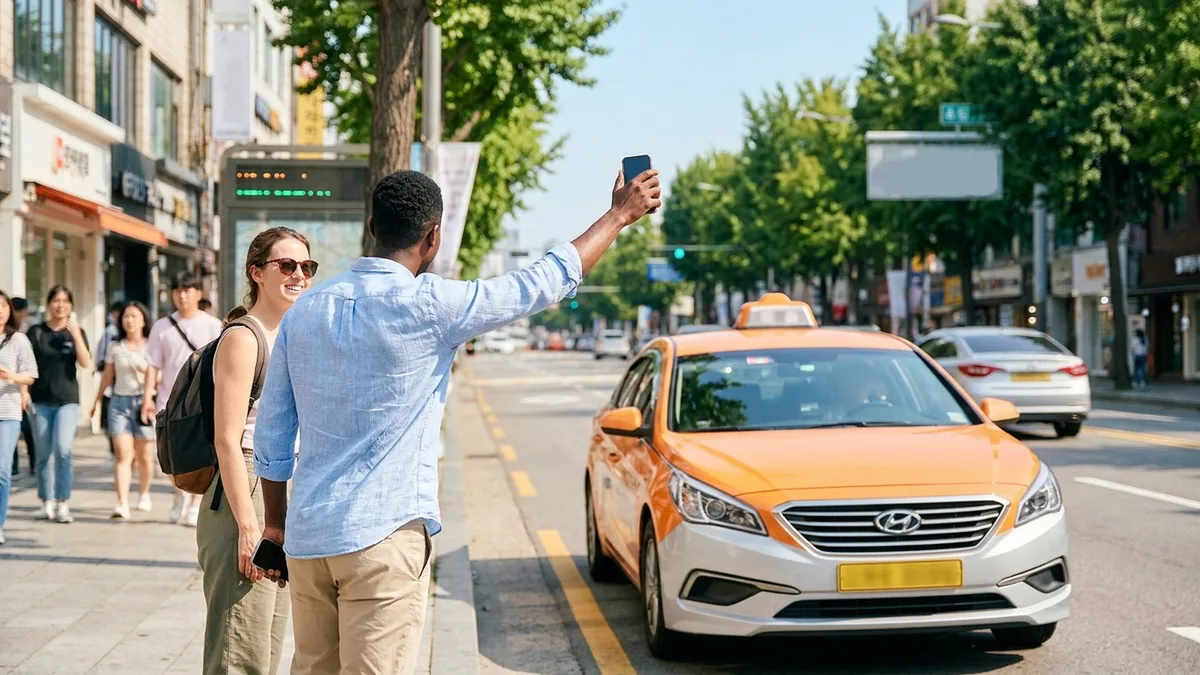
If you've just discovered your IDP has no A, the thing to look for right now isn't a rental shop — it's an alternate way to get around. The good news is that the gaps a scooter would fill — the five minutes to the station, intercity hops, hauling bags home late at night — are mostly covered by public transit and taxis. How to hail a taxi without a Korean phone number is covered in How to Call a Taxi in Korea Without a Korean Phone Number.
| Mode of transport | License | Where foreigners get stuck |
|---|---|---|
| Scooters & motorcycles | Category A IDP or Korean Class 2 Small license | Can't add A after arrival; one year from entry date |
| Shared electric kick scooters | Required (100,000 KRW fine for unlicensed riding) | The app may take your payment, but the license requirement remains |
| Kakao T taxi | Not required | Requires Korean phone number verification |
| LACHA | Not required | Doesn't handle two-wheelers or car rentals |
LACHA is a transport-and-payment super app for foreign visitors that you can use right away without Korean identity verification. You can get started with just your passport — no Korean bank account or phone number — and handle taxi hailing plus KTX, express buses, the Airport Railroad, and transit cards all in one place. It accepts overseas payment services like Alipay and WeChat Pay as well as foreign cards. Which means you don't have to put your travel on hold while you sort out the license issue. That said, it doesn't handle two-wheeler rentals or license procedures.
Want to search and book KTX and express buses in one app? Check out LACHA.
Built to work without a Korean phone number or bank account, with overseas payment methods like Alipay, WeChat Pay, and Apple Pay. Taxi hailing plus KTX, express bus, and airport railroad (AREX) booking — all in one app.
Up to 60% off Korea transit with a coupon (max ₩3,000): enter code at sign-up. KTX gets up to 18% off on top
Download now


Frequently Asked Questions (FAQ)
Q1. Can I ride a 125cc or smaller scooter on a car-category (B) International Driving Permit? No. Article 96(1) of the Road Traffic Act limits the vehicle types you may drive on a foreign-issued IDP to "those listed," so a B-only IDP covers neither motorcycles nor motorized bicycles. Korea's Class 1 and Class 2 Ordinary licenses do include a motorized bicycle entry (Attached Table 18 of the Enforcement Rules), but that's about Korean licenses — the effect doesn't carry over to an IDP. Getting caught riding something 125cc or under means a criminal fine of up to 300,000 KRW or detention (Art. 154, item 2).
Q2. Can I add the motorcycle category (A) to my International Driving Permit after arriving in Korea? You can't. An IDP can only be issued in the country that issued your license, so there's no office inside Korea that can add or amend a category. Your options are: ① get a new IDP that includes A the next time you have a reason to visit home, ② obtain a Korean Class 2 Small license from scratch, or ③ give up on two-wheelers and get around by public transit and taxi. Note that even with option ①, the clock is one year from your re-entry date, not the new IDP's validity period — and we don't recommend hopping in and out of the country to stretch your stay. There is no route to exchange a home-country motorcycle license for a Korean one.
Q3. My IDP is valid for another two years — can I keep riding? No. The standard in Korea isn't the validity period printed on the IDP, it's one year from the date you entered the country (Art. 96(1)). On top of that, Article 152, item 1 explicitly notes in parentheses that the offense "includes cases where the validity period has expired," so riding a two-wheeler over 125cc on an expired IDP puts you in the up-to-one-year imprisonment or up-to-3-million-KRW criminal fine bracket. Extending the window by leaving and re-entering isn't a safe approach.
Q4. If the rental shop let me rent it, doesn't that make it legal? No. The rental going through and your being qualified to ride are two separate things, and the person subject to enforcement on the road is the rider. On top of that, Article 154, item 5 of the Road Traffic Act imposes a criminal fine of up to 300,000 KRW or detention on an employer or similar person who lets someone without a motorized bicycle license or an IDP ride a motorized bicycle. For reference, the industry line that "Class 2 Small starts at 250cc" contradicts the law — the statutory line is anything over 125cc.
Q5. Can I convert the motorcycle license I got back home into a Korean license? There's no path on the two-wheeler side. Per Korea Road Traffic Authority guidance, the only Korean license available through foreign license exchange is the domestic Class 2 Ordinary (with Belgium, Poland, Spain, Italy, and Ireland as mutual recognition exceptions), and there's no procedure for exchanging into a Class 2 Small. To keep riding two-wheelers in Korea, you have to obtain a Class 2 Small license from scratch. The exchange fee is 15,000 KRW for a mobile IC license and 10,000 KRW for a standard one, and you need the original Alien Registration Card when you apply.
Note: This article is for general information only and is not legal advice. The statutes, fines, and fees in the text reflect what we confirmed as of 2026-08 in the Road Traffic Act and its Enforcement Decree and Enforcement Rules, along with official Korea Road Traffic Authority guidance, and they may change with amendments to the law or revised fine schedules. We couldn't confirm from official sources how Korea recognizes the Vienna Convention's A1/A2/AM subcategories, or the current sanction amount for a passenger not wearing protective headgear, so we hedged or omitted those in the text — please check with the Korea Road Traffic Authority (1577-1120). Rental terms, insurance coverage, and shop-specific document requirements are not covered here. LACHA does not handle two-wheeler rentals or license issuance and exchange procedures.