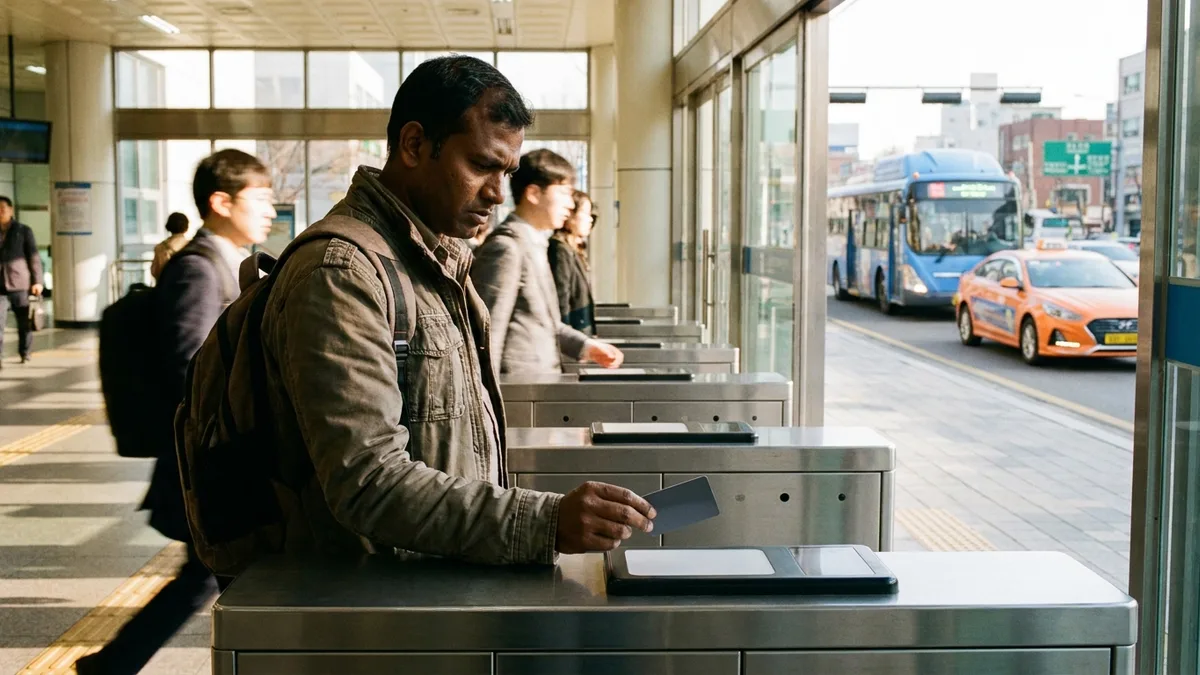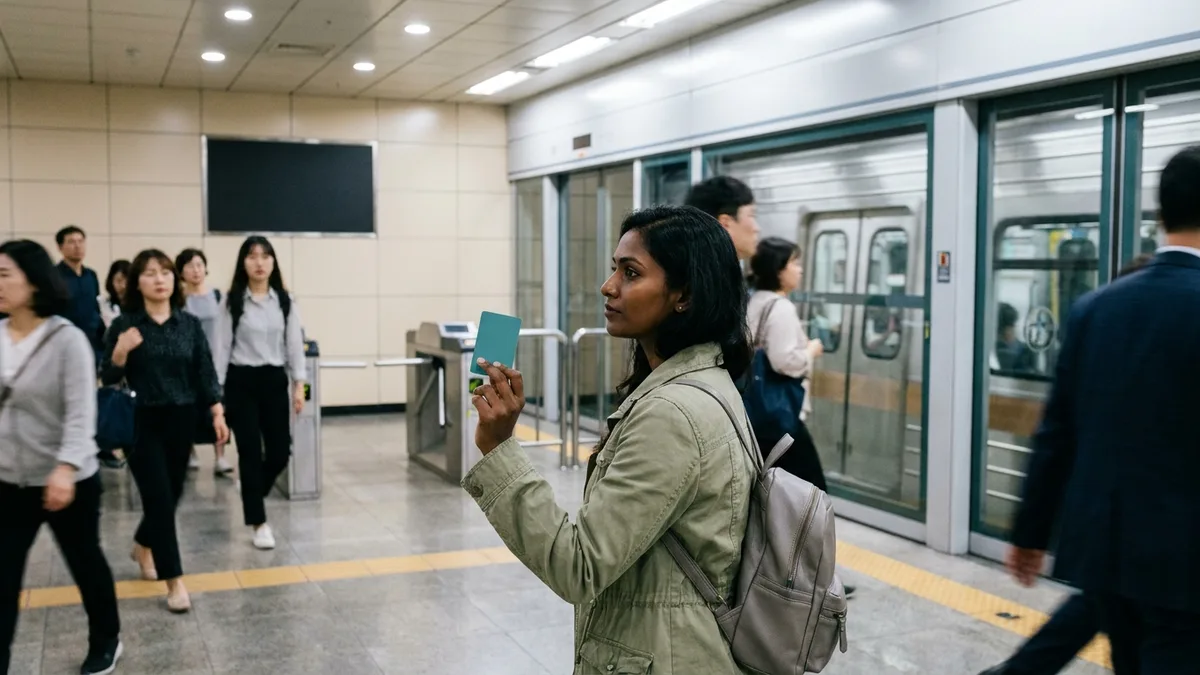

Usually you notice about 30 seconds after getting off. Your bag is gone, the vehicle has already left, and the first thought in your head is "Do I need to go to the police station?" But if you move in that order in Korea, you end up letting the whole first week slip by.
Article 10 of the Lost Property Act says that anyone who picks up someone else's property inside a ship, vehicle, or building that has a manager must hand it over to the manager, and it treats the occupant of that vehicle or building as the finder. A bag on a subway train goes to the station, a wallet on a bus goes to that company's depot, and a phone in the back seat of a taxi goes first to that taxi company or the driver. The police come after that.
So the first question isn't "What did I lose?" but "Whose vehicle did I leave it in?" That structure is invisible to foreigners from the start, because on a map app, Line 2, the Airport Railroad, and the Shinbundang Line all look like just another colored line.
Note: The phone numbers, hours, fees, and procedures below were compiled from the legal provisions and the official guidance of each police, rail, bus, and taxi agency as of 2026-09 (sources are gathered at the end of the article). Lost-and-found centers change location and phone number often, so call again to confirm before you go.
The First Thing to Decide: "Whose Vehicle Did I Leave It In?"
Article 1(1) of the Lost Property Act requires anyone who finds property someone else has lost to promptly return it to the person who lost it or to its owner, or to hand it in at a police station (including police substations and police boxes) or an office of the Jeju Special Self-Governing Province Autonomous Police. Items picked up on the street go straight to the police under this provision.
But items found inside public transport take one extra step because of Article 10 above. The operator holds the item first, and generally, if the person who lost it doesn't turn up within 7 days, it moves to a police station or a lost-and-found center. In effect, the first week after the loss is "the period to call the company," and after that it's "the period to search through the police." If you reverse the order, you'll walk right past the depot where your item is actually sitting.
The second thing to prepare is information that identifies the vehicle you rode. Lost-item searches work by finding the vehicle first, not by the name of the item, so without this, no counter can even start a search.
| Where you left it | Where the item goes first | Information you need when you ask |
|---|---|---|
| Taxi | The taxi company (corporation) or the driver personally | The card number you paid with, the date of the ride, and the receipt |
| Subway / metropolitan rail | The lost-and-found center of the company that runs that line | Line and operator, station where you got off, time you got off, which car you were in |
| City bus / village bus | That bus company's branch office or depot | Route number, stop where you got off, time you got off |
| KTX / SRT | The rail operator's customer center or a station lost-and-found center | Date of travel, train number, route, car and seat number |
| Express bus | The regional lost-and-found center of the bus company you rode with | Bus company name, departure and arrival terminals, boarding time |
| Airport Railroad | Geomam Station lost-and-found center | Station where you got off, time you got off |
See what the rows have in common? Every one of them asks for time and place. So the first thing to do the moment you notice something is missing isn't to call; it's to write down what time and where you got off before the memory fades. If you have a transit card usage history or an app payment record, open that first.
If asking in Korean is hard, remember two lines. Seoul's 120 Dasan Call Center (120 with no area code, or 02-120) runs 24 hours a day, 365 days a year, and costs only regular call charges with no separate information fee. But only the Korean-language service is 24 hours; foreign-language service (English, Chinese, Japanese, Vietnamese, Mongolian) is weekdays 09:00–18:00 only. Outside those hours, the line you can reach in a foreign language is 1330. The Korea Tourism Organization's Korea Travel Hotline 1330 (+82-2-1330 from abroad) handles tourism interpretation and tourist complaint consultations, connects you through three-way interpretation when you need an interpreter on public transport, and also serves as a line for reaching the tourist police.
Taxis: How You Paid Decides Whether You Can Find It
Taxis are the most extreme case. Even if you leave the same item in the same seat of the same car, if you paid in cash there's no trail, and if you paid by card you can get as far as the plate number.
The official guidance from the national federation of taxi business associations (전국택시운송사업조합연합회) splits this situation into three steps depending on how you paid. Just follow them in order.
- If you got a receipt, check the ride time, the taxi operator, and the phone number printed on it. According to Seoul's guidance, a card payment receipt shows the vehicle number, the ride time, and the operator's phone number. For company taxis it connects you to the company's call center, and for individually owned taxis it connects you to the driver's personal phone number.
- If you paid by card (credit, debit, or T-money card), call the ARS lines below and enter your card number. You can get the vehicle number and the driver's contact for the taxi you paid.
- If you have neither a receipt nor a card payment, move on to Seoul's integrated public transit lost-and-found center and the police lost-item search.
What's easy to miss here is that there's more than one payment-terminal company. If one lookup turns up nothing, the fare may have been paid on another company's terminal, so try both numbers.
- T-money (Korea Smart Card) 1644-1188 : 2 for lost-item search → 1 for a T-money card or 2 for a credit card → enter your card number and the 6-digit year, month, and day of use. The option-2 search also works outside weekday business hours (18:00 to 09:00 the next day) and on public holidays
- Idong-ui Jeulgeoum (이동의즐거움, Cashbee / Mybi) 1644-6001 : 4 for the lost-item ARS search → enter the card number used and the date of use. The ARS search is available 24 hours
T-money's ARS hides one feature that makes all the difference if you have trouble following Korean. After the search, press 3 to receive the results by text message on your phone (1 for the number you're calling from, 2 for a different number). Even if you didn't catch all of the voice guidance, the vehicle number and contact stay in writing, so you can paste them into a translator. A live agent is available only on weekdays 09:00–18:00 (lunch break 13:00–14:00).
You can also ask about company taxis through the associations, but the number differs by region: for example, Seoul 02-2033-9200, Busan 051-462-4651, Daegu 053-765-4111, Incheon 032-466-5101, Gwangju 062-676-8031, Daejeon 042-527-1241, Gyeonggi 031-255-7881, and Jeju 064-722-0274. Individually owned taxis aren't handled by these associations; you need to contact the private taxi federation (개인택시연합회, 02-557-7351) separately. In Seoul, the department in charge of taxi lost items is the Seoul Metropolitan Government's Taxi & Logistics Division (택시물류과, 02-6321-4262).
If you hailed the taxi with an app, open your past ride history first. The date, time, and route are saved there, so you can pass them straight to the counters above. That said, whether the app gives you a way to contact the driver directly varies by service and the screens keep changing, so we won't make a definitive claim here. Problems you might hit when creating an account are covered in the Kakao T guide for foreigners. If you booked and paid for a taxi, KTX, express bus, or the Airport Railroad with LACHA, the date, route, and payment record stay in your order history, so you can pull out the "when, where, and what you rode" that the inquiry needs as is. It isn't a feature that finds your item or gives you the driver's contact.
Subway: Even Within "the Seoul Subway," Each Line Has a Different Company
This is where people make the most wasted trips. Seoul has no single "Seoul Subway Lost and Found Center." Each line has its own center location and phone number, and some lines are run by an entirely different company.
Line 9 is the classic example. Even on the same Line 9 train, the Gaehwa–Sinnonhyeon section is run by Seoul Metro Line 9 Corporation (서울시메트로9호선), so items go to Dongjak Station, while the Eonju–Jungang Bohun Hospital section is run by Seoul Metro, so items go to Sports Complex Station. It's one line on the map, but the operator changes partway along. There's no better example of how Korean subways work by company, not by line.
| Line | Operator | Lost-and-found center | Phone |
|---|---|---|---|
| Lines 1 & 2 | Seoul Metro | City Hall Station | 02-6110-1122 |
| Lines 3 & 4 | Seoul Metro | Chungmuro Station | 02-6110-3344 |
| Lines 5 & 8 | Seoul Metro | Wangsimni Station | 02-6311-6765 |
| Lines 6 & 7 | Seoul Metro | Taereung Station (태릉입구) | 02-6311-6766 |
| Line 9 (Eonju–Jungang Bohun Hospital) | Seoul Metro | Sports Complex Station | 02-2656-0787 |
| Line 9 (Gaehwa–Sinnonhyeon) | Seoul Metro Line 9 Corporation | Dongjak Station | 02-2656-0009 |
| Korail sections of the Seoul metropolitan subway | Korail | Guro Station | 02-869-0089 / 1588-7788 |
| Airport Railroad | Airport Railroad Co. | Geomam Station | 1599-7788 |
| Shinbundang Line | Shinbundang Line | Yangjae Station | 02-568-7715 |
| Incheon Subway | Incheon Transit Corporation | Incheon City Hall Station | 032-451-3650 |
| Busan Metro | Busan Transportation Corporation | Seomyeon Station Lost Item Service Center | 051-640-7339 / 051-678-6191 |
All five Seoul Metro lost-and-found centers are open only on weekdays 09:00–18:00 and closed on Saturdays, Sundays, and public holidays. The Busan Lost Item Service Center (B2 of Seomyeon Station, in the Line 1–2 transfer passage) is also open weekdays 09:00–18:00. We didn't verify the urban railways of other cities such as Daegu, Gwangju, and Daejeon this time, so please check the relevant operator's website directly.
How to report depends on when you notice. Incheon Transit Corporation's guidance spells this out clearly. If you notice right after the train leaves, tell that station's office (customer service center) immediately; if you notice later, report it to the terminal station or a lost-and-found center. You'll need to give the train number, the time you got off, and the position of the car you got off from (which car it was). The train keeps running, so "which car" narrows the search a great deal.
Knowing the route items take also helps you feel less rushed. Seoul Metro's procedure goes: registered at the station → handled by the lost-and-found center within 7 days → kept at a police station for 6 months → reverts to the state, and if the owner is identified at any stage, the item is handed back to them. In Busan, items stay at the station where they were found until 10:00 the next day, then move to the Seomyeon Station center and are kept for 7 days; Incheon also keeps them for one week before handing them over to the National Police Agency.
That said, not every item waits 7 days. Seoul Metro discards opened food the same day, and even unopened food with an unclear expiration date or that could spoil (lunch boxes, fresh/chilled/frozen food, fruit, vegetables, gimbap, kimchi, baked goods, etc.) is discarded the same day. On the other hand, high-value items of any kind are transferred to a police station immediately.
If you lost the transit card itself, the balance is handled by the card company's rules, not by the lost-item procedure; that's covered in Transit card loss and balance problems, and if the difference between lines and operators is unfamiliar, see The complete guide to the Seoul subway.
Buses: Call That Company's Depot, Not a Search Site
Buses are the mode least likely to be solved by an online search. According to Seoul's guidance, lost items from buses are kept at the depot for 7 days after the bus finishes its run, and to find them you need to remember the bus number and the stop number.
The Gyeonggi Bus Transportation Business Association (경기버스운송사업조합) goes one step further. It says items found on buses are kept at each bus company's branch office and depot, and that "if a found item is at the bus company (branch office), the principle is that the owner visits in person, confirms it, and collects it." To inquire, you need to know the route number of the bus you rode (e.g., 10, 10-1), where you got off, and what time you got off.
These three are the hardest hurdle for foreigners. If you couldn't understand the announcements or read the stop name, you have none of that information. That's why, for buses, keeping a record works far better than trying to fix things afterward. The fastest option is to snap one photo of the vehicle number posted inside the bus when you board; if you forgot, your map app's route history or your transit card usage history still keeps the stop and time you got off, so you can work backward to the route. Route systems and real-time arrival info are in Real-time bus apps and seat reservations.
To see found items from Seoul's city buses, village buses, company taxis, and individually owned taxis in one place, use Seoul's integrated public transit lost-and-found center (서울시 대중교통 통합분실물센터, news.seoul.go.kr/traffic/find). The old address (seoul.go.kr/v2012/find.html) automatically redirects there, and the data is updated as needed by the Bus Policy Division of Seoul's Transportation Office. That said, we couldn't confirm whether this page has its own screen for searching the list of found items directly. If you can't find a search box, asking the 120 Dasan Call Center is faster.
KTX, SRT, Express Buses, and the Airport Railroad: A Seat Number Makes It Fastest
Rail is the opposite. Seats are assigned, so exactly where your item was can be pinned down. As long as you have a booking record, it's the mode where searches work best.
For Korail (KTX and conventional trains), contact the rail customer center at 1588-7788 or any station or lost-and-found center. The lost-and-found center for the Seoul metropolitan subway sections is at Guro Station (02-869-0089). With the merger of Korail and SR on September 1, 2026, inquiries for the former SRT were also folded into this number. In July 2019 Korail signed an agreement with the National Police Agency, and from September that year, items found at train stations also became searchable on the National Police Agency's lost-and-found portal (as of 2018, trains and stations took in some 156,000 found items a year). However, we couldn't obtain the original text of Korail's official guidance on its current storage period and pickup requirements, so we haven't listed them; please confirm at 1588-7788. If booking itself is blocked, see Booking KTX without a Korean card.
SR (SRT) takes reports at station lost-and-found centers (Suseo Station 02-6177-8245, Dongtan Station 031-328-9505, Pyeongtaek-Jije Station 031-646-8805). SR's lost-and-found guidance still lists its customer center at 1800-1472, but SR's customer center page now gives 1588-7788 as the number for general phone consultations. When reporting, you need to give the date of travel, train number, route, car number, seat number, and details of the lost item. The lost-and-found center keeps items for 7 days and hands them over, and if the owner still doesn't turn up after that, they're transferred to the police station with jurisdiction. To collect in person, bring ID; for a proxy pickup, prepare a power of attorney on the company's form, a copy of the owner's ID, and the proxy's own ID. That said, this procedure follows SR's lost-and-found guidance, and the guidance is still changing after the merger, so check with 1588-7788 or the station lost-and-found center before you set out. The differences between the two trains are in SRT vs. KTX.
Express buses are the most frustrating part. There's no nationwide integrated lost-and-found center. Kobus, the integrated booking site, only says, "Please select the express bus company you rode with and contact the lost-and-found center in that region." That means you have to know the bus company and region of the bus you took before you know where to call. The bus company's name is on your ticket or booking record, so check that first, and if you're unsure, ask the Kobus customer center (1644-9030). How to read the booking screen is in Booking a Korean express bus in English.
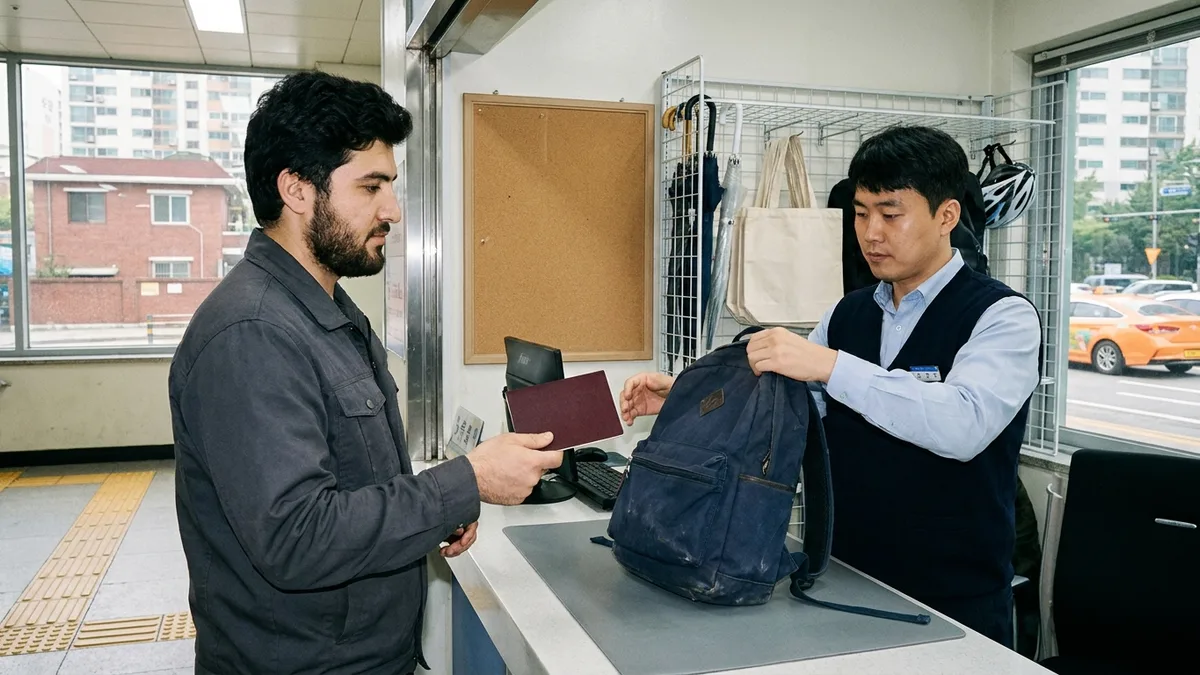
The Airport Railroad (AREX) lost-and-found center is in the customer information center inside Exit 1 of Geomam Station, open 06:30–23:00, contact 1599-7788. There are two constraints. You can only collect the item by visiting in person, and courier delivery isn't available. And when you collect it, you must bring ID to verify your identity (passport, Korean resident registration card, etc.). Food that may spoil is disposed of by the operator. The difference between express and all-stop trains is in AREX express vs. all-stop tickets.
Incheon International Airport runs its own lost-and-found centers. They're on B1 of Terminal 1 (032-741-3110, 3114 / lostnfound@biz.airport.kr) and inside the Government Complex Administration Center on 2F of Terminal 2 (032-741-8988, 8989 / lostnfound2@biz.airport.kr), open 07:00–21:30 every day of the year. Pickup requirements are summarized in the table further below.
After 7 Days It Goes to the Police: How to Use Police Civil Service 24
Please remember one address. The National Police Agency's long-used lost-item management system LOST112 (lost112.go.kr) has been integrated into Police Civil Service 24 (minwon24.police.go.kr) since January 26, 2026. The Airport Railroad and Busan Transportation Corporation posted notices to the same effect, and the search button on Seoul Metro's lost-and-found page also links to Police Civil Service 24. Many posts online still point to the old address, so if you search for it, it's easy to land first on a screen that won't open. The site isn't dead; the address has changed.
There are two things to do here: a found-item search to see whether your item is among those someone picked up and reported, and a lost-item report to register what you lost. Transfers take time, so even if your item isn't in today's search, it may be registered a few days later; do both.
The reporting conditions are fairly favorable for foreigners. You can report online or in person, there are no required documents or fees, and processing is immediate (within 3 working hours). The report form can be downloaded in both Korean and English. However, online submissions can't be edited, to prevent false reports; to change something, you have to cancel and resubmit. Double-check the date and place before you submit.
The website can switch its display into more than 30 languages, including English, Japanese, Simplified Chinese, Traditional Chinese, Thai, Vietnamese, Indonesian, Hindi, and Arabic. However, whether this multilingual display extends to the found-item search and lost-item report screens, and how foreigners get through identity verification for online reports (whether a passport number works, or whether non-member submissions are accepted), isn't in the official guidance and needs checking. If the online route is blocked, you can still visit the nearest police station in person, so don't stop there.
There's also a phone line you can ask. It's the Police Civil Service Call Center at 182 (charged call, weekdays 09:00–18:00); from abroad, dial +82-182. The lost property storage centers of the metropolitan and provincial police agencies are Seoul 02-700-2976, Busan 051-868-0899, Daegu 053-804-2247, Incheon 032-455-2847, Daejeon 042-609-2347, Southern Gyeonggi 031-888-3948, and South Chungcheong 041-336-2347. Police Civil Service 24's list of linked institutions also includes Korail, subway and bus associations, and airports as separate categories.
Mobile phones alone have one more route. At the Handphone Finder Call Center (핸드폰찾기콜센터, handphone.or.kr, 1566-4300 / 02-3471-1155, 3F, 156 Yeoksam-ro, Gangnam-gu, Seoul), run by the Korea Association for ICT Promotion (KAIT), you can check whether a found phone has been registered. Seoul's public transit lost-and-found center also points to this route, so if it's a phone, check this third channel too.
The Clock Runs Three Times: 7 Days, 6 Months, 3 Months
Many people get the deadlines mixed up. The three periods run one after another; they don't add up.
| Clock | Period | What happens during it | Basis |
|---|---|---|---|
| First | Generally 7 days | The operator (station, depot, lost-and-found center) holds the item and, if no owner appears, transfers it to a police station or lost-and-found center | Each operator's guidance |
| Second | 6 months | If the owner doesn't claim their rights within 6 months after public notice, the finder acquires ownership | Civil Act, Article 253 |
| Third | 3 months | If the person who acquired ownership doesn't collect it within 3 months, they lose ownership, and if there's no one to receive it, it reverts to the state | Lost Property Act, Articles 14 and 15 |
The third clock's 3 months used to be 6 months and was shortened by a 2014 amendment. In practice, the first clock is what matters. If you contact the operator within the first week after the loss, your item is most likely still with that company.
There are much shorter clocks too. Incheon International Airport reverts items to the state or disposes of them once the 6-month statutory period and the 3-month period for the finder to acquire ownership have passed, but "non-registered items" (비접수 물품) such as IDs and cards are kept only 1 month, and empty suitcases only 7 days. That means documents that must be reissued, like passports, can be disposed of sooner than ordinary items.
The question of a reward may come up when you get your item back. Article 4 of the Lost Property Act requires the person getting the item back to pay the finder a reward of at least 5% and no more than 20% of the item's value. It's a range with a floor and a ceiling, not a fixed 20%. The state, local governments, and public institutions designated by Presidential Decree can't claim it, and Article 6 of the Enforcement Decree of the Lost Property Act defines those public institutions as public institutions under Article 4 of the Act on the Management of Public Institutions and local public corporations and local public agencies under the Local Public Enterprises Act. Cases where a local public corporation such as Seoul Metro or Busan Transportation Corporation became the occupant fall under this.
Conversely, there's also something to follow when you're the one who finds something. Article 360 of the Criminal Act punishes anyone who embezzles lost property, drifting property, or other property that has left another person's possession with imprisonment of up to 1 year, a criminal fine of up to 3,000,000 KRW, or a minor fine (과료) (embezzlement of lost property). This is a criminal penalty, a different system from an administrative fine (과태료), which is an administrative sanction. If you find someone's bag, just leave it at the station office.
Walls Only Foreigners Hit When Reclaiming Items
Even after going through every step, there are separate points where you can get stuck at the final counter. These are things you can prepare for if you know them in advance.
ID requirements. Almost every lost-and-found center just says "bring ID when collecting," without explaining what that means for foreigners. Only the Airport Railroad names the passport, saying "passport, resident registration card, etc." The standard is Article 27(1) of the Immigration Act. Foreigners staying in Korea must always carry a passport, seafarer's identity document, foreigner entry permit, Alien Registration Card, mobile Alien Registration Card, or landing permit (except those under 17), and for foreigners, the ID that lost-and-found centers refer to means these documents. Article 13 of the Enforcement Decree of the Lost Property Act also allows the police to process data containing passport numbers or alien registration numbers when this is unavoidable for handling found items.
If you lose your passport, it stops being a lost-item problem and becomes a residence-status problem. It's a document you must always carry, and at Incheon Airport it's kept for only 1 month. It's safer to contact your country's embassy or consulate and start the reissue at the same time as the lost-item search. How to contact them is in Getting help from your embassy in Korea.
Hours. Operator lost-and-found centers are mostly open only on weekdays 09:00–18:00 and closed on weekends and public holidays. For people who work during the week and people who come to Seoul only on weekends, those are exactly the hours they can't make it. On the other hand, the taxi card ARS lines are open at night and on holidays, so start there. The 120 Dasan Call Center also answers at night, but only in Korean during those hours. If you need a foreign language at night or on weekends, call 1330.
If you're outside Seoul or your departure date is approaching, proxy pickup and courier delivery remain, and this is where institutions differ the most.
| Institution | In-person pickup | Courier delivery | Proxy pickup |
|---|---|---|---|
| Seoul Metro | Lost-and-found centers, weekdays 09:00–18:00 | Door-to-door delivery since 2026-07-20 (under 2 kg 5,000 KRW / 2 kg or more but under 10 kg 6,000 KRW / 10 kg or more but under 20 kg 7,000 KRW) | Not confirmed in official guidance |
| Airport Railroad | Geomam Station 06:30–23:00, ID required | Not available (in-person only) | Not confirmed in official guidance |
| SR (SRT) | Station lost-and-found centers, ID required | Not confirmed in official guidance | Power of attorney on company form + copy of owner's ID + proxy's ID (per SR's lost-and-found guidance; still changing after the merger) |
| Incheon International Airport | 07:00–21:30 year-round, ID and receipt number | Available (from 7,000 KRW; valuables and cash excluded) | Copy of owner's ID, proxy's ID, receipt number + advance submission of personal details |
Seoul Metro offers courier delivery, the Airport Railroad doesn't at all, and Incheon Airport does under conditions. No institution states whether it ships overseas, so we haven't included that in this article. If you've already left Korea or your departure is imminent, call first and make a plan.
Language. Whether each subway operator's lost-and-found center can respond in English isn't in any guidance and needs checking. In practice, this order is safe: first use Police Civil Service 24's multilingual display and the English report form; if you need to call, go through 1330's three-way interpretation; and with the T-money ARS, press 3 to get the results by text and confirm them in writing. Problems caused by not having a Korean number are covered in Services you can use without a Korean phone number.
Want to get a taxi without a Korean phone number? Check out LACHA.
Built to work without a Korean phone number or bank account, with overseas payment methods like Alipay, WeChat Pay, and Apple Pay. Taxi hailing plus KTX, express bus, and airport railroad (AREX) booking — all in one app.
KTX now up to ₩10,000 off. Enter code at sign-up for 3,000P on top
Download now


Frequently Asked Questions (FAQ)
Q1. I left something behind. Should I go to the police station first? For the first week, the company that runs the vehicle comes first. Under Article 10 of the Lost Property Act, items found inside a vehicle are handed over to the manager, and each operator generally keeps them for 7 days before transferring them to a police station or lost-and-found center. For the subway, contact that line operator's lost-and-found center first; for a bus, that company's depot; for a taxi, the card payment ARS or the number on your receipt. If you also file a lost-item report on Police Civil Service 24 (minwon24.police.go.kr) at the same time, it will be matched once the item is transferred.
Q2. I went to lost112.go.kr and it won't open. Is the site gone? The address changed. LOST112 has been integrated into Police Civil Service 24 (minwon24.police.go.kr) since January 26, 2026. The Airport Railroad and Busan Transportation Corporation posted the same notice, and the search button on Seoul Metro's lost-and-found page also links to Police Civil Service 24. The display can be switched into more than 30 languages, including English, Japanese, Chinese, Thai, and Vietnamese, and the lost-item report form can also be downloaded in English.
Q3. I left something in a taxi, but I paid in cash. Is there nothing I can do? There's no lead as solid as a card payment, but two options remain. If you got a receipt, it shows the ride time and the operator's phone number. If you don't even have a receipt, check for found-item registrations on Seoul's integrated public transit lost-and-found center (news.seoul.go.kr/traffic/find) and Police Civil Service 24, and contact the regional association for company taxis (Seoul 02-2033-9200, etc.) or the private taxi federation (02-557-7351) for individually owned taxis.
Q4. Is ID other than a passport OK when I go to pick up my item? For foreigners, the ID that lost-and-found centers refer to means the documents set out in Article 27(1) of the Immigration Act: passport, seafarer's identity document, foreigner entry permit, Alien Registration Card, mobile Alien Registration Card, and landing permit (except those under 17). Requirements for sending someone else in your place differ by institution: SR asks for a power of attorney on its company form, a copy of the owner's ID, and the proxy's ID, and Incheon International Airport additionally requires advance submission of personal details. We couldn't confirm Seoul Metro's and Korail's proxy pickup requirements in official guidance, and SR's requirements are also still changing as the guidance is updated after the Korail merger, so call ahead and ask.
Q5. I'm leaving Korea soon and can't go pick up my item. Can I get it by courier? It depends on the institution. Since July 20, 2026, Seoul Metro has offered door-to-door delivery: apply and pay at the lost-and-found center and you can receive it by courier (under 2 kg 5,000 KRW, 2 kg or more but under 10 kg 6,000 KRW, 10 kg or more but under 20 kg 7,000 KRW). The Airport Railroad has no courier option, so you must go to Geomam Station in person. Incheon International Airport can send it if you provide a copy of your ID, the receipt number, and a completed courier form, but it costs at least 7,000 KRW, and valuables and cash are excluded. No institution has said whether it ships overseas, so call directly to confirm before you leave.
Note: This article is for general informational purposes. The provisions, deadlines, phone numbers, and fees in the text were confirmed as of 2026-09 from the Lost Property Act, the Enforcement Decree of the Lost Property Act, the Civil Act, the Criminal Act, and the Immigration Act on the National Law Information Center; Police Civil Service 24's civil service guidance; and the official guidance of Seoul Metro, Busan Transportation Corporation, Incheon Transit Corporation, Airport Railroad Co., SR, Korea Railroad Corporation (Korail), Incheon International Airport Corporation, the national federation of taxi business associations, T-money, Idong-ui Jeulgeoum, the Seoul Metropolitan Government and the Gyeonggi Bus Transportation Business Association, the Handphone Finder Call Center, and the Korea Tourism Organization. We couldn't obtain primary sources for Korail's current storage period and pickup requirements, the proxy pickup documents for Seoul Metro and Korail, whether each lost-and-found center offers foreign-language service, how foreigners verify their identity for online reports on Police Civil Service 24, how the search screen of Seoul's integrated lost-and-found center is set up, or whether overseas courier delivery is possible, so we haven't stated them definitively. Lost-and-found centers change location, phone number, and hours often, and statutory deadlines may apply differently depending on the case, so check each agency's official channel again before you go or file a report. LACHA does not store lost items or find them for you, does not provide drivers' or crew members' contact details, and does not handle city buses or the subway.