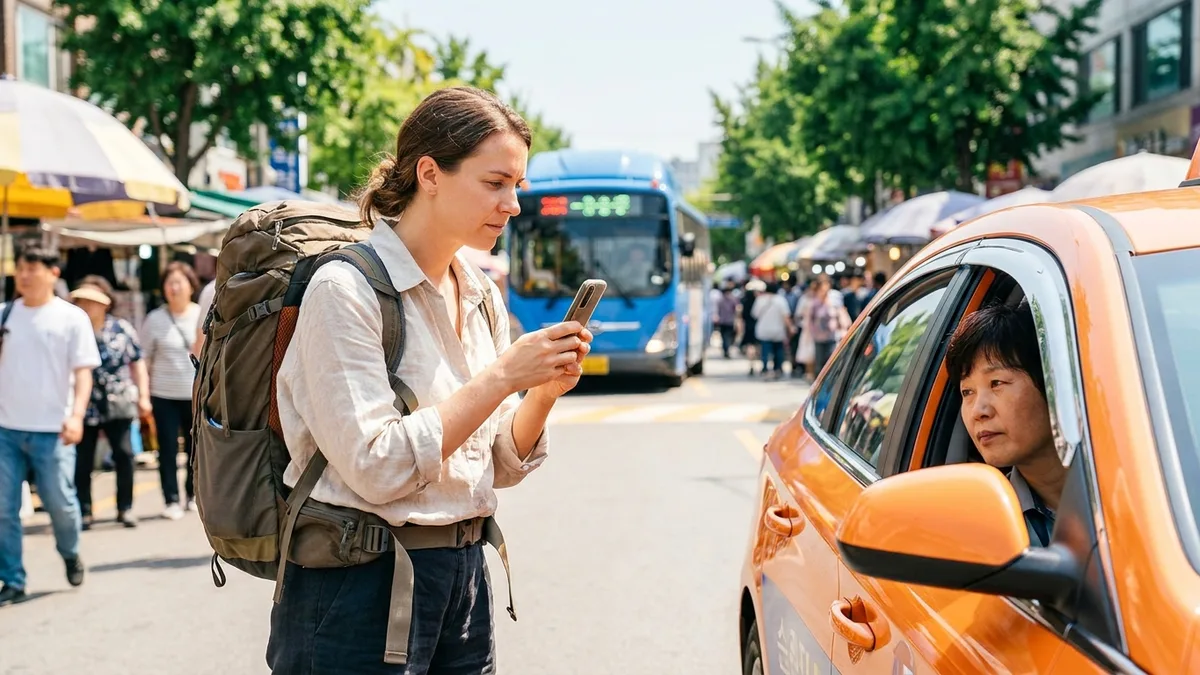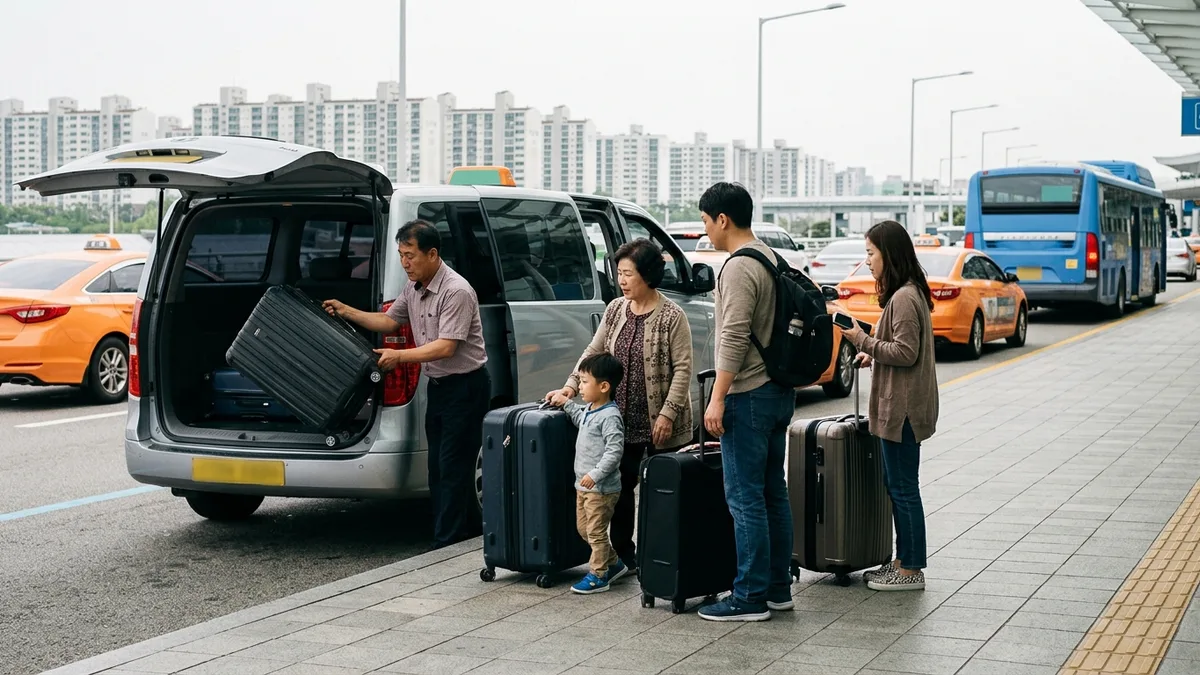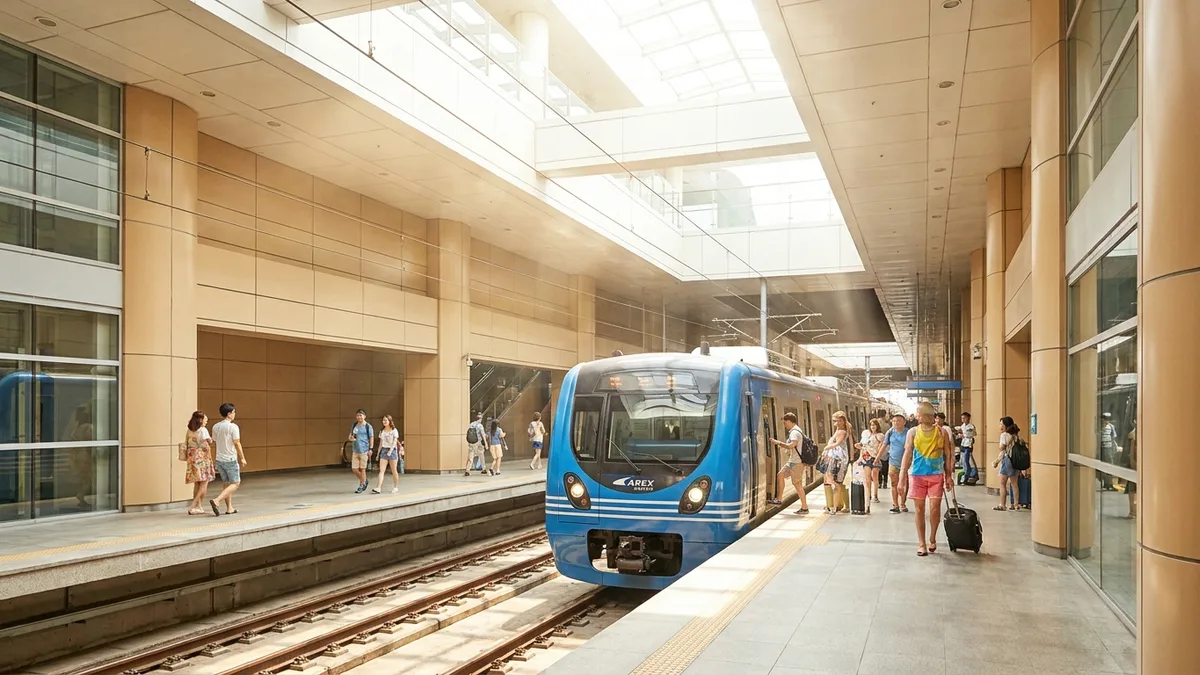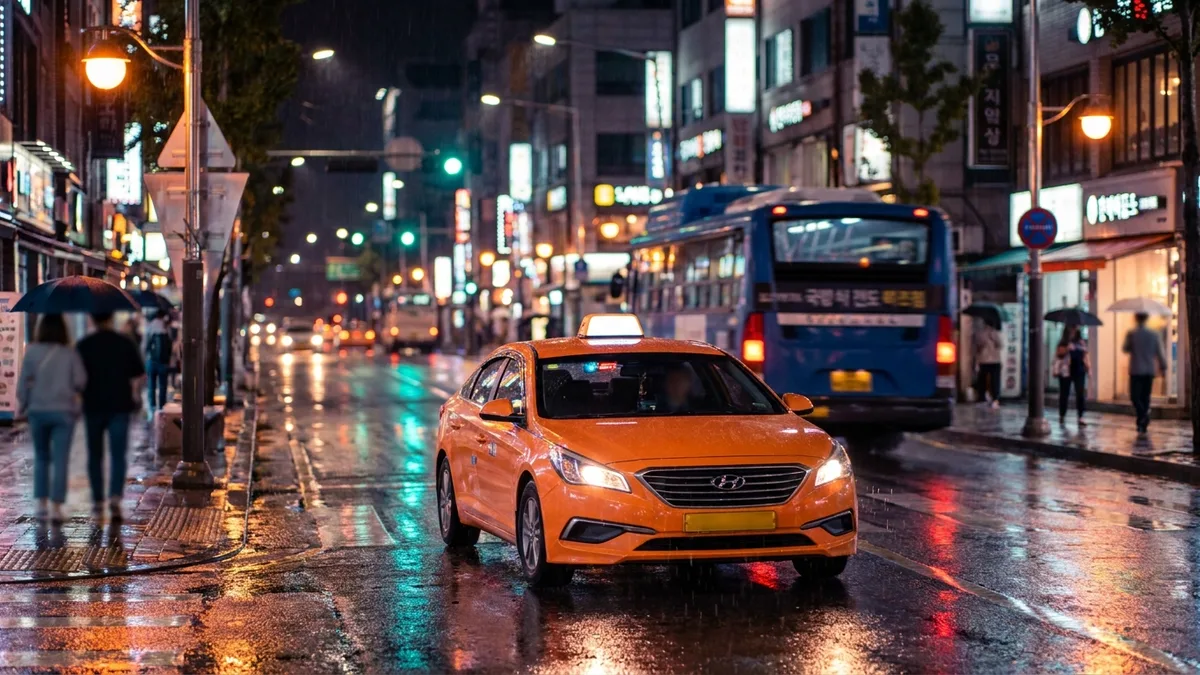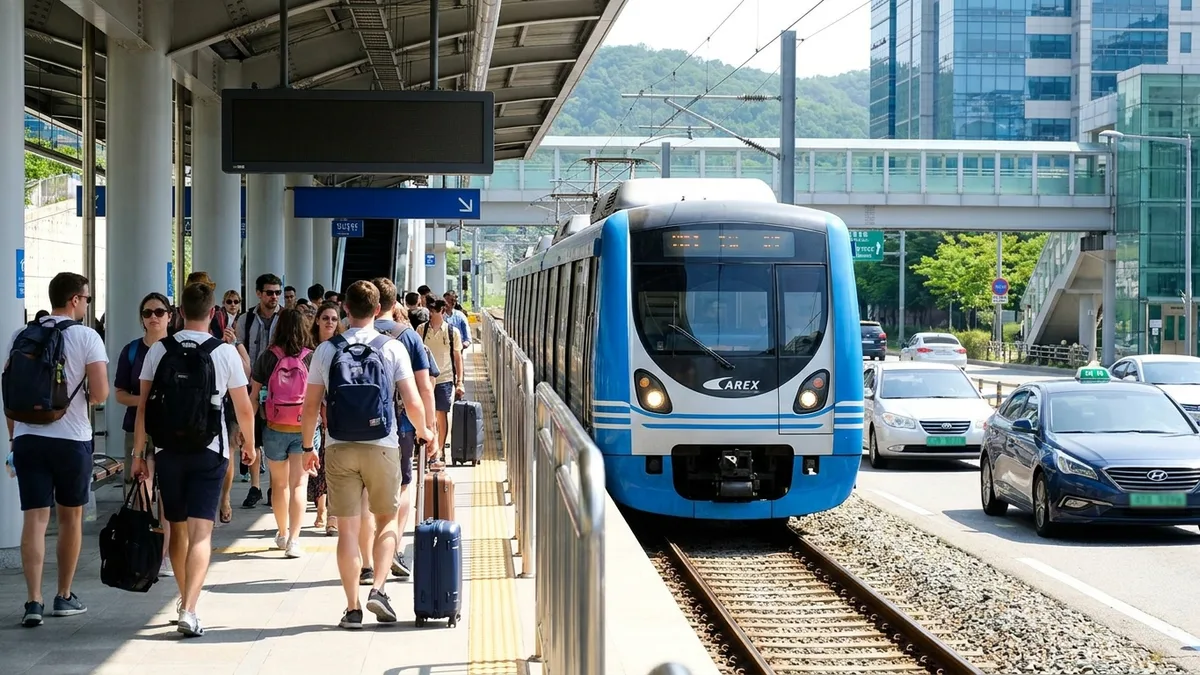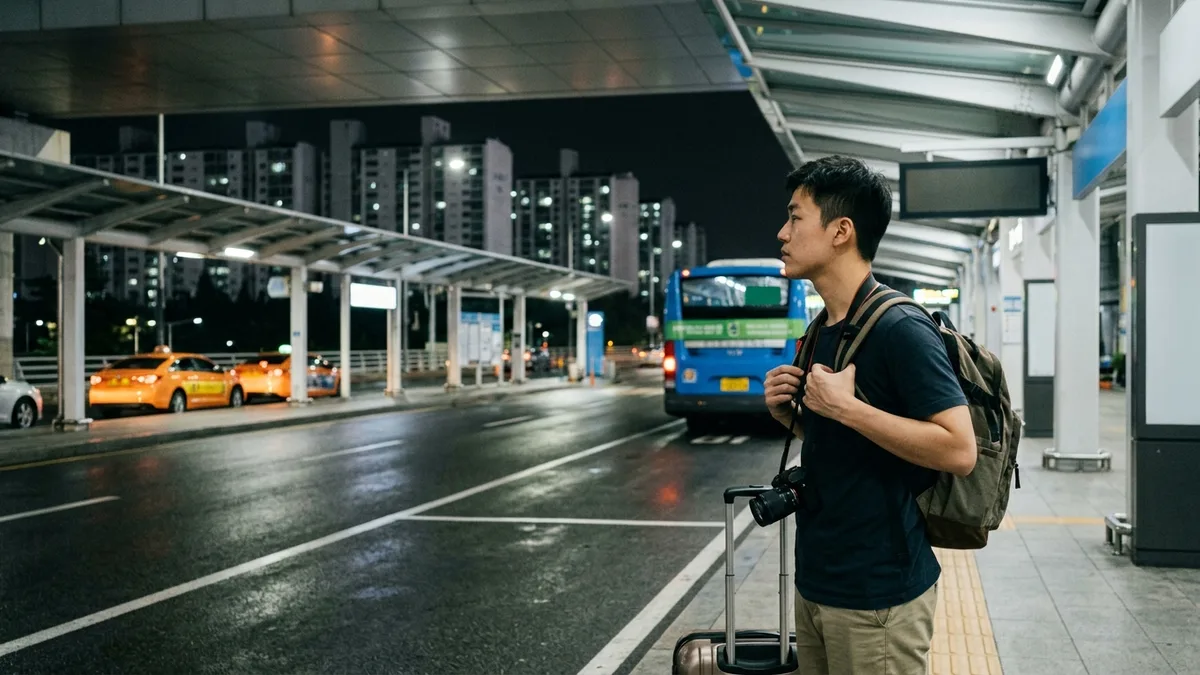
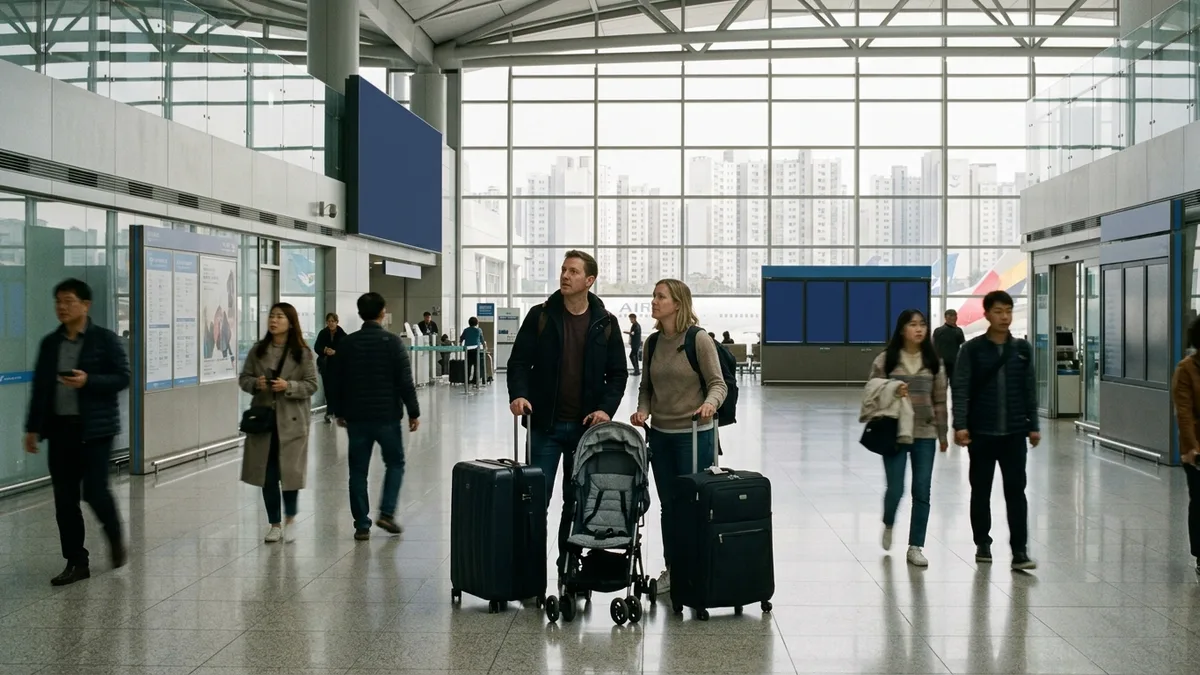
The vehicles people call "call vans" at Incheon Airport are not taxis. Under Article 3-2 of the Enforcement Rule of the Trucking Transport Business Act, they are van-type freight vehicles — legally speaking, cargo trucks. They aren't vehicles for carrying people; they're vehicles for carrying goods, and a person can only ride along as the owner of the cargo, traveling together with their own luggage.
That means the way you verify one is the exact opposite of how you'd verify a taxi. A licensed call van carries a commercial freight vehicle marking on its body, plus the word "화물" (cargo) displayed in four languages — Korean, English, Chinese, and Japanese (Enforcement Rule Article 21, Item 3(c)). Conversely, if it has a taxi fare meter installed, that isn't normal — it's a prohibited act (Trucking Transport Business Act Article 12(1)7).
The official channels are narrower than you'd expect. There are only two Airport Call Van Information Counters: one at Terminal 1, 1F, in the middle between Exits 12 and 13, and one at Terminal 2, 1F, near Exit 7. Both operate 08:00–21:00 (open year-round). If your flight lands after 9 PM, you'll walk out into the arrivals hall at a time when there's no official desk to ask.
And there's no published fare table by destination anywhere. On the official Incheon International Airport Corporation guidance (airport.kr), the call van fare listing — in both Korean and English — says nothing more than "zone fare (tolls not included)." That information gap, the fact that you have no way to compare prices in advance, is exactly the condition that lets overcharging happen. So what the law guarantees isn't a price — it's a procedure: telling you the total before departure is a legal duty.
Note: The locations, operating hours, and fare rules in this article are compiled as of 2026-08 from official Incheon International Airport Corporation guidance (airport.kr) and the texts of the Trucking Transport Business Act, the Passenger Transport Service Act, and the Airport Facilities Act. Pickup point numbers and counter hours can change due to terminal operations, so please re-check the official Incheon International Airport Corporation channels before you travel.
A call van is not a taxi — start with "van-type freight vehicle"
Get this wrong and every judgment that follows goes wrong too. A taxi is passenger transport — carrying people. A call van is freight transport — carrying goods. A freight vehicle carrying people isn't something that's normally allowed; it's an exception permitted only when the conditions set by law are met.
Those conditions are in Article 3-2 of the Enforcement Rule. Paragraph 1 sets the requirement for a cargo owner to ride along at 20 kg or more of cargo per owner, or a volume of 40,000 cubic centimeters or more, and Paragraph 2 limits the eligible vehicles to van-type freight vehicles. 40,000 cubic cm is width × depth × height — so 50 cm × 40 cm × 20 cm comes out to exactly 40,000.
The phrase "passengers carrying 20 kg of cargo per person" in the airport corporation's user guidance is the very same number as that statute. The airport guidance and the statute are separate sources, yet the figures match. What matters, though, is that this isn't a business condition meaning "we'll only serve you if you have over 20 kg" — it's the requirement that makes it legal for a freight vehicle to carry a person at all.
| Category | Call van | Taxi |
|---|---|---|
| Legal status | Van-type freight vehicle (freight transport) | Passenger transport business (passenger transport) |
| Basis for carrying people | Limited to a cargo owner riding with their own cargo (Enforcement Rule Art. 3-2) | Carrying people is the very purpose of the business |
| Fare meter | Installing one is a prohibited act (Act Art. 12(1)7) | Metered fare is the rule |
| How the fare is set | Total quoted before departure (Enforcement Rule Art. 21, Item 22) | Meter, or official flat/zone fares |
| Published fare table | No fare table by destination | Base fares and surcharge rates are publicly posted |
If there's no cargo and only people, the story changes completely. Carrying people for payment without cargo falls under Article 90(1) of the Passenger Transport Service Act, which carries up to 2 years' imprisonment or a criminal fine of up to 20,000,000 KRW. That penalty applies to the party operating that way.
Where an official call van starts — counters, pickup points, and booking channels
There are exactly two official routes: register at the information counter after you arrive, or book in advance by phone or email. There is no online booking form and no dedicated app.
| Category | Terminal 1 (T1) | Terminal 2 (T2) |
|---|---|---|
| Information counter | 1F, center between Exits 12–13 | 1F, near Exit 7 |
| Call van pickup point | 1F, 10C | 1F, 8D |
| Operating hours | 08:00–21:00 (open year-round) | 08:00–21:00 (open year-round) |
| Phone | 032-743-0828 | 032-743-0831 |
| incheonairportcallvan1@gmail.com | incheonairportcallvan2@gmail.com |
One thing jumps out of that table right away. The counter and the pickup point are in different spots. At T1 you register at the counter near Exits 12–13, then move to pickup point 10C; at T2 you register near Exit 7, then head to 8D. Plan ahead for one trip pushing your luggage cart between the two.
Email booking has another lag built in. The guidance says "emails are checked daily at 08:00 (KST), after which the booking process proceeds," so a message sent at night doesn't get opened until the next morning. If your flight lands at 11 PM, writing an email at that moment won't get you an answer that night.
Phone booking isn't an easy option either if you don't have a Korean mobile number. You can call internationally, but it requires an actual conversation, and we could not confirm whether counter or phone staff respond in English, Chinese, or Japanese. All we verified is that an English-language guidance page exists, so don't assume on-site interpretation support is available (unconfirmed).
Per the airport corporation's guidance, the service is intended for groups of five or fewer. We were unable to confirm from primary sources what the legal maximum occupancy of a call van is, so in this article we're only citing the airport's criterion.
Caution: If you arrive after 9 PM, the call van information counter is closed. Anyone who walks up to you in the arrivals area at that hour asking "Need a van?" did not come from the official counter. At that time of night, it's safer to head toward the taxi stands described below.
The key point is that there's no fare table — instead, quoting the total before departure is a legal duty
You'll find call van fares floating around online — "so many tens of thousands of won to Hongdae, so many to Myeongdong." But those numbers come from individual operators' own listings or news reports; they are not an officially published fare table. The Incheon International Airport Corporation page doesn't list amounts by destination either. So we won't list destination-by-destination amounts here either. Memorizing a number with no basis for comparison actually makes it more likely you'll shrug and think, "sounds about right."
What the law does guarantee is clear. When a van-type freight vehicle transports a cargo owner together with their cargo, the driver must inform the cargo owner, verbally or in writing, of the total fare and charges before transport begins (Enforcement Rule Article 21, Item 22). Flip that around and it means:
- Naming the price after you arrive isn't a difference in service style — it's a violation of the rules
- It's not a right to ask before departure; it's a duty to tell you even if you don't ask
- Since tolls are listed as separate, confirm "what's the total including tolls?" in a single sentence
Demanding unfair fares or charges is itself prohibited. Article 12(1)3 of the Trucking Transport Business Act bans it, and a violation carries an administrative fine of up to 5,000,000 KRW (Article 70(2)6). Violations of Items 3 and 7 (taxi-lookalike display) are also grounds for revoking or suspending the freight transport worker's qualification (Article 23(1)8). Note that this 5,000,000 KRW is an administrative fine under the Trucking Transport Business Act — don't confuse it with the touting rules under the Airport Facilities Act discussed later; different law, different provision.
Tip: Write down the total you're quoted before departure right then and there, or put it on a translation app screen and confirm it together. Having the number verified eye to eye leaves you with something to point to if the story changes on arrival. We could not confirm from primary sources whether call vans are obligated to accept card payment or issue receipts (unconfirmed), so it's safest to ask about payment methods along with the total, in advance.
The 3-second licensed-call-van check — the four-language "화물" marking and the meter
This is the most important section of the article. There's exactly one physical test you can use even if you can't read Korean, and that's the four-language "화물" (cargo) marking on the vehicle body.
A licensed commercial call van must display a commercial freight vehicle marking on its body along with the word "화물" in four languages — Korean, English, Chinese, and Japanese (Enforcement Rule Article 21, Item 3(c)). Because the rule is written that way, you can verify it in a language you know even with zero Korean, and the presence of all four languages side by side is itself the signal. Look at the side of the vehicle before you walk up to it.
| What to check | Licensed call van | Warning sign |
|---|---|---|
| Body markings | Commercial freight vehicle marking + "화물" in four languages | No marking, or only one language |
| Fare meter | Not having one is normal | If you see a meter, that's a prohibited act (Act Art. 12(1)7) |
| How contact was made | Registered at the counter, or booked by phone/email | Someone approaches you first in the arrivals area |
| Fare disclosure | Total is given up front, before departure | Price announced after arrival, or haggled on the spot |
| Boarding location | Pickup point T1 10C · T2 8D | Leads you to a parking lot, outside the building, or another floor |
The second row is where people get especially confused. Most taxi advice says "ask them to turn on the meter," and for taxis, that's correct. But a call van is a freight vehicle, so installing a taxi fare meter is itself prohibited as a "taxi-lookalike display." If a vehicle calls itself a call van and points to a meter, that's not a reassuring sign — it's the opposite. Taxi-side tactics are covered separately in How to avoid taxi scams in Korea.
To sum up, the order is: ① Did I register at the counter? → ② Does the body have the four-language "화물" marking? → ③ Was I told the total before departure? If any one of the three is missing, don't get in.
Where and when touts appear — why you end up lost in exactly that stretch
Touts don't work just anywhere. They work where people are looking around, disoriented. And the first floor of Incheon Airport naturally creates such stretches by design.
Take T1: three key points are all in different places. The call van information counter is in the middle between Exits 12–13, the call van pickup point is 10C, and the large taxi stands are 7C and 8C. Where you register, where you board, and where the alternative is are all separated from one another. Those few minutes of pushing a luggage cart while hunting for numbers are precisely the window when someone approaches.
The airport corporation knows this and has posted warnings itself. The call van guidance page states, "Please be careful not to suffer harm from touting outside these areas," and the taxi guidance page puts it even more directly: "Cases of unfair fares collected through illegal touting by call vans posing as taxis occur frequently." It's not common for an operator to write that in its own facility guidance.
It's prohibited by law, too. Article 56(6)3 of the Airport Facilities Act bans unauthorized touting, and Article 12(1)5 of the Trucking Transport Business Act separately bans "parking in one place for a long period to solicit cargo owners." In other words, simply standing around waiting for customers is already outside the rules.
Add the time of day and the conditions are complete. The official counter closes at 21:00, but late-night flights keep arriving. A window opens in which the official channel has vanished and only unofficial approaches remain. If you're landing at that hour, plan your route to the taxi stand from the start — and if you can't find your way, ask an airport information desk, not the person who spoke to you first.
Even with lots of luggage, a call van isn't the only answer — comparing large taxis (9-seaters)
You don't have to jump straight from "I have a lot of luggage" to "call van." There's a legal, metered alternative on the same floor: the large taxi (9-seater).
| Option | Fare system | Pickup point | Good to know |
|---|---|---|---|
| Large taxi (9-seater) | Base fare 7,000 KRW (same as deluxe taxi) · metered | T1 7C·8C / T2 7D | Late-night surcharge 22:00–04:00, 20% (Gyeonggi taxis: 23:00–04:00) |
| Standard mid-size taxi | Base fare 4,800 KRW (same in Seoul, Gyeonggi, Incheon) · metered | Terminal taxi stands | Late-night surcharge 40% from 23:00–02:00; 20% each for 22:00–23:00 and 02:00–04:00 |
| International Taxi | Zone-fare system within Seoul (1644-2255) | T1 4C / T2 3C | Airport-designated foreign-language-support taxi |
| Call van | Zone fare (tolls separate) · total quoted before departure | T1 10C / T2 8D | No official fare table published by destination |
There's one caveat about the large taxi stand numbers. The airport guidance groups "deluxe taxi / large taxi (9-seater)" together and lists them at T1 7C·8C, so it doesn't distinguish which spot is exclusively for large taxis. Check both spots before you commit. The procedure for calling a large taxi and the International Taxi zone flat fares are covered separately in How to call a large taxi or van at Incheon Airport.
If you're worried about the language barrier, there are two airport-designated foreign-language-support taxi services: International Taxi (1644-2255) and Smart Taxi (032-743-2357). The reserved-taxi pickup points are T1 1C·14C and T2 1C·10C. The pickup point numbers look similar to one another, so check the numbers in the table exactly before you move.
There's one fare advantage worth knowing. Incheon Airport sits in a joint taxi business zone that ties together Seoul, Incheon, and four Gyeonggi cities (Bucheon, Gwangmyeong, Gimpo, Goyang). Trips to these six cities carry no out-of-city surcharge. Go beyond them and Seoul/Gyeonggi taxis add 20%, while Incheon taxis add 30%. You can see the late-night surcharge structure in more detail in Korean taxi late-night surcharges explained.
Whether your luggage will actually fit is hard to confirm by numbers in advance. We could not find official material stating baggage capacity limits by taxi type in numerical terms. There's no official conversion rule for how many suitcases means you need a call van, either. The surest approach is to open the trunk in front of the vehicle, see whether everything fits, and then get in.
You can also reduce the luggage itself. Send your bags from the airport to your accommodation and travel light — see Luggage storage and delivery in Korea. To compare all the routes into central Seoul, How to get from Incheon Airport to Seoul and AREX Express vs. All-Stop compared will help.
What you can do beforehand — and what actually happens if it goes wrong
Prevention is simple. Essentially three things.
- Don't get into a vehicle that approached you first — the only official routes are counter registration or advance booking
- Check the four-language "화물" marking on the body — it's the one physical test that doesn't require language skills
- Hear the total including tolls before departure — this isn't a favor you're asking; it's their duty
The problem starts once you're already in the vehicle. This is where setting accurate expectations reduces your losses. Touting inside the airport carries no penalty or administrative fine in itself. Article 56(6)3 of the Airport Facilities Act prohibits it, but the individual administrative fine standards in [Annex Table 3] of the same Act's Enforcement Decree don't include Article 56(6) as an item at all.
What actually operates is a different provision. Article 56(7) of the Airport Facilities Act is the basis for police officers and others to restrain a person or order them to leave, and Article 67-2 sets "a criminal fine of up to 200,000 KRW, detention, or a minor criminal fine (과료)" for failing to comply with such an order. In practice, that means if a situation turns threatening, asking airport police and the information desk for help is a legally grounded response.
Fare-related sanctions fall under the Trucking Transport Business Act we saw earlier. Demanding unfair fares can lead to an administrative fine of up to 5,000,000 KRW (Article 70(2)6) and revocation or suspension of the worker's qualification (Article 23(1)8). But nowhere in that process is there a step where "the money comes back on the spot." Administrative sanctions are aimed at the operator; recovering what you paid is a separate matter.
For foreign visitors, there's one more layer. If you're flying out in a few days, staying involved in an investigation and enforcement process is realistically difficult. We also could not confirm from official sources which body handles complaints specifically about call van overcharging (unconfirmed). That's why the conclusion of this article isn't "report it if it happens to you" — it's "settle everything in the three minutes before you get in."
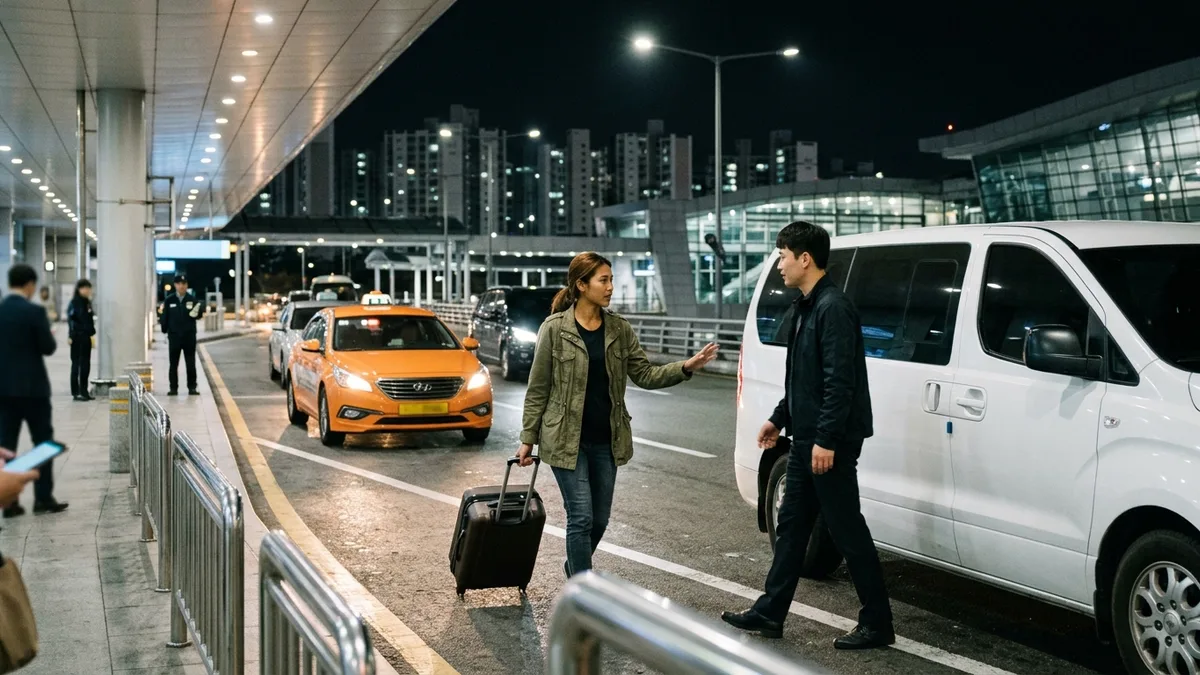
If you land after 21:00, the official call van counter is closed, and email bookings are only processed at 08:00 the next morning. The realistic options left at that hour are metered taxis and the airport railroad — and this is where foreign visitors without a Korean mobile number or a domestic bank account hit another wall. Taxi-hailing apps demand identity verification, or overseas cards get declined at ticket payment. LACHA is a transport-and-payment super app for foreign visitors that works right away with no identity verification. It's designed so that identity verification isn't required in the formal process, so without a Korean bank account or phone number you can hail taxis, ride the airport railroad, use transit cards, and book KTX and express buses all in one app — paying with overseas simple-payment services like Alipay and WeChat Pay, or with an overseas card. If you're traveling with a big group and lots of bags, there's also a 5- or 6-seater VAN hailing option, but that's a separate service from the airport call van booking channels covered in this article, so check the vehicle types and fares directly in the app. You can also call taxis with Kakao T, but it often requires Korean phone number verification.
Want to handle everything from your first ride after landing in one app? Check out LACHA.
Built to work without a Korean phone number or bank account, with overseas payment methods like Alipay, WeChat Pay, and Apple Pay. Taxi hailing plus KTX, express bus, and airport railroad (AREX) booking — all in one app.
Up to 60% off Korea transit with a coupon (max ₩3,000): enter code at sign-up. KTX gets up to 18% off on top
Download now


Frequently Asked Questions (FAQ)
Q1. My call van doesn't have a meter — is that normal? Yes, not having one is normal. A call van isn't a taxi but a van-type freight vehicle, so installing a taxi fare meter is prohibited as a "taxi-lookalike display" (Trucking Transport Business Act Article 12(1)7). So if you do see a meter, that's actually a warning sign. With a call van, you confirm the price not through a meter but through the total quoted before departure (Enforcement Rule Article 21, Item 22).
Q2. How many suitcases do I need before I should take a call van? There's no official standard based on the number of bags. What the law specifies isn't count but weight and volume — with 20 kg or more of cargo per owner, or a volume of 40,000 cubic cm or more, the cargo owner may ride along with their cargo (Enforcement Rule Article 3-2(1)). The Incheon International Airport Corporation guidance likewise says "passengers carrying 20 kg of cargo per person" and "groups of five or fewer." There's no official table converting suitcases into kilograms, so the surest way to know whether your luggage fits is to check at the vehicle itself.
Q3. I'm arriving after 9 PM — can I book a call van? The official channels are closed at that hour. The information counters operate 08:00–21:00 (open year-round), and there's no online booking form or app. Email booking follows the "emails checked daily at 08:00 (KST), after which the booking process proceeds" rule, so a message sent at night is handled the next morning. For a late-night arrival, it's more realistic to plan your route toward the large taxi (9-seater, base fare 7,000 KRW) stands at T1 7C·8C / T2 7D.
Q4. What if they ask for more than the price they first quoted once we arrive? That's a violation of the rules. When a van-type freight vehicle transports a cargo owner together with their cargo, the total fare and charges must be disclosed verbally or in writing before transport begins (Trucking Transport Business Act Enforcement Rule Article 21, Item 22), and demanding unfair fares or charges carries an administrative fine of up to 5,000,000 KRW under the Trucking Transport Business Act (same Act Article 12(1)3 and Article 70(2)6). That said, it isn't a structure that resolves on the spot, so it's far more effective to confirm the total including tolls with each other — in writing or on a screen — before departure.
Q5. Do touts at the airport get punished? Touting itself carries no penalty or administrative fine. Article 56(6)3 of the Airport Facilities Act prohibits unauthorized touting, but the individual administrative fine standards in [Annex Table 3] of the Enforcement Decree don't include that item. The actual sanction is the criminal fine of up to 200,000 KRW, detention, or a minor criminal fine (과료) under Article 67-2, which applies when someone fails to comply with a police officer's restraint or removal order under Article 56(7). Fare issues are handled separately through administrative fines under the Trucking Transport Business Act. Keep your expectations low and finish your checks before you get in — that's far safer.
Note: This article is for general informational purposes. The locations, operating hours, contact details, fare rules, and statutory provisions in the text were verified as of 2026-08 against official Incheon International Airport Corporation guidance (airport.kr) and the Trucking Transport Business Act, the Passenger Transport Service Act, and the Airport Facilities Act. Call van fare tables by destination are not officially published, so no amounts are listed here; whether counters offer foreign-language service, whether call vans are obligated to accept cards and issue receipts, which body handles complaints about unfair fares, and which stand number is exclusively for large taxis (the 7C/8C distinction) could not be verified from primary sources and are marked as unconfirmed. Pickup point numbers and operating hours may change due to terminal circumstances, so please re-check the official Incheon International Airport Corporation channels before use. LACHA does not book or operate airport call vans.