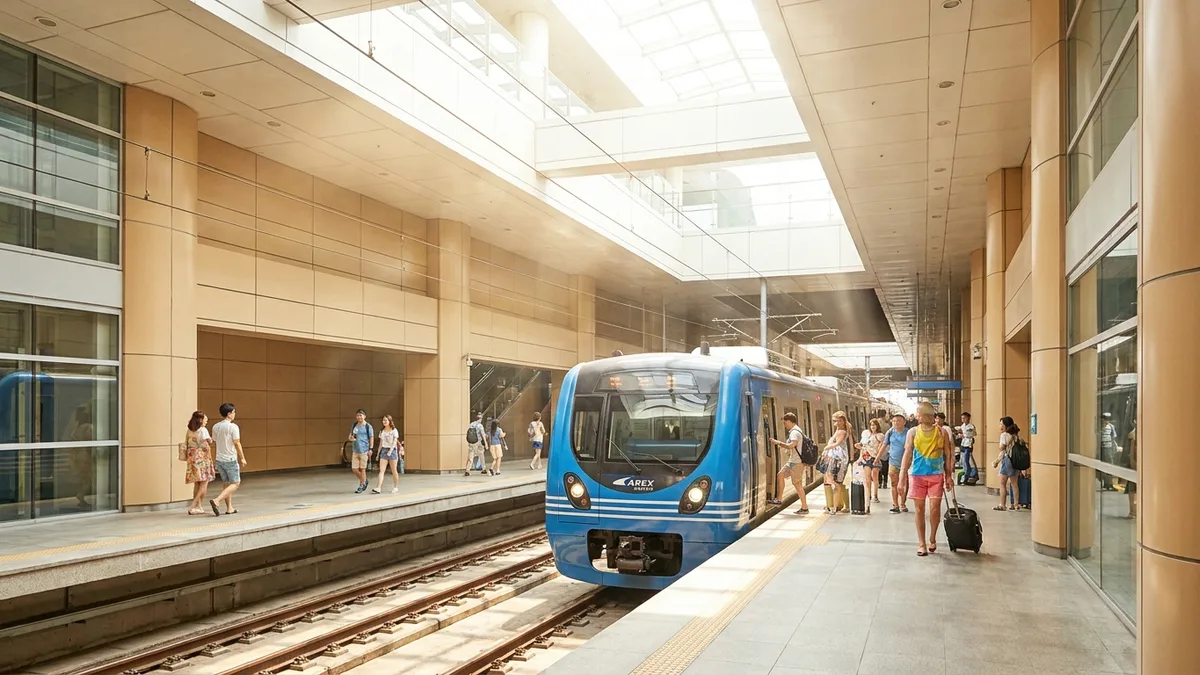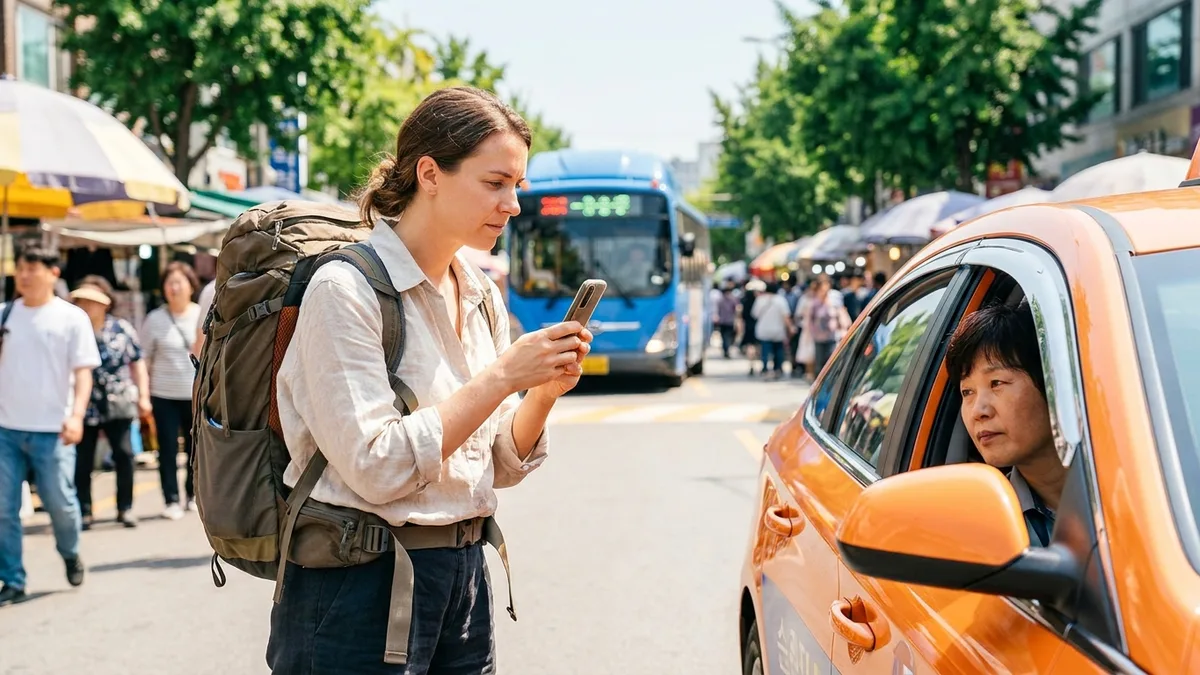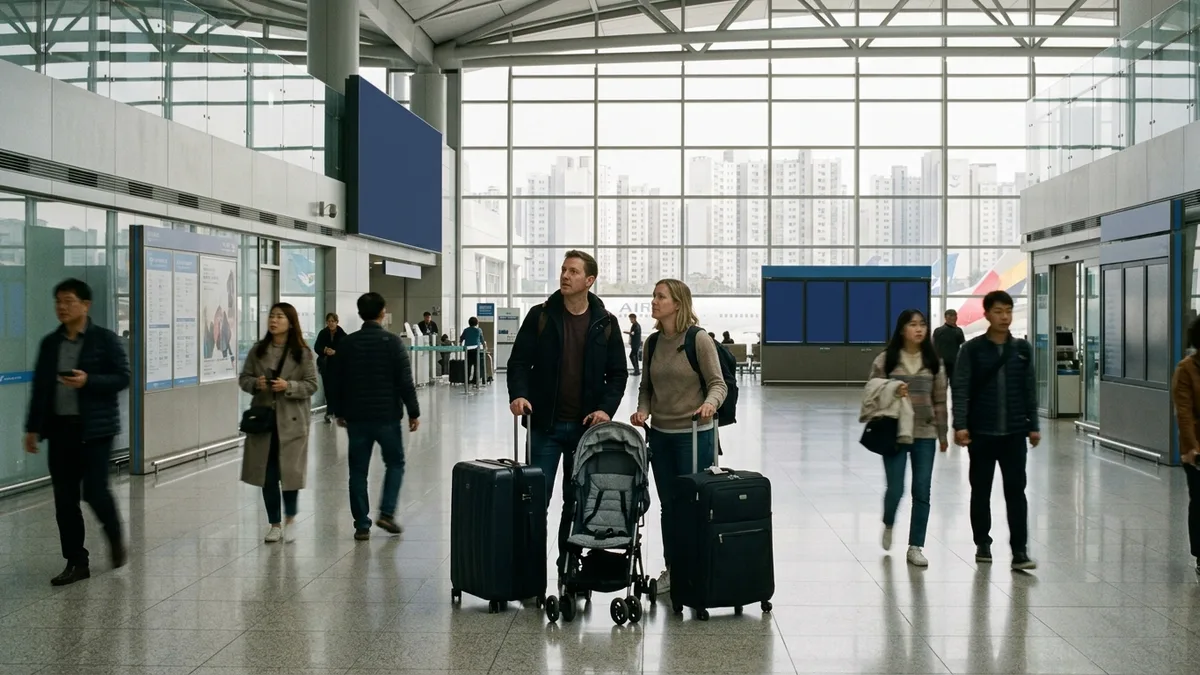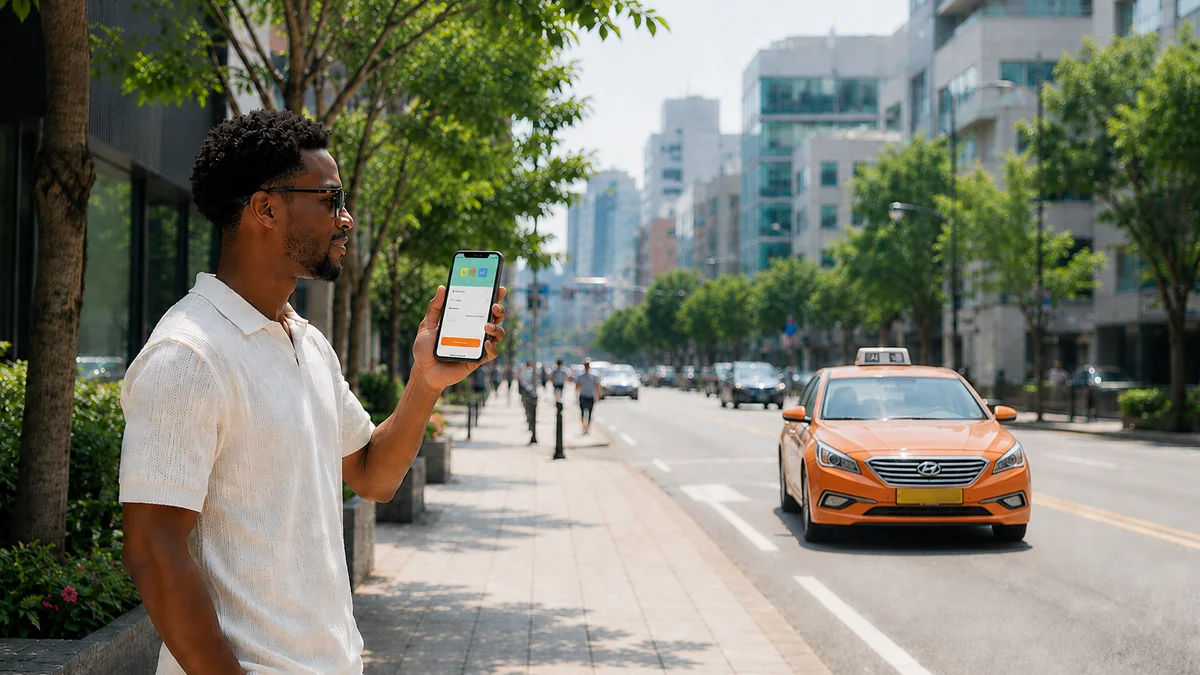
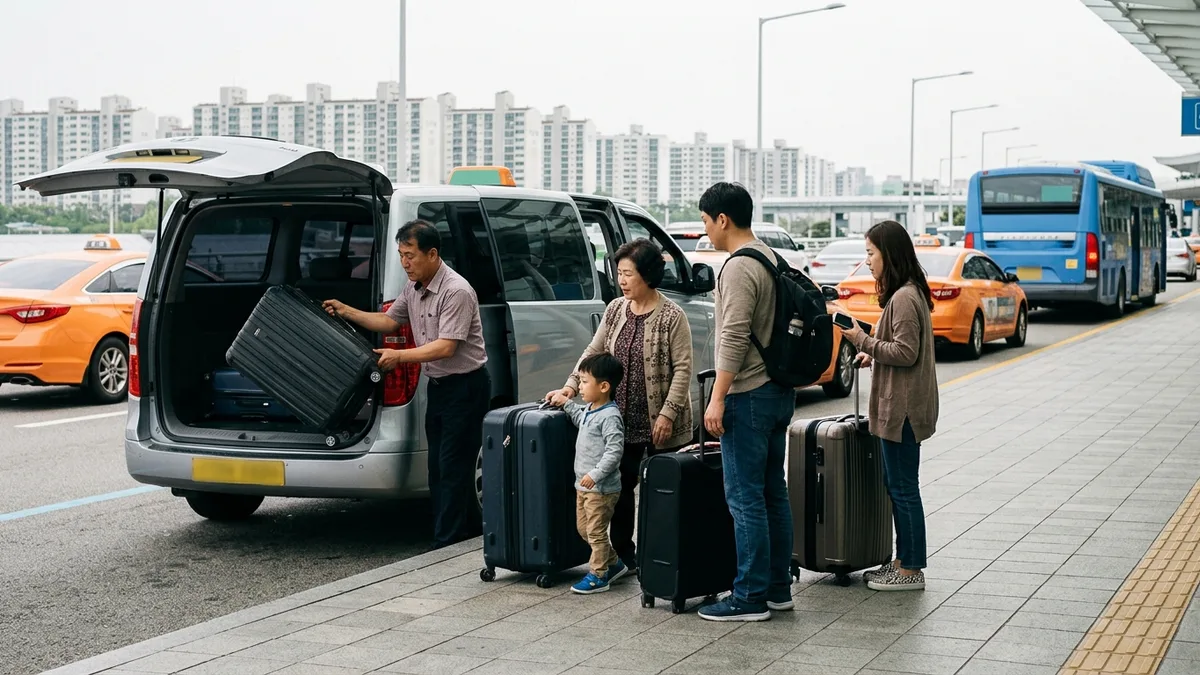
If there are five of you, taking a midsize taxi from Incheon Airport isn't just impractical — it isn't legally an option at all. Article 3, Item 2 of the Enforcement Decree of the Passenger Transport Service Act and Article 9, Paragraph 1 of the same Act's Enforcement Rules define midsize taxis and deluxe (mobeom) taxis as "passenger vehicles with a seating capacity of 5 or fewer," and that capacity includes the driver. So the maximum is four passengers. From five people up, you need a large taxi to travel in one vehicle.
The problem is that large taxis rarely show up in the airport taxi line. According to the real-time waiting data published by Incheon International Airport Corporation, as of 2026-08-25 17:30 at Terminal 1, 102 regular (midsize) taxis were waiting while only 11 large and 12 deluxe taxis were on hand. Terminal 2 showed 131 regular taxis heading toward Seoul against 12 large and 8 deluxe. If you just stand in line, what comes is almost always a midsize.
Fares are set in advance. The fixed fares posted by the Seoul Metropolitan Government for International Taxi (the foreign tourist taxi) on the Incheon International Airport↔Seoul route are divided into five zones by destination district (gu), running from 100,000 KRW to 140,000 KRW for large and deluxe vehicles. Tolls are included in that amount. Even within Seoul, a different zone means a 40% difference — and if you don't know which district your accommodation is in, you have no way to check whether the price you're quoted is normal.
On top of that, there are three more walls that trip up foreign visitors specifically. Kakao T Venti, the large van taxi service, can only be called with a registered auto-payment card, so the standard workaround of "just pay the driver directly" doesn't apply. International Taxi online reservations close at least 24 hours in advance. And if you have lots of luggage and call a "van," what arrives is a freight vehicle, not a passenger car.
Note: The fares, taxi stands, and waiting counts in this article are compiled as of 2026-08 from the Seoul Metropolitan Government's "Seoul Taxi Fares" and "Foreign Tourist Taxi" pages, Incheon International Airport Corporation's "Taxi Information" and "Call Van Information" pages, and official Kakao Mobility materials. The real-time waiting counts are a single snapshot from 2026-08-25 17:30, and fares and operating details can change, so please re-check on each organization's official channels before you set out.
With Five People, a Midsize Is Legally Off the Table — Start With Capacity by Vehicle Class
Korean taxis are divided into classes by law, and each class has a set capacity. Look at this table first and pick your vehicle class — that's how you avoid a wasted trip at the airport.
| Class | Legal standard | Seating capacity (incl. driver) | Passengers you can carry |
|---|---|---|---|
| Midsize | Passenger vehicle, 1,600cc or more | 5 or fewer | Up to 4 |
| Deluxe (mobeom) | Passenger vehicle, 1,900cc or more | 5 or fewer | Up to 4 |
| Large (sedan-type) | Passenger vehicle, 2,000cc or more | 6–10 seats | 5–9 |
| Large (van-type) | Van-type vehicle, 2,000cc or more | 13 seats or fewer | Up to 12 |
| Premium | Passenger vehicle, 2,800cc or more | Varies by vehicle | Varies by vehicle |
Incheon Airport's signage lumps them together as "Deluxe Taxi / Large Taxi (9-seater)," and the 9-seater figure refers to the large taxi. If a large taxi is a 9-seater, that's 8 passengers minus the driver, so a group of 5 to 8 fits in one vehicle. Deluxe taxis have a legal capacity of 5 or fewer, meaning up to 4 passengers.
There's one more trap in the numbers. Legally a midsize can carry 4 people, but the official International Taxi guidance lists Midsize as 3 passengers and 3 bags. That's a service standard separate from the legal capacity. If a family of four rolls up to a midsize with four suitcases, the trunk stops you before the seating does.
Switching to a large vehicle on the spot adds 30,000–45,000 KRW at once, depending on the zone: 30,000 KRW more in Zone A, 35,000 KRW in Zones B and C, 40,000 KRW in Zone D, and 45,000 KRW in Zone E. That's why it's better to settle on a vehicle class before you leave, not at the arrivals hall.
Tip: Count your bags first. Even with four people or fewer, if you have more than four suitcases 20 inches or larger, a midsize is realistically out. If you need somewhere to stash your bags for a bit after landing, see How to Use Luggage Storage and Delivery as well.
Stand in the Airport Taxi Line and No Large Taxi Will Come — The Stands Are Completely Different
Incheon Airport doesn't have just one taxi stand. Each type has its own numbered spot, and it's hard to catch the distinction from the signs alone.
| Type | T1 stand | T2 stand | Waiting count, 2026-08-25 17:30 |
|---|---|---|---|
| Regular (midsize) | 5C·6C·6D | 7C | T1 102 / T2 131 (toward Seoul) |
| Deluxe & large (large listed as 9-seater) | 7C·8C | 7D | T1 12 deluxe / 11 large; T2 8 deluxe / 12 large |
| Foreigner-only | 4C | 3C | Sign up at the desk |
| Pre-booked taxis | 1C·14C | 1C·10C | Booked vehicles only |
| Official call van | 1F 10C | 1F 8D | Sign up at the counter |
Here, "foreigner-only" refers to the stand where the Incheon Airport–Seoul zone fares apply. The airport signage lists two services together: International Taxi (1644-2255) and Smart Taxi (032-743-2357). Of these, the one designated and managed by the Seoul Metropolitan Government is International Taxi (we were not able to verify who designates Smart Taxi or what its fare table is).
One stand number is still ambiguous. The airport's guidance groups "Deluxe Taxi / Large Taxi (9-seater)" together at 7C and 8C, so it isn't clear which one is exclusively for large taxis. We recommend checking both spots, or playing it safe and heading to the foreigner-only desks at 4C (T1) or 3C (T2).
Base fares differ by stand too. Regular (midsize) taxis heading to Seoul start at 4,800 KRW for the first 1.6 km; deluxe and large taxis start at 7,000 KRW for the first 3 km (effective 2023.2.1, Seoul standard). Late at night, deluxe and large go up to 8,400 KRW for the first 3 km.
Caution: In Seoul, deluxe and large taxis also carry the 20% late-night surcharge (22:00–04:00). You'll see claims floating around that "deluxe taxis have no late-night surcharge," but that varies by region. Fare notices are issued at the local government level, so Busan and Seoul differ — and when you're going from Incheon Airport into Seoul, the Seoul rules are what count.
International Taxi Fixed Zone Fares — 100,000–140,000 KRW for Large and Deluxe, Tolls Included
International Taxi is the foreign tourist taxi designated and managed by the Seoul Metropolitan Government, in operation since May 1, 2009. There are three fare systems, and for airport↔Seoul trips, the fixed zone rate is the default.
| Zone | Seoul districts | Midsize | Large & deluxe |
|---|---|---|---|
| A | Gangseo | 70,000 KRW | 100,000 KRW |
| B | Yangcheon, Guro, Yeongdeungpo, Mapo, Eunpyeong, Seodaemun | 75,000 KRW | 110,000 KRW |
| C | Geumcheon, Gwanak, Dongjak, Yongsan, Jung, Jongno | 85,000 KRW | 120,000 KRW |
| D | Seocho, Gangnam, Seongdong, Dongdaemun, Seongbuk, Gangbuk | 90,000 KRW | 130,000 KRW |
| E | Songpa, Gangdong, Gwangjin, Jungnang, Nowon, Dobong | 95,000 KRW | 140,000 KRW |
Let's clear up the most misunderstood item first. The original Seoul city notice states, "Tolls included in the zone fare system" and "Tolls charged separately under the charter fare system." In other words, the amounts in the table above are the final total, tolls included. If you're asked for a separate bridge toll on arrival, confirm right then whether you're on the zone fare system.
The charter (full-day rental) fare system is a separate matter. Midsize runs 70,000 KRW for 3 hours / 110,000 KRW for 5 hours / 160,000 KRW for 8 hours / 190,000 KRW for 10 hours / 240,000 KRW for a full day, and large & deluxe run 90,000 / 130,000 / 180,000 / 210,000 / 260,000 KRW. Charter fares exclude tolls, so they work differently from the fixed zone fares above.
Payment options are fairly broad. They accept cash (KRW), domestic and international credit cards (VISA, AMEX, Mastercard, etc.), and prepaid transit cards, and you can also register the credit card you use at home in the passenger booking app for automatic payment. There are relatively few points where not having a Korean card blocks you.
📌 Important: Whether a late-night surcharge is added on top of the fixed zone fare isn't specified in the Seoul city notice or in the official International Taxi guidance. Don't assume "it's a fixed fare, so there's no surcharge" — confirm the final amount as a number when you book or at the desk.
Which Zone Is My Hotel In? — Myeongdong C, Hongdae B, Gangnam D, Jamsil E
Zones are defined by district (gu), not by neighborhood name. This is exactly where foreign visitors most often get stuck. Your booking confirmation usually just says something like "Myeongdong" or "Hongdae," without mentioning which district that is.
- Myeongdong is in Jung-gu, so it's Zone C. That's 120,000 KRW for large and deluxe.
- Hongdae is in Mapo-gu, so it's Zone B, at 110,000 KRW — 10,000 KRW cheaper than Myeongdong.
- The Gangnam Station area is in Gangnam-gu, so it's Zone D, at 130,000 KRW.
- Jamsil is in Songpa-gu, so it's Zone E, at 140,000 KRW. Compared with Zone A (Gangseo), that's a 40,000 KRW difference — 40% in percentage terms.
So before booking, just find the "○○-gu" part in your accommodation's address. Search for your hotel in a map app, and the second word of the address is the district name. Getting to specific destinations is covered separately in How to Get to Myeongdong, Hongdae, and Gangnam.
One more thing worth knowing. International Taxi's metered fare system includes an institutional "20% foreigner surcharge." That means if you use the metered system for trips within Seoul, a Korean pays the meter as-is for the same distance while a foreign passenger may pay 20% more. For midsize taxis, there's a cap: even with the foreigner surcharge, the late-night surcharge, and the out-of-city surcharge applied all at once, the total surcharge can't exceed 60%.
That leads to a practical conclusion. It works in your favor to use the fixed fare for airport↔Seoul trips and regular taxis for getting around within Seoul. With the fixed zone fare, there's no room for a foreigner surcharge to enter the picture.
Arriving Today? Online Booking Is Closed — The 24-Hour Rule and the Airport Information Desk
Official International Taxi guidance requires online reservations to be made at least 24 hours in advance. A plan to book two hours before landing, from your seat on the plane, simply won't work.
That doesn't mean same-day use is impossible. It's just a different channel.
- More than 24 hours out: Book online via the website or app, then head to the pre-booked taxi stand on arrival (T1 1C·14C / T2 1C·10C).
- Arriving today: Sign up in person at the T1 or T2 information booth and board at the dedicated stand (T1 4C / T2 3C).
- Booking by phone: Call 1644-2255.
The airport information desks are staffed around the clock by 10 attendants speaking English, Japanese, and Chinese. If you don't want to end up wandering the arrivals floor unable to communicate, making that desk your destination is the surest move.
Groups arriving at Gimpo Airport face a different situation. According to official Seoul city information, the International Taxi information desk at Gimpo Airport's international terminal has been suspended since April 2020 due to COVID-19 and is currently not operating. If you land at Gimpo, don't look for a desk — book separately by phone or through the website or app. Getting around Gimpo Airport itself is covered in the Gimpo Airport Transport Guide.
As a related note, we won't list a number for the Gimpo Airport↔Seoul fixed fare in this article. The Seoul city notice's zone fare table only covers "Incheon International Airport ↔ Seoul," with no Gimpo amounts. The International Taxi website says Gimpo is also covered by fixed fares, so you'll need to confirm the amount directly when you book.
Caution: If you walk out into the arrivals hall with no same-day booking, you land straight in tout territory. Incheon International Airport Corporation officially warns that "cases of unfair fare collection through illegal soliciting by call vans posing as taxis occur frequently." Don't follow anyone who approaches you — walk directly to a designated stand or information counter. Case-by-case responses are collected in How to Avoid Taxi Rip-offs.
Kakao T Venti — Without an Auto-Payment Card, You Can't Even Call One
Kakao T Venti is a large van taxi service. It automatically dispatches minivans like the Carnival or Starex (Staria), so it looks like a natural choice for groups with lots of luggage.
The registered Seoul fare is 4,000 KRW for the first 0.8 km, plus 100 KRW per 123 m and 100 KRW per 40 seconds, with time and distance charged fully in parallel. But on top of that comes dynamic pricing of 0.8x to 4.0x. That multiplier alone moves the base fare anywhere between 3,200 KRW and 16,000 KRW. As for whether there's a separate fixed fare for the airport route, the Seoul city notice only says "separate zone and charter fare systems operated" without listing amounts, so the only way to know is to check the price on the booking screen.
The real wall isn't the fare — it's payment. Kakao Mobility's official guidance states flatly that Venti can only be used with an auto-payment card registered to Kakao T. That applies to both immediate calls and time-based charter reservations. The standard workaround foreign visitors rely on in Korean taxi apps — "pay the driver directly in cash or by card" — doesn't exist for Venti.
Which creates this paradox: the person with the most luggage, who needs a large vehicle most, is precisely the one who can't call it. If your overseas-issued card won't register for Kakao T auto-payment, the option disappears on the spot (there's no official figure for registration success rates, so we won't claim one either).
There are two workarounds.
- k.ride: Kakao Mobility's app for foreign visitors. You sign up with just a phone number plus Google/Apple account or email verification, and it supports auto-payment with overseas-issued cards as well as international mobile payment services. It offers Kakao T Blue, Venti, Black, and Deluxe calls, with automatic translation in over 100 languages in the driver chat (600,000 domestic taxi calls as of 2025-03).
- International Taxi: Accepts cash, domestic and international credit cards, and prepaid transit cards, so payment method is never an obstacle. The fixed zone fares covered above apply as-is.
There are some conditions to know. With Venti, canceling more than 3 minutes after a vehicle is assigned incurs a 4,000 KRW cancellation fee. Time-based charter bookings are made in one-hour blocks up to 12 hours, and can be booked from 30 minutes to 2 weeks in advance. Maximum passenger capacity isn't confirmed in official documentation and may vary by vehicle, so check the capacity in the app before you call. How to use Kakao T itself is covered in the Kakao T Guide for Foreign Visitors.
Call a "Van" and a Freight Truck Shows Up — The Call Van's 20 kg Rule and Unregulated Fares
Overseas, a van is the big taxi you take when you have a lot of luggage. Korea is different. A Korean call van isn't a passenger vehicle — it's a freight vehicle under the Trucking Transport Business Act. That difference changes both the fare structure and who's even eligible to ride.
First, fares aren't fixed. According to Seoul city guidance, freight vehicle transport charges fall under a free-pricing system rather than a registered-fare system, so you have to negotiate the fare each time you board. Using an arbitrarily installed meter is itself illegal. It's a structure where seeing a meter running should not put you at ease.
The complaint case published on Seoul's official page is precisely a foreigner-targeted one. On a ride from a Dongdaemun fashion mall to a hotel, the meter started at 4,500 KRW and the charge on arrival was 57,000 KRW. Displaying taxi-like markings such as "van taxi" on the vehicle exterior is also a violation, subject to a 60-day operating suspension for a first offense and fleet reduction for a second.
Second, if you don't have luggage, you actually can't ride. Carrying cargo of 20 kg or more in weight, or 40,000 cm³ or more in volume (roughly 35 cm on each side), per shipper is a legal boarding requirement. Operating with a passenger who isn't carrying cargo is punishable by up to 2 years' imprisonment or a criminal fine of up to 20 million KRW (Passenger Transport Service Act, Article 90). Carrying a passenger whose cargo falls short of the standard brings a 10-day operating suspension for a first offense, 20 days for a second, and 30 days for a third, plus a penalty surcharge (200,000 KRW for a second offense, 300,000 KRW from the third).
Incheon Airport's official call van service likewise states its eligible users flatly as "groups of 5 or fewer, with 20 kg of cargo per person." Hours are 08:00–21:00, open year-round; information counters are at the center of Exits 12–13 on T1 1F and near Exit 7 on T2 1F, and the boarding areas are T1 1F 10C and T2 1F 8D. Inquiries go to T1 032-743-0828 and T2 032-743-0831, and reservation emails are checked daily at 08:00 before processing proceeds. Fares are described only as "zone fares (tolls separate)," with no price table posted. How to identify a legitimate call van by its vehicle markings, plus alternatives after 21:00, are covered separately in How to Tell Official Incheon Airport Call Vans From Touts.
The confusing part is that the same 20 kg and 35 cm figures work in opposite directions on each side. On the taxi side, that size is grounds for refusing a ride; on the call van side, it's a boarding qualification. Foreign visitors hauling large suitcases stand right on that line, and neither set of rules is explained in English at the airport.
Caution: Even if you do use a call van, always go through the airport call van information counter. Incheon International Airport Corporation explicitly warns travelers to watch out for soliciting outside the information counters. Go through the counter and the amount is quoted in advance; follow a tout and you end up in on-the-spot haggling or facing an illegal meter. This fork in the road is exactly where foreign visitors' experiences diverge.
One Large Taxi or Two Midsize? — Doing the Math on a Route With No Out-of-City Surcharge
First, there's one item you can drop from the calculation. Incheon International Airport is part of a joint taxi business zone covering Seoul, Incheon, and Gyeonggi Province (Bucheon, Gwangmyeong, Gimpo, and Goyang), so trips from the airport to any of these six cities carry no out-of-city surcharge. Incheon International Airport Corporation, the Seoul Metropolitan Government, and the Ministry of Government Legislation all state the same thing. Only trips beyond that area add 20% for Seoul and Gyeonggi taxis and 30% for Incheon taxis.
If you don't know this, you'll accept a driver's added 20% as a normal fare. If a metered fare for a trip into Seoul has something labeled "out-of-city surcharge" attached, ask what it's based on.
Now let's run the numbers on International Taxi fixed fares. Comparing five or more people splitting into two midsize taxis versus one large taxi:
- Zone A (Gangseo): Two midsize at 140,000 KRW vs. one large at 100,000 KRW → the large is 40,000 KRW cheaper.
- Zone C (Myeongdong, Jongno, Yongsan, etc.): Two midsize at 170,000 KRW vs. one large at 120,000 KRW → the large is 50,000 KRW cheaper.
- Zone E (Jamsil, Gangdong, etc.): Two midsize at 190,000 KRW vs. one large at 140,000 KRW → the large is 50,000 KRW cheaper.
The conclusion is simple. In every zone, one large taxi is 40,000–50,000 KRW cheaper than two midsize taxis. And when you split into two cars, your arrival times split too. With five or more people, there's not much to think about.
Flip to four people or fewer and the story changes. By our calculation using published fares (estimate), four people heading to Zone C would pay 17,000 KRW × 4 = 68,000 KRW on the limousine bus, versus 120,000 KRW for the large/deluxe fixed fare — meaning the taxi costs 52,000 KRW more. The gap widens with children in the group: two adults plus two elementary schoolers comes to 17,000 × 2 + 12,000 × 2 = 58,000 KRW. That's because the bus is priced per person while the taxi zone fare is priced per vehicle.
So at what group size does the taxi win? Dividing each zone's large-vehicle fixed fare by the 17,000 KRW per-person limousine fare, the crossover comes at 6 people for Zone A, 7 for Zone B, 8 for Zones C and D, and 9 for Zone E (our own calculation). For Zone C's 120,000 KRW, the per-person cost is 24,000 KRW at 5 people, 20,000 KRW at 6, and 15,000 KRW at 8.
| Option | Works for 5 people + 6 bags? | Fare structure | Where foreign visitors get stuck |
|---|---|---|---|
| International Taxi (large/deluxe) | Yes (listed as 9-seater; bag count not officially published — confirm when booking or at the desk) | Fixed fare by zone, tolls included | Online booking closes 24 hours ahead |
| Kakao T Venti | Check capacity in the app | Meter + dynamic pricing 0.8x–4.0x | Auto-payment card only; no direct payment |
| Official airport call van | For groups of 5 or fewer | Free pricing (no zone fare table posted) | 20 kg of cargo per person is a boarding requirement |
| Two midsize taxis | Possible, but pricey | Zone fixed fare ×2 | Cars split up, so arrival times split too |
| Airport limousine bus | Yes (priced per person) | Premium class 17,000–18,000 KRW | Some routes may require buying tickets in advance |
| LACHA | Check capacity in the app | Amount shown in the app | Pays without a Korean number or identity verification |
Limousine buses work differently depending on the operator. Korea Airport Limousine Co. operates its Incheon Airport departures on an advance-ticket basis, stating that you need to buy your ticket at a ticket office or self-service machine before boarding. For route details see the Airport Limousine Bus Guide, and for a full comparison of ways to get from the airport into Seoul see How to Get from Incheon Airport to Seoul.
The bigger your group, the more the sticking point isn't the vehicle class — it's payment. There are plenty of apps for calling a large vehicle, but they trip you up one after another at the point where they demand a Korean phone number or a Korean card. LACHA is a transportation and payment super app for foreign visitors that you can use right away without identity verification. It's designed so that identity verification isn't required in the formal process, so you can get started without a Korean bank account or phone number, and you can pay with international mobile payment services like Alipay and WeChat Pay or with an overseas card. It handles taxi calls, 5- and 6-seater vans, KTX, express buses, the Airport Railroad, and transit cards in one app, so you can put your airport-to-hotel ride and your next intercity trip on the same payment method. That said, please check the capacity in the app before calling to make sure the vehicle fits your group size. It does not handle call van or International Taxi reservations on your behalf.
Want to get a taxi without a Korean phone number? Check out LACHA.
Built to work without a Korean phone number or bank account, with overseas payment methods like Alipay, WeChat Pay, and Apple Pay. Taxi hailing plus KTX, express bus, and airport railroad (AREX) booking — all in one app.
Up to 60% off Korea transit with a coupon (max ₩3,000): enter code at sign-up. KTX gets up to 18% off on top
Download now


Frequently Asked Questions (FAQ)
Q1. There are five of us — can't we just stand in the taxi line? Stand in line and what comes is almost always a midsize. Midsize and deluxe taxis have a legal seating capacity of 5 or fewer (including the driver), so the maximum is four passengers. On top of that, Incheon Airport's real-time waiting data (2026-08-25 17:30) showed T1 with 102 regular taxis against just 11 large and 12 deluxe. If you need a large vehicle, you have to change stands — deluxe and large are at T1 7C·8C / T2 7D, foreigner-only is at T1 4C / T2 3C, and pre-booked vehicles are at T1 1C·14C / T2 1C·10C.
Q2. Do I have to pay a 20% out-of-city surcharge going from Incheon Airport to Seoul? No. Incheon International Airport is part of a joint taxi business zone with Seoul, Incheon, Bucheon, Gwangmyeong, Gimpo, and Goyang, so no out-of-city surcharge applies for trips to those six cities. Incheon International Airport Corporation, the Seoul Metropolitan Government, and the Ministry of Government Legislation all state the same thing. Only trips beyond that area add 20% for Seoul and Gyeonggi taxis and 30% for Incheon taxis. That said, Seoul's 20% late-night surcharge (22:00–04:00) is a separate item.
Q3. I'm arriving today and couldn't book an International Taxi. Online booking closes at least 24 hours ahead, so you can't secure one on the day. Instead, sign up in person at the T1 or T2 information booth and board at the dedicated stand (T1 4C / T2 3C). Ten attendants speaking English, Japanese, and Chinese are on duty around the clock. The phone number is 1644-2255, and payment works with cash (KRW), credit cards (VISA, AMEX, Mastercard, etc.), and prepaid transit cards. At Gimpo Airport, the international terminal information desk has been out of operation since April 2020, so you'll need to book separately by phone or through the website or app.
Q4. If my overseas card won't register with Kakao T, how do I call a large vehicle? Kakao T Venti can only be used with an auto-payment card registered to Kakao T, so the workaround of paying the driver directly doesn't apply. There are two alternatives. One is k.ride, the app for foreign visitors, which supports auto-payment with overseas-issued cards and international mobile payment services, and offers Venti, Blue, Black, and Deluxe calls. The other is International Taxi, which accepts any payment method. Situations where you can't get a call through at all are covered in Calling a Taxi in Korea Without a Korean Phone.
Q5. I have a lot of luggage — should I just call a "van"? A Korean call van isn't a big taxi; it's a freight vehicle under the Trucking Transport Business Act. Fares fall under a free-pricing system, so you have to negotiate each time you ride, and using an arbitrary meter is illegal. In fact, if you don't have luggage, you can't ride at all — carrying 20 kg or more, or 40,000 cm³ or more in volume (roughly 35 cm per side), per shipper is a legal requirement, and carrying a passenger without cargo is punishable by up to 2 years' imprisonment or a criminal fine of up to 20 million KRW (Passenger Transport Service Act, Article 90). If you do use one, always go through the airport call van information counter (center of Exits 12–13 on T1 1F / near Exit 7 on T2 1F).
Note: This article is intended for general informational purposes. The fares, taxi stands, operating hours, and legal provisions in the text are values verified as of 2026-08 from the Seoul Metropolitan Government's "Seoul Taxi Fares," "Foreign Tourist Taxi," and "Call Van" pages, Incheon International Airport Corporation's "Taxi Information" and "Call Van Information" pages, the Ministry of Government Legislation's Easy-to-Find Practical Law information, and official Kakao Mobility materials. The real-time taxi waiting counts are a snapshot from a single moment, 2026-08-25 17:30, and vary by time of day. The stand number reserved for large taxis (the 7C vs. 8C distinction), whether a late-night surcharge is added to the fixed zone fare, the passenger capacity and bag count for International Taxi large/deluxe vehicles, Kakao T Venti's maximum passenger capacity, the zone fare amounts for Incheon Airport's official call vans, and the Gimpo Airport↔Seoul fixed fare could not be verified in official sources, so no figures for them appear in this article. Fares and operating practices are subject to change, so please re-check with each organization's official channels before you travel. LACHA does not handle call vans or rental cars, and does not make International Taxi reservations on your behalf.