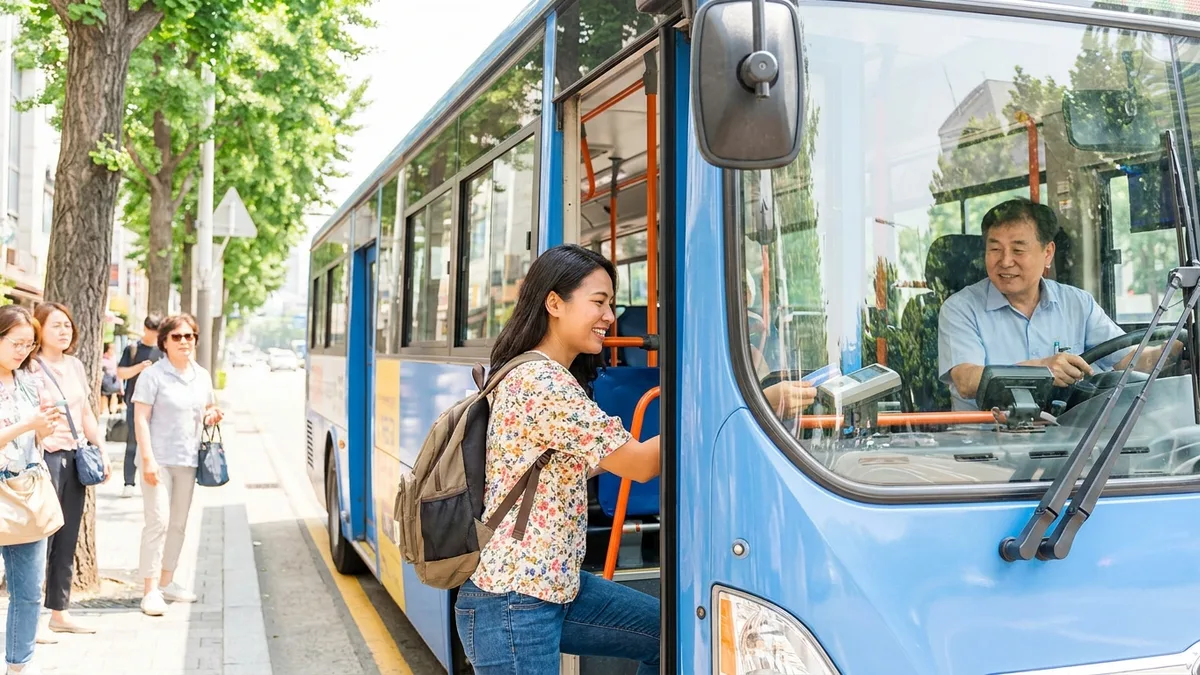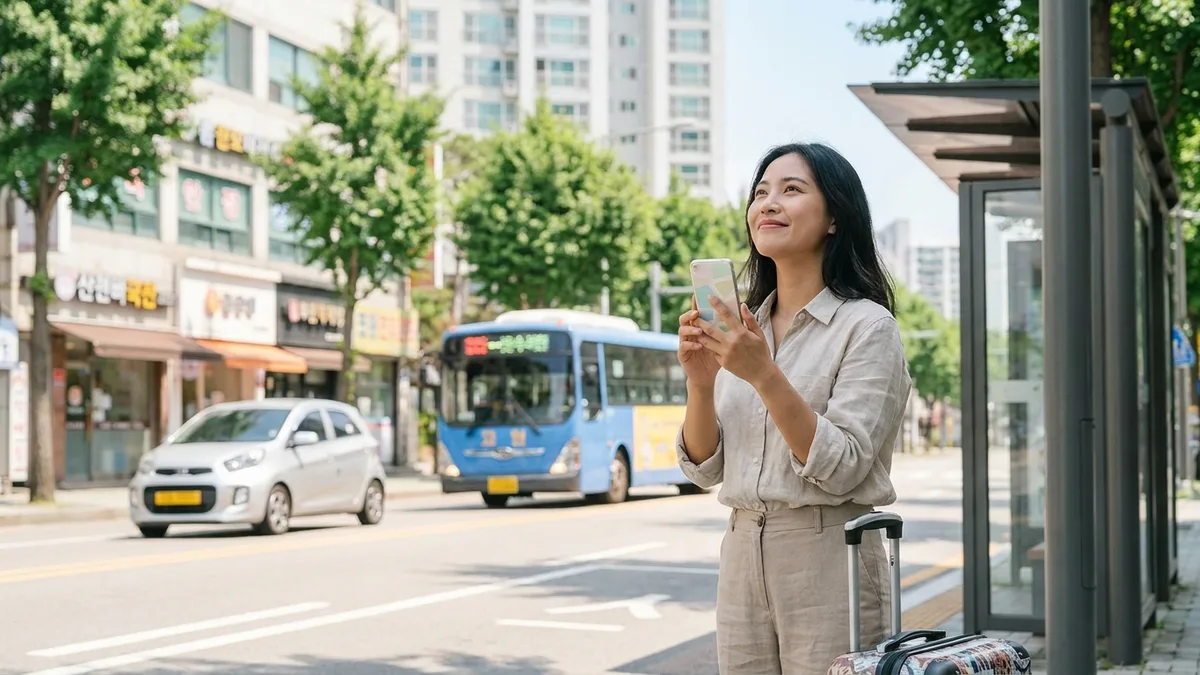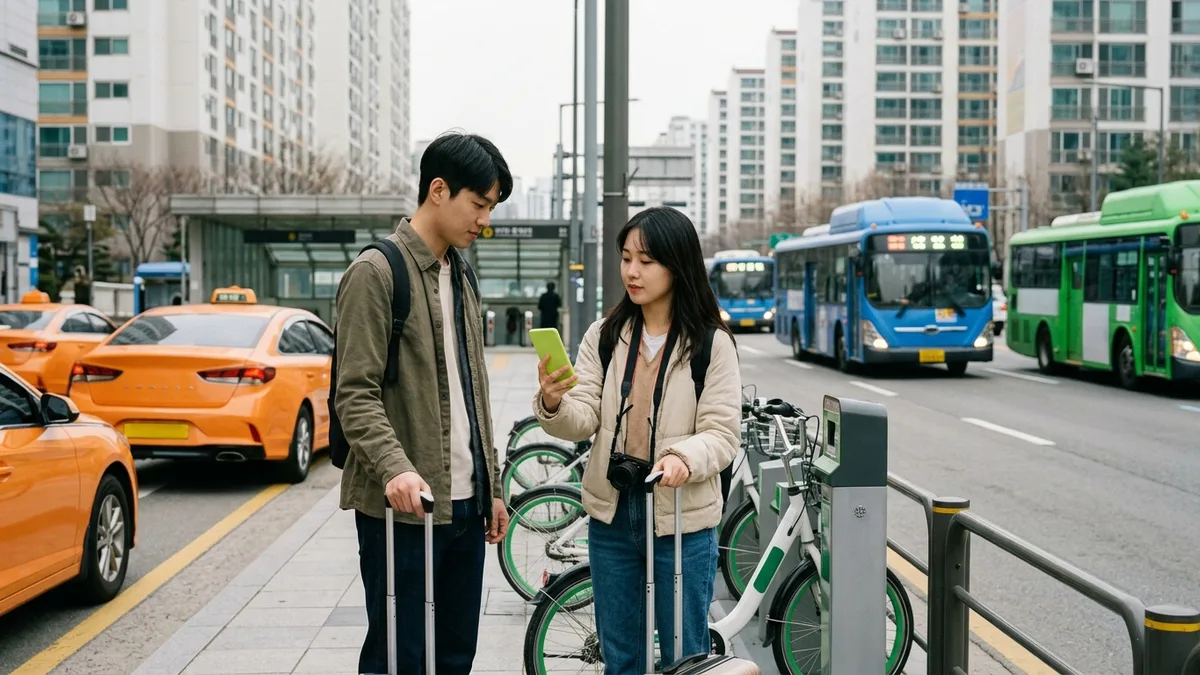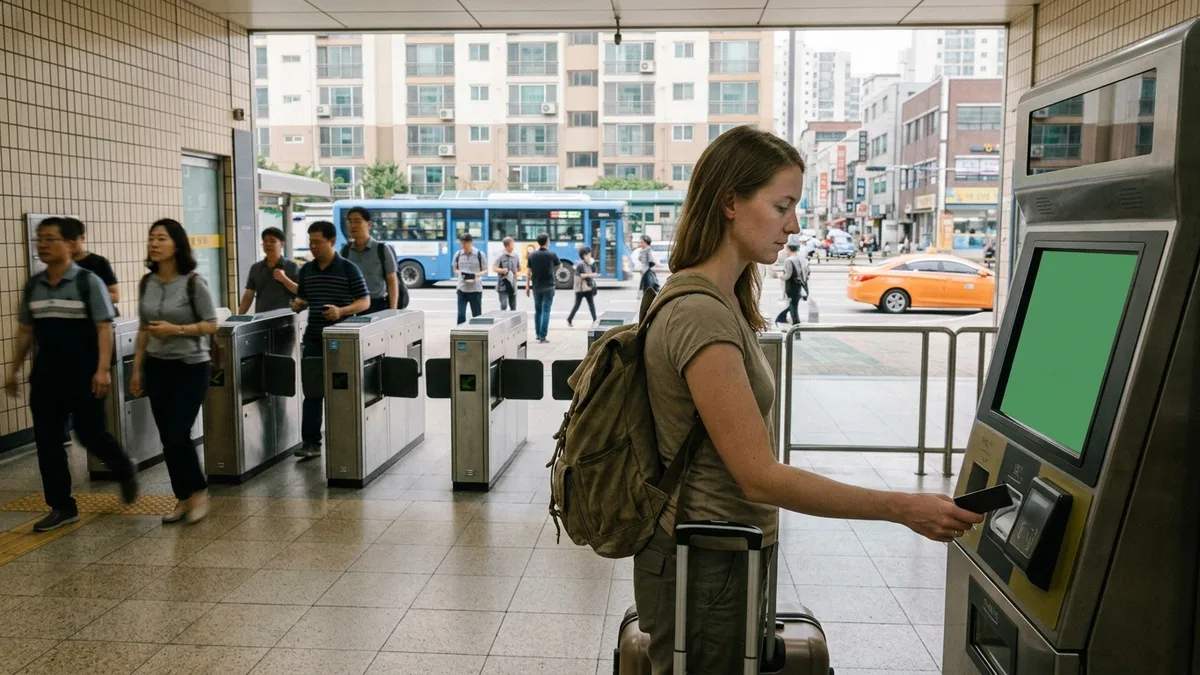
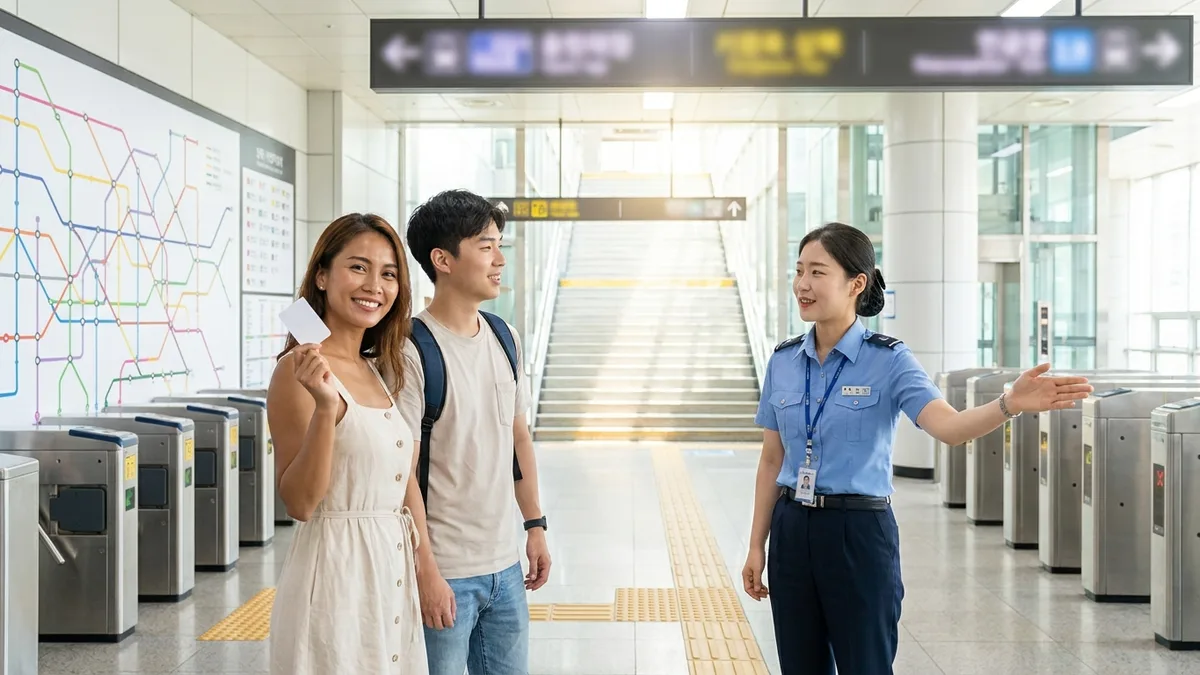
Standing in front of a subway gate with your suitcase, not knowing where to tap your card or which platform leads to your destination — these are the most common stumbling blocks for first-time Seoul subway riders. You see over 20 lines tangled on the route map, you're not sure where to buy tickets, which corridor to take for transfers, or why there are so many exit numbers. Many people wander around the station for a while and end up boarding a train going the wrong direction.
This guide is written for complete beginners who've never ridden the Seoul subway. We'll walk through everything from reading line numbers to first and last trains, step by step. For advanced topics like transfer discount calculations or comparing three types of transit cards, we'll link to separate articles.
The fares and policies below are based on publicly available information as of 2026-08. Since fares and policies can change, please verify through official channels like Seoul Metro (www.seoulmetro.co.kr) before your actual trip.
Prepare These 3 Things Before Heading to the Station
To avoid standing confused in front of the station, just have these three things ready before you leave.
| What to Prepare | What to Check |
|---|---|
| Map App | Install Naver Map and search your destination in advance to check which line, which direction, and which exit number |
| Payment Method | Korean won cash or transit card. You can't pay cash directly at the gates |
| Station Name/Number Memo | If pronunciation is difficult, write down the numeric code (e.g., Gangnam Station = 222). Just showing this on your screen to staff works |
If it's your first ride today, here's the sequence: ① Search route on map app → ② Prepare KRW cash/card → ③ Buy single-journey ticket or charge transit card → ④ Tag at gate → ⑤ Check direction at platform → ⑥ Tag when exiting and find exit number. The sections below explain each of these six steps in detail.
How to Read Lines — Colors, Station Numbers, Directions, and Express Train Alerts
Seoul's subway is broadly divided into numbered lines (Lines 1-9) and named lines (Airport Railroad, Sinbundang Line, Gyeongui-Jungang Line, Suin-Bundang Line, etc.). Each line has a unique color, and all signs and floor guides in stations use this color scheme. For example, Line 2 is green, Line 4 is blue, and Line 9 is gold. Just remember "which line, what color" and you can follow the colors inside the station.
Here are three useful points when reading route maps:
- Station numbers: Every station has a numeric code. For example, Gangnam Station is 222 — the first 2 means Line 2, and the rest is the station sequence. When pronunciation is difficult, finding by number is much faster.
- Directions shown by terminal names: Train directions aren't labeled "upline/downline" but by the terminal or major station name in that direction. The most reliable method is to match the "toward ○○" shown in your map app's route results with what appears on the platform electronic board. However, Line 2 is a loop line, so instead of terminals it shows "inner loop/outer loop" — in this case, check if the next station name on the board matches your intended direction. Before descending to the platform, just cross-check the next station name once on the wall route map to dramatically reduce wrong-direction boarding.
- Express train alert: Some lines like Line 9 and the Airport Railroad run express trains that only stop at certain stations. Route maps and train fronts will be marked "Express," so check first whether your destination is an express stop.
English, Chinese, and Japanese labels are displayed at almost all stations, and major stations have multilingual announcements.
Fare Structure (As of 2026-08)
Seoul subway fares use a base fare + distance-based additional fare structure. On June 28, 2025, the base fare increased from 1,400 KRW to 1,550 KRW, and as of 2026-08, this fare remains in effect.
| Category | Fare (Adult, Transit Card) | Notes |
|---|---|---|
| Base fare | 1,550 KRW | Up to 10km distance |
| Distance surcharge (10-50km) | 100 KRW per 5km | Automatically calculated and settled when you tag out |
| Distance surcharge (over 50km) | 100 KRW per 8km | When traveling to outer metro areas |
The rate schedule alone doesn't give you a clear picture. In practical terms, most trips within Seoul proper cost between the base fare and 2,000 KRW, and trips out to Gyeonggi Province suburbs can exceed 2,000 KRW (as of 2026-08, varies by section, official confirmation needed). To know exactly how much your route costs, Naver Map shows the fare along with route search results, so check it before departure to budget your daily transportation costs.
There are discounted fares for children ages 6-12 and teenagers, but you need to buy a dedicated transit card and register the age at a convenience store or station office for the discount to apply. Without registration, adult fares will be charged. When registering, bring an ID document like the child's passport that shows date of birth. If the convenience store can't process it, try the station office (Customer Service Center) window. However, eligibility and required documents for foreign children may vary by point of sale, so confirming in advance with the T-money Customer Center at ☎1644-0088 is the surest approach (as of 2026-08, official confirmation needed).
Some lines like Sinbundang Line, GTX, and Airport Railroad express trains charge separate additional fares (official confirmation needed). Especially if you're taking your first subway from the airport, the Airport Railroad has completely different fares and ticketing systems for express vs. all-stop trains. For this, it's faster to read AREX Express vs All-Stop and 4 Ways from Incheon Airport to Seoul first.
What You Need to Ride — Cash, and Transit Card or Single-Journey Ticket
Step 0 — Get Korean Won Cash First
This is surprisingly where most people get stuck. Buying a single-journey ticket at the unmanned ticket machines, or purchasing and recharging transit cards at convenience stores or station vending machines, all fundamentally require Korean won cash. If you've just arrived at the airport with zero won in your wallet, you can't even get started.
- If you don't have cash, withdraw from an airport/station ATM with your foreign-issued card or visit a currency exchange first. For procedures and fees, see Withdrawing Cash from ATMs with Foreign Cards.
- There are some locations where you can recharge transit cards with foreign-issued cards, but availability and fees vary by vendor (as of 2026-08, official confirmation needed). For details, see Recharging Transit Cards with Foreign Cards.
- For your first day, having about 20,000-30,000 KRW cash on hand means you won't get blocked whether you choose to buy a card, recharge, or get single-journey tickets.
Transit Cards (Recommended if Staying Multiple Days)
Seoul's subway is fundamentally designed for prepaid transit cards like T-money. Buy a card at a convenience store or station vending machine, recharge with cash, and you can use it right away. Bus-subway transfer discounts only apply when using transit cards.
One thing to know upfront: besides the balance you load, there's a card purchase fee, and this isn't a deposit — you won't get it back later. The card price varies by vendor and design, typically a few thousand KRW (varies by convenience store/station vending machine, as of 2026-08, official confirmation needed). For card pricing, recharging, and refund procedures, see T-money Complete Guide: Purchase, Recharge, Refund, and for buying and recharging at convenience stores, see Korea Convenience Store Complete Guide.
Besides T-money, there are options like WOWPASS and Seoul's unlimited Climate Card. To see which card fits your travel pattern, check out our 3-Way Transit Card Comparison.
Single-Journey Tickets (Single-Use Transit Cards)
When you don't have a transit card, you can buy single-journey tickets at unmanned ticket machines inside stations. The system is a bit unique:
- At the machine, select language (English supported) and choose your destination station.
- Insert the fare + 500 KRW deposit shown on screen, and you'll receive a card-type ticket.
- After arriving at your destination and exiting through the gate, insert the card into the Deposit Refund Device to get your 500 KRW back.
Deposit refund machines are located outside the gates. If you walk away with the card, you're essentially throwing away 500 KRW, so be sure to get your refund.
If you chose the wrong destination: If you traveled farther than your designated station, the exit gate won't open. In this case, pay the difference at a Fare Adjustment Machine or station office (not the refund machine), then get your 500 KRW deposit back at the refund machine afterward. Going the opposite direction — getting off before your designated station — you can just exit normally. Machine names and locations may vary by station, so if you can't find them, asking station staff is fastest (official confirmation needed).
Which Option is Better?
| Comparison | Transit Card | Single-Journey Ticket |
|---|---|---|
| Single ride (base) | 1,550 KRW | 1,650 KRW |
| Card cost | Separate, non-refundable | None |
| Deposit | None | 500 KRW (fully refunded when exiting) |
| Transfer discount with buses | Yes | No |
| 15-minute re-entry | Yes | No |
| Destination designation | Not needed | Must designate each time |
Let's break down the numbers: the 100 KRW per-ride savings means you'd need dozens of rides just to break even on the card cost. So the real advantage of transit cards isn't the 100 KRW discount but rather the transfer discounts, bus compatibility, and not having to designate a destination every time. The decision becomes simple: if you're staying 3 days or less and only taking subway, single-journey tickets work; if staying longer or transferring to buses, get a transit card (as of 2026-08).
From Gate Tagging to Transfers and Re-Entry
Passing Through Gates
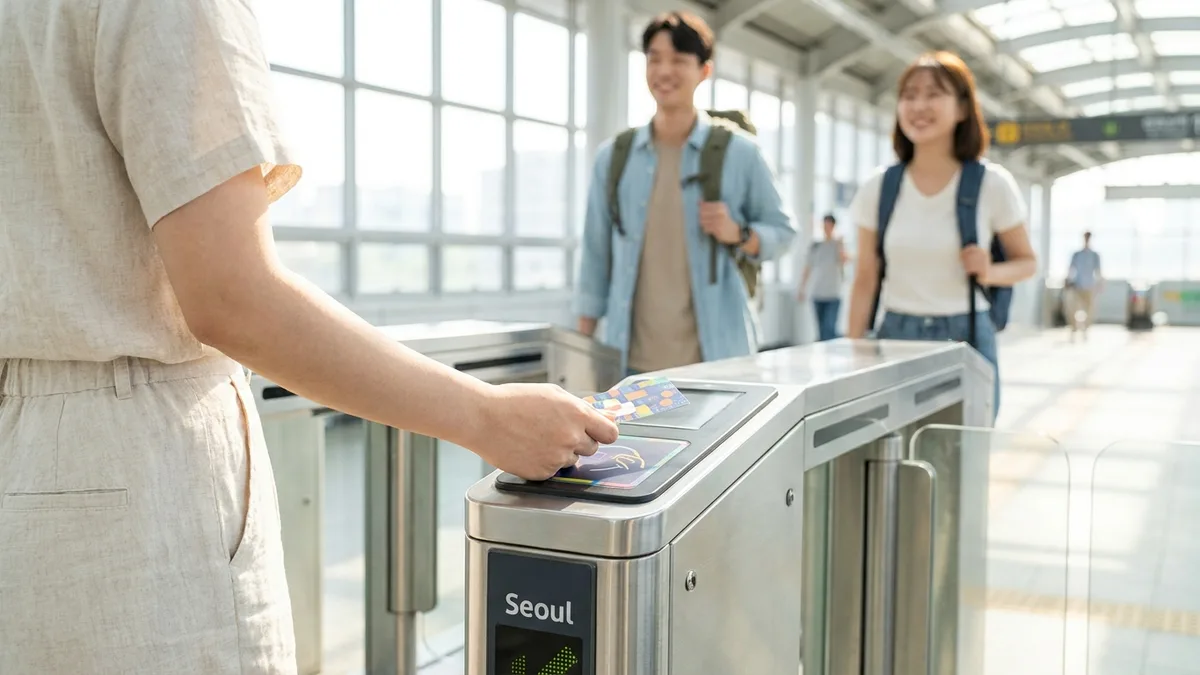
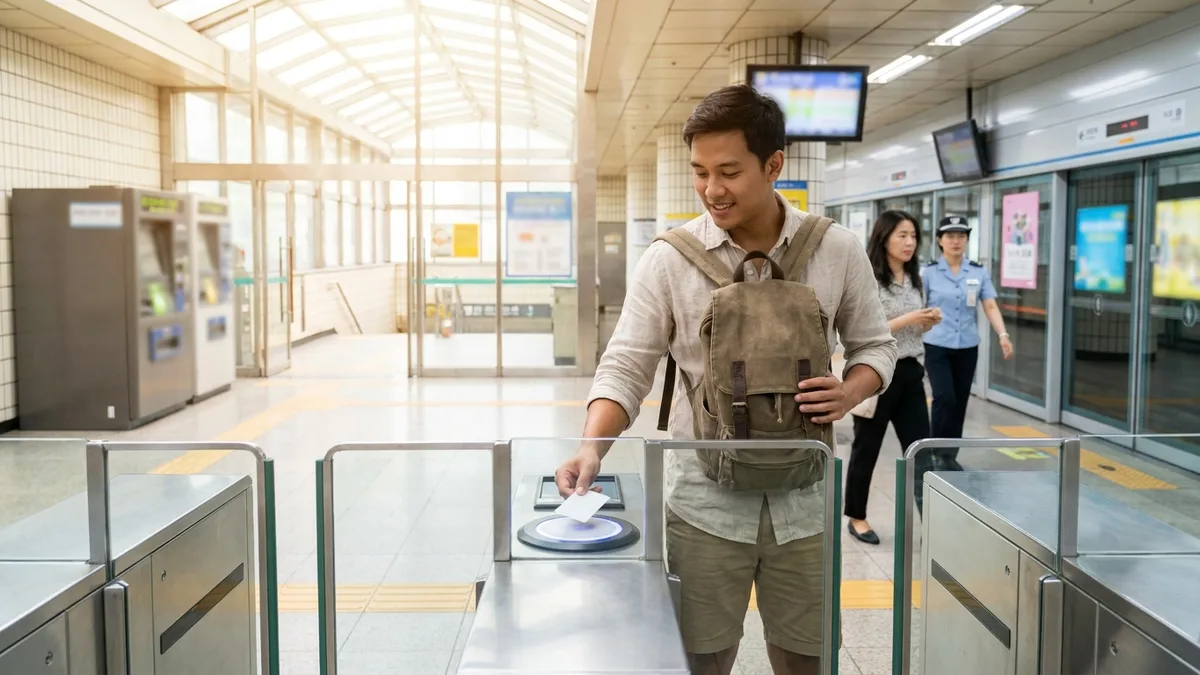
Hold your card for 1 second against the pad with a card icon on top of the gate terminal. You'll hear a beep and the gate opens. Tag once when entering, and you must tag once again when exiting. If you don't tag out, distance fare calculation won't work and you might be charged extra fees or lose transfer discounts on your next ride.
When the Gate Won't Open
This is the most common first-timer situation. Don't worry about people behind you — just step aside and try these in order:
- Insufficient balance: The terminal screen shows your balance, so check it. Recharge at the machine next to the gate, then tag again.
- Card reading error: Tapping your whole wallet can cause interference with other cards. Take out just the card and hold it flat against the pad.
- Still doesn't work: Head to the station office (Customer Service Center) next to the gates, or press the intercom call button on the gate. Most stations have staff on duty, and simple English or showing a translation app screen usually solves it.
If you exited without tagging out or already exceeded the 15-minute re-entry window mentioned below, explaining the situation at the station office can help with settlement or adjustment (handling varies by station/operator, official confirmation needed). It's much faster than struggling alone at the machine.
Subway-to-Subway Transfers
When transferring between subway lines, you don't exit through gates — you walk through in-station transfer corridors. Just follow the floor and ceiling signs showing the line color and number you're transferring to. No extra tagging needed, and fares are calculated continuously.
- Airport Railroad/Sinbundang Line transfers: There may be transfer gates in the middle requiring you to tag again. Your journey stays connected and settles continuously, but since these lines charge separate fares, seeing your balance drop more than usual is normal (as of 2026-08, official confirmation needed).
Transfer Discounts with Buses (Summary)
When using a transit card, transfers between subway↔bus within 30 minutes of alighting (60 minutes between 9 PM and 7 AM), up to 4 transfers (total 5 modes) receive transfer discounts (as of 2026-08). Instead of paying the base fare again, only distance is added. For conditions, calculations, and common mistakes, see Seoul Transfer Discount Complete Guide.
Re-Entry When You Got Off by Mistake
Even if you boarded the wrong direction or urgently needed a restroom and exited through gates, if you re-enter through the same line's gate within 15 minutes, you won't be charged the base fare again (as of 2026-08, official confirmation needed). This policy started in 2023 with Seoul Metro at 10 minutes, extended to 15 minutes the same year, and later expanded to Korail metropolitan rail sections.
Two important notes:
- You must return through the same gate you exited. At stations like Sindorim or Wangsimni where multiple lines overlap, entering through a different line's gate might charge the base fare again.
- This applies only when using transit cards and counts as one transfer. Single-journey tickets aren't eligible.
Allowed time and coverage may vary by line operator, so if unclear, confirming with Seoul Metro Customer Center ☎1577-1234 is most reliable.
Exit Numbers and Wayfinding — Use with Naver Map
All Seoul subway station exits have numbers. Large stations have over 10 exits, so if you randomly pick one, you might end up on the opposite side of a major street from your destination. When sharing meeting locations, Koreans say things like "Gangnam Station Exit 11" — station name + exit number.
To avoid exiting the wrong way, just remember these three things:
- Naver Map shows exactly which station and which exit number to use when you search for a destination. Google Maps' turn-by-turn navigation for driving and walking is still unreleased as of 2026-08, even after the February 2026 conditional map data export approval (official confirmation needed). For background and app setup/usage, see Naver Map & Kakao Map Guide for Foreigners.
- Inside the station, after exiting through gates, follow the ceiling exit number signs (yellow) to your exit. Signs also list nearby major buildings and landmarks.
- If you have large luggage, check first whether the exit has elevator signs. Some exits have only stairs, forcing you to carry your suitcase up. Naver Map station info or in-station guide maps show elevator locations. If you want to leave your luggage and travel light, see Luggage Storage & Delivery Complete Guide.
Etiquette
- Leave priority seats empty: Designated seats at both ends of cars are for seniors, people with disabilities, and pregnant women. Seoul culture is to not sit there even when empty.
- Pink pregnancy priority seats: Seats and floor areas marked in pink are pregnancy priority seats. If you're not pregnant, it's courteous not to sit there.
- Phone calls short and quiet: Loud phone conversations or watching videos on speaker in the subway definitely draws disapproval. Earphones are a must.
- Let people off first: When doors open, step aside to both sides and let everyone exit before boarding. The screen above car doors shows which side opens ("doors open on the right"), so if you have large luggage, moving to that side in advance makes things easier for everyone.
- Backpacks to the front: When crowded, wear large bags in front or place on overhead racks.
- While eating food isn't technically prohibited, eating smelly food on trains is avoided.
First/Last Trains & Rush Hour
- First trains: Most lines start around 5:00 AM to 5:30 AM. Timing varies by station position (distance from terminals).
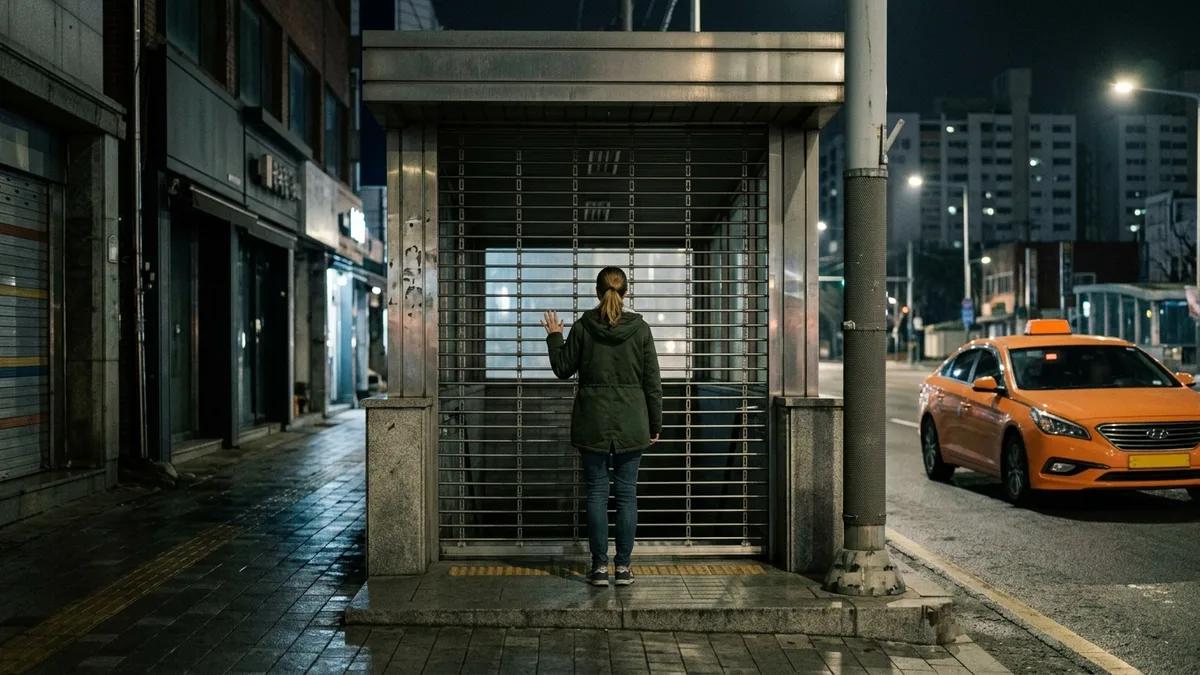
- Last trains: Usually depart from terminals around 11:30 PM to midnight. For mid-route stations, this might be earlier or later, varying by line and day (weekday/weekend). Check exact times on Naver Map route search or station information boards. If you miss the last train, first check if an Owl Bus (N bus, 14 major arterial routes) serves your area; if not, you'll need to call a taxi. If you can't register for taxi apps without a Korean number, pre-read How to Call Taxis Without a Korean Phone Number and Kakao T Guide for Foreigners. The simplest approach is to check last train times on Naver Map route search and, when in doubt, move 30 minutes early.
- Rush hour: Weekday mornings 7-9 AM and evenings 6-8 PM are extremely crowded. Especially Line 2 and Line 9 express trains can be so packed you need to push your way in. If you have a large suitcase, avoiding these times makes life easier for everyone.
Transportation & Payment Connection Tips
You only need one transit card for the subway, but as you move around Seoul, there will definitely be moments when the subway alone won't cut it. KTX or express buses when traveling to other cities, and taxis when you miss the last train at night. You can buy KTX or express bus tickets at station/terminal counters and automated machines with your passport and foreign-issued card, but it's definitely more convenient to secure seats in advance through apps.
Especially if Chuseok or Seollal holidays are involved, start early. Unlike usual, holiday train tickets are released all at once about a month in advance and sell out in minutes. For details, see How to Book Chuseok/Seollal Train Tickets.
However, many Korean apps require Korean mobile number-based identity verification, blocking many first-timers. Having a transportation/payment app designed to work without identity verification can make everything beyond subway — KTX/bus reservations or late-night taxi calls — flow much more smoothly.
Want to search and book KTX and express buses in one app? Check out LACHA.
Built to work without a Korean phone number or bank account, with overseas payment methods like Alipay, WeChat Pay, and Apple Pay. Taxi hailing plus KTX, express bus, and airport railroad (AREX) booking — all in one app.
KTX now up to ₩10,000 off. Enter code at sign-up for 3,000P on top
Download now


Frequently Asked Questions (FAQ)
Q1. What happens if I tap my card at the gate with insufficient balance? When boarding, if your balance is less than the base fare, the gate won't open. Recharge at the charging machine next to the gate, then tag again. The problem is when exiting — if you lack enough for distance surcharges, the exit gate won't open. In this case, recharge the shortfall at a charging machine inside the gates and exit. If you can't find the machine, show your card at the station office (Customer Service Center) and they'll help (machine locations/names vary by station, official confirmation needed).
Q2. My suitcase is too big to fit through the gate. At the end of gate rows or next to station offices, there's usually one wider gate (for mobility-impaired passengers). Card tapping works the same way; just the door opens wider. If carrying luggage up stairs is difficult, when choosing your exit, check for exits with elevator signs. If you want to store your luggage and travel unencumbered, see Luggage Storage & Delivery Complete Guide.
Q3. I lost something on the subway. Note the station and time you got off, and if possible the car number, then report first at the nearest station office (Customer Service Center). Lost items usually gather at line-specific lost-and-found centers, and you can inquire through Seoul Metro Customer Center ☎1577-1234. Since intake windows differ by operator (Seoul Metro, Korail, Airport Railroad, etc.), checking which line you lost it on first is fastest (official confirmation needed).
Q4. What route map app should I use? For route-finding, Naver Map or Kakao Map are standard. They show departure/arrival stations, fast transfer locations, and even exit numbers. Google Maps can search subway routes and transfers but is weaker on exit number display and walking guidance, so it's better as backup (turn-by-turn navigation for driving/walking still unreleased as of 2026-08).
Q5. Is there Wi-Fi on the subway? Most stations and trains have public Wi-Fi, but speed and connection stability are hit-or-miss. For your first few days when you'll be constantly using map apps, having SIM/eSIM data is safer.
Note: This article is for general informational purposes. Fares, policies, and operating hours mentioned are based on publicly available information as of 2026-08 and are subject to change. Before actual use, please verify through Seoul Metro (www.seoulmetro.co.kr) and official announcements from each line operator. For fare and lost-item inquiries, contact Seoul Metro Customer Center ☎1577-1234. For foreign language support, use Seoul Dasan Call ☎120 (English, Chinese, Japanese, Vietnamese, Mongolian, weekdays 09:00-18:00, excluding holidays) or the Immigration Contact Center ☎1345 (operating hours and supported languages subject to official confirmation). LACHA is not affiliated with subway operators and assumes no responsibility for outcomes resulting from this guide.