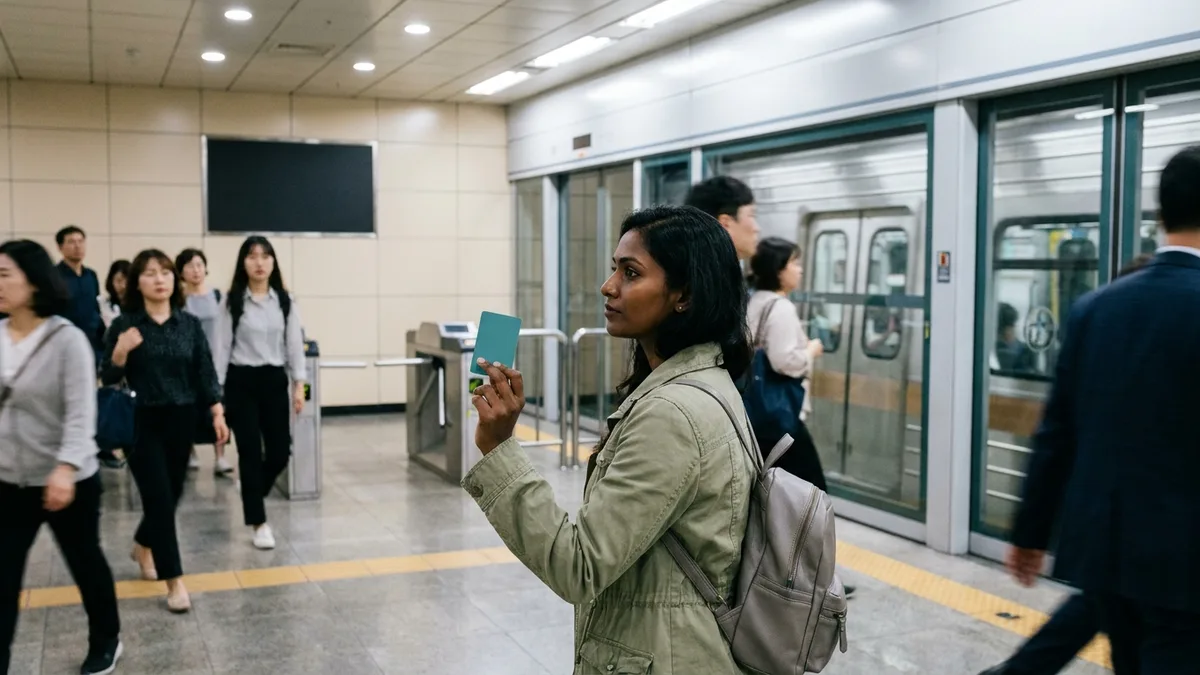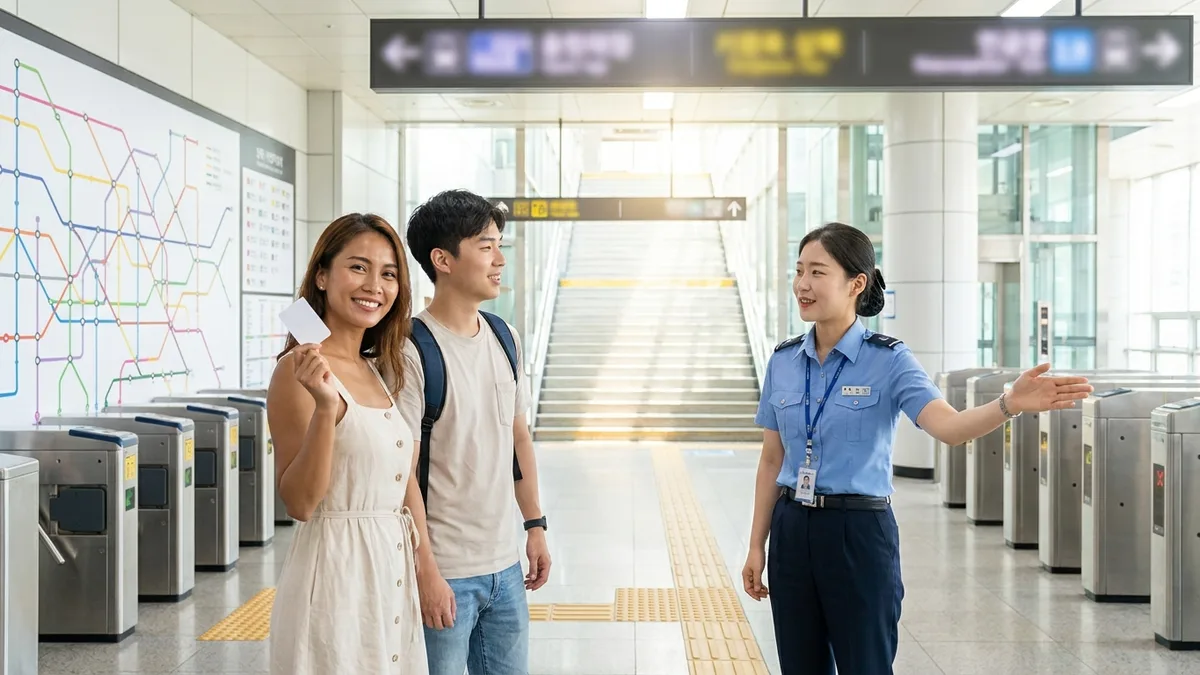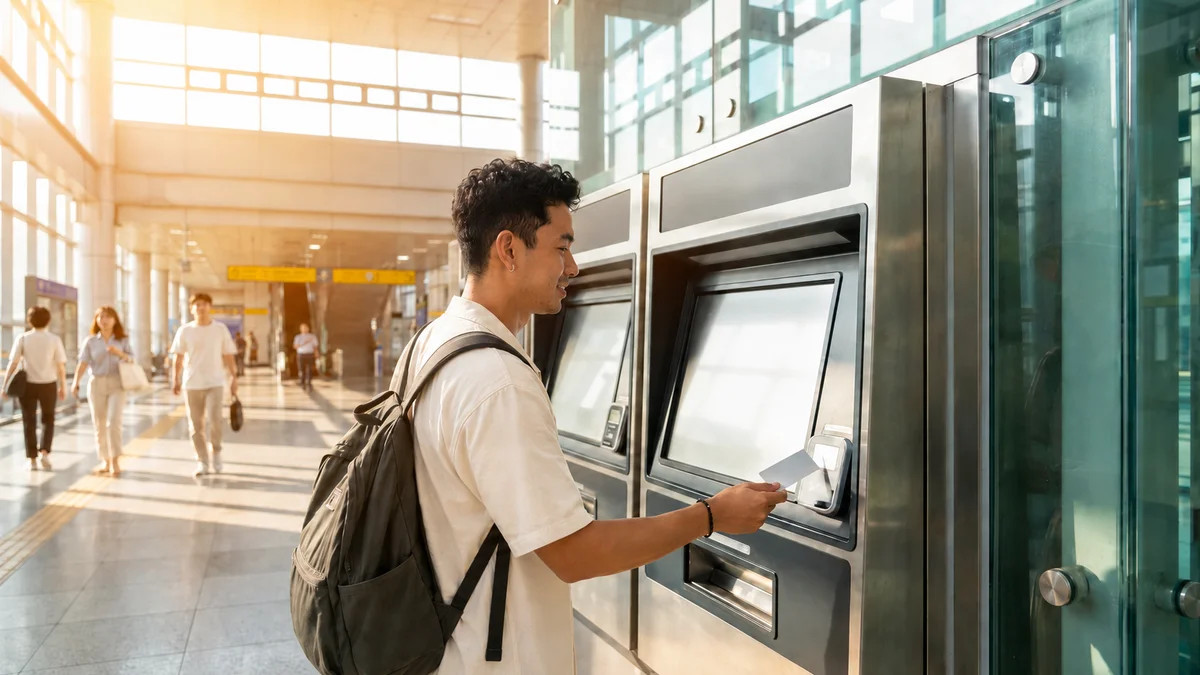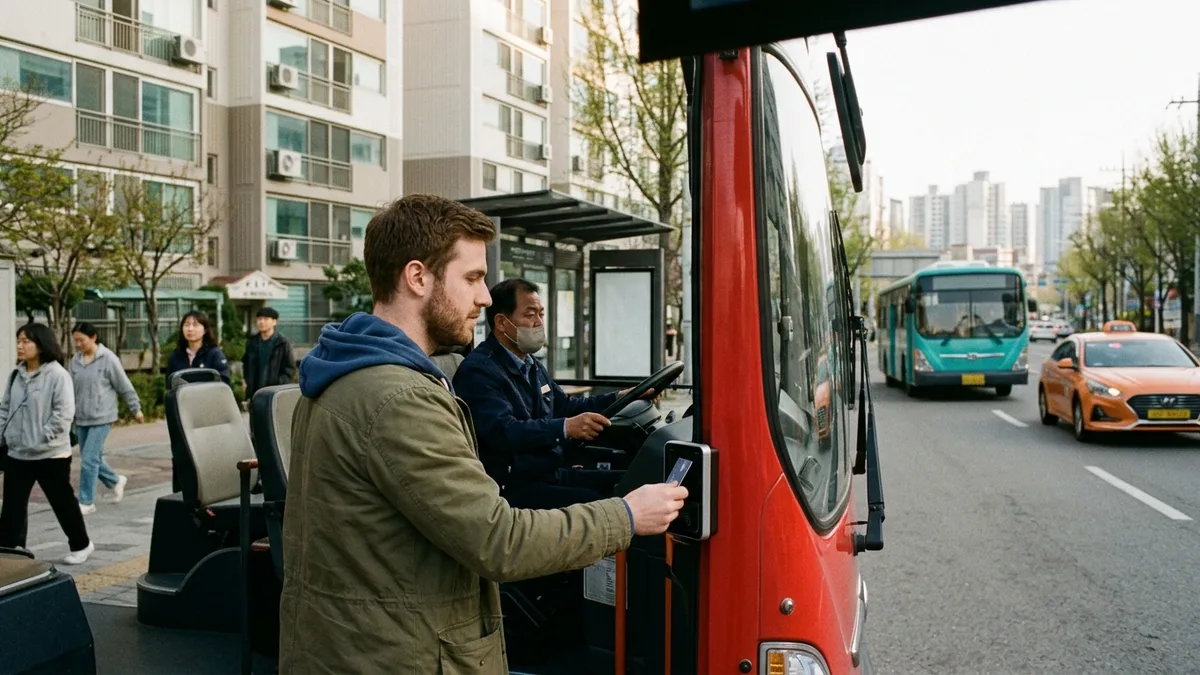
The Daegu urban railway costs 1,500 KRW by transit card no matter how far you go. Line 1 runs 37.6 km with 35 stations from Seolhwa-Myeonggok to Hayang, and the fare is identical whether you ride from the first station to the last or just one stop. Article 24 (1) of Daegu Transportation Corporation's Passenger Transport Terms states that "passenger fares shall be a flat-fare system applying the same fare to all sections of the urban railway regardless of riding distance, and the standard for imposing passenger fares shall be the transit-card passenger fare set out in Article 23 (6)." The rate took effect with the first train on January 13, 2024, and as of August 2026 it hasn't gone up.
That's the good news. The problem is that three habits you've built up in Seoul or Busan don't work in Daegu. There's no re-entry system for when you get off at the wrong stop (Article 35 of the Terms), the T-money card you used in Seoul can be used to ride the Daegu subway but can't be recharged there, and the Daegyeong Line — the metropolitan railway coming into Daegu from Gumi and Waegwan — isn't flat-fare at all, ranging from 1,500 to 2,800 KRW by distance.
On top of that, these rules split along whether you can read Korean. Put Daegu Transportation Corporation's English transfer guide (revised 2026-06-23) side by side with the Korean one (revised 2026-01-15), and the Daegyeong Line is missing entirely from the English version, with the coverage area listed as only Daegu and Gyeongsan. Meaning: if you check only in English, there's no way to learn the transfer rules for Gumi, Gimcheon, and Chilgok, or the half-price Daegyeong Line transfer.
It's a city with cheap fares, and also a city where you can end up stuck simply because you couldn't buy a card. Below we'll go through the fare structure, the spots where money leaks at the fare gate, transit cards, the Daegyeong Line, and transfers, in that order.
Note: The fares and rules in this article were verified as of 2026-08 against Daegu Transportation Corporation's Passenger Transport Terms and fare system, Daegu Metropolitan City's urban railway fare guide, the Daegu bus information system, and official Gumi City materials. Fares and timetables change often, so please re-check with Daegu Transportation Corporation (dtro.or.kr) before you travel.
Three things you learned in Seoul don't apply in Daegu
First, here's what's different, all on one page.
| Habit | The way you do it in Seoul | What actually happens in Daegu |
|---|---|---|
| Fare calculation | Fares rise the farther you go | Flat 1,500 KRW for all sections (Article 24 (1)) |
| Getting off at the wrong stop | You can re-enter within 15 minutes of exiting (Seoul standard, needs official confirmation) | No re-entry system — another 1,500 KRW (Article 35) |
| Recharging cards | You recharge T-money at stations and convenience stores | T-money, Cashbee, Hanpay, and Rail Plus can't be recharged |
| Metropolitan railway fares | Same system even outside the city | The Daegyeong Line is distance-based, 1,500–2,800 KRW |
| Tourist passes | There are period passes like the Climate Card | No unlimited-ride pass appears on the official ticket list |
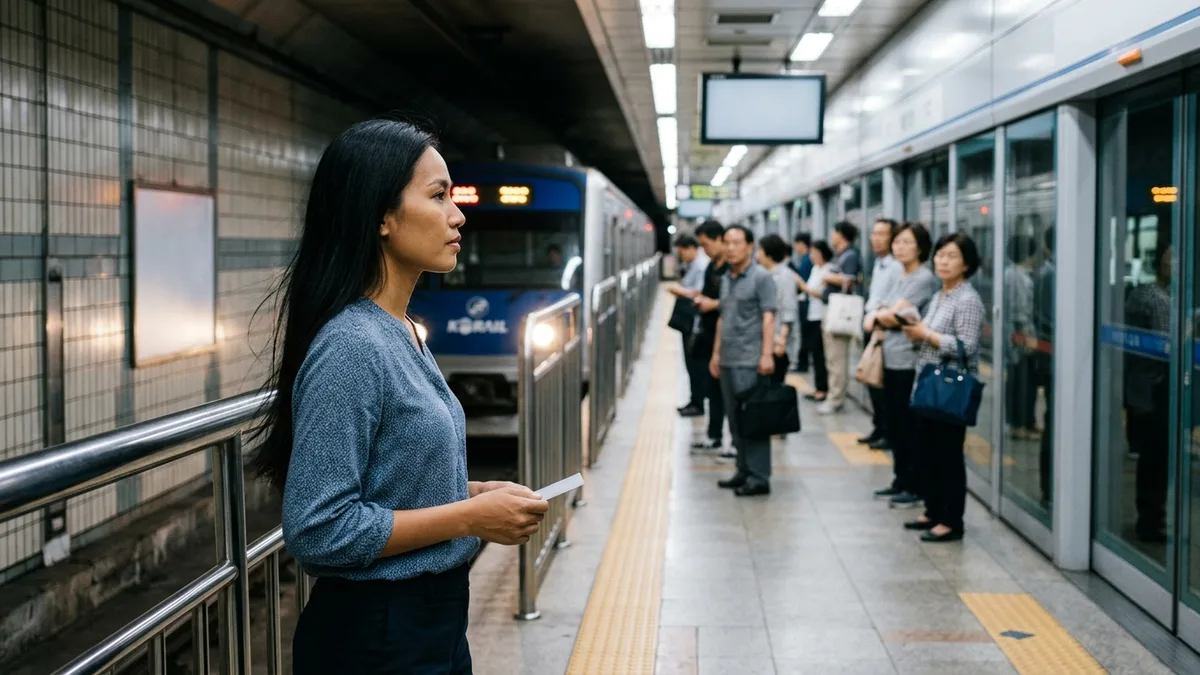
Row three is the most painful for anyone without a Korean bank account or card. If you arrive in Daegu with a T-money card bought in Seoul or Busan, you can ride — but once the balance runs out, there's no way to recharge it there. You'd have to buy a new card, and that card can only be purchased with cash or a cashier's check.
How the re-entry system works on the Seoul metropolitan rail network is covered in the Complete Seoul Subway Guide; Busan's sectional fares and transfer structure are in the Busan Transport Guide; and Daejeon's 10 km sectional system and Gwangju's 30-minute free transfer are laid out separately in the Gwangju & Daejeon Subway Fare and Transfer Guide. Just remember that all four cities are different.
Tip: If you're staying in Daegu for several days, top up your T-money balance generously before you arrive. What you can't do in Daegu is "recharge," not "ride" — as long as you have a balance, you'll never need to buy a new card.
The fare is 1,500 KRW no matter how far — what is a flat-fare system?
A flat-fare system means exactly what it says: distance isn't counted. Daegu Metropolitan City's own guide lists it as "flat fare for all sections (1,500 KRW by transit card)." As for line lengths: Line 1 runs 37.6 km with 35 stations from Seolhwa-Myeonggok to Hayang, Line 2 runs 31.4 km with 29 stations from Munyang to Yeungnam University, and Line 3 runs 23.1 km with 30 stations from Chilgok Kyungpook National University Hospital to Yongji.
| Ticket type | Adult (19+) | Youth (13–18) | Child (6–12) |
|---|---|---|---|
| Transit card | 1,500 KRW | 850 KRW | 400 KRW |
| Single-journey ticket (standard) | 1,700 KRW | 1,700 KRW | 500 KRW |
Two things stand out in this table. First, a single-journey ticket costs 200 KRW more than a transit card for adults. Second, youths lose their discount entirely with a single-journey ticket — 850 KRW becomes 1,700 KRW. If you're traveling with kids for a few days, buying cards is clearly the better move.
Lots of people look for an unlimited pass, but the ticket types defined in Article 13 of Daegu Transportation Corporation's Passenger Transport Terms are: standard tickets, group tickets, concession tickets, adjustment tickets, regular-entry tickets, and three kinds of transit cards. Tourist-oriented unlimited passes like Seoul's Climate Card or Busan's one-day pass are not on that official list. That said, with a flat fare, even four rides a day comes to 6,000 KRW, so you're not really losing out by not having a pass.
The age for free rides is being raised in stages: 67 in 2025, 68 in 2026, 69 in 2027, and 70 in 2028. Concession transit cards are issued only to residents of Daegu Metropolitan City and the cities of Gyeongsan and Yeongcheon; we couldn't confirm from official guidance whether registered foreign residents are issued them under the same criteria. If you're in that age range, please ask directly at a station window or at city hall.
Three situations where money leaks at the fare gate
In Daegu, most unexpected charges happen right at the fare gate. Know these three and you'll avoid nearly all of them.
① Riding one stop too far — getting back on costs another 1,500 KRW
Article 35 of the Terms is literally titled "Prohibition of Re-boarding." It states that "if a passenger, after commencing travel and within the validity period of the ticket, alights at an intermediate station within the fare section and exits past the ticket collection gate, the passenger may not board again." The moment you step out of the fare gate, that ticket is done — going back in means paying a new fare.
Missing your stop because you couldn't catch the Korean announcement happens far more often to foreign visitors. In Daegu, it's easier on the nerves to just assume it costs 1,500 KRW each time. Here, the habit of checking the station name on the display before you get off saves you money.
② Entering by mistake and exiting at the same station — it's not waived automatically
If you go in the wrong direction, or need a restroom and exit at the same station after tapping in, the standard fare is deducted from your transit card under Article 45 (1) 4 of the Terms. There is a way to get it back, but it comes with conditions and a process.
- It must be within 10 minutes of commencing travel (at transfer stations, boarding within 10 minutes of alighting)
- It must not be intentional, and supporting evidence must be confirmed
- You must file a claim at an urban railway station within 30 days, including the day in question (Article 45 (2))
The key point is that it's not waived automatically. The gate doesn't sort it out for you — you have to claim it afterward, so if you don't know the process, you simply lose the money. The surest approach is to speak to the station office the moment you exit.
③ The 2-hour validity period and the 46,500 KRW surcharge
The validity period of a ticket, for both standard tickets and transit cards, is 2 hours from tap-in to tap-out (Article 34). Exceed 2 hours and you're subject to a fare adjustment. It's easy to assume that because Daegu is flat-fare, riding a long time won't raise your fare — but there is a time limit.
The surcharge for fare evasion is far heavier. If you're caught, you pay the applicable fare plus 30 times the standard fare (Article 54 (1)). For an adult, that's 1,500 KRW + 45,000 KRW = 46,500 KRW.
Caution: Anyone using a non-standard ticket — youth, child, or concession transit cards — must carry the corresponding ID (Article 36). If you don't have your ID or refuse to present it, that alone is classified as fare evasion, and you'll owe the applicable fare plus 30 times the standard fare (46,500 KRW for an adult). If you use a discount card, always carry the documents that prove your eligibility.
That said, Article 54 (1) also has a proviso. If it's accepted that you couldn't buy a ticket or lost one for unavoidable reasons, you'll only be charged the equivalent of a single-journey ticket for your section — but this applies "only where reported in advance." Explaining after you've been caught and speaking up beforehand lead to completely different outcomes.
Transit cards — you can ride with T-money, but you can't recharge it
Daegu Transportation Corporation's guidance puts it this way: "Prepaid transit cards other than Daegyeong/Toppass/Onepass cards can be used on the Daegu urban railway, but cannot be recharged." The English page says the same.
| Card | Riding the Daegu urban railway | Recharging at Daegu stations | Daegyeong Line / Gumi / Gimcheon |
|---|---|---|---|
| Onepass | Yes | Yes (1,000–500,000 KRW) | No restriction noted in official guidance |
| Toppass | Yes | Yes (1,000–500,000 KRW) | Not usable |
| Daegyeong Transit Card | Yes | Yes (1,000–100,000 KRW) | Not usable |
| T-money, Cashbee, Hanpay, Rail Plus | Yes | No | Not noted in official guidance |
Recharging is only possible in 1,000 KRW increments. A footnote in the Korean guidance also states that the postpaid Citi card can't be used on the Daegyeong Line.
If you need to buy a new card, check where first. Sales points are Daegu urban railway stations (excluding Line 3), all iM Bank branches, and some convenience stores. Recharging works at every station, but sales happen only at Line 1 and Line 2 stations — so if your accommodation is along Line 3, you'll have to head over to another line just to buy a single card.
Payment method is the real wall. Buying tickets and topping up transit cards is possible only with cash or a cashier's check (100,000 KRW or less). Credit cards aren't accepted, and neither are cards issued overseas. It's safest to have some cash ready before you get to Daegu. Ways to recharge transit cards with an overseas card in other regions are covered in Recharging a Transit Card with a Foreign Card, but whether those methods apply to Daegu-area cards (Onepass, Toppass, Daegyeong Transit) hasn't been confirmed.
Refunds also have a fixed location. Transit card balance refunds are handled only at iM Bank (formerly Daegu Bank) branches, not at urban railway stations. The card purchase price isn't refunded, and a refund fee applies. On the night before your departure or on a weekend there's essentially no option, and iM Bank branches are hard to find outside Daegu and Gyeongbuk — so it's better to spend your balance down to the last won before you leave.
📌 Important: The more used you are to getting refunds at convenience stores, the later you'll find out about this rule. If you're buying a new card in Daegu, first work out "how many rides over how many days" and load only that much. Even four rides a day is just 6,000 KRW.
The Daegyeong Line — coming into Daegu from Gumi, Waegwan, and Gyeongsan
The Daegyeong Line (the Daegu-area metropolitan railway) began service on December 14, 2024. It stops at seven stations: Gumi, Sagok, Waegwan, Seodaegu, Daegu, Dongdaegu, and Gyeongsan. For people commuting into central Daegu from the Gumi National Industrial Complex or the Gyeongsan side, it's the most practical line there is.
And here's where visitors to Daegu most often get it wrong. The Daegyeong Line is not flat-fare. The base fare is 1,500 KRW, with 100 KRW added per 5 km beyond the first 10 km, plus a one-time 200 KRW surcharge when crossing between Daegu Metropolitan City and Gyeongsangbuk-do. Board it assuming it's the same 1,500 KRW as the urban railway and your math will be off.
| Section | Transit card fare | Notes |
|---|---|---|
| Between Seodaegu, Daegu, and Dongdaegu | 1,500 KRW | Travel entirely within Daegu |
| Dongdaegu–Gyeongsan | 1,800 KRW | Crosses the city/province boundary |
| Waegwan–Dongdaegu | 2,200 KRW | From Chilgok-gun into central Daegu |
| Gumi–Seodaegu | 2,400 KRW | |
| Gumi–Daegu / Gumi–Dongdaegu | 2,500 KRW | |
| Gumi–Gyeongsan | 2,800 KRW | Longest section; single-journey ticket is 3,000 KRW |
On weekdays, the first train from Gumi Station departs at 05:30 (bound for Gyeongsan), and the last train from Gumi Station leaves at 23:50. The last train from Gyeongsan Station toward Gumi is at 23:38. We weren't able to obtain official wording on headways, so please check actual train times on the KORAIL timetable.
Let's revisit the card restrictions too. Daegyeong and Toppass cards can't be used on the Daegyeong Line or in the Gumi and Gimcheon areas. If you live in Gumi and commute to Daegu on the Daegyeong Line, which card you buy determines your monthly commuting costs. Yet this proviso appears only in a footnote on the Korean page.
Caution: The Daegyeong Line is a metropolitan electric railway operated by KORAIL, so we weren't able to confirm this time whether the urban railway Terms' 30x surcharge rule applies to Daegyeong Line sections as well. The same goes for whether the Seoul metropolitan rail re-entry system applies on the Daegyeong Line. Please confirm rules for Daegyeong Line sections separately through KORAIL guidance.
Transfers: 2 times within 30 minutes, and the Daegyeong Line is "half price," not "free"
Daegu-area transfers apply up to 2 times within 30 minutes of alighting. Coverage spans nine cities and counties — Daegu, Gyeongsan, Yeongcheon, Cheongdo, Goryeong, Seongju, Chilgok, Gimcheon, and Gumi — and covers city and rural buses, the urban railway, and the Daegyeong Line.
The catch is that the valid window differs by region.
- Daegu, jointly operated Gyeongsan routes, and the Daegyeong Line are within 30 minutes
- Other cities and counties (Gumi, Gimcheon, Chilgok, Yeongcheon, Cheongdo, Seongju, Goryeong) are within 60 minutes
- Gumi City's official materials also state "within 60 minutes of tapping the alighting terminal (up to 2 times)"
For a combination like departing from Gumi, taking the Daegyeong Line, then transferring back to a Gumi city bus, the agencies' guidance reads inconsistently on whether it's 30 or 60 minutes. To be safe, plan around 30 minutes, and if it's a daily commute, confirm once at a station window.
Daegyeong Line transfers are especially misunderstood. Secondary sources often lump it in as a "free transfer," but Daegu Transportation Corporation's guidance says "50% discount when transferring between the urban railway and the Daegyeong Line." Gumi City's materials also list it as a 750 KRW discount, or 50% of the metropolitan railway base fare. It's not free — it's half price.
Some combinations don't qualify for a transfer at all.
- Getting off the urban railway and boarding the urban railway again isn't eligible
- Getting off a bus and boarding the same route's bus again is also excluded
- If you don't tap your card on the alighting terminal, no transfer is registered at all
- You must use the same card for boarding and alighting, and only one person per card gets the benefit
- Tapping the alighting terminal twice (more than 3 minutes apart) triggers a new fare
It helps to know bus fares too. In Daegu, regular buses cost 1,500 KRW by transit card and 1,700 KRW in cash; express/direct buses cost 1,950 KRW by transit card and 2,200 KRW in cash. Transferring from a regular bus to an express or direct bus deducts the difference.
The disappearance of intercity section fares is another big change. With the introduction of the integrated metropolitan transfer fare system, sectional fares (out-of-city-limit fares) were abolished, and the bus fare from Gumi to Gimcheon went from a maximum of 4,700 KRW down to 1,500 KRW (per Gumi City's official materials, effective November 29, 2024).
The English guidance page differs from the Korean one
This may be the most important part of this article. Compare Daegu Transportation Corporation's English transfer guide directly against the Korean one and the content isn't the same.
- The English version lists coverage as only "Metro, Daegu City Bus, Kyungsan City Bus," leaving out the Daegyeong Line, Gumi, Gimcheon, Chilgok, and Cheongdo
- Transfer types run only from Type 1 to 7, so Korean types 8 and 9, which include the Daegyeong Line, are missing
- The valid window is listed as only "Within 30 mins.," so the 60-minute exception isn't visible
- The proviso that Daegyeong and Toppass cards can't be used in Gumi and Gimcheon isn't in the English version either
It's not just slightly less information — someone reading only English has no way to learn the rules for commuting from Gumi into Daegu through official channels. If anything about fares is unclear, running the Korean page through a translator is the more accurate route. Even with browser translation, the tables come through fine.
Some of you may be getting transit refunds through K-Pass, but we couldn't find official confirmation of whether the Daegu urban railway and the Daegyeong Line qualify for accrual. The program itself is covered in the K-Pass Guide for Foreigners, so please re-check Daegu eligibility through official K-Pass guidance.
Connecting to KTX and express buses at Dongdaegu Station
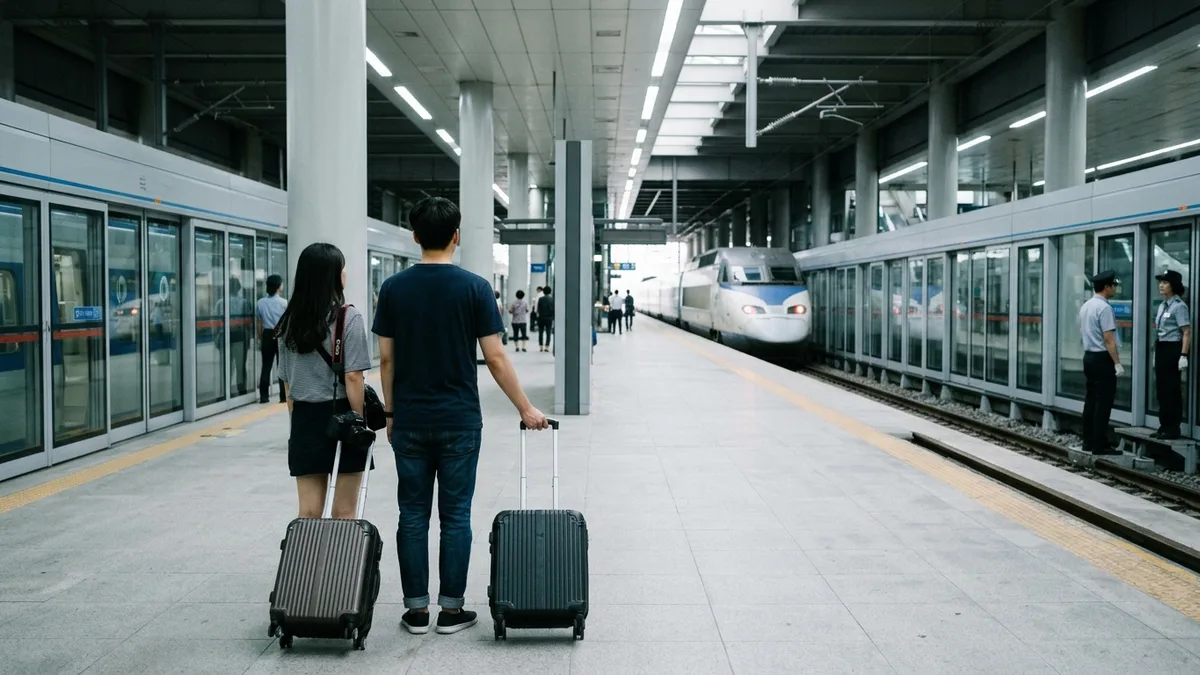
The gateway in and out of Daegu is Dongdaegu Station. It's a KTX stop, a transfer station where urban railway Line 1 meets the Daegyeong Line, and it has the Dongdaegu Station Intermodal Transfer Center (express buses) attached right next door. Arriving by train from Seoul or Busan and switching to the subway all happens inside one building.
Getting around within Daegu is handled almost entirely by a single 1,500 KRW transit card, so what actually takes preparation is the trip to and from Daegu. Train and bus routes connecting to other regional cities are covered in the Regional Cities Train & Bus Access Guide, and the taxi fare structure from the station to your accommodation is in Taxi Fares and the Late-Night Surcharge.
LACHA is a transport and payment super app for foreigners that you can use right away without identity verification. It's designed so that identity verification isn't required under formal procedures, so even without a Korean bank account or phone number you can book KTX tickets to Dongdaegu Station and express buses departing from or arriving at Dongdaegu, and call a taxi after you step off. That said, LACHA doesn't sell Daegu urban railway or Daegyeong Line tickets. For getting around within Daegu, you'll need to prepare a Daegu transit card such as Onepass or Toppass separately.
Want to search and book KTX and express buses in one app? Check out LACHA.
Built to work without a Korean phone number or bank account, with overseas payment methods like Alipay, WeChat Pay, and Apple Pay. Taxi hailing plus KTX, express bus, and airport railroad (AREX) booking — all in one app.
Up to 60% off Korea transit with a coupon (max ₩3,000): enter code at sign-up. KTX gets up to 18% off on top
Download now


Frequently Asked Questions (FAQ)
Q1. Can I use the T-money card I've been using in Seoul in Daegu as is? You can ride with it. T-money, Cashbee, Hanpay, and Rail Plus can all be used on the Daegu urban railway. However, Daegu Transportation Corporation explicitly states that "prepaid transit cards other than Daegyeong/Toppass/Onepass cards can be used but cannot be recharged," so once your balance runs out there's no way to recharge in Daegu. Top up generously before you come, or bring cash and buy a new Onepass, Toppass, or Daegyeong Transit Card.
Q2. Does Daegu have a one-day pass or a tourist pass? The ticket types defined in Article 13 of Daegu Transportation Corporation's Passenger Transport Terms are standard, group, concession, adjustment, and regular-entry tickets plus three types of transit cards, so unlimited passes like Seoul's Climate Card or Busan's one-day pass aren't on the official list. That may sound disappointing, but with a flat fare for all sections, even four rides a day is 6,000 KRW. A single-journey ticket is 1,700 KRW for adults — 200 KRW more per ride than a transit card — and the card purchase price isn't refunded, so a card wins when you plan multiple rides over several days.
Q3. If I ride one stop too far and get back on, do I pay again? Yes, you pay again. Article 35 of the Passenger Transport Terms, "Prohibition of Re-boarding," blocks re-entry after you exit the fare gate, so the re-entry system on the Seoul metropolitan rail network (within 15 minutes of exiting, Seoul standard, needs official confirmation) doesn't exist in Daegu. That said, if you entered in the wrong direction and exited at the same station right away, and it was within 10 minutes, unintentional, and supported by evidence, you can file a claim at an urban railway station within 30 days including that day to get the fare back (Article 45). Just remember it's an after-the-fact claim, not an automatic waiver.
Q4. I commute from Gumi to Daegu — which card should I buy? Daegyeong and Toppass cards can't be used on the Daegyeong Line or in the Gumi and Gimcheon areas. The postpaid Citi card doesn't work on the Daegyeong Line either. Those three are the only restrictions stated in official guidance, so if you're choosing a card for a Gumi commute, it's safest to avoid the ones with noted restrictions. Official guidance doesn't specify how Onepass, T-money, or Cashbee are handled at Daegyeong Line fare gates, so if you'll be riding regularly, check at the Gumi Station or Dongdaegu Station window first to see whether your card actually taps.
Q5. If I use a youth card or a concession card, do I have to carry ID? Yes — Article 36 requires passengers using tickets other than standard tickets to carry the corresponding ID. If you don't have it or refuse to present it, you go on Daegu Transportation Corporation's fare evasion list, and under Article 54 (1) you'll be charged the applicable fare plus 30 times the standard fare. For an adult, that's 46,500 KRW. If you use a discount card, always carry ID that proves your age.
Reference: The fares, rules, and times in this article were verified as of 2026-08 from Daegu Transportation Corporation's Passenger Transport Terms, fare system, and transfer guidance, Daegu Metropolitan City's urban railway fare guide, the Daegu Metropolitan City bus information system, and official Gumi City materials. Urban railway fares took effect with the first train on January 13, 2024, and the Daegyeong Line began service on December 14, 2024. The valid transfer window when the Daegyeong Line is involved (30 vs. 60 minutes), the legal basis for surcharges on Daegyeong Line sections, whether Onepass and T-money can be used on the Daegyeong Line, whether concession transit cards are issued to foreign residents, and Daegyeong Line headways could not be settled in this article and are left as items needing confirmation. Fares and timetables change, so please re-check with the official channels of Daegu Transportation Corporation and KORAIL before you travel. LACHA does not sell Daegu urban railway or Daegyeong Line tickets.