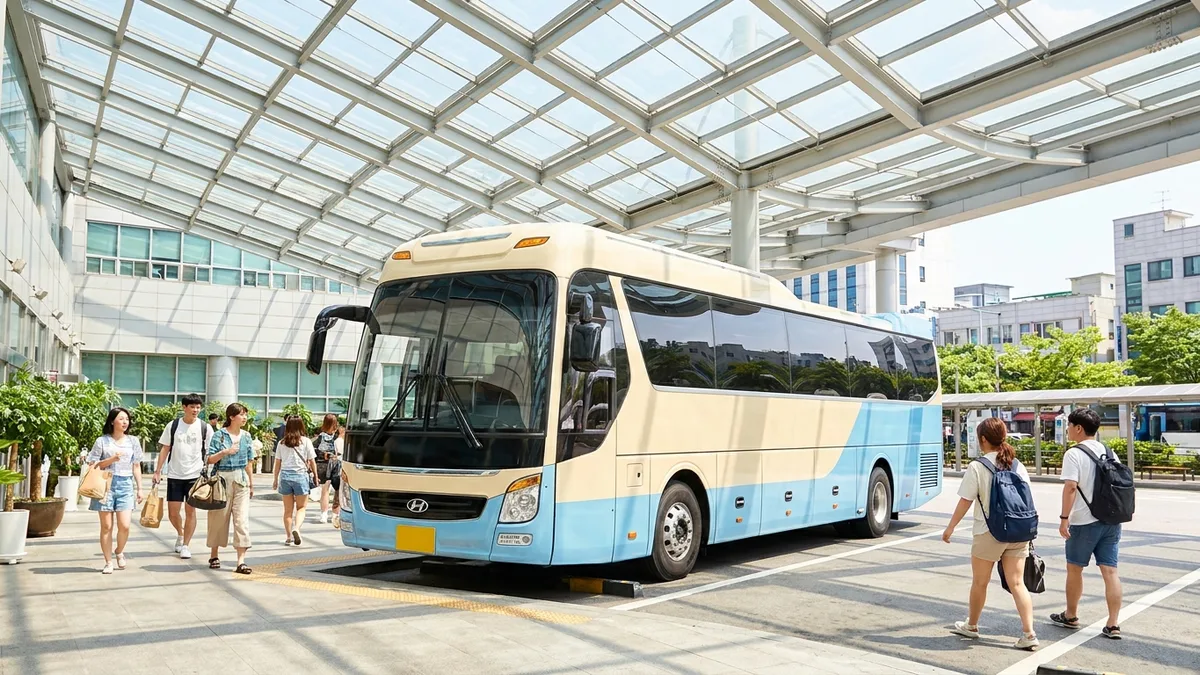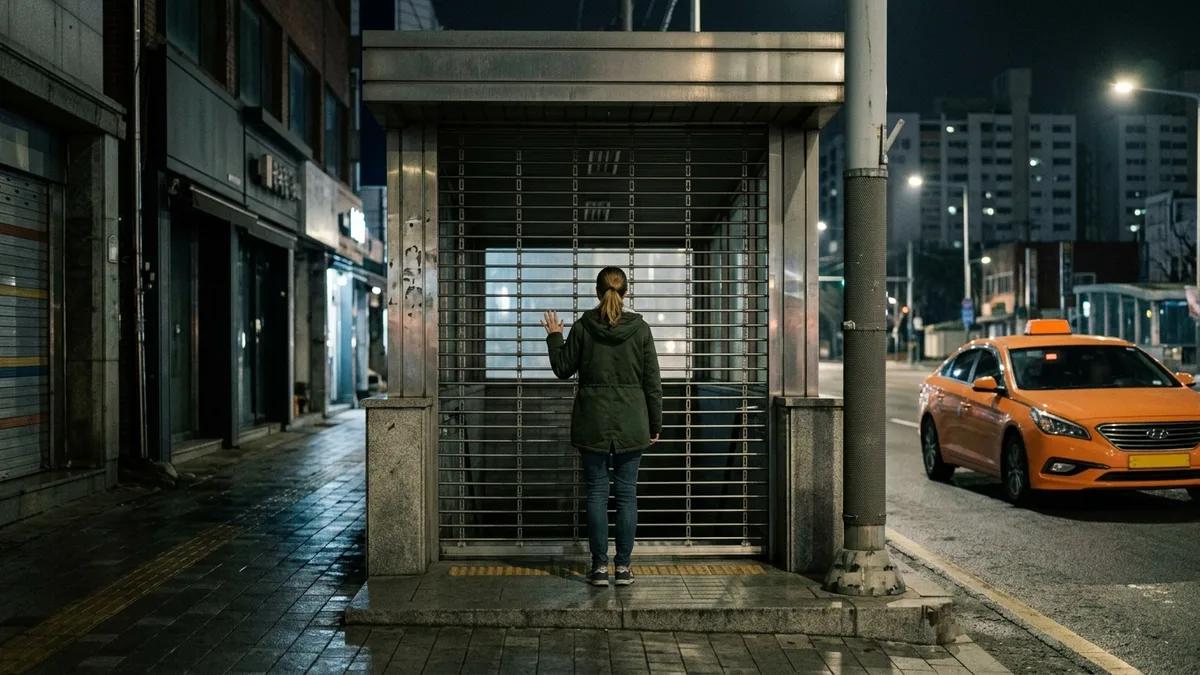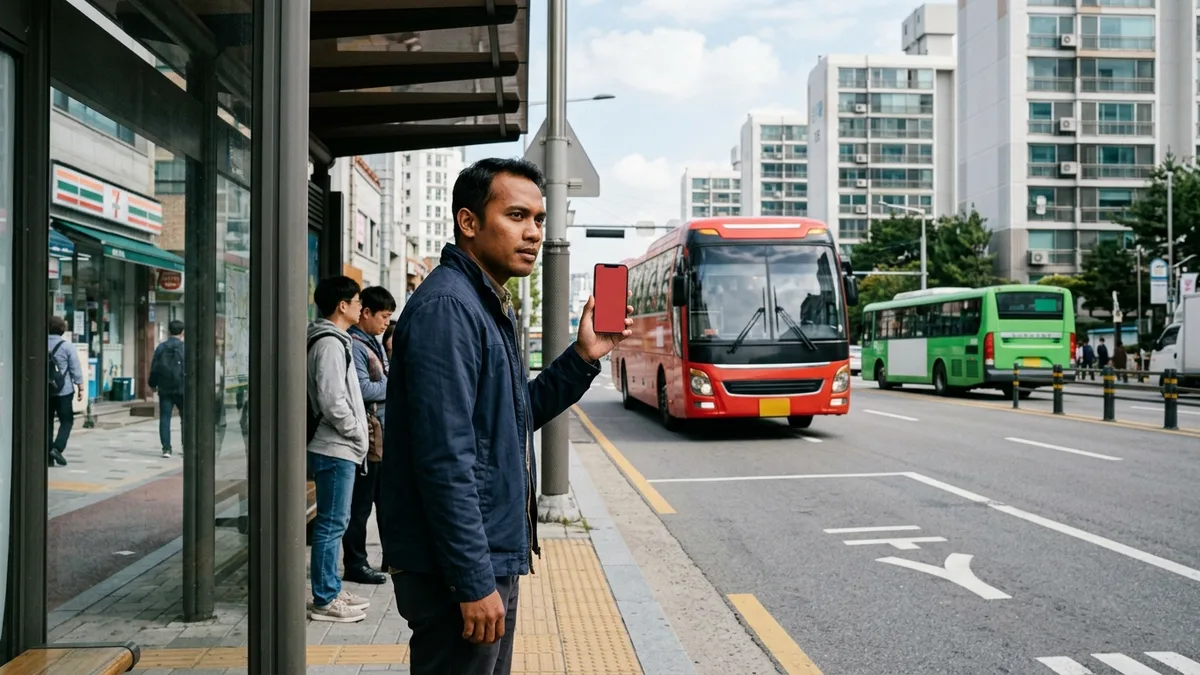
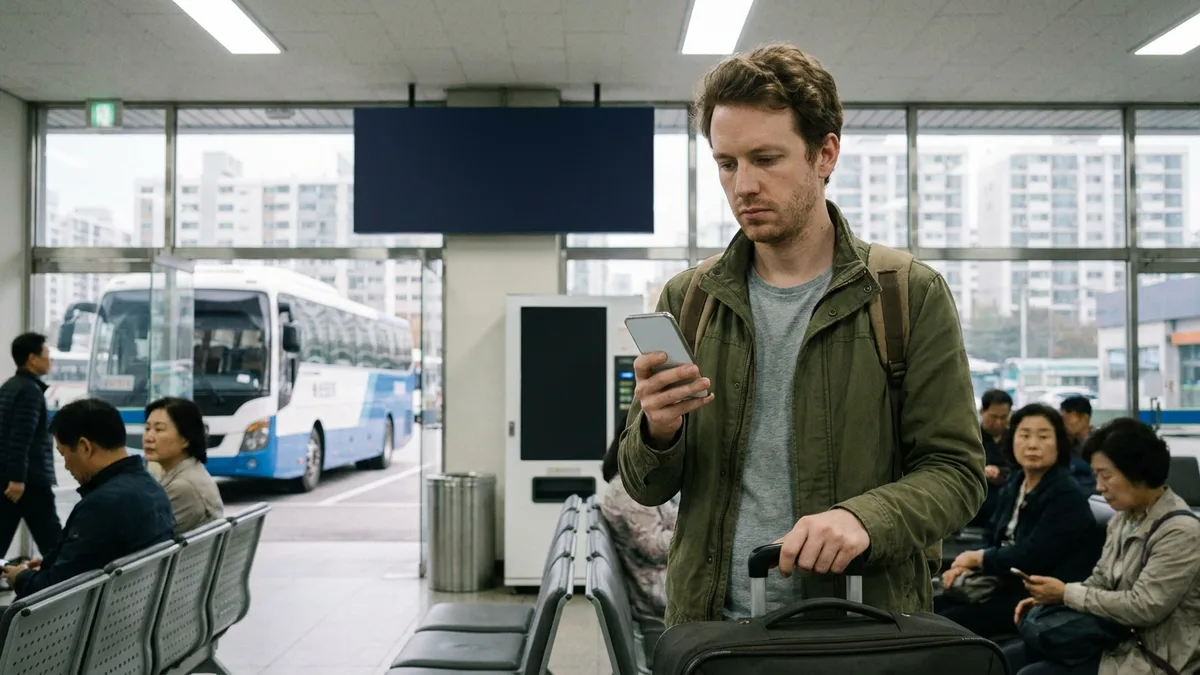
Just because your booking screen says "sold out" doesn't mean there are no empty seats on that bus. For Korea's long-distance buses, booking is split across three channels, each site has different partner terminals, and at some terminals the seats sold online are separate from the seats sold at the terminal counter. So a sell-out you see on one screen is often closer to "this site has no seats it can sell right now under these conditions."
Trains are in better shape. With Korail, once seats sell out you can put yourself on the reservation waitlist, and it texts you when a seat opens up. But when we went through the user guides and FAQs of the three bus booking sites, Kobus, TxBus (the T-money intercity bus integrated booking site), and Bustago, in September 2026, we found no description of any equivalent seat-opening alert or waitlist feature on the bus side. We couldn't check inside the apps, so you'll need to check in each app yourself. No alert means finding a seat again is a job you have to do by hand. This article lays out that hands-on work step by step.
Note: The fee rates, rules, and terminal information below are compiled from the official guidance of the Korea Express Bus Association (Kobus), Tmoney Mobility's intercity bus integrated booking (TxBus), the National Federation of Bus Transport Business Associations (Bustago), the National Law Information Center, and Korail (Korea Railroad Corporation), as of 2026-09. Payment methods and cancellation rules change often, so please double-check on the site you're booking with on the day.
Four Cases That Look Sold Out but Aren't
Start by doubting the screen. In the four cases below, the search comes up empty or looks sold out for some reason other than a lack of seats.
| What you see on screen | Actual cause | How to check |
|---|---|---|
| A seat that was there a moment ago suddenly shows as sold | A payment error left that seat temporarily held | Released after 5 minutes on TxBus, or 20–30 minutes on Bustago |
| "No buses available" | You searched with a bus class filter on | Set the bus class to All and search again |
| The timetable itself is empty | The terminal hasn't entered the dispatch schedule yet | Usually only entered up to 1 month ahead |
| An 'On-site purchase' (현장구매) label next to the destination | A route that isn't sold online | Can only be bought at the terminal ticket counter |
The first row is the most common. If an error occurs during payment, the seat you were choosing keeps showing as already sold for a while. If you don't know how long that lasts, you end up grabbing a different bus and missing your original seat.
The second is a sell-out you created yourself. Bustago's official guidance says that in this case you should search with the bus class set to All. If you were only looking at Premium, there may still be Deluxe or Standard seats left.
The third is the booking window. Intercity bus tickets have no fixed release date; they're sold up to the last date for which that route's dispatch schedule has been entered. The departure terminal handles that entry, and it's usually entered up to 1 month from the current date. An empty search result is not a sell-out.
The fourth is a route that isn't sold online at all. If it carries the 'On-site purchase' (현장구매) label, no amount of refreshing will make seats appear.
Search the Same Route Again on All Three Sites
In Korea, express buses and intercity buses run on separate systems. Express buses are operated by eight companies (Kumho Express, Dongbu Express, Dongyang Express, Samhwa Express, Songnisan Express, Jungang Express, Chunil Express, and Hanil Express), and Kobus handles integrated booking for them. Intercity buses are run by many separate operators, and their booking is split again across two sites.
| Category | Kobus | TxBus (intercity bus integrated booking) | Bustago |
|---|---|---|---|
| Address | kobus.co.kr | txbus.t-money.co.kr | bustago.or.kr |
| Routes covered | Express buses | Intercity buses | Intercity buses |
| Operated by | Korea Express Bus Association | Tmoney Mobility | National Federation of Bus Transport Business Associations |
| Display languages | Korean, English, Chinese, Japanese | Korean, English, Chinese, Japanese | Korean, English, Chinese, Japanese |
| Overseas card info | Not mentioned in its guidance | Not mentioned in its guidance | Overseas cards listed as a payment method |
| Same-day booking cutoff | Up to 1 hour before departure | Check on the site | Up to 20 minutes before departure |
The key point here is that a route you can't see on one site may be on another, because each booking site has different partner terminals. Bustago itself says that "if a route doesn't come up in a search, it may not be one of our partner terminals," and advises you to search on another company's site or contact the terminal directly. So when you hit a sell-out, your first move isn't refreshing; it's searching the same route again on a different site.
Booking cutoff times are easy to miss too. Kobus sells on the web until 1 hour before departure and tells you to use the express bus mobile app for anything closer than that, while Bustago accepts bookings until 20 minutes before departure. In other words, if it's 40 minutes before departure, booking is closed on the Kobus website but may still be open on Bustago.
The catch is that pushing last-minute buses onto an app works against foreigners. The app Kobus points you to (T-money GO, 티머니GO) lists Korean as its only supported language on the app store (developer Tmoney Mobility, version 2.6.9 / as of 2025-08-27). We couldn't confirm whether there's a language switch inside the app. The channel that works in English and the channel that gets you last-minute seats are split, so the more urgent things get, the more you're pushed onto Korean-language screens. The basics of using each site are covered in How to Book Korean Express Buses in English.
Cancelled Tickets Come Back Around the Points Where Fees Go Up
There are no published operator statistics on when the most cancelled tickets come up. So we won't repeat claims like "they're released every night at midnight" here. What we can say for sure is one structural thing: the points at which the cancellation fee rises from 0% are fixed, and people generally cancel before it costs them more. Below are the cancellation fees under the revision effective 2025-05-01; all three sites show the same table.
| When you cancel | Mon–Thu | Fri–Sun & public holidays | Seollal & Chuseok |
|---|---|---|---|
| Up to 2 days before departure | 0% | 0% | 0% |
| From 1 day before departure until 3 hours before departure | 5% | 7.5% | 10% |
| Less than 3 hours before departure, until departure | 10% | 15% | 20% |
| After departure | 50–70% depending on the year | 50–70% depending on the year | 50–70% depending on the year |
| After the scheduled arrival time | 100% | 100% | 100% |
The 'After departure' row goes up every year: 50% from 2025-05-01 to 2026-04-30, 60% from 2026-05-01 to 2027-04-30, and 70% from 2027-05-01 onward. Please check the rate that applies when you're reading this on the site you booked with.
What to read from this is two walls: 2 days before departure and 3 hours before departure. Past these points, the person cancelling has to pay more, so people who are on the fence make their decision before then. If you're hunting for a seat, it makes sense to look once just before and once just after each of those points. But this is an inference from the rules, not an observed statistic.
There's also a window with no fee at all. If you cancel within 1 hour of when the ticket was issued, or within 1 hour of when it was booked, no fee applies (only before your designated bus departs). However, the issuance-based window doesn't apply if you booked in advance and printed the ticket later — booking and then printing it at the counter a few days later doesn't give you a fresh 1-hour window from that point.
Caution: We don't recommend holding multiple seats and cancelling the ones you don't need later. In a notice dated 2025-11-14, Kobus announced that booking large numbers of tickets and then refunding them without riding may lead to membership suspension and blocked access for the card used. On top of that, booking more than 4 times with the same card for the same departure date is restricted (up to 6 tickets per booking; tickets issued at a terminal ticket office don't count toward this limit). If your account and card get blocked while you're trying to get a seat right now, even your next trip gets harder.
Know the refund timing too. Card payment cancellations take 3–5 business days depending on whether it's a credit or debit card, and if a fee applied, only the amount minus that fee is cancelled.
Change, Don't Cancel — How to Switch Seats Without a Fee
This is the least-known part of this article. A 'change' to your booking carries no fee. It may look similar to cancelling and buying again, but the cost is different. For express buses, you can change the time, number of tickets, or bus class for free, once only, up to 1 hour before departure, and Bustago also allows a free time change "only once, up to 1 hour before departure, for the same destination on the designated bus's departure date." In short:
- Moving the time earlier or later on the same day, for the same destination, is free
- Changing the bus class is also covered by the free change for express buses
- Changing the date isn't a change but a cancellation and rebooking (fees apply)
- You get only one chance, and once it's past 1 hour before departure, even that closes
That leads to this order of moves. If the time slot you want is sold out, first secure any bus still available that day, then use the free change to move once a seat opens up. That way you avoid having nothing in hand while you wait for cancellations. Just note that you're holding one ticket and moving that one ticket, which is different from holding several buses at once.
Switching bus class works on the same principle. On Bustago's booking screen, the classes are split finely: Standard (일반), Intercity Express (시외고속), Late-night Express (심야고속), Intercity Deluxe (시외우등), Late-night Deluxe (심야우등), Premium Deluxe (프리미엄우등), Premium Late-night Deluxe (프리미엄심야우등), Weekend Premium Deluxe (프리미엄우등(주말)), and Weekend Premium Late-night Deluxe (프리미엄심야우등(주말)). Even if one class is sold out, a bus of another class may be scheduled in the same time slot. For seat layouts and price differences by class, compare them in Premium vs. Deluxe vs. Standard Express Buses.
It's also worth checking discount conditions. Deluxe-type buses offer a 10% discount each for advance booking (booking 2 days before departure), group booking (5–10 people), and round-trip booking. They apply only to adult tickets, can't be combined, and once you apply a discount, you can pay only by credit card. These discounts don't apply during the special transport period for the Seollal and Chuseok holidays.
Changing Your Departure Terminal Can Turn Up Seats
Even to the same destination, a different departure terminal means a different route. Seoul is the classic example: its long-distance bus terminals are split across four locations, each covering different regions.
| Terminal | Main regions served | Nearest station |
|---|---|---|
| Seoul Express Bus Terminal, Gyeongbu & Yeongdong Lines (서울고속버스터미널) | Southeast: Busan, Daegu, Gyeongju, Pohang, etc. | Express Bus Terminal Station |
| Central City, Honam Line (센트럴시티) | Southwest: Gwangju, Jeonju, Mokpo, Suncheon, Yeosu, etc. | Express Bus Terminal Station |
| Dong Seoul Bus Terminal (동서울종합터미널) | Gangwon, Gyeonggi, Chungcheong, Gyeongsang, Jeonbuk, Gwangju (both express and intercity) | Gangbyeon Station |
| Seoul Nambu Terminal (서울남부터미널) | Some intercity routes to Gyeonggi, Gangwon, Chungcheong, and Gyeongnam | Nambu Bus Terminal Station |
Seoul Express Bus Terminal and Central City are attached to the same station. You can walk between the two buildings, but each covers different directions, so tickets to the southwest, like Gwangju or Jeonju, have to be looked for on the Central City side, not at Seoul Express Bus Terminal (Central City is the main hub for the southwest, and Dong Seoul also has some buses to Gwangju and Jeonju). Dong Seoul and Seoul Nambu, on the other hand, are in completely different places. If you type 'Seoul Bus Terminal' into a map app, it will pin the wrong terminal, so search using the official names in the table above. Terminal layouts and facilities are covered in Korea Bus Terminal Guide.
There's one more option: rest-area transfers. Express-type intercity buses normally don't stop between their origin and final stop, but the law makes an exception allowing an intermediate stop at transfer stops in expressway rest areas (Enforcement Rule of the Passenger Transport Service Act (여객자동차 운수사업법 시행규칙), Article 8(8)). Kobus runs these transfers at five locations.
- Seonsan Rest Area (선산휴게소) on the Gyeongbu Line
- Jeongan Rest Area (정안휴게소) and Seomjingang Rest Area (섬진강휴게소) on the Honam Line
- Hoengseong Rest Area (횡성휴게소) on the Yeongdong Line
- Insamland Rest Area (인삼랜드휴게소) on the Jungbu Line
They operate 08:00–22:00, and each leg is booked separately. That means even if the direct bus is sold out, you can piece a trip together if "Seoul → rest area" and "rest area → destination" each still have seats. However, they can't be used during the special transport period for Seollal and Chuseok. It's a method you can't use exactly when tickets are scarcest, so don't count it as a holiday strategy. Terminal setups between regional cities are covered in Getting to Regional Cities by Train and Bus.
Sold Out Online Doesn't Always Mean Sold Out at the Terminal
This is the spot foreigners miss most. Some terminals keep online booking seats separate from on-site sales seats. Bustago's official guidance puts it this way: "At terminals where online and on-site seats are the same, if it's sold out online, it's also sold out on-site; at other terminals, on-site ticketing at the terminal is possible for some seats."
That means you can't be absolute in either direction. It's wrong to say that going to the terminal is pointless if it's sold out online, and it's just as wrong to say the terminal always has tickets. There's no public list of which terminals keep seats separate, so the right order is to check with the departure terminal before you go. That said, ticket-office phone support is basically in Korean, so if Korean is hard for you, it may be better to just go in person and ask at the counter.
Here's what you can do on-site.
- Buy directly at the ticket counter — you can pay with cash, credit card, or mobile pay
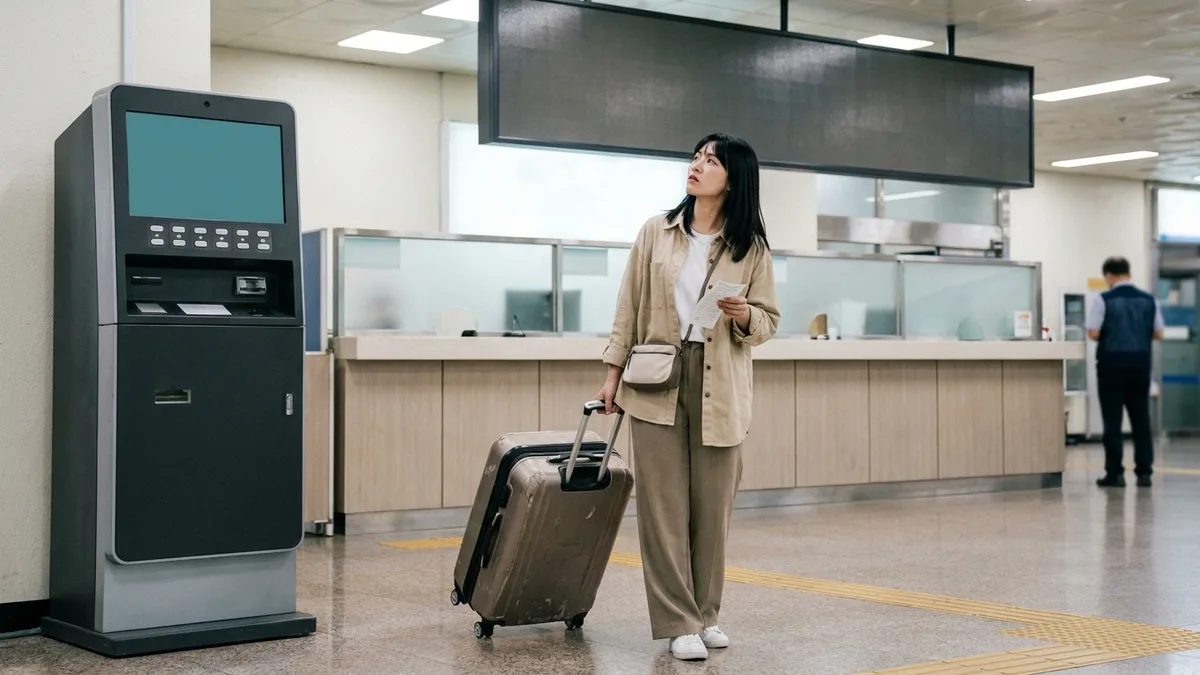
- Use a self-service ticket kiosk — some terminals have them and some don't. You can check in advance in Bustago's terminal information
- Print tickets you booked online — only before departure, and only at the departure terminal. Once the departure time passes, you can't print the ticket at all
- Check your boarding platform — find the platform number on the departure board in the waiting room and board 5–10 minutes before departure
What you need to print the ticket is the credit card you used to book. Even without the physical card, you can get the ticket issued at the counter if you know the card number; conversely, if you lose the card and don't know the number either, that ticket can't be issued, changed, or cancelled (per Kobus's express bus integrated booking guidance). If you booked by card, write the number down separately. If you booked on Kobus with a simple-payment service, you print the ticket not with a card but with your mobile number + 6-digit date of birth, or your mobile number + 8-digit departure date.
There's one point of no return. Once you print an online-booked ticket as a paper ticket, you can't cancel it on the website. From then on, it can only be cancelled at the departure terminal's ticket counter. If there's still a chance you'll move to a different bus, don't rush to print it.
The last resort is E-PASS boarding. On express buses, you can board without booking in advance by paying with a transit card or credit card. But Kobus's official guidance limits this to "when there are empty seats on the bus." It's not a way to guarantee a seat, just a possibility that may be left at the end. In case it fails, check the next bus's time, buses from other terminals, and train options before you go.
Caution: There's no way to buy a standing ticket and ride standing. Article 39(1) of the Road Traffic Act prohibits driving with passengers on board beyond the operational safety standards set by Presidential Decree, and Article 22, Item 1 of the Act's Enforcement Decree sets that standard as "the number of passengers in a vehicle shall be within its passenger capacity." The former rule allowing up to 110% of passenger capacity was deleted in an amendment on June 20, 2023. However, we couldn't confirm how it works in practice when a vehicle's passenger capacity includes standing room, as with standard-type (일반형) intercity buses, so please ask the terminal for that route.
If Payment Fails, You Can't Buy the Ticket Even When Seats Exist
It's common to find a seat and then get stuck at payment. In particular, since February 24, 2026, non-members can no longer pay by entering a credit or debit card number directly on the Kobus website (PC and mobile web). Non-member payment is now only possible through the simple-payment services Toss Pay and Naver Pay, and both assume identity verification in Korea. We couldn't confirm whether they work with an Alien Registration Number or an overseas phone number, so you'll have to try it yourself at the sign-up stage.
On the intercity bus side, Bustago explicitly lists overseas cards as a payment method. It also accepts personal and corporate credit and debit cards, plus PAYCO, Naver Pay, and Kakao Pay. However, for simple payments the phone and the card must be in the same person's name, supported card issuers are limited, and they can't be used for round-trip bookings. By contrast, Kobus's and TxBus's guidance says nothing at all about whether overseas cards work, and actual approval can vary by card issuer and issuing country; we haven't tested it ourselves either.
So avoid planning to pay right before departure relying on an overseas card alone. If you test it once on a cheap route while you have time, you won't flounder when you're in a hurry. If signing up feels like a hassle, Bustago lets you book, look up, change, and cancel without an account (you agree to the terms and enter your date of birth and contact details). If your overseas card keeps getting declined, also see Services You Can Use Without a Korean Phone Number and What Works Without Identity Verification.
Switch to the Train, or Wait for the Next Bus?
There's a point where holding out for a bus only costs you more. Use the criteria below to decide.
- You're within 3 hours of departure → the cancellation fee is in the 10–20% range, so cancellations drop sharply
- The online cutoff has passed → the Kobus website closes 1 hour before departure, Bustago 20 minutes before
- Getting to the terminal takes time → if you go and there's nothing, you lose that time entirely
- The gap until the next bus is too long → intervals vary by route. Check the next bus's time on the search screen first
Switching to the train gives you one more tool. When KTX seats sell out, you can apply for the reservation waitlist, and you get a text when a seat is assigned. If you don't pay by the payment deadline, the seat is cancelled again. We couldn't find a description of this kind of feature on the bus booking sites, so if you'll need to wait, the train has the edge.
There's one snag, though. Buying a ticket itself doesn't require signing up: Korail's English site (korail.com) takes non-member bookings with a passport and an overseas card. The exception is the Seollal and Chuseok holiday advance reservation: booking it online is open only to Korail Membership members. But Korail's official guide explains the waitlist from a screen you're already logged into with a membership number, so we couldn't confirm whether non-members can join the waitlist too. If you're planning to wait for a seat, it's safer to sign up for Korail Membership in advance. Where people get stuck at sign-up and payment is covered in Booking KTX Without a Korean Card, and which to look at between KTX and SRT is in SRT vs. KTX.
Checking one app here speeds up your decision. LACHA is an app for foreigners that lets you book and pay for taxis, KTX, express buses, VANs (5- and 6-seaters), and the Airport Railroad in one app. Its standard sign-up requires no identity verification, just a name, email, and password, and you can pay with overseas simple-payment services like Alipay and WeChat Pay, or with VISA, Mastercard, JCB, AMEX, and UnionPay cards. What makes it useful in this situation is that when express buses are sold out, you can check KTX seats right away on the same screen. Note, though, that LACHA doesn't handle intercity buses, so for intercity routes you'll need to look separately on TxBus or Bustago.
Want to search and book KTX and express buses in one app? Check out LACHA.
Built to work without a Korean phone number or bank account, with overseas payment methods like Alipay, WeChat Pay, and Apple Pay. Taxi hailing plus KTX, express bus, and airport railroad (AREX) booking — all in one app.
KTX now up to ₩10,000 off. Enter code at sign-up for 3,000P on top
Download now


During Seollal and Chuseok, the Rules Themselves Change
The Seollal and Chuseok holidays are when tickets are scarcest, and that's exactly when several of the methods in this article get blocked.
First, the period covered by the 'Seollal & Chuseok' column in the cancellation fee table is wider than you might think. It applies not just to the day of Seollal or Chuseok itself but to four days: two days before, the day before, the day itself, and the day after. During these four days, cancelling after the 3-hours-before-departure mark costs you 20%, so this is the period when waiting for cancelled tickets is least effective.
Next, these are blocked:
- Rest-area transfers don't operate during the holiday special transport period
- Deluxe-type discounts (advance, group, and round-trip, 10% each) don't apply during the holiday special transport period
- KTX unreserved seats (자유석) and seats for travelers with infants (유아동반석) don't run during the holidays — so "if there are no seats, take an unreserved seat" isn't an option
Supply does increase, though. For every Seollal and Chuseok, the government sets a special transportation measures period and adds express bus runs. For Chuseok 2023 (September 27 to October 3, 7 days), it added 8,442 express bus runs and increased seat supply by 152,000 seats. Intercity buses kept their regular schedules but added buses flexibly with reserve vehicles when demand surged; for Chuseok 2022, 342 reserve express buses and 591 reserve intercity buses were deployed. This means search results change once the added runs are released, so don't give up after seeing one sell-out; check again after the measures are announced.
As of early September 2026, when we checked, the start date for special express and intercity bus booking for Chuseok 2026 hadn't yet been posted in Kobus's notices. Please check Kobus's notices directly. Advance booking on the train side works differently, so we've covered it separately in How to Get Train Tickets for Chuseok and Seollal.
Finally, what if you book and don't ride? If you neither print nor cancel the ticket, it's treated as a 'no-show' and a penalty applies, but the criteria are stated differently on each site. TxBus lists 30% up to 6 hours after the bus departs and 100% after 6 hours, while Bustago lists 100% from 4 hours after the designated bus departs (automatically cancelled the next day). We couldn't confirm which one is current, so please follow the rules of the site you booked with. If you can't make it, cancelling before departure at the latest is the cheapest option.
Frequently Asked Questions (FAQ)
Q1. Do the booking sites have a seat-opening alert or waitlist feature? When we checked the user guides, FAQs, and notices of the three sites (Kobus, TxBus, and Bustago) in September 2026, we couldn't find any description of such a feature. We couldn't check inside the apps, so please check in each app yourself. KTX, on the other hand, lets you apply for the reservation waitlist when seats sell out and texts you when a seat is assigned (it's cancelled if you don't pay by the payment deadline). Buying a ticket itself works as a non-member on Korail's English site, except for the Seollal and Chuseok holiday advance reservation, which is open online only to Korail Membership members. We couldn't confirm whether non-members can join the waitlist too, so if you're planning to wait for a seat, sign up for Korail Membership in advance.
Q2. What time do the most cancelled tickets come up? Operators haven't published any statistics, so we can't pin down a time. The only thing confirmed is the points at which cancellation fees rise. Up to 2 days before departure it's 0%; after that, until 3 hours before departure, it's 5% Mon–Thu, 7.5% Fri–Sun and public holidays, and 10% during Seollal and Chuseok; from less than 3 hours before departure, it's 10% Mon–Thu, 15% Fri–Sun and public holidays, and 20% during Seollal and Chuseok. Use this only to check around those points, and avoid holding multiple seats. Kobus has announced membership suspension and card access blocking for booking large numbers of tickets and then refunding them.
Q3. If it's sold out online, is going to the terminal pointless? It depends on the terminal. Bustago's official guidance states: "At terminals where online and on-site seats are the same, if it's sold out online, it's also sold out on-site; at other terminals, on-site ticketing at the terminal is possible for some seats." There's no public list of which terminals keep seats separate, so checking directly with the departure terminal is the most accurate. For express buses, you can also board by tapping a transit card or credit card on the E-PASS reader if there are empty seats, but this doesn't guarantee a seat.
Q4. The time slot I want is sold out, but other times are still available. Should I buy one for now? That's actually the safer approach. A 'change' to your booking carries no fee. For express buses, you can change the time, number of tickets, or bus class for free, once only, up to 1 hour before departure, and Bustago also allows one free time change up to 1 hour before departure, limited to the same departure date and the same destination. However, you can't change the date (that's handled as a cancellation and rebooking), and you get only one chance.
Q5. Can I book with a card issued overseas? It varies by site. Bustago is the only one that lists overseas cards as a payment method; Kobus's and TxBus's guidance doesn't say whether overseas cards work. Actual approval can vary by card issuer and issuing country, and we haven't tested it ourselves. Also, since February 24, 2026, non-members on the Kobus website can no longer pay by entering a card number directly, leaving only the simple-payment options Toss Pay and Naver Pay. Don't try it for the first time on an urgent day; test it once when you have time to spare.
Note: This article is for general information purposes. The cancellation fee rates, booking cutoff times, terminal information, and rest-area transfer conditions in the body are values we confirmed as of 2026-09 from the official guidance and FAQs of the Korea Express Bus Association (Kobus), Tmoney Mobility's intercity bus integrated booking (TxBus), and the National Federation of Bus Transport Business Associations (Bustago). The passenger capacity rules follow the Road Traffic Act and its Enforcement Decree on the National Law Information Center (checked 2026-08), the basis for intercity bus service types and rest-area transfers follows the Enforcement Rule of the Passenger Transport Service Act (checked 2026-04), the holiday added-run figures are based on the Ministry of Land, Infrastructure and Transport's policy briefings (Chuseok 2022 and 2023), and the KTX reservation waitlist and the suspension of unreserved seats during holidays are based on the user guide of Korail (Korea Railroad Corporation). Statistics on when cancelled tickets actually come up most, a list of terminals that keep online and on-site seats separate, whether Kobus and TxBus approve overseas cards, the current no-show penalty criteria (which are stated differently by site), the start date for Chuseok 2026 special booking, and whether the T-money GO app supports multiple languages inside the app could not be confirmed from primary sources, so we haven't stated them as figures or definitive claims. The fee rates are from the 2025-05-01 revision, the after-departure tier rises every year (50% in 2025 → 60% in 2026 → 70% in 2027), and payment methods and non-member policies change often, so be sure to double-check on each site before booking. If the rules differ from what's on screen, the screen and the departure terminal's guidance take precedence. LACHA does not book or operate intercity buses, and it does not offer cancelled-ticket alerts or booking on your behalf.