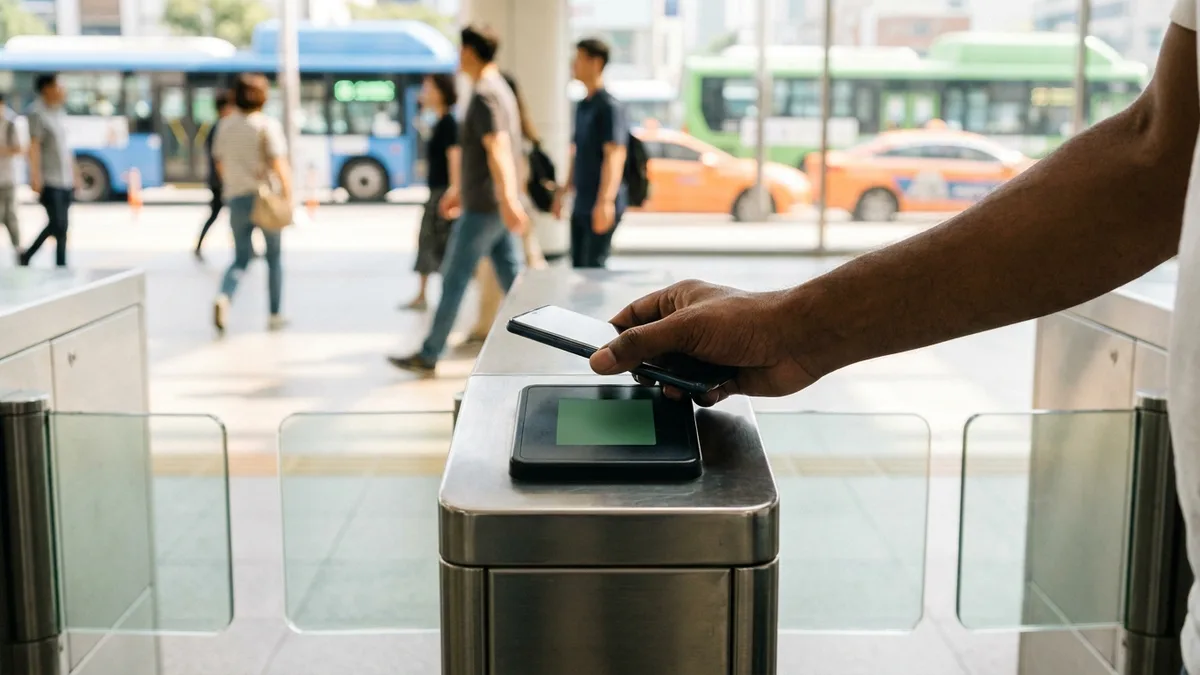

The place where TmoneyGO stops you isn't the install — it's the signup. On the identity verification screen for a Tmoney integrated membership, you get four options: Toss, KakaoBank, mobile phone, and i-PIN (confirmed at the Tmoney Login Center, 2026-08), and all four assume an identity created in Korea. Phone verification needs a line opened in your own name with a Korean carrier, Toss and KakaoBank need a Korean financial account, and i-PIN asks for a resident registration number or an alien registration number. If you don't have a Korean number, all four boxes close at the same time.
There isn't much room to work around it inside the app, either. According to the iOS App Store listing, TmoneyGO's only supported language is Korean (developer: Tmoney Mobility Co., Ltd., confirmed 2026-08-25). On the web you could get by with browser translation, but that translation doesn't reach app screens, so the signup screen itself is hard to even read.
So you might think you can just fall back to the PC web — but that road actually got narrower recently. Kobus, the integrated express bus booking site, stopped letting non-members pay by typing in a credit or debit card number as of February 24, 2026 (Kobus Notice No. 55, "Notice on the Discontinuation of Non-Member Card Payments"). That leaves non-members with two payment options, TossPay and Naver Pay, and both require Korean identity verification to use. It isn't an alternative — it's the same wall.
The door that is open is somewhere else. Per Ministry of Land, Infrastructure and Transport announcements, as of July 17, 2024 the number of intercity bus routes bookable online from both the origin and intermediate stops grew to 2,749 (74% of all 3,700), and as of July 31, 2024 all 243 intercity bus terminals nationwide accept overseas-issued cards. Express buses and intercity buses run on different booking systems, so one side can be closed while the other stays open. Below, we'll walk through the shape of the wall and the roads that are left, in order.
Note: Everything in this article is current as of 2026-08, confirmed from the official Tmoney and Kobus pages, Ministry of Land, Infrastructure and Transport announcements, Apple App Store listings, and press coverage. Signup policies and payment methods sometimes change without notice, and the items in the "What's still unconfirmed" section below may or may not actually launch — so please re-check each official channel before you book.
"It installs fine, but I can't log in" — where exactly TmoneyGO stops you
The app's full listed name on the iOS App Store is '티머니GO - 택시 고속시외 따릉이 킥보드' (TmoneyGO — Taxi, Express and Intercity Bus, Ttareungi, Scooter). The name alone tells you what's bundled inside: taxis, express buses, intercity buses, public bikes, and kick scooters, all in one app. That's why getting blocked here doesn't feel like losing one option — it feels like five boxes disappearing at once.
The places where you get stuck fall into three groups.
- Signup identity verification — you have to pick one of Toss, KakaoBank, mobile phone, or i-PIN to move to the next step.
- App language — the App Store listing shows exactly one supported language: Korean.
- Payment methods — Tmoney has stated that its integrated transit app TmoneyGO will continue to accept only cards issued in Korea (reported by The Korea Herald, 2026-07-01).
The third one matters most. The first two are problems that can unlock once you meet the conditions, but the third is a policy the operator has announced. It means the path that ends inside the app is closed by policy, not by technology — so even if you get through signup, you can get stopped again at the payment step.
Caution: We couldn't confirm in this research whether TmoneyGO requires an alien registration number, or at which stage an overseas-issued card gets rejected — registration, authorization, or 3D Secure. What we did confirm is that there are four identity verification methods, and the card policy the company stated.
What the wall actually is: the four Tmoney integrated-member verification methods
Open the signup identity verification screen at the Tmoney Login Center and you'll see four choices. Once you look at what each one actually presupposes, it becomes clear why all four close at the same time.
| Verification method | What it actually requires | If you have no Korean number or account |
|---|---|---|
| Phone verification | A line opened in your own name with a Korean carrier | Can't proceed until the line is opened |
| Toss | An account linked to a Korean financial account | Opening an account comes first |
| KakaoBank | A Korean bank account | Opening an account comes first |
| i-PIN | A resident registration number or alien registration number | Can't proceed until the number is issued |
They look like four separate paths, but there are really only two roots: either a Korean phone line in your name, or a Korean financial or administrative identity. If you've just arrived or you're waiting for your alien registration card, you probably have neither yet — which is why "surely at least one of them will work" doesn't hold up. We've put together a separate rundown of what does and doesn't work during the wait for your card in Everything you can do without identity verification.
The thought that comes up a lot here is, "So why not just get an i-PIN?" We won't recommend that in this article. The i-PIN issuance process itself is understood to loop back and ask for a phone line in your own name or a joint certificate, and we weren't able to pin down the foreigner eligibility requirements for each i-PIN issuer with primary sources this time (needs confirmation). The public i-PIN site also didn't respond when we tried to check it.
If you're wondering whether you can actually create a Toss or KakaoBank account, read Toss and KakaoBank signup requirements for foreigners first. Just keep the order in mind: opening a bank account usually requires an alien registration card, and that card doesn't arrive right after you land. Even when you try to route around it by signing up for something, that signup asks for identity verification again — and the loop closes.
📌 Note: The screen we checked directly showed four options, but cached versions still in search engines sometimes appear with only three, without Toss. The layout can differ depending on when you look, so pay less attention to the exact count and more to the nature of it: all four assume a Korean identity.
The app supports only Korean — and browser translation doesn't work on apps
People who've lived in Korea a while are used to getting by on the web with browser translation. Open a Korean page in Chrome or Safari, turn translation on, and even the button labels become readable. That trick doesn't work on apps, though. Browser translation only applies to web pages.
TmoneyGO's iOS App Store listing shows Korean as the only supported language (confirmed 2026-08-25). We weren't able to confirm the Android version's supported languages because the Google Play page lookup failed in this research, so if you're on Android, please check the store listing yourself (needs confirmation).
What's interesting is that the same company's websites are multilingual. The Kobus integrated express bus booking site offers four languages — Korean, English, 中文, and 日本語 — and Tmoney's integrated intercity bus booking site (txbus.t-money.co.kr) offers the same four. In short: the multilingual support is on the web, not in the app.
Tip: If you're stuck on an app screen, moving over to the same company's website is faster. The screen is bigger, there's a language switcher, and if that fails you still have browser translation as a last resort.
In February 2026, the PC web workaround actually got narrower — Kobus ended direct card entry for non-members
This is the most recent change in this article, and the point where the guidance floating around the internet is most out of date.
Through Notice No. 55, "Notice on the Discontinuation of Non-Member Card Payments" (posted February 24, 2026), Kobus stopped accepting payments where non-members type in a credit or debit card number directly on the PC or mobile web. As a result, non-members are left with two payment methods: TossPay and Naver Pay. Both are services you can only use with an account that has completed Korean identity verification, so for someone without a Korean number, the options have effectively vanished.
There's one more obstacle at the ticket pickup stage. After a non-member books with a simple-pay service, collecting the ticket at a counter or a self-service kiosk requires your mobile number plus the 6-digit date of birth you entered when booking, or your mobile number plus the 8-digit departure date. Since the lookup key starts with a mobile number, even a successful payment means one more check on site. The Kobus booking guide also notes that non-members can only book one-way tickets.
Caution: You can still find guidance in plenty of places saying "if you enter a card number on the Kobus website, overseas cards work too" — but that reflects the situation before February 24, 2026. Per the notice, direct card-number entry for non-members has been discontinued (we weren't able to confirm the actual payment screen layout in this research). The overall English booking flow is covered in our English guide to booking express buses.
What the bank transfer alternative demands: a joint certificate, ActiveX, and Internet Explorer
When cards are blocked, the official guidance points to bank transfer. But read the conditions and it turns out to be hard to pull off — not just for foreigners, but for Korean users these days too.
The Kobus payment methods page, in both Korean and English, is organized into four categories: credit card payment, bank transfer, Freepass and commuter passes, and premium mileage. And the English version contains this sentence, word for word: "Bank transfer is available in the Internet Explorer browser environment." To use bank transfer you have to install a joint certificate and ActiveX, and there's an additional condition that you can't book round-trip tickets by bank transfer.
| Kobus payment method | Conditions stated in the guidance | If you have no Korean identity |
|---|---|---|
| Credit card payment | Non-members can't enter a card number directly as of 2026-02-24; membership requirements not confirmed this time (needs confirmation) | Blocked for non-members, member route unverified |
| Bank transfer | Joint certificate and ActiveX installation, Internet Explorer environment, no round-trip booking | Even with a Korean account, the environment requirements get in the way |
| Freepass / commuter pass | A product for regular riders | Not applicable when you're buying a single ticket |
| Premium mileage | A separate item in the guidance | Not applicable for a first-time user |
Read the table vertically and the structure comes into focus. Among the four paths the official guidance offers, we couldn't confirm a single box a one-off traveler can pass through as a non-member. Whether signing up as a Kobus member opens up card payment, and what that signup requires, we weren't able to confirm in this research (needs confirmation). What's left right now is buying at the counter, or the intercity bus routes we'll cover below. That said, we weren't able to confirm whether express bus terminal counters accept overseas-issued cards (needs confirmation), so if you're heading to a counter, we'd suggest bringing cash as well.
The doors Tmoney opened separately for foreigners — Mobile Tmoney 'Foreigner', InterCity Bus, and the multilingual booking sites
There's one thing that's easy to get confused about here: even within the same Tmoney brand, the policy toward foreigners is the opposite from one channel to the next. The names are similar, so if you download whichever app you happen to find, you're guaranteed to get lost.
The Ministry of Land, Infrastructure and Transport announcements explicitly state that 'InterCity Bus' is an intercity bus booking app Tmoney built specifically for foreigners. And indeed, the iOS listing shows English as this app's only supported language. However, the latest version, 1.1, came out on May 25, 2020, and there's been no update record since (confirmed 2026-08-25). A door existing and a door being maintained are two different things. We'd suggest checking the store's recent reviews and listing details before you install.
| Tmoney-family channel | Languages | Status confirmed as of 2026-08 |
|---|---|---|
| TmoneyGO app | Korean only | Stated policy of continuing to accept only Korean-issued cards (reported 2026-07-01) |
| InterCity Bus app | English | Built specifically for foreigners, but no updates since 2020-05-25 |
| Intercity bus booking site (txbus) | Korean, English, Chinese, Japanese | Four languages offered |
| Kobus site (express buses) | Korean, English, Chinese, Japanese | Direct card-number entry for non-members discontinued (2026-02-24) |
| Mobile Tmoney family of apps | A separate guidance path for foreigners exists | Whether it currently works is unverified |
Transit cards are a different story again. Tmoney maintains separate app routes built for people without a Korean carrier USIM, but we couldn't establish whether those apps still work properly today. We've laid out the details in three branches in How to use a Korean transit card on an Android phone.
For reference, the bottom of the English Kobus main page carries an official Klook booking banner reading 'Book Korea Express Bus Tickets on Klook'. We haven't verified the payment or refund process on that route, so just take it as a fact that such a banner exists on the official page.
Intercity buses already opened up to overseas cards back in 2024 — 243 terminals, 2,749 routes
While the express bus side has been narrowing, the intercity bus side opened its doors two years ago. Per Ministry of Land, Infrastructure and Transport announcements, three things changed.
- As of July 17, 2024, the number of intercity bus routes bookable online from both the origin and intermediate stops grew from 1,500 (41% of all 3,700) to 2,749 (74%).
- As of July 31, 2024, all 243 intercity bus terminals nationwide began accepting overseas-issued cards (Visa, Mastercard, JCB, UnionPay) for both on-site ticketing and online booking.
- As of August 16, 2024, the eZL and Tmoney systems were linked, so you can search every route and pay with an overseas card from either app — Bustago or InterCity Bus.
The third item matters most in practice. It used to be that the routes you could search differed by app, so "this app doesn't have this route" came up all the time, and that split is gone. That said, we weren't able to confirm this time whether non-members can pay with an overseas card on the PC web (needs confirmation). What we verified as open applies to the apps and to terminals on site.
The whole flow of buying a ticket at a terminal and getting on the bus is covered in our guide to using and booking intercity bus terminals. It also includes how to tell express buses from intercity buses, seat classes, and refund rules.
📌 Note: Express buses and intercity buses have different operators and different booking systems. So the fact that the intercity side opened up doesn't automatically apply to express buses. If your destination can be reached either way, the intercity bus route currently runs into fewer payment roadblocks.
What's still unconfirmed — the Kobus overseas card announcement and the WOWPASS tie-up
There are two things that have been announced as possible changes. Neither has been confirmed as actually launched, so please read them as plans only.
The first is express buses. According to The Korea Herald's July 1, 2026 report, Tmoney stated that starting in August 2026 you would be able to buy express bus tickets on the Kobus website with an overseas-issued card without signing up for an account, and that it was preparing to introduce the same for intercity buses with a September target. However, as of 2026-08-25 the most recent post on the Kobus notice board was dated May 17, 2026, so we couldn't find a launch announcement. In the same statement, Tmoney said the TmoneyGO app will continue to accept only Korean-issued cards.
The second is the WOWPASS tie-up. On August 14, 2026, Tmoney Mobility and Orange Square, the operator of WOWPASS, signed a memorandum of understanding on mobility and payment cooperation for foreigners (reported by VentureSquare and Edaily, 2026-08-14). The plan is to connect TmoneyGO services into the WOWPASS app in stages, starting with taxi hailing and moving on to express and intercity bus booking, e-bikes and kick scooters, and travel and charter bus reservations. But it's at the MOU stage, so the actual launch timing and scope haven't been disclosed.
Let us also list the items we ultimately couldn't pin down in this research: the actual payment screen layouts on Kobus and txbus, whether express bus terminal counters accept overseas-issued cards, what Kobus membership signup requires, whether TmoneyGO demands an alien registration number, the foreigner eligibility requirements at each i-PIN issuer, and whether the InterCity Bus app currently works. Writing "it works" about something we haven't confirmed costs readers time at the terminal. So this article only states things definitively within what we verified.

If you need to buy a ticket right now — sorted by situation
Here's the summary. Set aside the plan to do everything in one app, and it's faster to split the route by what you're trying to buy.
| What you're buying | Confirmed route (as of) | Where it gets stuck |
|---|---|---|
| Express bus | Ticketing at the terminal counter (we couldn't confirm in this research whether counters accept overseas-issued cards · bringing cash recommended), the multilingual Kobus site (non-members can only use simple pay · per official Kobus guidance, 2026-08) | Direct card-number entry discontinued for non-members, ticket lookup key is a mobile number |
| Intercity bus | On-site ticketing at 243 terminals, overseas card payment in the Bustago and InterCity Bus apps — per MOLIT announcements, 2024-07 to 08 | The PC web non-member route is unverified, InterCity Bus hasn't been updated since 2020 |
| Transit card | Buying a physical card, app routes that don't look at your USIM | Whether topping up with an overseas-issued card gets approved needs separate confirmation |
| Taxi | Hailing apps like Kakao T | Identity verification and payment method requirements were outside the scope of this research, so please check the app's official guidance (needs confirmation) |
| LACHA | KTX, express buses, taxis, the Airport Railroad, vans (5–6 seaters), transit cards | Doesn't cover intercity buses, Ttareungi, kick scooters, rental cars, ferries, or flights |
Let us explain that last row a little more. Of the five boxes TmoneyGO bundles into one app, only two overlap with LACHA: taxis and express buses. Intercity buses, Ttareungi, and kick scooters aren't replaced by LACHA, so you'll want to look at the other rows above. LACHA is a transit and payment super app for foreigners that you can use right away without identity verification — it's designed so that no identity check is required as part of the official process, which means you can get started even during the stretch when you don't have a Korean account or phone number yet. You pay with an overseas-issued card or an overseas simple-pay service like Alipay or WeChat Pay. Lock in your express bus, taxi, and KTX legs in one place, and you can handle the rest at the counter.

Want to search and book KTX and express buses in one app? Check out LACHA.
Built to work without a Korean phone number or bank account, with overseas payment methods like Alipay, WeChat Pay, and Apple Pay. Taxi hailing plus KTX, express bus, and airport railroad (AREX) booking — all in one app.
Up to 60% off Korea transit with a coupon (max ₩3,000): enter code at sign-up. KTX gets up to 18% off on top
Download now


Frequently Asked Questions (FAQ)
Q1. Can I not sign up for TmoneyGO without a Korean phone number? The identity verification methods you can choose on the signup screen are Toss, KakaoBank, mobile phone, and i-PIN — four in total — and all four assume a Korean identity. Phone verification needs a line in your own name with a Korean carrier, Toss and KakaoBank need a Korean financial account, and i-PIN needs a resident registration number or an alien registration number. So we couldn't confirm any box you can get through with neither a Korean number nor a Korean account. We weren't able to establish with primary sources how far i-PIN issuance goes with an alien registration number (needs confirmation), so please re-check with the issuers' official guidance.
Q2. Can I pay on the Kobus site by entering an overseas card number? As of February 24, 2026, non-members can't. Kobus Notice No. 55 discontinued payments where non-members type in a credit or debit card number directly on the PC or mobile web, and the remaining non-member payment methods are TossPay and Naver Pay. Both require an account that has completed Korean identity verification. The "just enter your card number" guidance still floating around the internet reflects the situation before this change.
Q3. Can I use the bank transfer option shown in the official guidance? The conditions are demanding. The English Kobus guidance states, "Bank transfer is available in the Internet Explorer browser environment," and it also requires installing a joint certificate and ActiveX. You also can't book round-trip tickets by bank transfer. Even if you have a Korean bank account, it's hard to even get started if you're in an environment where you can't use Internet Explorer.
Q4. I hear intercity buses take overseas cards — so why not express buses? Because the two run on different systems. For intercity buses, per Ministry of Land, Infrastructure and Transport announcements, overseas-issued card payment (Visa, Mastercard, JCB, UnionPay) opened up at all 243 terminals nationwide as of July 31, 2024, and as of August 16, 2024 the eZL–Tmoney system linkage made it possible to search and pay for every route from any of the apps. Integrated express bus booking (Kobus) is a separate system, so that opening doesn't apply to it automatically.
Q5. I saw an article saying overseas cards will work on Kobus starting August 2026. That's a plan Tmoney announced, carried in The Korea Herald's July 1, 2026 report. The content was that you would be able to buy express bus tickets with an overseas-issued card without signing up for an account, with intercity buses targeted for September. But as of 2026-08-25 the most recent post on the Kobus notice board was dated May 17, so we couldn't confirm a launch announcement. Please re-check the Kobus notice board to see whether it actually opened. In the same statement, Tmoney said the TmoneyGO app will continue to accept only Korean-issued cards.
Note: This article is intended as general information. The signup procedures, payment methods, and effective dates in the text are current as of 2026-08, confirmed from the Tmoney Login Center, the Kobus notice board and payment methods guidance from the Korea Express Bus Transport Association (effective date of the discontinuation of direct card entry for Kobus non-members: 2026-02-24), Tmoney's integrated intercity bus booking site (txbus.t-money.co.kr), Ministry of Land, Infrastructure and Transport policy briefings (expansion of online-bookable intercity bus routes 2024-07-17 · opening of 243 terminals to overseas cards 2024-07-31), Apple App Store listings, and reports from The Korea Herald on 2026-07-01 and VentureSquare and Edaily on 2026-08-14. App signup policies and payment methods change without notice, and the items marked "needs confirmation" in the text (whether Kobus overseas card payment has launched, Kobus membership signup requirements, i-PIN eligibility requirements for foreigners, the Android version's supported languages, whether the InterCity Bus app currently works, overseas card payment for non-members on the PC web, whether express bus counters accept overseas cards, and the identity verification and payment method requirements of taxi hailing apps) haven't been established with primary sources yet. Please be sure to re-check each operator's official channels before you book.