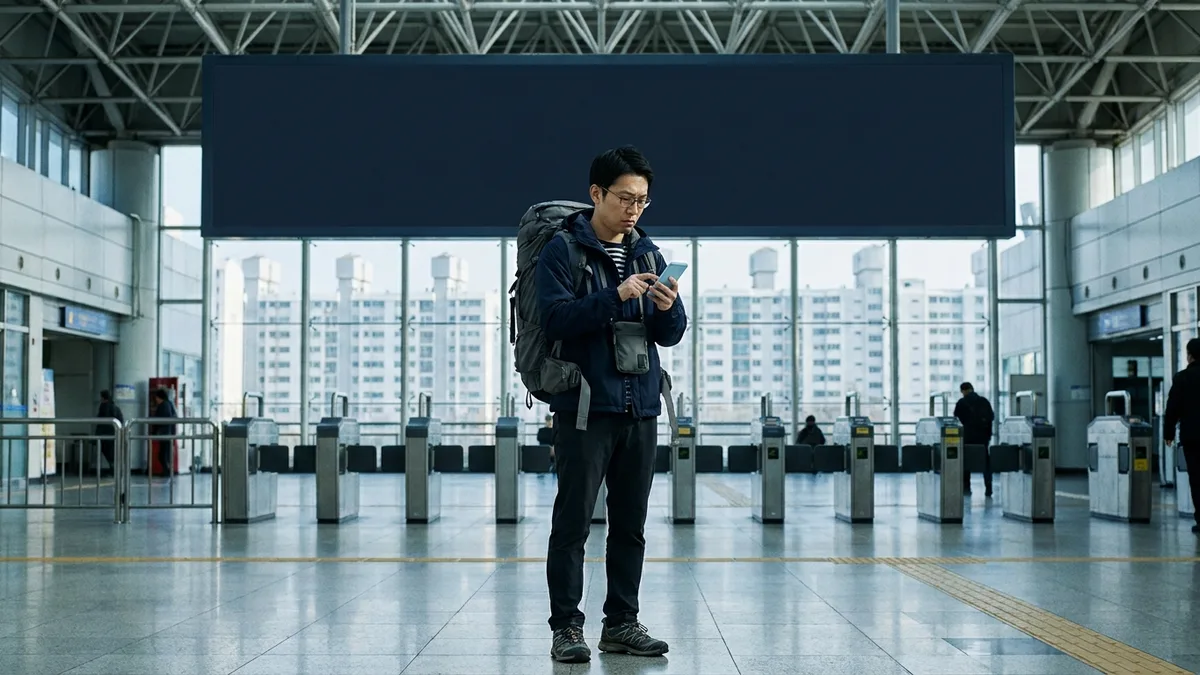
When you first see news of a strike, it's easy to read it as "there won't be any trains at all tomorrow." In reality, a considerable share of railway and subway service keeps running as usual. That's because the Trade Union and Labor Relations Adjustment Act (노동조합 및 노동관계조정법) groups railways and urban railways together as essential public services and separately specifies work that must not stop even during a strike.
Buses, on the other hand, aren't on that list. So even though the same word "strike" is used, the exact opposite happens: most subways keep running while almost all city buses stop. If you don't know this difference, you may spend hours trying to catch a taxi while trains are running just fine, or keep waiting at a bus stop for a bus that isn't coming.
This article doesn't forecast or analyze any particular strike. Based on the law and official announcements, it covers what matters when a strike happens: ① what keeps running ② whether your route is affected ③ what happens to tickets you've already bought ④ in what order to line up alternatives ⑤ where to ask if you don't speak Korean.
Note: Legal provisions are based on the National Law Information Center, and operating rates and refund measures on official announcements from Korea Railroad Corporation (Korail), the Ministry of Land, Infrastructure and Transport (MOLIT), the Seoul Metropolitan Government, and Seoul Metro, as of 2026-09. Service levels and refund measures differ with each strike, so be sure to check again on each organization's official channels before you travel.
Not everything stops in a strike — the "essential maintenance services" system
It helps to learn the name first. The system is called essential maintenance services (필수유지업무).
Article 42-2(1) of the Trade Union and Labor Relations Adjustment Act defines them as "among the work of essential public services, work whose stoppage or discontinuation would significantly endanger the life, health, or physical safety of the public, or the daily life of the public." In other words, it's a list, chosen in advance, of work that puts people at risk if it stops.
The key part is paragraph 2 of the same article. It states firmly that "acts that stop, discontinue, or obstruct the proper maintenance and operation of essential maintenance services may not be carried out as industrial action." This means this work has to keep going even after a strike begins, and the National Labor Relations Commission likewise explains that essential public services must maintain a certain level of service even during a strike.
What falls under this for railways and urban railways is listed as seven items in [Appended Table 1] of the Enforcement Decree of the same Act: driving the trains, traffic control of train operations (including operation handling at stations and depots), maintenance and management of electrical, signaling, and communication facilities and equipment, routine inspection and maintenance of trains needed for safe operation, and track inspection and repair.
However, this list names work items, not operating rates. The law doesn't set a number like "run X percent of trains." Article 42-3 has labor and management set "the minimum necessary level of maintenance and operation, the target duties, and the required personnel" in a written agreement, and Article 42-4 provides that if they can't agree, they apply to the Labor Relations Commission (its special mediation committee of three public-interest members) for a decision. That's why operating rates differ by operator, and from strike to strike, even for what's called the same "subway strike."
There are also Article 43(3) and (4). For essential public services only, they allow hiring or substituting outside workers, and subcontracting, during industrial action within a limit not exceeding 50 percent of the workers taking part in the strike. This is why actual operating rates come out higher than the minimum level in the agreement.
Railways and subways vs. buses: the law treats them differently
This is the most practical part of this article. Essential maintenance services don't apply just anywhere.
Article 71(2) lists only five essential public services: ① railway, urban railway, and air transport businesses ② water, electricity, gas, oil refining, and oil supply businesses ③ hospital and blood supply businesses ④ the Bank of Korea ⑤ telecommunications. Buses aren't on it.
Buses (scheduled-route passenger transport businesses) fall under "public services" in Article 71(1) but not under "essential public services." The Seoul Metropolitan Government officially explained that, unlike railways and urban railways, city buses aren't designated as essential public services under the Trade Union Act, so they have no obligation to keep a minimum operating rate, and the structure allows a full strike.
| Mode | Essential public service? | What actually happens in a strike |
|---|---|---|
| KTX, Saemaeul, Mugunghwa and other railways | Yes (Article 71(2), item 1) | Service level maintained through agreements or Labor Relations Commission decisions |
| Subways and metropolitan commuter rail (urban railways) | Yes (Article 71(2), item 1) | Morning and evening rush hours in particular are prioritized |
| Air | Yes (Article 71(2), item 1) | Item 2 of Appended Table 1 of the Enforcement Decree lists check-in, security screening, piloting, cabin crew duties, maintenance, and more |
| City, intercity, and express buses | No (public service only) | No minimum service obligation, so a full strike is possible |
The numbers make the difference even clearer. From its records on the day of the March 2024 city bus strike, the Seoul Metropolitan Government officially announced that city bus service ran at 4.4% (from the first bus until noon), with 95% or more of buses stopped. That's a whole different order of magnitude from the 70–100% range seen on railways and subways. Prompted by this, the Seoul Metropolitan Government proposed amending the law to designate city buses as an essential public service, so this is also an area where the system could change.
Caution: For air travel, staffing ratios of 80% for international flights, 70% for Jeju routes, and 50% for domestic mainland routes are often quoted, but these numbers aren't written in the text of the law. Appended Table 1 of the Enforcement Decree only lists work items, and the ratios are reported to be set by Labor Relations Commission decisions or labor-management agreements. Check flights through the airline's notices.
How much actually kept running in past strikes
The system alone doesn't give you a feel for it, so let's look at the numbers left in official announcements, together with when they were issued. The figures below are the plans for those specific strikes. There's no guarantee the same level will be maintained in the next strike.
| Train type | December 2024 strike plan | December 2025 strike plan |
|---|---|---|
| Seoul-area and metropolitan commuter rail | 75% (76% per MOLIT), 90% or more during the 07:00–09:00 morning rush | Required operating rate 63% (Labor Relations Commission decision) → target 75.4% |
| KTX | 67% (75% including SRT) | No separate figure announced |
| Saemaeul | 58% | No separate figure announced |
| Mugunghwa | 62% | No separate figure announced |
| Freight trains | 22% | No separate figure announced |
Two things are worth pointing out.
First, rush hours are managed separately. For the December 2024 strike, the Ministry of Land, Infrastructure and Transport said it would adjust metropolitan commuter rail to 76% of normal levels, but run it at 90% during the morning rush (07:00–09:00; 95% on Line 1 and the Suin-Bundang Line) and 85% during the evening rush (18:00–20:00). That means daytime service is cut more, so during a strike, the morning rush hour can actually be more reliable than midday.
Second, the floor set by the Labor Relations Commission and the target the company sets are different. Because Korail and its union couldn't conclude an agreement in 2008, the Chungnam Regional Labor Relations Commission decided the essential maintenance levels, setting Seoul-area commuter trains at 63% of normal service. Korail said that in December 2025 the required operating rate for metropolitan commuter rail was around 63%, but it planned to raise that to 75.4% by bringing in additional internal replacement staff, military personnel, and others. This is the replacement-worker provision of Article 43 in action.
Just because the average is in the 70s doesn't mean your line will be. In the same announcement, rates by line varied: Gyeonggang Line 73.0% (89.5% during the morning rush), Daegyeong Line 76.3% (78.6%), Donghae Line 70.3% (78.6%), and Gyeongui-Jungang Line 74.0% (90.6%). It also warned that on some lines, intervals between trains could grow to anywhere from 40 minutes to as long as an hour.
How to tell whether a "subway strike" affects your route
There's one distinction that's hard to see even for Koreans. Even with the same line number, the operating company can differ by section.
Some sections of Seoul Subway Lines 1, 3, and 4 are operated by Korail, while the Seoul city sections of Lines 1–8 are operated by Seoul Metro. So a "Korail strike" and a "Seoul Metro strike" affect different sections, even on the same line. In other words, just hearing "subway strike" doesn't tell you whether your commute is affected.
Korail's metropolitan commuter rail is limited to lines such as Seoul Subway Lines 1, 3, and 4 (some sections), the Suin-Bundang Line, the Gyeongui-Jungang Line, the Gyeonggang Line, the Daegyeong Line, and the Donghae Line. And even in a Korail strike, GTX-A and the Incheon Airport Railroad (AREX) run normally because they have different operators. This one sentence is the most useful thing to know when you're looking for alternatives.
⚠️ SRT is no longer an alternative. When the merger of Korail and SR (SRT's operator) was completed on September 1, 2026, SRT was absorbed into Korail's KTX and its trains were renamed KTX-Sancheon. Older guides still contain the line "Even during a Korail strike, SRT runs normally because it's a separate company," but after the merger, trains departing from Suseo belong to the same company too. If you go by pre-merger information and plan on SRT as your backup, you could end up stranded at the station.
If the strike is on the Seoul Metro side, the standard is different again. According to the Seoul Metropolitan Government, Lines 1–8 run under the agreement at 100% during the morning rush and around 86% during the evening rush (Line 2 and Lines 5–8 at 100% during the evening rush as well), and the goal is to keep this level even if the strike lasts 8 days or longer.
So if you see news of a strike, first match up ① which company is on strike and ② which company operates the line and section you ride, then find the adjusted timetable in that company's notices. If the line structure is unfamiliar, start with Seoul Subway Complete Guide, and for the difference between trains from Suseo and trains from Seoul Station, SRT vs. KTX will get you up to speed quickly.
Where to find strike notices and suspension information
Strikes don't start out of nowhere. Article 45 bars industrial action without first going through mediation procedures (the principle that mediation comes first), and Article 54 sets the mediation period at 10 days for ordinary businesses and 15 days for public services. Railways and urban railways are public services, so there's a window of at least 15 days from the mediation request, and news reports and notices about the planned strike come out during that time.
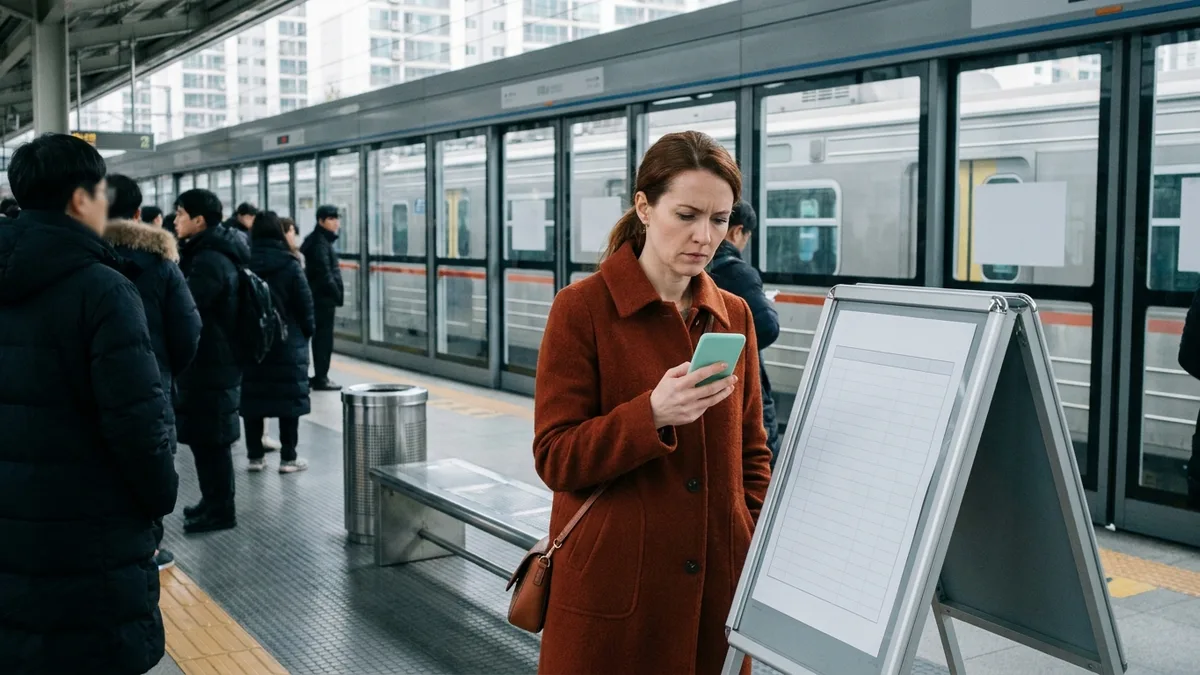
Korail has an official way to tell whether your train is suspended. Trains that don't come up in a search on the Korail+ app (formerly KorailTalk) or website are suspended trains, and the list of affected trains can be downloaded from the notices section of the website. Announcements also go out through station PA announcements, the passenger information system (TIDS), and onboard video screens.
It's also easy to mistake being unable to book for a system error. When a strike is announced, Korail restricts ticket sales for trains scheduled to be suspended in the first place. People who have already booked are notified individually; in December 2025, Korail said it would send text messages three times in total: 3 days before, the day before, and the day of travel.
Caution: The default notification route is a text message to a Korean mobile number. Without a Korean number, you won't get these texts at all. Logging into the app and turning on push notifications is a realistic alternative, but we haven't been able to confirm whether texts are also sent to accounts registered with an overseas number (unconfirmed). If you've booked, don't wait for a text; check the app yourself the day before and the day of departure. Services you can use without a Korean number are listed in Services that work without a Korean phone number.
Subways come with one more warning. In its strike notices, Seoul Metro states that the train timetables provided by various portals and the Ttota Subway app are the existing timetables and may differ from actual service, and it posts the adjusted timetables as files for each line in its notices.
📌 Important: During a strike, don't trust the timetables in Naver Map, Kakao Map, or Ttota Subway. The app may show a train that simply never comes. Use map apps only for route planning, and check whether trains are running in the operator's notices. How to use map apps is covered in How to use Naver Map and Kakao Map.
To sum up, here's where to check.
| Channel | What you can find there | Foreign languages |
|---|---|---|
| Korail+ app | Look up your train (not shown = suspended), push notifications, booking, refunds | 7 languages (which ones hasn't been disclosed) |
| Korail website notices | Suspended train list files, refund measure announcements | English and Chinese notices posted separately (whether attachments are translated is unconfirmed) |
| Seoul Metro notices | Adjusted timetables for Lines 1–8 (attached files per line) | English, Chinese, and Japanese pages |
| Seoul TOPIS (topis.seoul.go.kr) | Real-time bus and subway traffic information, strike countermeasures | English page |
| MOLIT press releases (Korea Policy Briefing) | Government transport measures, overall operating rate plans | Mainly Korean |
If it's a bus strike, Seoul adds more channels. The Seoul Metropolitan Government said it would provide information through TOPIS, the 120 Dasan Call Center (02-120), the Seoul city website and social media, roadside electronic signs, and the bus information terminals (BIT) at bus stops.
What happens to tickets you've already bought
Let's start with trains. The measures Korail took during strikes fell into three categories.
- Return and change penalties waived during the strike-notice period — In December 2024, Korail said that returning or changing a ticket during the notice period would be penalty-free on all trains, and in December 2025 it also waived refund penalties for suspended trains
- Suspended trains refunded in full, all at once, with no application needed — This means you get your refund even if you do nothing
- Tickets bought with cash are the exception — Cash-purchased tickets for suspended trains must be refunded at a nearby station within one year. They aren't refunded automatically
Caution: The three measures above aren't rights guaranteed by law; they're measures Korea Railroad Corporation implemented through a separate notice for each strike. Don't assume they'll apply the same way in the next strike. If you hold a ticket, the right move is to open that strike's notice and check for yourself. Regular refund rules and penalty calculations are covered in KTX seat classes and refund rules.
If you paid with an overseas card, card company settlement adds a few more days even after the refund is processed. Common sticking points for foreigners on Korail's booking and refund screens are collected in Problems foreigners run into on the Korail app.
Buses are a different story. There's no nationwide common refund rule for suspended bus services. Under Article 9 of the Passenger Transport Service Act and Article 30, item 3 of its Enforcement Rule, matters concerning the collection and refund of fares and charges are set out in the terms of carriage each transport operator has filed. That means how cancelled runs are handled can vary by company and route. For reference, the regular cancellation fees on the integrated express bus booking system (Kobus) are tiered: 0% two days before departure, 5% from one day before to 3 hours before (7.5% on Fridays through Sundays and public holidays, 10% during major holidays), and 10% from 3 hours before until departure (15% and 20%, respectively).
📌 Important: However, we couldn't confirm on an official information page how the integrated booking system handles tickets when express or intercity buses are cancelled because of a strike (unconfirmed). The fees above are the standard for regular cancellations, not compensation for cancelled runs. If a bus strike affects you, asking the bus company or terminal directly is the surest route. If the booking screens are unfamiliar, see How to book express buses in English.
The order for finding alternative transportation
There's one principle. Start by looking for a different company and a different mode from the one that stopped.
If the trains have stopped, here's the order.
- A different operator on the same route — GTX-A and AREX aren't affected by a Korail strike (SRT became part of Korail in the September 2026 merger). Seoul subways also split by the operator of each section
- Express buses — The government said it would run a joint government transport task force to make up for the shortfall in trains with express, intercity, and city buses, and add extra express and chartered buses depending on congestion
- Taxis and VANs — The last option. The Ministry of Land, Infrastructure and Transport also announced a temporary measure allowing taxis from Seoul, Incheon, and Gyeonggi to operate outside their licensed business areas
Keep your expectations low for the third one. During a strike, demand surges and taxis actually become harder to get. That's exactly why the government had to boost supply by even allowing taxis to operate outside their business areas. If you're traveling in a group, looking into 5- or 6-seat VANs as well will save you time.
If buses have stopped, flip the order. Subways and shuttles come first. As countermeasures for city bus strikes, the Seoul Metropolitan Government added 172 to 189 extra subway runs a day, extended the last trains to 2 a.m. the next day, and deployed free shuttle buses in large numbers (625 buses on 117 routes in May 2025; 670-odd public and private vehicles in January 2026).
| Situation | Check first | Next | Good to know |
|---|---|---|---|
| Korail strike | GTX-A, AREX, Seoul Metro sections | Express buses | SRT is now the same company after the merger. Morning rush service runs at a higher rate than midday |
| Seoul Metro strike | Korail sections, Line 9 and other operators | Buses, taxis | The target is around 100% in the morning rush and 86% in the evening rush |
| City bus strike | Extra subway runs, free shuttles | Taxis | No minimum service obligation, so nearly all buses can stop |
| Getting to the airport | AREX, airport buses | Taxis, VANs | Leave much more time than usual |
Be especially careful when heading to the airport. AREX isn't affected by a Korail strike, but getting from central Seoul to the station can be the part that gets blocked. The difference between express and all-stop trains is in AREX Express vs. All-Stop: which ticket to choose, and bus options are in How to use airport limousine buses.
If you use LACHA, you can book your alternatives in one app. It covers five services: taxis, KTX, express buses, VANs (5- and 6-seaters), and the airport railroad, and you can pay with overseas payment methods without a Korean bank account or mobile phone identity verification. It doesn't cover city buses, subways, or intercity buses, so check those on TOPIS and Seoul Metro's notices.
Where to ask even if you don't speak Korean
If you can't read Korean notices, you're cut off from the information entirely, but many people don't know there are two multilingual help lines.
The Korea Tourism Organization's 1330 Travel Hotline can be reached by dialing 1330 with no area code within Korea, or +82-2-1330 from overseas. Besides phone calls, it also works through 1330 Messenger, KakaoTalk, LINE, and Facebook chat. Its services include tourist interpretation (connecting a three-way interpreter on the spot), so if you can't understand the Korean explanation at a station counter, you can ask for interpretation.
The Seoul 120 Dasan Call Foundation offers counseling in five languages (English, Chinese, Japanese, Vietnamese, and Mongolian), and its scope includes transportation information. However, it's only available on weekdays from 09:00 to 18:00 (excluding weekends and public holidays), so you can't get through at night or on weekends.
- How to use it: within Korea, dial (02)120 → press 9 → choose a language; from overseas, call +82-2-731-2120. It can add a three-way interpreter if needed
- 1330's hours depend on the language. Korean, English, Japanese, and Chinese are available 24 hours a day, year-round, while Russian, Vietnamese, Thai, and Malay/Indonesian are available 08:00–19:00. Strike notices often come out at night, so check the hours for your language in advance
It's also good to know the operators' customer centers. The Korail customer center is 1588-7788 (charged to the caller), and Seoul Metro's main number is 1577-1234. Whether they offer multilingual support may vary over time, so if Korean is difficult, use 1330's interpretation alongside them. If residency issues are also involved, see How to get help from your embassy in Korea as well.
Even after a strike ends, service isn't back to normal that same day
This last point is the one people miss most often. Don't go back to your original plans for that day just because you saw news that the strike ended.
On the day the 2019 strike ended, Korail said Seoul-area rail would run at normalized levels from the first train, while KTX and conventional trains would return to normal in stages. The actual operating rates that day were high-speed 80.5%, conventional 74.4%, metropolitan 99.9%, and freight 35.2%. In other words, metropolitan commuter rail was almost back to normal, but KTX and conventional trains were still running at only 70% to just over 80%. In December 2025 too, Korail announced a phased return to normal after training returning staff and adjusting schedules.
So even if you've seen news that the strike is over, look up your ticket for that day again in the app. If it doesn't come up, that train is still suspended. For plans you can't afford to miss, like getting to the airport or a job interview, book a train one departure earlier, and leave more buffer time than usual through the day after the strike ends.
If it overlaps with a period when tickets are scarce anyway, like major holidays, recovery is even slower. Holiday booking rules are in Booking train tickets for Seollal and Chuseok, and if you need to rework your whole schedule, Planning transportation for your Korea itinerary can help.
Want to search and book KTX and express buses in one app? Check out LACHA.
Built to work without a Korean phone number or bank account, with overseas payment methods like Alipay, WeChat Pay, and Apple Pay. Taxi hailing plus KTX, express bus, and airport railroad (AREX) booking — all in one app.
KTX now up to ₩10,000 off. Enter code at sign-up for 3,000P on top
Download now


Frequently Asked Questions (FAQ)
Q1. If there's a rail strike, do all trains stop? No. Article 42-2(2) of the Trade Union and Labor Relations Adjustment Act provides that stopping, discontinuing, or obstructing essential maintenance services can't be done as industrial action, so railways and urban railways keep running at a certain level even during a strike. However, that floor isn't set as a number by law; it's determined by agreements at each workplace or by Labor Relations Commission decisions. At Korail, the 63% for Seoul-area commuter trains set by the Labor Relations Commission in 2008 was still the floor in the 2016 and 2025 strikes; what changes from strike to strike is the planned operating rate the company sets by adding replacement staff on top of it. Korail's planned operating rates in December 2024 were Seoul-area rail 75%, KTX 67%, Saemaeul 58%, and Mugunghwa 62%, and in December 2025 it announced it would lift metropolitan commuter rail from the required operating rate of 63% set by the Labor Relations Commission to 75.4% by bringing in replacement staff. Don't apply these numbers as-is to the next strike.
Q2. Why are subways running but no buses coming at all? Because the law treats them differently. The list of essential public services in Article 71(2) of the Trade Union Act includes railway, urban railway, and air transport businesses, but not buses. The Seoul Metropolitan Government also explained that because city buses aren't designated as an essential public service, they have no obligation to keep a minimum operating rate and a full strike is possible. In fact, on the day of the March 2024 Seoul city bus strike, the operating rate was 4.4% from the first bus until noon. If a bus strike is announced, look into the subway and free shuttles first.
Q3. What happens to a KTX ticket I've already bought? Do I have to apply for a refund? Based on the measures Korail took during past strikes, tickets for suspended trains were refunded in full all at once, without a separate refund application. Penalties for returning or changing tickets during the strike-notice period were also waived. However, tickets bought with cash aren't refunded automatically and must be refunded at a nearby station within one year. These measures aren't rights guaranteed by law but were implemented by Korail through a separate notice for each strike, so be sure to check the notice at the time.
Q4. How do I check whether my train is running? I don't have a Korean phone. Looking it up yourself on the Korail+ app or website is the surest way. Korail has officially stated that trains that don't come up in a search are suspended, and the list of suspended trains can be downloaded from the notices section of the website. Individual notifications go out by text message three times (3 days before, the day before, and the day of travel), but they're hard to receive without a Korean number, so log into the app, turn on push notifications, and check for yourself the day before and the day of departure. The Ministry of Land, Infrastructure and Transport said the integrated app supports 7 languages but hasn't disclosed which ones, so check in the app whether your language is available.
Q5. Naver Map says a train is coming, so why isn't it? Because map apps and timetable apps aren't updated during a strike. In its strike notices, Seoul Metro states that the train timetables provided by various portals and the Ttota Subway app are the existing timetables and may differ from actual service, and it posts the adjusted timetables as files for each line in its notices. Use map apps only to check routes, and look at the operator's notices for whether and when trains are running. If Korean notices are hard to read, you can ask 1330 (1330 within Korea, +82-2-1330 from overseas) by phone or chat.
Note: This article is for general information purposes. Legal provisions are based on the Trade Union and Labor Relations Adjustment Act, its Enforcement Decree, and the Enforcement Rule of the Passenger Transport Service Act on the National Law Information Center; operating rates and refund measures on announcements from Korea Railroad Corporation (October 2019, December 2024, December 2025), the Ministry of Land, Infrastructure and Transport (December 2024), the Seoul Metropolitan Government, Seoul Metro, and the National Labor Relations Commission; multilingual help lines on the Korea Tourism Organization and the 120 Dasan Call Foundation; and cancellation fees on the integrated express bus booking guide, all as of 2026-09. All operating rates in this article are planned or actual figures from specific strikes, so there's no guarantee the same levels will hold in the next strike, and penalty waivers and automatic full refunds were measures Korea Railroad Corporation implemented through a separate notice for each strike. We couldn't obtain primary sources for the following, so we haven't given figures on them: whether Korail's notification texts also go to overseas numbers; when English and Chinese notices are posted and whether their attachments are translated; how the integrated booking system handles express and intercity bus cancellations; operating rates and foreign-language information channels for urban railways outside Seoul; and compensation standards for commuter passes and the KORAIL PASS during strikes. For matters requiring interpretation of labor laws, check with the relevant authorities such as the Ministry of Employment and Labor or the Labor Relations Commission. This article is not legal advice. Before you travel, check again on the Korail+ app, Korail and Seoul Metro notices, Seoul TOPIS, and 1330. LACHA does not judge or announce whether a strike is on or whether trains are running, and it does not operate or book city buses, subways, or intercity buses.