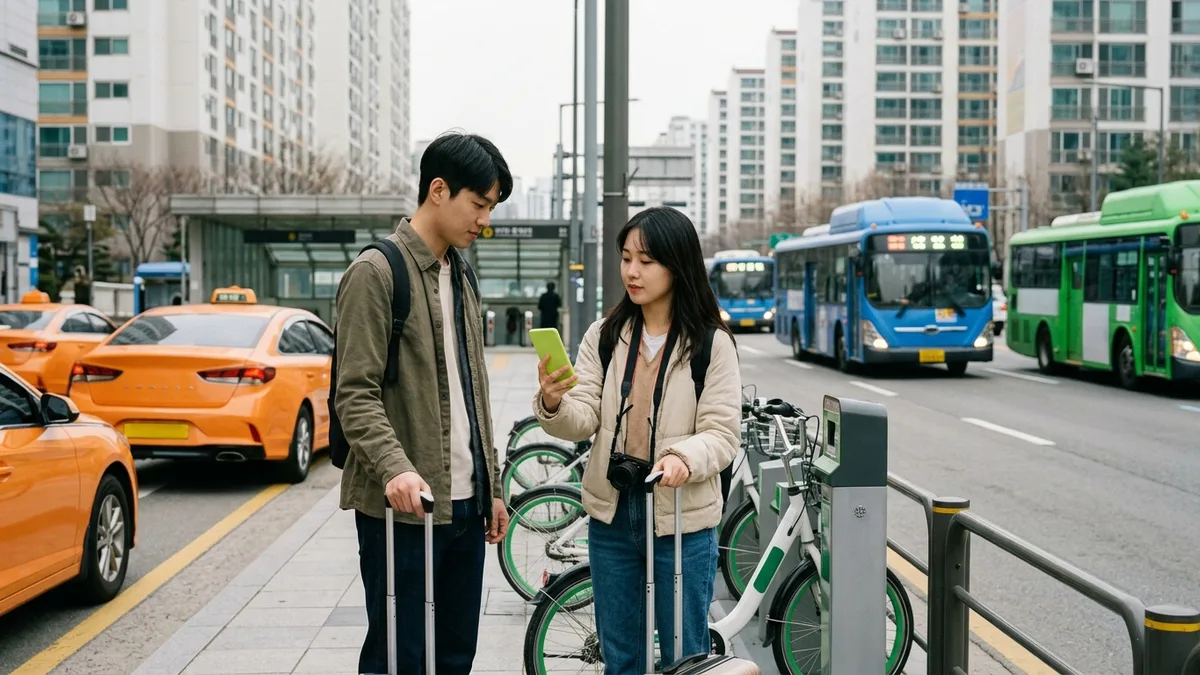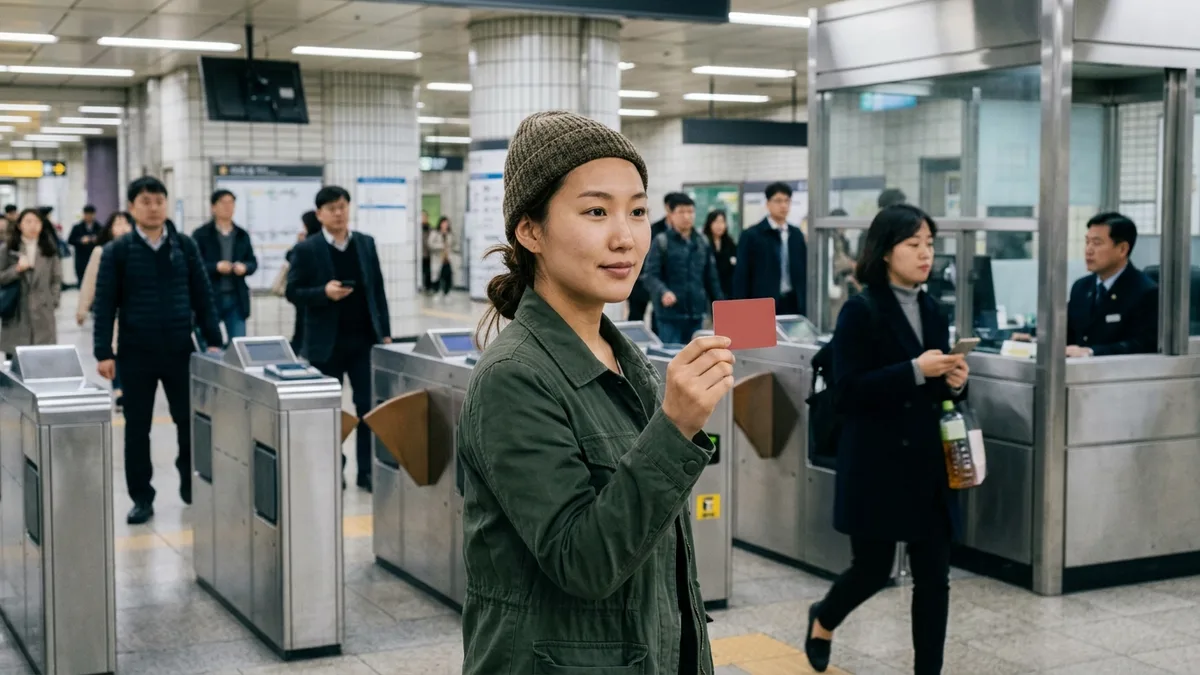
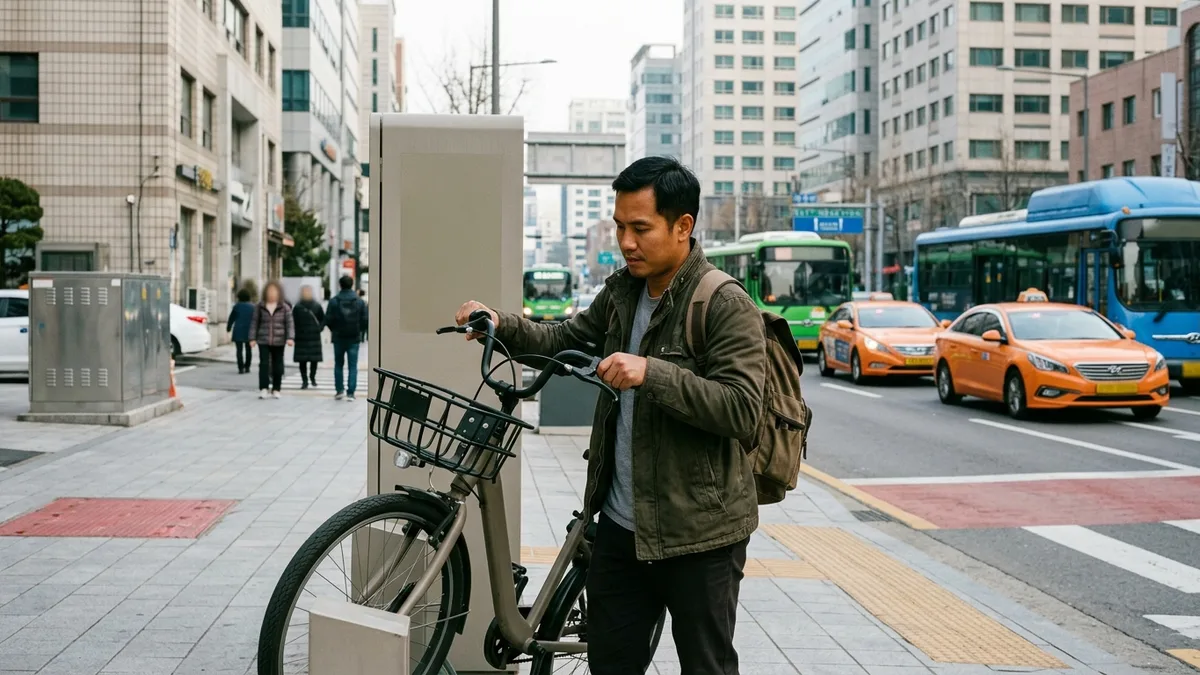
Daejeon's public bike system, "Tashu," gives you the first hour free. Return it within the hour and rent again, and you can keep riding over and over with no extra charge. Purely on price, it's about as low-barrier as it gets — but since January 7, 2025, the app has required identity verification. You have to pick a Korean mobile carrier and verify by SMS or PASS, so if you don't have a number registered under your own name with a Korean carrier, installing the app won't get you as far as the rental step.
Sejong's "Eoullung" gives you a longer base ride time of 90 minutes. A one-day pass for associate (general) members is 1,000 KRW, and full memberships start at 5,000 KRW per month. But the official guidance lists payment methods as "mobile carrier billing, credit card, etc.," so foreigners often hit a wall at the payment screen before they ever get to look at the fare table.
Busan is a different story entirely. The city discontinued the public bike program it had been running in the Haeundae New Town area as of December 31, 2015. The stated reason was that ridership collapsed after fares were introduced and the accumulated deficit became unsustainable, and the bikes, system machinery, and docks were all removed. What Busan has now isn't a city-wide system — it's a scattering of bike rental stations in individual parks.
If you've ridden Ttareungi in Seoul and searched thinking "there must be something similar outside the capital," this is why you get a different answer in every city.
Note: The fares, operating hours, and rental station details below are current as of 2026-08, verified against the official guidance and terms of use from the Tashu and Eoullung operators, the official Sejong City and Busan City pages, and the Korea Law Information Center. Public bike programs change fares and hours when ordinances are amended or operating contracts change, so please re-check each operator's official guidance before you ride.
Looking for "something like Ttareungi" outside Seoul gets you a different answer in every city
Let's start with the big picture. All three cities run on different models, and the sticking point for foreigners is different in each one.
| City | What exists now | Base ride time | Base cost | Where foreigners get stuck first |
|---|---|---|---|---|
| Daejeon | Tashu public bikes (operated under contract by Daejeon Transportation Corporation) | 1 hour | Free | App identity verification introduced in 2025 (carrier SMS / PASS) |
| Sejong | Eoullung public bikes | 90 min | 1,000 KRW associate 1-day pass | Payment methods are mobile carrier billing / credit card |
| Sejong (residents) | Eoullung access via Yeoeung Pass | 90 min, unlimited rides | 20,000 KRW/month for adults | Sejong alien registration and periodic residence re-verification |
| Busan | No public bike system; 17 park rental stations | 2 hours at free stations | Free or paid depending on the station | Short operating hours, and each station has a different operator |
There's one thing worth noticing here. The fares themselves aren't a burden in any of the three cities. The real gates are all clustered at the sign-up and payment stage. That's why this article spends more time on what comes before the fare table than on the fare table itself.
App language support is relatively good news. Both the Tashu and Eoullung apps support three languages: Korean, English, and Simplified Chinese. That said, "the app screens support English" and "the terms of use and insurance information exist in English" are two different things — more on that later.
Daejeon's Tashu — one hour free, but identity verification arrived in 2025
Tashu's fare structure is simple. The first hour is free, and beyond that it's 500 KRW per 30 minutes. No matter how long you ride in a day, the extra usage charge per rental is capped at 5,000 KRW.
| Item | Details |
|---|---|
| Base fare | First hour free |
| Overage | 500 KRW per 30 minutes |
| Daily cap | Maximum 5,000 KRW in extra usage charges per rental per day |
| Re-rental | Return within an hour and rent again to keep riding with no extra charge |
| Eligibility | Anyone aged 15 or older who is able to ride a bicycle |
| Rental hours | 05:00–24:00 (returns accepted 24 hours; operates 24 hours a day from March to November) |
The "re-rental" row is the most practically important line in that table. Ride two hours straight and you'll pay 500 KRW, but return to a nearby station before the hour is up and immediately rent again, and it stays free. In other words, you can cover half a day around downtown Daejeon for essentially 0 KRW.
Rental hours are seasonal. Normally you can rent from 5 a.m. to midnight with returns available 24 hours, but during the peak season from March through November it runs 24 hours a day. If the rent button won't work late on a winter night, it may not be broken — it may just be outside operating hours.
The catch dates to January 7, 2025, when the Tashu app introduced identity verification. Here's how it goes:
- On the sign-up screen, you're first asked to choose a mobile carrier (from a list of Korean carriers).
- Next you pick a verification method: SMS or PASS.
- You enter your name, date of birth, and mobile number, then input the verification code you receive.
- Existing members also have to complete this verification to use the service normally. That's why an account that worked fine through 2024 can suddenly stop working.
This is exactly the same wall covered in Services you can use without a Korean phone number. If you're using a company phone, a family member's phone, or a prepaid phone that isn't tied to your identity, the verification screen is where you stop.
Caution: Even if you signed up before verification launched on January 7, 2025, you're not in the clear. Article 5(3) of the terms of use requires identity verification at sign-up (effective January 7, 2025), and according to press reports, existing members must also complete this verification to use the service normally. There's no fallback if you get blocked while trying to use it in a hurry after arriving in Daejeon, so if bikes are part of your plan, install the app and finish verification in advance.
The word "citizen" in Tashu's terms — where it clashes with the English guidance
This section is one that doesn't appear at all in guidance written for Korean readers.
Tashu's official "Service Information" lists eligibility as "anyone aged 15 or older who is able to ride a bicycle." The English page says only "Persons aged 15 or above who are eligible to ride bicycles." Neither page mentions residence in Daejeon or resident registration. You'll find secondhand sources online claiming "only citizens with resident registration in Daejeon can use Tashu," but by the official guidance, that isn't true.
Yet the terms of use posted by the same organization are worded differently. Article 5(1) of the terms reads: "Any citizen (국민) aged 15 or older who is able to operate a bicycle may register as a member." So the word "citizen," absent from the guidance, appears in the binding terms. And the terms contain no separate clause specifying whether foreigners may register.
To sum up: the official service information, in both Korean and English, goes no further than "anyone aged 15 or older who is able to ride a bicycle" ("Persons aged 15 or above" in English), with no condition other than age. Only Article 5(1) of the terms of use says "citizens aged 15 or older." Two documents posted by the same organization contradict each other, and the only people for whom that discrepancy actually matters are foreigners.
So this article won't flatly state that "foreigners can register for Tashu." Going by the guidance alone it looks possible, and the English page reads that way too, but the wording of the terms differs and we weren't able to get written confirmation from the operator. We also couldn't verify whether the carrier verification screen actually accepts a line opened with an alien registration number.
📌 Important: If you're planning to use Tashu in Daejeon, get a one-line confirmation before you leave, via the inquiry channel on the official Tashu site (tashu.or.kr), on whether alien registration card holders can register as members. Tashu is a program that Daejeon Metropolitan City has contracted out to Daejeon Transportation Corporation for operation and management, and the basis for its fees and base ride time is the Daejeon Metropolitan City Ordinance on Promoting Bicycle Use. That means it's not something staff can decide on the spot.
Sejong's Eoullung — 90-minute base, and the fare table plus payment methods are the real gate
Eoullung is open to "people of all ages aged 15 and over." The base usage fee is calculated on a 90-minute basis, and like Tashu, if you return the bike within the base time and rent again, no additional fee applies. The New Eoullung system operates 24 hours, so you can rent late at night too.
Fares vary by membership type. Per the operator's official guidance, they break down like this.
| Membership type | Pass | Fare | Overage past 90 minutes |
|---|---|---|---|
| Full (paid) member | Annual (12 months) | 30,000 KRW | 500 KRW per 30 min |
| Full member | Half-year (6 months) | 20,000 KRW | 500 KRW per 30 min |
| Full member | Monthly (30 days) | 5,000 KRW | 500 KRW per 30 min |
| Full member | Weekly (7 days) | 2,500 KRW | 500 KRW per 30 min |
| Associate (general) member | 1-day pass | 1,000 KRW | 1,000 KRW per 30 min |
The math is quick. If you're in Sejong for just two or three days, the 1,000 KRW associate day pass is the right call; the 5,000 KRW monthly full membership costs the same as five day passes, so if you plan to ride six days or more, full membership comes out cheaper. Overage is also half the price for full members, so the longer you ride, the more full membership favors you.
Up to here, it's the same for Koreans and foreigners. Where it diverges is payment. The official guidance lists payment methods as "mobile carrier billing, credit card, etc.," with payment made in the Eoullung app. But for foreigners, mobile carrier billing is often blocked outright or has a limit set to zero. That leaves credit cards — and the official guidance doesn't say whether cards issued overseas are accepted.
Tip: If you're planning to use Eoullung in Sejong, check payment before you check the fare table. The official service information page also doesn't describe what identity verification method sign-up uses (whether it's mobile phone verification, or whether there's a field for an alien registration number). Calling Sejong City Transportation Corporation (1899-9161) and asking about payment methods and verification methods together is the fastest route.
Yeoeung Pass — if you have alien registration in Sejong, Eoullung is free for 90 minutes
If you live in Sejong as a foreign resident, look at this before the Eoullung fare table.
Yeoeung Pass is a transit pass run by Sejong City. It's for Sejong residents aged 13 and up, and foreigners can also get one by entering their alien registration number in the Yeoeung Pass app. Adults (ages 19–69) pay 20,000 KRW per month, and that includes a benefit of up to 90 minutes free on Eoullung public bikes with unlimited rentals.
So foreign residents of Sejong have two options.
- If you'll only ride Eoullung, the 5,000 KRW monthly full membership is cheapest.
- If you'll also use buses, 20,000 KRW a month for Yeoeung Pass includes 90 minutes of Eoullung with no cap on the number of rentals.
There is one line visiting tourists can't cross, though. Residence in Sejong (alien registration) is a requirement, so short-term visitors aren't eligible in the first place. If you're just passing through Sejong for a few days as a traveler, the Eoullung associate day pass is your route.
Residents have a pitfall too. Yeoeung Pass requires periodic residence re-verification, and if you don't complete it in your designated month, your access is suspended starting the following month. Notices usually come by text or messenger and are in Korean, so they're easy to miss, and if the timing clashes with when you file a change-of-residence report, you can get stuck at the re-verification step. Write your re-verification month on your calendar ahead of time.
One note on insurance. Sejong City's citizen bicycle insurance explicitly names the insured as "all citizens with resident registration in Sejong City (including foreigners)." The policyholder is Sejong Special Self-Governing City and the city pays the premium, so there's no separate enrollment process for individuals. Many residents don't even know that "including foreigners" is written into the document, so claims go unfiled even after an accident.
Caution: That said, the coverage period listed on the official page is 2024.03.16.–2025.03.15., which has expired. Whether a renewal contract is in place and what the coverage amounts are can't be confirmed from that page alone. On top of that, the standard claim documents list a "resident registration certificate (full/abridged)," so foreigners need to ask separately about substitute documents. If you've had an accident, it's safest to first check the current coverage period and the claim documents for foreigners with the responsible department at Sejong City.
Why Busan has no public bike system — abolished in 2015, and what's left now
Search "where can I rent a public bike in Busan?" and old articles come up first. That's how people end up making wasted trips.
The facts are clear. Busan discontinued the public bike program it ran in the Haeundae New Town area as of December 31, 2015. The city's own stated reason was that ridership plummeted after fares were introduced and the accumulated deficit became unsustainable, and the bikes as well as the system machinery and docks were all removed. Busan currently has no city-wide unmanned rental system like Seoul's Ttareungi or Daejeon's Tashu.
What remains instead are park rental stations. According to Busan City data, as of April 1, 2026, bike rental stations operate at 17 locations, including Oncheoncheon Citizens' Park and the Nakdong River Eco Park, with a fleet of 1,074 adult bikes and 473 children's bikes.
And here's where foreigners get most confused. Those 17 locations aren't run by a single organization. Operations are split among the Nakdong River Management Headquarters, Spo1, Dongnae-gu, Haeundae-gu, Geumjeong-gu, Yeonje-gu, Suyeong-gu, and Gijang-gun. That means the rental method, the fares, and the operating hours all differ from station to station. Getting around Busan more broadly is covered separately in our Busan transportation guide.
Busan's stations only need an ID — but the operating hours are the trap
Ironically, Busan's rental stations have the lowest barrier to entry for foreigners. Just don't treat all 12 free stations as one bloc. The five free stations run by Dongnae-gu, Haeundae-gu, Geumjeong-gu, Yeonje-gu, and Suyeong-gu require no app install and no carrier identity verification. Show an ID and you can ride freely for up to two hours, returning the bike to the same place you got it. The seven Gijang-gun stations, by contrast, are also free but use unmanned mobile-app rental, so you need to install an app — and the official table doesn't say what kind of identity verification sign-up requires. Meaning: show up at Jukhyang Park or Imnang Beach with only an ID and you may not be able to rent.
| Operator | Stations | Fee | Things to know |
|---|---|---|---|
| Nakdong River Management Headquarters | 4 sites: Samnak, Hwamyeong, Maekdo, Daejeo Eco Park | Paid | Listed in the status table as "operations suspended from May 1, 2026 – TBD" |
| Spo1 | 1 site | Paid | You'll need to confirm rental conditions directly with the operator |
| Dongnae-gu, Haeundae-gu, Geumjeong-gu, Yeonje-gu, Suyeong-gu | 5 sites incl. Oncheoncheon Citizens' Park, Suyeong River | Free | Show ID, up to 2 hours, return where you rented |
| Gijang-gun | 7 sites: Jukhyang Park, Jeonggwan Senior Welfare Center, Jungang Park, Dalsan Bridge, Daleum Bridge, Jwagwangcheon Embankment, Imnang Beach | Free | Unmanned mobile app rental, 07:00–22:00 (call center 09:00–18:00) |
The problem is opening hours. Busan City's status table shows that a good number of the free stations open only on weekdays during the day, and only for short windows. Haeundae-gu's Jwasuyeong Bridge station is listed as 13:00–17:00 and Dongnae-gu as 10:00–16:00, and some sites operate only in March–June and August–November. A 4-to-6-hour daily window is effectively closed for someone working six days a week at a factory or job site. Gijang-gun's stations have the longest hours at 07:00–22:00, but those use unmanned mobile-app rental, and since the app name and sign-up requirements (what identity verification it uses) aren't listed in the official table, you'll need to check in advance.
The scope of "ID" also needs checking. Busan City's press release says only "just show an ID," so whether an alien registration card or passport counts as that ID can't be confirmed from official documents alone. It may come down to on-site discretion at each station, so calling the relevant district or county office before traveling a long way beats a wasted trip.
Caution: The four sites run by the Nakdong River Management Headquarters — Samnak, Hwamyeong, Maekdo, and Daejeo Eco Park — are listed in Busan City's status table as "operations suspended from May 1, 2026 – TBD." We only confirmed one responsible page, so we can't say definitively whether service has resumed. If you're planning to bike around the Nakdong River eco parks, check with Busan City's Living Space Innovation Division (051-888-1235) before visiting.
In Korea a bicycle is legally a "vehicle" — helmets and drunk riding
The last section is the most important. In Korea, a bicycle is a "vehicle" governed by the Road Traffic Act. If you come from a country where riding a bike after drinking isn't an issue, pay particular attention here.
Helmets first. Article 50(4) of the Road Traffic Act states that "a driver of a bicycle, etc., shall wear personal protective equipment prescribed by Ordinance of the Ministry of the Interior and Safety when riding on a bicycle path or a road under the Road Act, and shall also have any passenger wear such equipment." The wording is an obligation: "shall wear."
The penalty provision, however, is peculiar. Article 156(6) makes a driver who fails to wear personal protective equipment in violation of Article 50(4) subject to a criminal fine of up to 200,000 KRW, detention, or a minor criminal fine — while explicitly noting in parentheses "(excluding bicycle riders)." In other words, it's a dual structure where the obligation exists but there's no penalty for bicycle riders. That's why you see so many people riding without helmets — and also why it's not true that there's no rule.
Drunk riding is a completely different matter. Here the penalties are alive and well.
- Article 44(1) of the Road Traffic Act prohibits operating a bicycle, etc., while under the influence of alcohol. It's the same provision that applies to cars.
- The enforcement threshold is a blood alcohol concentration of 0.03 percent or higher (Article 44(4)) — the same figure as for cars.
- Riding while intoxicated carries, under Article 156(11), a criminal fine of up to 200,000 KRW, detention, or a minor criminal fine.
- Refusing a breath test carries the same penalty under Article 156(12).
0.03 percent is a level you can reach with a single drink. Which makes "it's close, let's just bike home" after a work dinner the single riskiest choice you can make. For reference, plenty of articles online list summary fine (notice disposition) amounts for drunk bike riding, but we couldn't verify those figures against the original attached tables of the Enforcement Decree of the Road Traffic Act. So this article lists only the statutory penalties we confirmed in the text of the law.
Night-riding rules are worth knowing too. Article 50(9) requires riders of bicycles, etc., traveling on roads at night to turn on a headlight and taillight or to wear a light-emitting device such as a reflective band. Article 156(1) again excludes bicycle riders from punishment for this clause, but riding without lights on a dark riverside bike path leads straight to accidents. Given that Tashu runs 24 hours from March to November and Sejong's New Eoullung runs 24 hours as well, night riding is genuinely possible — so this isn't someone else's problem.
📌 Note: The app screens work in English and Chinese, but there are still areas — like Eoullung's web pages on service information, duties and responsibilities, and insurance — that exist only in Korean, and those are exactly the documents you'd be reading at the dispute or insurance stage. In other words, the documents you'd need to read after an accident aren't translated, so it's worth lining up a Korean-reading friend or an interpretation support line in advance.
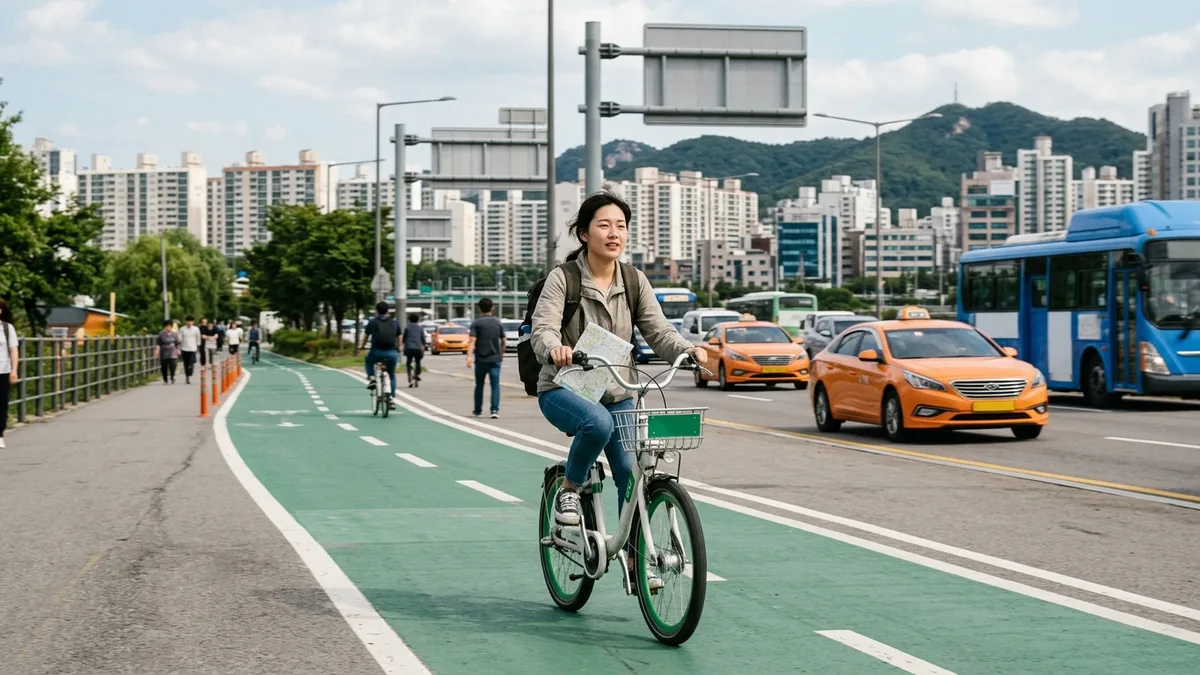
All the bikes covered here can only be rented through each city operator's own app and rental stations. LACHA is a transportation and payment super app that foreigners can use right away without identity verification, but its coverage runs to KTX, express buses, taxis, the Airport Railroad, and transit cards — it doesn't handle bike rentals. For Tashu, Eoullung, and Busan's rental stations, you'll need to go through each operator's own channels.
Want to search and book KTX and express buses in one app? Check out LACHA.
Built to work without a Korean phone number or bank account, with overseas payment methods like Alipay, WeChat Pay, and Apple Pay. Taxi hailing plus KTX, express bus, and airport railroad (AREX) booking — all in one app.
Up to 60% off Korea transit with a coupon (max ₩3,000): enter code at sign-up. KTX gets up to 18% off on top
Download now


Frequently Asked Questions (FAQ)
Q1. Can foreigners sign up for Daejeon's Tashu? The official service information, in both Korean and English, lists eligibility only as "anyone aged 15 or older who is able to ride a bicycle." There's no residence-in-Daejeon or resident registration requirement. However, Article 5(1) of the terms of use is worded differently as "citizens aged 15 or older," and the terms contain no clause specifying whether foreigners may register. Since we couldn't obtain written confirmation from the operator, we won't state flatly that "you can register." If bikes are part of your Daejeon plans, please check ahead via the inquiry channel at tashu.or.kr.
Q2. Can I use Tashu or Eoullung without a Korean phone number? Tashu has required in-app identity verification since January 7, 2025. The structure requires selecting a carrier and verifying by SMS or PASS, so without a number opened in your own name with a Korean carrier, it's hard to get as far as the rental step. A company or family member's phone is blocked for the same reason. For Eoullung, the sign-up verification method isn't described on the official page so it needs checking, and since payment methods are mobile carrier billing and credit card, you may get stopped at the payment stage first. Checking with Sejong City Transportation Corporation (1899-9161) is the accurate route.
Q3. I live in Sejong — can I ride bikes for free with Yeoeung Pass? Yes. Yeoeung Pass is for Sejong residents aged 13 and over, and foreigners can also get one by entering their alien registration number in the Yeoeung Pass app. It's 20,000 KRW a month for adults (ages 19–69), and it includes up to 90 minutes free on Eoullung public bikes with unlimited rentals. Note that it requires periodic residence re-verification, and missing your designated month means suspension starting the following month, so put the re-verification notice on your calendar. If you only plan to use bikes, the 5,000 KRW monthly Eoullung full membership is cheaper.
Q4. Where do I go in Busan to rent a public bike like Ttareungi? Busan has no city-wide public bike system. The program run in the Haeundae New Town area was discontinued as of December 31, 2015, and all the facilities were removed. What remains are bike rental stations at 17 locations including Oncheoncheon Citizens' Park and the Nakdong River Eco Park; the four Nakdong River Management Headquarters sites and Spo1 charge a fee, and the other 12 are free. Note that the four Nakdong River Management Headquarters sites (Samnak, Hwamyeong, Maekdo, Daejeo Eco Park) are listed in Busan City's status table as suspended from May 1, 2026, so check with the Living Space Innovation Division (051-888-1235) before visiting. Among the 12 free sites, the five run by Dongnae-gu, Haeundae-gu, Geumjeong-gu, Yeonje-gu, and Suyeong-gu let you ride for up to two hours on presentation of an ID, with return to the place you rented from. The other seven in Gijang-gun are also free but use unmanned mobile app rental, so you'll need to install an app, and since the official table doesn't say what identity verification sign-up uses, check in advance. Many sites are open only 4–6 hours a day, so be sure to confirm hours before you set out.
Q5. Do I pay a fine for not wearing a helmet? What about drinking and cycling? For helmets, Article 50(4) of the Road Traffic Act sets a duty to wear them, but Article 156(6) explicitly notes in parentheses "(excluding bicycle riders)," so there's no penalty for bicycle riders. It's a structure with an obligation but no punishment. Drunk riding, by contrast, is punishable. Article 44(1) covers bicycles, the threshold is a blood alcohol concentration of 0.03 percent or higher (Article 44(4)), and Articles 156(11) and 156(12) set penalties of a criminal fine of up to 200,000 KRW, detention, or a minor criminal fine for drunk riding and for refusing a breath test, respectively.
Note: This article is intended as general information. The fares, operating hours, rental station details, and statutory penalties in the text are current as of 2026-08, verified against Tashu's official guidance and terms of use, the Eoullung operator's official guidance, Sejong City's Yeoeung Pass information, Busan City's official pages, and the text of the Road Traffic Act at the Korea Law Information Center. Whether foreigners may register for Tashu, Eoullung's sign-up verification method and whether overseas-issued cards are accepted, the current coverage period of Sejong's citizen bicycle insurance, whether the four Nakdong River park rental stations in Busan have resumed operation, and the sign-up requirements for Gijang-gun's unmanned rental app could not be confirmed from official sources alone, so we've hedged on them in the text. Public bike programs change often with ordinance amendments and changes in operating contracts, so please re-check with each operator's official guidance and call center before you ride. LACHA does not rent bicycles or operate public bike systems.