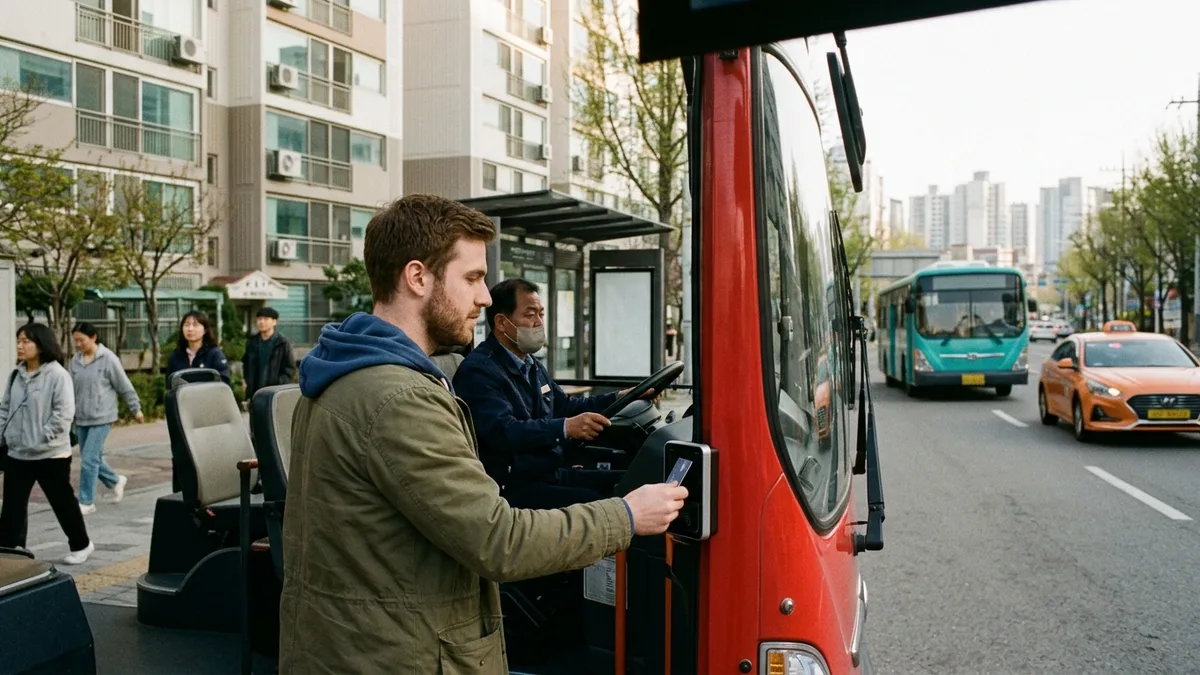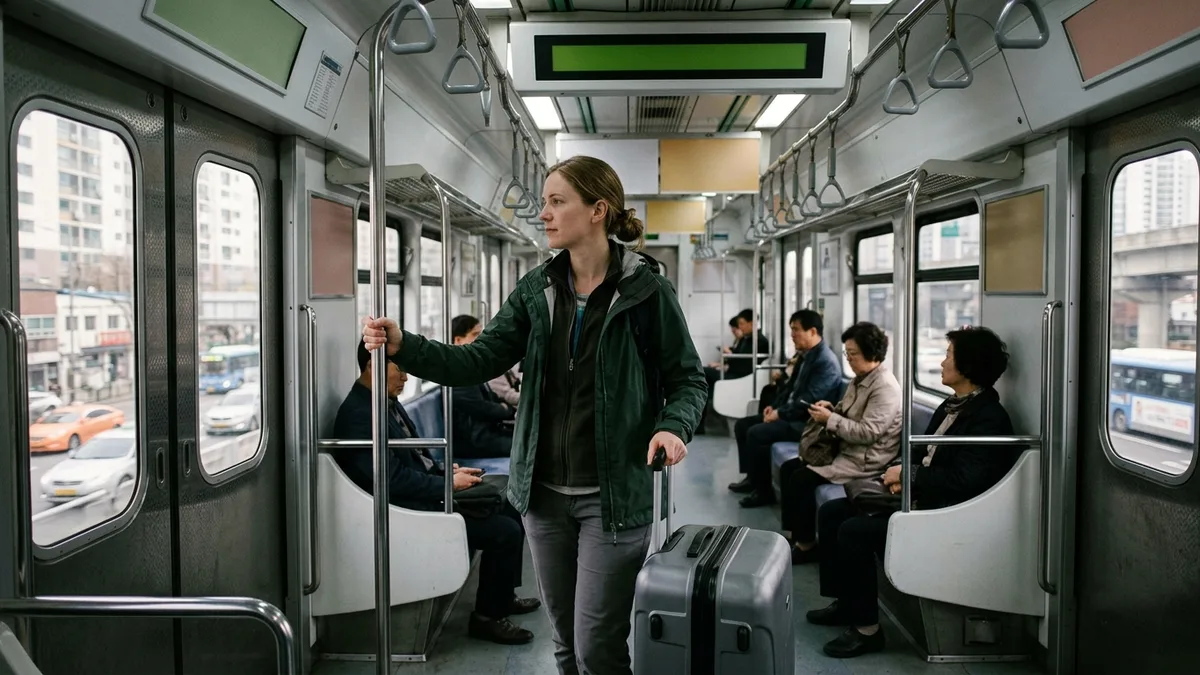
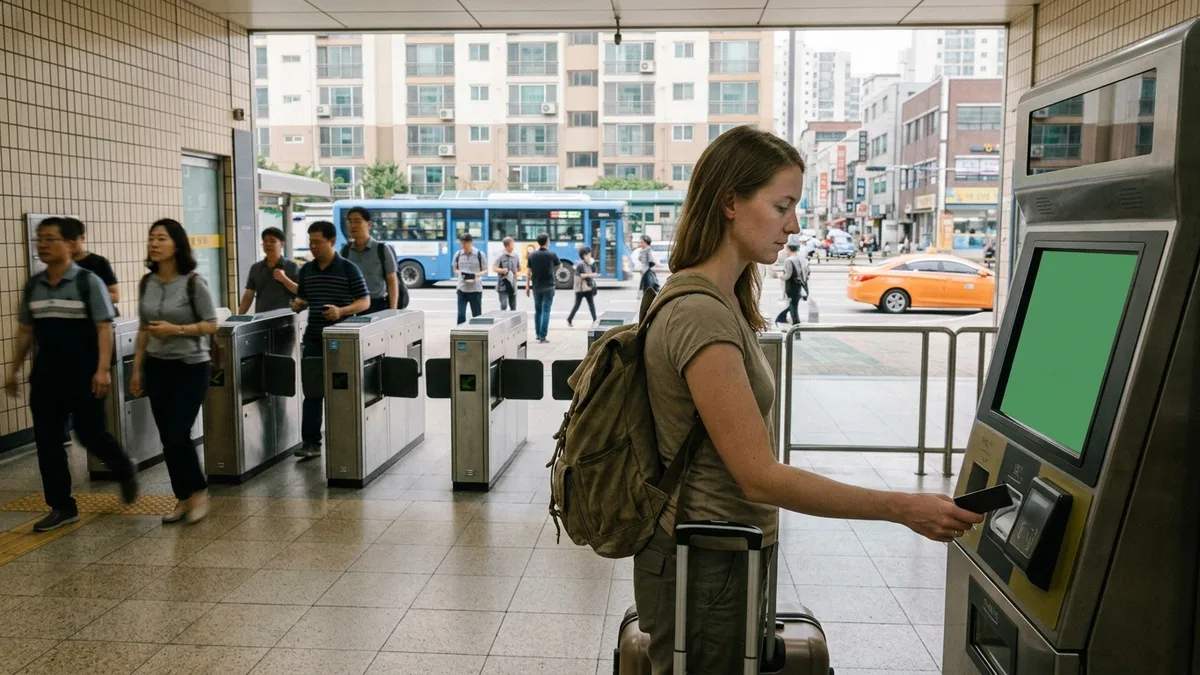
The adult transit-card fare on the Daejeon urban railway is 1,550 KRW. But that figure only holds if you stay within 10 km of your boarding station. The moment you cross 10 km, 1,650 KRW comes out instead. That's because Daejeon doesn't use a flat fare — it uses a distance-zone system.
Gwangju's structure is simpler, but it trips you up somewhere else. The adult transit-card fare is 1,250 KRW for both the urban railway and city buses, and that figure — set on August 1, 2016 — is still in effect as of August 2026.
The trap that catches you in both cities is the single-journey ticket. If you buy a paper ticket every time instead of using a transit card, the youth discount disappears entirely. In Daejeon, youths pay the same 1,700 KRW as adults (about 1.9× the 880 KRW transit-card fare); in Gwangju it's 1,400 KRW (vs. 900 KRW with a card).
Transfers also work differently from the instincts you've built up in Seoul or Busan. In Daejeon, if you get off a city bus and transfer to the urban railway, adults pay an extra 50 KRW, and urban railway transfers are limited to one out of your three allowed transfers. The real problem is that your balance doesn't match what you expected, and it's hard to find out why from Korean-only signage.
Even the name can be confusing. On July 1, 2026, the Jeonnam-Gwangju Integrated Special City was launched, abolishing Gwangju Metropolitan City and Jeollanam-do and merging them into a single wide-area local government. Search results and administrative documents mix the old and new names, but the urban railway operator is still Gwangju Transportation Corporation.
Note: The fare and transfer rules in this article are compiled as of 2026-08 from materials published by Gwangju Transportation Corporation, Daejeon Transportation Corporation, the Public Transportation Division of Jeonnam-Gwangju Integrated Special City, and Daejeon Metropolitan City Hall. Public transit fares change by local government notice, so please re-check with each operator's official notices before you ride.
3-Minute Summary — Four Places Where Seoul Habits Break Down
Put the two cities side by side and the differences jump out. They both use the word "subway," but the math is different.
| Item | Gwangju | Daejeon |
|---|---|---|
| Adult base fare (transit card) | 1,250 KRW | 1,550 KRW |
| Fare structure | Same fare regardless of distance | Two zones split at 10 km (1,550 / 1,650 KRW) |
| Adult single-journey ticket | 1,400 KRW | 1,700 KRW (Zone 2: 1,800 KRW) |
| Youth single-journey ticket | 1,400 KRW (same as adult) | 1,700 KRW (same as adult) |
| Transfer window | Within 30 min of first tap-out | Within 30 min from tap-out |
| Number of transfers | Free transfers (re-boarding the same route excluded) | 3 total, of which 1 may be the urban railway |
| Bus → subway surcharge | None for city buses or village buses | City bus: adult 50 KRW (none for youth/child) / village bus: 200, 230, 250 KRW |
| Youth age range | 13 or older and under 19 | 13 or older and under 19 |
The bottom row only differs in how it's written — the range is the same. Gwangju's notices say "ages 13–18" while Daejeon's say "ages 13–19," but in both cities the adult fare starts at age 19, so in practice both mean 13 or older and under 19. Because the upper limit is written differently, search results can look contradictory — so when registering a child's transit card, double-check the birth-year criteria in each operator's notices.
- Zone system — Cross 10 km in Daejeon and you pay an extra 100 KRW (adult), 80 KRW (youth), or 50 KRW (child)
- Single-journey tickets — Without a transit card, the youth discount vanishes. True in both cities
- Surcharges — In Daejeon, adults pay 50 KRW only when going from city bus to subway. The reverse direction is 0 KRW, and village buses have their own amounts
- Paperwork — Free senior passes and the K-Pass require a resident registration or alien registration number
Caution: If you type only "광주" (Gwangju) into a Korean search box, results for Gwangju-si in Gyeonggi-do come up too. It's a completely different local government with no urban railway at all, so it's easy to read the wrong fare table entirely. The Gwangju in this article is the Gwangju in the Honam region (Jeonnam-Gwangju Integrated Special City).
Gwangju Urban Railway Fares — 1,250 KRW by Card, and No Youth Discount on Single-Journey Tickets
The Gwangju urban railway is a single line, Line 1. It runs between Sotae Station and Pyeongdong Station, passing Gwangju Songjeong Station (where the KTX Honam Line stops), Kim Daejung Convention Center Station, and Sangmu Station.
Here's how fares break down. Putting the urban railway and city buses in one table makes it obvious which option wins.
| Category | Urban railway (card) | Urban railway (single-journey ticket) | City bus (card) | City bus (cash) |
|---|---|---|---|---|
| Adult | 1,250 KRW | 1,400 KRW | 1,250 KRW | 1,400 KRW |
| Youth | 900 KRW | 1,400 KRW | 800 KRW | 1,000 KRW |
| Child | 500 KRW | 500 KRW | 400 KRW | 500 KRW |
Look at the youth row. It's 900 KRW with a transit card, but 1,400 KRW if you buy a ticket at the window. That's 500 KRW extra every single ride.
The reason lies in the ticket types. The single-journey tickets sold by Gwangju Transportation Corporation come in only three kinds: regular (age 13 to under 65), discounted (ages 6 to under 13), and preferential. There's no youth-specific single-journey ticket at all, so from age 13 you end up buying the same regular ticket as an adult.
Even for adults, the card is 150 KRW cheaper. Even on a day when you'll only ride the urban railway two or three times, getting a transit card first pays off.
Tip: The Gwangju single-journey ticket fares here were confirmed by cross-checking two pages on the Gwangju Transportation Corporation website. We couldn't cross-verify them with any other agency's materials, so if you're traveling with a teenager, please double-check with the Gwangju Transportation Corporation call center (062-604-8000) or a station ticket machine.
First and last train times vary by station, and even the official timetable pages are inconsistent between directions. Rather than memorizing specific times, it's safer to check that day's times on the station information board or a map app before you head out.
Daejeon Urban Railway Fares — Not a Flat Fare, but Two Zones Split at 10 km
This is where things go wrong most often in Daejeon. Daejeon Transportation Corporation's terms of carriage define the Daejeon urban railway as a distance-zone system. Within 10 km of your boarding station is Zone 1; beyond 10 km is Zone 2.
| Category | Card, Zone 1 | Card, Zone 2 | Single ticket, Zone 1 | Single ticket, Zone 2 |
|---|---|---|---|---|
| Adult (19 to under 65) | 1,550 KRW | 1,650 KRW | 1,700 KRW | 1,800 KRW |
| Youth (13 to under 19) | 880 KRW | 960 KRW | 1,700 KRW | 1,800 KRW |
| Child (6 to under 13) | 550 KRW | 600 KRW | 600 KRW | 650 KRW |
| Infant (under 6) | Free | Free | — | — |
The gap in the youth row is the biggest of any figure across the two cities. The 880 KRW card fare becomes 1,700 KRW on a single-journey ticket. That's about 1.9×. Only children get a separate discounted ticket (600 KRW); youths have to buy the same regular ticket as adults.
This fare table took its current shape on January 1, 2024. Raising public transit fares for the first time in nine years since 2015, Daejeon increased city buses from 1,250 KRW to 1,500 KRW (+250 KRW) and the urban railway from 1,250 KRW to 1,550 KRW (+300 KRW). Youth and child fares were frozen.
The original plan had buses at the same 1,550 KRW as the urban railway. But during review by the Consumer Policy Committee, only the bus fare was lowered to 1,500 KRW, creating a 50 KRW gap between the two modes. That gap is exactly the 50 KRW transfer surcharge you'll see below.
It helps to know the city bus fares too, so the math adds up. Adults pay 1,500 KRW by card and 1,700 KRW in cash; youths 750 KRW by card and 900 KRW in cash; children 350 KRW by card and 400 KRW in cash.
Daejeon Transfers — 30 Minutes and 3 Transfers, but Only 1 Subway Transfer, Plus 50 KRW Coming from a Bus
Daejeon's transfer rules boil down to three lines: within 30 minutes from tap-out, up to 3 transfers total, of which at most 1 may be an urban railway transfer. And you must use a transit card.
The catch is that the surcharge depends on the direction. In table form, the asymmetry is stark.
| Transfer direction | Adult | Youth | Child |
|---|---|---|---|
| City bus → urban railway | +50 KRW | None | None |
| Urban railway → city bus | None | None | None |
| Village bus → urban railway | +200 KRW | +230 KRW | +250 KRW |
| Zone 2 (over 10 km) excess fare | +100 KRW | +80 KRW | +50 KRW |
Compare the first and second rows. You're transferring between the same two modes, but flip the order and the amount changes. Adults pay an extra 50 KRW only when stepping up from a bus to the subway; going from the subway down to a bus costs 0 KRW. Think of it as squaring up the difference between the 1,500 KRW bus fare and the 1,550 KRW subway fare after the fact.
Pay attention to the third row too. Transferring from a village bus to the urban railway costs much more, and unlike with city buses, youths and children aren't exempt. These figures were confirmed only on Daejeon Transportation Corporation's transfer fare page, so if you ride village buses often, it's worth verifying against the changes in your card balance.
The excess fare in the fourth row is exactly the same as the Zone 1 / Zone 2 difference we saw earlier. The 100 KRW that takes 1,550 KRW up to 1,650 KRW is precisely this excess fare.
Caution: If you commute end to end on the line — say, between Banseok and Panam — you'll be off by 100 KRW every single day. Twenty round-trip days a month comes to 4,000 KRW. If all you had memorized was "Daejeon subway base fare 1,550 KRW," redo the math now.
Gwangju Transfers — Free Within 30 Minutes, but Tap-Out and Rural Buses Are the Traps
Gwangju is simpler than Daejeon. Within 30 minutes of your first tap-out, you can transfer freely among the urban railway, city buses, and village buses. No surcharge applies.
There are four conditions. Gwangju Transportation Corporation and the Public Transportation Division of Jeonnam-Gwangju Integrated Special City describe them identically.
- You must pay with a transit card. Pay cash and the transfer never registers in the first place
- When getting off a bus, you must tap the tap-out reader
- Re-boarding the same route doesn't count as a transfer
- If your card balance is insufficient, the transaction won't go through at all. The payment is blocked before any transfer discount applies
The second point is the most unfamiliar action for foreigners. If you come from a country where tapping out isn't a habit, you'll just walk out the back door — and the moment you do, your next transfer is gone. There's also no easy way to find out later that you forgot to tap. If you'd like to compare this with Seoul's transfer rules, see Seoul Transfer Discounts Explained.
One more thing. When transferring to a rural (nong-eochon) bus serving the areas around Gwangju, it isn't free — you get a 50% discount, once only. The rules differ from in-city transfers, so if you're crossing the city boundary, assume half the fare will be deducted and keep your balance topped up (per Gwangju Transportation Corporation fare notices).
Payment Methods Are the Real Wall — Transit Cards, Cash, Overseas Cards
Memorizing every fare doesn't help if you get stuck at payment. This is where foreigners actually run into trouble most often.
First, the good news. T-money's official list of accepted locations includes both Gwangju Line 1 and Daejeon Line 1. That means a T-money card bought in Seoul works on both cities' urban railways as-is. No need to buy a new card.
The problem is loading money onto the card. Credit and debit cards issued abroad are often blocked from recharging Korean transit cards. Which stores can recharge which card types varies, so if you want to know your options ahead of time, see Recharging a Transit Card with an Overseas Card.
Station ticket machines need even more caution. In Seoul, since March 17, 2026, the new-model machines on Subway Lines 1–8 accept overseas-issued cards such as VISA and Mastercard for single-journey tickets and short-term Climate Card passes (with an average 3.7% service fee). But whether the machines in Gwangju and Daejeon accept overseas cards isn't confirmed in either operator's official notices.
We can't say for certain that they do, or that they don't. So there's only one practical precaution: bring a bit of cash in bills when you arrive in either city. The goal is to avoid standing in front of a fare gate with nothing but a card.
Caution: If the gate won't open because your balance is short, do not tailgate the person in front of you. Article 10(1) of the Railroad Business Act provides that for fare evasion, in addition to the proper fare, a surcharge of up to 30 times that fare may be collected. A 1,550 KRW trip can turn into tens of thousands of won. If your balance is short, find the station office or a recharge machine first.
The Paperwork Wall That Only Catches Foreigners — Free Senior Passes, G-Pass, K-Pass
From here on, you hit a wall that doesn't exist for Koreans. It's not the fares themselves — it's the documentation requirements.
First, the free transit card for people aged 65 and over. Gwangju describes the eligible group as seniors "with resident registration in Gwangju," and says you apply at one of 12 Hana Bank branches with ID such as a resident registration card, driver's license, or passport.
Whether an alien registration card or domestic residence report card also works isn't stated in the notice. Neither city's materials mention it, so this article can't say yes or no either. If you're 65 or older and living in Korea, calling ahead before you go to the bank counter will save you a wasted trip.
Next, Gwangju's G-Pass. It took effect on January 1, 2025, and covers city buses, seated buses, village buses, and the urban railway. But how it works differs completely by age.
- Children get 100% fare support and youths get a 50% discount, applied automatically if you use your existing child or youth transit card
- Adults (young adults 19–39, general 40–64) and seniors must sign up and register with the K-Pass and ride at least 15 times a month to get a refund the following month
- In short, kids need no extra steps, while adults must first clear the hurdle of signing up
One more note: in the official G-Pass table, the youth discount amount is based on the city bus fare (half of 800 KRW). The urban railway youth base fare is 900 KRW, so the calculation basis is different. We couldn't confirm via official notice exactly how much a youth actually pays on the urban railway, so treat any figure copied verbatim with a bit of skepticism.
Last is the K-Pass. Foreigners need an alien registration number to sign up. On the sign-up screen, you enter your alien registration number instead of a resident registration number and go through address verification.
The problem is that under Article 31 of the Immigration Act, short-term stayers of 90 days or less aren't subject to alien registration. With no number at all, you simply stall at the sign-up screen. Anyone who arrived at a university, government complex, or industrial park less than 90 days ago gets stuck exactly here. The application steps and required documents are covered separately in the K-Pass Guide for Foreigners.
Getting to the Station — From Gwangju Songjeong Station and Daejeon Station into Town
In both cities, the train station and the urban railway meet in one place. That's a big plus for travelers.
In Gwangju, Line 1 passes through Gwangju Songjeong Station, where the KTX Honam Line stops. You can step off the train and transfer to the urban railway right inside the station, continuing on toward Kim Daejung Convention Center Station or Sangmu Station. In Daejeon, Line 1 passes through Daejeon Station.
Here's where one calculation is needed. When boarding the urban railway at Daejeon Station, first check whether your destination is more than 10 km away. If it is, it's 1,650 KRW for adults. In Gwangju, it's 1,250 KRW regardless of distance, so no such calculation is needed.
Travel between cities is another story. To connect Gwangju and Daejeon, or to come down from Seoul to either city, you'll need a train or an express bus — and this is where foreigners without a Korean bank account or phone number often get stuck at the payment step. To compare intercity options, Getting to Korea's Regional Cities by Train and Bus will help.
The same rules work differently again in Busan. If you'd like one more look at how cities differ, reading Busan Transportation Guide for Foreigners alongside this will give you a feel for it. Daegu splits off yet again: it charges a flat 1,500 KRW across the whole network regardless of distance, but has no system at all for re-entering if you get off at the wrong stop. That difference is covered in the Daegu Subway & Daegyeong Line Guide.
Drawing a clear line makes preparation easier. Inside the fare gates — that is, the urban railway tickets in both cities — you'll need to handle with a local transit card or a station ticket machine. But the trip to the station and your movements after you get off can all be bundled into one app. LACHA is a transportation and payment super app for foreigners that you can use right away without identity verification. It's designed so that no identity verification is required under formal procedures, so you can book KTX tickets to Gwangju Songjeong Station or Daejeon Station without a Korean bank account or phone number, paying with overseas services like Alipay or WeChat Pay. Express buses can be booked in the same app, but in both cities the express bus terminal is somewhere other than the train station, so if you arrive at a terminal you'll need one more leg to get into town. And once you've arrived at a station or terminal, you can also call a taxi in the same app if you have a lot of luggage or it's late. Just note that Gwangju and Daejeon urban railway tickets aren't handled, so prepare urban railway fares separately as shown in the tables above.
Want to search and book KTX and express buses in one app? Check out LACHA.
Built to work without a Korean phone number or bank account, with overseas payment methods like Alipay, WeChat Pay, and Apple Pay. Taxi hailing plus KTX, express bus, and airport railroad (AREX) booking — all in one app.
Up to 60% off Korea transit with a coupon (max ₩3,000): enter code at sign-up. KTX gets up to 18% off on top
Download now


Frequently Asked Questions (FAQ)
Q1. Can I use the T-money card I've been using in Seoul on the Gwangju and Daejeon subways? Yes — T-money's official list of accepted locations includes both Gwangju Line 1 and Daejeon Line 1, so you can use it as-is. No need to buy a new card. Recharging is the issue, though. Cards issued abroad are often blocked from recharging, and whether the ticket machines at Gwangju and Daejeon stations accept overseas cards isn't confirmed in either operator's official notices. It's safer to have a little cash ready before you arrive.
Q2. I heard the Daejeon subway base fare is 1,550 KRW, so why was 1,650 KRW deducted? Because Daejeon uses a distance-zone system, not a flat fare. Within 10 km of your boarding station is Zone 1 at 1,550 KRW; beyond 10 km is Zone 2 at 1,650 KRW. The excess fare adds 100 KRW for adults, 80 KRW for youths, and 50 KRW for children. If you commute end to end on the line, like between Banseok and Panam, that difference comes up every day, so it's worth working out the monthly total.
Q3. If I don't have a transit card, is it fine to just buy single-journey tickets? You can ride, but it's especially disadvantageous for youths. In Daejeon, youths have to buy the same 1,700 KRW regular ticket as adults — about 1.9× the 880 KRW card fare — and in Gwangju the youth single-journey ticket is 1,400 KRW, 500 KRW more than the 900 KRW card fare. That's because neither city has a youth-only single-journey ticket type at all. If you're traveling with kids, getting transit cards first is clearly the better deal.
Q4. I took a bus in Daejeon and transferred to the subway, and an extra 50 KRW was deducted. Is that a mistake? That's normal. In Daejeon, only adults pay a 50 KRW surcharge when transferring from a city bus to the urban railway. Youths and children pay nothing extra, and in the reverse direction — urban railway to city bus — even adults pay 0 KRW. It's a way of settling up, after the fact, the 50 KRW gap created in the January 2024 fare hike between the 1,500 KRW bus fare and the 1,550 KRW subway fare. Transferring from a village bus to the urban railway costs more: 200 KRW for adults, 230 KRW for youths, and 250 KRW for children.
Q5. I'm on a short stay of under 90 days — can I get the K-Pass or G-Pass discount? It's difficult for adults. The K-Pass requires an alien registration number to sign up, and under Article 31 of the Immigration Act, short-term stayers of 90 days or less aren't subject to alien registration, so the number doesn't exist. Gwangju's G-Pass is set up the same way for adults and seniors — you must join the K-Pass and ride at least 15 times a month to get a refund the following month — so you hit the same hurdle. That said, any children or youths traveling with you get the discount immediately with their existing child or youth transit cards.
Note: The fares, transfer rules, and program details in this article were compiled as of 2026-08 from materials published by Gwangju Transportation Corporation, Daejeon Transportation Corporation, the Public Transportation Division of Jeonnam-Gwangju Integrated Special City, Daejeon Metropolitan City Hall, and T-money. Public transit fares change by local government notice, and amounts may differ before and after an effective date. In particular, the youth fare for Gwangju single-journey tickets, the actual out-of-pocket amount when Gwangju's G-Pass applies to youths on the urban railway, whether the ticket machines at Gwangju and Daejeon stations accept overseas cards, and whether holders of an alien registration card or domestic residence report card can obtain the free senior pass for those 65 and over are all items this article could not confirm. Please be sure to re-check with each operator's official notices or call center before you ride. LACHA does not sell Gwangju or Daejeon urban railway tickets.